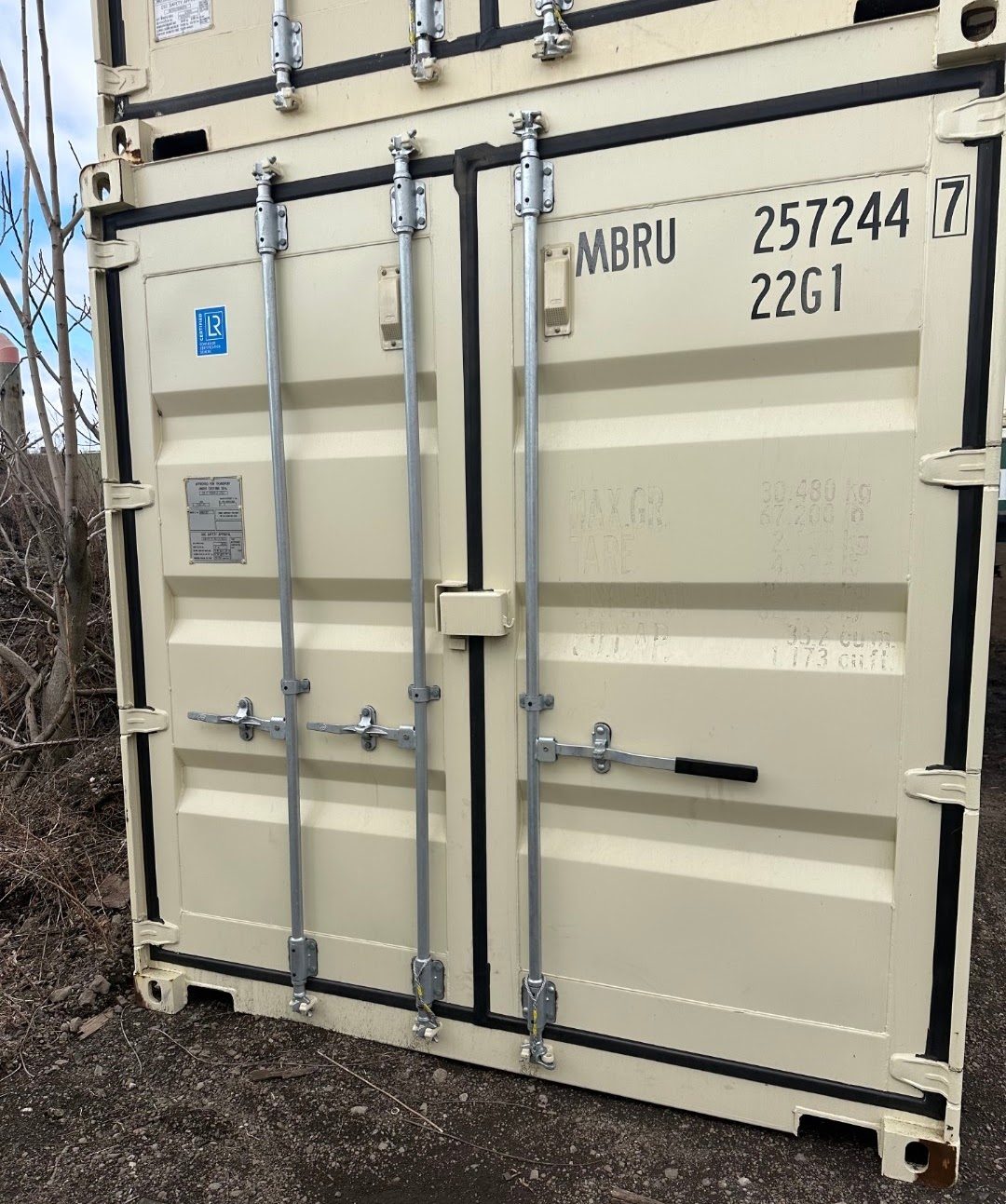
Shipping Container Sizes and Types in Ontario

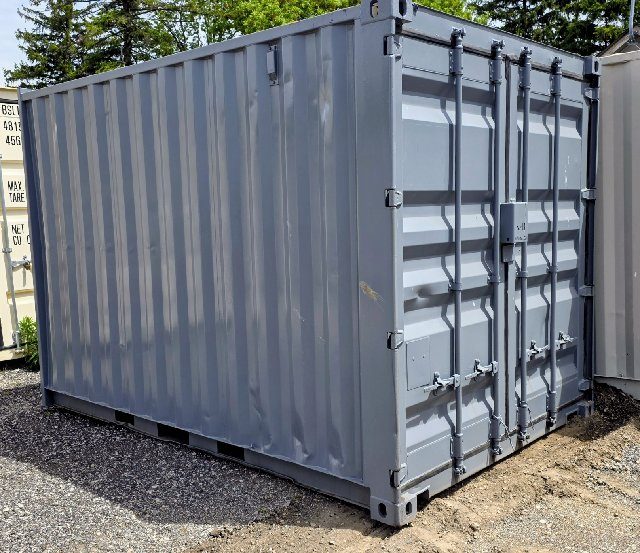
From the 20ft standard dry box to the 53ft high cube, plus refrigerated reefer units, Van Blanc stocks every common shipping container size at our Brantford yard and delivers across Ontario. If you are comparing shipping container dimensions for a backyard build, weighing the different types of containers for a job site, or working out which size fits your driveway, start here. Every container option we sell and rent is listed below, each with full specifications.

Two decisions drive the rest: size and grade. Standard 20ft and 40ft dry containers handle most storage and conversion projects. High cube units, the 40HC, 45HC and 53ft, add a foot of interior height for extra headroom. Refrigerated containers hold temperature for cold storage. For a side by side of external and internal measurements across all sizes, see our shipping container sizes and dimensions guide. When you are ready, browse containers for sale or tell us about your project and we will recommend the right box.

  • 10ft Standard Dry Container

    10ft Standard Dry Container

    Quick Answer

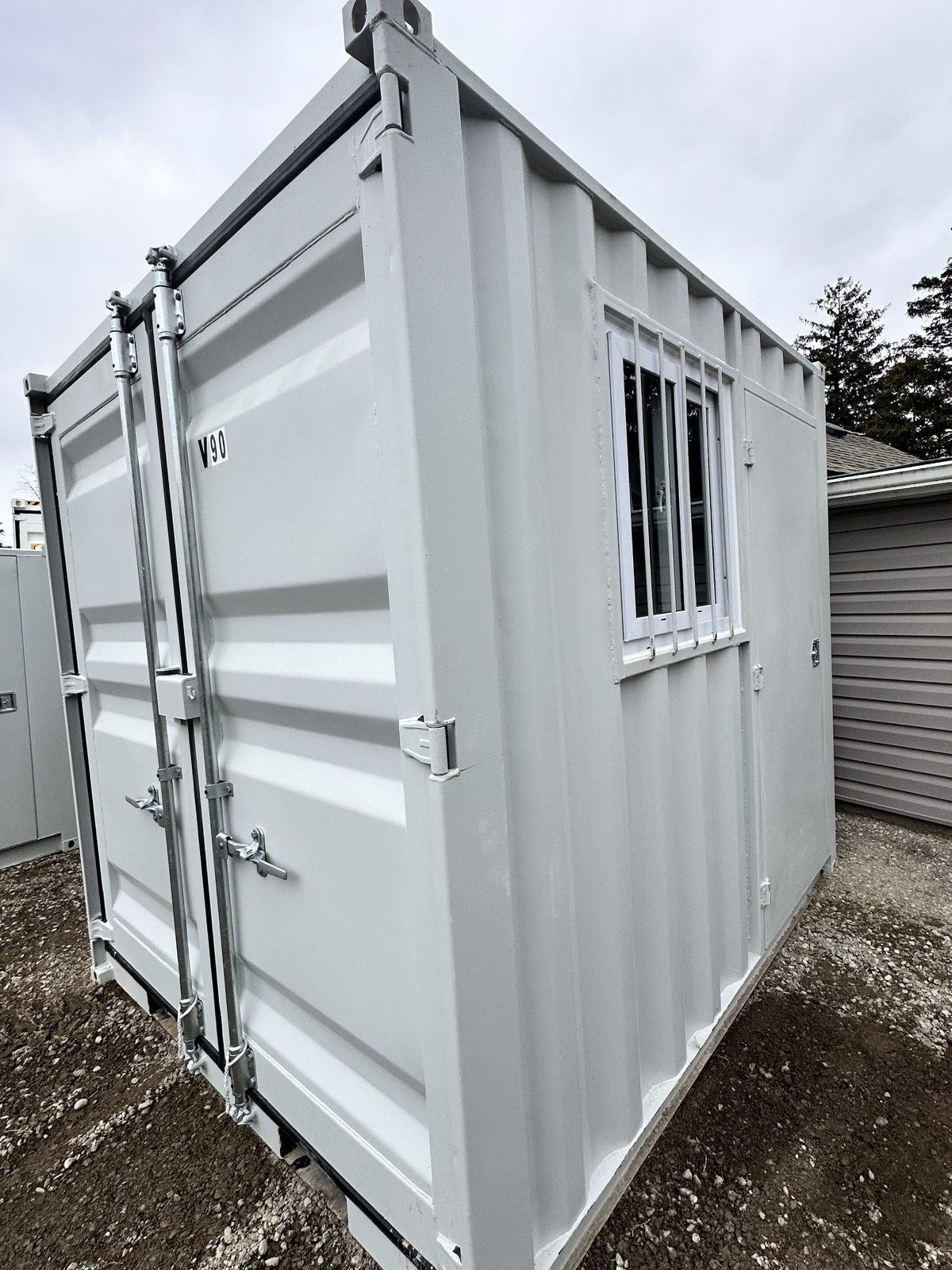
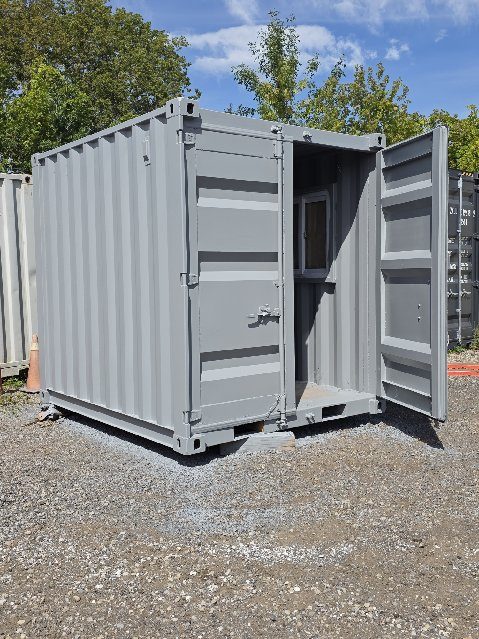
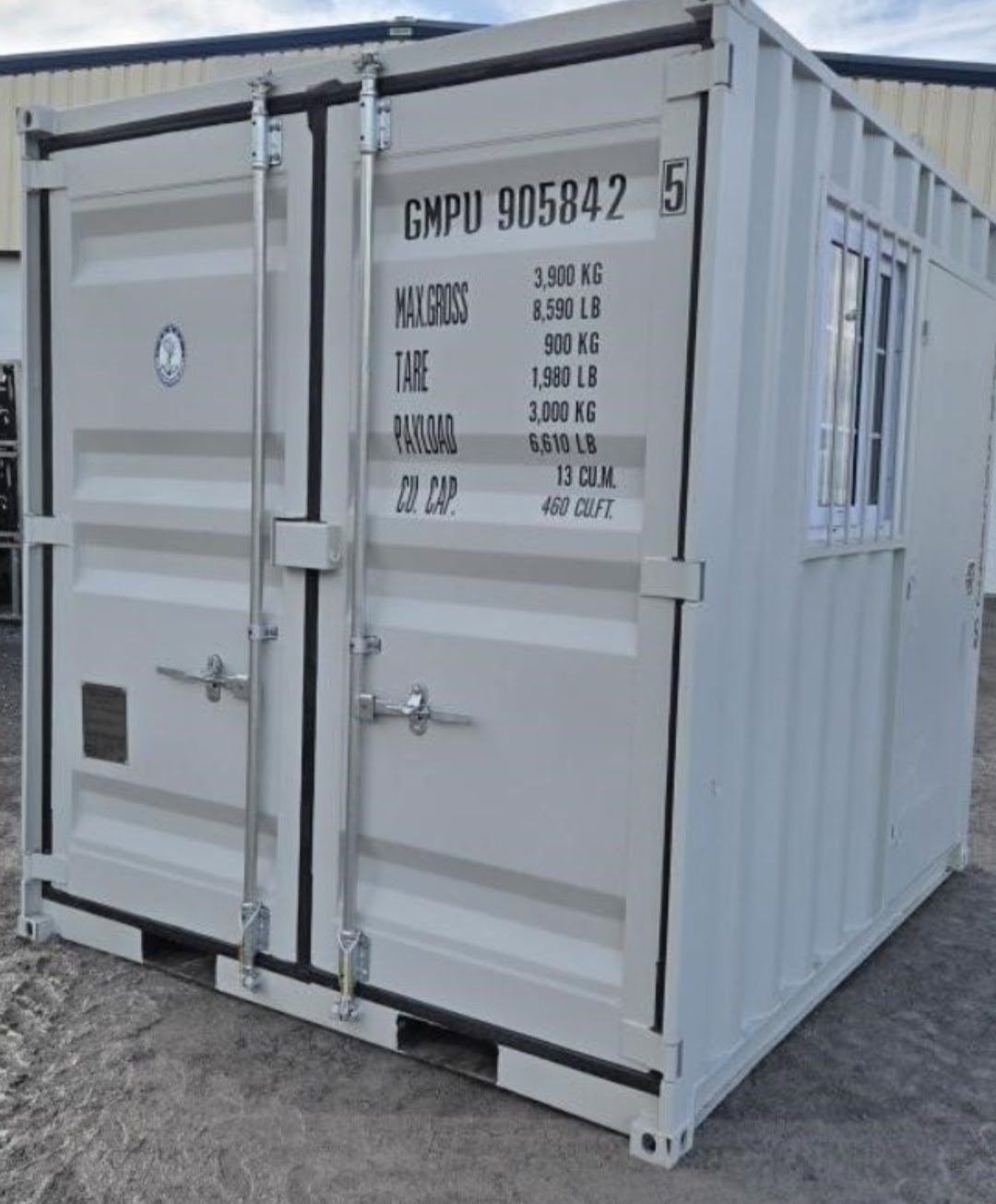
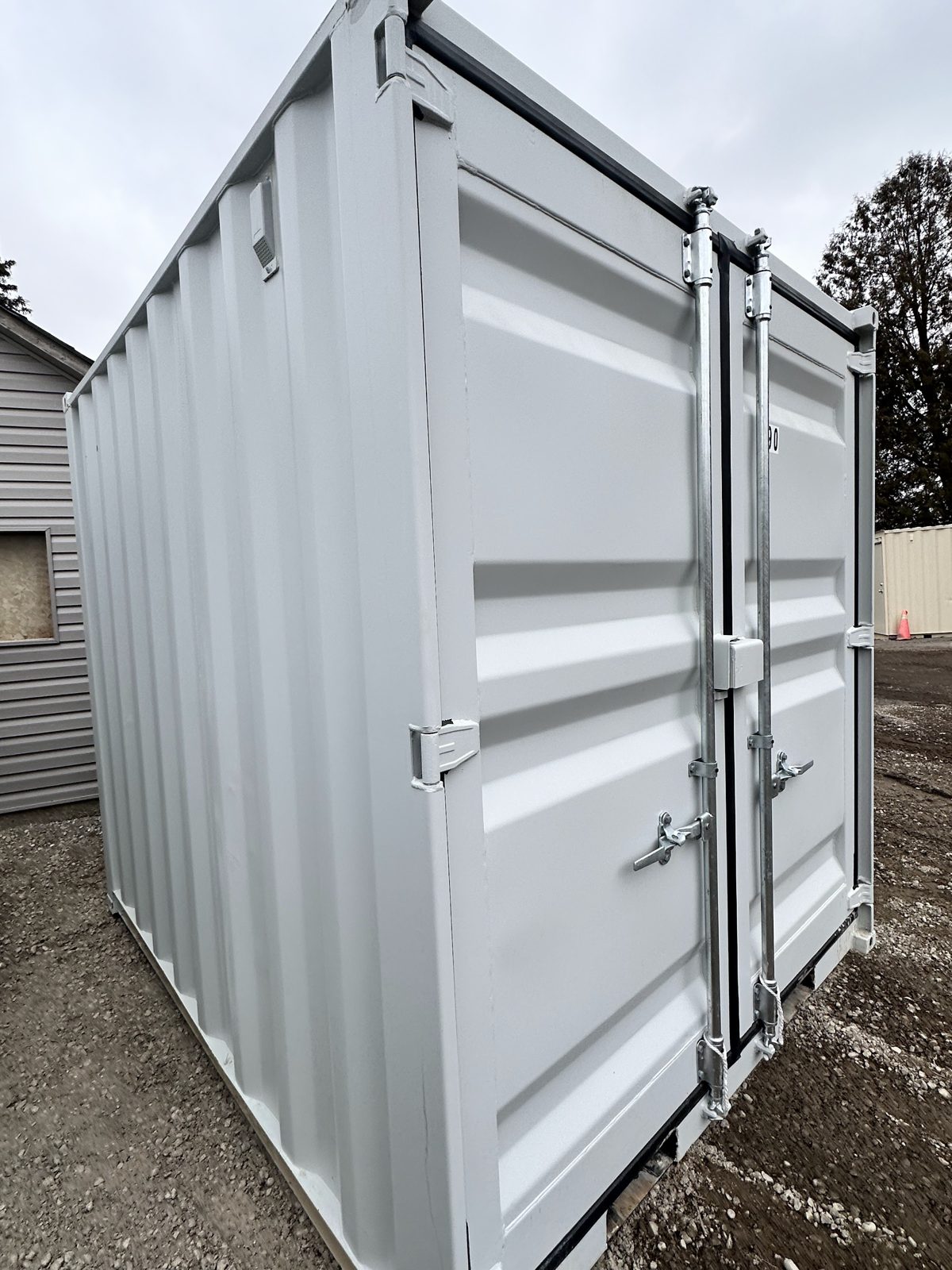
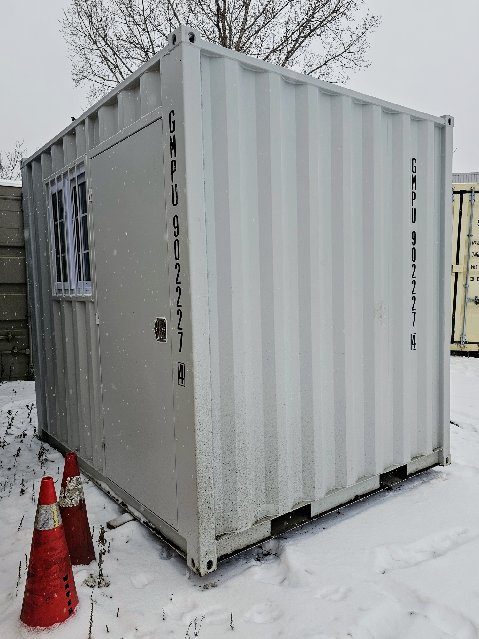
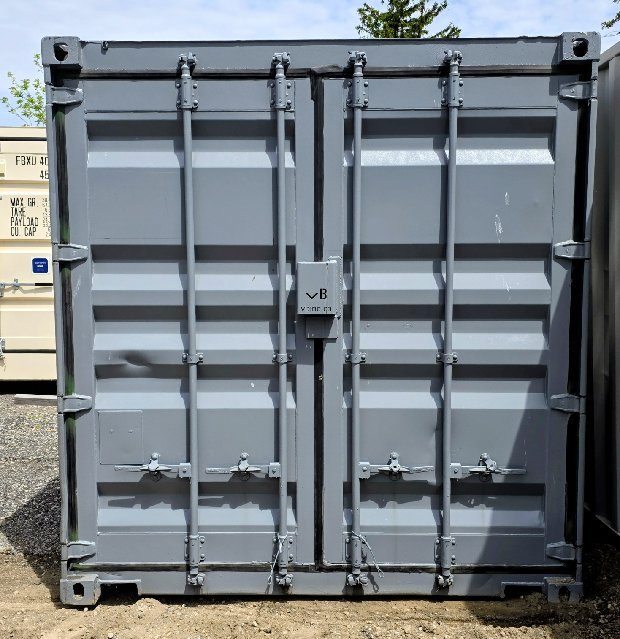
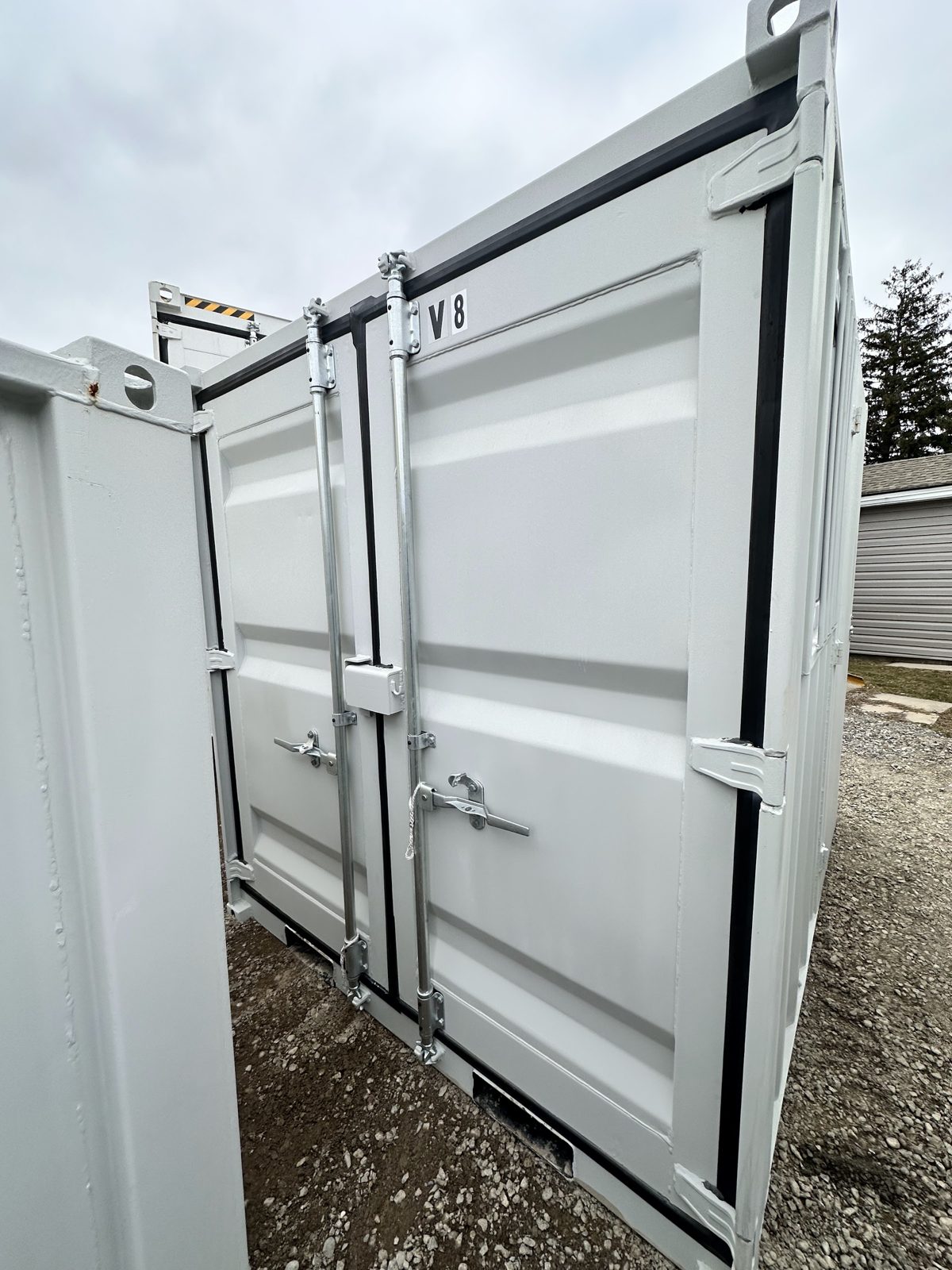
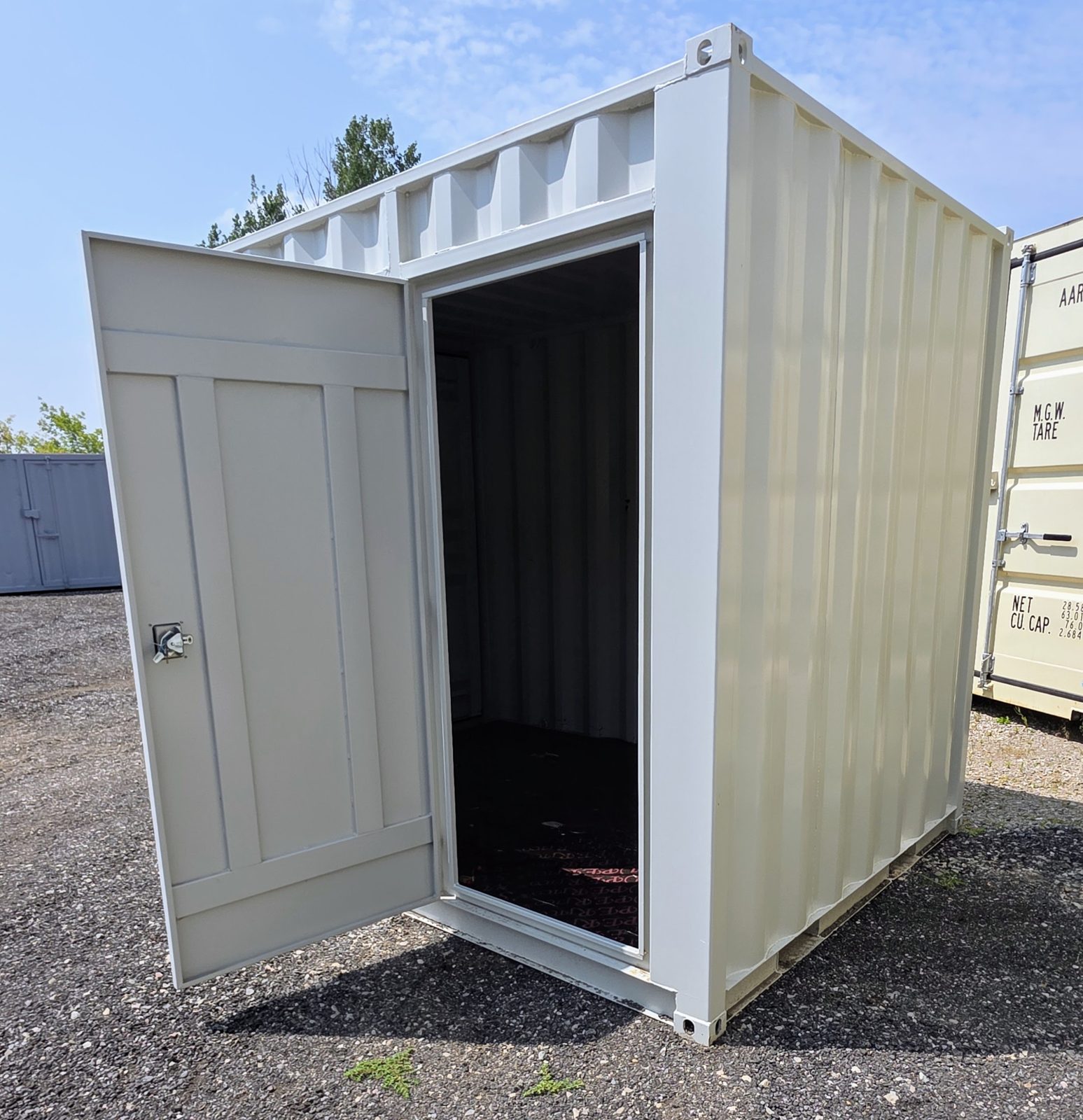
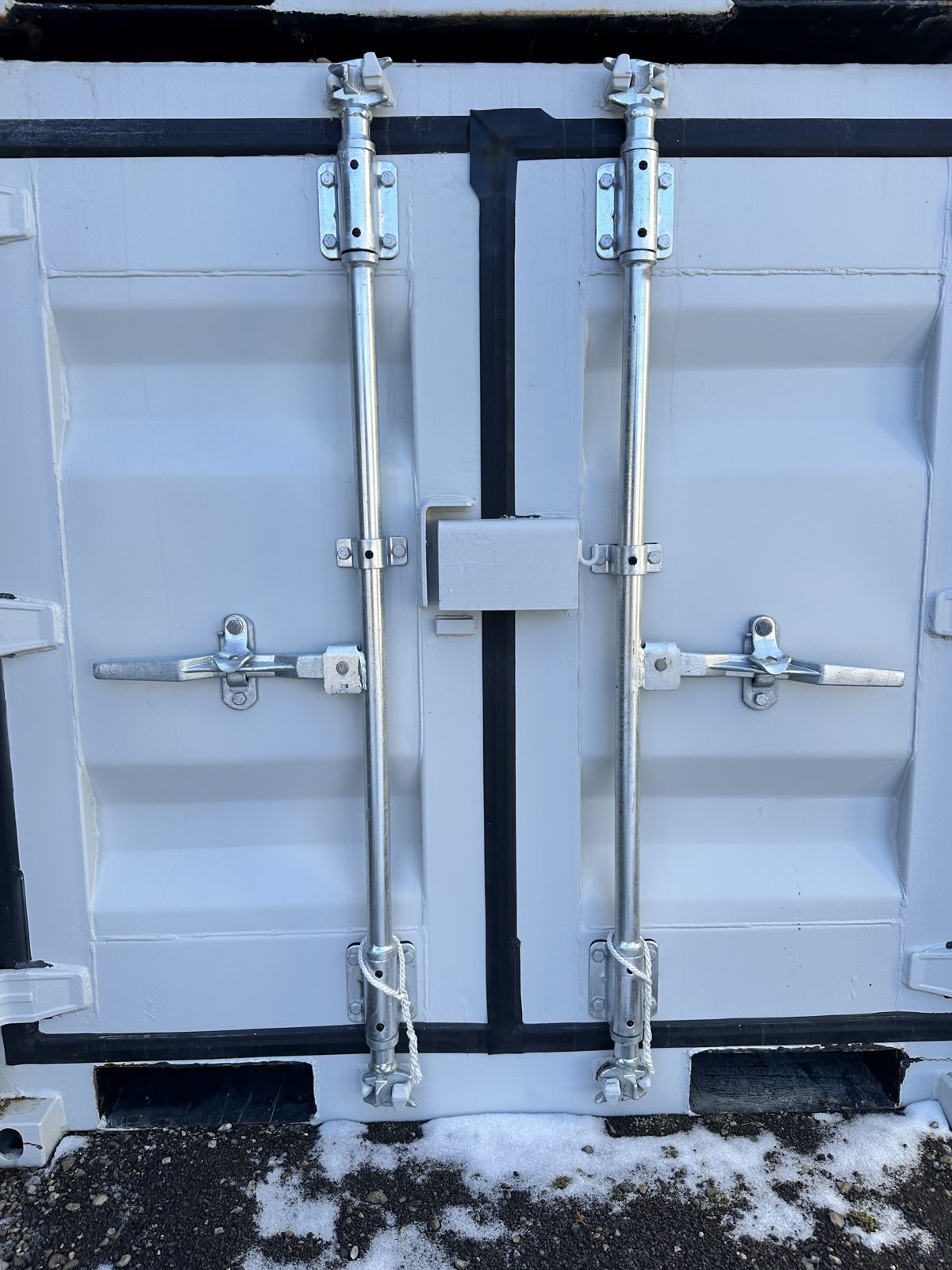
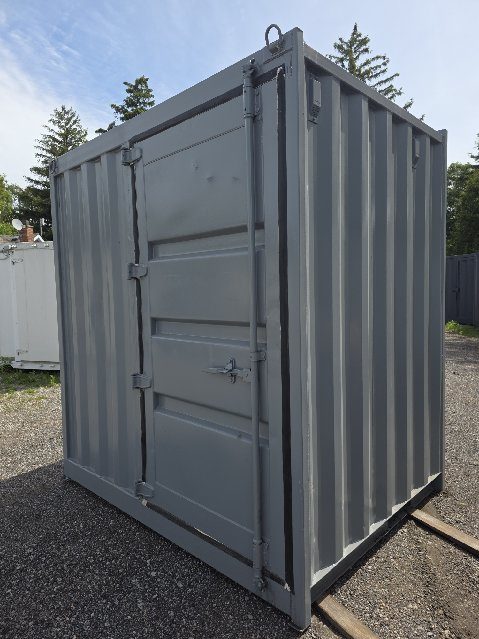
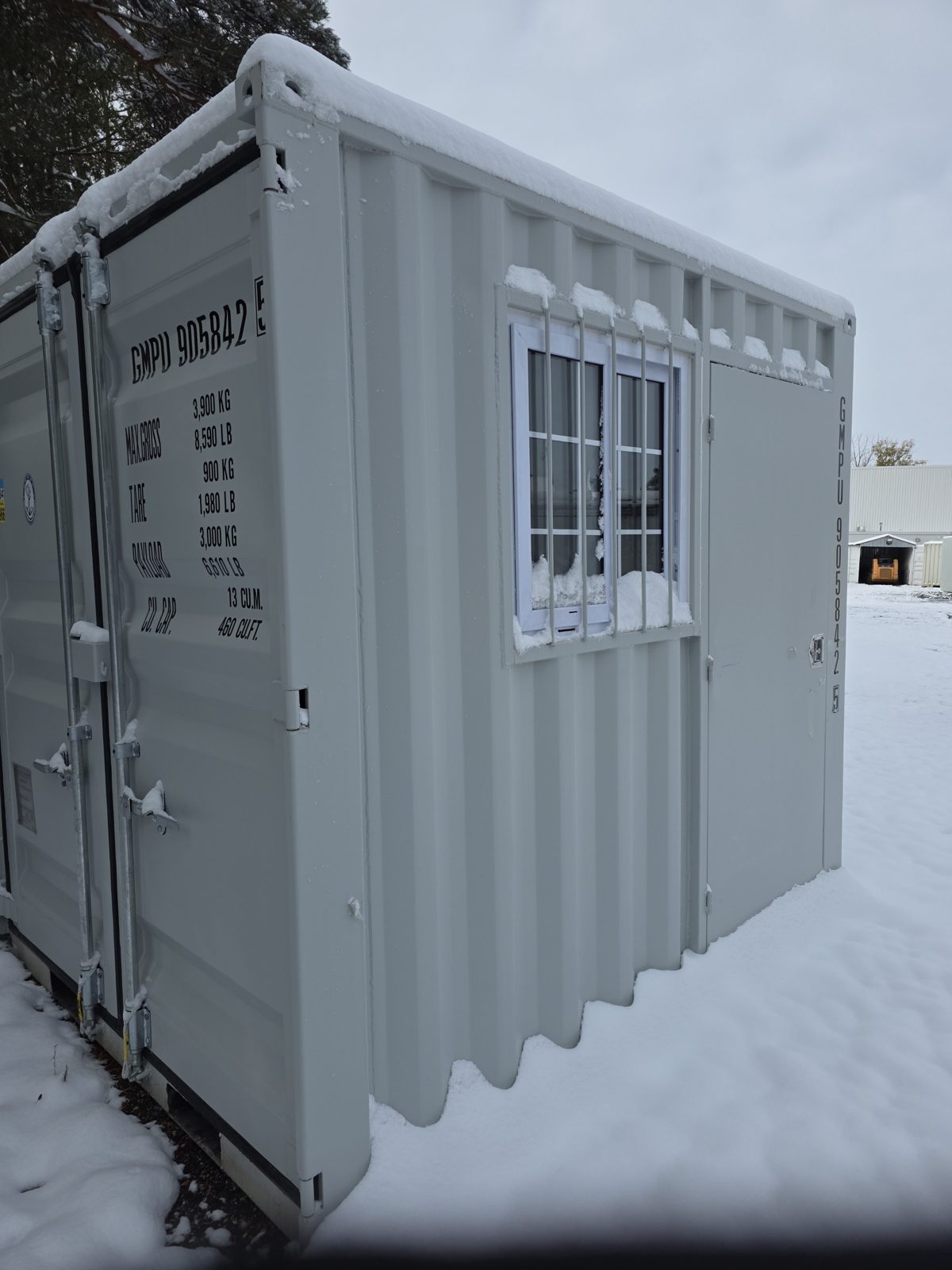
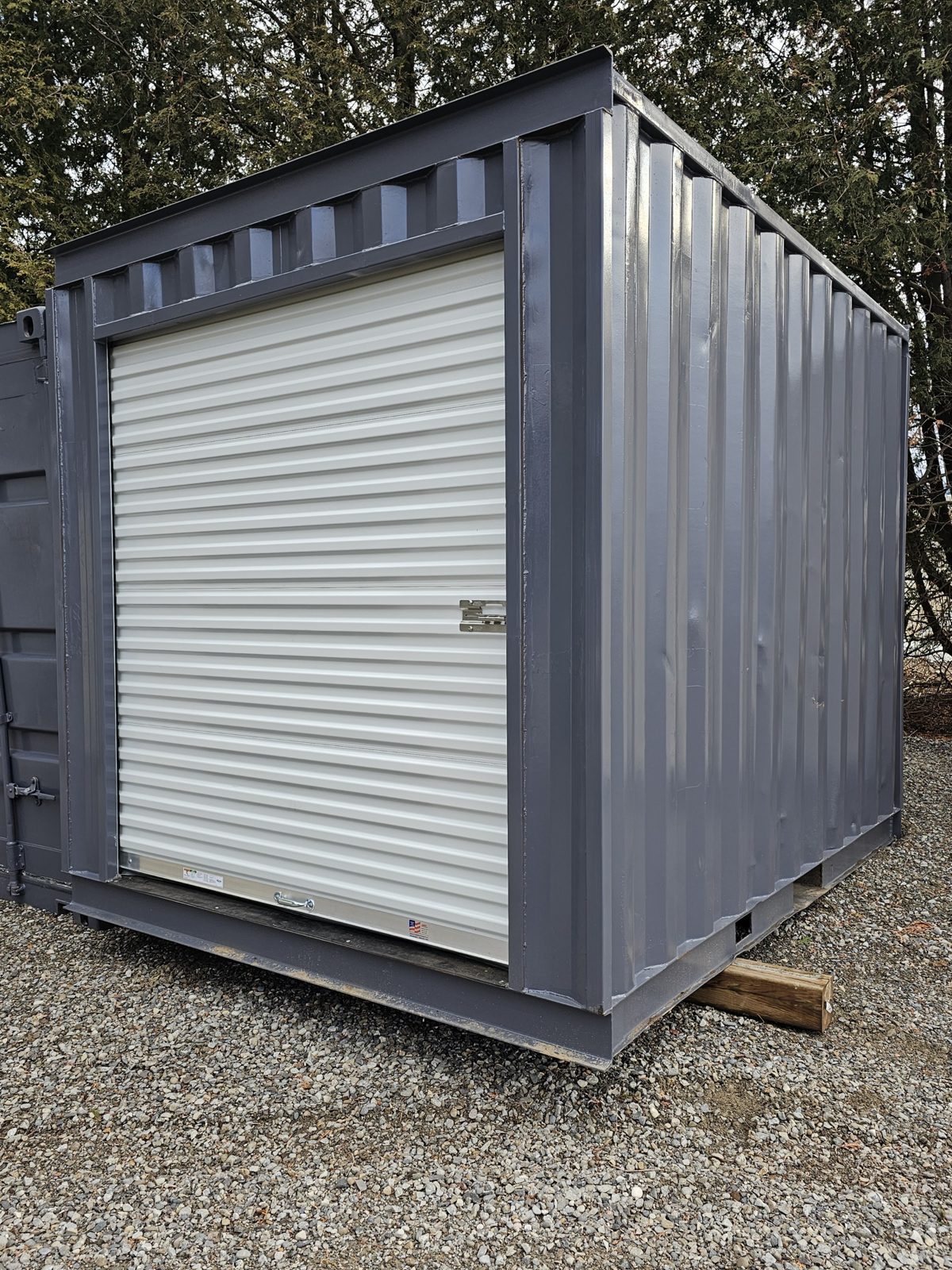
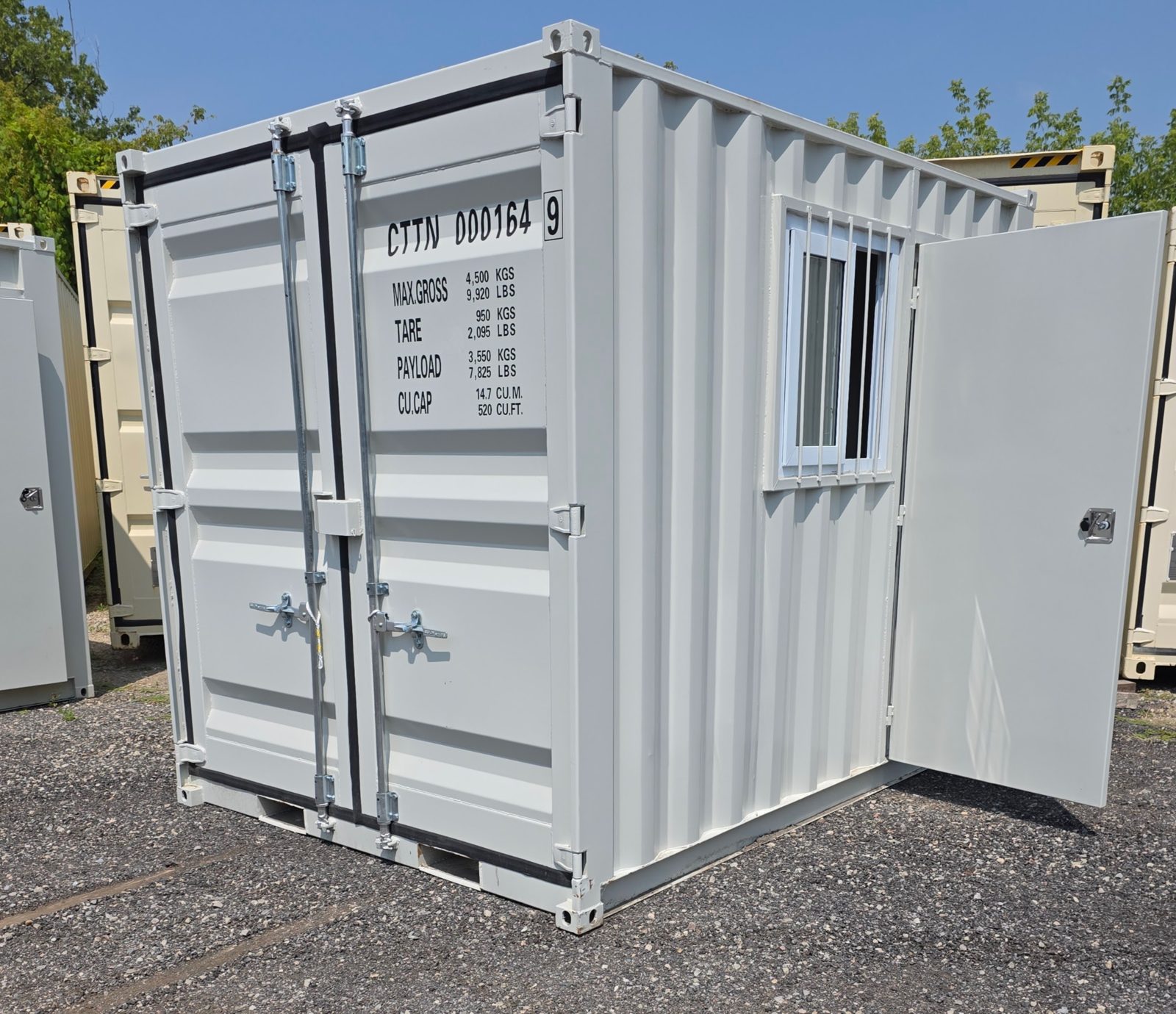
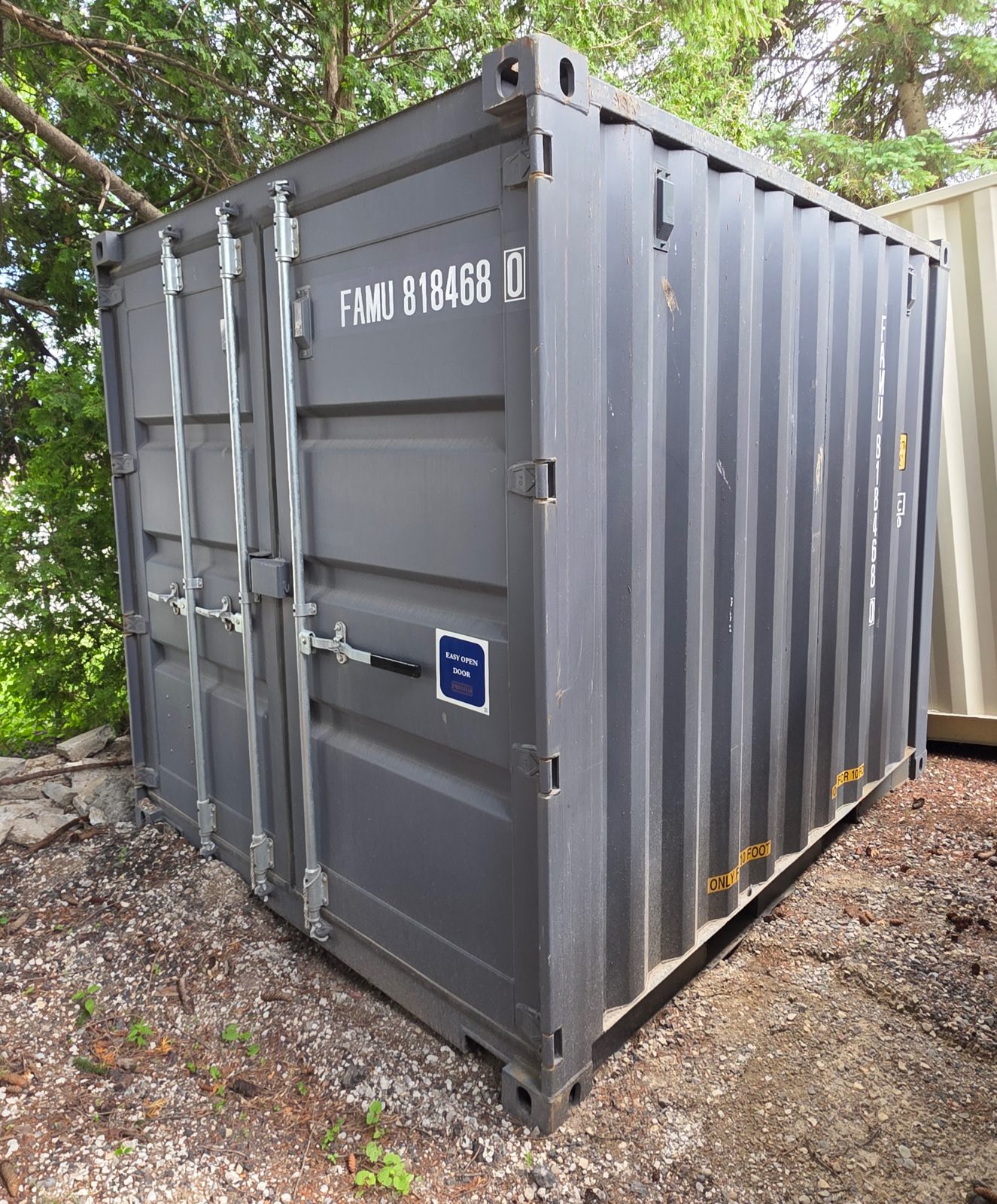
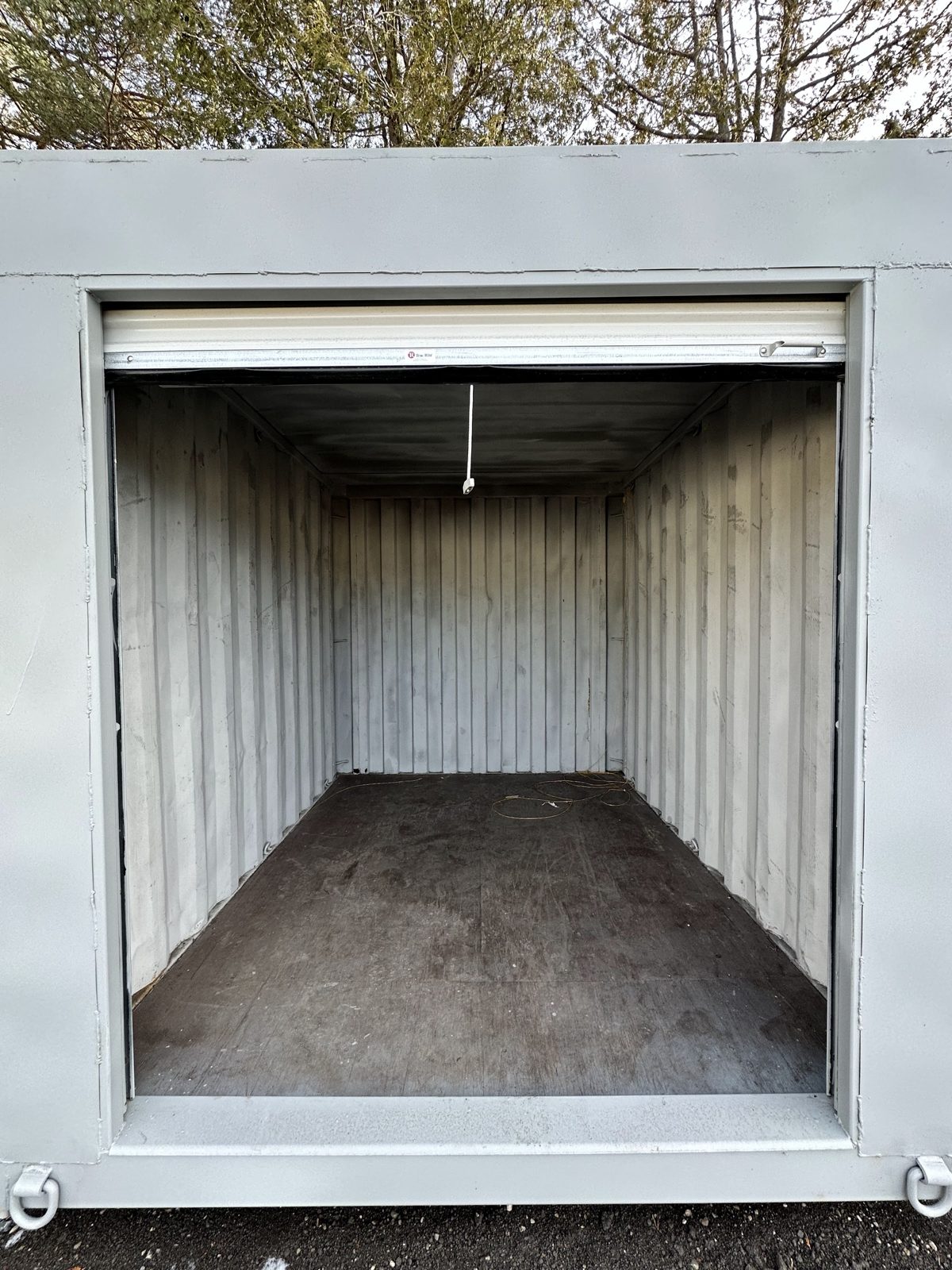
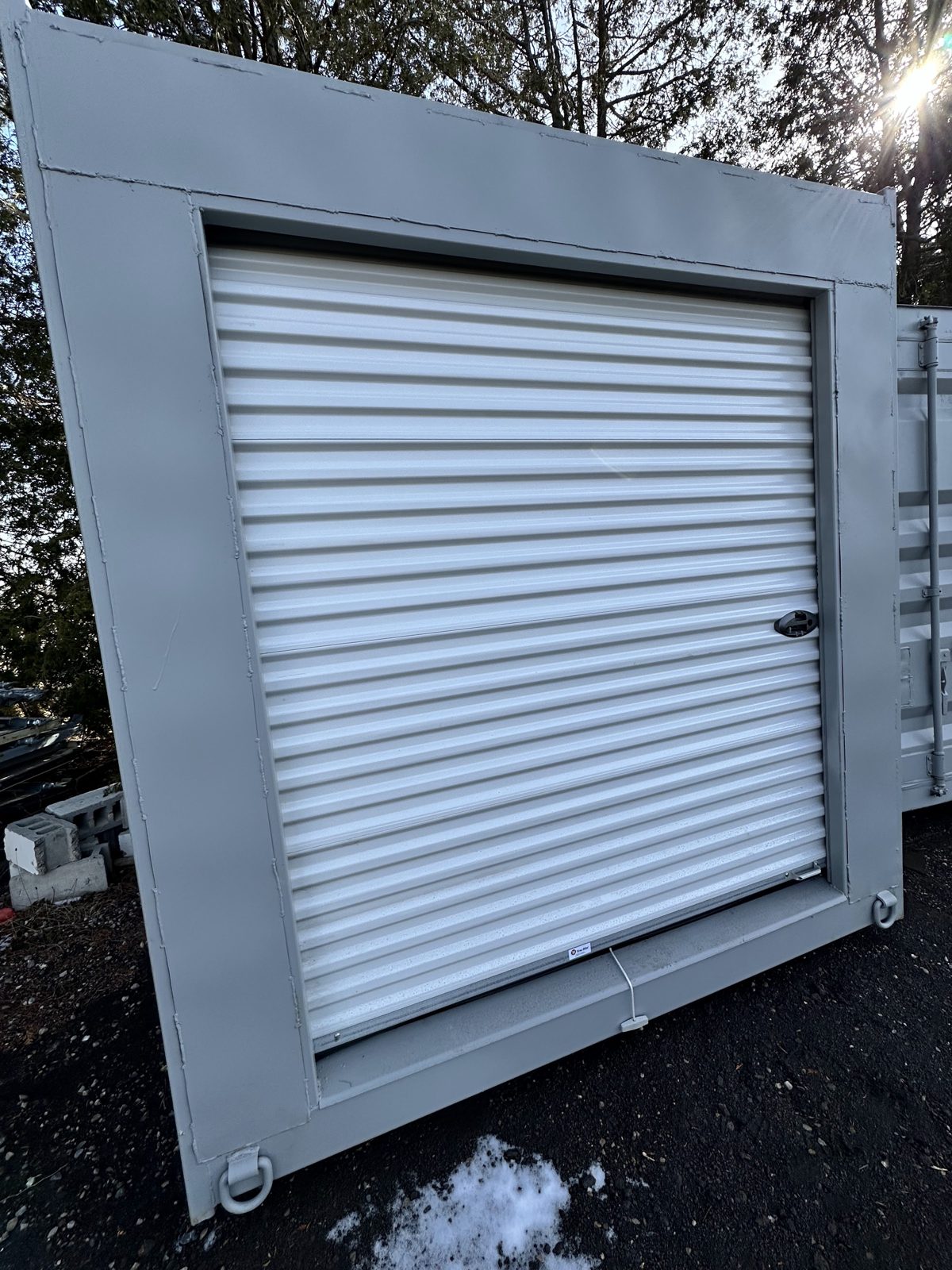
    A 10ft dry shipping container is the compact box for sites where a 20ft will not land: roughly 9 feet 10 inches long outside, 8 feet wide, 8 feet 6 inches tall, with about 560 cubic feet inside and a footprint of half a parking stall. We keep 10ft Standard units in stock across our Brantford yards in every grade, factory-built tens and honest cut-downs both, and you can walk the row and pick yours before paying a dollar.

    The Drop-Zone Box: Why the 10ft Exists

    Nobody buys a 10ft container for the storage math. Per cubic metre it is the most expensive standard box in the yard, because supply is thin and the tight-site demand that wants one never lets up. What a 10ft buys you is placement. It fits through gates a 20ft cannot approach, lands in courtyards, laneways, and side yards where the tilt-deck has no room to stretch out, and sits on an 8-by-10 pad, literally half a parking stall. When the drop zone is the constraint rather than the budget, the ten is the answer, and when the drop zone is not the constraint, we will be the first to tell you the 20ft is more box for meaningfully better value.

    Toronto laneway lots, older Hamilton and Brantford side yards, cottage properties where the drive narrows between trees, and condo corporations tucking grounds equipment behind a fence line: that is the 10ft customer list in Ontario, and it has been remarkably stable for thirty years.

    10ft Container Specifications

    The 10ft is a true ISO-series container: same 8-foot width, same corner castings, same door hardware as its bigger siblings, shortened to a nominal ten feet. The numbers that matter, with the 20ft alongside for scale:

    Spec10ft Dry20ft Dry (for comparison)
    External length2.99 m (9’10”)6.06 m (19’10”)
    External width2.44 m (8’0″)2.44 m (8’0″)
    External height2.59 m (8’6″)2.59 m (8’6″)
    Internal volumeapprox. 16 m³ (560 ft³)33.2 m³ (1,172 ft³)
    Tare weightapprox. 1,300 kg (2,870 lb)approx. 2,260 kg (4,982 lb)
    Footprint8 ft x 10 ft (half a parking stall)8 ft x 20 ft (one parking stall)
    Floor-loaded pallets4 standard pallets10 standard pallets

    Every dimension above is the standard spec; individual units vary slightly by manufacturer and build year, which is one more reason we put the exact unit in front of you before you commit. The full size family, 10ft through 53ft, is laid out in our complete dimensions guide.

    Factory-Built Tens vs Cut-Down 20s: The Question Most Buyers Do Not Know to Ask

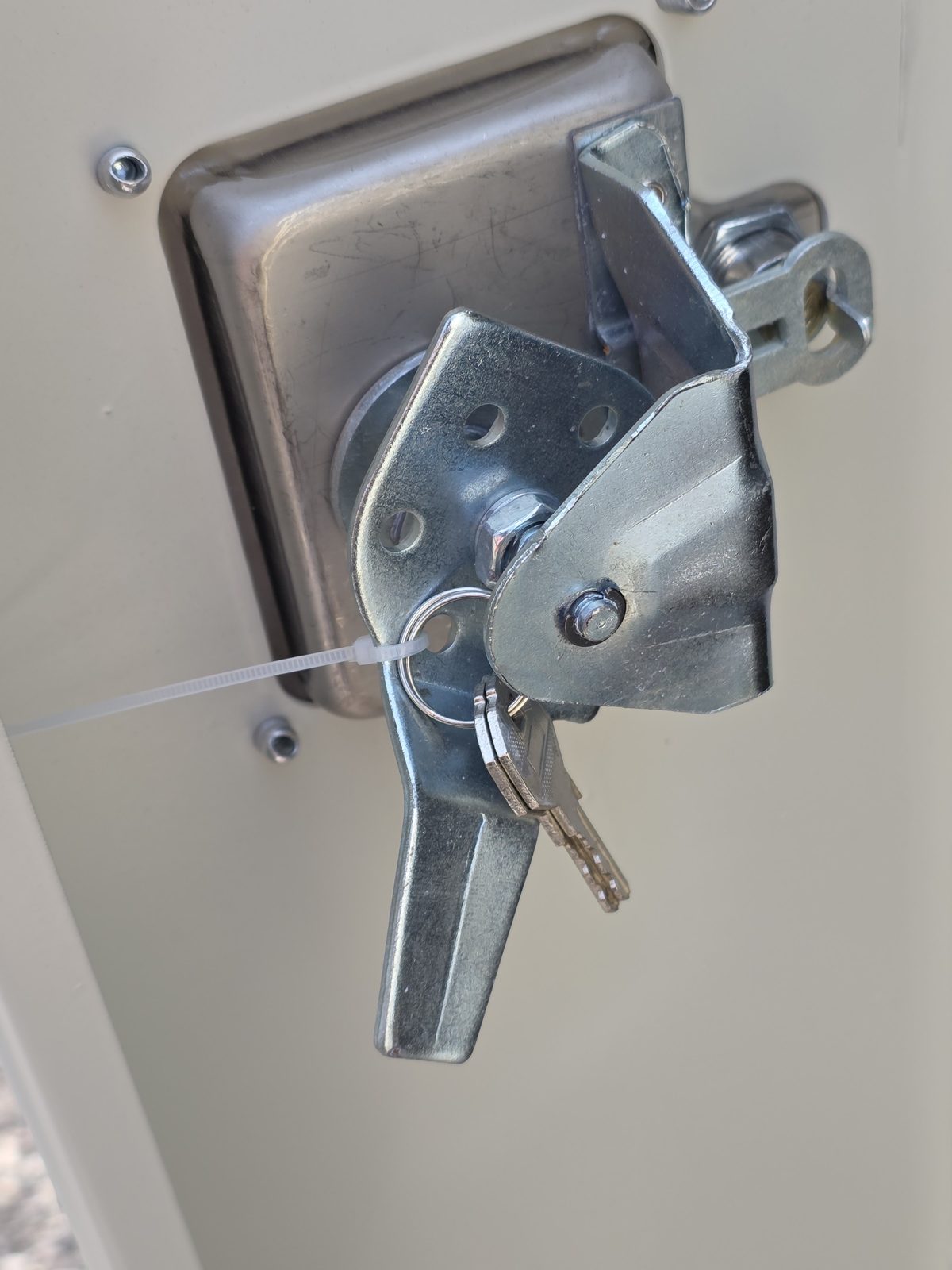
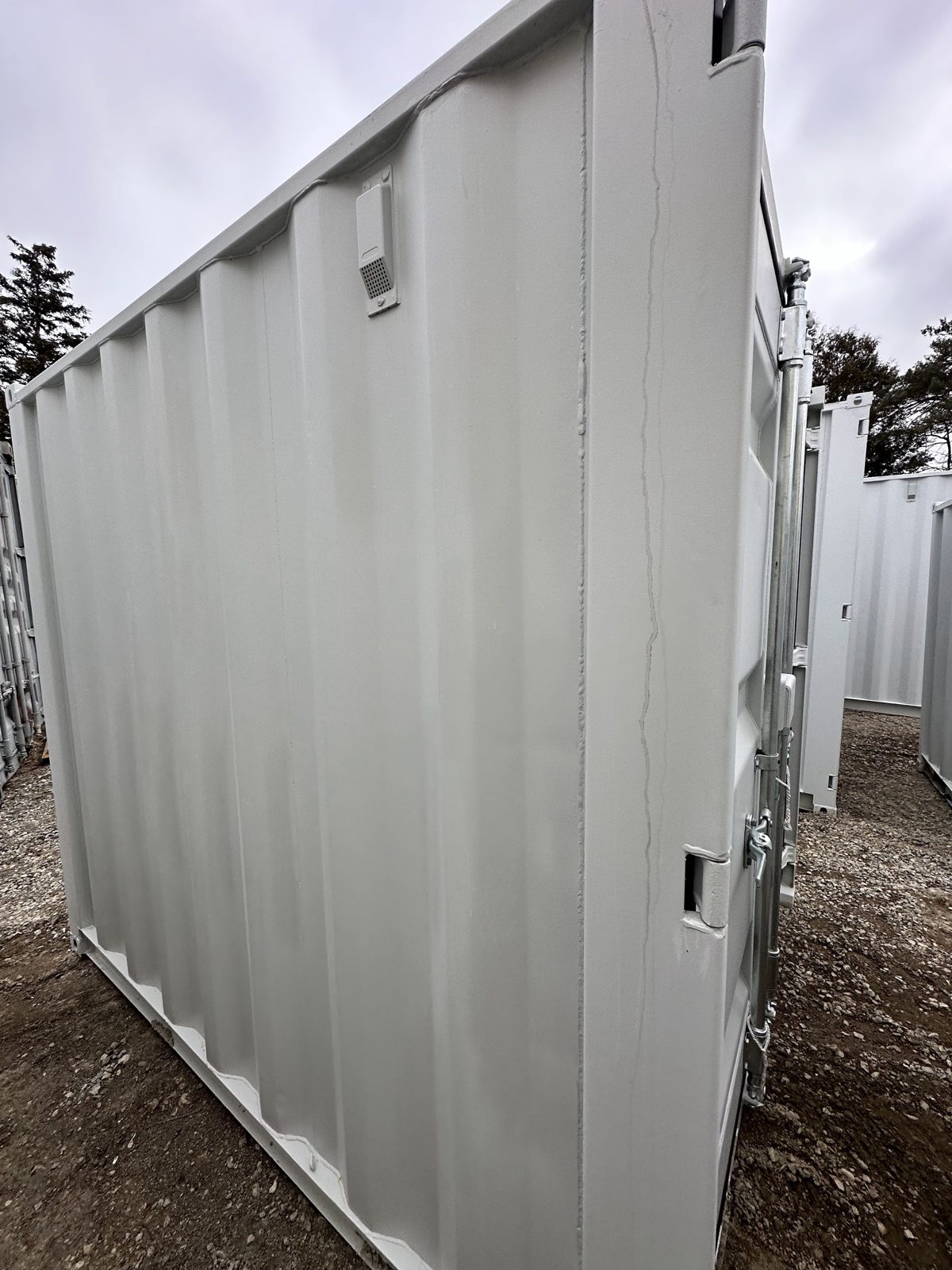
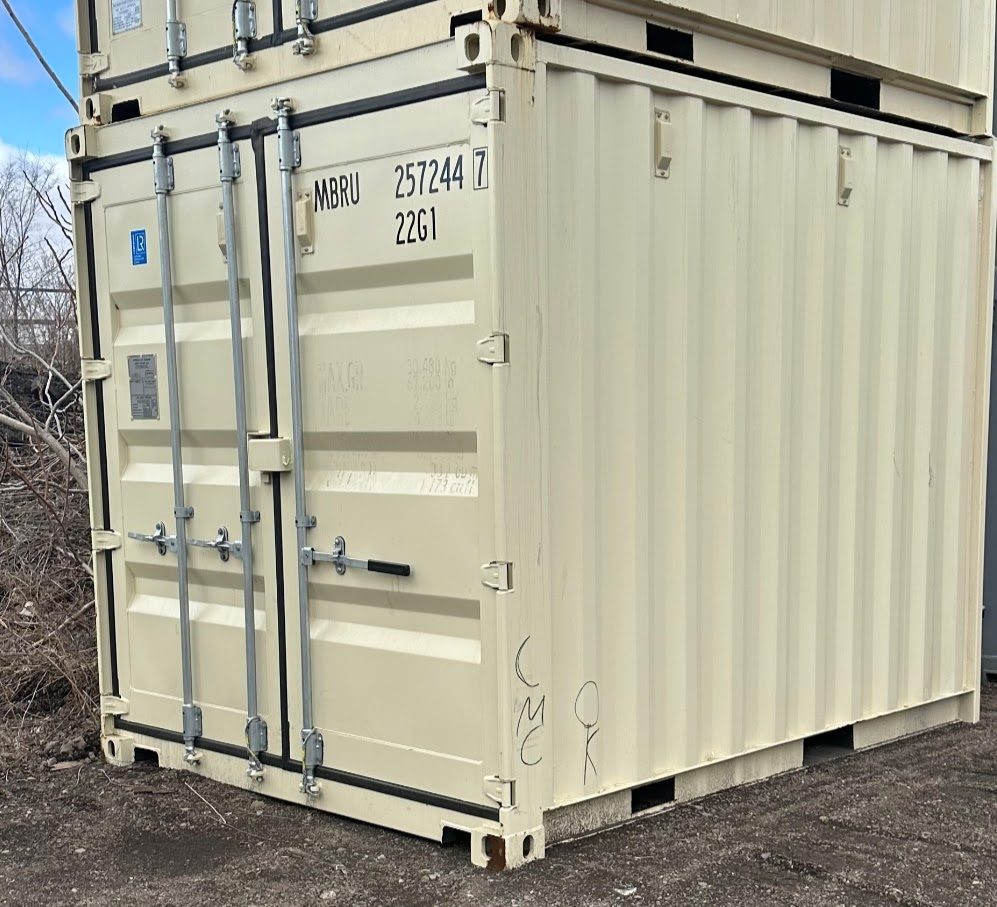
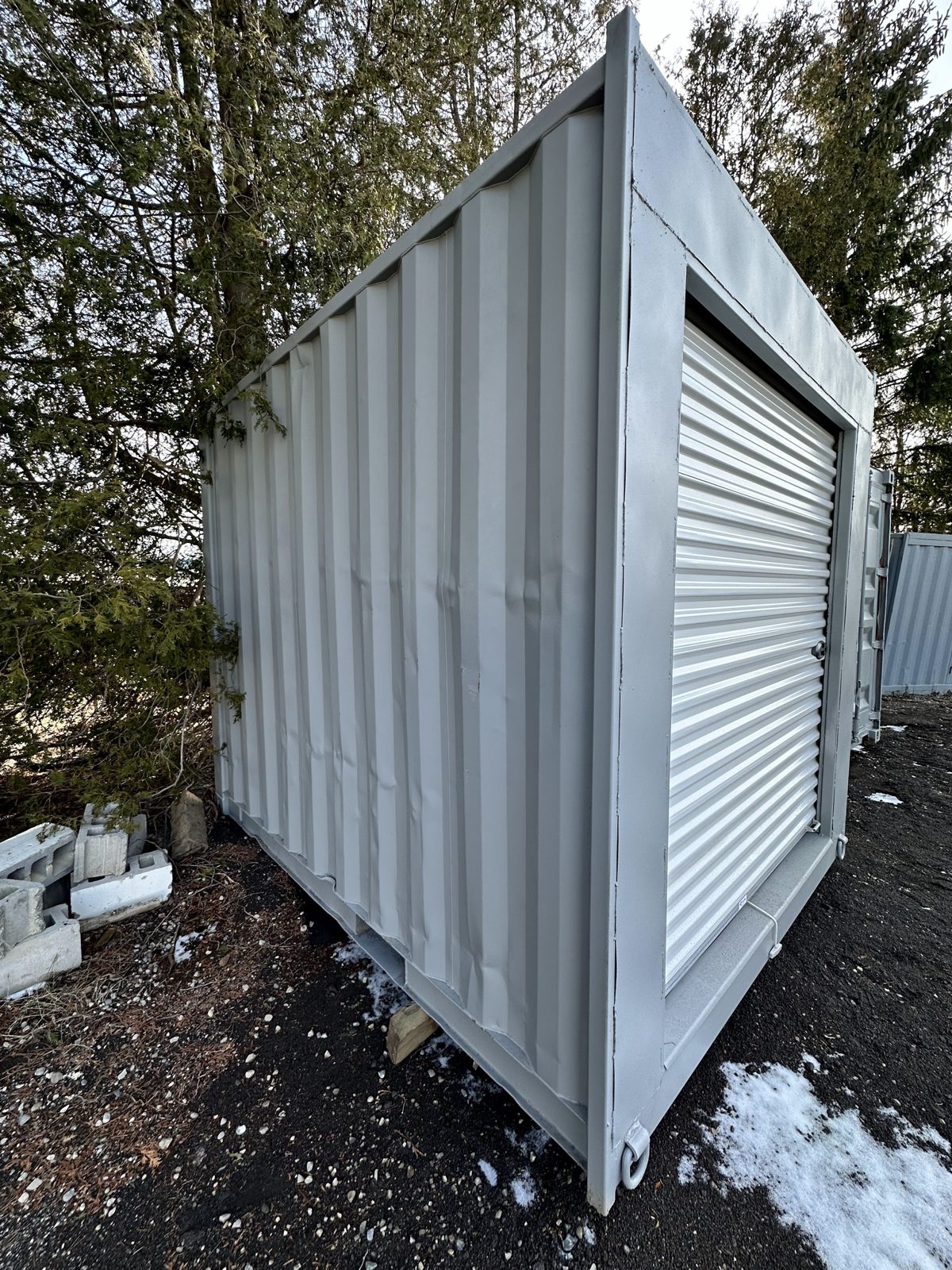
    Here is the piece of 10ft market honesty that almost no listing will volunteer: most 10ft containers in Canada started life as 20ft containers. Factories build far fewer true tens than the market wants, so fabrication shops cut 20s in half and weld a new end on. A well-executed cut-down is a perfectly good storage box. A badly executed one hides its sins in the weld line and the frame, and you will not find them in a depot stock photo.

    How to Tell Them Apart in the Yard

    • Corner castings: a factory ten has all eight castings integrated into one continuous frame. On a cut-down, the new end’s castings are welded onto the shortened rails; look for the fresh weld collar.
    • The second door end: many cut-downs finish with a welded blank panel where the cut was made. Straight, sealed, and primed is fine. Wavy, patched, or already blooming rust is a walk-away.
    • CSC plate: the original 20ft plate does not certify the shortened box. A cut-down being sold “with valid CSC” deserves hard questions; for stationary storage it does not matter, but the honesty of the seller does.
    • Floor seams: the plywood floor should be re-secured at the cut end, not floating on the last cross member.

    We stock both kinds, we label them as what they are, and we price them as what they are. Walk the row at 90 Morton Avenue East and you can put your hand on the weld line yourself, which is exactly the buying experience a depot-photo listing cannot offer. If you want the deeper background on how tens trade across the country, our 10ft container guide for Canada covers the market end to end.

    New (One-Trip) 10ft Containers

    Buyers search for a new 10ft shipping container; the industry calls the same unit one-trip, because it made a single loaded voyage from the factory. For a ten, the new (one-trip) question matters more than it does on bigger boxes: a factory-built one-trip ten is the only way to get a 10ft with original paint, integrated frame, and no fabrication history at all. They are genuinely scarce, they hold value stubbornly, and when a batch lands in the new container program they do not sit long. If a visible placement, a conversion base, or simple buy-once-cry-once economics are driving the purchase, tell us early and we will flag the next arrivals.

    What a 10ft Actually Does in Ontario

    1. The laneway and infill build

    Toronto and Hamilton infill projects rarely have room for a full stall of steel. A ten holds the tools, fasteners, and weather-sensitive materials for a laneway-house or garden-suite build, inside the fence, off the street, and gone the week after final inspection.

    2. The side-yard shed replacement

    An 8-by-10 garden shed costs real money, takes a weekend to assemble, and can be opened with a cordless drill. A 10ft container lands in an afternoon, shrugs off every winter, and locks like what it is: marine steel. For homeowners on older streets where the side yard is the only option, this is the classic order.

    3. Grounds equipment for condo corporations and property managers

    Mowers, blowers, salt, and seasonal signage need to live somewhere that is not the parking garage. A ten behind the fence line carries the load without consuming visitor parking, and a lockbox and venting package from the yard turns it into a purpose-built grounds locker.

    4. The kiosk and booth base

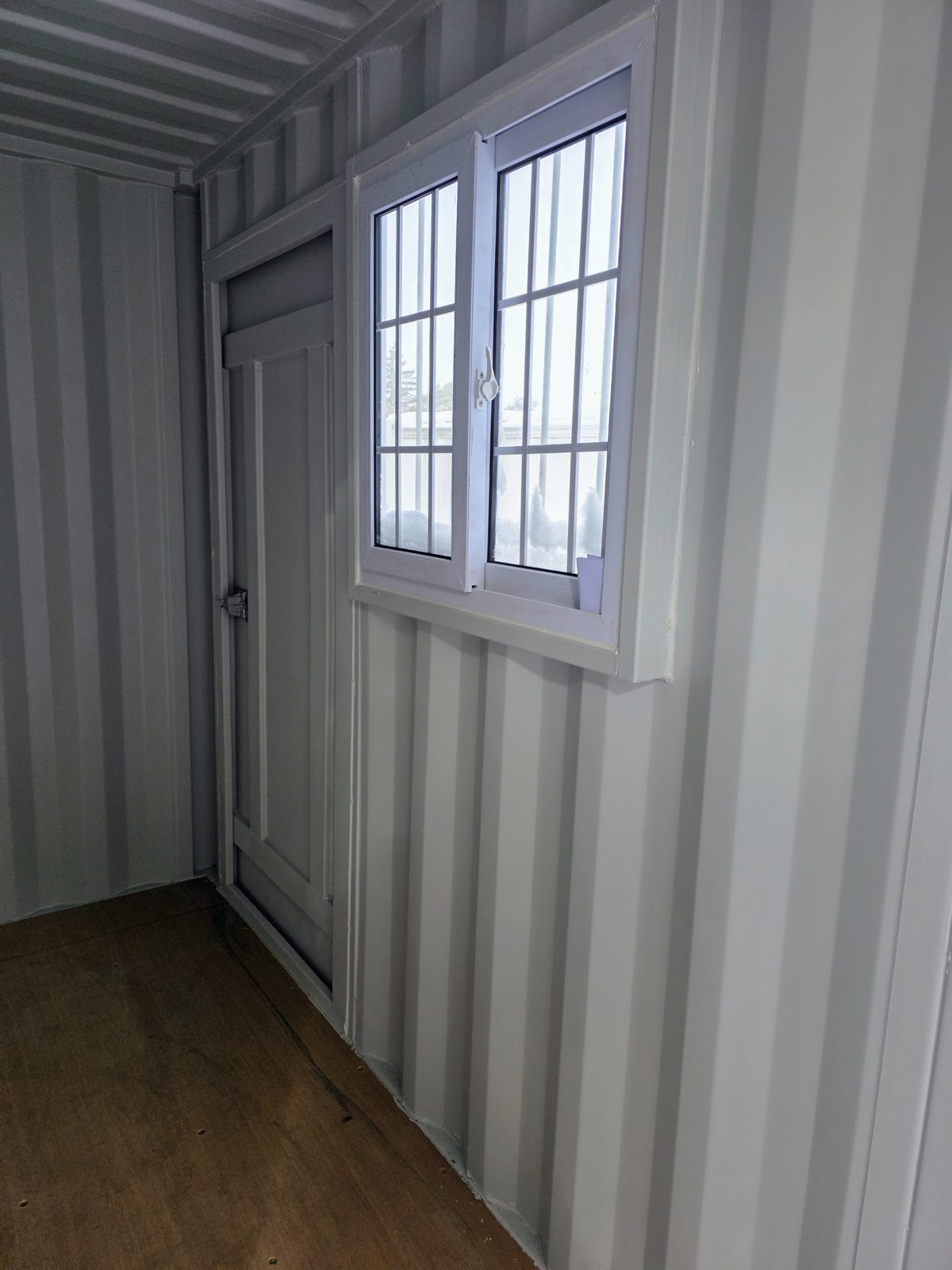
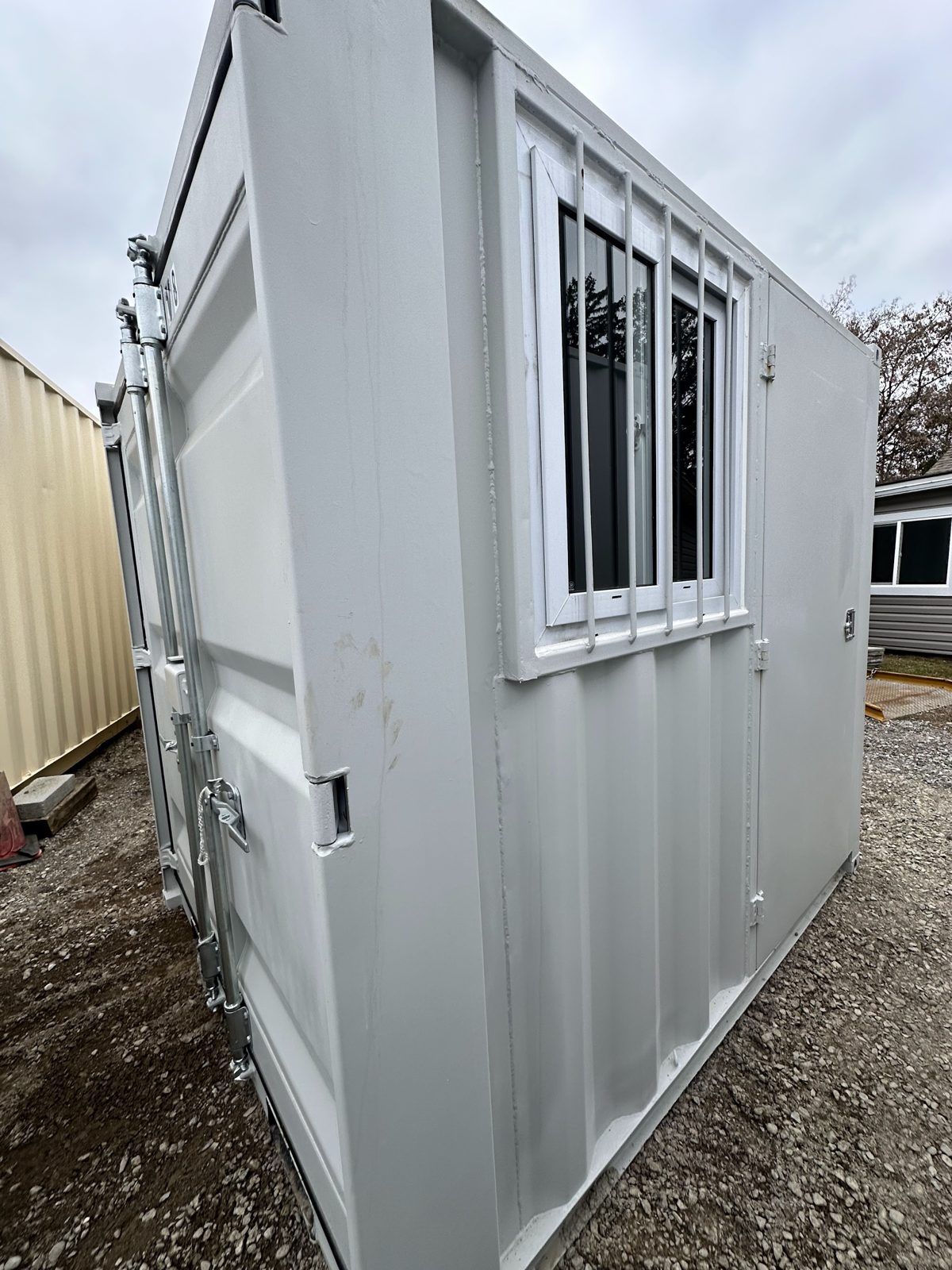
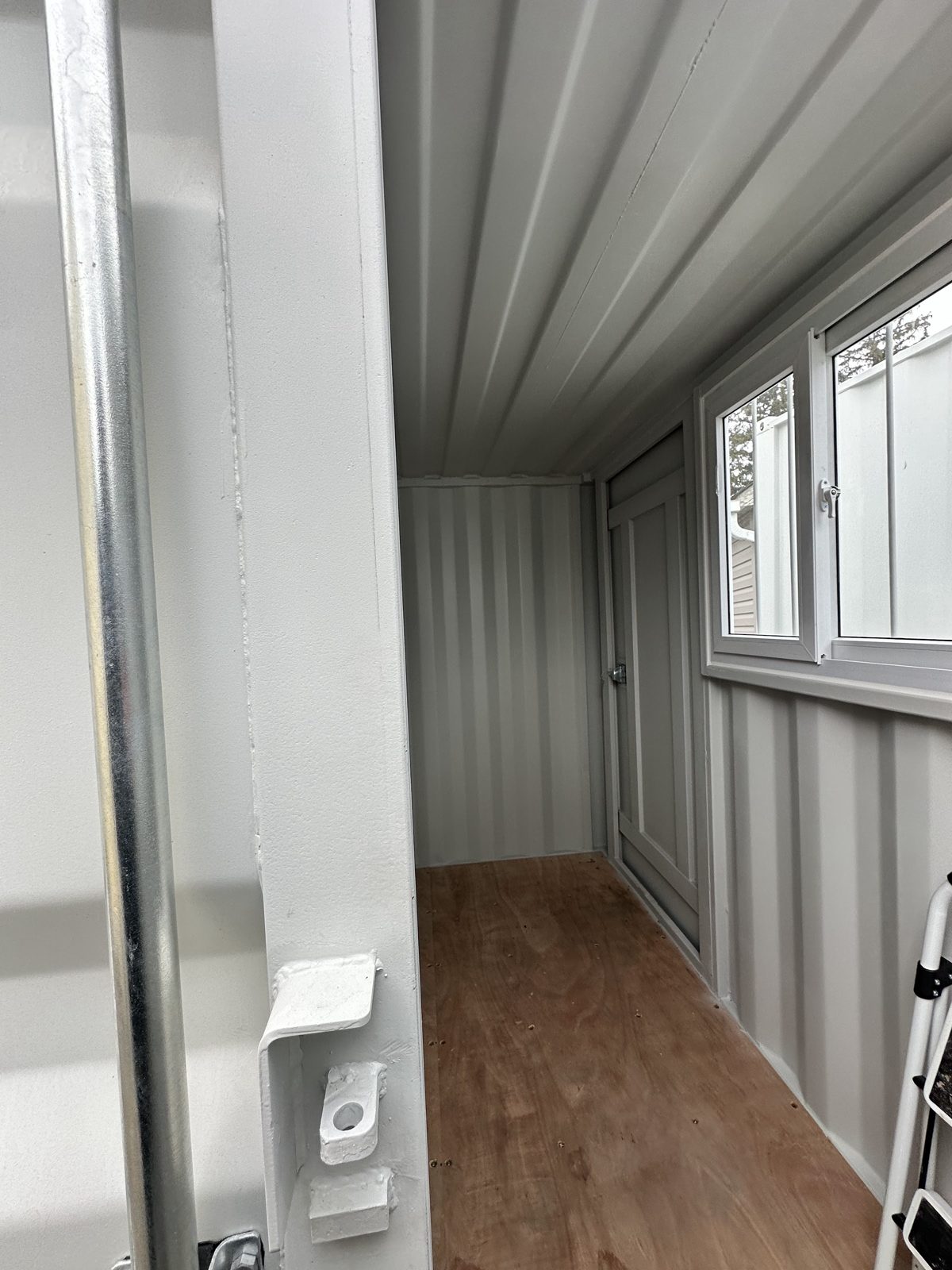
    Coffee stands, ticket booths, parking attendant shelters, scorekeeper boxes: the ten is the smallest container that converts into occupied space without feeling like a phone booth. Man door, window, insulation, and electrical rough-in happen at our Brantford yard before delivery, with final connections by your licensed trades on site.

    What Sets the Price of a 10ft

    Four things move a 10ft quote: whether the unit is a factory ten or a cut-down, the grade it carries, what the steel market is doing that quarter, and where in Ontario it is landing. Thin supply keeps tens firm even when 20ft prices soften, and the per-cubic-metre premium is real, which is why the first question we ask is whether your site truly rules out a 20. If it does, we quote the ten honestly; if it does not, we will say so and save you the premium. Tell us the size and your postal code and you get an all-in number with a real lead time, usually the same day.

    Delivery: The Easiest Drop We Do

    A ten rides the tilt-deck like everything else, but it also shares trailer space, which means a 10ft delivery can often pair with another load heading your direction and split the freight leg. On site it needs the shortest straight run of any box we place: if a pickup truck can reach the spot and back out, the ten can usually land there. Standard 1-3 day delivery across Ontario from our Brantford yards, quoted per order, and the two-minute site conversation before dispatch is what makes the drop boring in the way deliveries should be.

    Frequently Asked Questions

    Will a 10ft container fit in a residential driveway or side yard?

    Almost always. The footprint is 8 feet by 10 feet, half a standard parking stall, and the height matches a garden shed at 8 feet 6 inches. The practical question is the approach: the truck needs a straight run to set it down, so a phone photo of the path saves everyone a surprise.

    How much does a 10ft shipping container cost in Ontario?

    It depends on factory-built versus cut-down, grade, the current steel market, and delivery distance. Tens carry a real per-cubic-metre premium because supply is thin, which is why we always confirm a 20ft genuinely will not fit your site first. Call the yard or send the quote form and you will get an honest, all-in number, usually the same day.

    Can I buy a new (one-trip) 10ft container?

    Yes, when they land. Factory-built one-trip tens are the scarcest standard box in the market, so they move through the yard quickly. If you need one for a conversion or a visible placement, tell us early and we will flag the next batch that arrives at our Brantford yards.

    Is a cut-down 10ft container safe to buy?

    A well-built cut-down is a perfectly good stationary storage box, and it is usually the more affordable path to a ten. The risk is workmanship you cannot see in photos: the weld collar, the blank end panel, the floor at the cut. That is exactly why we let you walk the row and inspect the specific unit before you pay.

    Can Van Blanc move my 10ft container to a new spot later?

    We deliver the container you buy and we collect rental units when the term ends. Relocating a placed or loaded container is a third-party hauling service you arrange, not something we offer, and we will say so plainly on the first call. If a future move is likely, keep the pad simple so any hauler can reach it.

    What is the difference between a 10ft container and a garden shed?

    Steel, security, and lifespan. A ten is marine-grade corten with a marine plywood floor and container-rated doors; it needs no assembly, no shingles, and no maintenance beyond keeping the door gaskets clean. A comparable-footprint shed is lighter, prettier out of the box, and far easier to break into. Most buyers who compare both at the yard leave with the steel.

    Reach Van Blanc in Brantford

    We have been supplying shipping containers across Ontario since 1995. Our warehouse is at 90 Morton Avenue E in Brantford, and we deliver right across the province on a cash-on-delivery basis. No surprise fees, no chase-the-paperwork.

    Van Blanc Ent. Inc. | 90 Morton Ave E Unit 1B, Brantford, ON N3R 7J7 | +1 888-509-6658

    Tens are the box people most regret buying from a photo. Come put your hand on the weld line, compare a factory ten against a cut-down in the same row, and decide with your own eyes. Fifteen minutes in the yard beats an hour of zoomed-in listing photos.

    Related Reading

  • 53ft High Cube Container

    53ft High Cube Container

    Quick Answer

    A 53ft shipping container is a North American domestic intermodal box, NOT an ISO ocean container. External 53 feet long, 8 feet 6 inches wide (six inches wider than a standard ISO 40HC), 9 feet 6 inches tall. Internal cargo space 110 cubic metres (3,884 cu ft), tare 5,490 kg, max payload 33,075 kg. Used by CN Rail, CP Rail, and Canadian trucking carriers for domestic freight. No CSC plate, no ocean-shipping certification. Source-to-order at our Brantford yard with a 2 to 4 week lead time. Honest per-order CAD quotes; every 53 is sourced and priced to your order.

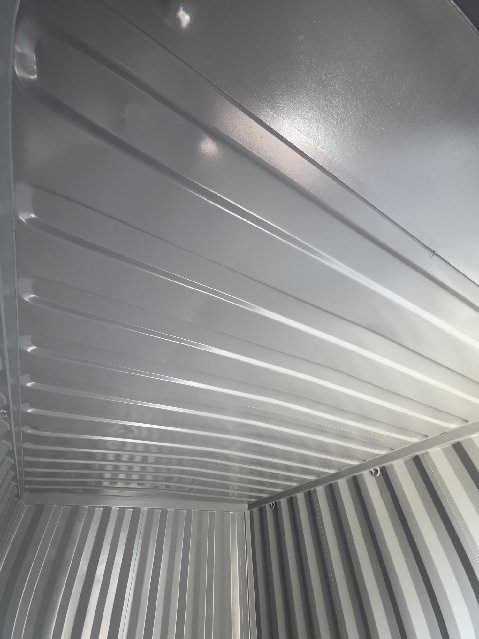
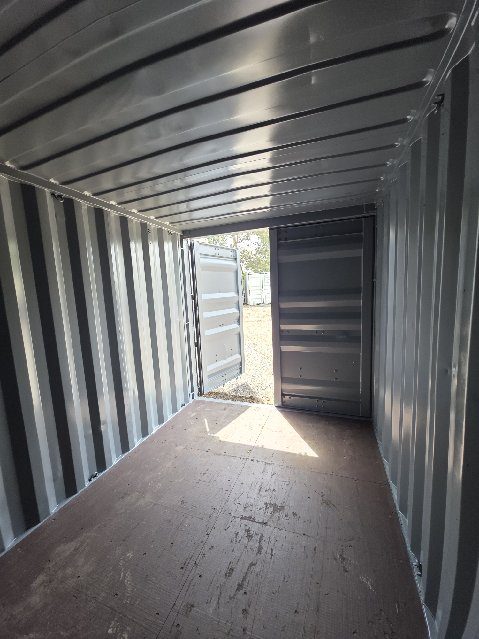
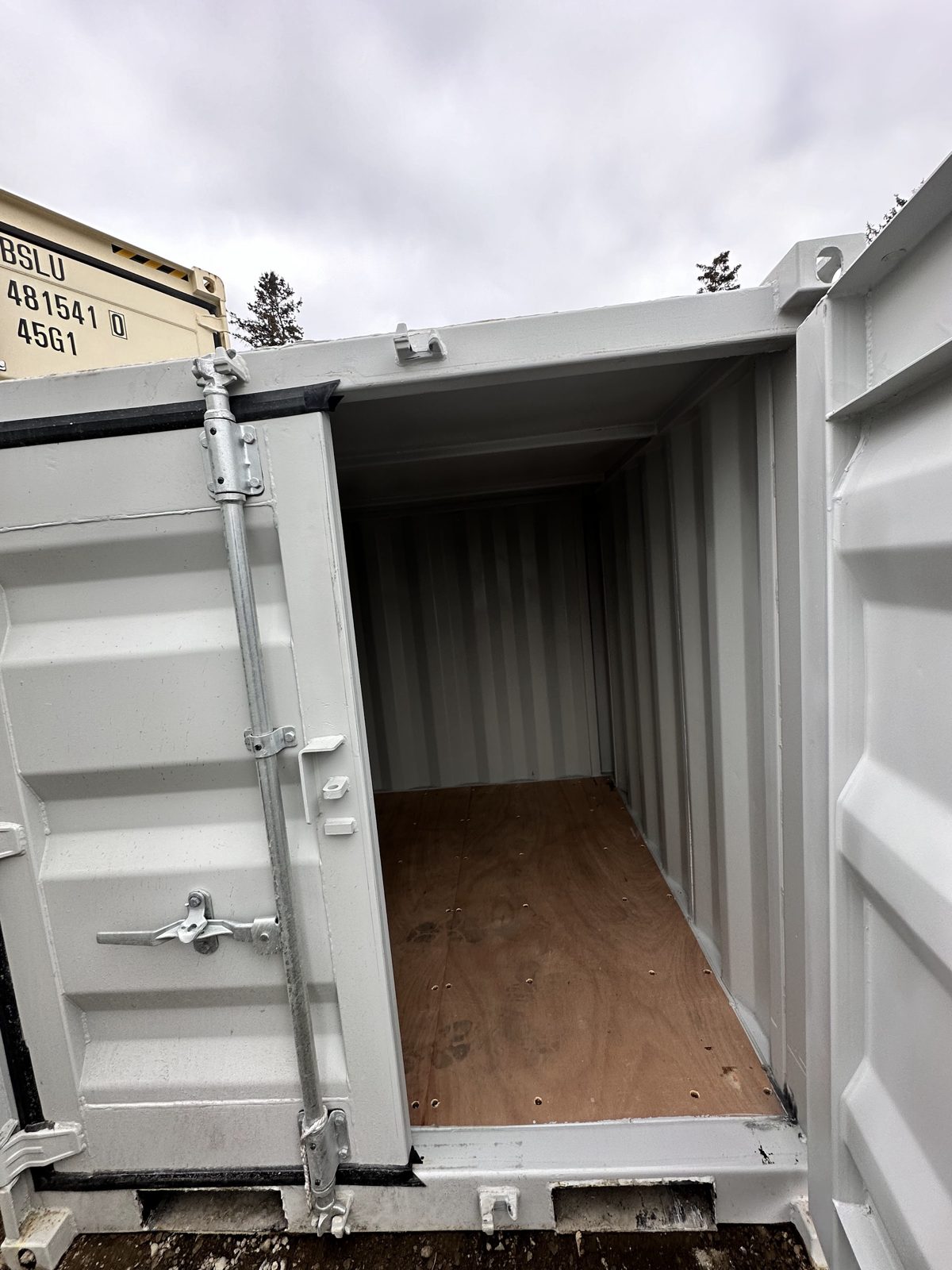
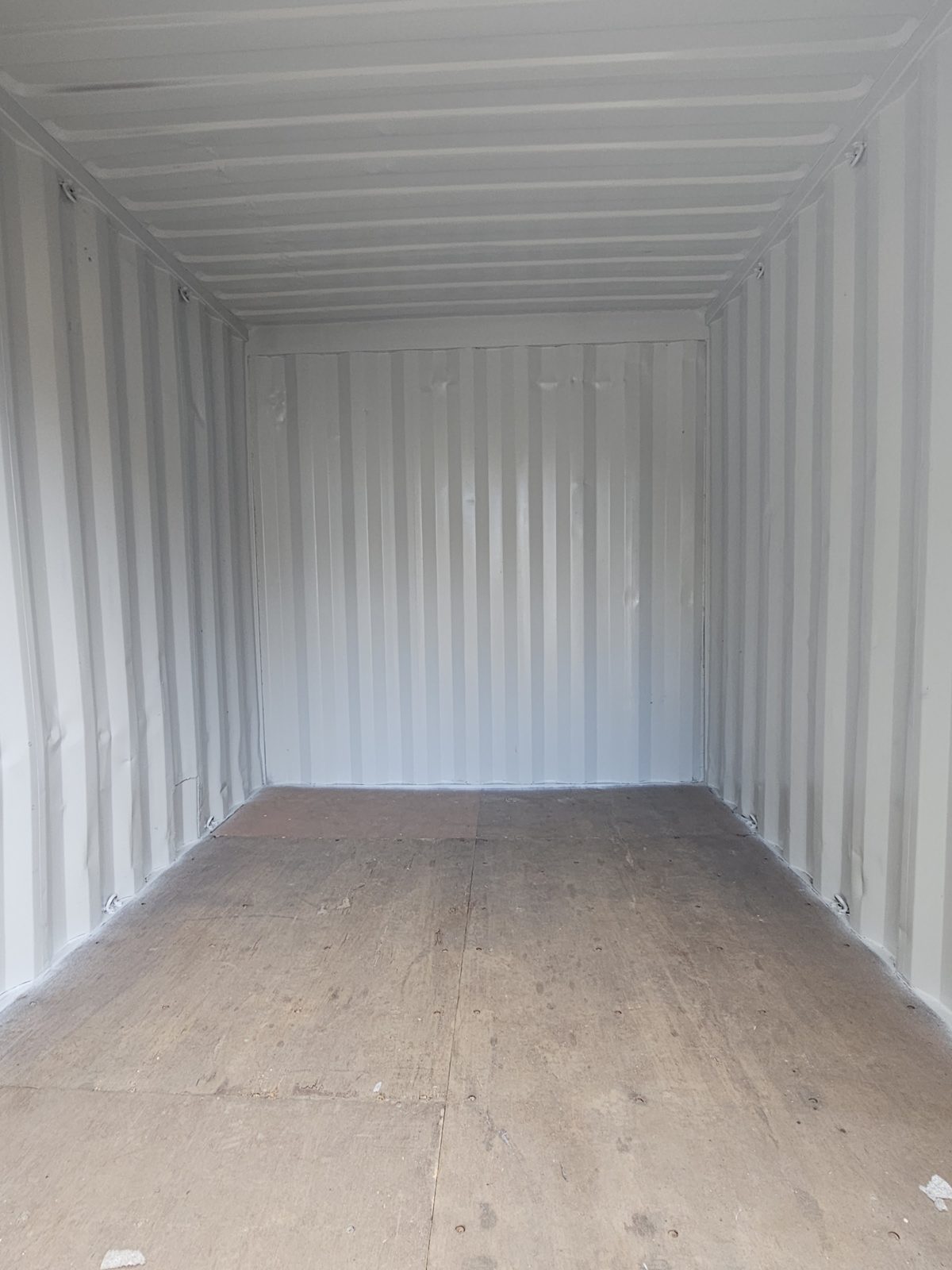
    Inside a high cube shipping container looking down its length

    The 53ft container is the largest single-piece container product available in Canada, and the most-misunderstood. Buyers often ask for one because the name suggests “bigger is better,” then are surprised when we explain it cannot ship internationally, costs more than a 45HC, and has narrower used-market liquidity. About half the buyers who call about 53ft units end up ordering a 45HC instead, once they understand the differences. The half who actually need a 53ft are usually doing one of three things: long-cargo domestic freight that genuinely exceeds 45 feet, maximum-volume single-unit storage where the extra 8 feet pays for itself, or a custom workshop conversion needing the longest available roof span.

    This page covers what a 53ft container actually is (the answer is a domestic intermodal box, not an ocean container), what it weighs and holds, when it earns the premium over a 45HC, and how source-to-order works from our Brantford yard. We carry a small standing inventory of 53ft units (typically 2 to 4 on hand at a time) and source-to-order for specific grade and condition requirements with a 2 to 4 week lead time.

    53ft Container Specifications (North American Domestic Intermodal)

    MeasurementImperialMetric
    External length53 ft 0 in16.154 m
    External width8 ft 6 in2.591 m
    External height9 ft 6 in2.896 m
    Internal length52 ft 6 in16.002 m
    Internal width8 ft 2 in2.489 m
    Internal height8 ft 8 in2.642 m
    Door opening width8 ft 2 in2.489 m
    Door opening height8 ft 5 in2.565 m
    Internal volume3,884 cu ft110.0 m³
    Tare weight (empty)12,103 lb5,490 kg
    Maximum payload72,918 lb33,075 kg
    Maximum gross weight85,021 lb38,565 kg
    ConstructionCorrugated steel, some aluminum-frame variants from specific carriers
    CertificationAAR (Association of American Railroads) domestic intermodal. NOT ISO 6346, NOT CSC ocean-rated.

    Why no ISO code: the 53ft length exceeds the upper limit of ISO 668 standard container dimensions (which tops out at 45 feet). 53ft containers are governed by AAR specifications (Association of American Railroads) and built specifically for CN Rail, CP Rail, and trucking fleet operators across Canada and the United States. The 8-foot-6-inch external width is six inches wider than standard ISO ocean containers (which are 8 feet wide), reflecting the looser dimensional constraints of North American rail and road versus international ocean shipping.

    Why the 53ft is Not an Ocean Container

    This is the single most-important fact about a 53ft container, and the one most often misunderstood by first-time buyers.

    1. No CSC plate. The Convention for Safe Containers (IMO regulation) requires ocean-going containers to carry a CSC plate certifying structural integrity for vessel stacking, lifting, and lashing forces. 53ft containers do not carry CSC plates because they are not engineered for these forces. They cannot legally be loaded onto an international cargo vessel.

    2. Wider than ISO standard. The 8-foot-6-inch external width does not fit standard ocean container slots, which are sized for 8-foot-wide ISO containers (with corner casting positions at standardized intervals). Even if a port crane could lift a 53ft container, the vessel slots cannot accommodate it.

    3. Different stacking ratings. ISO containers are rated for 8-high vessel stacking under ocean-shipping loads. 53ft containers are rated for 2-high or 3-high rail-stacking under domestic rail intermodal conditions, a much lower load envelope.

    For buyers who need maximum volume PLUS ocean-shipping certification, the answer is the 45HC (the largest ISO-certified container available). The 53ft serves a different market entirely.

    “The 53ft conversation always starts the same way. Customer calls in saying they want a 53 because someone told them it’s the biggest container available. I ask what they are doing with it. Half the time the answer is something that fits in a 45HC, and that’s where the conversation goes. The other half need the 53ft because their cargo is 47 to 52 feet long, or they have a domestic-only freight operation and the extra width matters for pallet density, or they need the maximum interior volume in one piece. For those buyers, the 53ft is the right call and we order it in. The premium over a 45HC is real, but so is the volume gain.”

    Paul LeBlanc, owner, Van Blanc Ent. Inc.

    53ft Container Grades We Stock

    GradeWhat It IsBest 53ft Use Cases
    One-Trip (New)Essentially new. Single domestic intermodal trip. Paint clean, doors tight, no rust. Source-to-order from carrier fleet retirements or new-build channels.Premium long-cargo storage. Customer-visible commercial placements. Workshop conversions where the steel envelope quality matters. Premium container homes where the extra 8 feet over a 45HC enables specific layouts.
    Cargo Worthy (CW)Used 5 to 12 years in domestic intermodal service. Doors functional and weather-sealed. Surface rust on exterior acceptable. AAR-acceptable structural condition.Long-cargo working storage. Equipment-yard staging at industrial sites. Multi-vehicle storage. Mid-tier workshop conversions.
    Wind and Water Tight (WWT)Used 12+ years. Heavier exterior rust. Weather-sealed but no AAR re-cert. Suitable for static storage only (not road transport).Long-term static storage on rural property or industrial yards. Bulk-equipment cover. Maximum-volume backup storage.
    As-IsSpecific repair scope disclosed in writing. Project shells.Heavy modification builds. Maximum-length custom workshop projects. Container-home builds where the shell will be extensively cut and re-skinned.

    Bare container prices at our Brantford yard. Delivery across Ontario is quoted by destination distance and access (the 53ft requires a 110-foot tilt-deck approach versus 90 feet for a 40HC; some sites cannot accommodate). Multi-bin orders are uncommon for 53ft units but a per-box delivery discount starts at two units. Source-to-order lead time is 2 to 4 weeks for a specific grade and condition; if we have one on the yard the week you call, delivery is 1 to 3 business days.

    Six Use Cases Where the 53ft Earns the Premium

    1. Long-cargo domestic freight

    Cargo exceeding 45 feet in length and not requiring ocean-shipping certification (steel tube, lumber, large agricultural implements, oversize machinery, recreational vehicles, large boats over 44 feet) ships in a 53ft container without disassembly or specialty flat-rack arrangement. The 52-foot 6-inch interior length accommodates almost everything road-and-rail legal.

    2. Maximum-volume single-unit storage

    For static storage applications where volume is the primary driver and ocean-shipping certification does not matter, the 53ft provides 28 percent more interior volume than the 45HC at roughly 30 to 45 percent higher price. Cost per cubic metre is comparable. Best for industrial sites that need the maximum possible single-container storage envelope.

    3. Multi-vehicle storage

    The 53ft’s 52-foot 6-inch interior length holds three full-size pickups or SUVs nose-to-tail with a few feet of clearance, or four mid-size sedans. Classic-car collectors, automotive restoration shops, and high-end fleet operators use 53ft containers as on-site secure vehicle storage where building a dedicated garage is not practical.

    4. Large workshop or shop conversion

    Industrial workshops requiring the longest possible roof span without intermediate supports (welding shops with overhead trolleys, woodworking shops with extended infeed-outfeed systems, mechanical shops with multiple parallel service bays) benefit from the 53ft’s 52-foot 6-inch unobstructed interior length. The extra 8 feet over a 45HC enables specific layout configurations that would otherwise require two-container welds.

    5. Premium container home or larger ADU

    Single-container ADU builds based on a 53ft One-Trip yield approximately 430 square feet of finished interior floor area (versus 320 in a 45HC and 280 in a 40HC). This crosses the threshold for a comfortable one-bedroom layout with separate kitchen, full bathroom, sleeping area, and living space, all within one structural container. Two-storey 53ft stacks (with engineering review and P.Eng-stamped foundation plans) produce 860 to 900 square feet of finished area, comparable to a small house.

    6. Trade-show and event-prep storage

    Large-format trade-show exhibitors and event-production companies use 53ft containers as on-site secure storage during multi-day setup windows. The extra interior volume accommodates pre-assembled booth modules, full-size production equipment, and the supporting inventory in a single secured location at the venue.

    53ft vs 45HC Direct Comparison

    53s are a sourced, quoted purchase

    Domestic 53s trade in a thinner market than ISO boxes, and the float to your site is a bigger share of the cost than most buyers expect. Tell us the placement and the access; the quote covers sourcing, the box, and the specialized trailer move in one number.

    The 53ft costs roughly 2x what a 45HC costs at equivalent grade. It is the right choice when you genuinely need the extra interior length or the wider 8-foot-6-inch interior width. For applications that fit a 45HC, the 45 is the cleaner buy.

    Real 2026 Pricing for a 53ft Container Landed in Ontario

    Quotes hold 14 days. Honest 2026 numbers. Lead time depends on whether the specific grade and condition is on the yard or needs to be sourced. We disclose during the quote conversation.

    The 1,000 Dollar Facebook Scam, 53ft Edition

    The 53ft container is a less-common Facebook scam target because the price point is high enough that even the inflated “deal” claims become implausible. The pattern that does appear: listings for 53ft CW at $3,500 or 53ft One-Trip at $6,000, with the usual Toronto/Vaughan/Hamilton seller, the $1,000 deposit ask, and the same disappearing seller pattern. The container does not exist.

    Defence: come walk our Brantford yard. We hold a small standing inventory of 53ft units and can show you the AAR identification plate, the door condition, the interior dimensions, and the structural state of the unit. No supplier offering a 53ft One-Trip at one-quarter of market is going to let you inspect, because there is no unit to inspect.

    Frequently Asked Questions

    Why is the 53ft container not ocean-rated?

    The 53ft length exceeds the upper limit of ISO 668 ocean container standards (which tops out at 45 feet). 53ft containers are governed by AAR (Association of American Railroads) specifications and engineered for North American domestic intermodal use (rail and road), not ocean vessel stacking and lashing. They do not carry CSC plates, do not fit standard ocean vessel slots (the 8-foot-6-inch external width is six inches wider than ISO containers), and are rated for 2-high or 3-high rail stacking only.

    How much does a 53ft container cost in Ontario in 2026?

    From Van Blanc in Brantford, every 53ft is sourced and quoted to order. The domestic-container market is thinner than the ISO sizes, so the honest answer is a dated quote covering sourcing, the box, and the specialized 53ft float to your site in one number. As-Is shells for modification projects are quoted the same way.

    Do you keep 53ft containers in stock at your Brantford yard?

    We typically hold 2 to 4 53ft units in standing inventory at any time, with the grade mix varying by season and supply. For specific grade and condition requirements, we source-to-order with a 2 to 4 week lead time. The lower standing inventory reflects the niche demand for 53ft units in Ontario (they sell slower than 40HCs or 45HCs). We tell you honestly during the quote whether your unit is in stock or coming in.

    What is the difference between a 53ft and a 45HC container?

    The 53ft is 8 feet longer, 6 inches wider, and the same height as a 45HC. Volume 110 cubic metres versus 86 cubic metres (28 percent more). Payload 33,075 kg versus 27,600 kg (20 percent more). The critical difference is certification: the 45HC is ocean-shipping certified (CSC plate, ISO compliance), the 53ft is domestic intermodal only (no CSC, AAR specification). Price is roughly 2x for the 53ft at equivalent grade. The 53ft is the right choice when ocean-shipping is not a requirement AND the extra volume is needed.

    Can a 53ft container be delivered to my property?

    Delivery requires a 110-foot straight-line tilt-deck approach (versus 90 feet for a 40HC and 100 feet for a 45HC), a 40-foot turning radius, and a level pad sized for a 53-foot footprint. Many residential properties cannot accommodate a 53ft delivery directly; in those cases we coordinate a roadside drop and a crane-lift to the final position, with the crane fee added to the quote. We send a Google Earth pre-check before scheduling to confirm access.

    What foundation does a 53ft container need?

    For temporary placement under 18 months, packed gravel direct-on-grade. For long-term placement, concrete piers below the frost line at the four corner castings, sized for the heavier loaded weight (up to 38,565 kg fully loaded versus 32,500 kg for a 45HC). The 53ft’s longer span between corner castings means the floor will deflect slightly more under uniform interior loading than a shorter container; for heavy-load applications we recommend an intermediate centre support pad in addition to the four corner piers.

    How many pallets does a 53ft container hold?

    28 to 30 standard North American 48-by-40-inch pallets in a single layer (the wider 8-foot-2-inch interior accommodates 30 in a tight configuration). For Euro pallets at 1200 by 800 mm, the count is 32 to 34. Double-stacking doubles the count to 56-60 NA pallets or 64-68 Euro pallets. The 53ft is the highest-pallet-density single container available in North America.

    Can a 53ft container be stacked into a two-storey build?

    With engineering review, yes. The 53ft container’s structural envelope supports 2-stack and 3-stack configurations under static load. For a two-storey 53ft residential or commercial build in Ontario, a professional engineer (P.Eng) review is the standard requirement, along with concrete pier foundations below the frost line for the four ground-floor corner castings designed for the higher loaded weight. The longer span between corner castings (compared to a 40HC) generally requires a slightly heavier-spec foundation plan.

    How does Van Blanc compare to BigSteelBox for a 53ft order?

    BigSteelBox primarily sells 40-foot ISO containers and rents 20ft/40ft units; they do not typically sell 53ft containers in Ontario. Specialty Ontario suppliers (intermodal-focused dealers, rail-fleet retirement resellers) sell 53ft units, usually with 4 to 8 week lead times and higher per-unit pricing. Van Blanc carries a small standing 53ft inventory at our Brantford yards with 1 to 3 day delivery on in-stock units, transparent grade and condition disclosure, and walk-the-yard inspection before purchase. Source-to-order lead time is 2 to 4 weeks, comparable to or faster than specialty suppliers. We are the local independent option for Ontario 53ft buyers.

    Do you offer rent-to-own on 53ft containers?

    Yes. Rent-to-own structures the cost as monthly payments that build equity in the unit. After 24 to 36 months the container is yours. Particularly useful for long-cargo storage operations spreading capital across an operating cycle, container-home builders working a multi-phase project, and trade-show / event production companies that want flexibility on retaining versus disposing the unit at the end of a project.

    Sources

    Placement requirements vary by municipality. A quick call to your local planning office before delivery is the easiest way to confirm what works for your property.

    Reach Van Blanc in Brantford

    Van Blanc Ent. Inc.
    90 Morton Ave. East, Unit 1-B, Brantford, ON N3R 7J7
    Cell: 519-754-6844
    Toll-free: 1-888-509-6658
    Family-owned and operated since 1995. Thirty years in Ontario shipping containers, four Brantford yards, 200-plus boxes in inventory including a small standing inventory of 53ft North American intermodal containers.

    Driving directions to our Brantford yard

    Related Reading

  • 20ft Standard Dry Container

    20ft Standard Dry Container

    Quick Answer

    A 20ft dry shipping container is the most-sold size in our Brantford yard. ISO 22G1 standard, 19 feet 4 inches long internally, 7 feet 8 inches wide, 7 feet 10 inches tall, holds 1,172 cubic feet, weighs 4,982 pounds empty, and carries up to 47,928 pounds of cargo. We stock 20ft units in One-Trip and Cargo Worthy grades across our four Brantford yards, with honest per-order quotes on every grade, One-Trip down to As-Is. Delivery in 1 to 3 business days across Ontario, family-run since 1995, and you can walk our 200-plus container inventory before you sign.

    Tan one-trip 20-foot dry shipping container at the Van Blanc yard

    The 20ft container is the workhorse of our Brantford yard. About six out of every ten units that leave our gates on a tilt-deck truck are 20-footers, and the reason is mathematical. A 20ft fits on almost any property, on any access road our trucks can drive, and holds enough volume to handle every common residential, construction, agricultural, and small-commercial use case. Plenty of jobsite crews never buy at all: a rented 20-footer covers a single build season, and the rent-versus-buy math in Ontario is worth running before you commit either way. When buyers call uncertain about which size to pick, the answer 70 percent of the time is 20ft, the most common shipping container size in global trade for fifty years and counting.

    This page covers the real specifications, the four grades we stock, the honest 2026 pricing, the use cases buyers actually choose this size for, and how delivery works from our Brantford yard to anywhere in Ontario. We are a family-owned independent supplier in business since 1995, and we let you walk the row of our 200-plus container inventory before any payment changes hands. No deposit on phantom inventory, no two-to-four-week generic-pool dispatch, no Facebook Marketplace fake-listing tricks. The 20ft container we show you in our yard is the 20ft container that lands at your site one to three business days later.

    20ft Container Specifications, ISO 22G1 Standard

    MeasurementImperialMetric
    External length19 ft 10 in6.058 m
    External width8 ft 0 in2.438 m
    External height (standard)8 ft 6 in2.591 m
    Internal length19 ft 4 in5.898 m
    Internal width7 ft 8 in2.352 m
    Internal height7 ft 10 in2.385 m
    Door opening width7 ft 8 in2.343 m
    Door opening height7 ft 5 in2.280 m
    Internal volume1,172 cu ft33.2 m³
    Tare weight (empty)4,982 lb2,260 kg
    Maximum payload47,928 lb21,740 kg
    Maximum gross weight52,910 lb24,000 kg
    ISO 6346 size + type code22G1 (standard 20ft, 8′6″ height, general-purpose)

    Every 20ft container we sell carries an ISO 6346 marking on the side panel showing the size and type code, plus a CSC (Convention for Safe Containers) plate on the cargo door confirming structural certification for ocean transport. Both stay with the container for its lifetime. Buyers can verify the codes against the unit they are buying when they walk our Brantford yard.

    Pallet and Practical Volume Math

    The 20ft holds 11 standard North American 48-by-40-inch pallets in two rows of five plus one extra at the door end (with strap-down clearance). For Euro pallets at 1200 by 800 mm, the 20ft holds about 11 pallets in the same two-row configuration. Stacked-pallet height of 7 feet 4 inches works inside a standard 22G1 with about half a foot of clearance under the ceiling for strapping and load-shift tolerance.

    In residential and homeowner terms, a 20ft container holds the contents of a typical one-bedroom apartment with room left over, or a two-car garage’s worth of seasonal storage (one car, motorcycles, snowblower, lawn equipment, deck furniture, the kids’ sports gear). The same footprint is also the standard box for sending a single vehicle abroad; our walkthrough of loading one sedan into a 20 ft container for ocean transit covers ramp angles, four-point tie-downs, and wheel chocking. Construction buyers fit a complete tradesperson’s tool inventory plus six months of finish-stage materials inside a single 20ft on a jobsite.

    Container Grades We Stock for 20ft

    Van Blanc carries four grades of 20ft container in our Brantford yards; around Brant County the same unit answers to 20ft sea can and c-can, and every name gets the same grade honesty. Each fits a specific buyer profile. We do not push the high-grade product when the lower grade is the right call, and we explain the trade-off honestly so the buyer can choose.

    GradeWhat It IsBest Use Cases
    One-TripEssentially new. Single voyage from Asia. Paint clean, doors tight, no rust, factory-original gaskets. Indistinguishable from new for most buyers.Backyard residential storage, customer-visible commercial use, container conversions where appearance matters, retail backstock for visible lots.
    Cargo Worthy (CW)Used 8 to 15 years. CSC re-cert valid. Wind and water tight. Surface rust acceptable on exterior. Doors function with full seal. The most popular grade we sell.Jobsite storage, agricultural equipment, workshop conversions, anywhere appearance is secondary to function. Default choice for working buyers.
    Wind and Water Tight (WWT)Used 12+ years. Roof and floor sealed. CSC may be expired. Heavier surface rust. Doors function but may need gasket replacement.Long-term static storage where appearance does not matter. Back-of-property farms, secondary tool storage, equipment-yard overflow.
    As-IsSpecific repair scope. Project box. We disclose all defects in writing before purchase.Container modification builds where the shell will be reworked. Custom projects. Welders who want a baseline for cutting.

    Prices are bare container at our Brantford yard. Delivery across Ontario is quoted by distance and site access, stated up front with the container. Multi-bin orders get a per-box discount on delivery starting at three units, deeper discounts at five and ten. Modifications (paint, lockbox, vents, windows, doors, electrical) are priced separately and added during the quote.

    “The 20ft is the size we end up at in seven out of ten conversations. Buyers think they want a 40 because bigger is better, then they hear what 1,172 cubic feet actually holds, see the access challenge of a 40ft tilt-deck approach, and realize the 20 is the smarter buy for their actual use case. We will not push you to the bigger product if the smaller one fits.”

    Christian LeBlanc, second-generation operator, Van Blanc Ent. Inc.

    Six Most Common 20ft Container Use Cases

    1. Backyard residential storage

    The single largest segment of 20ft sales. Backyard, side-yard, or back-of-driveway placement, painted matte black, charcoal, or forest green, clad in cedar in some Muskoka-style installations. Holds the snowblower, the deck furniture, motorcycles, kids’ sports equipment, garden tools, and the family canoe. One-Trip grade is the residential default because the box is visible from the kitchen window for the next 20 years.

    2. Construction jobsite storage

    The residential GC and trades crew workhorse. Cargo Worthy grade with a welded lockbox is the default for 6-to-14 month subdivision and renovation builds. Holds tools, finish materials, mechanical inventory, and the small expensive items that walk away from an open jobsite. After the build, the 20ft is resold to the next GC or returned to us under a buyback arrangement.

    3. Workshop or garage conversion

    Cutting in a man-door, installing electrical (ESA-certified), insulating with closed-cell spray foam, and fitting a workbench produces a year-round workshop in a 20ft footprint. Welders, mechanics, carpenters, and small fabricators run their own shops out of converted 20-footers across Ontario. CW grade is the workshop default because the cutting and welding work happens regardless of original paint condition.

    4. Mobile office or jobsite trailer replacement

    A 20ft converts cleanly into a single-room office with desk, windows, HVAC mini-split, and 60-amp electrical sub-panel. ESA-certified electrical, one-trip grade exterior, painted in company colours. Common for surveying firms, construction site supervisors, parking-lot retail, and seasonal field operations. About 220 square feet of interior floor space.

    5. Agricultural equipment and chemical storage

    Working farms across Ontario use 20ft containers for tractor implement storage, seed staging, chemical handling, hay tools, and overflow inventory. CW grade is standard. Tilt-deck delivery onto packed gravel or hardwood mats at the farmyard edge. Multi-bin orders for larger operations.

    6. Retail backstock and pop-up

    Smaller retail operations use a 20ft as a back-of-store inventory bunker or, with a full-front roll-up door cut in, as a pop-up storefront for markets and festivals. One-Trip grade and painted in brand colours. About 220 square feet of selling space, comparable to a small kiosk or coffee-shop interior.

    Real 2026 Pricing for a 20ft Container Landed in Ontario

    Price a 20ft for your site

    Grade, delivery distance, and placement set the number, and the market moves with steel and the season. Tell us which grade fits and where the box is landing, and we’ll send back the real all-in figure for your order, container, truck, and drop included, usually the same day.

    Quotes hold 14 days. Pricing has not moved meaningfully in eighteen months despite container index pressure because our cost base is the same Brantford yard we have run since 1995. Final pricing on modifications is added to the base quote with the modification scope written down before any payment.

    How Delivery Works from Our Brantford Yard

    Every 20ft we sell leaves on one of our tilt-deck trucks from one of our four Brantford yards. Our standard service area covers all of southern Ontario from Windsor to Kingston, with delivery into Muskoka and the Almaguin Highlands on regular routes too. Drive time depends on destination, typically 1 to 3 hours for southern Ontario, 2.5 to 4 hours for cottage country.

    The tilt-deck driver needs a 70-foot straight-line approach to the drop spot, a foot of clearance on either side, and a pad level enough that the container will not rock when the chains release. For residential drops, the pad is usually packed gravel, railway ties, or pressure-treated 6-by-6 cribbing under the four corner castings. For jobsite drops, packed gravel is the norm. For permanent commercial placement, concrete piers below the frost line are the right call.

    We send a Google Earth pre-check for any delivery where the access is unclear. If the tilt-deck cannot reach the final drop spot, we coordinate a roadside drop and a forklift transfer with the customer’s local equipment operator, or we recommend a placement adjustment. Honest dispatch call the morning of delivery, not a surprise at the lot.

    The 1,000 Dollar Facebook Container Scam Aimed at 20ft Buyers

    First-time 20ft buyers are the most common targets for Facebook Marketplace and craigslist container scams in Ontario. The pattern is identical every time. A listing offers a 20ft One-Trip at $950 or a 20ft CW at $700. The seller claims to be in Toronto, Vaughan, or Hamilton, says delivery is included, and asks for an e-transfer deposit of $1,000 to hold the unit. The container does not exist. The seller account disappears within 48 hours of the deposit clearing.

    The simplest defence for anyone looking to buy a 20ft container safely is to come walk our Brantford yard before you pay anything. We have 200-plus containers in stock at any time, including a steady inventory of 20ft One-Trip and CW units. You can read the CSC plate, check the cargo doors, inspect the interior, and pick the physical box you are buying. No supplier in Ontario whose price is half of market is going to let you inspect before payment because there is no inspection to do. The container is not there. Our policy is no deposit on phantom inventory, and that policy is older than most container buyers in Ontario.

    Frequently Asked Questions

    What does a 20ft shipping container actually hold?

    About 1,172 cubic feet of internal volume. Practically that is the contents of a one-bedroom apartment with room to spare, a two-car garage’s worth of seasonal residential storage, 11 standard 48×40-inch pallets in a two-row configuration, or a complete tradesperson’s tool inventory plus six months of finish-stage construction materials.

    How much does a 20ft container cost in Ontario in 2026?

    From Van Blanc in Brantford, 20ft containers are priced by grade, with One-Trip the premium option, Cargo Worthy the popular working grade, and Wind-and-Water-Tight the most affordable for static long-term storage. Delivery across Ontario is added based on destination distance, and a multi-bin discount starts at three units. Contact us for a current quote.

    What is the difference between One-Trip and Cargo Worthy 20ft containers?

    One-Trip is essentially new, single voyage from Asia, paint clean and doors tight. Cargo Worthy is used 8 to 15 years with valid CSC re-certification, surface rust on the exterior, fully functional doors and seal. For aesthetic-sensitive placements like residential backyards, One-Trip is worth the premium. For jobsite, agricultural, and workshop use, Cargo Worthy is the standard. Both carry the same structural rating.

    How long does delivery take from your Brantford yard?

    One to three business days for most Ontario destinations. Same-day quote, next-day dispatch on most orders. Southern Ontario destinations (Hamilton, Toronto, Niagara, Kitchener-Waterloo, London) typically arrive the next business day. Muskoka and northern destinations may take 2 to 3 days depending on route and weather.

    Can a 20ft container be modified into a workshop or office?

    Yes. 20ft conversions into workshops, offices, studios, and small commercial spaces are routine. Modifications include man-door cuts, windows, vents, electrical (ESA-certified), insulation, HVAC mini-split, interior finish, and exterior paint. We source the base container and refer modification work to local fabricators. Our customizing-containers guide covers the conversion process and typical cost ranges.

    What weight can a 20ft container hold?

    Maximum payload is 47,928 pounds (21,740 kg). Combined with the 4,982 pound tare weight, the maximum gross weight is 52,910 pounds (24,000 kg). For static storage on a residential or jobsite property, you will never approach these limits. The structural limit matters for international cargo shipping, not for stationary storage use.

    Will a 20ft container fit on my residential lot?

    Almost always. The external footprint is 20 feet by 8 feet (160 square feet, slightly smaller than a single-car garage footprint). What matters more than the lot size is the tilt-deck delivery access. The driver needs a 70-foot straight-line approach and a foot of clearance on each side. We send a Google Earth pre-check before scheduling to confirm fit. If the approach genuinely rules out a 20, the compact 10ft dry container exists for exactly that site.

    Do I need a foundation for a 20ft container?

    For temporary or short-term placement (under 12 months), packed gravel or direct-on-grade is fine. For permanent or long-term placement, railway ties or pressure-treated 6×6 cribbing under the four corner castings is the residential standard. For permanent commercial placement, concrete piers below the frost line. The container bears weight on the four corner castings only, not the entire floor area.

    How does Van Blanc compare to BigSteelBox for a 20ft order?

    BigSteelBox is a national franchise with central dispatch. Lead times typically run 2 to 4 weeks, pricing is higher on equivalent grades, and you do not see the physical box before it lands. Van Blanc is family-owned, four Brantford yards, 1 to 3 day lead times, walk-the-yard inventory inspection before purchase. BigSteelBox is a legitimate business; the difference is structural. We are the local independent option.

    Do you offer rent-to-own on 20ft containers?

    Yes. Rent-to-own structures the cost as monthly payments that build equity in the container. After 24 to 36 months the container is yours. Useful for jobsite GCs spreading capital across a build cycle, and for residential buyers who want to test the placement before committing to the full purchase.

    Sources

    Placement requirements vary by municipality. A quick call to your local planning office before delivery is the easiest way to confirm what works for your property.

    Reach Van Blanc in Brantford

    Van Blanc Ent. Inc.
    90 Morton Ave. East, Unit 1-B, Brantford, ON N3R 7J7
    Cell: 519-754-6844
    Toll-free: 1-888-509-6658
    Family-owned and operated since 1995. Thirty years in Ontario shipping containers, four Brantford yards, 200-plus boxes in inventory, and worth the drive from anywhere in Ontario to walk the row before you sign.

    Driving directions to our Brantford yard

    Related Reading

  • 45ft High Cube Container

    45ft High Cube Container

    Quick Answer

    A 45ft High Cube dry container is the niche bigger sibling of the 40HC. ISO L5G1 standard, 13.55 m internal length (44 feet 6 inches), 2.35 m wide, 2.70 m tall (8 feet 10 inches), holds 86 cubic metres (3,040 cu ft), tare 4,900 kg, max payload 27,600 kg. Same width and height as a 40HC with five extra feet of length. We carry a small standing inventory at our Brantford yard and source-to-order on demand. Honest per-order CAD quotes on stocked and source-to-order units alike. Delivery in 1 to 3 business days for stocked units, 2 to 4 weeks if we have to bring one in.

    One-trip high cube shipping container in near-new condition

    The 45ft High Cube is the smallest-volume product on our yard by unit count. Out of roughly 200 containers we hold at any given time across our four Brantford yards, about 6 to 12 are 45HCs depending on the month. We sell them honestly: most buyers who ask for a 45HC actually need a 40HC, and we walk them through the math. If you are still weighing lengths, comparing the dimensions of every length we carry usually settles it in a minute. The buyers who genuinely need the 45HC need it for one specific reason, and when that reason exists the 45 is the right call. This page covers when it is, when it is not, what the spec actually does, and what you pay landed.

    The 45HC is the largest container variant that still carries a full ocean-going ISO certification with a CSC plate. Anything bigger (the 53ft domestic intermodal box) is a North American road-rail product without ocean-shipping certification. So if the buyer needs international-cargo provenance and the absolute maximum interior volume in a single piece, the 45HC is the answer.

    45HC Specifications, ISO L5G1 Standard

    MeasurementImperialMetric
    External length45 ft 0 in13.716 m
    External width8 ft 0 in2.438 m
    External height (High Cube)9 ft 6 in2.896 m
    Internal length44 ft 6 in13.556 m
    Internal width7 ft 8 in2.347 m
    Internal height8 ft 10 in2.696 m
    Door opening width7 ft 8 in2.340 m
    Door opening height8 ft 5 in2.585 m
    Internal volume3,040 cu ft86.0 m³
    Tare weight (empty)10,800 lb4,900 kg
    Maximum payload60,860 lb27,600 kg
    Maximum gross weight71,650 lb32,500 kg
    ISO 6346 size + type codeL5G1 (45ft length, 9′6″ high-cube, general-purpose)

    Code reading: the L identifies the 45-foot length, the 5 identifies the 9-foot-6-inch height (High Cube), G identifies general-purpose dry cargo, and the 1 identifies the closed-side door configuration. The same code is stamped on every 45HC we sell, alongside a CSC plate on the cargo doors confirming the structural integrity for ocean transport.

    The Five Extra Feet, in Practical Terms

    A 40HC holds 67.7 cubic metres (2,390 cu ft). A 45HC holds 86.0 cubic metres (3,040 cu ft). That is a 27 percent volume increase for a 12.5 percent length increase. The extra length sits at the door end of the box, so the cargo door opening is identical to a 40HC. Inside, the floor is five feet longer than a 40HC at the same width and height.

    For palletised cargo, the 45HC fits 24 to 26 standard 40-by-48-inch pallets in a single layer (versus 20 to 21 in a 40HC), or 27 to 28 Euro pallets (versus 23 to 24 in a 40HC). Double-stack with stackable cargo and the count doubles. The pallet density per dollar is roughly comparable to a 40HC because the 45HC carries a price premium of about 10 to 15 percent.

    For non-palletised use cases the five feet matters in three specific ways. Long-item cargo (steel tube, lumber, kayaks, classic-car frames, boats up to 44 feet) fits in a 45HC where a 40HC just barely does not. Residential conversion buyers who want a longer single-container layout get an extra 40 square feet of floor area without going to a two-container weld. Workshop builders who run lathes, long workbenches, or roll-out vehicle bays get usable extra reach without buying a second box.

    “The 45 question I get most often goes like this. Buyer comes in asking for a 45HC because someone told them bigger is better. I ask what they are putting in it. About four out of five times the answer is something that fits inside a 40HC with room to spare. Those four buyers leave with a 40HC and save 1,500 dollars. The fifth buyer has a 43-foot canoe trailer or a custom workshop layout that needs the extra five feet, and they walk out with the right product. Honest sizing is the conversation, not selling up.”

    Christian LeBlanc, second-generation operator, Van Blanc Ent. Inc.

    45HC Container Grades We Stock

    GradeWhat It IsBest 45HC Use Cases
    One-TripEssentially new. Single voyage from Asia. Paint clean, doors tight, no rust.Premium residential conversions. Customer-visible commercial placements. High-end container homes where the extra length matters for layout.
    Cargo Worthy (CW)Used 8 to 15 years. CSC re-cert valid. Wind and water tight. Surface rust on exterior.3PL extra-capacity overflow. Specialty long-cargo storage. Workshop conversions where exterior is painted over anyway.
    Wind and Water Tight (WWT)Used 12+ years. Roof and floor sealed. CSC may be expired.Long-term static storage. Equipment-yard overflow at industrial sites where the 5-foot extra length matters for parking a specific piece of gear.
    As-IsProject shell. Disclosed defects.Heavy modification builds. Container-home projects where the shell will be extensively cut and re-skinned anyway.

    Bare container prices at our Brantford yard. Delivery across Ontario is quoted by destination distance and access (45HC delivery is harder than 40HC because the longer trailer needs more swing room on the drop). Multi-bin orders get a per-box delivery discount starting at three units. Modifications priced separately.

    The 45HC is source-to-order more often than 40HC. We typically hold 6 to 12 in standing inventory across our four Brantford yards. If your specific size and grade combination is not on the yard the week you call, lead time runs 2 to 4 weeks to bring one in from container terminals in Toronto, Montreal, or Halifax. We will tell you honestly whether your unit is in stock or source-to-order during the quote conversation.

    Six Use Cases Where the 45HC Earns the Premium

    1. Long-cargo storage and transport

    Boats up to 44 feet, classic-car frames over 18 feet, structural lumber in standard 16-foot lengths (with end-spacing), large agricultural implements, and recreational vehicles such as travel trailers fit cleanly in a 45HC where a 40HC requires either disassembly or a bigger product. For one-time shipping use, a 45HC is sometimes the difference between a single-unit shipment and a flat-rack arrangement that costs significantly more.

    2. Single-container ADU or studio dwelling

    A 45HC One-Trip converted into a one-bedroom ADU yields about 320 square feet of finished interior floor space (versus 280 in a 40HC). That extra 40 square feet often determines whether the layout fits a separate sleeping room or has to settle for a studio. For Ontario residential conversions where municipal accessory-dwelling rules require a minimum bedroom footprint, the 45HC is sometimes the only single-container option that meets the minimum.

    3. Workshop with rolling-vehicle bay or extended workbench

    Mechanic shops fitting a full-size pickup with the rear bumper inside the closed cargo doors, woodworking shops running a 10-foot table saw outfeed plus a planer plus a router table in series, and welding shops with a 20-foot steel-rack length all benefit from the extra five feet. Below the 45ft mark these use cases require a 40HC plus a tool shed, or two 40s welded together. The 45 is the cleanest single-container solution.

    4. 3PL extra-capacity overflow

    Mid-sized 3PLs in the GTA who run pallet operations and want to maximize unit-density per box choose 45HC for the 27 percent volume bonus over 40HC at only 10 to 15 percent price premium. Cost per cubic foot of storage favours the 45 if the use case can fill the volume. Multi-bin orders of 4 to 8 45HCs are routine for larger 3PL operations.

    5. Specialty equipment or material staging

    Large equipment with non-standard dimensions, oversize crated machinery, and specialty material that needs to ship as a single unit benefit from the 45’s extra interior length. Heavy industrial buyers along the QEW and 401 industrial corridors order 45HCs specifically for this reason.

    6. International cargo with maximum-CSC-rated volume

    The 45HC is the largest box that still carries full ISO 1496-1 ocean-shipping certification. The 53ft is North American domestic only (no ocean cert), and flat-racks lose the weather-sealed envelope. For shippers who need both maximum single-piece volume AND ocean-shipping compliance, the 45HC is the only correct answer.

    When a 40HC Beats a 45HC

    Honest sizing conversation: about four out of five buyers asking about 45HC actually fit a 40HC. The 40 wins in these specific situations.

    • Pallet count under 22. If your operation maxes out at 20 to 21 pallets, the 40HC matches at lower cost.
    • Cargo fits inside a 40HC with room to spare. No volume benefit, just premium paid.
    • Tight residential lot or industrial yard where the 5-foot longer trailer swing does not fit. The 40HC tilt-deck delivery has a 90-foot approach requirement; the 45HC needs about 100. Some sites do not have the extra 10 feet.
    • Budget-conscious build where the unit price difference matters. The 1,200 to 1,800 CAD premium for a 45HC is meaningful for first-time buyers.
    • Future resale. Used 40HC market is deep and liquid. Used 45HC market is thinner, with fewer buyers per unit, so resale takes longer.

    Real 2026 Pricing for a 45HC Container Landed in Ontario

    45s are quoted to your order

    Forty-five-footers move between stocked-in-Brantford and source-to-order, so the honest answer is a dated quote, not a posted number. Stocked units quote same-day; sourced units come with a real lead time, not a hopeful one.

    Quotes hold 14 days. Honest 2026 numbers. Lead time depends on standing inventory at our Brantford yard at the time of order, you should call or email and we tell you yes-in-stock or source-to-order before the quote.

    The 1,000 Dollar Facebook Scam, 45HC Edition

    The 45HC is a less-common Facebook scam target than the 20ft or 40HC because the price point is higher and the scammers need to invent more elaborate listings. But it does happen. Listings appear for 45HC One-Trip at $2,500 or 45HC CW at $1,500, with the same Toronto / Vaughan / Hamilton seller claim and the same $1,000 deposit ask. The container does not exist.

    Defence: come walk our Brantford yard before you pay anything. We have between 6 and 12 45HCs in stock at any given time and a backlog of source-to-order units we can show on paperwork from the container terminal. You can read the CSC plate, verify the L5G1 ISO code, check the interior dimensions, and walk the cargo doors. No supplier in Ontario offering half-market pricing will let you inspect before payment, because there is no inspection to do. Our policy is no deposit on phantom inventory.

    Frequently Asked Questions

    What is the difference between a 45ft High Cube and a 40ft High Cube?

    The 45HC is five feet longer than the 40HC at the same width and height. Internal length 44 feet 6 inches versus 39 feet 5 inches. Internal volume 3,040 cubic feet versus 2,390 (about 27 percent more space). Same 8-foot-10 interior height and 7-foot-8 width. The 45HC carries a price premium of approximately 10 to 15 percent over the equivalent grade in 40HC.

    Why is the 45HC the largest container with ocean-shipping certification?

    ISO 1496-1 standardizes container dimensions and load ratings for international ocean transport. The 45HC is the upper length limit within this standard. The 53ft container, which is even longer, is a North American domestic intermodal product (designed for road and rail in Canada and the United States only) and does not carry CSC ocean certification. If your application requires both maximum single-piece volume and ocean-shipping provenance, the 45HC is the only correct answer.

    How much does a 45HC container cost in Ontario in 2026?

    From Van Blanc in Brantford, 45HC pricing is quoted per order: stocked units quote same-day, source-to-order units come with a dated quote and a real lead time. Grade, sourcing, and delivery distance set the number. Tell us the use and the postal code and we will give you the honest all-in figure before you commit to anything.

    Do you stock 45HC containers at your Brantford yard?

    Yes, we hold a standing inventory of approximately 6 to 12 45HC units across our four Brantford yards at any given time. The mix between One-Trip and Cargo Worthy varies by season and supply. If your specific size and grade combination is not on the yard the week you call, we source-to-order with a 2 to 4 week lead time. We tell you honestly during the quote whether your unit is in stock or coming in.

    Does the 45HC require special delivery considerations?

    Yes, slightly. The tilt-deck driver needs approximately 100 feet of straight-line approach to the drop spot, versus 90 feet for a 40HC. About 35 feet of turning radius. Overhead clearance during transport is the same as a 40HC (approximately 13 feet on the trailer). For sites with tight rear access or overhead constraints, we coordinate a roadside drop plus a crane-lift to the final position, with the crane fee added to the quote.

    How many pallets does a 45HC hold?

    24 to 26 standard North American 40-by-48-inch pallets in a single layer, or 27 to 28 Euro pallets at 1200 by 800 mm. Double-stacked with stackable cargo and the count doubles to 48 to 52 NA pallets or 54 to 56 Euro pallets. The 45HC is the most pallet-dense single ocean-rated container available.

    Can a 45HC be stacked into a multi-storey container build?

    Yes, with engineering review. The ISO stacking load rating of a single container is 192 metric tonnes, which is well above what a two-stack or three-stack 45HC configuration applies. For residential or commercial multi-storey container builds in Ontario, a professional engineer (P.Eng.) review is the standard requirement, along with concrete pier foundations below the frost line for the four ground-floor corner castings.

    What foundation does a 45HC container need?

    For temporary placement under 18 months, packed gravel direct-on-grade works. For long-term residential or industrial placement, concrete piers below the frost line (1.2 metres in southern Ontario, deeper farther north) at the four corner castings is the right call. The container bears its weight entirely on the four corner castings, not across the full floor area. The 45HC’s slightly heavier tare weight (10,800 pounds versus 8,775 for the 40HC) does not meaningfully change foundation requirements.

    How does Van Blanc compare to BigSteelBox for a 45HC order?

    BigSteelBox is a national franchise with central dispatch. Lead times typically run 2 to 4 weeks even on standard sizes, pricing is higher on equivalent grades, and you do not see the physical box before it lands. Van Blanc is family-owned, four Brantford yards, 1 to 3 day lead times on in-stock units (2 to 4 weeks on source-to-order, same as BigSteelBox), and walk-the-yard inventory inspection before purchase. BigSteelBox is a legitimate business; the difference is structural. We are the local independent option for Ontario 45HC buyers.

    Do you offer rent-to-own on 45HC containers?

    Yes. Rent-to-own structures the cost as monthly payments that build equity in the container. After 24 to 36 months the container is yours. Particularly useful for container-home builders and commercial buyers running an extended use cycle who want to spread capital across an 18-to-24 month build window.

    Sources

    Placement requirements vary by municipality. A quick call to your local planning office before delivery is the easiest way to confirm what works for your property.

    Reach Van Blanc in Brantford

    Van Blanc Ent. Inc.
    90 Morton Ave. East, Unit 1-B, Brantford, ON N3R 7J7
    Cell: 519-754-6844
    Toll-free: 1-888-509-6658
    Family-owned and operated since 1995. Thirty years in Ontario shipping containers, four Brantford yards, 200-plus boxes in inventory across all sizes including a small standing inventory of 45HCs.

    Driving directions to our Brantford yard

    Related Reading

  • 40ft Standard Dry Container

    40ft Standard Dry Container

    Quick Answer

    A 40ft dry shipping container is the workhorse of construction compounds, industrial yards, and retail backstock across Ontario. ISO 42G1 standard, 39 feet 5 inches long internally, 7 feet 8 inches wide, 7 feet 10 inches tall, holds 2,390 cubic feet (double a 20ft), weighs 8,160 pounds empty, and carries up to 59,040 pounds of cargo. Fits 20 to 21 standard North American pallets in a single layer. We stock 40ft units in One-Trip and Cargo Worthy grades at our Brantford yards quoted per order, with the grade walk-through included before you commit. Delivery in 1 to 3 business days across Ontario.

    One-trip 40-foot dry shipping container ready for delivery

    If the 20ft container is the most-sold size in our Brantford yard, the 40ft is the most-revenue-per-unit size. About three out of every ten units that leave our gates are 40-footers, and the buyers calling for them are usually doing something substantial. Multi-tenant GC compounds along the Davis Drive corridor in Newmarket. Multi-bin contractor yards along Forbes Road. Mid-sized retail backstock for chain locations. Agricultural growers staging a season’s equipment in a single locked structure. Light-industrial buyers running a parts cage that needs to hold 1,000-plus SKUs.

    The 40ft is twice the internal volume of a 20ft (2,390 cubic feet vs 1,172) at roughly 1.4 times the price, which is why one forty against a pair of twenties usually resolves in the forty’s favour on cost per cubic foot. That is the cleanest math in container buying: you pay less per cubic foot of stored space when you go larger. The trade-off is access. A 40ft tilt-deck delivery needs a longer straight-line approach than a 20ft, and some residential and rear-yard commercial sites simply cannot accommodate the swing. We do a Google Earth pre-check before scheduling so the constraint is identified before the truck leaves Brantford, not after the driver gets stuck on a tight bend.

    This page covers the real specifications, the four grades we stock, the honest 2026 pricing, the use cases buyers actually pick 40ft for, and how delivery works. Family-owned independent supplier in business since 1995, you walk our 200-plus container inventory before any payment, and we let you read the CSC plate on the physical box you are buying.

    40ft Container Specifications, ISO 42G1 Standard

    MeasurementImperialMetric
    External length40 ft 0 in12.192 m
    External width8 ft 0 in2.438 m
    External height (standard)8 ft 6 in2.591 m
    Internal length39 ft 5 in12.032 m
    Internal width7 ft 8 in2.352 m
    Internal height7 ft 10 in2.385 m
    Door opening width7 ft 8 in2.343 m
    Door opening height7 ft 5 in2.280 m
    Internal volume2,390 cu ft67.7 m³
    Tare weight (empty)8,160 lb3,700 kg
    Maximum payload59,040 lb26,780 kg
    Maximum gross weight67,200 lb30,480 kg
    ISO 6346 size + type code42G1 (standard 40ft, 8′6″ height, general-purpose)

    Every 40ft we sell carries an ISO 6346 marking and a CSC (Convention for Safe Containers) plate on the cargo doors. Both confirm the container was built to the international standard for ocean transport and remain on the unit for its lifetime. Buyers verify both against the box they are buying when they walk our Brantford yard.

    Pallet Math and Real Practical Volume

    A standard 40ft holds 20 to 21 standard North American pallets (40 by 48 inches) in a single layer, with two rows of ten plus a partial at the door end. For Euro pallets at 1200 by 800 mm, the 40ft holds 23 to 24 in the same single-layer configuration. The reason the 40ft fits proportionally more Euro pallets than the 20ft is the floor length math works out cleaner at the longer dimension.

    In residential terms, a 40ft holds the contents of a typical three-bedroom house with room left over, or a complete two-car garage (both cars plus all the seasonal storage, motorcycles, tools, lawn equipment, kids’ sports gear). For construction buyers, a 40ft fits a complete framing-stage and mechanical-stage tool and materials inventory for a four-to-six house subdivision build with shared compound access. For commercial buyers, a 40ft holds 1,000 to 2,500 SKUs of small-to-medium item retail backstock, depending on shelf arrangement.

    40ft Container Grades We Stock

    Same four grades as our 20ft inventory, but with one important difference for 40ft buyers: the CW grade premium over WWT is smaller because the 40ft used market is deeper, and the CW pricing reflects supply abundance. Below is the honest grade ladder.

    GradeWhat It IsBest 40ft Use Cases
    One-TripEssentially new. Single voyage from Asia. Paint clean, doors tight, no rust.Customer-visible commercial placements. Premium residential garage conversions. Container homes. Retail kiosk full-storefront builds.
    Cargo Worthy (CW)Used 8 to 15 years. CSC re-cert valid. Wind and water tight. Surface rust on exterior acceptable. The most popular 40ft grade.GC compound storage. Multi-bin industrial yard. Agricultural overflow. Retail backstock. Working-buyer default.
    Wind and Water Tight (WWT)Used 12+ years. Roof and floor sealed. CSC may be expired. Heavier exterior rust.Long-term static storage. Equipment-yard overflow. Back-of-farm placement. Multi-year cargo-block fixed positions.
    As-IsSpecific repair scope disclosed in writing. Project shell.Custom modification builds. Container houses where the shell is heavily cut. Workshop conversions with extensive structural rework.

    Bare container prices at our Brantford yard. Delivery across Ontario is quoted by destination distance and access, alongside the container itself. Multi-bin orders get a per-box discount on delivery starting at three units, deeper discounts at five and ten units. Modifications priced separately and added during the quote.

    “The 40ft makes the math work for buyers who actually need it. I have walked customers backwards from a 40 to a 20 plenty of times when their use case is genuinely a 20-footer’s worth of stuff. But when the buyer is running a four-house compound, or a multi-tenant industrial yard, or a retail location with real backstock pressure, the 40 is the only honest call. We do not push you to the bigger product if you do not need it, and we do not let you under-buy when you do.”

    Paul LeBlanc, owner, Van Blanc Ent. Inc.

    Six Most Common 40ft Container Use Cases

    1. Multi-tenant GC compound storage

    Compound storage often arrives beside a converted site office on the same delivery. Mid-rise and subdivision GC compounds along Davis Drive in Newmarket, Carson Road in Midhurst, the Pickering north builds, and the Milton 401-corridor developments use 40ft Cargo Worthy units as primary jobsite storage. Two to four 40-footers per compound, side-by-side with a forklift aisle between them. Each box dedicated to a stage of the build (framing, mechanical, finish, security cabinet). Welded lockbox installed before delivery. Buyback available at end of build.

    2. Industrial multi-bin contractor yards

    Forbes Road in Springwater, Mulock Drive in Newmarket, the 401 employment corridors in Mississauga, the QEW industrial belt in Stoney Creek and Burlington. Multi-bin 40ft layouts hold electrical-contractor parts cages, HVAC distributor seasonal stock, fleet-vehicle accessories, and equipment-rental yards’ returnable inventory. CW grade, multi-bin discount, paint-matched to lot visual standard.

    3. Retail backstock for chain locations

    Multi-location retail (auto-parts chains, home-improvement, small-format grocery, building-supply outlets) uses 40ft High Cube containers as overflow backstock at the back parking lot, holding seasonal inventory the in-store backroom cannot accommodate. One-Trip grade preferred because the box is visible from the customer parking area. Painted in brand colours. Operational year-round, replaced every 5 to 7 years as the corporate visual standard evolves.

    4. Agricultural equipment and harvest staging

    Working farms across Norfolk, Haldimand, Brant, Wellington, Simcoe, and Durham counties use 40ft CW units for tractor implement storage, seed-staging, chemical-handling, harvest-handling overflow, and hay-equipment storage between cuts. Multi-bin orders common, two or three units in a row along the equipment yard. Tilt-deck delivery onto packed gravel or hardwood mats during the wet shoulder seasons.

    5. Container home and ADU base structure

    40ft One-Trip is the most-purchased size for residential container-home and ADU (accessory dwelling unit) builds in Ontario. Two stacked 40HCs form a four-bedroom 1,500-square-foot footprint. A single 40HC at grade builds a 320-square-foot studio ADU. Container-home builds are growing in Ontario as a residential alternative to traditional construction, and we work with several local fabricators who do the conversion work.

    6. Workshop, garage, or commercial conversion

    40ft conversions into auto-repair shops, welding shops, commercial-grade workshops, and small manufacturing facilities. About 305 square feet of interior floor space, large enough for a two-vehicle service bay or a complete cabinet-making shop. ESA-certified electrical, insulation, HVAC mini-split, finished interior. Larger commercial conversions use 40HC for the extra ceiling clearance for hoists and overhead equipment.

    Where Can You Buy a 40ft Shipping Container for Sale in Ontario?

    A 40ft shipping container for sale in Ontario comes from three places: a stocked supplier yard, a franchise depot, or a classified listing. Van Blanc keeps 40ft units on the ground at our Brantford yard in New (one-trip) and Cargo Worthy grades, you walk the rows and pick the exact box, and it lands anywhere in Ontario in 1 to 3 days with payment on delivery.

    That stocked-yard difference is the practical one. A listing shows a photo of somebody else’s container; the yard shows you the doors swinging on yours. Buyers comparing the market usually check the current stock list first, then drive in or call 519-754-6844 and describe the job.
    Real 2026 Pricing for a 40ft Container Landed in Ontario

    Get the honest 40ft number

    Forty-footers are our volume bin, and the spread between grades is wider than most buyers expect. Walk the row at the Brantford yard or send your postal code and intended use; the quote covers the box, the truck, and the drop, with nothing bolted on after.

    Quotes hold 14 days. Honest 2026 numbers. Multi-bin discounts deepen at five and ten units. Modifications (paint, lockbox, vents, windows, doors, electrical, insulation) are priced separately and added to the quote with scope written down before payment.

    Delivery Logistics for a 40ft into an Ontario Site

    Every 40ft we sell leaves on one of our tilt-deck trucks from one of our four Brantford yards. The 40ft tilt-deck has different access requirements than the 20ft and they are worth knowing before you schedule a drop.

    Delivery day runs the way every tilt-deck drop does, with more room needed. The driver needs a straight-line approach of approximately 90 feet to the drop spot (longer than the 70-foot approach a 20ft needs because of the truck length). A foot of clearance on each side of the trailer. A turning radius of about 35 feet to maneuver into position. A pad level enough that the container will not rock when the chains release. For most jobsite, industrial, and rural-residential properties, these constraints are easy to meet. For urban residential, suburban back-yard placement, and some older Yonge Street-style commercial rear-yards, the 40ft may not fit and we go to a 20ft instead.

    For permanent placement of a 40ft, concrete piers below frost line at the four corner castings is the right call, and preparing the pad properly is what keeps the floor dry for decades. The piers carry the load directly, the container floor stays clear of soil contact, the box stays level for the next 25 years even on clay-loam ground that heaves in February. For temporary jobsite placement, packed gravel direct-on-grade is fine for build cycles under 18 months.

    We send a Google Earth pre-check for any delivery where the access is unclear, and we recommend a placement adjustment or a different size if the tilt-deck cannot reach the final spot. Honest dispatch call the morning of, no surprise at the lot.

    The 1,000 Dollar Facebook Container Scam Aimed at 40ft Buyers

    First-time 40ft buyers, particularly the GC superintendents running their first compound and the agricultural buyers looking at a multi-bin order, get hit by Facebook Marketplace and craigslist container scams at a steady rate. The pattern is identical every time. A listing offers a 40ft One-Trip at $1,800 or a 40ft CW at $1,200. The seller claims to be in Toronto, Vaughan, or Hamilton, says delivery is included, and asks for an e-transfer deposit of $1,000 to hold the unit. The container does not exist. The seller account disappears within 48 hours of the deposit clearing.

    The simplest defence is to come walk our Brantford yard before you pay anything. We have 200-plus containers in stock at any time, including a steady inventory of 40ft One-Trip and CW units. You can read the CSC plate, check the cargo doors, inspect the interior, and pick the physical box you are buying. No supplier in Ontario whose price is half of market is going to let you inspect before payment, because there is no inspection to do. The container is not there. Our policy is no deposit on phantom inventory.

    Frequently Asked Questions

    What does a 40ft shipping container actually hold?

    About 2,390 cubic feet of internal volume, double a 20ft. Practically that is the contents of a three-bedroom house with room to spare, a complete two-car garage including both vehicles, 20 to 21 standard 40×48-inch pallets in a single layer (40-42 if double-stacked in a High Cube), or 1,000 to 2,500 small-to-medium item retail SKUs depending on shelving.

    How much does a 40ft container cost in Ontario in 2026?

    From Van Blanc in Brantford, 40ft pricing is quoted per order: grade sets most of the spread, delivery distance sets the rest, and the market moves with steel. One-Trip leads, Cargo Worthy is the working default, WWT covers static storage on a budget. Send the grade and your postal code and the all-in quote comes back, usually the same day, with multi-bin discounts from three units.

    Is a 40ft container twice the price of a 20ft?

    No, roughly 1.4 times the price for the same grade. That is the buying math that makes 40ft attractive when the use case justifies the volume. You pay about $1.40 per cubic foot of stored space on a 20ft Cargo Worthy and about $1.00 per cubic foot on a 40ft Cargo Worthy. The volume math favours the 40 if you can use it.

    What is the difference between a 40ft and a 40ft High Cube?

    Same external length and width. The High Cube (40HC) is 1 foot taller (9 feet 6 inches vs 8 feet 6 inches external), giving 1 foot more interior headroom. Internal volume goes from 2,390 to 2,700 cubic feet. The high-cube premium is modest relative to the build value; we quote both heights side by side on request. For pallet-stacking applications, container conversions needing taller doors or windows, or any use case that benefits from extra ceiling, the HC is worth the small premium.

    Can a 40ft container fit on my residential lot?

    It depends. The 40ft external footprint is 40 feet by 8 feet (320 square feet). What usually determines fit is not the lot size itself but the tilt-deck delivery access. The driver needs about a 90-foot straight-line approach and a 35-foot turning radius. For many suburban back-yards and tight side-driveways the 40ft does not fit and we recommend the 20ft instead. We send a Google Earth pre-check before scheduling.

    How long does delivery take from your Brantford yard for a 40ft?

    One to three business days for most Ontario destinations. Same-day quote, next-day dispatch. Multi-bin orders are coordinated as a single delivery route from our Brantford yard, so a 3 or 4-bin compound order arrives together rather than as separate single trips.

    What foundation does a 40ft container need?

    For temporary jobsite placement under 18 months, packed gravel direct-on-grade is fine. For long-term residential or rural placement, railway ties or pressure-treated 6×6 cribbing under the four corner castings, with a half-inch drainage gap to grade. For permanent commercial or industrial placement, concrete piers below the frost line (1.2 metres in southern Ontario, deeper north). The container bears weight on the four corner castings only.

    Do you stock 40ft containers at your Brantford yard?

    Yes. We carry 40ft One-Trip and 40ft Cargo Worthy at all times across our four Brantford yards. 40ft High Cube and 40ft WWT vary by season and supply. As-Is project containers depend on what comes through the yard. Phone or email for current inventory.

    How does Van Blanc compare to BigSteelBox for a 40ft order?

    BigSteelBox is a national franchise with central dispatch. Lead times typically 2 to 4 weeks, pricing higher on equivalent grades, and you do not see the physical box before it lands. Van Blanc is family-owned, four Brantford yards, 1 to 3 day lead times, walk-the-yard inventory inspection. BigSteelBox is a legitimate business; the difference is structural. We are the local independent option.

    Do you offer rent-to-own on 40ft containers?

    Yes. Rent-to-own structures the cost as monthly payments that build equity. After 24 to 36 months the container is yours. Particularly useful for GC compounds spreading capital across a build cycle and for buyers running an extended commercial use that may convert to permanent ownership.

    Sources

    Placement requirements vary by municipality. A quick call to your local planning office before delivery is the easiest way to confirm what works for your property.

    Reach Van Blanc in Brantford

    Van Blanc Ent. Inc.
    90 Morton Ave. East, Unit 1-B, Brantford, ON N3R 7J7
    Cell: 519-754-6844
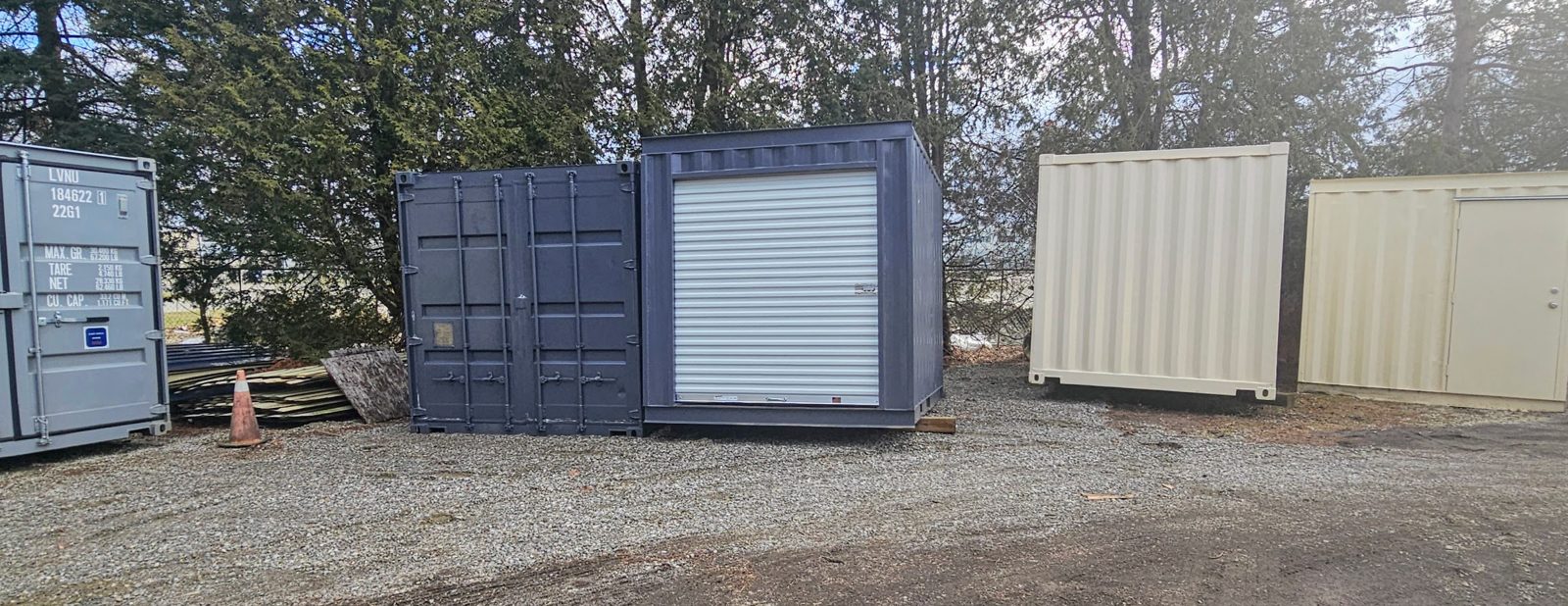
    Toll-free: 1-888-509-6658
    Family-owned and operated since 1995. Thirty years in Ontario shipping containers, four Brantford yards, 200-plus boxes in inventory.

    Driving directions to our Brantford yard

    Related Reading

  • 40ft High Cube Dry Container

    40ft High Cube Dry Container

    Quick Answer

    A 40ft High Cube dry container is the most-built container in the world and the most-purchased size for residential container-home conversions, workshop builds, and pallet-stacked storage in Canada. ISO 45G1 standard, 39 feet 5 inches long internally, 7 feet 8 inches wide, and 8 feet 10 inches tall (a full foot taller than a standard 40ft), holds 2,700 cubic feet of interior volume, weighs 8,775 pounds empty, and carries up to 58,335 pounds of cargo. We stock 40HC units in One-Trip and Cargo Worthy grades at our Brantford yards, honest per-order quotes, including a side-by-side against the standard 40. Delivery in 1 to 3 business days across Ontario.

    One-trip 40-foot high cube shipping container seen from the door end

    The 40ft High Cube is the workhorse of the global container fleet. Roughly 60 percent of new containers built worldwide since 2018 have been 40HCs rather than standard 40s, because the one-foot-taller interior unlocks pallet-stacking applications, residential conversion possibilities, and equipment-mounting clearances that the standard 8 foot 6 inch external box cannot support. Nearly all of those conversion builds begin with a One-Trip shell fresh off its first and only ocean voyage, since the steel underneath decides how the finished project weathers. In our Brantford yard, the 40HC is the size we sell to almost every container-home builder, every pallet-rack 3PL, every commercial workshop with overhead hoist or lift requirements, and a growing share of residential ADU and granny-suite buyers.

    The 40HC and the standard 40ft share the same external footprint. Same length (40 feet), same width (8 feet), same pallet count single-layer, same delivery access requirements. The only physical difference is one foot of additional height, raising the external from 8 feet 6 inches to 9 feet 6 inches, and the internal from 7 feet 10 inches to 8 feet 10 inches. That one foot transforms what the container can do. A 5-foot-2-inch person walks under an 8-foot-10 ceiling without thinking about it. The same person ducks slightly under a 7-foot-10 ceiling. For any conversion where humans spend extended time inside (offices, homes, workshops), the HC is the right call.

    This page covers the real specifications, the four grades we stock, the honest 2026 pricing, the use cases that make the HC the better buy than a standard 40, and how delivery works from our Brantford yard. We are family-owned, in business since 1995, and we let you walk our 200-plus container inventory before any payment changes hands.

    40HC Container Specifications, ISO 45G1 Standard

    MeasurementImperialMetric
    External length40 ft 0 in12.192 m
    External width8 ft 0 in2.438 m
    External height (HC)9 ft 6 in2.895 m
    Internal length39 ft 5 in12.032 m
    Internal width7 ft 8 in2.350 m
    Internal height (HC)8 ft 10 in2.695 m
    Door opening width7 ft 8 in2.340 m
    Door opening height (HC)8 ft 5 in2.575 m
    Internal volume2,700 cu ft76.4 m³
    Tare weight (empty)8,775 lb3,980 kg
    Maximum payload58,335 lb26,460 kg
    Maximum gross weight67,200 lb30,480 kg
    ISO 6346 size + type code45G1 (40ft, 9′6″ high-cube, general-purpose)

    The size-type code 45G1 is the global identifier for a 40-foot high-cube dry container. The number 4 designates 40-foot length, the 5 designates the 9-foot-6-inch height (the high cube), and G1 designates general-purpose dry construction with closed sides. Every 40HC we sell carries this code stamped on the side panel and a CSC plate on the cargo doors confirming ocean-transport certification.

    The Extra Foot, and Why It Matters

    The single most important fact about a 40HC compared to a standard 40 is that one foot of vertical space changes what the container can be used for. Below are the specific applications where the HC is the right buy and the standard 40 is not.

    Pallet stacking. A standard 40 holds 20 to 21 pallets in a single layer. A 40HC holds the same 20 to 21 pallets in a single layer AND can stack a second layer on top of stackable cargo, doubling the effective pallet capacity to 40 to 42. For any 3PL, overflow warehouse, or distribution operation that uses pallet racking, the HC is the only viable choice.

    Residential conversion. Container home and ADU builds use the 40HC as the base structural shell because the 8-foot-10 interior ceiling reads as a normal home ceiling height after insulation, drywall, and finished flooring eat about 6 to 10 inches of height. A standard 40 ends up with a 7-foot-or-shorter interior ceiling after the same finishing, which feels oppressive. Two stacked 40HCs form a 1,500-square-foot two-storey unit with 8-foot finished ceilings throughout.

    Workshop with overhead equipment. Mechanic shops with engine hoists, welding shops with overhead trolleys, woodworking shops with dust-collection ducting, and cabinet-making shops with stacked storage racks all need the HC’s extra clearance. A 2-ton chain hoist mounted to a top rail in a 40HC has 5 to 6 feet of working height below it. The same hoist in a standard 40 has 4 feet, which is below what most lift operations need.

    Climate-control conversion. Container offices, classrooms, and crew quarters that install ductwork, drop ceilings, and recessed lighting need the HC because the finished interior ceiling needs to be 8 feet or higher for occupancy comfort and code-friendly construction.

    “The HC versus standard 40 is one of the easiest conversations in the yard. If the box is going to hold cargo on pallets, it is an HC question. If a person is going to walk into the box on a regular basis (workshop, office, home), it is an HC question. If neither of those applies, the standard 40 is the smarter buy, and skipping the high-cube premium is real money. We do not push the HC when the use case does not justify it.”

    Christian LeBlanc, second-generation operator, Van Blanc Ent. Inc.

    40HC Container Grades We Stock

    GradeWhat It IsBest 40HC Use Cases
    One-TripEssentially new. Single voyage from Asia. Paint clean, doors tight, no rust.Container homes and ADUs. Premium workshop conversions. Customer-visible commercial placements. Premium retail-display kiosks.
    Cargo Worthy (CW)Used 8 to 15 years. CSC re-cert valid. Wind and water tight. Surface rust on exterior acceptable.3PL pallet-rack storage. Multi-bin contractor yards. Working agricultural use. Industrial workshop conversions where exterior is painted over.
    Wind and Water Tight (WWT)Used 12+ years. Roof and floor sealed. CSC may be expired. Heavier exterior rust.Long-term static pallet storage. Equipment-yard overflow. Where appearance does not matter.
    As-IsSpecific repair scope disclosed in writing.Heavy modification builds. Container home projects where the shell will be extensively cut and re-skinned.

    The 40HC carries a real premium over the equivalent grade in standard 40ft. The premium tracks the cost of building a 9-foot-6-inch container versus the standard 8-foot-6-inch frame at the original manufacturing point. For applications where the extra height is the reason you are buying, the premium pays itself back in usability.

    Six Most Common 40HC Container Use Cases

    1. Residential container home base structure

    The 40HC is the most-used size for residential container-home construction in Canada. A single 40HC at grade builds a 320-square-foot studio ADU. Two stacked 40HCs form a 1,500-square-foot two-storey home. Three or four 40HCs welded side-by-side form a 1,200-to-1,800-square-foot ranch-style residence. Container-home builders we work with across Ontario specify 40HC One-Trip almost exclusively because the finished aesthetic justifies the premium.

    2. 3PL pallet-rack overflow storage

    3PLs along the 401 industrial corridor (Mississauga, Brampton west, Milton, Pickering east, Whitby) use 40HC Cargo Worthy units for pallet-rack overflow when the permanent warehouse is full. Two-stack pallet racking inside a 40HC handles 40 standard pallets per box. Multi-bin orders are common, four to ten 40HCs per 3PL site.

    3. Commercial workshop and small-manufacturing conversion

    Automotive repair shops, welding shops, woodworking shops, and small fabricators convert 40HC One-Trip or CW units into permanent workshop facilities. ESA-certified electrical, insulation, HVAC mini-split, finished interior, and exterior paint. About 305 square feet of interior floor space with an 8-foot-10 unfinished ceiling. The extra ceiling clearance makes overhead-equipment installation practical. Automotive buyers put the same 45G1 shell to work in transit as well; two sedans loaded nose-to-tail for overseas shipment fit a 40HC with room left over for spares and accessories.

    4. Office, classroom, or crew-quarters conversion

    Construction site offices, modular classrooms, mining-camp crew quarters, and remote-work studios convert 40HC units into livable interior space. Drop ceilings, recessed lighting, HVAC ductwork, and code-friendly construction all fit within the HC envelope. ESA-certified electrical, insulation to R-25, finished drywall interior.

    5. Large retail kiosk or pop-up storefront

    40HC units with a full-front roll-up door cut form a 320-square-foot retail pop-up space, large enough for a coffee shop, food kiosk, or seasonal retail outlet. One-Trip grade and painted in brand colours, the HC provides a customer-visible commercial space with proper ceiling height for retail merchandising.

    6. Container art gallery, studio, or maker space

    Artists, photographers, ceramicists, and maker-space operators convert 40HC One-Trip units into backyard or commercial studios. The extra height accommodates skylights, north-facing window cutouts for painter light, and large-format printing or photography equipment. Customer-installed cedar-cladding on the exterior is common for residential placement.

    Real 2026 Pricing for a 40HC Container Landed in Ontario

    Quote the high cube against the standard

    The extra foot of height either earns its premium for your build or it does not. Tell us what is going inside and we will quote the 40HC and the standard 40 side by side, so the decision is made on your use case, not on a sales pitch.

    Quotes hold 14 days. Honest 2026 numbers. Multi-bin discounts deepen at five and ten units. The HC premium over standard 40 is built into the base pricing above.

    Delivery and Placement of a 40HC

    The 40HC ships on the same tilt-deck truck as a standard 40ft. The driver needs about a 90-foot straight-line approach to the drop spot, a foot of clearance on each side, and about a 35-foot turning radius to maneuver into position. The container will be approximately 13 feet tall on the trailer during transport (trailer deck height plus 9-foot-6 container), so overhead clearance under bridges, low-hanging branches, and overhead utility wires becomes a consideration on rural Ontario delivery routes. Our drivers know the Ontario corridor and route around the known low-clearance bridges.

    For permanent placement of a 40HC, concrete piers below the frost line at the four corner castings is the right call, particularly for container-home, two-stack residential, and commercial workshop installations where the structure will be in place for 25 years or more. For temporary or jobsite placement, packed gravel direct-on-grade is fine for build cycles under 18 months.

    We send a Google Earth pre-check for any 40HC delivery where overhead clearance or approach access is unclear. If the access requires a roadside drop and crane-lift to the final position, we coordinate with a local crane operator and add the crane fee separately to the quote.

    The 1,000 Dollar Facebook Container Scam Aimed at 40HC Buyers

    40HC One-Trip is the most-targeted product in the Ontario container-scam ecosystem because the price point leaves room for the scammer to offer half-market pricing and still trap meaningful deposit money. The pattern is identical every time. A listing offers a 40HC One-Trip at $3,200 or a 40HC CW at $1,800. The seller claims to be in Toronto, Vaughan, or Hamilton, says delivery is included, and asks for an e-transfer deposit of $1,000 to hold the unit. The container does not exist. The seller account disappears within 48 hours of the deposit clearing.

    The simplest defence is to come walk our Brantford yard before you pay anything. We have 200-plus containers in stock at any time, including a steady inventory of 40HC One-Trip and CW units. You can read the CSC plate, check the cargo doors, inspect the interior, verify the 9-foot-6 external height, and pick the physical box you are buying. No supplier in Ontario whose price is half of market is going to let you inspect before payment because there is no inspection to do. The container is not there. Our policy is no deposit on phantom inventory.

    Frequently Asked Questions

    What is the difference between a 40ft High Cube and a standard 40ft container?

    The High Cube is one foot taller. External height 9 feet 6 inches versus 8 feet 6 inches. Internal height 8 feet 10 inches versus 7 feet 10 inches. Same external length and width. Internal volume 2,700 cubic feet versus 2,390 (about 13 percent more space). The high-cube premium over the equivalent standard-40 grade is modest; ask for the side-by-side quote and judge it against your use case.

    Why is the 40HC the preferred size for container home conversions?

    The extra foot of interior height means that after insulation, drywall, and finished flooring (which together eat about 6 to 10 inches of vertical space), the finished interior ceiling is still approximately 8 feet. A standard 40 finishes to a 7-foot or shorter ceiling, which feels oppressive in a livable space. The 40HC is the residential conversion default for any container build where humans will live or work inside long-term.

    How much does a 40HC container cost in Ontario in 2026?

    From Van Blanc in Brantford, 40HC pricing is quoted per order, and we always quote it beside the standard 40 so you can see exactly what the extra foot costs for your grade. One-Trip, Cargo Worthy, and WWT all carry the high-cube premium; whether it earns its keep depends on what you are stacking. All-in quotes, delivery included, usually same-day.

    Can a 40HC be stacked into a two-storey container home?

    Yes, this is one of the most common 40HC use cases for residential construction in Ontario. Two stacked 40HC One-Trip units form a 1,500-square-foot two-storey home with 8-foot finished ceilings on both floors after insulation. Stacking requires engineering review by a professional engineer (P.Eng.) and concrete pier foundations below frost line for the four ground-floor corner castings. The stacking ISO rating of a single container is rated for 192 metric tonnes of stack load, so the two-stack configuration is well within the structural envelope.

    Does the 40HC require special delivery considerations versus a standard 40?

    The same tilt-deck truck delivers both. The 40HC will sit approximately 13 feet tall on the trailer during transport, so overhead clearance under low bridges, low-hanging branches, and overhead utility wires becomes a consideration on rural routes. Our drivers know the Ontario corridor and route around known low-clearance points. For sites with overhead access constraints, we coordinate a roadside drop and crane-lift to the final position.

    How many pallets can a 40HC hold compared to a standard 40?

    Same single-layer pallet count: 20 to 21 standard North American 40×48-inch pallets, or 23 to 24 Euro pallets at 1200 by 800 mm. The HC’s value comes from double-stacking. With stackable cargo and proper racking, the HC holds 40 to 42 NA pallets or 46 to 48 Euro pallets in a double-stack configuration. Standard 40ft cannot accommodate stable double-stacking at this density because the ceiling clearance is insufficient.

    What foundation does a 40HC container need?

    For temporary placement under 18 months, packed gravel direct-on-grade. For long-term residential or two-stack placements, concrete piers below the frost line (1.2 metres in southern Ontario) at the four corner castings. For container-home foundations specifically, an engineer-stamped pier or screw-pile foundation plan is the standard, with P.Eng review for any stacked configuration. The container bears weight on the four corner castings only, never the entire floor area.

    Do you stock 40HC containers at your Brantford yard?

    Yes. We carry 40HC One-Trip and 40HC Cargo Worthy at all times across our four Brantford yards. WWT and As-Is grades vary by season and supply. We typically hold 15 to 30 40HC units in inventory at any given time. Phone or email for current availability and any specific grade or condition requirements.

    How does Van Blanc compare to BigSteelBox for a 40HC order?

    BigSteelBox is a national franchise with central dispatch. Lead times typically 2 to 4 weeks, pricing higher on equivalent grades, and you do not see the physical box before it lands. Van Blanc is family-owned, four Brantford yards, 1 to 3 day lead times, walk-the-yard inventory inspection. BigSteelBox is a legitimate business; the difference is structural. We are the local independent option for Ontario 40HC buyers.

    Do you offer rent-to-own on 40HC containers?

    Yes. Rent-to-own structures the cost as monthly payments that build equity. After 24 to 36 months the container is yours. Useful for container-home builders spreading capital across a build cycle and for commercial buyers running an extended use that may convert to permanent ownership.

    Sources

    Placement requirements vary by municipality. A quick call to your local planning office before delivery is the easiest way to confirm what works for your property.

    Reach Van Blanc in Brantford

    Van Blanc Ent. Inc.
    90 Morton Ave. East, Unit 1-B, Brantford, ON N3R 7J7
    Cell: 519-754-6844
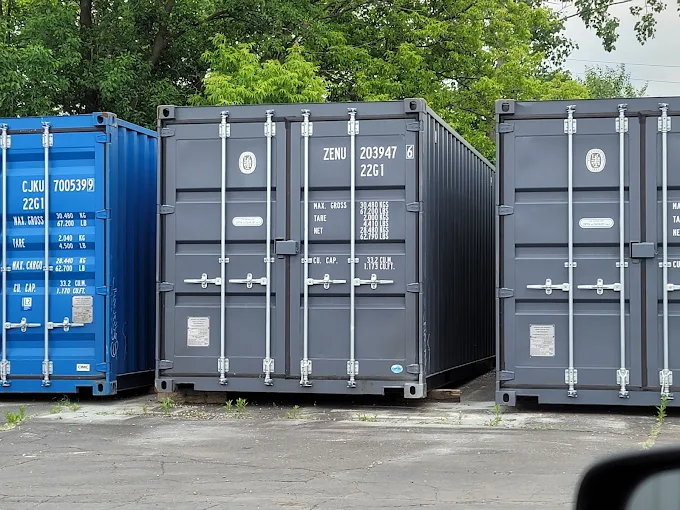
    Toll-free: 1-888-509-6658
    Family-owned and operated since 1995. Thirty years in Ontario shipping containers, four Brantford yards, 200-plus boxes in inventory.

    Driving directions to our Brantford yard

    Related Reading

  • 40ft High Cube Refrigerated Container

    40ft High Cube Refrigerated Container

    Quick Answer

    A 40ft High Cube refrigerated container (40HC reefer) is the workhorse of regional cold-chain operations. ISO 45R1 standard, 11.58 m internal length (38 feet), 2.29 m wide, 2.55 m tall (8 feet 4 inches interior), holds 67 cubic metres (2,366 cu ft), tare 4,575 kg, max payload 29,425 kg. Carrier or Thermo King refrigeration unit, 30-amp 240-volt continuous draw, temperature range -30 to +30 Celsius. We stock both Cargo Worthy and One-Trip 40HC reefers at our Brantford yards. Honest per-order CAD quotes, scoped to your cold-chain and your site power. Delivery in 1 to 3 business days across Ontario for in-stock units.

    The 40HC reefer is roughly two and a half times the cargo volume of a 20ft reefer at twice the price. For operations where the use case actually fills 67 cubic metres, the 40HC is the economical choice on a per-cubic-foot basis. For operations that genuinely need less than 30 cubic metres of refrigerated space, the 20ft reefer is the smarter buy and the conversation we always have during the quote. First-time reefer owners usually have a second question about winter operation, and our notes on how the defrost cycle holds set-point through a cold snap answer most of it.

    Buyers calling about 40HC reefers in our service area fall into five main categories: regional cold-storage operations serving multi-county distribution, federally licensed cannabis cultivators expanding flowering or post-harvest cure capacity, larger Holland Marsh growers staging full-truckload harvest overflow, food banks operating regional distribution hubs, and mid-sized food-service groups (multi-location restaurants, catering operations serving large-venue work). Each application has slightly different temperature, humidity, and access-control requirements, and the 40HC reefer’s larger envelope provides the working volume to handle them with proper airflow and stacking room.

    40HC Reefer Specifications, ISO 45R1 Standard

    MeasurementImperialMetric
    External length40 ft 0 in12.192 m
    External width8 ft 0 in2.438 m
    External height (High Cube)9 ft 6 in2.895 m
    Internal length (cargo zone)38 ft 0 in11.583 m
    Internal width7 ft 6 in2.294 m
    Internal height8 ft 4 in2.548 m
    Door opening width7 ft 6 in2.294 m
    Door opening height8 ft 3 in2.520 m
    Internal volume2,366 cu ft67.0 m³
    Tare weight (with refrigeration unit)10,082 lb4,575 kg
    Maximum payload64,857 lb29,425 kg
    Maximum gross weight74,956 lb34,000 kg
    Temperature range-22°F to +86°F-30°C to +30°C
    Electrical (continuous)30 A @ 240 V single-phase, 3-pole 4-wire plug (NEMA L15-30) or 16 A @ 480 V three-phase commercial
    Insulation80-100 mm polyurethane foam, U-value below 0.4 W/m²K
    FloorT-bar aluminium air-channel decking
    Interior liningStainless steel (food-grade)
    ISO 6346 size + type code45R1 (40ft, 9′6″ high-cube, refrigerated)

    The code reading: 4 for 40-foot length, 5 for 9-foot-6-inch height (high cube), R for refrigerated with integral unit, 1 for closed-side door configuration. The R1 designation specifies an integrated refrigeration unit with its own monitoring and control electronics (versus an R2 which is a “porthole” style requiring external refrigeration plant). Every 45R1 we sell carries a CSC plate confirming ocean-shipping certification.

    How a 40HC Reefer Differs from a 20ft Reefer

    The 40HC reefer is the same envelope concept as the 20ft reefer (insulated steel box with integrated refrigeration unit at the front), scaled up to roughly 2.5 times the cargo volume. Three practical differences worth knowing:

    1. Volume per dollar favours the 40HC. A 40HC reefer carries roughly two and a half times the cargo volume of a 20ft reefer, while the landed quote is nowhere near two and a half times higher, so volume per dollar strongly favours the bigger unit. If your application can fill the volume, the 40HC is 38 percent cheaper per cubic metre of refrigerated space.

    2. Multi-zone cooling becomes practical. The 40HC’s longer cargo zone allows partition walls to create two or three independently controlled temperature zones inside one container. Most Ontario cannabis cultivators using 40HC reefers run a two-zone configuration (cure room at 15-18°C + dry-storage room at 4°C). The 20ft reefer is too short for practical multi-zone partitioning.

    3. Power requirements are similar but cycle harder. The 40HC reefer pulls the same 30-amp 240-volt continuous draw as the 20ft, but the compressor runs at a higher duty cycle to maintain temperature across the larger cargo volume. Annual electricity cost runs roughly 1.4 to 1.7 times what a 20ft reefer consumes under equivalent ambient and set-point conditions (not double, because the larger thermal mass actually moderates short-cycle losses).

    “The 40HC reefer is the size we sell to operations that are scaling, not starting. First-time cannabis cultivators or first-time brewery owners almost always do better with a 20-footer to validate the cold-chain requirements before they commit to the 40HC’s larger capital line. Scale-up customers who already know they need 60 cubic metres of refrigerated space, year-round, on a long-term basis, that’s when the 40HC math makes sense and we ship it without hesitation.”

    Paul LeBlanc, owner, Van Blanc Ent. Inc.

    40HC Reefer Grades We Stock

    GradeWhat It IsBest Use Cases
    One-TripEssentially new. Single voyage from Asia. Refrigeration unit under 5,000 hours. Factory-fresh insulation, gaskets, doors.Cannabis cultivation facilities (multi-zone). Pharmaceutical cold-chain. Regional food-distribution hubs. Customer-visible commercial reefers where appearance and reliability both matter.
    Cargo Worthy (CW)Used 8 to 15 years. Refrigeration unit recently serviced. CSC re-certified. Surface rust on exterior steel acceptable. Refrigeration hours 30,000 to 60,000.Holland Marsh harvest overflow. Brewery long-run cellars. Food bank distribution. Multi-location restaurant cold storage. The default 40HC reefer for working operations.
    Wind and Water Tight (WWT)Older unit (15+ years). Refrigeration may have had a recent compressor or condenser rebuild. Insulation intact. Heavier exterior rust.Above-zero only operations (4-12°C) where the refrigeration unit does not have to work hard. Long-term seasonal storage where appearance does not matter.
    As-IsRefrigeration unit non-functional or removed. Insulation envelope intact.Custom cooling system retrofits. Large insulated workshops or workshops needing thermal stability. Container homes wanting deep insulation envelope.

    The quote lands the unit at your site: reefer plus delivery priced by distance and access, stated together up front. Multi-bin orders get a per-box discount on delivery starting at three units. Electrical installation paid separately to a licensed Ontario electrician (typical range $1,800 to $4,500 for commercial 30-amp 240V or 480V three-phase service).

    Six Common 40HC Reefer Use Cases in Ontario

    1. Federally licensed cannabis cultivation expansion

    Health Canada licensed cannabis facilities scaling beyond their initial vegetative or flowering room footprint use 40HC reefers as additional grow rooms (single or multi-zone), post-harvest cure rooms (15-18°C, 60-65% RH for 30-60 days), and finished-product cold storage. The 40HC’s longer envelope allows independent zone partitioning for cure-then-dry-then-trim workflow within one container. Multiple Ontario cannabis cultivators have built phased expansion strategies around modular 40HC reefer additions to their existing facility footprint.

    2. Regional food distribution hubs

    Multi-location restaurant groups, catering distribution operations, and small-scale specialty distributors (gourmet, ethnic, organic) use 40HC reefers as regional cold-chain hubs serving 8 to 15 outlets within a 200-kilometre radius. The 40HC’s 67 m³ volume holds roughly 24 to 28 standard reach-in’s worth of inventory at multi-temperature zones.

    3. Holland Marsh full-truckload harvest staging

    Larger Holland Marsh vegetable operations (carrots, onions, celery at scale) running full-truckload outbound shipments need cold-buffer capacity sized to a 53-foot truck-trailer load. A 40HC reefer holds approximately one truckload of palletised produce at 4°C, providing 24-72 hours of holding time between field harvest and outbound truck departure. Multi-bin orders of 2 to 5 40HC reefers are common at the larger Holland Marsh operations.

    4. Brewery distribution and aged-beer warehousing

    Mid-sized Ontario craft breweries (10,000+ hL annual production) and barrel-aging beer programs use 40HC reefers for fermented-beer warehousing at 0-4°C, sour-program barrel storage at 15-18°C, and chilled distribution loading docks. The 40HC’s larger envelope accommodates full pallet racks of 750ml bottles or 30-litre kegs at proper conditioning temperature.

    5. Food bank regional distribution

    Food Banks Canada member operations and regional food-rescue organizations (Second Harvest, smaller affiliates) use 40HC reefers as mobile cold-chain capacity expansion during peak donation cycles (post-harvest, holidays, disaster-response). The 40HC’s longer envelope holds roughly 20-25 pallets of mixed refrigerated and frozen donations at multi-zone temperature.

    6. Pharmaceutical and specialty cold-chain

    Smaller pharmaceutical distributors, specialty veterinary supply operations, and biotech cold-chain serving the GTA innovation corridor use 40HC reefers as either temporary expansion capacity during facility construction or as permanent cold-room replacements that move with operations. Temperature stability documentation and access control are critical; we provide unit specifications and refrigeration-service history matching standard pharmaceutical-grade quality assurance requirements.

    Multi-Zone Cooling, Practical Notes

    The 40HC reefer’s 38-foot interior cargo length supports two or three independently controlled temperature zones with a partition wall. Common configurations we deliver:

    Two-zone cure-and-dry for cannabis: Front zone (closest to refrigeration unit) at 15-18°C / 60-65% RH for post-harvest cure (30-60 days). Rear zone at 4-8°C for finished-product cold storage. Partition wall is insulated and includes a small air-balance port to maintain zone integrity while the single refrigeration unit serves both zones via duct work.

    Two-zone refrigeration-plus-freezer for food distribution: Front zone at 4°C for refrigerated produce and dairy. Rear zone at -18°C for frozen items. Some Daikin units support dual-temperature setpoints natively; others require a separate add-on freezer module retrofitted into the rear zone.

    Three-zone specialty for high-margin operations: Front zone at 18°C (room temperature controlled), middle zone at 4°C, rear zone at -18°C. Used for operations needing transitional thermal control across multiple product categories. Requires custom HVAC retrofit; not a standard delivery configuration.

    Partition walls are quoted per build; insulation thickness, door inclusion, and air-balance ducting set the scope. We do not install partitions ourselves; we deliver the bare 40HC reefer and refer the partition build to local refrigeration contractors or container modification specialists.

    Real 2026 Pricing for a 40HC Reefer Landed in Ontario

    Cold chain, quoted to your dock

    Forty-foot reefers are working machines, and the right one depends on your product, your turnover, and your power. Send us the use case and the site, and the quote comes back with the unit, the delivery, and the runtime expectations in plain language.

    Quotes hold 14 days. Honest 2026 numbers. The bare reefer is what we sell; electrical installation is paid to a licensed Ontario electrician separately. Multi-zone partition builds are a separate scope of work paid to a refrigeration contractor or container modification specialist.

    The 1,000 Dollar Facebook Scam, 40HC Reefer Edition

    40HC reefer Facebook Marketplace scams are less common than the 20ft variety because the price point ($25,000 to $50,000) is too high to plausibly half-discount, but they do happen on the lower end. Listings claim 40HC CW reefers at $4,500 or 40HC One-Trip reefers at $8,000, with the same Toronto/Vaughan/Hamilton seller claim and $1,000 deposit ask. The reefer does not exist.

    Defence: come walk our Brantford yard. We hold 1 to 3 40HC reefers in stock at any given time and can show you the refrigeration unit running, the temperature display reading, the interior stainless-steel lining, gasket condition, T-bar floor structure, and refrigeration hours-of-use. No supplier in Ontario whose price is one-tenth of market is going to start the refrigeration unit for you to inspect, because there is no unit to start. Our policy is no deposit on phantom inventory.

    Frequently Asked Questions

    What is the difference between a 40HC reefer and a 20ft reefer?

    The 40HC reefer is roughly 2.5 times the cargo volume of a 20ft reefer at about 1.6 times the price. Internal volume 67 m³ versus 27.7 m³. Same temperature range (-30 to +30°C), same Carrier/Thermo King/Daikin refrigeration unit families, same 30-amp 240-volt continuous draw (the 40HC’s compressor cycles harder due to larger cargo zone). The 40HC supports multi-zone partitioning and is the economical choice on a per-cubic-metre basis if your operation can fill the volume. The 20ft is the right call if you need under 30 cubic metres of refrigerated space.

    How much does a 40HC reefer cost in Ontario in 2026?

    From Van Blanc in Brantford, 40HC reefer pricing is quoted per order. Grade, machinery hours, and service history drive the number more than the box itself, which is why we quote with the condition report attached. Tell us your product, turnover, and site power and the all-in quote covers the unit, delivery to your dock or pad, and runtime expectations in plain language.

    Can a 40HC reefer hold multiple temperature zones at once?

    Yes, with a partition-wall installation. Two-zone configurations are most common (cannabis cure plus dry storage, refrigeration plus freezer, conditioning plus distribution). Three-zone is possible with custom HVAC retrofit. Partition walls are quoted per build, with insulation and ducting complexity setting the scope. We deliver the bare 40HC reefer; the partition build is paid separately to a refrigeration contractor or container modification specialist familiar with multi-zone cold-chain installations.

    How much electricity does a 40HC reefer consume?

    Continuous draw is the same 30 amps at 240 volts single-phase as a 20ft reefer, but the compressor cycles at a higher duty rate to maintain temperature across the larger 67 m³ cargo volume. Annual Ontario electricity cost runs approximately $2,500 to $5,000 for above-zero operations (most applications), $5,000 to $8,500 for below-zero (frozen storage). The actual cost depends heavily on ambient temperature, set-point, cargo thermal mass turnover, and door-open cycle frequency.

    What refrigeration unit brand is on the 40HC reefer I’m buying?

    We disclose the make, model, and approximate hours-of-use on every reefer during the quote conversation. Common brands are Carrier Transicold (PrimeLINE family), Thermo King (MAGNUM PLUS family), and Daikin (ZESTIA family). All three have parts and service networks in Ontario. The unit in your specific reefer depends on what we have in stock the week you order. For applications where brand-specific reliability matters (cannabis, pharmaceutical, regulated food-service), we recommend a pre-purchase inspection by a licensed refrigeration technician.

    How long does delivery take from your Brantford yard?

    One to three business days for in-stock units. We typically hold 1 to 3 40HC reefers on our Brantford yard at any time. If your specific grade and configuration is not in stock, we source-to-order with a 2 to 4 week lead time. The lower standing inventory for 40HC reefers (compared to 20ft reefers) is because the larger unit moves slower in the used market; we do not over-stock the inventory and tie up capital.

    What foundation does a 40HC reefer need?

    Same as a standard 40HC dry container for static placement, with attention to the heavier tare weight (10,082 pounds for the reefer versus 8,775 for the dry HC). For temporary placement under 18 months, packed gravel direct-on-grade. For long-term commercial or pharma placements, concrete piers below the frost line at the four corner castings, designed for the higher loaded weight (up to 34,000 kg fully loaded). The pad must accommodate the cable run from the reefer’s electrical plug to the site outlet.

    How does Van Blanc compare to BigSteelBox for a 40HC reefer order?

    BigSteelBox primarily sells dry containers; they may rent 40HC reefers but typically do not sell them outright in our service area. Other Ontario reefer suppliers (Storstac, regional refrigeration-specialty dealers, container resellers in the GTA) sell 40HC reefers, often at higher per-unit pricing with longer lead times. Van Blanc carries a standing 40HC reefer inventory at our Brantford yards with 1 to 3 day delivery on in-stock units, transparent refrigeration-unit hours-of-use disclosure, and walk-the-yard inspection before purchase. We are the local independent option for Ontario 40HC reefer buyers.

    Can a 40HC reefer be used in a Health Canada licensed cannabis facility?

    Yes. Our 40HC reefers meet the temperature-stability, humidity-control, and access-control requirements typical for Health Canada licensed cannabis cultivation, post-harvest cure rooms, finished-product storage, and multi-zone facility expansion. Documentation of unit specifications matching standard cannabis licence application requirements is available on request. We work with several Ontario licensed cannabis operators on phased facility-expansion using 40HC reefers as modular grow-zone additions.

    Do you offer rent-to-own on 40HC reefers?

    Yes. Rent-to-own structures the cost as monthly payments that build equity in the unit. After 24 to 36 months the reefer is yours. Particularly useful for cannabis cultivators spreading capital across a facility-expansion build phase, food banks managing donor-funding cycles, and seasonal food-service operations that want the 40HC for active months only with the option to keep it longer.

    Sources

    Placement requirements vary by municipality. A quick call to your local planning office before delivery is the easiest way to confirm what works for your property.

    Reach Van Blanc in Brantford

    Van Blanc Ent. Inc.
    90 Morton Ave. East, Unit 1-B, Brantford, ON N3R 7J7
    Cell: 519-754-6844
    Toll-free: 1-888-509-6658
    Family-owned and operated since 1995. Thirty years in Ontario shipping containers, four Brantford yards, 200-plus boxes in inventory including a standing inventory of refrigerated containers.

    Driving directions to our Brantford yard

    Related Reading

  • 20ft Refrigerated Container

    20ft Refrigerated Container

    Quick Answer

    A 20ft refrigerated shipping container (reefer) is a thermally insulated steel box with an integrated refrigeration unit at one end, holding cargo at any temperature between -30 and +30 degrees Celsius. ISO 22R1 standard, 5.44 m internal length (17 feet 10 inches), 2.27 m wide, 2.24 m tall, 27.7 cubic metres of internal volume, max payload 27,700 kg. Carrier or Thermo King refrigeration unit, 30-amp 240-volt electrical plug-in for road operation (or genset for off-grid). We stock both Cargo Worthy and One-Trip 20ft reefers at our Brantford yards. Honest per-order CAD quotes, with the power and condition walk-through included. Delivery in 1 to 3 business days across Ontario.

    The 20ft reefer is the smallest refrigerated container in the global fleet and the most-asked-about specialty product on our Brantford yard. Operations that outgrow it step up to the 40ft High Cube reefer, and anyone still mapping cold-chain basics can start with our field guide to refrigerated containers before picking a size. Buyers calling about one usually fall into one of six categories: a florist needing post-harvest cool-down for cut flowers, a craft brewery cellaring fermentation tanks, a mushroom grower running a temperature-stable substrate room, a Holland Marsh vegetable operation staging harvest overflow, a restaurant or food-service group needing seasonal cold-storage expansion, or a Health Canada licensed cannabis facility running climate-controlled cultivation or post-harvest cure rooms.

    Every one of those buyers has the same underlying problem: they need a specific temperature held inside a sealed box, day in and day out, and they want the box on their site within a week. The 20ft reefer solves that. Where it gets complicated is the power source. A reefer pulls 30 amps at 240 volts continuous when the unit is cycling. Most residential properties cannot supply that load without an electrical panel upgrade. Industrial sites with three-phase 480-volt service can plug in directly. Off-grid or temporary sites run a diesel genset. We walk through the power question during every reefer quote because getting it wrong is the most expensive mistake a first-time reefer buyer makes.

    20ft Reefer Specifications, ISO 22R1 Standard

    MeasurementImperialMetric
    External length20 ft 0 in6.058 m
    External width8 ft 0 in2.438 m
    External height8 ft 6 in2.591 m
    Internal length (cargo zone)17 ft 10 in5.440 m
    Internal width7 ft 5 in2.270 m
    Internal height7 ft 4 in2.240 m
    Door opening width7 ft 6 in2.290 m
    Door opening height7 ft 3 in2.210 m
    Internal volume978 cu ft27.7 m³
    Tare weight (with refrigeration unit)6,613 lb3,000 kg
    Maximum payload61,062 lb27,700 kg
    Maximum gross weight67,675 lb30,700 kg
    Temperature range-22°F to +86°F-30°C to +30°C
    Electrical (continuous)30 A @ 240 V single-phase, 3-pole 4-wire plug (NEMA L15-30)
    Insulation80-100 mm polyurethane foam, U-value below 0.4 W/m²K
    FloorT-bar aluminium air-channel decking
    ISO 6346 size + type code22R1 (20ft, refrigerated)

    The R in 22R1 designates “refrigerated” with the refrigeration unit integral to the container. The interior dimensions are smaller than a standard 22G1 dry container because the insulation occupies ~10 cm of wall thickness on all sides, the refrigeration unit takes about 90 cm of length at the front end, and the T-bar aluminium floor adds a few centimetres of structural depth above the steel substrate. Net cargo volume is approximately 27.7 m³ versus 33.2 m³ for the dry equivalent, a 16 percent reduction in payload capacity for the thermal envelope.

    Carrier vs Thermo King vs Daikin Refrigeration Units

    Three brand families dominate the global reefer market. We carry units from all three on our yard at different times. The choice usually comes down to what is available in our standing inventory at the moment of order, but the brand differences are worth knowing.

    BrandStrengthsTypical Find
    Carrier TransicoldLargest installed base globally. Parts and service network in Ontario is strong (Vehcom, Carrier dealers in Mississauga and Hamilton). PrimeLINE family is the modern unit, ThinLINE older. Reliable, well-documented.Most One-Trip 20ft reefers ship with a Carrier PrimeLINE or equivalent.
    Thermo KingStrong in road transport (Thermo King is also the trailer-reefer leader). MAGNUM PLUS family is the modern unit. Slightly higher initial cost, slightly lower running cost. Parts via Maxitrans in Ontario.Common on Cargo Worthy used reefers because Thermo King runs hard and lasts.
    DaikinEngineering-quality Japanese-built units. ZESTIA family is the modern unit. Strong in temperature-stability for sensitive cargo (cannabis, pharma). Smaller installed base in North America.Less common on used inventory; show up periodically.

    For most Ontario buyers (florists, breweries, mushroom growers, restaurants), the brand on the unit matters less than the unit’s hours-of-use history and the local parts availability. We disclose unit make, model, and approximate hours during the quote, and we recommend a pre-purchase inspection by a refrigeration technician if your application demands proven reliability (cannabis, pharma, food-service compliance).

    “The most expensive mistake a first-time reefer buyer makes is forgetting about power. Customer calls in, wants a 20-footer for their backyard brewery cellar, all excited. We deliver the unit, they plug it in, the breaker pops, and now they need an electrician to add a 30-amp 240-volt circuit before they can use it. That conversation has to happen during the quote, not on delivery day. We always ask about the electrical service before the bin leaves Brantford.”

    Christian LeBlanc, second-generation operator, Van Blanc Ent. Inc.

    20ft Reefer Grades We Stock

    GradeWhat It IsBest Use Cases
    One-TripEssentially new. Single voyage from Asia. Paint clean, refrigeration unit under 5,000 hours, doors and gaskets factory-tight.Florist post-harvest cool-down. Cannabis cultivation. Pharma storage. Cellaring breweries where temperature stability matters most. Long-term residential cottage food storage.
    Cargo Worthy (CW)Used 8 to 15 years. Refrigeration unit serviced and CSC re-certified. Insulation intact. Surface rust on exterior steel acceptable. Refrigeration unit hours typically 30,000 to 60,000.Mushroom growing. Holland Marsh harvest staging. Restaurant overflow cold storage. Food bank distribution. The default reefer for working operations.
    Wind and Water Tight (WWT)Older unit (15+ years). Refrigeration may need rebuild or recent rebuild already done. Insulation intact. Heavier exterior rust. Most reefer WWT we sell has had a recent compressor or fan replacement.Above-zero only (4-12°C) operations where the refrigeration unit does not have to work hard. Brewery cellaring, root-cellar replacement, off-grid cabin cold storage.
    As-IsRefrigeration unit may be non-functional or removed entirely. Insulation envelope intact. Suitable for buyers who want to install their own custom cooling system, or for static insulated storage with no active refrigeration.Custom cooling builds. Insulated workshops. Container homes where the thermal envelope matters but mechanical refrigeration is not needed.

    Every reefer quote is landed: the unit at our Brantford yard plus delivery priced by distance and access, stated together in one number. Multi-bin orders get a per-box discount on delivery starting at three units. Installation of a 30-amp 240-volt electrical circuit at the destination site is a separate cost paid to a licensed Ontario electrician (typical range $800 to $2,000 for a residential install, $1,500 to $4,000 for industrial).

    Six Common 20ft Reefer Use Cases in Ontario

    1. Florist post-harvest cold chain

    Cut flowers need 2-4°C within hours of harvest to extend vase life. Wholesale florists serving the GTA, the Toronto Flower Auction supply chain, and Niagara region greenhouse operations use 20ft reefers for on-site cool-down and short-term storage between cutting and shipment. One-Trip grade is typical because cleanliness for product contact matters. Average annual operating cost (electricity) is $1,800 to $3,000 depending on cycle time and ambient temperature.

    2. Craft brewery fermentation cellar

    Lager fermentation requires 8-12°C for two to four weeks. Conditioning runs 0-4°C for another month or longer. A 20ft reefer holds 4-6 stainless fermenters or 8-10 cornelius kegs in conditioning. Cargo Worthy grade is the default because the reefer sits inside the brewery building, exterior aesthetic does not matter. Multiple Ontario craft breweries from Cambridge to Welland run 20ft reefers as fermentation cellars.

    3. Mushroom growing substrate room

    Most commercial mushroom species (button, oyster, shiitake, lion’s mane) require 12-18°C with high humidity (85-95% RH) for fruiting. A 20ft reefer with a humidifier add-on holds the temperature and humidity stable while a separate dehumidifier handles excess moisture during the spawn-run phase. Norfolk County and Wellington County host several Ontario mushroom operations using reefer fleets.

    4. Holland Marsh harvest staging

    The Holland Marsh produces carrots, onions, celery, leeks, and Asian greens at scale. During peak harvest (August through October), permanent cold-storage capacity at the farm fills before the produce can move to the Ontario Food Terminal. A 20ft reefer at the field edge holds harvested product at 4°C for 24 to 72 hours, providing critical buffer time. Multi-bin orders of 3 to 6 reefers per large Holland Marsh operation are routine.

    5. Restaurant and food-service overflow

    Multi-location restaurant groups, catering companies serving large-event venues, and seasonal food-service operations (festival catering, wedding catering, golf course kitchens) use 20ft reefers as portable overflow walk-in cooler capacity. The reefer arrives in 1 to 3 days, plugs in, and provides immediate refrigeration without the construction cost of a permanent walk-in.

    6. Health Canada licensed cannabis cultivation and post-harvest

    Federally licensed cannabis cultivators use 20ft reefers for vegetative-stage propagation rooms (18-20°C, lower humidity), flowering rooms (with custom HVAC retrofit), and post-harvest cure rooms (15-18°C, 60-65% RH for 30 to 60 days). The Health Canada licensing process requires specific documentation of temperature stability and access control; our reefer specifications match what the standard licence application asks for. We work with several Ontario cannabis operators on facility-expansion reefer purchases.

    The Power Question, Solved Three Ways

    Every 20ft reefer needs continuous electrical power to run. There are three ways to provide it in Ontario:

    1. Plug-in to existing site power (most common). The reefer’s 30-amp 240-volt single-phase plug (typically NEMA L15-30 or similar locking-type) connects to a matching outlet at the site. For commercial properties with three-phase 480-volt service, a 60-amp three-phase outlet is the equivalent. Residential properties typically need a dedicated 30-amp 240-volt circuit installed by a licensed electrician ($800 to $2,000 typical cost in Ontario), plus the local utility may require a panel upgrade if the existing service is at capacity.

    2. Diesel genset (off-grid or temporary). A 15-20 kW diesel generator powers the reefer continuously. Fuel consumption runs roughly 1.5 to 2.5 litres of diesel per hour depending on ambient temperature and cycle frequency. Best for remote sites (off-grid cottages, mining camps, remote agricultural operations) or short-term temporary use. Operating cost is significantly higher than grid electricity (roughly 3 to 5 times the equivalent kWh cost).

    3. Solar plus battery (specialty). A 6-10 kW solar array plus 30-40 kWh battery bank can run a 20ft reefer continuously if the duty cycle is favourable (above-zero operation, mild ambient temperature, daylight-heavy season). Capital cost is high (typically $25,000 to $45,000 installed) but operating cost is near zero. Best for permanent off-grid cottage food storage or specialty operations where grid power is not available.

    Real 2026 Pricing for a 20ft Reefer Landed in Ontario

    Reefer quotes include the power talk

    A reefer is a purchase plus an electrical plan. Tell us what you are keeping cold and where it sits, and we will quote the unit and walk you through the power requirement and condition report before you commit a dollar.

    Quotes hold 14 days. Honest 2026 numbers. The bare reefer is what we sell; electrical installation is paid to a licensed Ontario electrician separately, and we recommend getting two quotes from electricians familiar with reefer applications before the reefer arrives.

    The 1,000 Dollar Facebook Reefer Scam

    The 20ft reefer is occasionally targeted by Facebook Marketplace scams, although less frequently than the 20ft or 40ft dry containers because the price point is higher and the scam ask is more conspicuous. Listings claim a 20ft reefer One-Trip at $4,500 or a Cargo Worthy at $2,800, with delivery included from a Toronto, Vaughan, or Mississauga seller. Same $1,000 deposit ask, same disappearing seller account 48 hours after the e-transfer clears. The reefer does not exist.

    Defence: come walk our Brantford yard. We hold reefers in stock and can show you the refrigeration unit running, the temperature display reading, the gasket condition, and the hours-of-use logged on the unit. No supplier in Ontario whose price is half of market is going to start the refrigeration unit for you to inspect, because there is no unit to start. Our policy is no deposit on phantom inventory.

    Frequently Asked Questions

    What temperature range does a 20ft reefer hold?

    The standard range is -30 to +30 degrees Celsius. Most Ontario applications run between +2 and +18 Celsius (florists, breweries, mushrooms, produce, restaurants). Below-zero operation (-18°C for frozen storage, for example) is fully supported by the refrigeration unit but requires the unit to work harder, increasing electrical draw and reducing component life. We disclose the running condition of the refrigeration unit during every quote.

    How much electrical power does a 20ft reefer consume?

    Continuous draw is approximately 30 amps at 240 volts single-phase when the refrigeration compressor is cycling. Cycle frequency depends on ambient temperature, set-point, and cargo thermal mass. Typical Ontario annual electricity cost runs $1,800 to $3,500 for above-zero operation (most applications) and $3,500 to $5,500 for below-zero (frozen storage). Three-phase 480-volt commercial service equivalents are available on some Daikin units.

    How much does a 20ft reefer cost in Ontario in 2026?

    From Van Blanc in Brantford, 20ft reefer pricing is quoted per order by grade and machinery condition: One-Trip for product-contact cleanliness, Cargo Worthy for working cold chain, WWT for above-zero duty with a recently serviced unit. Every quote includes the condition report and the power walk-through, so you know the electrical requirement before you spend a dollar.

    What refrigeration unit brand is on the reefer I’m buying?

    We disclose the make, model, and approximate hours-of-use on every reefer during the quote conversation. Common brands are Carrier Transicold (PrimeLINE family), Thermo King (MAGNUM PLUS family), and Daikin (ZESTIA family). All three have parts and service networks in Ontario. We do not pre-select the brand for you; the unit we have in stock determines what’s available the week you call. For applications where brand-specific reliability matters (cannabis, pharma), we recommend a pre-purchase inspection by a licensed refrigeration technician.

    Can a 20ft reefer run off solar power?

    Yes, with a properly sized solar array (6-10 kW) and battery bank (30-40 kWh) for continuous above-zero operation. Below-zero operation requires significantly more solar capacity due to the higher continuous draw. Capital cost for a solar-plus-battery reefer power system runs $25,000 to $45,000 installed. Best for permanent off-grid applications (Muskoka cottages, remote agricultural operations, off-grid homesteads) where grid power is not available or extending grid service is impractical.

    How long does delivery take from your Brantford yard?

    One to three business days for in-stock units. We typically hold 2 to 4 reefers on our Brantford yard at any time. If your specific grade and temperature spec is not in stock, we source-to-order with a 2 to 4 week lead time. We tell you honestly during the quote whether your unit is in stock or coming in.

    What foundation does a 20ft reefer need?

    Same as a standard 20ft container for static placement: railway ties, pressure-treated 6×6 cribbing under the four corner castings, or concrete piers below the frost line for permanent placement. The 20ft reefer is approximately 1,000 kg heavier than a standard 20ft (refrigeration unit + insulation), but the four corner castings still carry the load. The pad must also accommodate the cable run from the reefer’s electrical plug to the site outlet, typically a 30 to 60 foot run depending on site layout.

    How does Van Blanc compare to BigSteelBox for a 20ft reefer order?

    BigSteelBox primarily sells dry containers and rents reefers; they typically do not sell reefers outright. Other Ontario reefer suppliers (Storstac, regional refrigeration-specialty dealers) sell reefers but often at higher per-unit pricing with longer lead times. Van Blanc carries a standing 20ft reefer inventory at our Brantford yards with 1 to 3 day delivery on in-stock units and honest hours-of-use disclosure during every quote. We are the local independent option for Ontario reefer buyers.

    Can a reefer be used in a Health Canada licensed cannabis facility?

    Yes. Our 20ft reefers meet the temperature-stability and access-control requirements typical for Health Canada licensed cannabis cultivation, vegetative-stage propagation rooms, flowering rooms (with HVAC retrofit for humidity and CO2 management), and post-harvest cure rooms. We work with several Ontario licensed cannabis operators on facility-expansion reefer purchases. Documentation of unit specifications matching the standard licence application requirements is available on request.

    Do you offer rent-to-own on 20ft reefers?

    Yes. Rent-to-own structures the cost as monthly payments that build equity in the unit. After 24 to 36 months the reefer is yours. Particularly useful for seasonal operations (Holland Marsh harvest staging, festival catering) that want the reefer for active months only with the option to keep it longer, and for cannabis cultivators spreading capital across a facility-build phase.

    Sources

    Placement requirements vary by municipality. A quick call to your local planning office before delivery is the easiest way to confirm what works for your property.

    Reach Van Blanc in Brantford

    Van Blanc Ent. Inc.
    90 Morton Ave. East, Unit 1-B, Brantford, ON N3R 7J7
    Cell: 519-754-6844
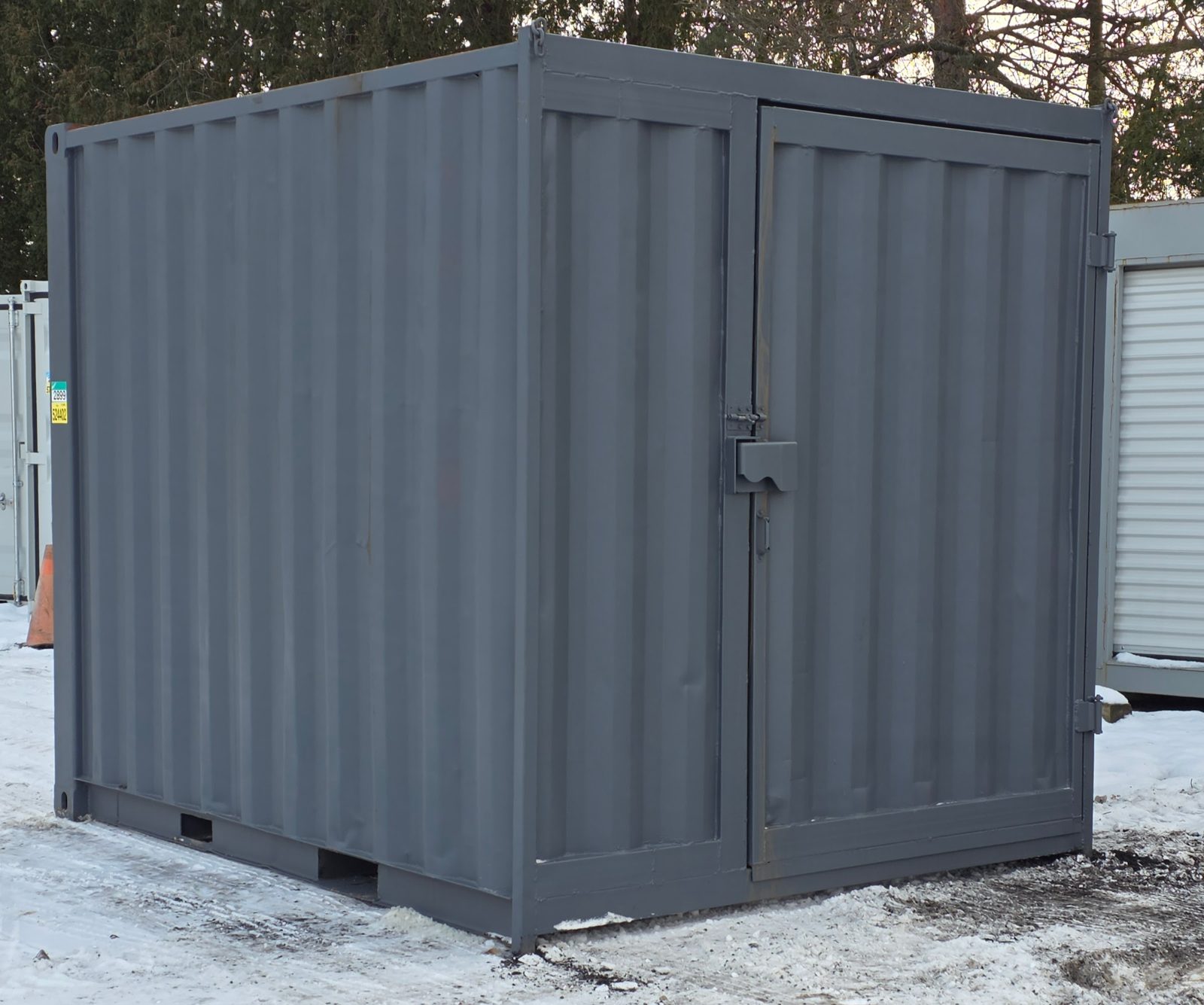
    Toll-free: 1-888-509-6658
    Family-owned and operated since 1995. Thirty years in Ontario shipping containers, four Brantford yards, 200-plus boxes in inventory including a small standing inventory of refrigerated containers.

    Driving directions to our Brantford yard

    Related Reading

Call Get a Quote