
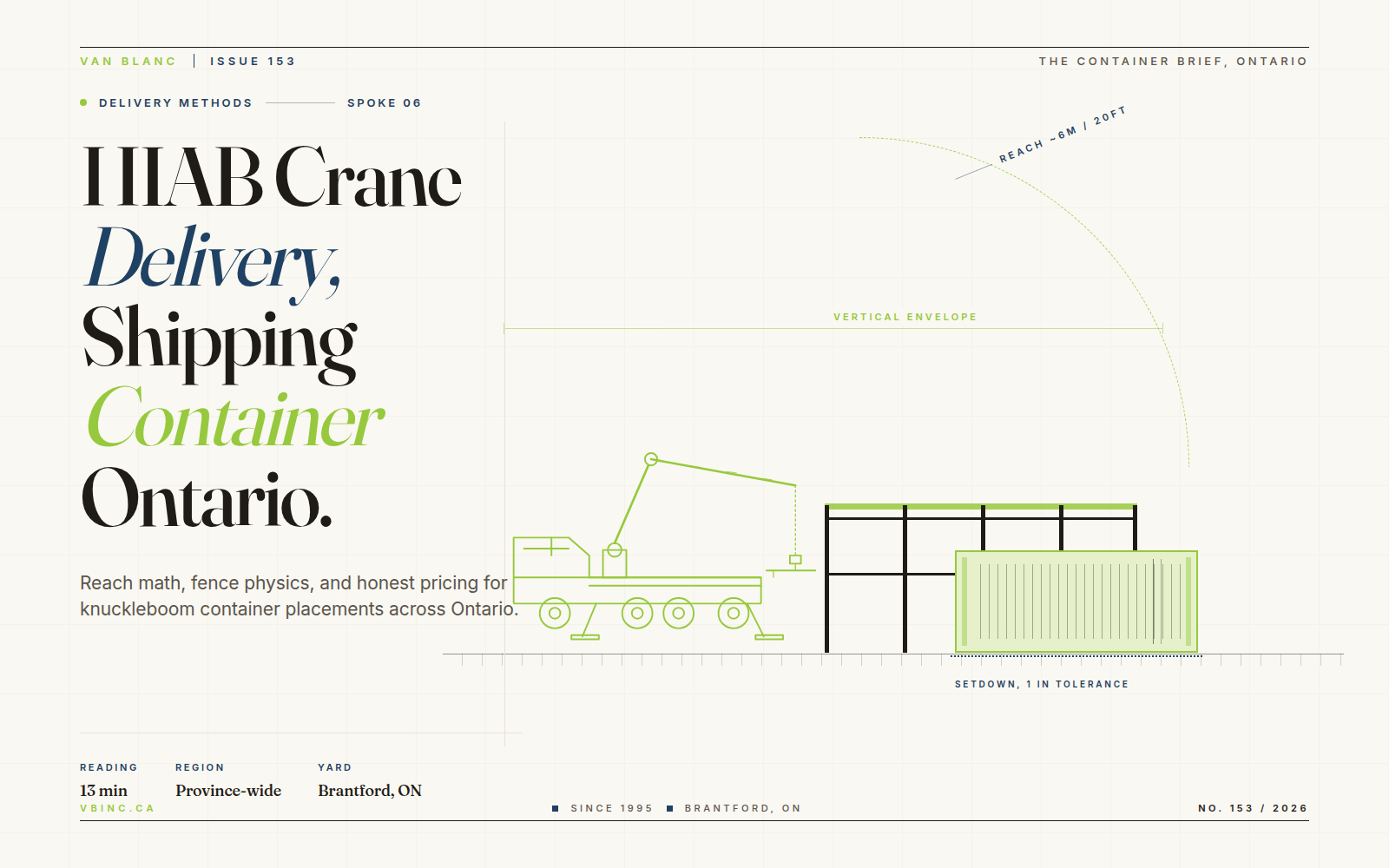
Quick answer. HIAB crane delivery for a shipping container in Ontario reaches 6 to 7 metres (20 to 23 feet) past the truck and clears fences up to 3 metres tall. Local placements and longer Northern routes alike are billed hourly from yard departure, so what you pay tracks the total time the crane truck is out.
Van Blanc has been delivering shipping containers across Ontario since 1995. Empty 20 ft containers are the comfortable working load for a standard truck-mounted knuckleboom; loaded 40 ft units typically exceed the reach-and-stability envelope and need a different rig. Site photographs sent in advance save more delivery days than any other single preparation step. The full reach math, pricing premium, comparison to tilt-deck, and three real Ontario placement stories sit in the sections below, with planning notes the buyer can take to the delivery scheduler. For how every Ontario delivery method compares on cost and site requirements, the main guide to getting a container delivered in Ontario covers the full picture. Real lead times and Cash-on-delivery pricing, quoted to your specific address: call us at 519-754-6844. 30+ years operating, 4.9 stars on 140+ Google reviews. 1-3 day delivery Ontario-wide from our Brantford yards.
In this guide
- Why does HIAB crane delivery exist in the Ontario container business?
- How far can a HIAB knuckleboom actually pick and place a container?
- HIAB or tilt-deck: which delivery method wins on your site?
- Can a HIAB lift a container over your fence?
- How are Ontario HIAB delivery rates built?
- What do real Ontario HIAB placements look like?
- What happens on HIAB delivery day?
- What should you check before you book a HIAB?
- Frequently asked questions
- Reach Van Blanc in Brantford
Reading time: 13 minutes
Why Does HIAB Crane Delivery Exist in the Ontario Container Business?
A HIAB is a truck-mounted knuckleboom crane that picks a shipping container off the trailer and swings it into a spot a tilt-deck truck cannot reach. In Ontario it exists for one reason: many sites are blocked by a fence, a narrow side yard, or planted rows, and the crane lifts the box over the obstacle.
HIAB is a brand name that became the generic Ontario word for a truck-mounted knuckleboom crane, the way “Kleenex” became the word for facial tissue. The company itself is Finnish, founded in 1944, and Atlas Polar brought the first hydraulic truck-mounted HIAB into Canada in 1953. Today most picker trucks rolling around Ontario job sites with a hinged steel arm folded behind the cab are running HIAB, Palfinger, or Hiab-licensed equivalents. Drivers and buyers shorten everything to “the HIAB” or “the picker.”
The reason this matters for the container business is geometry. A tilt-deck truck delivers by reversing the trailer up to a level pad, hydraulically lifting the front of the deck, and winching the container backward off the rails until it sits on the ground. That motion needs a clear straight-line corridor roughly 60 feet long for a 20 ft container and 100 feet for a 40 ft. It needs 12 feet of width and 14 feet of vertical clearance. On a rural farm laneway or an industrial yard with open access, this is the cheapest, fastest, lowest-stress way to place a container.
Many Ontario placement sites are not that. A Toronto driveway might be 18 feet long. A Niagara orchard might be hemmed in by a 6-foot deer fence. A Muskoka cottage path might wrap around a pair of mature pines that close up to 9 feet of vertical clearance. A Brantford east-side backyard might require swinging a container over a board fence, across a rear lawn, and onto a corner gravel pad behind a detached garage. The tilt-deck cannot do any of those. The HIAB can.
Christian LeBlanc, second-generation operator at Van Blanc: “Half the calls we take are people who already tried to book a plain drop-off and found out the truck cannot fit. The HIAB is the answer to a blocked site. I grew up around this trade, working beside my dad from the age of fifteen, and the geometry question is the same every time: where can the truck park, and what is in the way between there and the pad?”
Ontario sites where HIAB is the only real option
Urban GTA infill lots with side yards under 12 feet wide. Niagara vineyard rows planted right to the line. Hamilton escarpment-side properties where the only access angle is across a neighbour’s lawn. Muskoka and Haliburton cottages where the access trail narrows to a footpath before reaching the placement pad. Brantford older neighbourhoods where the back fence is closer to the alley than tilt-deck math allows. These are the sites where customers either pay the HIAB premium or do not get a container.
How Far Can a HIAB Knuckleboom Actually Pick and Place a Container?
A standard truck-mounted knuckleboom has two hinged segments and a hydraulic extension. From the truck side, the operator can reach roughly 6 to 7 metres horizontally for an empty 20 ft container at typical lift weight, which translates to about 20 to 23 feet of side reach. With a lighter pick and a heavy-range crane, manufacturer specs go further, but those are not the standard Ontario yard configuration. For the working math most buyers should use when imagining their delivery, picture a half-circle reaching about 25 feet from the centreline of the truck. The container itself keeps the same standard 20 ft and 40 ft external dimensions regardless of which delivery method moves it, and those measurements drive the geometry the crane has to work.
The vertical reach matters as much as the horizontal. The truck bed sits roughly 6 feet off the ground. The folded boom unfolds upward before extending outward, which means the crane can clear an obstacle of about 3 metres (10 feet) without difficulty as long as the placement is inside the horizontal reach envelope. Past 10 feet of obstacle height, the geometry compresses fast. The arm has to extend higher, which forces the lifting end to travel a longer arc, which reduces the safe working load. A standard house ridge at 20 to 25 feet is outside the working envelope of a typical Ontario container HIAB.
| Crane variable | Standard Ontario container HIAB | Heavy-range knuckleboom |
|---|---|---|
| Maximum side reach (empty 20 ft pick) | 20 to 23 ft (6 to 7 m) | 40 to 60 ft (12 to 18 m) |
| Maximum vertical lift | 16 to 22 ft | 35 to 60 ft |
| Comfortable working load at maximum reach | 4,500 to 6,000 lb | 10,000 lb and up |
| Empty 20 ft container weight | 4,800 lb (2,180 kg) | 4,800 lb |
| Empty 40 ft container weight | 8,400 lb (3,810 kg) | 8,400 lb |
| Practical fence-clearance limit | 10 ft (3 m) | 15 to 18 ft |
| Set-down precision (certified operator) | Within 1 to 2 inches | Within 1 to 2 inches |
The number a buyer needs to hear first is that an empty 20 ft container is the comfortable working load for a standard truck-mounted knuckleboom. Empty 40 ft units sit close to or above the safe envelope at full reach. A loaded 40 ft, with cargo already inside, almost never goes via standard HIAB. Those moves go via flat-bed plus an on-site mobile crane or via tilt-deck with site preparation that removes the reason the customer wanted HIAB in the first place. The reach number means nothing without the load number alongside it.
The Load Stability System that settles the swing
Modern HIAB cranes carry a Load Stability System branded LSS-V that dampens the bounce when a boom is raised or lowered quickly. Without it, a hard control input sets the load swinging on a pendulum that can take 20 to 30 seconds to settle. With it, the load settles in 3 to 5. On an Ontario residential placement where the container has to drop between a deck and a fence with two feet of margin each side, that damping is the difference between an uneventful delivery and an apologetic phone call. The certified operator running the crane controls is the other half of that equation. Hiring crane-equipped trucks without a certified operator is one of the cheapest ways to wreck a fence, a soffit, or the container itself.
HIAB or Tilt-Deck: Which Delivery Method Wins on Your Site?
The simplest decision rule is this: tilt-deck wants a runway, HIAB wants a half-circle. If the buyer has a clear 60 to 100 feet of straight-line approach with 12 feet of width and 14 feet of overhead clearance ending at the placement pad, tilt-deck is faster and cheaper. If the buyer has an open zone within 25 feet of the road or driveway but the path from road to pad is blocked, HIAB earns its premium. Most Ontario placements fit one camp or the other clearly, and our walkthrough of when a roll-off tilt-deck drop is the right call covers the open-access half of the decision. The grey middle is small.
Picking the right delivery method by site type
- Rural agricultural field, farm lane, industrial yard, open commercial parking lot. Tilt-deck wins. Open access, firm gravel or compacted earth, no overhead obstacles. The premium for HIAB on these sites is wasted money.
- Suburban driveway with backyard placement. Tilt-deck wins if the driveway runs in a straight line to the placement spot, the access width holds at 12 ft, and overhead wires sit above 14 ft. HIAB wins if the driveway dead-ends or wraps around the house.
- Urban infill, narrow side yard, hedge or fence between road and pad. HIAB wins. The premium pays for itself in saved fence damage and saved re-positioning attempts.
- Niagara vineyard, orchard between planted rows, tight fruit-belt access. HIAB usually wins because the planted rows compress the access geometry below tilt-deck requirements.
- Cottage country narrow trail to lakeside pad. Depends on the trail. A well-graded 14 ft wide trail with low overhead canopy works for tilt-deck. A 9 ft wide footpath needs HIAB or a different access plan entirely.
- Construction site with existing on-site crane or telehandler. Flat-bed delivery wins because the site already owns the lifting capacity. HIAB delivery duplicates equipment already on site.
The other side of this is timing. A tilt-deck driver pulls in, drops the container, and is gone in 15 to 45 minutes. A HIAB delivery typically runs 30 to 90 minutes on site because the operator has to set outriggers, level the truck, run the crane through its rigging cycle, lift, swing, place, settle, and stow the boom. That additional time is part of why the hourly rate exists. The premium covers the labour hour and the operator certification as much as the equipment.
Can a HIAB Lift a Container Over Your Fence?
The single most common Ontario customer question about HIAB delivery is some version of “can you lift it over my fence and put it in the backyard?” The answer depends on three numbers: fence height, fence distance from where the truck can park, and the size of the container being placed.
For a 6-foot residential board fence with the truck parked on the street or in the driveway 5 to 15 feet from the fence line, an empty 20 ft container clears easily. The boom unfolds above the fence, extends outward, lowers the container to the placement pad on the other side, and the operator stows the rigging. This is the textbook HIAB scenario in Ontario residential work, and what shapes the price of lifting a box over a fence comes down to the same three numbers.
For an 8 to 10 foot privacy fence or hedge, the geometry tightens. The crane still clears the obstacle but the working load drops because the arm is closer to vertical reach than horizontal reach. Placement distance behind the fence shrinks from 25 feet to about 15 feet of effective range. The driver may need to re-park to find a working angle.
Above 10 feet of obstacle height, the working envelope compresses to the point that standard truck-mounted HIAB is the wrong tool. Lifting over a single-storey residential roof at 12 to 15 feet, the operator needs a heavier-range crane, or a different approach angle, or in many cases a different placement plan entirely. Over a two-storey house ridge at 20 to 25 feet, the standard Ontario container HIAB cannot do it. The Mississauga delivery in the parent hub where a container was lifted over a house roof used a specialist heavy-range crane truck, not the standard yard rig.
The answer most customers do not want to hear
If the placement site requires lifting over an obstacle taller than the truck and the container combined plus a working safety margin, the answer is to find a different access route or to plan a different placement. Forcing a lift past the working envelope is how containers end up resting on top of fences when the lift was supposed to put them next to the fence. We send photos of similar past placements to customers who are unsure, and most of the time the geometry conversation settles the question in five minutes on the phone.
How Are Ontario HIAB Delivery Rates Built?
HIAB crane delivery in Ontario runs roughly 50 to 100 percent above the tilt-deck rate for the same distance and the same container. The premium covers four cost components stacked on top of standard delivery: the crane truck capital cost, the certified operator wage, the longer site time, and the rigging and insurance overhead. None of these components is hidden, and a proper delivery quote breaks them out when the customer asks.
Most reputable Ontario operators bill HIAB delivery on an hourly rate that begins when the truck departs the yard and ends when the truck returns. The hourly clock means that a 90-minute job 25 km from the yard costs roughly the same as a 90-minute job 80 km from the yard when the longer drive offsets a shorter on-site time. The customer pays for total hours used, not just the placement minutes.
| Ontario region | Distance from Brantford | HIAB premium over tilt-deck | What drives the quote in this region |
|---|---|---|---|
| Brantford and Brant County | 0 to 30 km | 50 to 100 percent | Short drive keeps travel hours low; site complexity and container size set the range |
| Hamilton, Burlington, KW, Cambridge | 60 to 100 km | 50 to 100 percent | Round-trip travel hours added; urban access tightness pushes toward the high end |
| GTA (Toronto, Mississauga, Brampton, Vaughan) | 100 to 150 km | 50 to 100 percent | Longer travel plus tight infill lots that often force a precise over-the-fence lift |
| Niagara wine country | 120 to 180 km | 50 to 100 percent | Travel hours plus planted-row access geometry that compresses reach |
| London and the Southwestern Ontario corridor | 100 to 200 km | 50 to 100 percent | Travel hours; rural sites often simpler, so site complexity sits lower |
| Ottawa and Eastern Ontario | 400 to 600 km | 50 to 100 percent | Long-haul travel hours dominate the hourly clock; book ahead for routing |
| Muskoka, Haliburton, Algonquin region | 250 to 400 km | 50 to 100 percent | Travel hours plus narrow cottage trails and soft ground requiring cribbing |
| Sudbury, Timmins, North Bay | 500 to 700 km | 50 to 100 percent | Long-haul travel hours and seasonal availability set the quote |
The rate range inside each region reflects three modifiers: container size (20 ft empty sits at the low end, 40 ft empty at the high end), site complexity (a simple lift over a 6-foot fence sits at the low end, a multi-position lift with re-park required sits at the high end), and time of year (summer construction season runs busier and crane truck availability tightens). A customer who calls in November for a Brantford-area job often pays the low end. The same customer calling in late June for the same job sits at the middle of the range because the operator can pick from more booked routes.
To see how the HIAB premium stacks up against tilt-deck and flat-bed across both container sizes, our region-by-region breakdown of Ontario delivery lays out the distance and site-prep tradeoffs in one table. The head-to-head numbers also live in our side-by-side of tilt-deck against crane delivery.
Paul LeBlanc, Van Blanc owner since 1995: “The cheaper bin on Facebook is the same bin that promises free crane delivery and shows up with a flat-bed and no operator. We have taken the call-back too many times in thirty years of containers to count. If a quote does not name the equipment type and the operator certification, that quote is selling you on the price and skipping everything that makes the price real.”
What Do Real Ontario HIAB Placements Look Like?
Three composite scenarios drawn from Brantford yard delivery logs over the past two years. Names are not used. The geometry, the equipment, and the outcomes are accurate to how Ontario HIAB jobs actually run.
The Toronto infill backyard
Old Toronto neighbourhood, semi-detached house, 11-foot wide driveway running 24 feet from the street to a chain-link gate. Backyard placement on a fresh gravel pad behind the house. The customer ordered an empty 20 ft factory-fresh box that has made a single loaded voyage for storage during a basement renovation, the unit most people call one-trip because it crossed the ocean exactly once. Tilt-deck was impossible because the driveway dead-ended at a fence and a 7-foot detached garage. HIAB delivery from our Brantford yard, truck parked half on the driveway and half on the street, crane swung the container over the side fence and lowered it onto the pad behind the garage. Site time 65 minutes including outrigger placement on cribbing to protect the driveway pavers. The HIAB premium was the only way to land the box here at all, since a tilt-deck rate, however much cheaper on paper, simply would not have worked on this lot. Customer kept the container for nine months, then sold it back to us when the renovation wrapped, booking the same style of crane rig to lift it back out.
The Niagara vineyard row
St. Catharines area winery, 40 acres under vine, planted in 8-foot row spacing. Customer ordered an empty 20 ft Cargo Worthy for vineyard tool and irrigation parts storage. Placement spot was 18 feet inside the headland between two end-rows of Cabernet Franc. Tilt-deck could not back into the headland without disturbing the trellis system. HIAB delivery from our Brantford yard, truck parked on the gravel lane outside the vineyard, crane swung the container over the headland turning area, set it down within four inches of the marked location. Site time 50 minutes, with the hourly clock the whole cost of the job since the lift itself was routine. The certified operator had set 14 containers into similar vineyards across the Niagara peninsula and the placement felt routine. The customer mentioned three neighbouring wineries that had asked about the same setup.
The Bracebridge cottage trail
Muskoka-area cottage, off-grid build, customer wanted an empty 20 ft High Cube as a tool shed during construction and eventual permanent storage. Access trail from the road narrowed to 9 feet wide between two pines about 80 metres from the placement pad. Tilt-deck could not pass the pines. The owner refused to take the pines down. HIAB delivery from our Brantford yard, truck parked at the trailhead, crane could not reach the placement pad from there. Solution: tilt-deck plus on-site lift was not possible because the cottage build had no crane. Final approach: customer cleared a wider service road around the back of the property at his own expense, tilt-deck delivered straight to the pad three weeks later. The lesson the customer took away was that HIAB has reach limits and not every constrained site has a HIAB-shaped answer. He paid for the road work once and the property now hosts whatever delivery rig is needed. There was no charge for the cancelled HIAB booking when the route plan changed.
What Happens on HIAB Delivery Day?
A HIAB delivery is more procedural than a straightforward drop on a level pad because the equipment is more sophisticated and the placement is usually more demanding. The driver arrives within a two-hour scheduling window, walks the placement site, confirms the lift plan with the customer, and positions the truck for the working angle. Once parked, the driver deploys hydraulic outriggers to level and stabilize the chassis. Outriggers ride on steel pads, but on soft surfaces they sit on cribbing planks the driver brings along to spread the load.
Once the outriggers are set, the boom unfolds from its stowed position behind the cab. The driver rigs the container using twist-lock connectors at the four corner castings, or a spreader bar with chains where the corner castings have been damaged. The lift begins slowly, the load lifts off the trailer deck by 6 to 12 inches to confirm balance, then the boom swings the container toward the placement spot. The set-down is the slowest portion of the operation. The operator lowers the container to within an inch of the pad, walks to verify clearances, lowers the final inch, and waits for the customer’s confirmation that the placement is correct before unrigging.
What the rigging actually attaches to
Shipping containers carry a corner casting at each of the eight corners (four bottom, four top), a steel block specified to ISO 1161 and designed to take twist-lock or spreader-bar rigging. The HIAB lift typically uses the four top corner castings via a spreader bar with chains that distribute load evenly. The corner casting is the only part of the container engineered to accept lifting forces. A crane operator who tries to sling a container around its middle or from the floor cross-members is using the wrong rigging and risks structural damage. A certified operator with a properly rigged spreader is a non-negotiable expectation for any HIAB lift.
What Should You Check Before You Book a HIAB?
Before you call to schedule
- Photograph the access route. Stand at the road, photograph the full path to the placement pad. Walk the path photographing overhead obstacles every 20 feet. Send the photos to the delivery scheduler before booking. Photo review at our yard catches roughly 80 percent of problems that would otherwise surface on delivery day.
- Measure the fence and overhead clearance. Get a real tape measure on the fence height, the gate width, the closest overhead wire, and the lowest tree branch the container would pass under. Round down for safety.
- Confirm the pad is ready. A 6-inch compacted gravel pad sized to the container plus 12 inches each side, level to within an inch, free of debris and standing water. The HIAB cannot fix a slumped or pitted pad.
- Identify where the truck will park. The crane lifts from the truck. The truck needs firm level ground within reach of the placement pad, ideally a driveway, a firm shoulder, or a stretch of yard that can take the outrigger load. Tell the scheduler where you expect the truck to sit so we can confirm the angle works.
- Walk the path with the scheduler on the phone. A 10-minute walk-through call before booking saves hours of delivery-day rework. We have done this with hundreds of Ontario customers since 1995.
- Have the access cleared on delivery morning. Cars moved, gates open, kids and pets inside, neighbour notified if the truck will affect their frontage. Small things. They all save minutes.
The single most useful preparation step is the photograph review. Most delivery-day surprises that escalate cost (the wire nobody measured, the tree branch nobody noticed, the soft ground from last week’s rain, the gate too narrow once you measure the actual posts) are visible in photos sent in advance. The 15 minutes a customer spends taking photos prevents the two-hour delay that turns a HIAB delivery into a re-scheduled delivery. The math of front-loading the planning is on the customer’s side every time.
Frequently asked questions
Can a HIAB crane lift a 40 ft shipping container in Ontario?
A standard truck-mounted knuckleboom rated for Ontario container delivery can lift an empty 40 ft container, but the reach distance compresses sharply at that weight. Most 40 ft HIAB placements use a heavy-range crane in place of the standard yard rig. Loaded 40 ft containers almost always go via flat-bed plus an on-site mobile crane. The planning rule is that 20 ft empty is the comfortable working load for standard HIAB delivery in Ontario.
How far can a HIAB crane reach from the truck side?
Standard truck-mounted knuckleboom cranes used for Ontario container delivery reach roughly 6 to 7 metres (20 to 23 feet) horizontally from the truck centreline for an empty 20 ft container at typical working weight. Heavy-range cranes go further, to about 12 to 18 metres (40 to 60 feet), but those are specialist rigs not standard yard equipment. For most Ontario residential and commercial placements, the planning number is 25 feet of effective half-circle reach around the truck.
How much does HIAB crane delivery cost compared to tilt-deck in Ontario?
HIAB crane delivery in Ontario runs 50 to 100 percent above the tilt-deck rate for the same distance and container. That premium holds whether the job is a local Ontario placement within 100 km of Brantford or a GTA placement, and long-distance Northern Ontario placements scale the same way, since both methods carry the added travel hours equally. What moves your number inside that range is container size, site complexity, and time of year, not your postal code alone. The premium pays for the crane equipment, certified operator, and longer on-site time.
Can a HIAB lift a shipping container over a house?
A standard Ontario container HIAB clears obstacles up to about 3 metres (10 feet) tall. Single-storey house roofs at 12 to 15 feet sit at the outside edge of the working envelope and usually require a heavy-range crane truck, not the standard rig. A two-storey house ridge at 20 to 25 feet is outside the standard envelope entirely and needs a specialist crane or a different access route. Send us photos of the roofline and the approach, and we will tell you on the phone whether the lift is realistic or whether a different placement plan saves you the trouble.
How long does a HIAB delivery take on site?
A typical Ontario HIAB delivery runs 30 to 90 minutes on site, depending on placement complexity. A simple lift over a 6-foot fence onto a flat backyard pad runs near 30 minutes. A multi-position lift with truck re-park, soft ground requiring cribbing under the outriggers, or a placement that needs precise alignment to footings or piers runs closer to the 90 minute end. Tilt-deck delivery for comparison usually runs 15 to 45 minutes on site.
What is the difference between HIAB and a regular boom crane?
A HIAB knuckleboom crane folds at a hinged knuckle in the middle of the arm, which lets it stow flat behind the truck cab and unfold into multiple working positions. A regular telescopic boom crane extends in a straight line and needs more parked footprint plus a longer fold-down sequence. Knuckleboom geometry is what makes HIAB the tool of choice for tight Ontario container placements where reach and precision matter more than maximum lift capacity.
What ground conditions does a HIAB picker truck need to set up safely?
A HIAB picker truck needs firm, level ground for outrigger deployment. Asphalt, packed gravel, and compacted earth all work. Soft lawn, fresh fill, and wet clay require cribbing planks under the outrigger pads to spread the load and prevent sinking. Operators carry cribbing as standard kit. For Ontario placements after a wet spring or rainy week, mention the ground condition when you book so the right cribbing comes with the truck.
Can a HIAB crane place a shipping container on piers or screw piles?
Yes. HIAB placement on piers, screw piles, or sonotubes is one of the strongest use cases for crane delivery because the operator can lower the container to within an inch of the planned position and verify alignment before the final set-down. Tilt-deck delivery on piers is risky because the winching motion drags the container across the foundation. For pier placements, it is worth checking the corner-casting condition before you buy a used box so the rigging seats cleanly on the day.
Is HIAB delivery available for refrigerated (reefer) shipping containers?
Yes. HIAB delivery handles a reefer unit with its own power and cooling gear the same way as a dry box, lifting on the ISO corner castings and placing on the prepared pad. Empty 20 ft reefers weigh roughly 6,600 lb compared to 4,800 lb for a dry, which sits at the upper edge of standard knuckleboom working load at full reach. Most reefer placements work with the standard rig at modest reach; long reaches require a heavy-range crane.
Sources
- International Organization for Standardization. (2016). ISO 1161:2016, Series 1 freight containers, corner and intermediate fittings, specifications. iso.org/standard/64349.html
- Hiab AB. (2026). Knuckle Boom Cranes, Container Application Overview. Hiab official product documentation. hiab.com/en-us/application-overview/container
- Atlas Polar Company Ltd. (2026). HIAB Truck-Mounted Cranes, Canadian distribution and service. Canada’s primary HIAB dealer since 1953. atlaspolar.com
- Rigging Force. (2025). Container Office Placement: Crane Requirements and Costs. Industry guidance on crane sizing for container placement, lift radius math, and operator certification. riggingforce.com
- Government of Ontario. (2024). Highway Traffic Act, R.S.O. 1990, c. H.8, oversize load and crane movement provisions. ontario.ca/laws/statute/90h08
Reach Van Blanc in Brantford
We have been supplying shipping containers across Ontario since 1995. Our warehouse is at 90 Morton Avenue E in Brantford, and we deliver right across the province on a cash-on-delivery basis. No surprise fees, no chase-the-paperwork.
Van Blanc Ent. Inc., 90 Morton Ave E Unit 1B, Brantford, ON N3R 7J7. +1 888-509-6658.
If your placement spot is hemmed in by a fence, a hedge, or a tight side yard, send us a few site photos before you book. We will walk the reach math with you on the phone and tell you straight whether HIAB delivery is the right call or whether tilt-deck with a small access adjustment is the cheaper way to land the same box. Our overview of every way we get a container to your site covers the method comparison and the per-region tables in one place.
Related reading
Ready to price your container?
Tell us the size and your postal code and we’ll send back an all-in number, container, delivery, and placement, usually within 1-3 days. No pressure, no mystery fees.
Family-run in Brantford since 1995 · 200+ containers in stock · 4.9★ across 140+ Google reviews · every box graded by a person, walk it before it lands.