
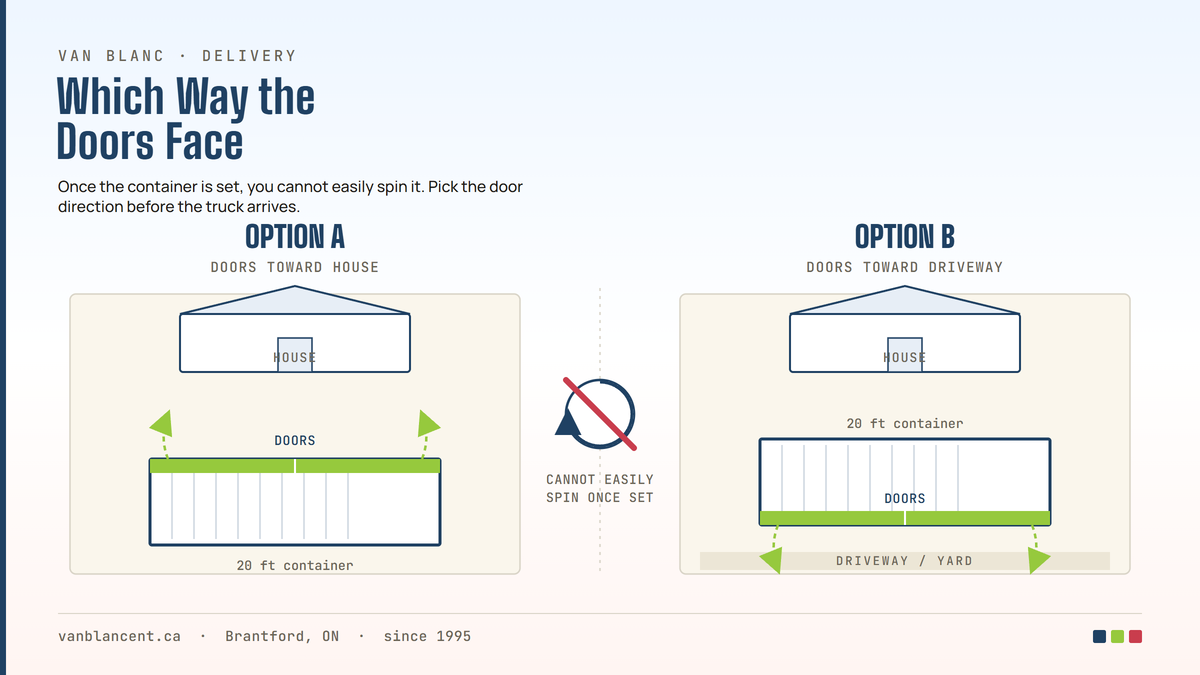
Quick Answer: Decide which way your shipping container doors face before the truck arrives, because you cannot easily spin a placed container. On a tilt-deck delivery, the end loaded toward the truck cab comes off last and lands on the approach side; the end loaded toward the rear comes off first and lands deeper in. Tell us your choice at order time.
Reading Time: 8 minutes
In This Guide
Door direction is the one delivery detail buyers forget to plan, and the one that is most annoying to get wrong. A shipping container has its swing doors on one end only. Once the box is sitting on the ground, those doors face one fixed direction, and that direction decides whether you walk straight into your storage or whether you are squeezing past a fence every time you load a wheelbarrow. The good news: it is a free choice. The catch: you have to make it before the truck leaves our Brantford yard, because the loading orientation is set then.
This is the decide-before-the-truck-arrives page. We will explain how a tilt-deck delivery determines which way the doors end up pointing, how to pick between doors-to-the-house and doors-out for your site, why a placed container is not something you spin around afterward, and exactly what to tell us when you order so it lands right the first time. Van Blanc has delivered containers across Ontario since 1995, so this comes from real driveways, not a diagram.
Why Does Container Door Direction Matter Before Delivery?
Container door direction matters before delivery because a shipping container has swing doors on one end only, and a tilt-deck drop sets that orientation as the box slides off the trailer. Once it lands, the doors point one fixed way. Turning them afterward means lifting the whole container, so the choice belongs in your order.
A standard shipping container carries its cargo doors on one end. The other three sides are solid steel. So “which way should the doors face” is really “which end of the box points where,” and that is a decision, not an accident. Get it right and the doors open into the space you actually use. Get it wrong and you have a 20ft or 40ft steel box with its only opening aimed at a fence, a hedge, or the side of the house. Whichever box you end up ordering from our Brantford stock, that single opening is the whole reason orientation is worth a minute of thought.
The reason this has to be settled up front is mechanical. The way the container is loaded onto the delivery trailer at the yard fixes which end comes off first and where it lands. By the time the truck is in your driveway, the orientation is already decided. There is no turning a 5,000 lb (20ft) or 9,200 to 9,600 lb (40ft) box around on the spot. This is why door direction belongs in the order, beside the size and the postal code.
Doors to cab and doors to rear, defined
In the trade, delivery drivers describe door orientation two ways. Doors to cab means the container is loaded so its doors face the front of the truck during transport. Doors to rear means the doors face the back of the trailer. These two phrases are the whole vocabulary you need. When you tell us which one you want, you are telling us how to load the box at the yard so it ends up pointing the right way at your site. Both cost the same. It is purely a matter of saying so in advance.
How Does the Tilt-Deck Decide Which Way the Doors Land?
A tilt-deck delivery works by gravity, and that mechanism is what links “how it was loaded” to “which way it points.” The driver backs the trailer into position, tilts the bed up at an angle, and the container slides off the rear of the trailer onto the ground while the truck eases forward out from under it. Nothing is craned or rotated. It slides straight back, in line with the truck, which is why the delivery needs a clear, straight run of room behind the trailer, and then settles where it stops.
Because it slides off the rear, the sequence is predictable. The end of the container facing the rear of the truck is the first part to touch down, so it ends up deepest into your property, furthest from where the truck drives away. The end facing the cab is the last part to come off, so it ends up on the approach side, nearest the road or driveway the truck pulled in on. That is the entire logic. Load doors-to-rear and the doors end up at the far end; load doors-to-cab and the doors end up on the approach side.
Paul LeBlanc, who founded Van Blanc in 1995 and has spent nearly two decades in the container business, puts it simply. “The trailer decides where the doors end up, not the driveway,” he says. “Tell us at the order, and we load the box to match your spot. Leave it to chance and the doors land wherever the slide stops.” He has watched the same regret play out for years: a buyer who never thought about door direction until the box was already sitting wrong.
| You ask for | How it rides on the truck | Where the doors end up on your site |
|---|---|---|
| Doors to rear | Doors face the back of the trailer | At the far end, deeper into the property, away from the approach |
| Doors to cab | Doors face the front of the truck | On the approach side, nearest where the truck entered |
The driver still controls the fine placement, of course. They line up the straight pull-out, ease back to the spot, and slide the box off square. What they cannot do is flip the doors to the opposite end at your gate. That was set when the container went onto the trailer. So the table above is the choice you are really making when you say “doors to cab” or “doors to rear” on the order.
The simplest way to picture it
Stand where the truck will come in and look at the spot. Whatever end of the container you want pointing back toward you (the approach), that is the “doors to cab” end if you want the doors there. Whatever end you want pointing away into the yard, that is “doors to rear.” If you are not sure, do not guess: snap a photo standing at the entry point and send it with your quote. It also helps to mark exactly where you want the box to land so the driver drops it where you pictured it. We will set the loading orientation for you.
Should the Doors Face the House or Face Out?
Whether the container doors should face the house or face out depends on how you will actually use the box day to day. A few patterns cover most sites.
Doors toward your access point (the common choice)
For most home and small-business storage, you want the doors facing the way you will approach the container with a cart, a wheelbarrow, a forklift, or your arms full of bins. That usually means doors toward the driveway, the yard you work in, or the shop. Shorter trips, fewer steps, less walking around the box. If the container sits near the house and you load from the house side, you want the doors on that side.
Doors away from the road or the wind
Some buyers want the opposite. Doors facing away from a busy road keep the contents out of sight and out of the prevailing weather. On a farm, doors pointed away from the laneway and into the work yard keep the opening sheltered. Doors that face north or away from driving rain tend to seal cleaner over the years, and if you are starting with a unit whose gaskets and paint begin factory-tight, that weather edge lasts longer. If privacy or weather is your priority, doors-out from the road may be the better call.
The clearance rule that decides it for you
- Leave room for the swing. Cargo doors swing wide, often close to 270 degrees, so you need open ground in front of them. Never aim the doors at a fence, wall, hedge, or slope. Doors against a structure cannot open, which makes the only opening on the box useless.
- Think about the forklift, not just the door. If a forklift or tractor loads the container, the doors have to face the path that machine can travel. A door that opens fine but has no approach lane is still a problem.
- Account for snow and runoff. In Ontario, doors that face uphill collect meltwater and snow drift against the seal. Doors facing the natural drainage side stay easier to open through winter.
Can You Spin a Container Around After It Is Placed?
Spinning a placed shipping container around is the most common regret call we take: “can you come back and turn it around.” Once a container is on the ground, rotating it is a real job, not a quick favour. A 20ft container weighs roughly 5,000 lb empty and a 40ft runs about 9,200 to 9,600 lb, and that weight concentrates on four corner castings. Spinning it means bringing equipment back to lift and reposition the whole box, which is a second delivery in everything but name.

It gets harder once you have used it. A loaded container cannot be turned at all until it is emptied. If you have built shelving, run a workbench down one wall, or set it on blocks and levelled it, all of that comes apart first. The five-minute decision you make at order time saves a return trip and a bill you did not plan for. Decide once, decide before, and the box lands right.
What our drivers see across Ontario
From our Brantford yard we deliver right across the province, onto farm laneways in Brant and Norfolk, into tight Hamilton and Kitchener-Waterloo driveways, and out to cottage lots. The buyers who tell us the door direction up front almost never call back. The ones who leave it to the driver to guess are the ones who later wish the opening faced the other way. It is the cheapest part of the whole order to get right, and it costs nothing but a sentence on the quote. Christian, who works the yard with his father Paul, sets the loading orientation himself before the trailer leaves.
Tell us which way before the truck rolls
Send us the container size, your postal code, and one line on door direction: doors toward the house, or doors out. Not sure which way the access works on your lot? Send a photo of the spot from where the truck will come in, and we will tell you on the spot which orientation lands right, plus a real lead time, not a hopeful one. The fastest answer is a call to the Brantford yard.
Van Blanc Ent. Inc. · 90 Morton Ave. East, Unit 1-B, Brantford, ON · Family-run since 1995 · 4.9 stars across 140+ Google reviews · Fast 1-3 day delivery across Ontario.
What Should You Tell Us at Order Time?
Door direction rides alongside the rest of the access picture, because the same tilt-deck physics that set the doors also set whether the truck can reach your spot at all. When you order, the details that make delivery day clean are quick to give.
The order-day checklist
- Size and grade: 20ft or 40ft, and which condition grade you are buying. If you are still weighing the footprint, our breakdown of how the 20ft and 40ft footprints actually compare on the ground lays out the interior space side by side.
- Door direction: doors to cab (approach side) or doors to rear (deep into the property), described in plain words like “doors facing the house.”
- Approach side: which way the truck enters, so we can match the loading orientation to it.
- Straight pull-out room: a tilt-deck needs roughly 75 to 100 ft for a 20ft and 120 to 130 ft for a 40ft, about 12 ft of width, and 14 to 16 ft of overhead (a high cube needs the higher figure). The box lands at ground level, so no crane is needed when access allows.
- Ground: firm, dry, and level. A loaded truck and container together can exceed 45,000 to 50,000 lb, so soft or wet ground is where deliveries stall.
- A photo: one shot from the entry point answers most of these at once.
If the spot is genuinely unreachable by a tilt-deck (over a fence, into a courtyard, behind a building), we can swing the container in with a HIAB crane instead, and a crane lift also gives full freedom on which way the doors point because the box is set rather than slid. Tell us about the access when you ask for a quote, and we will tell you which method fits and what the doors will do. If you want the full picture of how the box gets from the yard to your spot, our overview of how a shipping container actually gets delivered in Ontario walks through every step.
Frequently Asked Questions
Which way should shipping container doors face when delivered?
Decide based on how you will use the container, then tell us before delivery. For most storage, doors should face your access point so you load and unload with the shortest path. For privacy or weather, doors can face away from the road. The choice is free, but it must be made at order time, because the loading orientation on the trailer fixes which way the doors end up pointing once the box is placed.
What is the difference between doors to cab and doors to rear?
Doors to cab means the container is loaded with its doors facing the front of the truck, so on a tilt-deck delivery they come off last and end up on the approach side, nearest where the truck entered. Doors to rear means the doors face the back of the trailer, so they come off first and end up deeper into your property, away from the approach. You pick whichever puts the opening where you want it.
Can you turn a shipping container around after it is delivered?
Not easily. Once a container is on the ground its weight sits on four corner castings, and a 20ft runs about 5,000 lb with a 40ft around 9,200 to 9,600 lb. Rotating it means bringing equipment back to lift and reposition the whole box, which is effectively a second delivery. If it is loaded or levelled on blocks, it cannot be turned until it is emptied and reset. Deciding door direction before delivery avoids all of that.
How much room do the container doors need to open?
Cargo doors swing wide, often close to 270 degrees, so you need clear, level ground in front of them. Never place the doors against a fence, wall, hedge, or slope, because doors that cannot open make the only opening on the box useless. Plan the door clearance and the forklift or cart path together, so the way you load the container actually works once it is sitting there.
Do I tell Van Blanc the door direction when I order?
Yes. Door direction belongs in the order beside the size and your postal code. Tell us plainly, for example “doors facing the house” or “doors toward the laneway,” and let us know which way the truck approaches. We set the loading orientation at our Brantford yard before the trailer leaves. If you are unsure, send a photo of the spot from the entry point and we will confirm the right orientation on the call.
Sources
- International Organization for Standardization. (2022). ISO 6346:2022, Freight containers, Coding, identification and marking. iso.org
- Container Traders. (2025). What is doors to cabin / doors to rear? containertraders.com.au
- ATS Containers. (2025). Ground Delivery of Shipping Containers. atscontainers.com
- Tradecorp. (2025). How Much Room Does a Shipping Container Truck Need at My Site? tradecorp-usa.com
- Hiab. (2025). Container Handling Equipment: Loader Cranes and Hooklifts (Application Overview). hiab.com
Reach Van Blanc in Brantford
We have been supplying shipping containers across Ontario since 1995. Our warehouse is at 90 Morton Avenue E in Brantford, and we deliver right across the province. No surprise fees, no chase-the-paperwork.
Van Blanc Ent. Inc., 90 Morton Ave E Unit 1B, Brantford, ON N3R 7J7, 519-754-6844
Tell us the size, your postal code, and which way you want the doors, and we will set the loading orientation before the trailer leaves the yard. Better yet, just call and describe the spot, and we will sort it on the phone.