
We sell containers. We do not rent.
Van Blanc sells shipping containers outright. We do not rent, we do not lease, and we do not offer rent-to-own. Stocked units deliver from our Brantford yards in 1 to 3 days. Request a sale quote or call the yard at 519-754-6844.
Quick Answer
A 40ft High Cube dry container is the most-built container in the world and the most-purchased size for residential container-home conversions, workshop builds, and pallet-stacked storage in Canada. ISO 45G1 standard, 39 feet 5 inches long internally, 7 feet 8 inches wide, and 8 feet 10 inches tall (a full foot taller than a standard 40ft), holds 2,700 cubic feet of interior volume, weighs 8,775 pounds empty, and carries up to 58,335 pounds of cargo. We stock 40HC units in One-Trip and Cargo Worthy grades at our Brantford yards, honest per-order quotes, including a side-by-side against the standard 40. Delivery in 1 to 3 business days across Ontario.

The 40ft High Cube is the workhorse of the global container fleet. Roughly 60 percent of new containers built worldwide since 2018 have been 40HCs rather than standard 40s, because the one-foot-taller interior unlocks pallet-stacking applications, residential conversion possibilities, and equipment-mounting clearances that the standard 8 foot 6 inch external box cannot support. Nearly all of those conversion builds begin with a One-Trip shell fresh off its first and only ocean voyage, since the steel underneath decides how the finished project weathers. In our Brantford yard, the 40HC is the size we sell to almost every container-home builder, every pallet-rack 3PL, every commercial workshop with overhead hoist or lift requirements, and a growing share of residential ADU and granny-suite buyers.
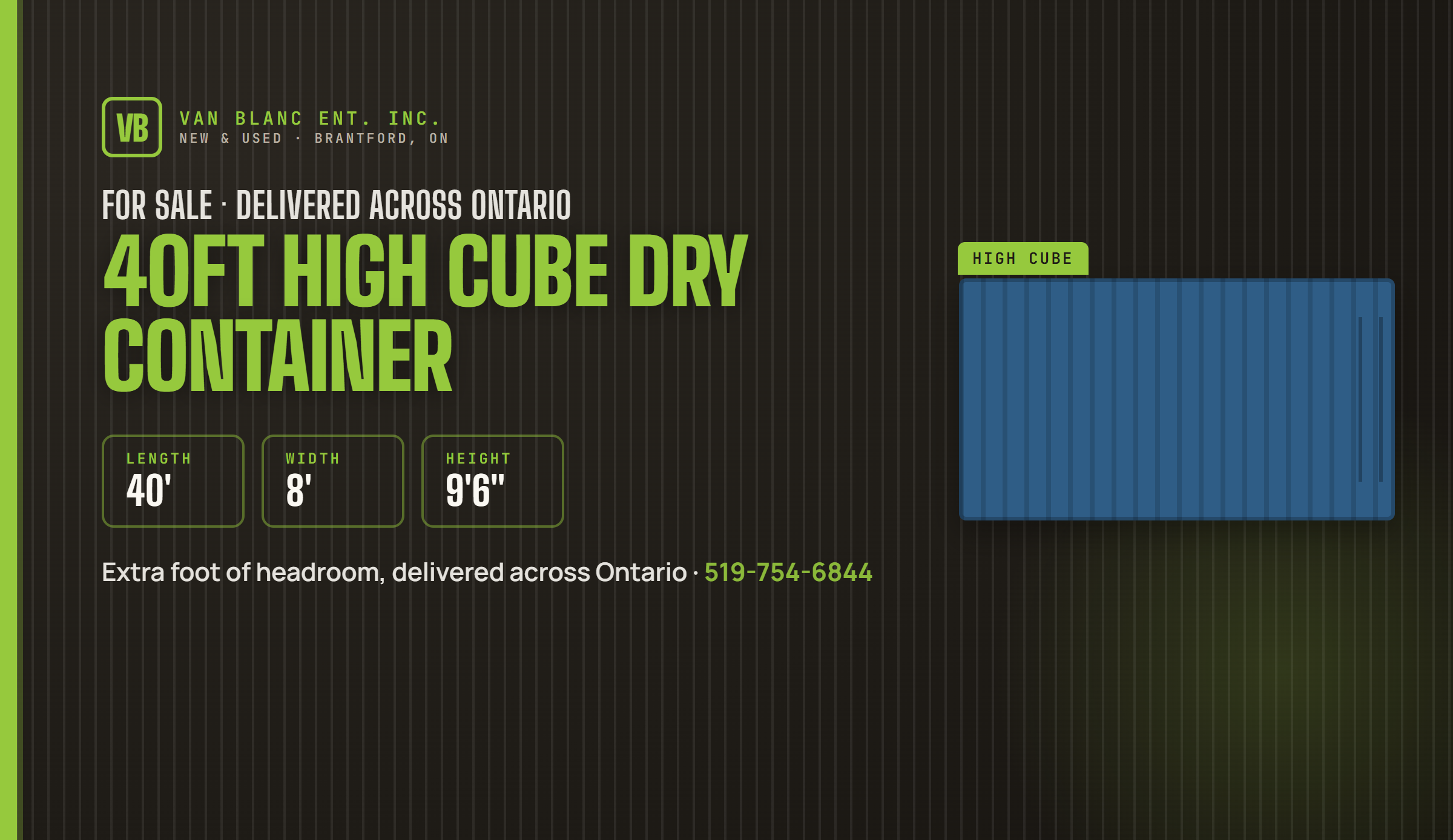
The 40HC and the standard 40ft share the same external footprint. Same length (40 feet), same width (8 feet), same pallet count single-layer, same delivery access requirements. The only physical difference is one foot of additional height, raising the external from 8 feet 6 inches to 9 feet 6 inches, and the internal from 7 feet 10 inches to 8 feet 10 inches. That one foot transforms what the container can do. A 5-foot-2-inch person walks under an 8-foot-10 ceiling without thinking about it. The same person ducks slightly under a 7-foot-10 ceiling. For any conversion where humans spend extended time inside (offices, homes, workshops), the HC is the right call.
This page covers the real specifications, the four grades we stock in a high cube, what moves a 40HC quote, the use cases that make the HC the better buy than a standard 40, and how delivery works from our Brantford yard. We are family-owned, in business since 1995, and we let you walk our 200-plus container inventory before any payment changes hands.
40HC Container Specifications, ISO 45G1 Standard
The table is the ISO figure set; on the ground the two numbers that decide most 40HC purchases are the 8 feet 10 inches of interior height and the 58,335-pound payload, and the full size run from 10 feet to 53 feet puts both beside every other box we stock.
| Measurement | Imperial | Metric |
|---|---|---|
| External length | 40 ft 0 in | 12.192 m |
| External width | 8 ft 0 in | 2.438 m |
| External height (HC) | 9 ft 6 in | 2.895 m |
| Internal length | 39 ft 5 in | 12.032 m |
| Internal width | 7 ft 8 in | 2.350 m |
| Internal height (HC) | 8 ft 10 in | 2.695 m |
| Door opening width | 7 ft 8 in | 2.340 m |
| Door opening height (HC) | 8 ft 5 in | 2.575 m |
| Internal volume | 2,700 cu ft | 76.4 m³ |
| Tare weight (empty) | 8,775 lb | 3,980 kg |
| Maximum payload | 58,335 lb | 26,460 kg |
| Maximum gross weight | 67,200 lb | 30,480 kg |
| ISO 6346 size + type code | 45G1 (40ft, 9′6″ high-cube, general-purpose) | |
The size-type code 45G1 is the global identifier for a 40-foot high-cube dry container. The number 4 designates 40-foot length, the 5 designates the 9-foot-6-inch height (the high cube), and G1 designates general-purpose dry construction with closed sides. Every 40HC we sell carries this code stamped on the side panel and a CSC plate on the cargo doors confirming ocean-transport certification.
The Extra Foot, and Why It Matters
The single most important fact about a 40HC compared to a standard 40 is that one foot of vertical space changes what the container can be used for. Below are the specific applications where the HC is the right buy and the standard 40 is not.
Pallet stacking. A standard 40 holds 20 to 21 pallets in a single layer. A 40HC holds the same 20 to 21 pallets in a single layer AND can stack a second layer on top of stackable cargo, doubling the effective pallet capacity to 40 to 42. For any 3PL, overflow warehouse, or distribution operation that runs pallet racking inside the box, the HC is the only viable choice.
Residential conversion. Container home and ADU builds use the 40HC as the base structural shell because the 8-foot-10 interior ceiling reads as a normal home ceiling height after insulation, drywall, and finished flooring eat about 6 to 10 inches of height. A standard 40 ends up with a 7-foot-or-shorter interior ceiling after the same finishing, which feels oppressive. Two stacked 40HCs form a 1,500-square-foot two-storey unit with 8-foot finished ceilings throughout.
Workshop with overhead equipment. Mechanic shops with engine hoists, welding shops with overhead trolleys, woodworking shops with dust-collection ducting, and cabinet-making shops with stacked storage racks all need the HC’s extra clearance. A 2-ton chain hoist mounted to a top rail in a 40HC has 5 to 6 feet of working height below it. The same hoist in a standard 40 has 4 feet, which is below what most lift operations need.
Climate-control conversion. Container offices, classrooms, and crew quarters that install ductwork, drop ceilings, and recessed lighting need the HC because the finished interior ceiling needs to be 8 feet or higher for occupancy comfort and code-friendly construction.
“The HC versus standard 40 is one of the easiest conversations in the yard. If the box is going to hold cargo on pallets, it is an HC question. If a person is going to walk into the box on a regular basis (workshop, office, home), it is an HC question. If neither of those applies, the standard 40 is the smarter buy, and skipping the high-cube premium is real money. We do not push the HC when the use case does not justify it.”
Christian LeBlanc, second-generation operator, Van Blanc Ent. Inc.
40HC Container Grades We Stock
Grade names on a 40HC mean what they mean on any other box, and the one-trip against cargo worthy decision is the one most 40HC buyers are actually making, since WWT and As-Is rarely justify paying for the extra foot.
| Grade | What It Is | Best 40HC Use Cases |
|---|---|---|
| One-Trip | Essentially new. Single voyage from Asia. Paint clean, doors tight, no rust. | Container homes and ADUs. Premium workshop conversions. Customer-visible commercial placements. Premium retail-display kiosks. |
| Cargo Worthy (CW) | Used 8 to 15 years. CSC re-cert still valid. Wind and water tight. Surface rust on exterior acceptable. | 3PL pallet-rack storage. Multi-bin contractor yards. Working agricultural use. Industrial workshop conversions where exterior is painted over. |
| Wind and Water Tight (WWT) | Used 12+ years. Roof and floor sealed. CSC may be expired. Heavier exterior rust. | Long-term static pallet storage. Equipment-yard overflow. Where appearance does not matter. |
| As-Is | Specific repair scope disclosed in writing. | Heavy modification builds. Container home projects where the shell will be extensively cut and re-skinned. |
The 40HC carries a real premium over the equivalent grade in standard 40ft. The premium tracks the cost of building a 9-foot-6-inch container versus the standard 8-foot-6-inch frame at the original manufacturing point. For applications where the extra height is the reason you are buying, the premium pays itself back in usability.
Six Most Common 40HC Container Use Cases
1. Residential container home base structure
The 40HC is the most-used size for residential container-home construction in Canada. A single 40HC at grade builds a 320-square-foot studio ADU. Two stacked 40HCs form a 1,500-square-foot two-storey home. Three or four 40HCs welded side-by-side form a 1,200-to-1,800-square-foot ranch-style residence. Container-home builders we work with across Ontario specify 40HC One-Trip almost exclusively because the finished aesthetic justifies the premium.
2. 3PL pallet-rack overflow storage
3PLs along the 401 industrial corridor (Mississauga, Brampton west, Milton, Pickering east, Whitby) use 40HC Cargo Worthy units for pallet-rack overflow when the permanent warehouse is full. Two-stack pallet racking inside a 40HC handles 40 standard pallets per box. Multi-bin orders are common, four to ten 40HCs per 3PL site.
3. Commercial workshop and small-manufacturing conversion
Automotive repair shops, welding shops, woodworking shops, and small fabricators convert 40HC One-Trip or CW units into permanent workshop facilities. ESA-certified electrical, insulation, HVAC mini-split, finished interior, and exterior paint. About 305 square feet of interior floor space with an 8-foot-10 unfinished ceiling. The extra ceiling clearance makes overhead-equipment installation practical, and when the bay needs to be longer, a 45ft High Cube adds five feet of floor at the same height. Automotive buyers put the same 45G1 shell to work in transit as well; two sedans loaded nose-to-tail for overseas shipment fit a 40HC with room left over for spares and accessories.
4. Office, classroom, or crew-quarters conversion
Construction site offices, modular classrooms, mining-camp crew quarters, and remote-work studios convert 40HC units into livable interior space. Drop ceilings, recessed lighting, HVAC ductwork, and code-friendly construction all fit within the HC envelope. ESA-certified electrical, insulation to R-25, finished drywall interior.
5. Large retail kiosk or pop-up storefront
40HC units with a full-front roll-up door cut form a 320-square-foot retail pop-up space, large enough for a coffee shop, food kiosk, or seasonal retail outlet. One-Trip grade and painted in brand colours, the HC provides a customer-visible commercial space with proper ceiling height for retail merchandising.
6. Container art gallery, studio, or maker space
Artists, photographers, ceramicists, and maker-space operators convert 40HC One-Trip units into backyard or commercial studios. The extra height accommodates skylights, north-facing window cutouts for painter light, and large-format printing or photography equipment. Customer-installed cedar-cladding on the exterior is common for residential placement.
Real 2026 Pricing for a 40HC Container Landed in Ontario
Quote the high cube against the standard
The extra foot of height either earns its premium for your build or it does not. Tell us what is going inside and we will quote the 40HC and the standard 40 side by side, so the decision is made on your use case, not on a sales pitch.
Quotes hold 14 days. Multi-bin discounts deepen at five and ten units. The HC premium over the standard 40 shows as its own line on the quote, so you can see what the extra foot costs. If the number needs spreading out, financing a container through your own lender is the route, and we supply the paperwork they ask for.
Delivery and Placement of a 40HC
The 40HC ships on the same tilt-deck truck as a standard 40ft. The driver needs about a 90-foot straight-line approach to the drop spot, a foot of clearance on each side, and about a 35-foot turning radius to maneuver into position. The container will be approximately 13 feet tall on the trailer during transport (trailer deck height plus 9-foot-6 container), so overhead clearance under bridges, low-hanging branches, and overhead utility wires becomes a consideration on rural Ontario delivery routes. Our drivers know the Ontario corridor and route around the known low-clearance bridges.
For permanent placement of a 40HC, concrete piers below the frost line at the four corner castings is the right call, particularly for container-home, two-stack residential, and commercial workshop installations where the structure will be in place for 25 years or more. For temporary or jobsite placement, packed gravel direct-on-grade is fine for build cycles under 18 months.
We send a Google Earth pre-check for any 40HC delivery where overhead clearance or approach access is unclear. If the access requires a roadside drop and crane-lift to the final position, we coordinate with a local crane operator and add the crane fee separately to the quote.
The 1,000 Dollar Facebook Container Scam Aimed at 40HC Buyers
40HC One-Trip is the most-targeted product in the Ontario container-scam ecosystem because the price point leaves room for the scammer to offer half-market pricing and still trap meaningful deposit money. The pattern is identical every time. A listing offers a 40HC One-Trip or CW at roughly half of what any yard charges. The seller claims to be in Toronto, Vaughan, or Hamilton, says delivery is included, and asks for an e-transfer deposit of about a thousand dollars to hold the unit. The container does not exist. The seller account disappears within 48 hours of the deposit clearing.
The simplest defence is to come walk our Brantford yard before you pay anything. We have 200-plus containers in stock at any time, including a steady inventory of 40HC One-Trip and CW units. You can read the CSC plate, check the cargo doors, inspect the interior, verify the 9-foot-6 external height, and pick the physical box you are buying. No supplier in Ontario whose price is half of market is going to let you inspect before payment because there is no inspection to do. The container is not there. Our policy is no deposit on phantom inventory.
Frequently Asked Questions
What is the difference between a 40ft High Cube and a standard 40ft container?
The High Cube is one foot taller. External height 9 feet 6 inches versus 8 feet 6 inches. Internal height 8 feet 10 inches versus 7 feet 10 inches. Same external length and width. Internal volume 2,700 cubic feet versus 2,390 (about 13 percent more space). The high-cube premium over the equivalent standard-40 grade is modest; ask for the side-by-side quote and judge it against your use case.
Why is the 40HC the preferred size for container home conversions?
The extra foot of interior height means that after insulation, drywall, and finished flooring (which together eat about 6 to 10 inches of vertical space), the finished interior ceiling is still approximately 8 feet. A standard 40 finishes to a 7-foot or shorter ceiling, which feels oppressive in a livable space. The 40HC is the residential conversion default for any container build where humans will live or work inside long-term.
How much does a 40HC container cost in Ontario in 2026?
From Van Blanc in Brantford, 40HC pricing is quoted per order, and we always quote it beside the standard 40 so you can see exactly what the extra foot costs for your grade. One-Trip, Cargo Worthy, and WWT all carry the high-cube premium; whether it earns its keep depends on what you are stacking. All-in quotes, delivery included, usually same-day.
Can a 40HC be stacked into a two-storey container home?
Yes, this is one of the most common 40HC use cases for residential construction in Ontario. Two stacked 40HC One-Trip units form a 1,500-square-foot two-storey home with 8-foot finished ceilings on both floors after insulation. Stacking requires engineering review by a professional engineer (P.Eng.) and concrete pier foundations below frost line for the four ground-floor corner castings. The stacking ISO rating of a single container is rated for 192 metric tonnes of stack load, so the two-stack configuration is well within the structural envelope.
Does the 40HC require special delivery considerations versus a standard 40?
The same tilt-deck truck delivers both. The 40HC will sit approximately 13 feet tall on the trailer during transport, so overhead clearance under low bridges, low-hanging branches, and overhead utility wires becomes a consideration on rural routes. Our drivers know the Ontario corridor and route around known low-clearance points. For sites with overhead access constraints, we coordinate a roadside drop and crane-lift to the final position.
How many pallets can a 40HC hold compared to a standard 40?
Same single-layer pallet count: 20 to 21 standard North American 40×48-inch pallets, or 23 to 24 Euro pallets at 1200 by 800 mm. The HC’s value comes from double-stacking. With stackable cargo and proper racking, the HC holds 40 to 42 NA pallets or 46 to 48 Euro pallets in a double-stack configuration. Standard 40ft cannot accommodate stable double-stacking at this density because the ceiling clearance is insufficient.
What foundation does a 40HC container need?
For temporary placement under 18 months, packed gravel direct-on-grade. For long-term residential or two-stack placements, concrete piers below the frost line (1.2 metres in southern Ontario) at the four corner castings. For container-home foundations specifically, an engineer-stamped pier or screw-pile foundation plan is the standard, with P.Eng review for any stacked configuration. The container bears weight on the four corner castings only, never the entire floor area.
Do you stock 40HC containers at your Brantford yard?
Yes. We carry 40HC One-Trip and 40HC Cargo Worthy at all times across our four Brantford yards. WWT and As-Is grades vary by season and supply. We typically hold 15 to 30 40HC units in inventory at any given time. Phone or email for current availability and any specific grade or condition requirements.
How does Van Blanc compare to BigSteelBox for a 40HC order?
We can only speak for our side of it. Van Blanc is family-owned, holds 15 to 30 40HC units across four Brantford yards, sells every box outright, lets you pick the physical container before you pay, quotes the 40HC beside the standard 40 on the same sheet, and delivers in-stock units in 1 to 3 days with payment on delivery. BigSteelBox is a legitimate national company with its own model; check its current terms on its site and put the two quotes side by side.
Do you offer rent-to-own on 40HC containers?
No. Van Blanc sells outright only: no rentals, no leases, and no rent-to-own. If spreading the cost matters, a purchase loan through your own bank or equipment financer is the route, and we will supply the invoice, specifications, and serial number they ask for.
Sources
Placement requirements vary by municipality. A quick call to your local planning office before delivery is the easiest way to confirm what works for your property.
Reach Van Blanc in Brantford
Van Blanc Ent. Inc.
90 Morton Ave. East, Unit 1-B, Brantford, ON N3R 7J7
Cell: 519-754-6844
Toll-free: 1-888-509-6658
Family-owned and operated since 1995. Thirty years in Ontario shipping containers, four Brantford yards, 200-plus boxes in inventory.