
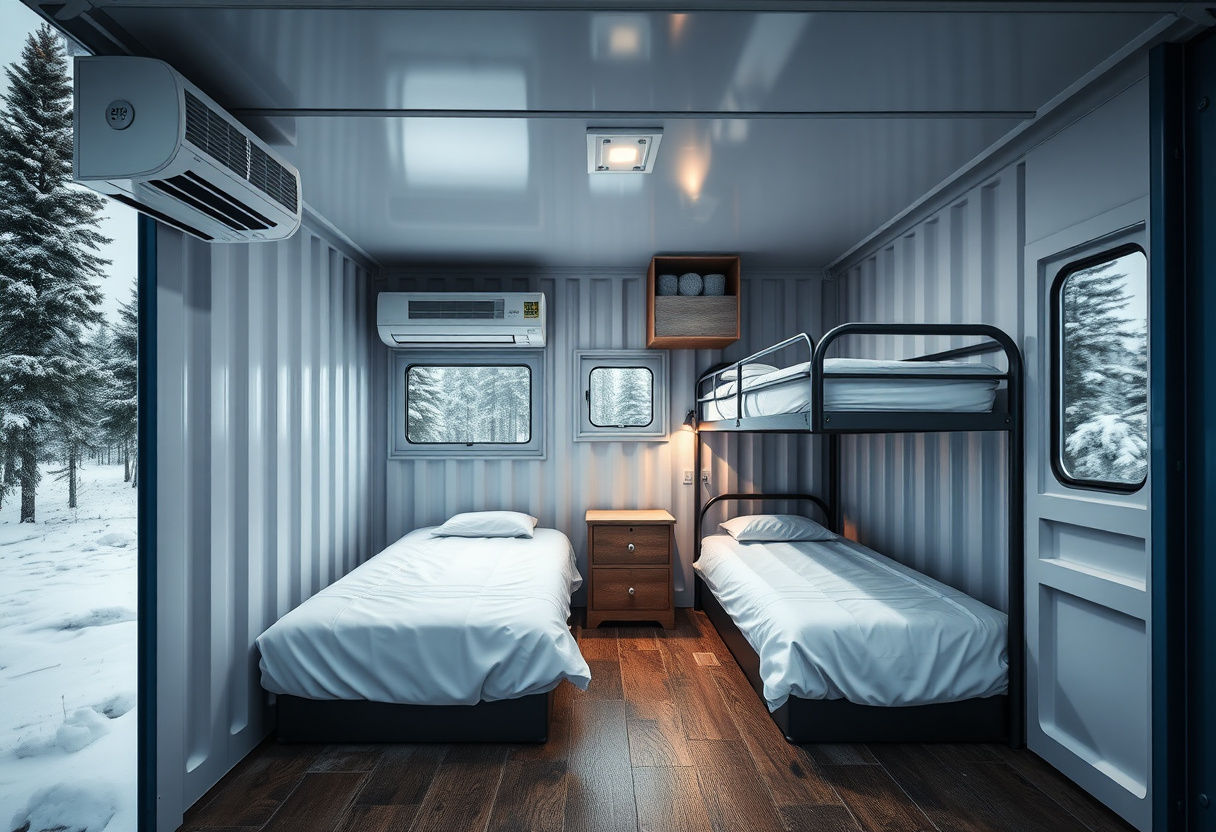
Quick Answer: A mining camp container sleeper unit in Ontario is a one-trip 20ft steel box outfitted as a worker bunkroom, fitted with R-25 closed-cell spray foam, two single bunks, a private vestibule, ESA-inspected LED lighting, and a 12,000 BTU mini-split sized for -40°C. Van Blanc supplies the bins from our four Brantford yards; freight runs 1-3 days to Sudbury and stretches to nine-to-twelve days for Red Lake.
In This Guide
- What is a mining camp container sleeper unit?
- Why is two bunks plus a vestibule the Ontario standard?
- What R-value does a Northern Ontario sleeper need?
- What size mini-split heats a sleeper from -40°C to +30°C?
- How does electrical and ESA work in a sleeper?
- How do multi-bin camp orders and the four-yard walk-through work?
- What are the real freight lead times to Northern Ontario?
- What are the real Ontario use cases for sleeper bins?
- What drives the cost of a bunk-unit configuration?
- Why do mining-camp project managers drive to Brantford?
- Frequently asked questions
Reading time: about 14 minutes.
What is a mining camp container sleeper unit?
A mining camp container sleeper unit is a 20ft one-trip shipping container converted into an insulated single bedroom for a remote-site worker. It holds two bunks, a vestibule, R-25 spray foam, ESA-inspected lighting, and a mini-split for heat and cooling. The steel box is the structure, weather skin, and foundation footprint at once.
A mining camp sleeper is a 20ft shipping container converted into a small bedroom for a worker on a remote-site rotation. The steel box becomes the structure, the weather skin, the security envelope, and the foundation footprint at once. Inside: two bunks against one long wall, a vestibule with hook rail and boot tray at the entry, R-25 closed-cell spray foam on every interior surface, a mini-split head, ESA-wired lighting and outlets. The container is one-trip stock, so the steel is essentially new, the paint uniform, doors close cleanly, no surface rust to chase before the spray-foam crew arrives.
Project managers reach for containers instead of wood-frame bunkhouses because the unit ships on the trailer that hauls it, lifts off with a forklift or small crane, holds R-25 across a seven-to-ten-year claim cycle, and moves to the next claim when the program ends. Paul started Van Blanc in 1995 supplying clients who had already learned that lesson, and the same thinking now shapes how we plan a full modular camp build.
Paul LeBlanc, owner: “A wood bunkhouse you build once and you abandon it when the claim closes. A sleeper bin you lift onto a deck and run to the next program for fifteen years. The mining clients who figured that out are still buying from us thirty years later. The steel outlasts the claim, every time.”
Why is two bunks plus a vestibule the Ontario standard?
The two-bunk-plus-vestibule sleeper is the Ontario standard because most mining clients order it over the four-bunk dorm or the single-bunk private variant. A 30-day in / 14-day out rotation puts two workers in the same bin for the work window, then a full air-out between rotations. Wage bands and work-camp policies have moved toward more privacy per worker over the last decade, and the two-bunk standard reflects that drift.
The layout is built around the four-foot vestibule at the entry. The vestibule holds the wet gear (insulated coveralls, boots, hard hats, lunch bags) and the electrical sub-panel behind a hinged service door so the panel never lives above a sleeping bunk. Beyond the vestibule, the bunk room runs about fifteen feet by eight. Two single bunks bolt to the right long wall; a storage cabinet and workspace bolt to the left. A small window above the bunks gives a daylight reference when winter sunrise lands well after the shift starts.
The sleeper does not include a kitchen or bathroom. Those live in dedicated containers: a mess container with cooking line, a shower-and-toilet container with grey-water tank, a dry container for laundry and lockers. The spray-foam crew needs a clean substrate. The ESA inspector needs panel-quality steel for bonding screws. The end client needs the unit to look respectable to a worker arriving after a fourteen-hour drive. Wind & Watertight earns its living as static farm storage. Cargo Worthy earns its living in international export. One-Trip is the platform for sleeper, mess, and office conversions. The grade has to match the conversion or the conversion fights the steel for five years.
| Container grade | Typical condition | Best mining-camp role | Right for a sleeper conversion? |
|---|---|---|---|
| One-Trip (new build) | Essentially new, uniform paint, clean doors, no rust to chase | Sleeper, mess, office, shower conversions | Yes. The default platform for any occupied bin. |
| Cargo Worthy (CW) | Multiple ocean crossings, surface rust, sound frame and floor | Bulk site storage, export, equipment shelter | Rarely. Cosmetic wear works against an occupied unit. |
| Wind & Watertight (WWT) | Visible wear, faded paint, seals weather and rodent tight | Static farm or laydown storage on the pad | No. Used for storage bins in a camp, not sleepers. |
| As-Is | Older units with possible floor or frame questions | Donor steel, cladding, structural reuse | No. We rarely recommend it for camp use at all. |
What R-value does a Northern Ontario container sleeper need?
A Northern Ontario container sleeper needs R-25, and the thermal envelope is the first conversation with any mining-camp project manager. Northern Ontario winters cycle between -25°C and -40°C through January and February, and the steel skin of a container has effectively zero insulating value on its own. With R-25 closed-cell spray foam covering walls, ceiling, and floor, a 12,000 BTU mini-split holds 20°C against -40°C outdoors comfortably and uses about half the energy of the same unit in a bare steel box.
R-25 is the working number. It sits above the ENERGY STAR wall recommendation for Ontario climate zone 6 and below the R-50 to R-60 attic targets NAIMA Canada publishes for residential construction. Closed-cell polyurethane runs about R-6.5 per inch, so four inches covers walls and ceiling at R-26 and adds two inches of usable floor depth before the subfloor. Pushing past four inches eats headroom workers feel every time they walk in.
Rock wool sandwich panels are the alternative spec, common in Chinese prefab competitors at 50mm to 100mm thicknesses. Rock wool brings fire-resistance benefits but adds factory-fab complexity that pushes lead times to eight-to-twelve weeks for offshore stock. For Ontario projects on a six-week build window, spray foam applied in Brantford or on site is faster and easier to inspect.
Spray foam in Brantford or on site
Two paths. Path one: we deliver a clean one-trip 20ft to your Southern Ontario modifier, the spray-foam crew applies foam in a heated shop, your hauler then runs the finished sleeper north. Path two: we deliver the bin direct to your remote site and your spray-foam crew applies foam on the camp pad. Path one gives a better foam result because the steel is warm during application; path two saves a hauling leg. Most clients use path one for the first six bins and path two for in-season add-ons. The framing, venting, and door work that go alongside the foam are part of the conversion work we scope at the yard, and we will tell you which path fits your timeline before you commit.
What size mini-split heats a sleeper from -40°C to +30°C?
A 12,000 BTU mini-split is the size that heats and cools a 20ft sleeper across the full -40°C to +30°C Ontario range, and it lands on that default for a reason. A 20ft container with R-25 foam, a double-glazed window, and an insulated entry door loses roughly 6,000-7,000 BTU per hour at the -27°C design temperature for Ontario climate zone 6. Mining camps run colder than design temperature regularly, so working sizing carries a safety margin to 12,000 BTU. The same head unit handles +25°C to +30°C summer peaks in cooling mode.
The mini-split mounts high on the long wall opposite the bunks. The outdoor condenser bolts to the sidewall, low enough that snow drifts do not bury it but high enough that snow-blower spray does not coat the coil. The refrigerant line set runs through a 7/8-inch sealed penetration above the condenser.
A back-up heat source is non-negotiable in Northern Ontario sleepers. The standard back-up is a baseboard convection heater on a thermostat set to 5°C, drawing from the camp generator panel. It stands by, never runs as primary. If the mini-split fails overnight at -35°C the worker wakes up to a cool but liveable room instead of a frozen one.
How does electrical and ESA work in a container sleeper?
Electrical is the most-asked, most-misunderstood part of a mining camp sleeper. Three rules cover what an Ontario project manager needs to know. First, every conversion that adds wiring, outlets, lighting, or a panel inside the container needs a licensed electrician on the job, and the work must pass ESA inspection before the camp commissions the unit. Second, the interior panel is a sub-panel, not a service panel: the feed runs from the camp’s diesel generator or shore-power tie through a main panel in the dry or genset container, then lands at each sleeper sub-panel through a properly rated cable and disconnect. Third, bonding and grounding inside a steel container is its own discipline, and the ESA-certified electrician is the one who knows it.
Van Blanc supplies the bins and the documentation the modifier and electrician work from. We do not run the electrical work ourselves. A supplier who claims “complete turnkey including electrical” is either contracting it out to a licensed trade (fine, but say so) or working outside their lane. We supply the steel, the dimensional drawings, and our ISO 6346 plate data, which is what the electrician needs to size the feed and the disconnect. The same documentation feeds the rest of the build sequence a modifier follows once the bin lands on the pad: rough-in, foam, framing, then the licensed-trade tie-ins. A sleeper that arrives with clean panel-quality steel and matched plate data is a sleeper the electrician can sign off on the first visit.
How do multi-bin camp orders and the four-yard walk-through work?
A multi-bin camp order works by letting the procurement officer pick matched bins in person, and it is where Van Blanc’s four Brantford yards earn their keep. A typical Ontario build needs eight to fourteen containers: six to ten sleepers, one mess, one shower-toilet, one dry-laundry, sometimes one generator-housing unit with sound-deadening insulation. Our pitch is simple: come walk the row in Brantford, pick the bins you want, we lock them with a deposit.
Christian walks the yard with most mining procurement officers personally. He started traveling to Asia with Paul at fifteen and has spent four years on the yard learning every steel mark and every one-trip container that crosses the row. When a procurement officer wants twelve bins with matched paint, square doors, no soft floors, and uniform ISO 6346 plates, Christian can spot the matched cluster in the morning and have it tagged for the build by lunchtime. That matched cluster comes straight off our one-trip stock arriving fresh from the factory, which is why the paint and the plates line up across a twelve-bin pull.
The four-yard model also means we hold the order while the modifier schedule shifts. Van Blanc holds locked bins at no extra storage cost for up to thirty days; beyond that, a modest hold fee. That predictability is what procurement officers tell us they did not get from offshore prefab suppliers.
What are the real freight lead times to Northern Ontario?
The real freight lead times to Northern Ontario depend on the destination, and honest freight is the second piece of the Brantford-yard pitch. Most of Ontario, Sudbury included, gets a 1-3 day delivery quote from us. The deeper north runs longer: Brantford to Timmins is about eight hours one way, Red Lake is sixteen plus seasonal conditions, and Pickle Lake is further again. Far-north freight runs six to fourteen days door-to-door once the access road is rated for the loaded tilt-deck or step-deck trailer.
Every quote comes with a real lead time, not a hopeful one. If we can move six bins in three weeks, we say three weeks. If the access road is not yet rated, we say honestly that the freight quote is conditional. Most procurement officers prefer that to a “we will hit any date you give us” promise that fails on the last leg.
| Destination (from Brantford) | Distance | Typical lead time | Freight notes |
|---|---|---|---|
| Sudbury (Greater Sudbury) | ~520 km | 1-3 days | Highway 400 + 69; year-round access |
| Timmins | ~770 km | 6-8 days | Highway 11 from North Bay; winter chains likely |
| Wawa / Marathon corridor | ~900-1,100 km | 7-9 days | Highway 17 north shore; weather watch in winter |
| Red Lake | ~2,000 km | 9-12 days | Highway 105 spur; freight permit on tilt-deck |
| Pickle Lake / north of | 2,200 km+ | 10-14 days | Multi-day overnight; winter-road dependent for sites beyond |
For exploration claims relying on a winter-road window, the math gets sharper. The road opens late December and closes by mid-March. Camps north of Pickle Lake have to commit by early November to give the bins time to stage, ship north, and reach the pad before the road closes.
What are the real Ontario use cases for sleeper bins?
The real Ontario use cases for mining-camp sleeper bins fall into three project types, and they account for most of the orders that cross our yard.
Exploration camp. Four-to-eight-person crew running geophysics or initial sampling. Sleeper count two to four bins. Procurement contact is often the project geologist. Spec leans toward simpler interior fit, fastest possible freight, and the option to relocate next season.
Infill or definition drill camp. Fifteen to thirty workers on an established claim with multiple drill rigs. Sleeper count six to fifteen bins plus mess, dry, and shower containers. Procurement contact is a project or contracts manager. Spec leans toward matched paint, uniform layout, ESA work signed off in advance, and staged delivery aligned with the drill program start.
Highway or access-road construction camp. Modular camps run along the road corridor for the construction season. Sleeper count fifteen to forty bins. The general contractor procures, and the camp dismantles and relocates mid-project as the road progresses. Van Blanc has supplied bins into Northern Ontario road builds since the early 2000s.
Christian LeBlanc, second-generation operator: “Mining-camp procurement officers come to Brantford because they want to walk the row before they buy. Twelve bins is a lot of money, and the difference between a clean matched cluster and a mixed-grade pull is the difference between a camp that opens on schedule and one that fights the steel for the first season. I show them the row, I show them the ISO plates, I show them which units came in on the same vessel. They leave with a build plan, not a brochure.”
What drives the cost of a bunk-unit configuration?
The cost of a mining camp bunk-unit configuration is driven by three layers: the bin, the conversion, the freight. Totalled, what an Ontario sleeper costs delivered depends on which choices you make inside each of those three layers. The bin layer is the one buyers control most directly, and knowing how the four grades are inspected before purchase is what keeps a sleeper build from inheriting a soft floor or an off-square door.
Layer one, the bin. A one-trip 20ft from Van Blanc’s Brantford yard runs in the upper end of the range, depending on volume and yard inventory. Twelve-bin orders trend toward the lower end.
Layer two, the conversion. Spray-foam at R-25 including labour is the single biggest line. Framing, bunks, vestibule wall, door, and windows add to it. The 12,000 BTU mini-split with refrigerant lineset adds more, and ESA electrical work adds more again. How far the conversion total climbs per unit depends on how many of these the modifier handles versus what arrives pre-finished.
Layer three, freight. This is the layer that scales hardest with distance: the Brantford-to-Sudbury run is the lightest, Brantford-to-Timmins sits in the middle, and Brantford-to-Red Lake on a tilt-deck with a freight permit is the heaviest because of the kilometres and the permitting. Procurement officers comparing offshore prefab brochure prices are comparing apples to a different fruit; offshore quotes rarely include Ontario-grade insulation, ESA electrical, real freight, or a service relationship that matters at -30°C.
The suspiciously cheap Facebook bin trap (mining-camp version)
Many procurement officers call us saying they can get a bin far below the market on Facebook Marketplace. Two weeks later they call back saying they got scammed. The pattern is the same whether the buyer is a homeowner or a mining-camp procurement officer: a listing too cheap, a seller who will not meet on a real yard, a “deposit” wired offshore, a bin that never arrives. The honest yard you can walk before you pay is the only safe path on a multi-bin order.
Why do mining-camp project managers drive to Brantford?
Mining-camp project managers drive to Brantford because walking the row in person beats buying a multi-bin camp sight-unseen. A procurement officer driving from Sudbury is making a five-hour trip to walk a container yard. The trip is rational. The alternative is a brochure purchase from an offshore prefab supplier or a phone purchase from a national chain without a real Ontario yard. The drive lets the officer see the actual steel, walk the row, read the ISO plates, and meet the family running the yard. Worth the drive for unbeatable quality, family customer service with 30 years of experience.
The procurement officer also gets a different conversation than a brochure call. Paul and Christian have spent decades watching mining cycles in Northern Ontario. They know which modifiers do clean spray-foam work, which haulers handle the Highway 11 north-of-Cochrane route well, and which over-promise. Paul has been in Asian trade for forty years and the container industry for nineteen; Christian was raised in the trade.
Continuity of supplier is the other quiet payoff. Procurement officers who buy from Van Blanc for the first sleeper tend to buy from us for the mess, dry, shower, and generator housing. Same bin grade, paint, dimensions, contact. When the next phase of a camp comes up, those buyers just send us the bin list and the postal code, and that steady continuity lets project managers stop fighting the supply chain and start running the camp.
Ready to price your container?
Tell us the size and your postal code and we’ll send back an honest, all-in number, container, delivery, and placement, usually within 1-3 days. No pressure, no mystery fees.
Family-run in Brantford since 1995 · 200+ containers in stock · 4.9★ across 140+ Google reviews · every box graded by a person, walk it before it lands.
Frequently asked questions
How much does a mining camp container sleeper unit cost in Ontario?
A delivered sleeper is the sum of three layers: the one-trip bin, the conversion (spray foam, framing, mini-split, and ESA electrical), and the freight, which scales with distance from Brantford. The bin grade and conversion spec set most of the cost, and volume orders trend lower per unit. Every quote is itemized, so you see each layer separately.
How many workers fit in a 20ft sleeper unit?
The Ontario standard is two workers, configured with two single bunks against one long wall and a four-foot vestibule at the entry. Single-bunk variants exist for senior crew. Four-bunk dorm layouts appear in some offshore prefab designs but are rare in current Ontario mining-camp specs because of privacy and rotation expectations.
What R-value of insulation does a Northern Ontario container sleeper need?
R-25 is the working target, achieved with four inches of closed-cell polyurethane spray foam at roughly R-6.5 per inch across walls, ceiling, and floor. R-25 sits above ENERGY STAR Ontario wall recommendations. Pushing past R-25 costs headroom without meaningfully reducing heating load.
What size mini-split fits a 20ft Ontario sleeper?
A 12,000 BTU mini-split is the working default. It holds 20°C against the -27°C Ontario climate zone 6 design temperature with a safety margin to -40°C. The same head unit handles +25°C to +30°C summer peaks. A baseboard back-up heater on the camp generator panel is non-negotiable.
How long does it take to get a mining camp sleeper to a Northern Ontario site?
From order lock, the timeline is two-to-four weeks for modification work plus the freight leg. Brantford to Sudbury runs 1-3 days; Timmins runs 6-8; Red Lake runs 9-12. The freight leg only starts once the access road is rated for a loaded tilt-deck or step-deck trailer, so we quote a conditional date if the road is not yet confirmed. Every quote comes with a real lead time, not a hopeful one.
Can the same container be reconfigured between mining claims?
Yes, and this is one of the strongest reasons mining clients pick containers over wood-frame bunkhouses. A sleeper lifts onto a tilt-deck or step-deck, ships to the next claim, and lands on a new pad without losing its thermal envelope or electrical fit. ESA recertification is required after relocation. Typical lifespan across multiple relocations is 15-25 years.
What is the difference between a sleeper container and a mess or shower container?
Sleepers hold bunks and personal storage. Mess containers hold the cooking line and dining tables. Shower containers hold wet plumbing, toilets, and a grey-water tank. Dry containers hold laundry, lockers, and drying space. Splitting functions across dedicated bins is how mining camps scale cleanly and keep each trade’s work contained to one unit.
Does Van Blanc do the spray foam and electrical work in-house?
No. Van Blanc supplies the one-trip 20fts from our 4 Brantford yards plus dimensional drawings and ISO 6346 plate data. The spray-foam crew, framer, ESA-certified electrician, and mini-split installer are licensed trades coordinated by your modifier or camp general contractor.
Is a national chain a real alternative for mining camp sleeper bins in Ontario?
National chains supply containers across the country. For procurement officers comparing options, the difference is a walkable Ontario yard and a direct supplier relationship. Van Blanc has been family-run from Brantford since 1995 with 4.9 stars across 140+ verified Google reviews. We are the local independent option.
Sources
- NAIMA Canada. (2024). What Does Insulation R-Value Mean? naimacanada.ca
- Electrical Safety Authority. (2024). Electrical inspections and the Ontario Electrical Safety Code. esasafe.com
- International Organization for Standardization. (2022). ISO 6346:2022 Freight containers: Coding, identification and marking. iso.org
- Discovery Mining Services. (2025). Camp Rentals and Construction in Northern Ontario. discoverymining.ca
- Alaska Structures. (2025). Guide to Remote Camp Design and Modular Buildings for Workforce Accommodations. alaskastructures.com
Reach Van Blanc in Brantford
We have been supplying shipping containers across Ontario since 1995. Our warehouse is at 90 Morton Avenue E in Brantford, and we deliver right across the province on a cash-on-delivery basis. No surprise fees, no chase-the-paperwork.
Van Blanc Ent. Inc., 90 Morton Ave E Unit 1B, Brantford, ON N3R 7J7. Call +1 888-509-6658.
If you are putting a Northern Ontario mining camp together this season, drive down to Brantford and walk the row with Christian. The matched cluster you pick in person is the camp that opens on schedule.
Placement requirements vary by municipality. A quick call to your local planning office before delivery is the easiest way to confirm what works for your property.