
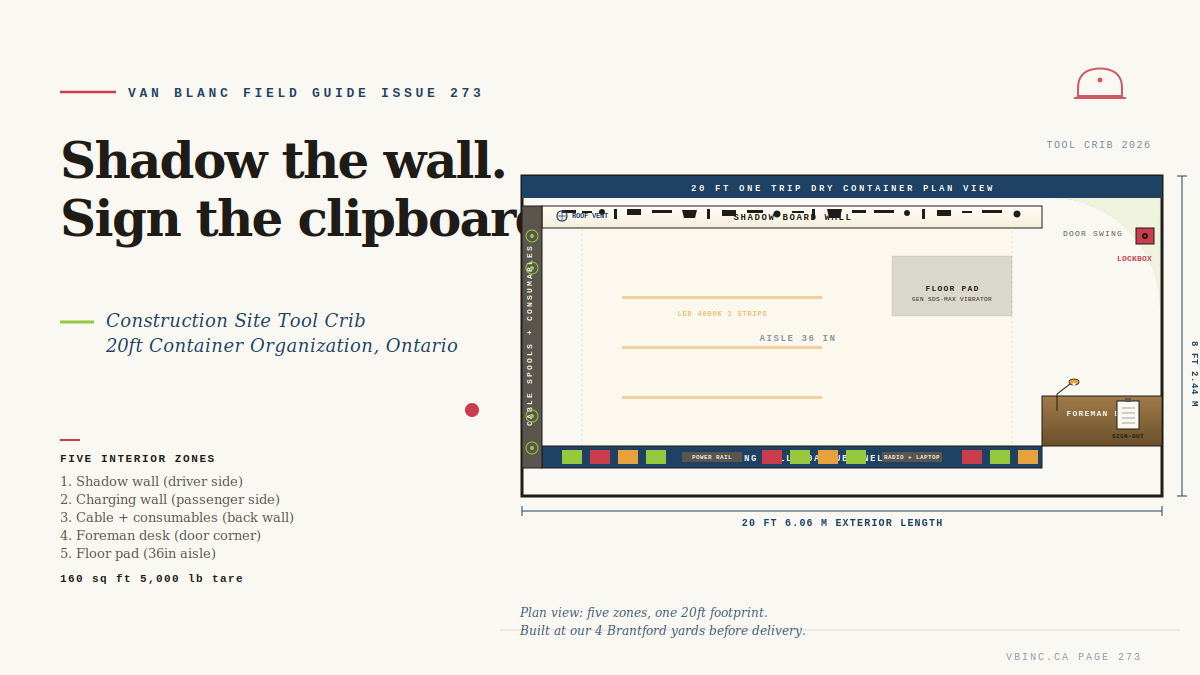
Quick Answer: A construction site tool crib container in Ontario is a locked 20ft sea can fitted with shadow boards, a charging wall, cable spool racks, a sign-out clipboard, LED task lights, and a foreman desk. Van Blanc builds this layout at our four Brantford yards before delivery, then ships it 1-3 days across Ontario. The LeBlanc family has run Van Blanc Ent. Inc. since 1995, with 140+ verified Google reviews at 4.9 stars.
In This Guide
- Why is a 20ft container the right tool-crib footprint?
- How do you build a shadow-board tool wall?
- What power and panel size does a charging station need?
- How should you set up the cable spool rack and consumables wall?
- Why does a tool crib need a sign-out clipboard?
- What lighting and foreman desk setup does a tool crib need?
- What are the five zones inside a 20ft tool crib?
- How do you prevent tool theft from a construction container?
- How does Van Blanc deliver a tool crib across Ontario?
- A note from Paul on what actually gets used
- Frequently asked questions
Reading time: about 13 minutes.
Why is a 20ft container the right tool-crib footprint?
A construction site tool crib is a locked steel container that holds and organizes a crew’s tools, batteries, and consumables on the jobsite. For most builds the right footprint is a 20ft dry box: 160 square feet of secured floor, an 8’6″ interior ceiling, and a tare weight light enough for a tilt-deck truck to set on most lots without ground prep.
A general contractor running a residential reno or a small commercial build does not need the larger 40ft box covered in our sizing breakdown. The crew is six to twelve people, the tool count is 80 to 200 line items, and the door swings open to a parking pad or a curb. A 20ft dry box gives you 160 square feet of secured floor, an 8’6″ interior ceiling, a single set of cargo doors, and a tare weight light enough that a tilt-deck truck can place it on most lots without ground prep. That footprint is what works on a Brantford or Hamilton residential street, on a school addition behind a six-foot fence, on a wind-farm staging pad, and at the edge of a Niagara vineyard pour.
The 40ft container becomes the right tool a step up: when crew counts pass 20, when the build runs longer than nine months, when a section of the box becomes a workbench room and another section stores roof-top materials. Below that scale the 20ft is the right answer. A 40ft on a 90-day driveway reno is paying for empty cubic feet.
| Factor | 20ft tool crib | 40ft tool crib |
|---|---|---|
| Secured floor area | 160 sq ft | 320 sq ft |
| Best crew size | 6 to 12 people | 20 or more people |
| Tool count it suits | 80 to 200 line items | 200+ plus a workbench room |
| Project length fit | Short reno to about 9 months | Long builds past 9 months |
| Site placement | Fits tight residential and urban lots | Needs a wider staging pad |
| Tilt-deck delivery | Light tare, drops on most lots | Heavier, needs more clearance |
The takeaway from that comparison is simple: match the box to the crew. A 20ft tool crib suits the six-to-twelve-person job that defines most Ontario residential and small-commercial work, and the 40ft earns its keep only once the crew, the tool count, and the timeline all grow past it.
Why one-trip beats used for a tool crib
A brand-new 20ft straight off its first ocean voyage comes off the manufacturing line in Asia, loads one cargo run to North America, then arrives at our Brantford yards essentially new. The industry calls these one-trip because they made exactly one loaded crossing. The factory paint is clean, the doors latch crisply, the gaskets are intact, and the rubber seals around the cam locks have not yet been beaten by ten North Atlantic winters. For a tool crib that will hold a full crew’s worth of high-value tools, the premium over a Cargo Worthy 20ft is worth it because every door cycle, every key turn, and every fastener you screw into the wall is happening on undamaged steel. Wind & Watertight grade works for stationary farm storage. For a crib that crew opens five times a day, one-trip is the grade buyers pick after they have run a CW for one build season and seen the door hinges sag. You can compare every grade and size we keep in the yard before you decide which box to crib out.
How do you build a shadow-board tool wall?
A shadow-board tool wall is the spine of the crib layout. You build it from a sheet of 3/4-inch plywood, painted matte white, screwed flush against the long sidewall of the container, with every hand tool’s silhouette outlined in 1/8-inch black marker. Without it you have an expensive 20ft locker. With it the foreman counts tools in a sixty-second visual sweep at end of day, and when a tool is missing, the outline screams.
Christian LeBlanc, second-generation operator: “The contractors who come back to us for a second and third crib are always the shadow-wall guys. I grew up around this trade, and the one thing I tell every foreman who walks our Brantford yard is the same: spend the morning drawing outlines, get that year of fewer lost tools back. The steel is the easy part. The wall is what makes it a crib instead of a pile.”
Shadow-wall layout that actually works
- Eye-level zone (54 to 66 inches above floor): Frequently used hand tools. Tape measures, utility knives, hammers, framing squares, levels.
- Hip-level zone (36 to 54 inches): Heavier hand tools and the bench-grinder bay. Pry bars, sledges, hand saws, the rotary hammer if no battery version exists.
- Shoulder-level zone (66 to 78 inches): Less frequent tools. Specialty saws, hole saws in a labeled rack, the laser level.
- Floor-level zone (0 to 36 inches): Heaviest items and cases. Concrete vibrator cases, large jackhammer in its hard case, generator if it lives in the crib overnight.
- Mark every outline in black, not coloured. Coloured paint fades under LED light and white outlines disappear against the plywood. Black on white is the high-contrast standard.
The shadow-board principle traces back to the 5S system out of Toyota Production: seiri sort, seiton set in order, seiso shine, seiketsu standardize, shitsuke sustain. A shadow board addresses set-in-order and sustain together. The visual feedback is automatic. The crew does not need a foreman lecturing them about missing tools. The empty silhouette does the work.
The 20ft container makes the shadow wall easy because the long sidewall, with the corrugations facing in, gives you 18 linear feet of mounting surface against a steel substrate that holds drywall screws and self-tapping fasteners without backing. You drill through the corrugation valleys with a #2 self-tapper, set the plywood at 3/4-inch standoff with washer spacers so air moves behind it, and you have a moisture-resistant wall that does not warp through a Brantford winter to a July heat day.
Skip the pegboard, use plywood
Pegboard fails under jobsite vibration. Hooks back out of the holes when the container gets bumped by a delivery truck or a forklift load. Plywood with screwed-in cup hooks, French cleats, or magnetic strips holds tools through eighteen months of rough handling. The minor labour difference of cutting one shadow profile per tool pays back in the first month of crew not chasing fallen impact drivers under the storage shelf.
What power and panel size does a charging station need?
A tool-crib charging station needs a hard-wired 60-amp sub-panel for most jobsites, stepping up to 100 amps for sites with bigger battery banks. A construction tool crib without a charging wall is a half-built crib. Crews run Milwaukee, DeWalt, Makita, and Bosch battery platforms now. A six-person framing crew carries between 18 and 36 battery packs through any given build day. The crib needs the capacity to charge all of those overnight without tripping a breaker.
For a stationary 20ft container that sits on a build longer than three months, hard-wire it to the temporary service. Wiring a container for power is one of the trickier jobs, and our walkthrough on fitting doors, windows, and electrical into a steel box covers the gland-plate and conduit details that keep an inspector happy. A 60-amp subpanel handles most jobsites: six 20-amp circuits gives you space for a charging wall, a lighting circuit, a heater receptacle, and two general-purpose duplex outlets for radios, the foreman laptop, and a portable saw. For sites pushing a generator or with bigger battery banks (excavator, wind-farm staging), step up to a 100-amp panel.
CSA and ESA sizing rule of thumb
Canadian Electrical Code (CSA C22.1) and the Ontario Electrical Safety Code (a derivative) require ESA certification on any commercial container that draws power from a temporary service. The container should be inspected and labeled. Sub-panel cabling is typically 6/3 copper for a 60A install, run through liquid-tight conduit, with a service entrance through a fitted box on the door header or a side gland plate. Do not let the sparky drill the corrugation valleys randomly. The gland plate keeps water out and the inspector happy. Reference: Electrical Safety Authority (ESA) Ontario, Section 76 of the OESC for portable structures.
The charging wall sits on the opposite long sidewall from the shadow board, which keeps cables and tools in separate visual lanes. Layout:
Charging wall, left to right
- Power strip rail, 48 inches above floor: A 12-outlet industrial power rail (Wiremold or equivalent) mounted on a 2×4 ledger. Surge-protected, individually switched if budget allows.
- Battery charger row: Six to eight chargers in a labelled row, brand-grouped. Each charger sits on a 6-inch shelf with a finger-pull cubby below for the loose batteries waiting their turn.
- Radio and laptop bay: Bottom-right corner, lower outlet rail, room for the jobsite radio, the foreman’s tablet dock, and the printer if there is one.
- Cable management hooks: Three or four short hooks for the extension cords that get used daily inside the crib (light strings, drill cords, the inspection light).
- Spare battery storage: Wall-mounted cubby grid above the charger row, one cubby per crew member, lettered with crew initials.
The crew that runs a charging wall like this stops losing tools to dead batteries on Friday afternoon. They stop walking back to the truck for a spare. They stop the foreman from buying replacement batteries every six weeks because three packs walked off the site.
How should you set up the cable spool rack and consumables wall?
The cable spool rack and consumables wall live on the third interior wall, usually the door-end short wall opposite the back wall. Extension cords on spools, not coiled on hooks. Spools mean the cord pays out at the working length, gets unrolled clean, and rolls back without the kink that ruins ground integrity over three years.
The rack is a wall-mounted steel frame holding four to six horizontal axles, each carrying a spool. Above the cable rack, three shelves carry the consumables: screws by box, framing nails by stick count, drywall fasteners, deck screws sorted by length, construction adhesive tubes, masking tape, painter’s tape, electrical tape, butyl tape for the roofers. Below the rack, on the floor, the welding-gas and propane cylinders chain to the wall (with proper ventilation considered for the gases stored inside, never inside a sealed crib without a vent).
Cable spool detail Paul drills home
Twelve-gauge stranded copper extension cord on a 50-foot spool weighs about 12 pounds. The spool axle needs to be steel rod, not wood dowel. We have seen wood dowels split inside six months. The 50-foot cord is the standard a jobsite electrician will ask for. The 100-foot cord stays in the truck. Inside the crib you want the 50-foot working cord on the spool and one 25-footer hanging on a hook for the quick reach.
Why does a tool crib need a sign-out clipboard?
A tool-crib sign-out clipboard is the accountability piece most jobsites skip and then regret. It is a clipboard, mounted by the doors on a 6-inch chain, with a half-letter pad of sign-out forms. The columns: date, crew initials, tool name, tool ID, expected return time, actual return time. The pad gets photographed by the foreman every Friday and kept in the project file.
The reason this matters is reconstruction after loss. When a SDS-Max rotary hammer goes missing on a Tuesday, the sign-out sheet lets you ask the four people who took it out that week which job they used it on. Nine times out of ten the tool is at a sub-trade’s site, not stolen. The sheet ends the argument. Without it, the conversation is “who had it last” and nobody knows.
The clipboard pairs with three small visual aids: a magnetic key board for vehicle keys, a labelled hook strip for radios and phones being charged off-shift, and a tool-ID-tag bowl by the doors. The bowl holds 1-inch metal stamped tags with hole punches; new tools get a tag stamped with a sequential number and an initial code, then a single ring is added to the tool’s lanyard or trigger guard. The tag is what gets logged on the sign-out sheet.
Why a paper clipboard beats an app for most jobsites
QR-code tool tracking apps work in a stable shop environment. They struggle on jobsites because crews work cold-fingered in winter, the phone battery dies, the cellular signal in a steel container is spotty without a booster, and the app gets used on day one then forgotten by day fourteen. The clipboard works in any weather. Pencil works at minus thirty. The pad is forty cents at a stationery store. A foreman serious about tool accountability uses both: clipboard for the crew, app for the high-value items the foreman tracks personally. But if you only build one system, build the clipboard.
What lighting and foreman desk setup does a tool crib need?
A tool crib needs two lighting layers, ambient and task, plus a foreman desk corner. Container roofs are insulated against direct daylight by design, so the interior is dark even with both cargo doors fully open, because the corrugation casts shadow across the back wall.
Ambient is two or three 4-foot LED strip fixtures wired to the ceiling, switched at the door. Cool white at 4000K is the standard for visual identification of tool colours, fastener sizes, and reading small case labels. Warm white at 2700K is the wrong colour temperature for a work environment.
Task lighting is the foreman desk corner. A 30-inch desk built into the door-end corner, with a wall-mounted swing-arm lamp, a power strip, a tablet dock, and the sign-out clipboard within arm’s reach. The desk doubles as the layout-drawing surface when the foreman pulls plans at end of day. Below the desk, a two-drawer steel filing cabinet holds permits, ESA inspection slips, the safety data sheets for any chemicals stored on site, the WSIB clearance certificate, and the petty-cash envelope.
Brantford and southern Ontario weather considerations
Containers in southern Ontario swing from -25C in February to +35C in July. The desk corner needs a small electric heater for winter mornings (4,000 BTU baseboard is plenty for a 20ft) and a 4-inch passive roof vent for summer heat dump. We install the vent with a roof penetration sealed with butyl tape and a marine-grade cap, drilled at the front-end short wall about eight inches off the roof centreline. The vent stops the foreman desk from becoming a sweat lodge in August.
What are the five zones inside a 20ft tool crib?
The five zones inside a 20ft tool crib are the shadow wall, the charging wall, the cable and consumables wall, the foreman desk, and the centre floor pad. The whole layout collapses into these five zones that the crew should be able to name on day one:
| Zone | Location inside 20ft | What lives there | Crew interaction |
|---|---|---|---|
| 1. Shadow wall | Long sidewall, driver side | Hand tools, frequent power tools | Pull and return at every shift change |
| 2. Charging wall | Long sidewall, passenger side | Battery chargers, radio dock, spare batteries | Plug in end of day, grab fresh batteries morning |
| 3. Cable + consumables | Back-end short wall | Extension cord spools, fasteners, adhesives | Pull as needed during shift |
| 4. Foreman desk | Door-end corner, driver side | Sign-out clipboard, permits, tablet dock, lamp | End of shift logging and morning plan review |
| 5. Floor pad | Centre floor, 36-inch aisle | Heavy equipment cases, generator, vibrator | Rolling in and out daily on cart or hand truck |
The five-zone map is what survives twelve months of crew use. We have watched cribs without this layout devolve into a pile inside ninety days. The crews who run the zones keep the layout legible for the whole project.
How do you prevent tool theft from a construction container?
Preventing tool theft from a construction container takes four layers: site fencing, the locked container itself, a shadow board that makes a missing tool obvious in sixty seconds, and GPS or QR tags on the highest-value items. Jobsite tool theft in Ontario is real, and the losses are not small. Construction Dive’s industry coverage puts annual North American jobsite theft losses in the billions, with cordless power tools the most-targeted category because they resell fast on online marketplaces, ahead of lumber and copper.
The tool crib container is the second layer of a four-layer security plan. Layer one is site fencing. Layer two is the container itself, locked with a hardened lockbox over the cam-lock handles. Layer three is the shadow board organization, which makes a theft visible inside sixty seconds and gives the foreman the paper trail to file an insurance claim. Layer four is GPS or QR tagging on the highest-value items (the SDS-Max, the laser level, the generator), so even if the tool walks, it can be located or identified.
Lockbox specification we recommend
- Hardened steel container lockbox welded to the right cargo door, covering both cam-lock handles. Bolt-cutter resistant.
- Abloy or American 2000 series puck lock. Round-body locks that defeat bolt cutters because there is no shackle to clip.
- Interior secondary lock on the foreman desk drawer for cash, drugs (if any prescription items are stored), and key duplicates.
- Two keyholders only: Site foreman and the project manager. No general crew keys. End-of-shift sign-out by foreman, morning sign-in by foreman.
- Lock log entry on the sign-out clipboard. Date, time, foreman initials. Pattern catches anomalies (someone in at 3 a.m.) inside one week.
What we will not recommend is putting an alarm on the container. Battery-powered jobsite alarms get false-tripped by wind, deer, and the morning crew arriving at 5:30 a.m. before someone disarms it. The lockbox plus a sign-out paper trail catches more theft than an alarm that the crew learns to ignore by week three.
How does Van Blanc deliver a tool crib across Ontario?
Van Blanc delivers a one-trip 20ft tool crib from our four Brantford yards across Ontario in 1 to 3 days. The crib comes empty unless you order the modifications package. We build the full conversion in-house at our Brantford yard before delivery: shadow plywood mounted, vent cut and sealed, ESA electrical sub-panel installed and inspected, lockbox welded on, interior LED strip wired. If you want to see every option we fit before delivery, the range of yard conversions and add-ons we offer covers the lot. The build adds about a week to the lead time. Most contractors prefer this because the crib arrives on the lowboy ready to plug in to the temp service.
Site prep is light for a 20ft tool crib. The container weighs about 5,000 pounds empty. It places on six 4×4 timber blocks, one at each corner and two at the centre line, on compacted gravel or a rolled-clay pad. No concrete footings needed unless the build runs over two years. The tilt-deck truck arrives, levels with the four blocks first, then drops the back two. The foreman walks the levelling shim by shim. Twenty minutes from arrival to truck pulling away.
For sites with tight access (a residential driveway between two houses, a school courtyard accessible only through a single gate), the carrier sends a tilt-deck operator who has placed thousands of bins on tight Ontario lots. Christian walks the lot plan with the foreman, by phone and photos, before the truck is dispatched, so the placement angle is settled before the rig is committed. The crib is one piece of how contractors run storage and security on an Ontario jobsite, and a tidy delivery is where it starts.
The four Brantford yards keep delivery predictable
We ship from our four Brantford yards. Highway 403 is twelve minutes from the warehouse. From there it is one hour and twenty minutes to most Hamilton, Cambridge, Kitchener, and Burlington sites. Two hours to most GTA sites. Four hours to Kingston or Sudbury. We tell you the real lead time, not a hopeful one. When a contractor asks for Tuesday morning delivery on a Thursday call, the dispatcher checks the lowboy schedule and the answer is yes or no on the call. No “we’ll see.” That is how we have run it since 1995.
Ready to price your container?
Tell us the size and your postal code and we’ll send back an all-in number, container, delivery, and placement, usually within 1-3 days. No pressure, no mystery fees.
Family-run in Brantford since 1995 · 200+ containers in stock · 4.9★ across 140+ Google reviews · every box graded by a person, walk it before it lands.
A note from Paul on what actually gets used
Paul LeBlanc, owner: “I have walked through a few hundred tool cribs over thirty years in this industry. The ones that work all share three things: a shadow wall, a charging station, and a sign-out clipboard on a chain by the door. Everything else is decoration. I tell contractors who order a 20ft crib from us: buy the plywood, buy the chargers, buy the clipboard. Skip the fancy steel shelving until year two. Crews lose tools because the crib has nowhere to put them, not because the crew is careless. Give them somewhere to put it, the tool comes back.”
Paul started Van Blanc in 1995 and has run it since. His son Christian, raised in the trade, runs the yard with him now. The four-yard model in Brantford gives us a real Ontario container store with bins on the lot, not a website with a stock photo.
One more thing Paul says, every time: do not buy a suspiciously cheap crib off a Facebook listing. Many people call us saying they found a bin priced far below the market on Facebook. Two weeks later they call back, scammed. The crib that holds your whole crew’s tools is not the place to roll the dice on a sketchy seller. Drive to Brantford. Walk the bin. Pay on delivery. That is the pattern we have run for 30 years.
This is also the reason we describe what we sell in the same words our customers use. Some crews call the crib a sea can, some call it a c-can, some call it a conex from their service days, some just call it the lockbox. They are all the same 20ft of steel. We deliver every term from our four Brantford yards. The tool-crib organization pattern we build does not change because the buyer calls it something different.
Frequently asked questions
What size container is best for a construction site tool crib in Ontario?
A 20ft one-trip dry container is the right size for crews of six to twelve people storing 80 to 200 tools. It gives you 160 square feet, a single set of doors, and a tare weight light enough for tilt-deck delivery to most Ontario sites. Step up to a 40ft only when your crew is over 20 people or the project runs longer than nine months.
Can Van Blanc install the shadow board and electrical before delivery?
Yes. We do the shadow plywood, vent cut, ESA-inspected 60-amp sub-panel, LED strip wiring, and lockbox welding at our Brantford yard before the truck leaves. Add about a week to the standard 1-to-3-day lead time for the modifications. Most contractors prefer this because the crib arrives ready to plug in.
How do I prevent tool theft from a construction site container?
Layer the security: site fencing, a hardened lockbox over the cargo doors, an Abloy or American 2000-series puck lock, two-key holder policy (foreman and project manager only), a sign-out clipboard chained by the doors, and GPS or QR tags on the highest-value items. The clipboard catches more theft than alarms because the paper trail tells you when and where a tool went missing within the same day.
What electrical capacity do I need for a tool crib container?
A 60-amp sub-panel with six 20-amp circuits handles most jobsites running 18 to 36 battery packs overnight. Step up to 100 amps for sites with bigger battery banks or auxiliary loads. The install must be ESA-certified per the Ontario Electrical Safety Code, with a proper gland-plate service entrance and liquid-tight conduit. Section 76 of the OESC covers portable structures like this.
How long does it take to deliver a tool crib container to a jobsite in Ontario?
Van Blanc delivers a one-trip 20ft from our four Brantford yards in 1 to 3 days across most of Ontario. Eastern Ontario routes run 1-3 days. Northern Ontario routes are 5 to 10 days on premium freight. Every quote comes with a real lead time, not a hopeful one. Modifications add about a week to the base lead time.
Should I use a shadow board or pegboard for tool organization?
Shadow board on 3/4-inch plywood, not pegboard. Pegboard hooks back out under jobsite vibration when the container gets bumped by trucks or forklifts. Plywood with screwed-in cup hooks, French cleats, or magnetic strips holds through eighteen months of rough handling. The minor labour difference pays back in the first month of crew not chasing fallen impact drivers under the shelf.
Do I need a paper sign-out clipboard or a tracking app?
Build the clipboard first, then add an app for high-value items if you want. The paper clipboard works at minus thirty, with dead phone batteries, with no cell signal inside the steel container. Apps fade out by day fourteen on most jobsites. The foreman photographs the sheet every Friday for the project file. That is the pattern that survives a year of crew use.
How do I keep the container cool in summer and warm in winter?
Cut a 4-inch passive roof vent at the front-end short wall for summer heat dump. Install a 4,000 BTU electric baseboard heater in the foreman desk corner for winter. Southern Ontario swings from minus 25 to plus 35 across the year. The vent and the heater together keep the foreman desk legible through both extremes without spending real money on full HVAC.
Can the tool crib container be relocated between jobsites?
Yes. A 20ft one-trip container is built to be portable on a tilt-deck truck. Disconnect the electrical, unbolt anything fixed to the floor, walk the crew through a shadow-board count first, and the bin is ready to ride. Relocating a container that is already placed on a site is something you arrange with a hauler of your choice, not a service Van Blanc runs. What we do is sell and deliver the crib to your first site. Buyers who run multi-site rotations often own two or three cribs and rotate them between active builds.
What does a fully modified tool crib container cost in Ontario?
The cost of a fully modified tool crib is driven by a few factors: the base grade of the one-trip 20ft (cosmetic condition), and the scope of the modifications package (shadow plywood, ESA-inspected 60-amp panel, LED strip lighting, roof vent, lockbox, foreman desk, charging wall). The more of that package you include, the higher the delivered total, since each addition carries its own materials and labour. Delivery distance from our Brantford yards also moves the number. Real pricing, no surprise fees, no Facebook discounts. Call us for a quote tailored to your spec and your postal code.
Sources
- Electrical Safety Authority. (2024). Ontario Electrical Safety Code, Section 76 (Portable structures and temporary services). esasafe.com
- International Organization for Standardization. (2022). ISO 6346:2022 / Freight containers / Coding, identification and marking. iso.org
- Milwaukee Tool OneKey Resources. (2024). Power Tool Theft Protection: Preventing and Responding to Stolen Tools. onekeyresources.milwaukeetool.com
- For Construction Pros. (2023). 10 Tips to Guard Against Jobsite Tool Theft. forconstructionpros.com
- Canadian Standards Association. (2024). CSA C22.1 / Canadian Electrical Code, Part I. csagroup.org
Reach Van Blanc in Brantford
We have been supplying shipping containers across Ontario since 1995. Our warehouse is at 90 Morton Avenue E in Brantford, and we deliver right across the province on a cash-on-delivery basis. No surprise fees, no chase-the-paperwork.
Van Blanc Ent. Inc., 90 Morton Ave E Unit 1B, Brantford, ON N3R 7J7, +1 888-509-6658
Come walk a 20ft one-trip in our yard before you order. Bring your shadow-board sketch, the crew tool count, and the site address. We will quote the crib and the modifications package on the spot, then build the layout at our yard before the truck rolls.