
Quick Answer: A 9ft shipping container is a steel box 9 feet (2.74 m) long, with cargo doors and a plywood floor. Three of the four 9ft units in recent stock are new, and all four add a side man door and a barred window. Stock rotates, so call 519-754-6844 first.
What This 9ft Container Page Covers
- 9ft Shipping Container Basics
- How Big Is a 9ft Container?
- 9ft Units in Recent Stock
- Door Ratings From Two Builds
- Container Numbers on a 9ft
- Door Layouts on a 9ft Box
- Forklift Moves and End Pockets
- Footing Under a 9ft Container
- 9ft Container Jobs Around Ontario
- 9ft Beside the 8ft, 10ft and 12ft
- Container Drop-Off for a 9ft
- What Moves a 9ft Quote
- Frequently Asked Questions
Reading Time: 14 minutes
9ft Shipping Container Basics
A 9ft shipping container is a steel storage box roughly 9 feet long, or 2.74 m. It has ribbed steel walls, a corner casting at each of its eight corners and lever-locked cargo doors. It sits on a shorter frame than a 20ft, so it fits a side yard, the back of a shop lot or a corner of a jobsite. Van Blanc sells the 9ft next to the rest of our small sizes, and every one of the 9ft units on our recent list has more than one way in.
The September 2026 stock list from Paul LeBlanc and his son Christian names four 9ft units. A new light grey 9ft has a man door and a window in its side wall. Two grey 9ft boxes carry cargo doors, a man door and a window: one is new, and the other was repainted. A fourth grey 9ft, also new, pairs its man door and window with a wall vent. All four have a pair of cargo doors on one end, so a mower or a pallet goes in the big way and people use the side door.
Those four are recent stock, the kind of 9ft units that pass through our Brantford yards. Small boxes sell quickly and the rows change week to week. Phone 519-754-6844 and we will say which 9ft units are standing in our rows this week, and in which yard.
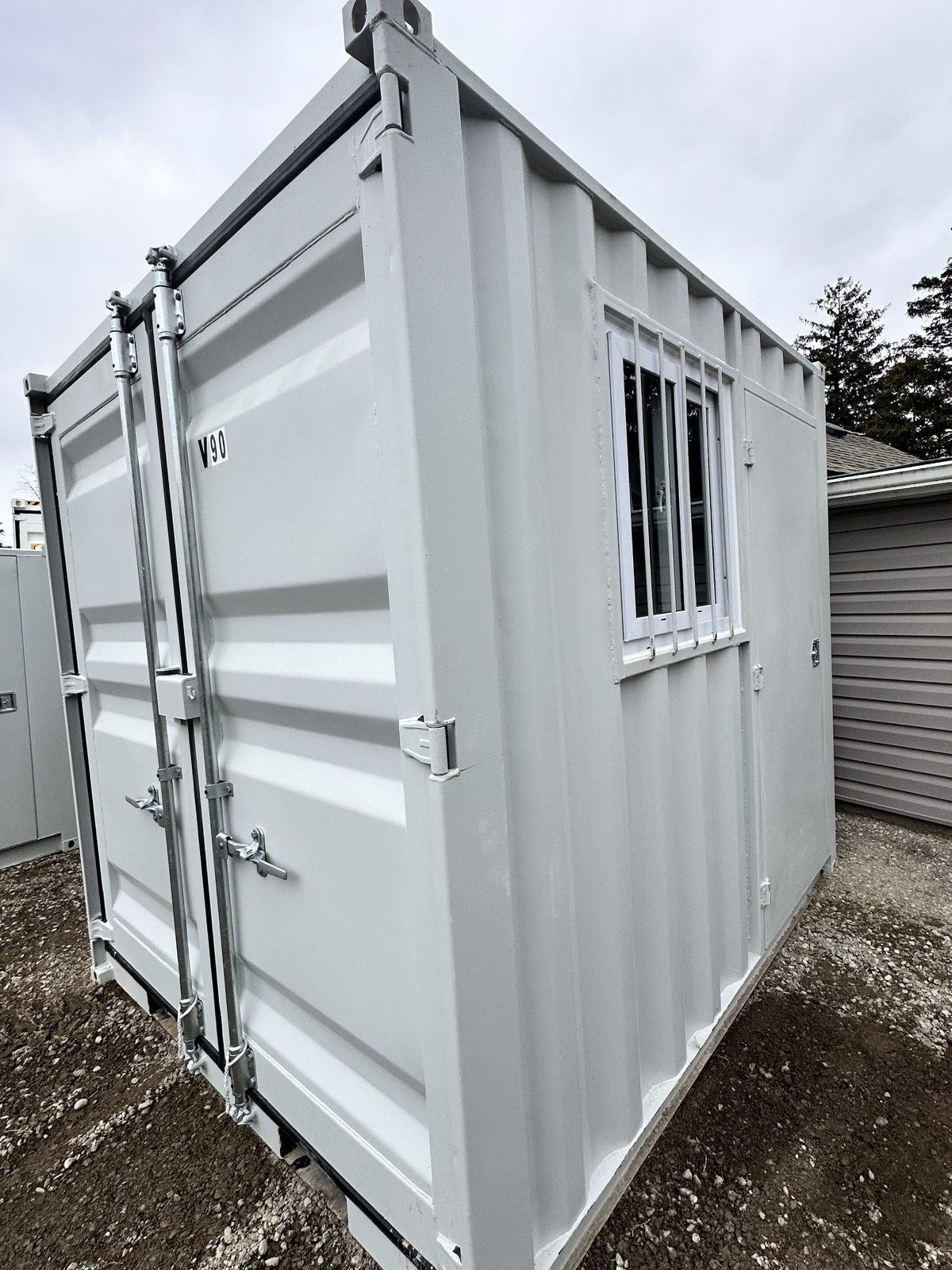
The 9ft sits one step below the 10ft, which is the shortest length the container trade codes as a standard size. Buyers who have room for the extra foot can compare our 10ft dry containers, factory built and cut down on their own page. The rest of this page stays with the 9ft: its real measurements, the ratings painted on its doors, and how it moves and sits once it lands.
How Big Is a 9ft Container?
A 9ft container is 9 feet long on the outside, which is 2.74 m. The width and the height are whatever the builder chose. That is the first thing to know about the size, because two 9ft boxes can hold noticeably different amounts. Van Blanc’s own units show it. One 9ft build is rated 13 cu m (460 cu ft) of cubic capacity on its doors. The repainted 9ft was rated 15.1 cu m before its paint went on, which works out to 2.1 cu m more room inside.
Floor area follows the width. If a 9ft is built to the full 8 ft width of a standard container, it covers 72 sq ft of ground, about 6.7 sq m. A narrower build covers less, and a shorter build has less headroom above the plywood. Neither shows up in the word “9ft” on a listing, so ask for the unit’s own measurements before you plan shelving or a desk. If you are still choosing a length, a step-by-step way to pick a length helps.
Van Blanc reads measurements off the actual box. Tell us what has to fit, such as a workbench, a ride-on mower or a stack of totes, and we check it against the unit you are looking at. For the lengths that do follow a standard, the ISO lengths from the 10ft up are laid out in one table.
Nine Feet in the ISO Size Codes
The Bureau International des Containers publishes the ISO 6346 size codes that containers carry on their doors. The first character of the code gives length, and the shortest length with a code is 2,991 mm, the 10ft. No code sits near 9 ft. A 9ft box is a maker’s length, built for storage and site work.
Nine feet does appear in the same tables, as a height. Height code 4 is 2,743 mm, or 9 ft. Code 5 is 2,895 mm, or 9 ft 6 in, which is the height of a high cube. That explains why listings called “9ft” are often a 20ft or 40ft that is 9’6″ tall. Those listings describe how tall the box is. A buyer who wants that extra foot of headroom on a long box can look at a 40ft high cube in our rows.
9ft Units in Recent Stock
Van Blanc’s recent 9ft units share a layout and differ in the details. Each has cargo doors on one end, a man door and a window in one side wall, and a lockbox at the seam between the cargo doors. The table sets them side by side, using only what the stock list and the photos show. New units, like the rest of our new container stock, can still carry minor handling marks from the trip to our yards. We point those out on the unit in the yard.
| 9ft unit | Doors and openings | Ratings on the doors | Worth knowing |
|---|---|---|---|
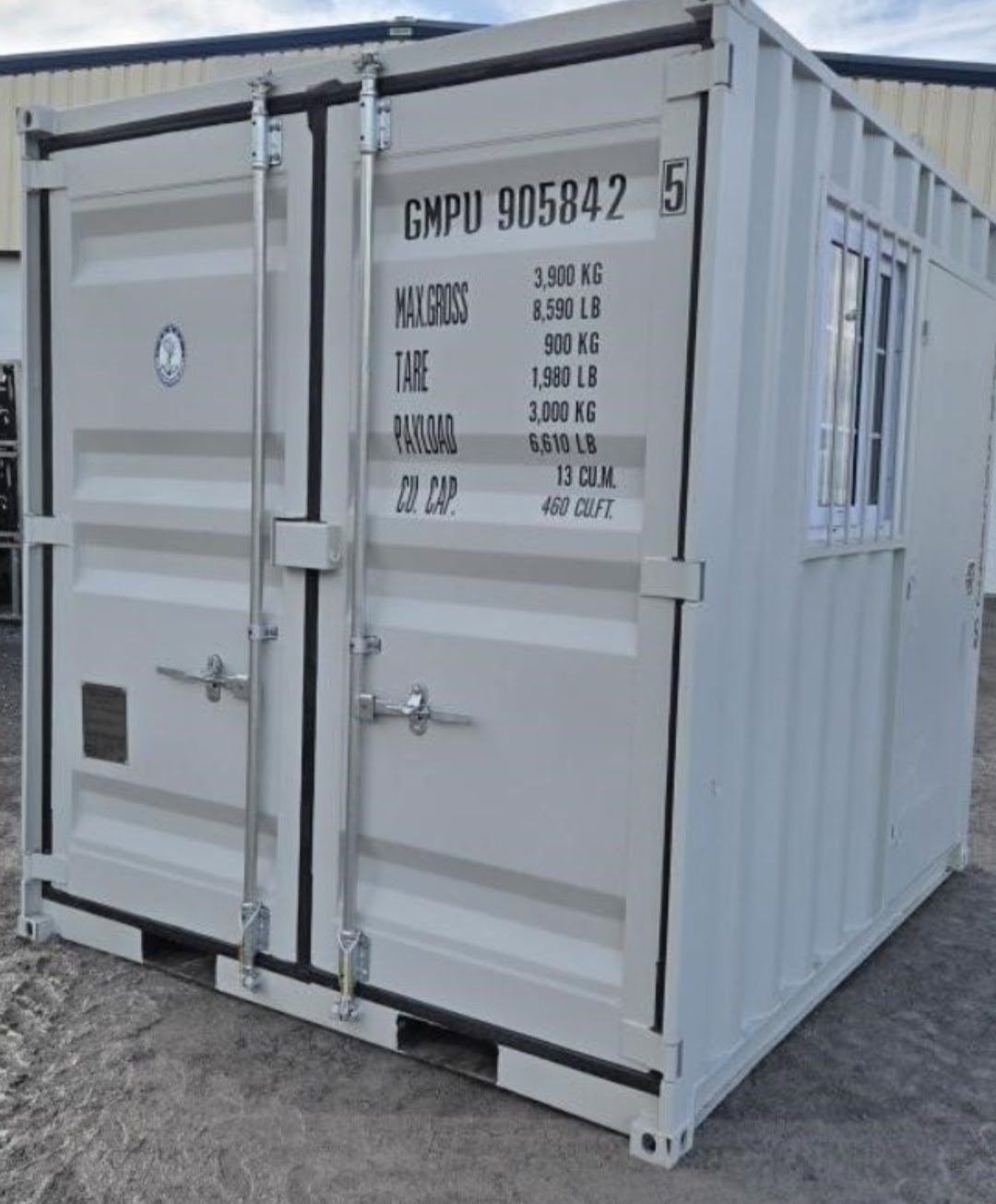
| New light grey 9ft | Cargo doors; man door and sliding window with bars on the side | 3,900 kg max gross; 13 cu m | White-painted inside walls, plywood floor, fork pockets in both end rails |
| New grey 9ft | Cargo doors; man door and barred window on the side | The same four ratings as the light grey, in the photos | Small data plate low on the left cargo door; timber blocks under the corners |
| Repainted grey 9ft | Cargo doors; man door and barred window on the side | Covered by the grey coat; 5,885 kg max gross and 15.1 cu m before paint | Yellow before the repaint, with a vent high on one side wall |
| New grey 9ft with wall vent | Cargo doors; man door and sliding window with bars on the side | None painted on the doors in the photos | A vent on the opposite side wall, grey-painted interior, plywood floor |
The Light Grey 9ft’s Side Wall
On the light grey 9ft, the side wall is where the daylight comes in. Its sliding window with two panes has a latch on the inside and steel bars across the outside. The man door sits right beside it, close to the end away from the cargo doors. Step in through the man door and the window is at your shoulder, with the whole floor ahead of you.
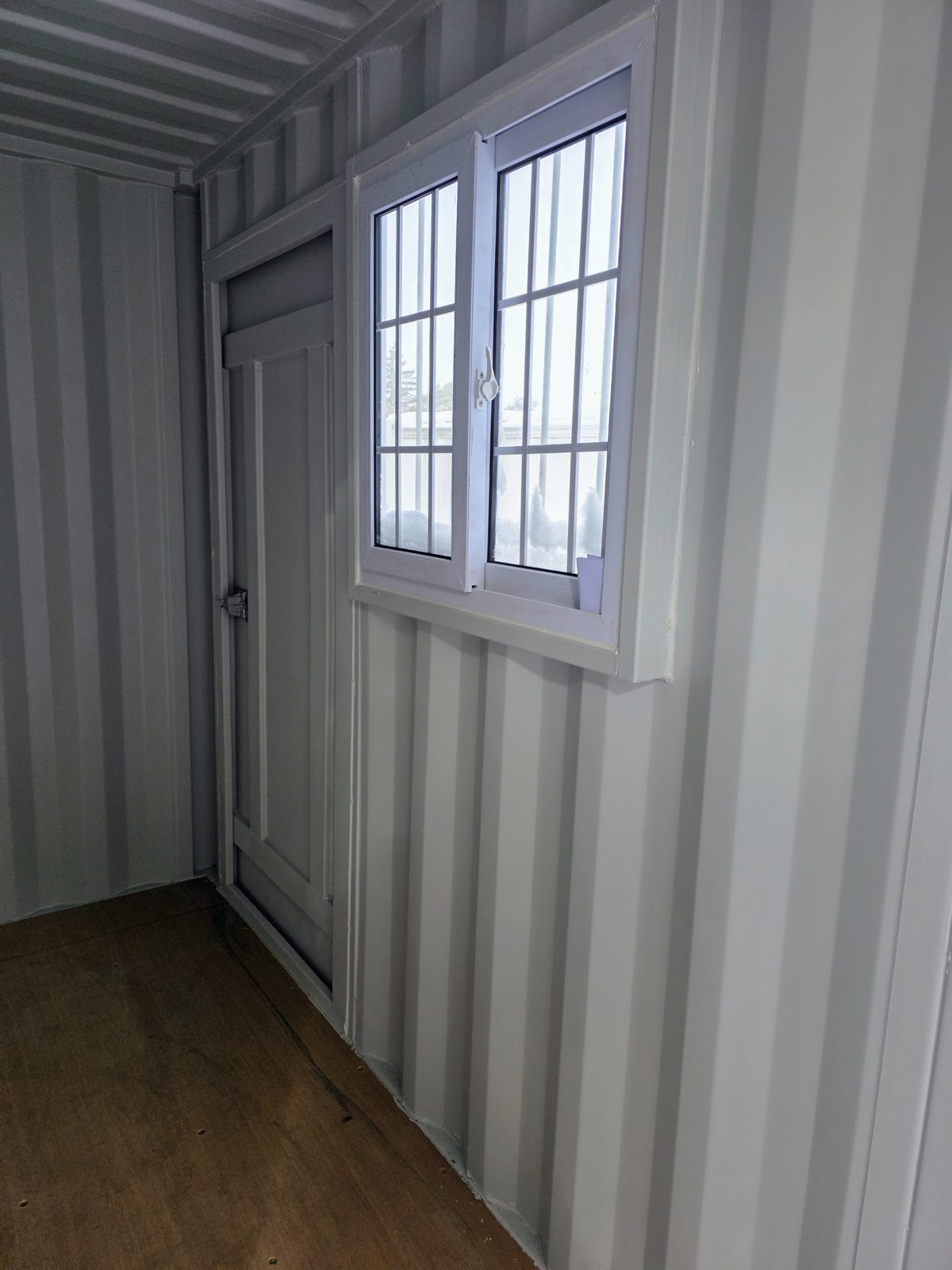
Inside, the corrugated walls and roof are painted white, which bounces the window light around a small space. The floor is plywood, fastened down in rows of screws you can see in the photos. A small container office build starts from exactly this kind of shell.
Before and After a Repaint
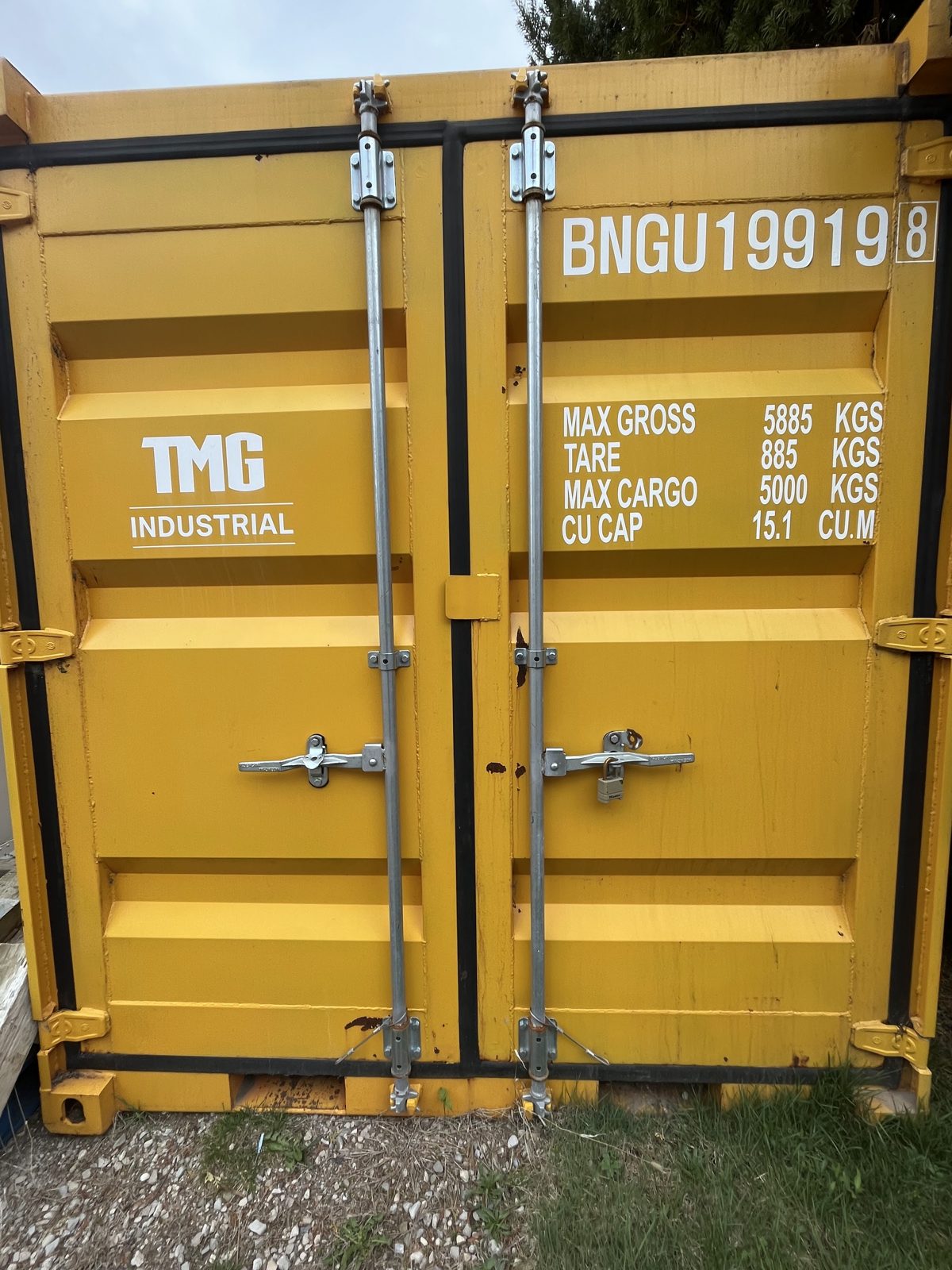
The repainted grey 9ft started out yellow, with a brand logo on one door and its ratings stencilled in white on the other. The grey coat went over all of it, the ratings and the container number included. Photos of the yellow doors taken before the paint keep those figures on record, and they appear in the ratings table below.
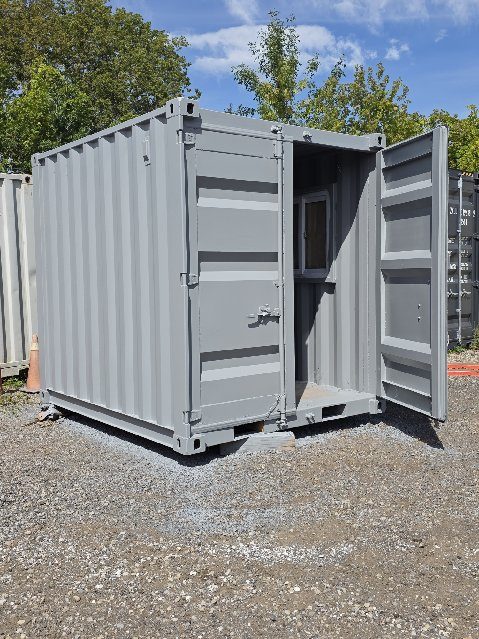
After the repaint, the box is one flat grey from roof to rails, doors included. Open the right cargo door and the window frame shows through from inside. Paint is only as good as the prep under it, and how a container is prepped before a repaint covers the steps that matter.
Door Ratings From Two Builds
Door ratings are the weight and volume figures painted on a container’s cargo door. Full-size boxes carry the same lines, and container weights by size gathers them for the standard lengths. Van Blanc’s 9ft units carry two different sets. The light grey unit and its grey sister share one set. The repainted unit had its own before the paint. Side by side, they show how far two 9ft builds can differ.
| Rating | 9ft build rated 13 cu m | Repainted 9ft, before paint |
|---|---|---|
| Max gross (box plus load) | 3,900 kg (8,590 lb as painted) | 5,885 kg (12,974 lb) |
| Tare (empty box) | 900 kg (1,980 lb) | 885 kg (1,951 lb) |
| Payload or max cargo | 3,000 kg (6,610 lb) | 5,000 kg (11,023 lb) |
| Cubic capacity | 13 cu m (460 cu ft) | 15.1 cu m (533 cu ft) |
The two tares sit within 15 kg of each other, so both builds weigh about the same empty. A standard 20ft’s door carries much bigger numbers, as the 20ft’s own weights and dimensions show. The payload ratings are 2,000 kg apart, and the volumes differ by 2.1 cu m. The larger box holds more, and it is rated to carry more. Both ratings are far above what shelves of tools, bins and garden gear weigh, so either build works as a storage room.
One small detail shows how closely the figures were read. On the light grey unit, 3,900 kg converts to 8,598 lb, but the door says 8,590 lb. We print the door as painted. The repainted unit’s door gave kilograms only, so its pound figures in the table are our conversions.
Container Numbers on a 9ft
A container number is the unit’s identity code, painted on the doors and the walls. The Bureau International des Containers describes its four parts, and our page on how ISO containers are identified and coded puts them in context. An owner code of three capital letters comes first, then the letter U for a freight container. A six-digit serial number follows, and one check digit closes it out, printed in a small box on these doors.
The check digit is there to catch a mistyped number. On a bill of sale or a lender’s paperwork, one wrong digit points to a different box. Van Blanc sells containers picked by container number, in person or on a video call, so the number on the doors is the one on your invoice. The repainted 9ft lost its painted number under the grey coat, and its before-paint photos still show it. A buyer financing through their own bank can see the paperwork a lender wants on a container loan.
CSC Rules and a 9ft Footprint
Canada’s Safe Containers Convention Act puts the International Convention for Safe Containers into Canadian law. The convention’s definition of a container sets a minimum footprint. The area inside the four outer bottom corners must be at least 14 sq m (150 sq ft). With top corner fittings, the minimum drops to 7 sq m (75 sq ft). Full-size boxes that go back to sea keep that approval current, as CSC recertification on a working box explains.
A 9ft built to the full 8 ft width covers about 6.7 sq m, just under the smaller line. At that size, a 9ft sits outside the convention’s definition, so the Act does not call for a safety approval plate on it. The small plate on some 9ft doors is still worth reading when you walk the unit. Our notes on what a CSC plate should list explain the lines on a full-size box’s plate.
Door Layouts on a 9ft Box
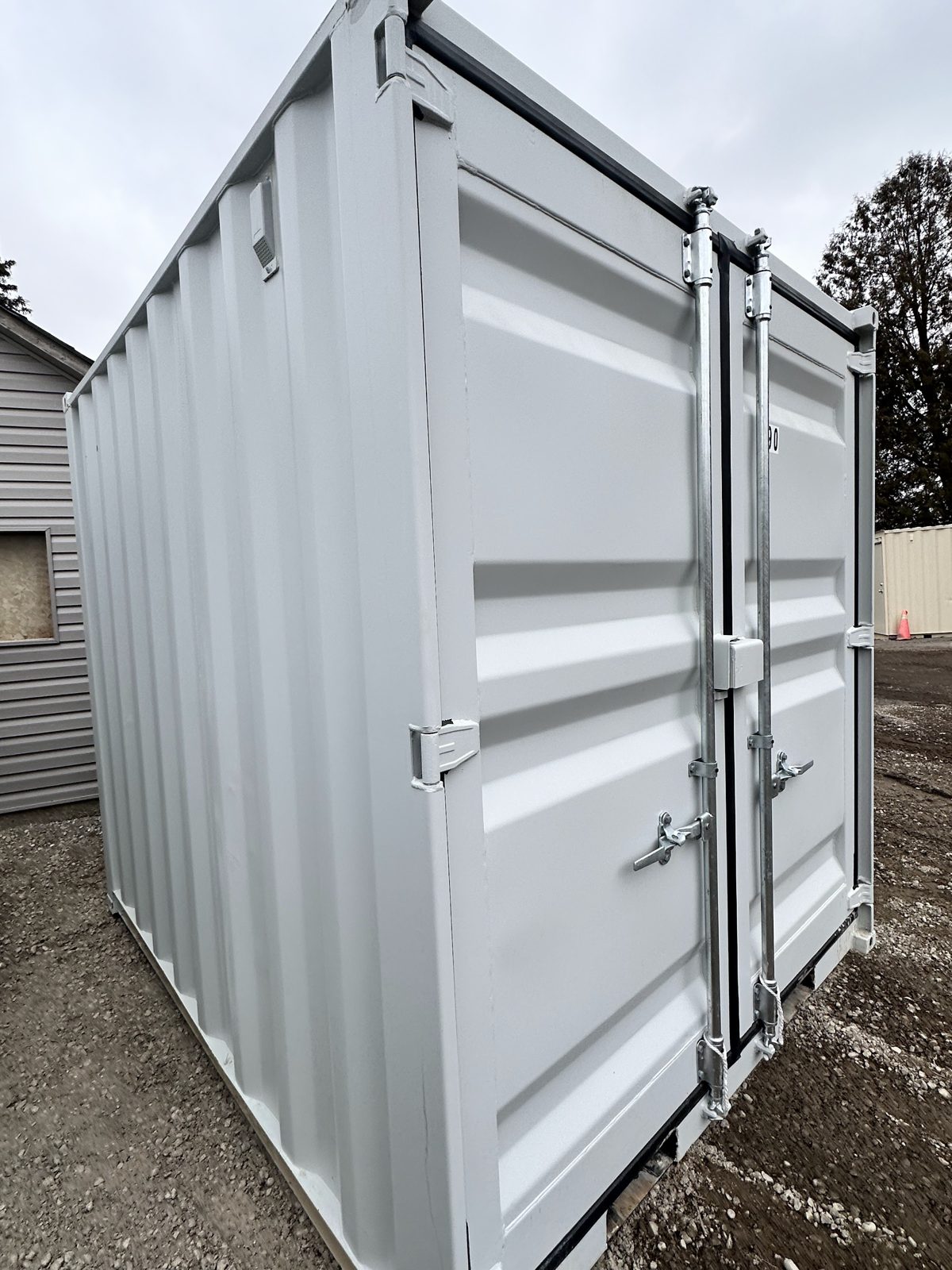
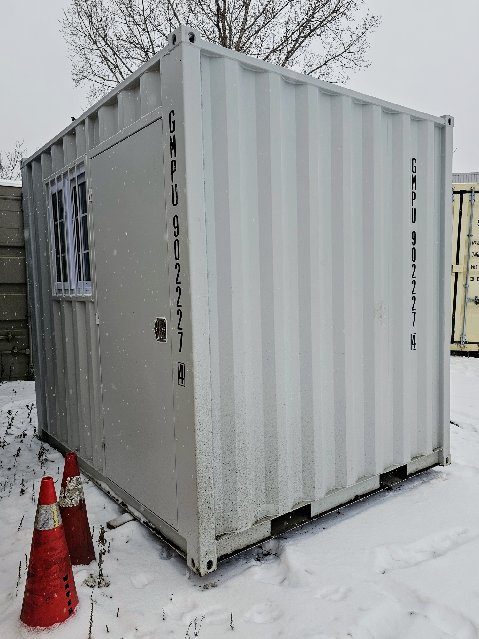
A 9ft with a side man door has two ways in, and each does a different job. The cargo doors open the full end of the box for anything wide: a mower, a pallet of block, a desk. The man door is a single hinged door in the side wall for the trips you make ten times a day. The window beside it lets you see inside without a light on.
On the units in our photos, the man door sits near the far end of the side wall, away from the cargo doors. That leaves the wall space near the cargo doors free for shelving. Before choosing where the box lands, think about which wall the man door is on, because the path to it needs to stay clear. Van Blanc also fits doors, windows and vents at our yards when a layout needs changing.
The windows are sliding units with two panes and a latch on the inside. Steel bars cover the outside, set in a steel frame around the opening. Cutting and trimming a window opening in container steel takes that kind of frame. A man door takes one too, and a side-wall man door and its frame walks through how it goes in.
Lockbox and Wall Vents
Each 9ft in the photos has a lockbox at the seam of its cargo doors. A lockbox is a steel security shroud around the padlock, so bolt cutters have nothing to grab. Our write-up on a welded lockbox over the padlock covers what makes a good one. The man door has its own latch, and a second padlock there keeps both entries locked.
Vents let damp air and moisture out of a closed steel box. The grey 9ft with the vent has one high on the side wall opposite its window, and the yellow unit had one before its repaint. Van Blanc’s custom features page says most containers ship with 2 to 4 vents, and we add more for a box that needs them. A 9ft used as an office with people breathing inside it all day may want more airflow than a storage box. Compare passive vents or a powered fan before you decide.
Forklift Moves and End Pockets
Fork pockets are the rectangular slots in a container’s bottom rail that take a forklift’s tines. On the 9ft units in our photos, the pockets sit in the end rails: under the cargo doors and in the blank end wall opposite. A forklift picks the box up from one end, with its forks running along the length of the floor. Look over the rails and pockets for rust before any lift.
The Canadian Centre for Occupational Health and Safety gives the basic load rules for a forklift. Stay under the load limit on the truck’s own data plate. Insert the forks all the way under the load. Use forks at least two-thirds as long as the load. On a 9ft picked from one end, two-thirds of the length is about 6 ft of fork.
Weight is the easy part. The empty 9ft builds on our list weigh 885 kg and 900 kg, and that figure goes against the load limit on the plate of the machine you have. Lift the box empty and set it down on a level spot. Our notes on fork length and mast clearance before a lift go further.
Moving a 9ft Later On
Our delivery ends when the 9ft is down, level, on the spot you picked. A later move across your property is yours to arrange, with a forklift or a hauler. Before an empty 9ft goes on a utility trailer, check that the trailer’s rating beats the box’s tare, and strap the box down before it rolls. How a load sits over trailer axles matters on a small trailer too.
Footing Under a 9ft Container
A 9ft container sits on its four bottom corner castings, and those four points carry the whole load. One of our grey 9ft units sits on timber blocks under its corners in the yard photos. The base can be that simple. What matters is that all four corners bear evenly and the box sits level.
Level matters more on a 9ft with a man door, because it has two door frames to keep square. When one corner settles, the frame racks, and the cargo doors or the man door start to bind. Shim the low corner before it gets that far. Shimming a low corner takes a level, a jack and a few steel plates or hardwood shims.
A concrete slab is not required under a 9ft. Firm, compacted ground with solid corner supports does the job. For the choices in between, compare timber, block or gravel footing side by side. Keep the corners out of standing water, so the rails and castings stay dry through spring melt.
Winter adds one more check. The man doors on these units hang on outside hinges, so they swing outward. A snowbank against that side wall holds the door shut, and the cargo doors need a clear arc too. Plan where the plow pushes snow before the box lands. A delivery in January brings its own questions, and a drop on frozen ground covers them.
9ft Container Jobs Around Ontario
A 9ft container with a window and a side door does work that a plain storage box can’t. People can use it all day, much like a site office beside the gate. The table matches common jobs to the parts of the 9ft that suit them. Each row names the feature to ask about when you call.
| Job | Why a 9ft with a window and man door suits it | Ask about |
|---|---|---|
| Jobsite tool crib | Crews walk in through the man door; big gear goes through the cargo doors | Shelving, and a lockbox on both doors |
| Site sign-in office | Daylight at the desk, a small footprint beside the gate | Insulation, lighting and power built at our yards |
| Backyard storage | Mower and patio set behind the cargo doors, daily items by the side door | Which wall faces the house |
| Farm parts room | Parts bins on shelves, light from the window, a lock on both doors | A level base near the barn |
| Gate or ticket booth | The window faces the lane or the lot entrance | Which side the window sits on |
Our guide to racking and bins for a crew’s tool crib shows a layout that works in a short box. At home, using a container as a backyard shed covers the placement questions a homeowner asks.
A 9ft Beside the Site Trailer
A general contractor on a housing build needs somewhere to lock up drills, lasers and fasteners each night. A 9ft parked beside the site trailer holds wall shelving on one side and a gang box behind the cargo doors. The crew uses the man door all day, and the window shows at a glance whether anyone is inside. At the end of the job, a forklift lifts it by the end pockets onto a trailer for the next site. Shelving systems that bolt to container walls fit this kind of room well.
A 9ft office needs more than daylight. Van Blanc builds insulation, lighting and electrical rough-in at our yards before delivery, and your licensed electrician makes the final connections on site. Tell us early if the 9ft is going to be an office, so the build and the lead time are quoted together.
9ft Beside the 8ft, 10ft and 12ft
The 9ft sits in the middle of the short sizes. The table puts its length next to its neighbours, in feet and metres. The 10ft length is the ISO figure, and it holds for a factory or cut-down 10ft alike. The others are the lengths listed for the units in our yards.
| Size | Length | Where it fits best |
|---|---|---|
| 8ft | 8 ft (2.44 m) | The tightest spot that still takes a window and man door |
| 9ft | 9 ft (2.74 m) | A side door and window with a little more floor behind the cargo doors |
| 10ft | 2,991 mm (9 ft 10 in) | The standard short length, factory built or cut down from a 20ft |
| 12ft | 12 ft (3.66 m) | Ladders, trim lengths and fence rails that need the extra floor |
Between the 9ft and the 10ft, the gap is about 25 cm, or 10 in. That small difference decides the fit on a tight pad, beside a fence or between two sheds. Measure the spot, add the clear space a delivery needs and room for the cargo doors to swing, and pick the length that fits with the doors open.
The 9ft’s advantage is its layout. The 9ft units on our list come with a side man door and window already in place, and recent 10ft stock has a unit built the same way. On a plain 10ft or 12ft we add them at our yards. If the spot takes a 9ft and you want an office-style box, the 9ft is ready as it stands. If the spot takes more length, a longer unit from the rows we have for sale can be quoted with its own man door and window.
Ask Which 9ft Units Are In
The quickest answer on a 9ft is a phone call. Tell us the job, the spot and your postal code. We will tell you which 9ft units are on the ground, what their doors read, and when one can reach you.
Container Drop-Off for a 9ft
A 9ft container travels from our 4 Brantford yards on one of Van Blanc’s own tilt-deck trucks. Stocked units without changes get fast 1-3 day delivery to every region across Ontario. The deck tilts and the box slides off onto its spot, so the driver needs a straight run in and room to pull away. How a tilt-deck sets a box down shows the space it takes.
A 9ft with a side man door has two faces to aim, where a plain box has one. Decide which way the cargo doors open and which way the man door and window look. Point the window at whatever you want to watch or light: the house, the gate or the south sun. Our notes on choosing which way the doors face help settle it before the truck is booked.
When you order, text us a photo of the spot and the route the truck will take. Overhead wires, a gate post or a soft lawn all show up in a picture. If we add a door, window or vents before it leaves, the delivery follows the build, and the quote gives that date.
Picking Your 9ft From Brantford
Van Blanc’s 4 yards are in Brantford, with the office at 90 Morton Avenue East. Buyers from Brantford and farther out are welcome to walk the small rows before they pay. If the drive doesn’t suit you, pick the unit by its container number on a video call instead. Either way, the 9ft that arrives is the one you chose.
What Moves a 9ft Quote
Van Blanc quotes each 9ft per order and does not post prices. These are the inputs that move the number.
- The build: a 9ft rated 13 cu m and one rated 15.1 cu m are different boxes.
- What is already fitted: man door, window, lockbox, vents and paint.
- Any new work before delivery, such as insulation, lighting or extra vents.
- The distance from Brantford to your site, and the access at the drop spot.
- The steel market and how many short boxes are available that month.
Send the job, the spot and your postal code through a quote request with your postal code, or call. The reply is one all-in figure with a real lead time, most often the same day.
Short boxes attract fake listings. People call us having found a bin a thousand dollars under our number on Facebook, then call back two weeks later after losing the deposit. Watch for a 9ft listed far below the rest, a seller who wants money before you see the box, and no yard address. Read about the deposit scam on cheap container listings, then see the real unit first. Van Blanc has been in the container trade since 1995, with 4.9 stars on 140+ Google reviews.
Frequently Asked Questions
What is the typical size of a 9-foot shipping container?
A 9-foot container is 9 ft (2.74 m) long outside. Width and height vary by maker, so volume varies too. Van Blanc’s recent 9ft units are rated 13 cu m on one build and 15.1 cu m on another. Ask for the actual unit’s tape measurements before you plan shelving or furniture.
Do they make 10 ft shipping containers?
Yes. The 10ft is the shortest length with an ISO size code, at 2,991 mm long. Some are built as a 10ft at the factory and others are cut down from a 20ft. Van Blanc sells both kinds from our 4 Brantford yards, alongside the 9ft units on this page.
Why are 10ft containers so expensive?
A short container still needs a full set of corner castings, cargo doors, a floor frame and the welding that joins them. Those parts do not shrink with the length, so a 10ft or a 9ft costs more per foot than a 20ft. Van Blanc quotes each short box per order as one all-in number.
Do you need a concrete slab for a shipping container?
No. A 9ft or any other container needs firm, level support under its four bottom corners. Compacted gravel, concrete blocks or timbers all work when every corner bears evenly. Keep the corners out of standing water, and shim a low corner before the doors start to bind.
How much does a 9ft shipping container cost?
Van Blanc quotes each 9ft per order instead of posting a price. The number depends on the build and its ratings, the man door, window and vents already fitted, any new work, the distance from Brantford and the steel market. Call 519-754-6844 with your postal code for an all-in quote.
Is a 9ft container the same as a 9’6″ high cube?
No. A 9ft container is 9 feet long. A 9’6″ high cube is a 20ft, 40ft or longer box that stands 9 ft 6 in tall, which is height code 5 (2,895 mm) in the ISO tables. Listings that say “9’6” describe the height, not the length.
Can a 9ft container be used as a site office?
Yes. The 9ft units in recent stock already have a side man door and a barred window, the two openings an office needs first. Van Blanc can add insulation, lighting and electrical rough-in at our yards before delivery, and your licensed electrician makes the final connections on site.
Sources
- Bureau International des Containers, Size and Type Code Tables (ISO 6346 Amendment 3), checked September 2026.
- Bureau International des Containers, Container Identification Number, checked September 2026.
- Justice Laws Website, Safe Containers Convention Act (R.S.C., 1985, c. S-1), full text, checked September 2026.
- Canadian Centre for Occupational Health and Safety, Forklift Trucks: Load Handling, checked September 2026.
Walk the 9ft Units in Brantford
A 9ft is easier to judge standing in it. Open the man door, slide the window, and check the ratings on the cargo doors for yourself. The LeBlanc family has sold containers across Ontario since 1995, and our small rows are open to walk before you buy.
Van Blanc Ent. Inc. | 90 Morton Ave. East, Unit 1-B, Brantford, ON N3R 7J7 | 519-754-6844