
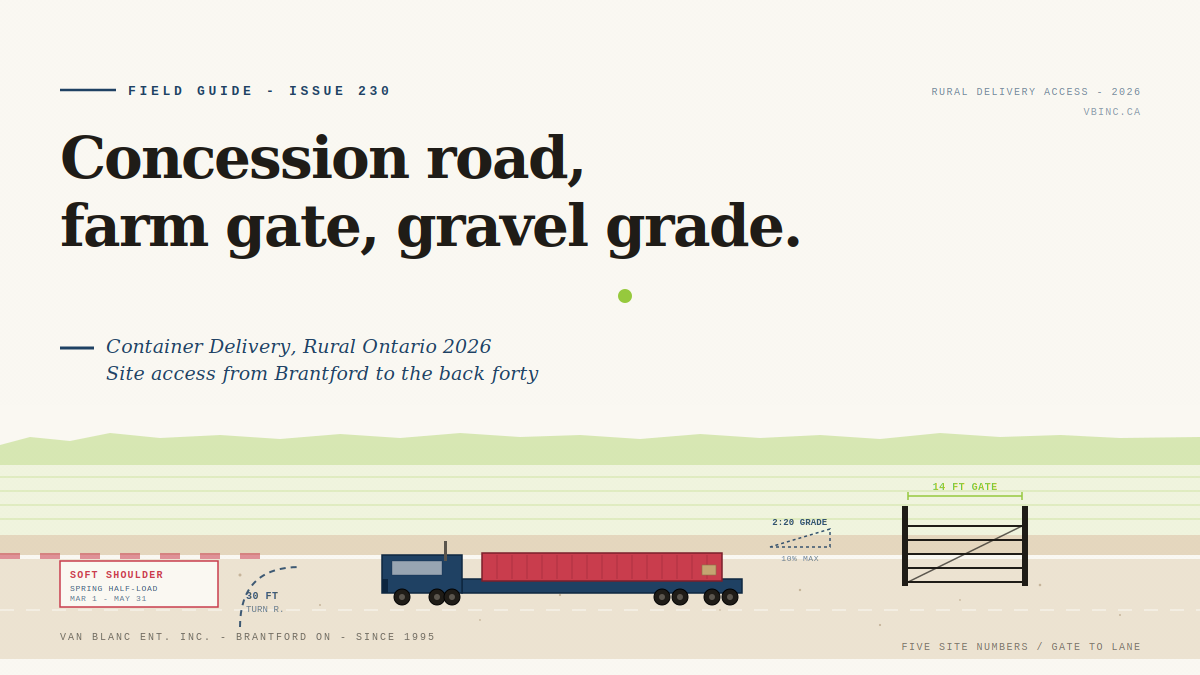
Quick Answer. Rural property delivery in Ontario depends on five site numbers rather than on the container. You need a 14 ft wide gate, a 30 ft turning radius into the laneway, a driveway grade no steeper than 2 ft of rise over 20 ft, a firm gravel base for an 80,000 lb truck, and clear overhead to 14 ft. Concession-road soft shoulders, spring half-load season, and field access are the real obstacles. The LeBlanc family has run Van Blanc Ent. Inc. since 1995. 140+ verified Google reviews at 4.9 stars, 1-3 day delivery.
In This Guide
- Why is rural container delivery different from a suburban driveway drop?
- What five site numbers decide whether the truck can unload?
- Can a container truck drive a concession road with soft shoulders?
- Will a delivery truck handle a gravel road during half-load season?
- How wide does a farm gate and turn-in need to be for delivery?
- How steep a driveway grade can a tilt-deck handle?
- Can a shipping container be dropped in a pasture or crop field?
- How much overhead clearance does rural container delivery need?
- What does a pre-delivery site walk on a rural property cover?
- What goes wrong on rural delivery days, and how do you prevent it?
- Frequently asked questions
Reading time: about 14 minutes.
If you live on a concession road, a sideroad, or a long laneway, your shipping container delivery is a different conversation than the suburban one. The bin and truck are the same. The pavement, shoulder, gate, and grade are not. Spring thaw turns half the back roads in Brant, Norfolk, Oxford, and Wellington into surfaces an 80,000 lb tilt-deck does not belong on for six to eight weeks. This guide walks rural delivery the way Van Blanc actually plans it. If you want the suburban and city version first, our walkthrough of how a container gets from our yard to your site covers the standard tilt-deck drop.
Why is rural container delivery different from a suburban driveway drop?
Rural container delivery in Ontario is governed by the road, the gate, and the grade rather than by the container. A concession-road site adds three obstacles a suburban driveway lacks: a narrow gravel road with a soft shoulder, an access built for a pickup rather than a 53 ft trailer, and ground that turns to no-go after rain or spring thaw.
The hub guide on container delivery in Ontario shows a tilt-deck drop on a suburban driveway. That is half our calendar. The other half is rural: hobby farms in Brant, dairy in Norfolk, cash-crop in Oxford, hunt camps north of Bancroft, cottages across Muskoka. Christian has been planning rural drops from the yard since he was a teenager. He says the same thing: the container is easy, the road in kills the day.
Christian LeBlanc, second-generation operator: “On a rural job the container almost never decides the day. The laneway does. I grew up around the Brantford yard taking these calls with my dad, and the pattern has not changed in thirty years: measure the gate, the grade, and the overhead before the truck leaves Brantford, and the delivery is boring in the good way. Skip that, and you find the surprise eighty feet up someone’s lane with an 80,000 lb rig that cannot back out.”
Three things make rural delivery harder. The road in front is narrower, often gravel, with a softer shoulder than brochures suggest. Your access point was built for a pickup or a tractor rather than a 53 ft trailer behind a 26,000 lb day cab. The surfaces inside your property decide what they can carry: a wet October week or a March thaw turns a fine site into a no-go.
The Brantford-and-out reality
Van Blanc operates four Brantford yards. From there deliveries run into every concession of Brant County, north into Wellington and Waterloo, west into Oxford, east toward Norfolk and Haldimand. The rural lanes we see most often are exactly the lanes Google Street View last updated three years ago. Send us a fresh phone photo of the gate, the laneway, and the placement spot. That five-minute task removes most of the surprises.
What five site numbers decide whether the truck can unload?
Five site numbers decide whether a rural delivery goes ahead: gate or laneway width, turn-in radius from the road, straight approach length on the property, ground bearing under the truck path, and overhead clearance. Before the yard confirms a rural slot, we want those five numbers. The physics of an 80,000 lb tractor-trailer placing a 5,000 to 9,000 lb steel box does not care about preferences. Every site has these numbers. The question is whether they are friendly to a tilt-deck, a crane-truck placement that lifts the box over a fence, or a winch transfer. The numbers below come from our full breakdown of Ontario delivery methods and site access, applied to every Brant, Norfolk, and Oxford route. They hold whether you are buying a 20 ft unit or browsing the wider range of bins we keep at the yard.
| Number | Minimum | Why it matters |
|---|---|---|
| Gate or laneway width | 14 ft (4.3 m) | Trailer is 8 ft 6 in wide, mirrors push to 12 ft, plus working margin. |
| Turn-in radius from road | 30 ft (9 m) | The truck must swing wide without dropping a wheel off the gravel shoulder. |
| Approach length on property | 60 ft (20 ft bin) / 100 ft (40 ft bin) | Straight pull-and-back distance to line up the tilt. Curved lanes burn this length fast. |
| Ground bearing under truck path | 80,000 lb gross, ~20,000 lb per axle | Gravel, compacted dirt, dry pasture: OK. Wet clay, March mud, tilled field: no-go. |
| Overhead clearance | 14 ft along lane, 18 ft at tilt | Branches, hydro drops, barn overhangs, guy wires all bite here. Measure under leaf cover. |
If three of those five fail, we are talking about a different delivery method. If one or two are tight, the carrier sends its most experienced driver on the route and the driver walks it with you on arrival. We just need to know in advance.
Can a container truck drive a concession road with soft shoulders?
A concession road can carry a loaded container truck, but the soft shoulder is the catch and the route has to be planned around it. A concession road in Southern Ontario is the surveyed line townships were laid out on, one mile apart, two lanes of gravel or chip-seal between farms, with a ditch on each side and a shoulder of half gravel, half grass. The shoulder is where rural delivery turns dangerous. A loaded tilt-deck weighs 60,000 to 80,000 lb, and that weight on a soft shoulder drops a wheel into the ditch faster than the driver gets a second decision.
Three things change concession-road behaviour: spring thaw, late-summer drought, and unannounced grading. From mid-March to early May the shoulder is saturated underneath even when the surface looks dry. That is the half-load window townships post, when axle loads are reduced while frost leaves the subgrade. After a grader passes in October, loose gravel sits higher than the base, and a heavy truck sinks an inch before it bites.
The MTO half-load season
Ontario’s Vehicle Weight and Dimension regulations let municipalities post reduced axle limits during spring thaw, typically March 1 to May 31, though dates shift with the weather. Posted half-load roads are limited to 5,000 kg per axle, roughly half the standard 10,000 kg, which means a fully loaded container truck cannot legally run on them. We watch the postings every spring, route around them, and warn customers a March or April delivery may slip if the thaw runs late.
The harder rule, not in any regulation, is that an 80,000 lb tractor-trailer does not back out of a dead end. If we commit to a road, we need to drive through and turn around at your property, or use a township intersection a kilometre on. A Google Maps screenshot with a turnaround marked is the single most useful thing to send on the booking call.
Will a delivery truck handle a gravel road during half-load season?
A gravel road handles a container truck most of the year, but during the spring half-load season a fully loaded standard rig is often over the posted axle limit and the carrier switches to a lighter trailer. Many deliveries run on year-round gravel roads. These sit on compacted pit-run or crushed limestone with surface dressing refreshed every couple of years. Summer they handle the trucks. Spring they are the riskiest surface a carrier drives on: sound base over saturated subgrade, wheel ruts that can leave a township unhappy enough to send a bill.
If your road is posted with half-loads or chewed up from spring rains, the carrier can usually still deliver on a smaller rig. The standard 53 ft tilt-deck weighs 36,000 lb empty. A 48 ft tilt-deck is closer to 30,000 lb. Loaded with a 20 ft container, gross drops to 38,000 to 42,000 lb, inside most half-load posts.
Photograph the road sign
If there is a half-load sign within a kilometre of your property, snap a photo and text it to us with the booking call. The sign tells the yard the exact axle limit, the posted dates, and whether the restriction applies to your stretch or only to a neighbouring road. That photo prevents a rerouted delivery and a forty-eight-hour delay.
How wide does a farm gate and turn-in need to be for delivery?
A farm gate needs about 14 ft of clear width and the turn-in from the road needs roughly a 30 ft radius for a standard tilt-deck, and the two together are where most rural deliveries get renegotiated on the spot. The gate is the first pinch point. Standard farm gates in Ontario come in 8, 10, 12, 14, and 16 ft widths, with 12 ft most common on older properties and 14 ft on newer builds. A 12 ft gate is too narrow for a standard tilt-deck: the trailer fits, but the mirrors do not, posts get scraped, and if the open leaf swings into the laneway, the driver loses another foot of useable width.
Hedgerows compound the gate problem. A cedar hedge planted thirty years ago has grown into the air space the truck needs. Laneways wide enough at ground level can have cedar limbs at six and ten feet that force the driver into the gravel centre. Trimming back to the property line rather than just where branches hang over the lane is the easiest pre-delivery job.
The turn-in radius from the sideroad into your laneway is the number rural customers measure least and need most. A 30 ft radius is the working minimum. If your laneway meets the road at a hard 90 degrees with no flare, the driver has to swing into the oncoming lane to make the corner. A flared apron, gravel that fans out for ten or fifteen feet on either side, gives the truck somewhere to put the steer tires while the trailer follows.
How steep a driveway grade can a tilt-deck handle?
A tilt-deck handles a driveway grade up to roughly 2 ft of rise over 20 ft of run, about a 10 percent slope, before it can no longer tilt enough to slide the container off cleanly. Driveway grade, the slope from road to placement spot, is the number the tilt-deck cares about most after ground bearing. The working maximum is roughly 2 ft of rise over 20 ft of run, a 10 percent grade. Steeper and the trailer cannot tilt enough to slide the container off without the back end dragging or the front lifting. Many rural laneways climb at 6 to 8 percent for a hundred feet, which is fine. Trouble spots are sharp dips at culvert crossings and short steep pitches up to a barn yard.
If your placement spot is on the high side of a steep pitch, there are options. Stage the container at the bottom and use the customer’s tractor to drag it up. Switch to a truck-mounted crane that can set the bin on the high pad. Or move the spot down twenty feet to where the lane flattens. Those calls happen on the phone three days out, which is how a rural route stays on schedule.
Christian LeBlanc, second-generation operator: “The rural drops I worry about are the ones where the customer says ‘just put it where my old shed was.’ That spot is usually up a grade, behind the barn, with a hedge on one side and a hydro line on the other. The carrier can land it there, but we plan it the day before rather than the morning of. Send a photo, send the gate width, tell me what vehicle normally comes up your lane. If a UPS truck makes it, a tilt-deck probably can. If only your pickup makes it, we are talking about a different method.”
Wet weather is the other variable. A laneway that carries the truck in August will not carry it in late October. Clay subsoils across Brant, Oxford, and Norfolk hold water for a week, and a saturated laneway turns into ruts in twenty feet. We sometimes push delivery 48 to 72 hours after heavy rain.
Can a shipping container be dropped in a pasture or crop field?
A shipping container can be dropped in a pasture or field when the ground is firm and dry, usually summer or fall, and the simplest test is whether a half-ton pickup crosses the field at speed without bouncing. Many rural deliveries are field drops: a pasture corner, a back-forty yard, a fence-line storage pad. Pasture in summer is firmer than it looks, tilled field in spring is softer. Christian’s rule: if you can drive a half-ton pickup across the field at highway speed without bouncing, the truck can probably make it.
The placement spot wants the same prep as a laneway drop. A 20 ft bin needs a footprint of at least 8 ft 6 in by 21 ft, plus space for the doors and a clear approach. The bin should sit on something firmer than raw soil: six railway ties as a sleeper pad, four precast deck blocks, or six inches of crushed stone over tamped subgrade. The four corners must sit on the same plane within an inch or two, because a twisted container does not seal at the doors. The same door seal and level checks we walk through before you pay are worth running once the bin is set on its pad.
The Norfolk back-forty drop
Cash-crop operation south of Simcoe, 40 ft Wind and Watertight container, placement on a fence-line corner for grain bags and combine parts. The drive in is a tractor lane between two crop fields, dry in late August, hard-packed by the corn header’s pre-harvest passes. The tilt-deck backs in, swings the corner, and slides the bin onto a four-tie sleeper pad. Gate to gate: ninety minutes. Same drop mid-April with snowmelt draining: no-go until late May.
How much overhead clearance does rural container delivery need?
Rural container delivery needs about 14 ft of overhead clearance along the travel lane and 18 ft at the placement spot where the trailer tilts, and overhead is the hazard customers underestimate most. Hydro service drops to farmhouses are typically 16 to 22 ft at the road, but the cable sags mid-span, and a 200 ft span between poles can dip to 14 ft or less. The tilt-deck needs 14 ft for travel and 18 ft at the tilt. If a hydro drop crosses your laneway between gate and placement, that measurement is needed before we commit a date.
Trees are the other issue. A maple that grew over the laneway twenty years ago is now in the truck’s path. The branches at 10 to 14 ft are the worry. Branches at 18 to 20 ft only matter at the tilt point. Customers who trim to 12 ft still scrape. Trim to 15 ft and the truck drives in clean.
Walk it with a tape measure
Walk the route with a 25 ft tape and a smartphone before delivery day. Stretch across the gate, the narrowest point of the lane, the placement footprint. Photograph each measurement with the tape visible. Estimate the lowest point under any hydro line or branch. Text the photos to the yard. Five minutes of measurement prevents most day-of friction.
What does a pre-delivery site walk on a rural property cover?
A pre-delivery site walk covers the gate width, the laneway pinch points, the driveway grade, the placement footprint, and the overhead under every hydro line and branch, and it takes twenty minutes. When the site is unusual, a hilltop hunt camp, a tile-drained back field, a laneway across a creek bridge, walk it yourself before the date is committed and send the photos in. Park at the gate, walk the lane, eyeball the grade, photograph the placement spot, check the overhead. Twenty minutes with a tape and a phone beats two hours of phone guessing, and Christian reads every set of photos before a rural slot is confirmed.
The walk almost always settles which of three placement methods fits the site. On a firm, well-graded lane the answer is usually the slide-off drop a tilt-deck trailer makes; on a tight or steep one it tips toward a crane or a drag. Here is how the three compare on a rural property, with no method better in the abstract, only better for your access.
| Placement method | Best rural fit | Needs to drive in? | Worst-case site for it |
|---|---|---|---|
| Tilt-deck slide | Firm laneway, grade under 10 percent, 14 ft gate, straight approach | Yes, full rig to the spot | Soft mud, steep pitch, tight turn-in |
| Truck-mounted crane lift | High pad behind a barn, over a fence line, hard staging point nearby | No, lifts from a firm staging spot | No solid ground anywhere within reach |
| Winch or tractor drag | Field or back-forty past where the trailer can safely go | Partly, stages at the firm edge | Long wet pull with no anchor point |
Paul started Van Blanc in 1995. The rural-delivery muscle came from those early years, when much of the customer base was farms looking for cheap durable storage and the road network across Brant and Norfolk was rougher than today. Christian grew up around the yard. Rural delivery is solved on the phone, with photos, before the truck leaves the yard.
What goes wrong on rural delivery days, and how do you prevent it?
What goes wrong on rural delivery days is almost always one of five access problems, and every one of them is prevented by a five-minute phone call the day before rather than a half-day scramble once the truck is in motion. The five failures we see most often on rural drops, in rough order of frequency:
The five most common rural-delivery failures
- Soft ground after rain. The customer’s tractor made it in fine Tuesday. By Friday after two inches of rain, the trailer would not. Fix: when in doubt, push the date.
- Hidden hydro sag. The drop looked fine at the gate. Eighty feet in, the cable was at 13 ft 6 in. The driver pulled back out and tilted in the open yard instead. Fix: walk the line with a measuring rod.
- Cedar hedge regrowth. The lane is 14 ft wide on the ground. At 8 ft up, the cedars are 11 ft apart. Trailer roof catches branches. Fix: trim before delivery.
- Gate that opens wrong. The 12 ft gate hinges in toward the laneway. Open, it blocks the inside foot of entry. Fix: tell us how the gate opens.
- Township half-load surprise. The customer did not realise their sideroad had a half-load posted. Standard rig over the limit, half-day lost. Fix: photograph the sign on the booking call.
Each is solved in a five-minute call the day before, and each becomes a half-day problem once the truck is in motion. Prep calls are free. A redelivery is not, and a rural concession redelivery can easily run 150 km of carrier time.
Ready to price your container?
Tell us the size and your postal code and we’ll send back an all-in number, container, delivery, and placement, usually within 1-3 days. No pressure, no mystery fees.
Family-run in Brantford since 1995 · 200+ containers in stock · 4.9★ across 140+ Google reviews · every box graded by a person, walk it before it lands.
Frequently Asked Questions
What is the minimum laneway width for a shipping container delivery in rural Ontario?
Fourteen feet of clear horizontal width is the working minimum for a standard tilt-deck. The trailer is 8 ft 6 in wide, and the mirrors push the practical envelope to around 12 ft. Narrower laneways may still be possible with a smaller rig, but tell us at the booking call.
How steep can a rural laneway be for a tilt-deck delivery?
Roughly 2 ft of rise over 20 ft of run, or a 10 percent grade. Steeper laneways may need a HIAB crane truck, or the placement spot may need to move to a flatter section. Send a photo and we will tell you which method fits.
Can Van Blanc deliver on a gravel road during spring half-load season?
Sometimes yes, on a lighter rig. Ontario townships post half-load axle limits roughly mid-March to early May. A standard 53 ft tilt-deck is often over the posted limit when loaded. The carrier can switch to a shorter trailer that comes in under the limit, or wait two weeks for the road to come off restriction.
What is the turn-in radius needed from a sideroad into a rural laneway?
Thirty feet of clear turn radius is the working minimum. A flared apron, gravel that fans out for ten to fifteen feet on either side of the gate, gives the steer tires somewhere to swing while the trailer follows. Hard 90-degree corners with no flare often force the driver into the oncoming lane.
Can a shipping container be placed in the middle of a pasture or crop field?
Yes, in summer or fall when the ground is firm and dry. A pasture that holds a half-ton pickup at speed will usually hold the delivery truck. Tilled fields in spring or after heavy rain are a no-go until they firm. We can stage at the field edge and drag into final position with a tractor.
How much overhead clearance do I need above a rural laneway for container delivery?
Fourteen feet for the travel corridor, eighteen feet at the placement spot where the trailer tilts up. Hydro service drops can sag well below that across long spans. Measure under leaf cover, trim branches back to fifteen feet rather than the bare minimum twelve.
Does a 40 ft container need more lane length than a 20 ft on a rural property?
Yes, significantly more. A 20 ft delivery needs about 60 ft of straight approach. A 40 ft delivery needs 100 ft or more. Many rural laneways have a curve or barn jog within 80 ft of the gate, which works for a 20 ft drop but forces a 40 ft to be staged and skidded.
What if my rural site can only be reached by a tractor or ATV trail?
Then the truck cannot drive the bin in directly. Two options: place the container at the closest road-accessible point and let the customer move it the last distance, or switch to a HIAB crane truck that can reach over fences from a firm staging point. Both are common in Northern and Eastern Ontario.
Do I need to be home for a rural delivery?
We strongly prefer it. The driver wants a second pair of eyes confirming placement direction, door orientation, and final position before the bin is off the trailer. On long laneways with multiple possible spots, the customer needs to wave the driver into the right one.
Does Van Blanc deliver to remote rural properties across all of Ontario?
Yes. Our four Brantford yards run rural delivery across Southwestern, Central, and Eastern Ontario routinely, and Northern Ontario on premium freight quotes. Every quote comes with a real lead time. Concession-road access, half-load season, and site grade all factor into our quote.
Sources
- Government of Ontario, Ministry of Transportation. (2024). Guide to Vehicle Weight and Dimension Limits in Ontario (Public Guidebook). ontario.ca/page/guide-oversizeoverweight-vehicles-and-loads
- Ontario Trucking Association. (2024). 2024 Ontario Vehicle Weight and Dimension (VW&D) Guidebook Available. ontruck.org
- International Organization for Standardization. (2022). ISO 6346:2022 Freight Containers, Coding, Identification and Marking. iso.org/standard/82754.html
- Transport Canada. (2025). Cargo Securement Standard 10, Containerized Cargo. tc.canada.ca
- DFS Projects. (2026). Oversize Load Ontario Guide, 2026 Rules. dfsprojects.com
Reach Van Blanc in Brantford
We have been supplying shipping containers across Ontario since 1995. Our warehouse is at 90 Morton Avenue E in Brantford, and we deliver right across the province on a cash-on-delivery basis. No surprise fees, no chase-the-paperwork.
Van Blanc Ent. Inc. 90 Morton Ave E Unit 1B, Brantford, ON N3R 7J7 +1 888-509-6658
If your property is on a concession road, a sideroad, or a long rural laneway, call us with the five site numbers and we will tell you on the spot which delivery method fits. Send a photo of the gate and the laneway and we can usually confirm a date the same day.