
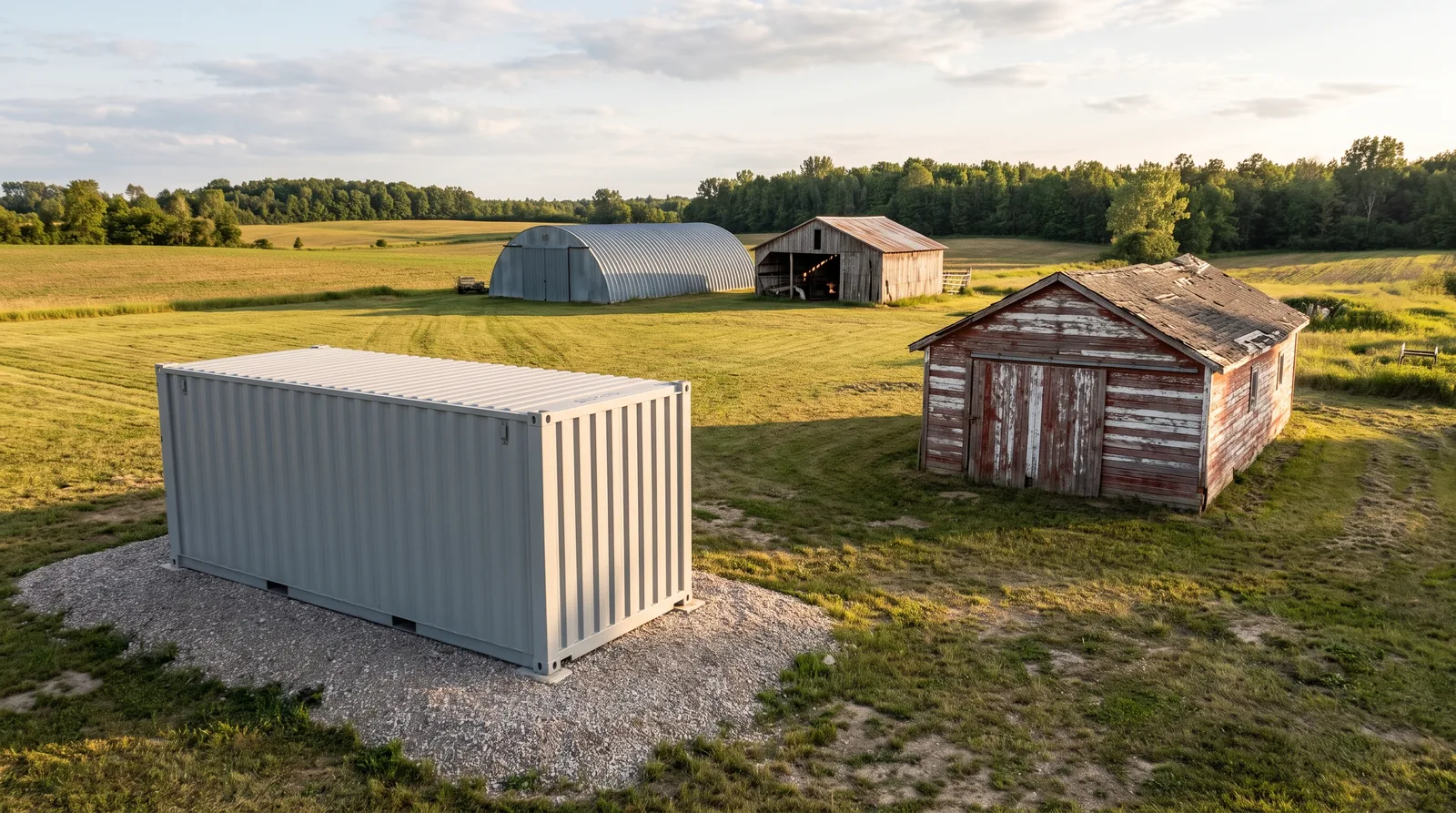
Quick answer. For most Ontario storage and many building bases, a shipping container is the most cost-effective, secure, durable, and movable choice, a sealed Corten steel box that lands ready to use. This guide sets each alternative beside it, from clear-span buildings to the RV at the camp, and shows what the box adds for that same buyer.
Why do Ontario buyers compare shipping containers to other options?
Almost every buyer who calls our Brantford yards has already been pricing something else. A farmer near Norfolk has a pole barn quote sitting on the kitchen table. A contractor in Hamilton is weighing a fabric shelter against a sea can for the jobsite. A couple up near the Kawarthas is deciding between a container and a trailer for the back of the lot. The question is rarely “what is a shipping container,” it is “is the box really the smarter buy than the thing I was about to order?”
That is a fair question, and for most of these jobs the answer is yes. A shipping container, what most Canadians call a sea can or a c-can, is an 8-foot-wide steel box engineered to cross oceans stacked nine high in salt spray. That overbuilt origin is exactly why it makes such a good land-based building. It is also why it can sit on a gravel pad for decades and still lock tight. Laying the box beside each alternative, row by row, is the whole point of this guide.
Paul LeBlanc, owner: “We would rather quote you the right thing the first time.”
Van Blanc has been a family business since 1995, so we have delivered into most of these situations and seen which choice the buyer was happy with two winters later. The rest of this page is built from that, not from a brochure. Industry buyers will see the box logged as an intermodal container or an ISO container; the Ottawa veteran calls it a conex; the farmer calls it a sea can. Same steel, many names, and it sits at the centre of the comparison every time.
What does a shipping container do better than the alternatives?
A shipping container beats most alternatives on four things at once: upfront cost for secure dry space, security, weather durability in Ontario, and the ability to pick it up and move it later. Very few of the alternatives win on more than one of those at a time. The box quietly wins on all four, which is why it keeps landing on so many Ontario properties.

The four places the box pulls ahead
- Security: a 20ft or 40ft unit is welded Corten steel with cargo doors and a lockbox. There is no soft wall, no fabric, no liftable panel. A would-be thief needs tools and time, which is most of the deterrent.
- Weather and snow: the roof and walls are structural steel rated to carry stacked containers. Ontario snow load is a non-event. Wind does not lift it. It does not rot, and it will not blow over in a March storm the way a light shelter can.
- Setup speed: it arrives finished. A tilt-deck truck sets it on a gravel pad or a few blocks and you are storing the same afternoon. No pour, no framing crew, no multi-week build window.
- It moves: when your needs change, a container goes back on a truck and relocates. A poured-foundation building stays where it is forever. If you may want it somewhere else in five years, keep the pad simple and the box stays an asset, not a fixture.
There is a durability number worth holding onto. A well-kept container runs roughly 25 to 30 years in a stationary land application, and the used grades carry real cosmetic honesty. The industry uses four grades, and you should know all four before you buy. One-trip (new) made a single loaded voyage and is essentially new, original paint, doors that swing clean, the right pick if it will be visible from the road or converted. Cargo Worthy (CW) is a used unit re-certified for shipping, structurally sound with surface rust and paint variance. Wind and Watertight (WWT), the grade just below cargo-worthy, is the workhorse used grade: it seals out weather and rodents but is not re-certified for ocean travel, ideal for farm and reno storage. As-Is is the lowest grade, older units with floor or door questions that we carry but rarely recommend unless you know exactly what you need it for. We point out the marks in the yard before you pay. The industry calls a new unit “one-trip” because it made exactly one loaded voyage, that is the synonym worth knowing.
Why steel built for the ocean over-performs on land
Containers are built to ISO 1496 and ISO 6346 standards to be stacked loaded, nine high, on a pitching ship deck, then lifted by crane at the corner castings. The Corten weathering steel resists corrosion, and the CSC plate (Container Safety Convention, 1972) certifies the structure for international transport. On dry Ontario land, with none of that ocean abuse, a container is operating at a fraction of its design stress. That headroom is the durability you are buying. For the complete walkthrough of the full breakdown of container sizes and grades, that guide takes the dimensions and condition tiers further than we can here.
Where do the alternatives differ from a shipping container?
The fixed number on a container is its width: 8 feet inside per unit. Three situations come up when buyers set it against a building, and each one has a container answer worth knowing.
The first is a true wide clear-span: a workshop where you swing a 30-foot truss around, an equipment shed that has to take a combine head-on, an aircraft hangar. A container is 8 feet of interior width per unit. You can place units side by side, and joining two 40ft units into one room gets you to roughly 16 feet with the inner walls cut out and a structural header added. Wider than that is clear-span building work. Inside that width, joined boxes give you a welded steel room on a level pad or piers, with no slab to pour and no framing crew.
The second is a very large single footprint. If you need 2,400 square feet of contiguous covered space, steel kits and big post-frame barns are designed to put that much area under one roof, with the engineered foundation and the build window that come with it. Containers work in modules: one or two boxes cover the part of the job that has to lock, they land finished, and each one keeps its resale value if the plan changes.
The third is true living comfort. If you want to sleep, cook, shower, and relax with the plumbing and the layout of an RV, a recreational vehicle comes with that layout built in. A container conversion starts as a steel shell that does not rot and locks when you leave, and the insulation, windows and man doors go in at the yard before delivery.
How do the options compare at a glance?
Here is the master comparison. Read it as relative, not absolute: “lower” or “higher” is each option against the others in this table, and nothing in it is a dollar figure because the honest number depends on size, grade, your postal code, the season, and the steel market on the day. The “best when” column is the one most buyers should read first.
| Alternative | Relative upfront cost | Lifespan in Ontario weather | Security | Snow / weather resistance | Foundation / site prep | Portability | Setup speed | Best when |
|---|---|---|---|---|---|---|---|---|
| A wood-post pole barn | Low per sq ft at large size | Long if maintained; posts can rot | Low (wood walls, big doors) | Good if engineered for local snow load | Posts set in ground or piers | None (permanent) | Slow (weeks, framing crew) | Large covered farm space for bulky, low-theft contents |
| An arched quonset hut | Moderate shell; extras add up | Long (40 to 50 yr steel) | Moderate (steel, end-wall doors) | Strong arch sheds snow well | Engineered slab or footings | None (permanent) | Slow (kit erect + foundation) | Wide clear-span on an engineered foundation |
| A bolt-together steel building kit | Higher installed than sticker | Longest (40 to 60+ yr) | Moderate to high | Engineered to local code | Engineered slab required | None (permanent) | Slow (foundation + assembly) | Large finished or occupied footprint |
| A fabric portable garage | Lowest | Short (fabric degrades, UV) | Very low (zip or fabric walls) | Weak under Ontario snow load | Stakes or light anchors | Semi (takes down, not durable) | Fast (a day) | Cheap temporary cover, mild season |
| A tensioned sprung structure | Moderate to high | Membrane wears; frame lasts | Low to moderate | Good clear-span snow shedding | Ballast or anchored footings | Relocatable (engineered to move) | Moderate (faster than slab build) | Big relocatable clear-span cover |
| A road storage trailer | Low to moderate (often rented) | Shorter (thinner steel, running gear) | Moderate (raised, road doors) | Fine, but raised deck = ramp/lift | Lands on its own wheels/jacks | High (it is a trailer) | Fast (drop and go) | Short-term or frequently moved storage |
| An RV parked at the hunt camp | Moderate to high | Short for year-round; built seasonal | Low (windows, thin walls) | Poor in deep winter (freeze risk) | Levelling blocks / pad | High (drive or tow it) | Fast (park it) | Real living comfort, seasonal use |
| A finished prefab cabin | Highest (finished space) | Long (built as a dwelling) | Moderate (residential doors/windows) | Built to dwelling code | Piers or slab | None to low (craned, then fixed) | Moderate (delivered finished) | Turn-key small dwelling, no conversion work |
| Two 40ft boxes welded side by side | Moderate (two boxes + cut/header) | Long (25 to 30+ yr steel) | High (steel, lockable) | Excellent | Level pad / piers | Low once joined (was movable) | Moderate (conversion at the yard) | ~16 ft wide secure room without a full building |
| One large building (single clear-span) | High | Longest (engineered) | Moderate to high | Engineered to code | Engineered slab | None (permanent) | Slow | Maximum single open footprint |
| Shipping container (the box) | Low for secure dry space | 25 to 30 yr stationary | Highest (welded steel + lockbox) | Excellent (rated to stack) | Gravel pad or blocks | High (goes back on a truck) | Fastest (lands ready) | Secure, durable, movable storage and many build bases |
Run your eye down the container row and the pattern is plain. It is rarely the single best on any one row, the prefab cabin is more comfortable, the steel kit lasts longer, the trailer moves more easily. It is the option that scores well on every column at once, with no soft spot, for the price of secure dry space. That balance is why it is the default recommendation for the majority of Ontario buyers.
Ready to price the box against your quote?
Tell us the size, the grade, and your postal code, and we will send back an honest, all-in number, container, delivery, and placement, usually the same day. The fastest answer is a call: describe the job over the phone and we will size the box with you on the spot.
Family-run in Brantford since 1995 · fast 1-3 day delivery to every region across Ontario from our 4 Brantford yards · 4.9★ across 140+ verified Google reviews · every box graded by a person, walk it before it lands.
What each alternative does, and what the box adds
Each alternative in its own terms, followed by what a container brings to the same buyer.
The pole barn: large covered area
When a buyer needs a lot of roof over a lot of dirt floor, hay, machinery, livestock, a wood-post pole barn is built to cover a big footprint. The trade-off is security (wood walls, big sliding doors), and the posts want maintenance against rot and pests over the decades. A container beside the barn takes the part the barn cannot lock: tools, fuel, seed and parts, behind welded steel and a lockbox. We lay out the head-to-head in the dedicated pole barn comparison.
The quonset and the steel kit: clear-span and lifespan
An arched quonset hut and a bolt-together steel kit both give you something a container physically cannot: a wide, column-free interior under one roof, with a 40-to-60-year steel lifespan. For a 40-by-60 workshop or an equipment building, these structures are built for the span. The honest caveat is the sticker is the shell only, the engineered foundation, doors, insulation, and labour are real added cost, and the build runs weeks, not an afternoon. A container skips the slab and the build window: it lands finished, locks the same day, and goes back on a truck if the plan changes.
The fabric shelter and sprung structure: speed and span (with caveats)
A fabric portable garage is the cheapest, fastest cover you can buy, fine for a mild-season car port or temporary equipment shade. Be clear-eyed about Ontario: fabric degrades in UV and the snow load is a real risk, so this is short-term cover, not a 20-year answer. A tensioned sprung structure is the grown-up version: a big relocatable clear-span engineered to shed snow and built to cover a wide area that may move later. Neither offers the lock-it-and-leave security of welded steel.
The trailer and the RV: movement and comfort
A road storage trailer is built for storage that moves often: drop it, fill it, tow it to the next site. It rides on its own running gear, so there is no crane and no pad. The trade is a raised deck (you need a ramp or a lift), thinner steel, and a shorter service life. An RV is built around living comfort: a built-in kitchen, a bed, a bathroom, climate control sized for a person, not a pallet. It also brings seals, plumbing and thin walls that need tending through a deep winter. A container at the same camp sits through the freeze with no plumbing to split, keeps the gear behind welded steel, and can be insulated and fitted with windows or a man door at the yard if you want to spend nights in it.
The prefab cabin: finished space with zero conversion
A finished prefab cabin arrives as a small dwelling: insulated, wired, drywalled, ready to occupy. If you want living space with no conversion to manage, that is what it is built for. It costs the most because you are buying finished square footage, and it does not relocate the way a box does. A container costs less to start, sits on blocks or a gravel pad, and can take insulation, windows and doors at the yard before it is delivered.
For buyers who pick the container, the box does a lot. The conversion work, venting, lockboxes, roll-up doors, man doors and windows, insulation, office and retail build-outs, happens at the Brantford yards under engineered drawings before delivery. If your build needs any of that, here is the conversion work we do before delivery. For systems that licensed trades must certify, gas, final electrical connections, exhaust hoods, we rough-in and document, and your trades complete and certify on site. We are straight about that split.
Which option is right for your use case?
Strip away the noise and the decision usually comes down to four questions. Answer them honestly and the table above points you to the right row almost every time.

Four questions that pick the option for you
- How wide does the room need to be? One box gives you 8 feet of clear width and two joined give you about 16. Inside that, the box or the joined pair gives you a steel room on a simple pad; past it, you are into clear-span building work.
- Does it need to be secure? If theft matters, welded steel beats fabric, wood, and most alternatives outright. The container is the most secure thing on this page.
- Might you move it later? If yes, a container or a trailer keeps its value as a movable asset. A poured-foundation building does not move.
- Is it for living, or for storing and working? RVs and prefab cabins come with the living layout built in. For storage, a workshop base, a jobsite office, or a secure shell to convert into living space, the container leads.
The Norfolk farmer storing equipment and feed wants a WWT 40ft sea can on a gravel pad, done. The Hamilton contractor who needs a lockable jobsite office that moves with the project wants a container, not a fabric shelter. The buyer planning a 50-foot equipment building still has tools and parts that need a lock, and a box beside the building holds them. The family with a seasonal camp gets a steel shell that rides out the winter with no pipes to freeze and no window to break. Different buyers, different boxes, and they tend to end up at the same family yard. If you would rather not guess, browse what we have in the yard or send us your job and your postal code and we will work it out with you. Every quote comes with a real lead time, not a hopeful one.
Comparisons beyond buildings: everything people buy instead of a container
Structures are only half the story. Ontario buyers also price containers against wheels, rentals, and the monthly storage they are already paying for. Each page below is a complete, honest comparison written for the moment that decision actually gets made.
Wheels, rentals, and other structures
- Enclosed trailer vs shipping container
- Cube van box vs shipping container
- School bus (skoolie) vs shipping container
- Office trailer alternative
- Reefer trailer vs reefer container
- Food trailer vs container kiosk
- Park model vs container cabin
- Bunkie vs shipping container
- Drive shed storage alternatives
- Guard shack and gatehouse options
- Job box vs shipping container
- Bin rental vs storage container
Homes, hobbies, and the barn
- Rowing shell and paddling club storage
- Classic car storage at home
- Motorcycle and snowmobile storage
- Ice hut and winter gear storage
- Tire storage for auto shops
- Tack room and hay storage
- Christmas tree farm storage
- Wild game cold storage for hunt camps
- Taxidermy studio storage
- Indoor bee wintering rooms
- Cheese aging caves
- Charcuterie curing chambers
- Distillery and cidery barrel rooms
- Mushroom fruiting rooms
- Microgreens vertical farms
- Vermiculture worm rooms
- Museum and archive overflow storage
- Archaeological artifact curation
- Green coffee storage for roasters
- Screen-printing emulsion storage
- Tool library storage
- Makerspace storage and security
- Fire-training base units and props
- Records storage
- Student summer storage
Businesses and organizations
- 3PL and warehouse overflow
- Print-shop paper storage
- Seasonal business storage
- Landscaping company depots
- Event equipment storage
- Restoration pack-out storage
- Estate cleanout staging
- Nonprofit and community storage
- Repair cafe home-base storage
- Municipal procurement
- Mobile veterinary base units
- Emergency supply caches for municipalities
- Market garden wash-pack
- Short-term rental host storage
Frequently asked questions
Is a shipping container cheaper than a pole barn or metal building in Ontario?
For secure, dry, lockable space, a container is usually the lower upfront cost, especially per usable square foot at small to medium sizes. At very large footprints, pole barns and steel kits are priced by the square foot of roof and come with an engineered foundation and a build crew; a container is priced by the box, lands finished, and keeps its resale value. The box prices are on the yard price list, and the delivered number depends on your postal code, so call the yard for a same-day figure.
How long does a shipping container last compared to a building?
A well-maintained container runs roughly 25 to 30 years in a stationary Ontario application. A galvalume steel building or a quonset can reach 40 to 60-plus years. The container’s advantage is not the longest life on the list, it is excellent durability for the price of secure storage, with the bonus that it can be moved or resold rather than demolished.
When do buyers compare an alternative with a shipping container?
Three cases come up most. One: a clear-span room over about 16 feet across, which is quonset, steel kit or sprung structure work; inside 16 feet, one box or two joined gives you a steel room on a simple pad. Two: a very large single footprint, where a container beside the building holds what needs a lock. Three: RV-style living, where a container starts as a steel shell that is insulated and fitted with windows and doors at the yard before delivery.
Is a shipping container more secure than a trailer or a fabric shelter?
Yes, by a wide margin. A container is welded Corten steel with cargo doors and a lockbox, no soft walls and no liftable panels. A fabric portable garage has zip or fabric walls, and a storage trailer has thinner steel and a raised deck. For anything theft-sensitive, the steel box is the most secure option on this page.
Can a shipping container give me a wide open room like a building?
One unit is 8 feet wide inside, which is the box’s main limit. You can place units side by side and join two 40ft containers into roughly a 16-foot-wide room by cutting the inner walls and adding a structural header, conversion work we do at the yard. Past about 16 feet of clear width you are into clear-span building work; up to that width, joined containers give you a lockable steel room on a level pad or piers.
What site preparation does a container need versus a building?
A container needs far less. A level gravel pad or a few concrete blocks at the corners is enough for most placements, and a tilt-deck truck sets it in an afternoon. Pole barns, quonsets, steel kits, and prefab cabins generally need engineered footings or a poured slab and a multi-week build window. If you might relocate the unit later, keep the pad simple so the box stays easy to move.
Do you deliver containers across Ontario, and how fast?
We deliver fast 1-3 day delivery to every region across Ontario from our 4 Brantford yards. Eastern Ontario and the far north can run a little longer on freight, and we quote that per route honestly. Van Blanc is an Ontario operation; for anything leaving the province you would arrange a third-party carrier. Delivery of the container you buy is part of our service, placement included.
What is the cheapest way to add secure storage this month?
For most Ontario properties it is a used Wind and Watertight container: it arrives finished, needs only level footing, and is lockable steel the day it lands. Kits and builds add foundation and assembly costs before the first item goes in; the box starts working immediately and keeps its resale value.
Sources & References
Authoritative external sources cited or referenced in this guide: