
Quick Answer: Containerized burn props are a category, but a raw container is not one. NFPA 1402 requires engineered drawings, thermal lining, two egress routes per burn room, and five-year re-inspection. Van Blanc supplies base units and non-burn props; we never build or certify live-fire structures. Base units ship in 1-3 days.
In This Guide
Reading Time: 10 minutes
The Honest Fork, Stated First
We are a container supplier, and this is the one container-use page we open by telling you what we will not sell you. Firefighter live-fire training is a category where getting the honesty wrong gets people hurt, so here is the fork before anything else. Containerized burn buildings and flashover simulators are a legitimate, established product, and departments across North America use them. They are also engineered, thermally lined, professionally designed structures built and certified by specialists. A standard shipping container is the raw steel some of those props start from. It is not, by itself, a training prop, and no one should ever light a live fire inside an unmodified box.
What we will sell a department is structurally sound base steel, and grade is the entirety of that conversation.
So Van Blanc’s role is specific and we will not overstate it. We supply base container units to departments and to the specialist manufacturers who convert them, and we build the non-burn training props and storage a department also needs. We do not build burn cells, we do not certify anything to NFPA, and we will point you to the engineers and specialist builders for the parts that are theirs. Everything below explains that line so a training officer can use this page to plan honestly.
What NFPA 1402 Actually Requires
The governing document is NFPA 1402, Standard on Facilities for Fire Training and Associated Props, in its 2019 edition; the older 2012 edition carried the title Guide to Building Fire Service Training Centers, which is why departments sometimes still call it the guide. Whatever it is called, it sets the bar that separates a training structure from a steel box, and the bar is high on purpose.

| NFPA 1402 requirement | What it means for a container-based prop |
|---|---|
| Professional engineer design (7.5) | An engineer must design the prop for vertical, horizontal, and foundation loads, stacked or not. Not a shop drawing, a stamped one. |
| Two means of egress per burn room (10.3) | Every room a fire is set in needs two ways out, a requirement shared with NFPA 1403. |
| Thermal lining | Burn cells are lined to endure repeated exposures; bare Corten steel is not built to take live fire. |
| Five-year re-inspection | The interior structure must be re-inspected on a five-year cycle to certify it is still safe to train in. |
| Flashover simulation design | Simulators are engineered so crews can watch rollover build to flashover by varying fuel load and ventilation, safely. |
Read that list and the reason a container alone fails it is obvious: every line is engineering and certification, not steel. The box can be an input to a compliant prop. It cannot be the prop.
Why a Raw Container Is Not a Burn Prop
The fire service has documented the hazards of untreated container burns in its own trade press for years, and they are not abstract. Bare steel conducts and radiates heat in ways a lined burn room is engineered to control, so temperatures and fire behaviour inside a raw box do not match the structures crews are supposed to learn on. Repeated uncontrolled heating fatigues the steel and the welds invisibly. And a box with one door is a box with one way out, which is precisely what NFPA 1402 and 1403 forbid for a burn room.
Christian LeBlanc, second-generation operator: “We get the call now and then: can you sell us a 40 we can burn in. The honest answer is we can sell you the 40, and then you take it to the people who engineer burn cells, because that part is not ours and it is not something to improvise with a crew inside.”
None of this means a container has no place in the training yard. It means the live-fire part belongs to engineers and specialist builders, full stop, and the honest supplier says so before taking the order.
Where a Container Supplier Honestly Fits
With the burn line drawn clearly, there is real and useful work a container supplier does for a training program. The specialist manufacturers who build compliant burn props start from base container units, and departments buying those props are, at the root, buying engineered conversions of the same steel we sell. Supplying clean, structurally sound base units to those builders, or to a department that has its own engineer, is squarely our lane.
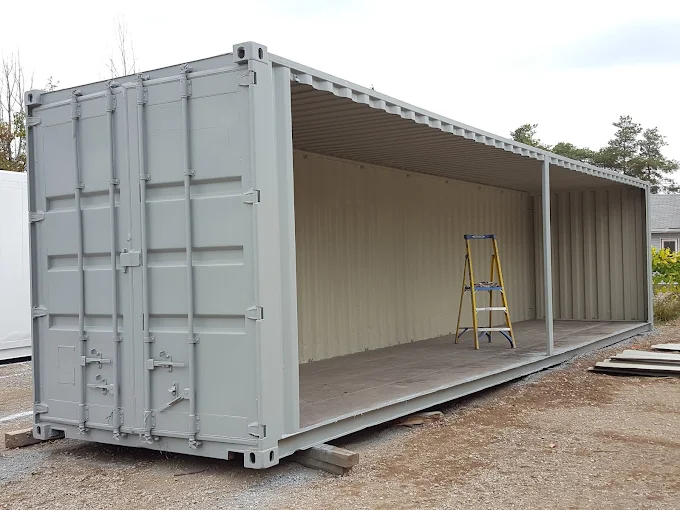
The grade conversation matters here more than usual. A base unit destined for engineering into a prop wants sound structure and honest disclosure of its condition, which is exactly how we grade every unit anyway. We will walk the frame and floor with the buyer and tell them plainly what they are getting, because an engineer designing loads onto that box needs the truth about its starting condition. Our plain-language guide to the four grades covers what cargo-worthy and the rest actually mean.
The Non-Burn Props We Can Build
Most of a fire-training curriculum is not live fire, and the non-burn props are ones we can honestly build in our conversion bay. This is where a department gets real value from a container supplier without anyone pretending steel is engineered fire structure.
Training Props Within Our Scope
Forcible-entry doors and prop walls for repetitive tool work. Confined-space and search-and-rescue mazes with reconfigurable interior baffles for zero-visibility crawls. Breach-and-shore walls for structural-collapse practice. Ventilation-cut roof props at ground level. Equipment and turnout-gear storage, and a secure base for the department’s training tools between drills. All fitted at the yard, none of it involving live fire.
These builds use the same modification skills we bring to any container conversion: cutting doors and openings, welding in reinforcement, fitting reconfigurable interiors. A confined-space maze in a 40ft high cube gives a crew a repeatable, lockable, weatherproof training environment for a fraction of a built structure, and it is genuinely ours to build and stand behind.
Base Units and Non-Burn Props, Built Straight
Tell us what the training program needs. We will quote clean base units and the non-burn props we build, and point you to the engineers for anything live-fire, all in one honest conversation.
Buying Base Units for a Training Program
For a department or a specialist builder sourcing base units, the practical notes are short. Buy on structure, not looks: an engineered prop cares about frame, floor, and corner-casting integrity, not paint, so cargo-worthy grade is usually the honest floor. Buy the size the design calls for; burn and maze props commonly start from 20ft and 40ft units, and stacked designs need the engineer’s load numbers before anyone orders. And build the five-year re-inspection into the program calendar from day one, because a training prop is a structure with a maintenance life, not a purchase that ends at delivery.
Base units ship province-wide in one to three days, and multi-unit orders for regional training centres are ordinary work here. If you are comparing a container-based approach to a fully built training structure, the hub that weighs a container against the alternatives frames the trade-offs, though for live-fire specifically the deciding voice is your engineer and your provincial fire-training authority, not us. Departments are welcome to walk our yard and inspect base units in person before committing; a training officer with a flashlight and a straightedge is exactly the buyer we want.
Frequently Asked Questions
Can you use a shipping container for live-fire training?
Only after it is engineered and built into a compliant prop by specialists. NFPA 1402 requires professional-engineer design, thermal lining, two egress routes per burn room, and five-year re-inspection. A raw, unmodified container is not a burn prop and should never have a live fire set inside it.
Does Van Blanc build burn buildings or flashover simulators?
No. We supply base container units to departments and to the specialist manufacturers who engineer and certify burn props, and we build non-burn training props. We do not build or certify live-fire structures, and we will point you to the right engineers for that work.
What does NFPA 1402 require for container training props?
Engineered drawings by a professional engineer for vertical, horizontal, and foundation loads; thermal lining in burn cells; two means of egress from every burn room; and re-inspection every five years to confirm the interior still holds structural integrity for training use.
What training props can a container supplier actually build?
Non-burn props: forcible-entry doors, confined-space and search-and-rescue mazes, breach-and-shore walls, ground-level ventilation-cut props, and secure equipment and turnout-gear storage. All of these are honest container-conversion work with no live fire involved.
What grade of container should a burn or training prop start from?
Structure matters more than cosmetics, so cargo-worthy is usually the honest floor: sound frame, floor, and corner castings that an engineer can design loads onto. We disclose each unit’s real condition because the engineer needs the truth about the starting steel.
Sources
- National Fire Protection Association. (2019). NFPA 1402, Standard on Facilities for Fire Training and Associated Props. nfpa.org
- Fire Engineering. The Use of Shipping Containers in Live Fire Training. fireengineering.com
- Fire Apparatus and Emergency Equipment. Should You Build Your Own Live-Fire Training System?. fireapparatusmagazine.com
- Office of the Fire Marshal and Emergency Management, Ontario. Firefighter training and certification. ontario.ca
- International Organization for Standardization. (2020). ISO 668, Series 1 freight containers: classification, dimensions and ratings. iso.org
Reach Van Blanc in Brantford
We have supplied containers across Ontario since 1995, including base units for conversion and honest non-burn training builds. Bring your training officer, your engineer, or just the plan, and we will tell you plainly what is ours to build and what belongs to the specialists.
Van Blanc Ent. Inc., 90 Morton Ave E Unit 1B, Brantford, ON N3R 7J7. +1 888-509-6658
Fire departments and regional training centres are welcome to inspect base units at the yard before committing to a build.