
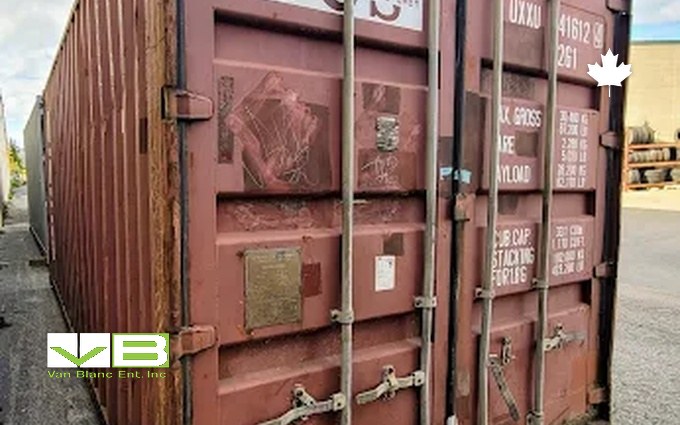
Quick Answer: Corten steel is a copper, chromium, nickel and phosphorus alloy that rusts on purpose, forming a tight patina that then seals and protects the metal underneath it. The patina only stabilises where the steel gets wet and then dries out again. Shipping containers are built from it, grade COR-TEN A.
In This Guide
- What Corten Steel Actually Is
- How the Patina Works, and What It Needs From You
- Case Study: The Building That Proved It (1964)
- Case Study: The Building That Disproved It (1972)
- The Chloride Problem, and Ontario’s Version of It
- Your Container Is Made of This
- Reading Rust: Patina, Scale, and Trouble
- Siting a Container So the Steel Can Do Its Job
- The Runoff Stain Nobody Warns You About
- Paint It or Leave It?
- Corten Steel FAQs
Reading Time: 16 minutes
What Corten Steel Actually Is
Corten steel is structural steel that has been alloyed to rust in a useful way. The name is a contraction of two properties its makers were selling: CORrosion resistance and TENsile strength. United States Steel trademarked COR-TEN in 1933, which makes the material older than almost everyone now arguing about it on design forums.
Ordinary carbon steel rusts in flakes. That rust is porous, it lifts off the surface, and every flake that falls away exposes clean metal for the weather to attack next. The corrosion never stops because the corrosion never seals. Corten changes the chemistry by adding modest amounts of copper, chromium, nickel and phosphorus to the melt. Those elements cause the first rust that forms to be dense and tightly bonded rather than flaky, and once that layer is in place it behaves like a coat of paint the steel grew for itself. Engineers call the whole family weathering steel; Corten is the brand that became the generic word, the way people say Kleenex.
This matters in our yard for one blunt reason: shipping containers are built out of it. Every used sea can in our Brantford rows is a weathering-steel structure that has already spent years proving the concept at sea. (The vocabulary itself, sea can, c-can, conex, has its own history page.) When a buyer asks whether the rust on a container is a problem, they are really asking a Corten question, and the honest answer depends entirely on which kind of rust they are looking at. That distinction is what this guide is for.
Paul LeBlanc, Van Blanc: “People see rust and think failure. In nineteen years in containers I have condemned very few bins for the rust you can see, and quite a few for the rust you cannot. The orange flank in the yard is usually the box doing exactly what it was designed to do. The trouble is always where water sat and never dried.”
How the Patina Works, and What It Needs From You
The protective layer is neither instant nor automatic. It is a process with a requirement, and the requirement is the part most articles skip.
The steel needs alternating wet and dry cycles. Rain wets the surface, the surface dries, and each cycle draws the rust layer tighter and denser. Run that loop for roughly six to nine months in an ordinary climate and the colour walks from bright orange, through red-brown, into the deep chocolate brown architects pay for. The patina is not finished at that point so much as settled: it goes on tightening for years, which is why decades-old weathering steel looks darker and more even than a panel installed last spring, and why a one-trip box and a cargo-worthy box read so differently in the same row.
Break the cycle and you break the material. Steel that stays permanently wet never gets the drying half of the equation, so the layer never densifies and corrosion simply continues. This is the single most useful thing a container owner can know, and it explains nearly every rust failure we see in Ontario yards. A container is not damaged by weather; it is damaged by trapped weather. Water pooling in a dented roof low spot, a bottom rail buried in gravel or long grass, snow banked against a wall until April, a tarp holding condensation against the steel: those are the four ways an owner accidentally cancels the material’s warranty on itself.
The One-Sentence Rule
Corten protects itself wherever it can dry out, and fails wherever it cannot. Every siting decision, maintenance habit, and inspection on the rest of this page is a restatement of that one sentence.
Case Study: The Building That Proved It (1964)
The material’s reputation was built by one project. In 1964 the John Deere World Headquarters opened in Moline, Illinois, designed by Eero Saarinen, who died before it was finished. Saarinen chose weathering steel because his client was a farm-machinery company and he wanted a building the colour of worked earth and implements left in a field. It was among the first major architectural structures clad in the material, and it turned a niche industrial alloy into an architectural movement.
The relevant fact for a container buyer is not the design history. It is the duration. That building has stood in the American Midwest for roughly sixty years, through humid summers and hard freezing winters, and the steel is still doing its job. Midwest Illinois is not a gentle test. What it is, and this is the point, is a climate that lets the steel dry out between weather events, the same cycle an Ontario freeze-thaw winter runs at a harder pace.
Sixty years of service is the number worth carrying into any conversation about a used container. When someone tells you a rusty-looking steel box has a short life ahead of it, the material itself says otherwise, provided the conditions are right. Our own writing on how long these boxes actually last reaches the same place from the yard side rather than the architecture side.
Case Study: The Building That Disproved It (1972)
Honesty requires the other case, and it is just as famous. The Omni Coliseum opened in Atlanta in 1972, designed by TVS Design, clad in the same fashionable weathering steel. It did not reach sixty years. It did not reach thirty. Holes formed in the structure, the rust never stabilised into a protective layer, and the arena was demolished after roughly twenty-five years.
The cause was climate plus detailing. Atlanta is humid, and the building kept surfaces damp rather than letting them cycle dry. Without the drying half of the loop the patina never densified; it just kept eating. Two buildings, the same material, eight years apart, and a service life differing by more than a factor of two, decided almost entirely by whether the steel got to dry; the ventilation a container needs is the same lesson at yard scale.
What the Two Buildings Teach a Container Buyer
- The material is not the variable. Both projects used weathering steel from the same era of metallurgy. One is sixty years old, the other lasted twenty-five.
- Drying is the variable. Moline cycles wet to dry. Atlanta’s humidity and detailing kept it wet.
- Detailing beats specification. Where water can sit, weathering steel behaves like ordinary steel with extra steps.
- Applied to your purchase: the grade on the invoice matters far less than where you set the box and whether its roof drains. A cargo-worthy bin on a bad pad will outlive nothing.
The Chloride Problem, and Ontario’s Version of It
One chemistry defeats weathering steel regardless of how well it dries: chloride. Salt.
When chloride ions land on the surface continuously, the rust that forms is not the tight protective oxide but a different mineral, akaganeite, which is non-adherent. It does not bond, it does not seal, and it actively prevents the good inner layer from establishing. The steel then corrodes roughly the way plain carbon steel would, minus the benefit anyone paid for. This is why structural-steel guidance is blunt about the coastline: as a rule of thumb, unpainted weathering steel is avoided within about two kilometres of the sea, and within roughly five hundred metres of breaking surf the patina may never form at all. Marine exposure is workable only where chlorides get washed off regularly, which is a maintenance promise most owners will not keep; the maintenance calendar we suggest puts that rinse on it.
Ontario has no surf. Ontario has something the architectural literature never discusses, because that literature is written in places that do not do this: we salt our roads for five months a year.
Road Salt Is Our Coastline
Inland Ontario manufactures its own chloride problem every winter. Brine spray off a county road drifts further than people expect. A plow throws salted snow into a bank, and that bank sits against the side of a container until April, holding chloride against steel that cannot dry. A container parked at the end of a laneway that gets salted, or beside a commercial lot that gets salted heavily, sits in a more aggressive chloride environment than plenty of buildings a coastal engineer would refuse to specify.
The fix is not exotic. Do not let salted snow pile against the walls. Keep the box back from the plow’s throw line if you have the room. And if one flank does take a winter of brine, rinse it in spring. That takes ten minutes with a garden hose and is the highest-value maintenance any Ontario container owner can perform.
Your Container Is Made of This
Shipping containers use the phosphorus-bearing grade, COR-TEN A, most often designated SPA-H under the Japanese standard JIS G3125 and belonging to the same family as ASTM A242 Type 1. This is not a marketing detail. It is the reason a steel box can sit in salt air on the deck of a ship for a decade and come off the vessel structurally intact, which is what the CSC plate on the door is certifying.
The thicknesses are worth knowing, because they explain where problems appear and where they do not:
| Component | Typical thickness | What that means in the yard |
|---|---|---|
| Side and end walls, roof | 1.6 to 2.0 mm | The thinnest steel on the unit. Roof low spots that hold water are where a through-hole appears first |
| Doors | 2.0 to 2.5 mm | Heavier than the walls, which is why doors usually survive. Door problems are gaskets and hinges, not steel |
| Floor frame and cross members | 4.0 to 4.5 mm | More than twice the wall thickness. This is the structure, and it is why a cosmetically ugly box can still be perfectly sound |
Read that table next to the two case studies and the whole inspection logic falls out of it. The roof is thin and horizontal, so trapped water does its damage there first. The frame is thick and either vertical or sheltered, so the frame keeps its structural life long after the paint looks tired. When we walk a buyer through the rows and they ask which rust matters, we are applying exactly this: thin steel plus standing water is a real question, thick steel plus surface bloom is a cosmetic one. The grade definitions we publish sit on top of this physics rather than replacing it.
Reading Rust: Patina, Scale, and Trouble
Three different things on a container all get called rust, and telling them apart is most of a competent inspection.
The Three Rusts
- Patina (good). Even, tight, dark orange through brown. Rub it with a thumb and you get a light dusting of colour at most, with firm surface underneath. This is the material working, and on a used box it is the normal condition of every panel that faces weather.
- Scale (watch it). Flaking, layered, lifts in plates when pressed, usually around a dent, a weld, or a scratch that broke the original coating. Scale means that spot has been staying wet. It is repairable, and it is a bargaining point rather than an automatic rejection. (Heavy scale at a bargain price is the start of the As-Is grade conversation.)
- Perforation (the real problem). Pinholes or soft spots, almost always on the roof or along the bottom rail where the box has sat in vegetation or gravel. Tap it: sound steel rings, compromised steel thuds. Daylight through the roof from inside a closed container ends the conversation.
The inspection order that follows from the thickness table is roof first, bottom rail second, walls third, doors last. Most buyers do the reverse, because doors and walls are what they can see from the driveway. Our replacement-threshold guide works through where the line sits between a unit worth repairing and one worth retiring.
Siting a Container So the Steel Can Do Its Job
Everything above reduces to a placement checklist. This is the part that decides whether your box is a twenty-five-year story or a sixty-year one.
Five Placement Rules Drawn Straight From the Metallurgy
- Lift the bottom rail off grade. Railway ties, concrete blocks, or a proper gravel pad under the corner castings. (Full pad recipes are in the site prep guide.) A bottom rail sitting in soil or long grass is permanently wet by definition, which is the Omni failure in miniature.
- Give the roof somewhere to send water. Set the unit with a slight fall so rain runs off rather than ponding in the corrugations. On a dead-level pad, a dented roof becomes a birdbath over the thinnest steel on the box.
- Leave air on all four sides. A container tight against a fence, hedge or building has a face that never dries. Half a metre of airflow is cheap insurance.
- Keep salted snow off the walls. The Ontario rule above. If the plow throws toward the container, move the container or move the pile.
- Do not tarp or shrink-wrap it long term. A cover that traps condensation against steel holds moisture exactly where you least want it. Ventilation beats wrapping every time.
None of this costs meaningful money at delivery. All of it is expensive to retrofit once a roof has started weeping, which is why we talk through pad and orientation on the phone before a truck is booked rather than after.
The Runoff Stain Nobody Warns You About
One consequence of weathering steel surprises people badly enough to deserve its own section: while the patina is still forming, it bleeds.
For the first months of wet-dry cycling, rain running off the steel carries fine rust particles with it, and whatever that water lands on gets stained. Concrete pads, interlock, patio stone, light siding, gravel and decking all pick up an orange cast ranging from noticeable to permanent depending on the surface. Architects design for this with drip edges, gravel margins and sacrificial gutters. Container owners almost never think about it until a new driveway is freckled.
The practical answers are simple. Set the box so runoff lands on grass, soil or gravel rather than concrete. Expect the worst of the bleeding in the first season and much less afterward. And if the unit is going somewhere visually sensitive, decide about coating it before it arrives rather than after the first rain. That decision is the next section, and it is the honest reason our paint and cladding guide exists.
Paint It or Leave It?
Because the steel protects itself, painting a container is a choice rather than a maintenance requirement, which is the opposite of how it works with ordinary steel. The decision splits cleanly on what the box is for.
Leave it bare when the unit is a working asset in a working place: a farm yard, a laydown area, a construction site, the back of an industrial lot. The patina is free protection, it needs no recoating schedule, and a weathered flank is honestly the best thing a working container can look like. Bare is also correct where the box may be resold or relocated, since a coating hands the next owner a maintenance obligation.
Coat it in three situations. First, when appearance is the point: a unit visible from the road, near a house, or part of a retail or hospitality build. Second, when runoff staining would land on something you care about and cannot be redirected. Third, and most important here, when the box lives in a chloride environment, which in Ontario means heavy road-salt exposure. Where chlorides prevent a stable patina, a coating does the job the patina cannot, and that is an engineering reason rather than an aesthetic one.
What we would not do is paint a container because rust appeared and someone panicked. Read the three rusts first. Painting over active scale without preparing the surface traps the problem and hides it from the next inspection, which is a worse outcome than the orange flank anybody was worried about.
Want the Steel Read Before You Buy?
Tell us where the unit is going, what it will hold, and whether that spot gets salted in winter. We will match a grade to those conditions and send back an honest, all-in number with a real lead time, not a hopeful one. Better still, walk the rows with us in Brantford and we will show you the difference between patina and a problem on real steel.
Van Blanc Ent. Inc. · Family-run since 1995 · 4.9 stars across 140+ Google reviews · Fast 1-3 day delivery across Ontario from our Brantford yards
Sixty years in Moline, twenty-five in Atlanta, the same alloy in both. The steel was never the variable, and it is not the variable in your yard either. Set the box where water leaves and salt does not gather, and the material will quietly outlast the argument about whether rust is bad.
Corten Steel FAQs
What does Corten steel mean?
It is a contraction of the two properties United States Steel trademarked in 1933: CORrosion resistance and TENsile strength. The generic engineering term is weathering steel. Copper, chromium, nickel and phosphorus in the alloy make the first rust dense and tightly bonded instead of flaky, so it seals the surface rather than shedding off it.
How long does the patina take to form?
Roughly six to nine months of ordinary weather takes it from bright orange through red-brown to a settled dark brown, and it keeps tightening for years after that. The requirement is alternating wet and dry cycles. Steel that never dries out never develops the protective layer at all.
Does road salt damage a shipping container?
Yes, and in Ontario it is the main chloride risk. Chlorides produce a non-adherent rust that blocks the protective layer from forming, so brine spray or plowed salt-snow held against a wall all winter makes weathering steel behave like plain steel. Keep salted piles off the sides and rinse an exposed flank in spring.
Is rust on a used shipping container a problem?
It depends which rust. Even, tight, dark surface patina is the material working as designed. Flaking scale that lifts in plates means that spot stays wet and is worth pricing in. Pinholes or soft spots, usually on the roof or bottom rail, are the real fault. Tap it: sound steel rings, compromised steel thuds.
Will a Corten container stain my driveway?
While the patina is still forming, runoff carries rust particles and will stain concrete, interlock and light siding. Bleeding is heaviest in the first season and eases afterward. Site the unit so water sheds onto grass or gravel, or decide on a coating before delivery rather than after the first heavy rain.
Do I need to paint a shipping container?
Not for protection in normal inland conditions, since the patina does that job for free. Coat it when appearance matters, when runoff would stain something you care about, or when the unit sits in heavy road-salt exposure where a stable patina cannot form. Never paint over active scale without preparing the surface first.
Sources
- Zahner. (2024). Weathering Steel Guide Part 1: The History of COR-TEN Steel. the metal fabricator’s history of the alloy
- Wikipedia contributors. (2025). John Deere World Headquarters. the Saarinen building’s record
- Atlanta History Center. (2025). Site of the Omni Coliseum. the Omni’s history and demolition
- SteelConstruction.info. (2025). Weathering steel: durability and environmental limits. the structural engineering guidance on chlorides
- Total Materia. (2025). Atmospheric corrosion resistant COR-TEN steel. the materials database entry
Reach Van Blanc in Brantford
We have been supplying shipping containers across Ontario since 1995, which means three decades of watching weathering steel behave on real pads, in real yards, through real winters. The rows at 90 Morton Avenue East are the best classroom for any of this.
Van Blanc Ent. Inc., 90 Morton Ave E Unit 1B, Brantford, ON N3R 7J7, 519-754-6844
Come put a thumb on a patina and a knuckle on a roof. Ten minutes in the yard teaches more about this material than any amount of reading, including this page.