
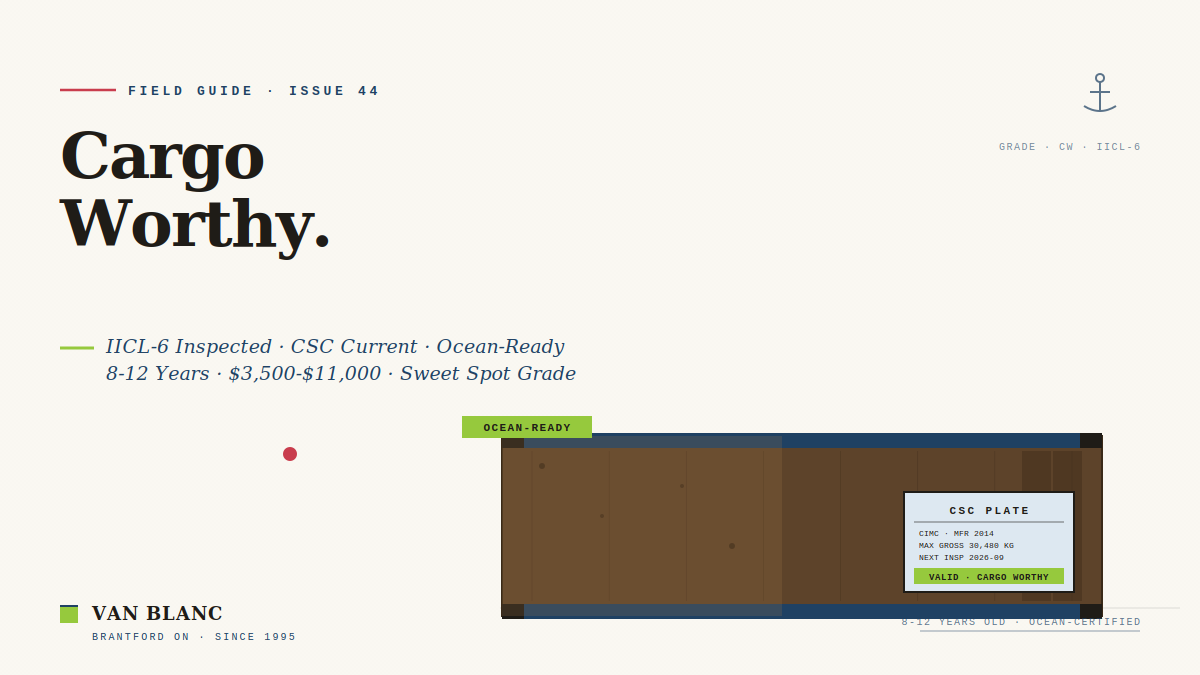
Quick Answer: Standard reference: IMO Convention for Safe Containers (CSC), 1972. A Cargo Worthy (CW) shipping container is a used container that has passed IICL inspection criteria and holds a current CSC plate certifying it for international ocean cargo service. Typically 8-12 years post-manufacture, structurally sound, weather-tight, with normal cosmetic wear from prior ocean service. In Ontario 2026, Cargo Worthy pricing tracks container size, with a 40ft costing more than a 20ft, and a delivery charge added on top that scales with distance from our Brantford yard. CW is the operational sweet spot for buyers who need ocean-grade structural integrity without paying the One-Trip premium. Remaining service life: 20-35 years. Van Blanc carries 200+ containers across all grades; walk the row and pick your CW in person. Family-run since 1995 with cash-on-delivery pricing, call for a same-day quote tailored to your site.
In This Guide
- What does “Cargo Worthy” actually mean? (the CSC + IICL test)
- What does the IICL inspection check on a Cargo Worthy container?
- Cargo Worthy vs One-Trip: when does CW fit?
- Cargo Worthy vs Wind & Watertight: what is the key difference?
- Why is Cargo Worthy the sweet spot for most buyers?
- What should you check on a Cargo Worthy container at the yard?
- How long does a Cargo Worthy container last?
- What drives the cost of a Cargo Worthy container in Ontario?
- Broker or real yard: why do “CW” claims need verifying?
- FAQs
Reading Time: about 14 minutes
Cargo Worthy is the middle grade in the shipping container market and the most-purchased grade in Ontario for buyers who want serious structural integrity without paying the One-Trip premium. A CW container has been to sea, done its primary cargo work, returned to North America, and still meets the international standards for ocean shipping service. Structurally sound, weather-tight, with current CSC certification, but priced below the equivalent One-Trip grade.
This guide explains what “Cargo Worthy” actually means under the IICL inspection standards, when CW is the right grade choice, what to verify when you walk our Brantford yard to pick one, and why the CW grade claim only matters if you can verify it on the specific unit before paying.
What Does “Cargo Worthy” Actually Mean? (The CSC + IICL Test)
A Cargo Worthy container is a used shipping container that has passed an IICL component inspection and carries a current CSC plate certifying it for ocean cargo service. It is usually 8 to 12 years past manufacture, structurally sound, weather-tight, and shows normal surface wear from prior sea duty.
Paul LeBlanc, owner since 1995: “Cargo Worthy is the grade I steer most Ontario buyers toward. People hear used and picture a wreck. A Cargo Worthy box is the same steel and the same ISO build as a new one, just a few crossings older. I have watched this grade hold up on farms and job sites in Ontario for thirty years. The trick is reading the CSC plate and walking the floor yourself before any money moves.”
“Cargo Worthy” is a formal industry designation rather than a marketing term, backed by two specific standards:
The CSC plate (regulatory authority)
Every Cargo Worthy container holds a current CSC (International Convention for Safe Containers) plate. The CSC plate is riveted to the cargo doors and certifies that the container has been inspected to international safety standards and is approved for ocean cargo service.
The CSC inspection cycle:
- First inspection: within 5 years of manufacture
- Subsequent inspections: every 30 months (2.5 years) thereafter
- The plate shows the next inspection date; a CW container has this date in the future
If the CSC plate inspection date has passed, the container is no longer technically Cargo Worthy. It has moved into the Wind & Watertight category (still structurally sound but no longer certified for ocean service). We break down that next category down in our explainer on weather-tight used boxes without a live certification.
The IICL inspection criteria (industry authority)
The Institute of International Container Lessors (IICL) publishes the global standard inspection criteria used worldwide: currently IICL-6 (released August 2016, replacing IICL-5). These criteria define the repair vs reject vs accept thresholds for every component of a shipping container.
A Cargo Worthy container passes the IICL-6 inspection. This means:
- No structural damage that exceeds repair thresholds
- No corrosion that penetrates the steel envelope
- Door operation works properly (cam-locks engage, gaskets seal)
- Floor is intact (no rot, no soft spots, no major chemical damage)
- Corner castings are sound (no cracks, no significant deformation)
- Roof is weathertight (no through-holes, no major patches)
- Side walls are intact (minor dents acceptable, no major impact damage)
The IICL-6 inspection is performed by certified inspectors at port depots before a container is sold into the secondary market as Cargo Worthy. It is a formal trade certification recognized by the major shipping lines and leasing companies worldwide rather than a marketing claim.
What Does the IICL Inspection Check on a Cargo Worthy Container?
The IICL inspection covers approximately 30 specific component checks. The most important for buyer verification:
Frame and structural integrity
- Corner castings: No cracks, no deformation greater than 5mm, twistlock openings clean
- Top and bottom rails: Continuous, no through-rust, no major impact damage
- Corner posts: Plumb (vertical), no buckling, no significant lean
Side walls and end walls
- Corrugation depth: Standard 36mm corrugation intact, no flattening from impact
- Panel deformation: Dents up to 35mm depth acceptable; deeper indicates rejection
- Through-holes: Zero tolerance. Any through-hole moves the container to Wind & Watertight grade at best
- Repair welds: Acceptable if properly executed; visible weld patches indicate prior damage
Doors and gaskets
- Door operation: Both cargo doors swing freely through 270 degrees
- Hinges: All hinges intact, no significant wear or distortion
- Locking bars: Cam-locks engage cleanly through all four lock positions
- Gaskets: Seal compresses against door frame; minor wear acceptable, no major degradation
- Door frame integrity: Frame plumb, no significant warping
Floor
- Floor panels: 28mm tropical hardwood plywood intact, no soft spots from water damage
- Floor seams: Sealed, no visible gaps that would allow moisture intrusion
- Floor bolts: Tight, not rusted through, not missing
- Chemical residue: No major contamination from prior cargo (common cargoes are not concerning)
Roof
- Roof panel: Weathertight, no through-rust, no through-holes
- Drainage corrugations: Clear, water drains freely
- Repair patches: Acceptable if properly welded and weathertight
A container passing all these checks earns the Cargo Worthy designation. The standard is rigorous. It’s what allows the unit to continue carrying high-value international cargo on ocean ships. For a buyer using the container in stationary Ontario service, this same structural integrity translates to 20-35 years of remaining usable life.
Cargo Worthy vs “passes inspection”
Some sellers use “passes inspection” or “structurally sound” interchangeably with “Cargo Worthy.” These are not the same. Cargo Worthy is a formal IICL standard with documented criteria. “Passes inspection” could mean anything. Always ask for the CSC plate status and the IICL grade specifically. We map out exactly what to ask and inspect in our walkthrough for vetting a second-hand box before you pay.
Cargo Worthy vs One-Trip: When Does CW Fit?
Cargo Worthy and the near-new single-voyage tier sit one rung apart in the grade hierarchy, and the gap between them widens with size. Here’s when CW is the smarter purchase.
| Factor | One-Trip | Cargo Worthy |
|---|---|---|
| Age at purchase | 0-2 years | 8-12 years |
| Paint condition | Factory new, uniform color | Weathered, surface patina, possible repaint touch-ups |
| Dents and marks | None to minimal | Normal wear from ocean service, no structural damage |
| Door gaskets | Fresh marine-grade EPDM | Original gaskets with some compression set; may benefit from replacement at year 12-15 |
| Floor condition | Intact factory floor | Intact, dry, possibly with minor cargo scoring |
| CSC plate | Current with 5+ years to next inspection | Current with 0-30 months to next inspection |
| Relative price (Ontario 2026) | Highest used grade, sets the ceiling | Roughly 30-50 percent below One-Trip |
| How the gap moves by size | Premium grows on 40ft and HC units | Savings widen on larger boxes |
| What you pay for | Near-new paint and minimal wear | Same structural envelope, cosmetic age |
| Remaining service life | 30-50 years | 20-35 years |
| Resale recovery at 5 years | 50-65 percent | 40-55 percent |
Cargo Worthy wins when:
- The container is for industrial, farm, or contractor outdoor storage. Cosmetic condition doesn’t matter on a unit parked at the back of a property. The CW structural integrity is identical to One-Trip for storage performance.
- You’re budget-conscious without compromising on structural soundness. CW comes in well under One-Trip while keeping the CSC certification and the IICL pass.
- The container will be moved between sites later. Construction-site boxes that get moved and re-set every 6 to 18 months accumulate handling wear regardless of starting condition, so paying the One-Trip premium for fresh paint makes little sense. CW is the operationally appropriate grade here.
- You plan to repaint or clad the container anyway. If you’ll wrap the container in cedar (for a backyard shed aesthetic) or paint it a custom color, the original factory paint of One-Trip is wasted under the new surface.
- You plan to cut openings or modify the envelope. Windows, personnel doors, side cutouts remove portions of the original factory finish. CW provides the same structural envelope at lower cost.
One-Trip wins when:
- The container will be a visible structure on a residential or customer-facing property
- The container will be an occupied conversion (home, restaurant, office)
- You need maximum 30-50 year remaining service life
- You plan to resell within 5-10 years
For most Ontario buyers in the storage / industrial / agricultural / construction segments, Cargo Worthy is the right answer. If your box will be a customer-facing build and you want one that has never carried a load, look instead at our factory-paint units fresh off their first voyage. Our new versus used, compared walks through every grade in detail.
Cargo Worthy vs Wind & Watertight: What Is the Key Difference?
Cargo Worthy and Wind & Watertight are the two most-confused grades, and “What is the difference between CW and WWT?” is one of the most-searched container questions.
The single key distinction
A Cargo Worthy container has a current CSC plate. A Wind & Watertight container has an expired or absent CSC plate.
This is the binary test. Everything else follows from it:
| Attribute | Cargo Worthy (CW) | Wind & Watertight (WWT) |
|---|---|---|
| CSC plate status | Current, valid | Expired or removed |
| Ocean cargo certified | Yes, can return to international service | No, stationary or domestic use only |
| Structural integrity | Passes IICL-6 inspection | Sealed but may have failures that exclude ocean service |
| Typical age | 8-12 years | 10-15 years |
| Cosmetic condition | Normal ocean-service wear | More visible wear, surface rust, patina |
| Floor condition | Intact, dry | Intact, may have minor wear |
| Door gaskets | Compression-set acceptable | May need replacement |
| Sealed against weather | Yes | Yes (this is the “watertight” definition) |
| Relative price (Ontario 2026) | Carries a premium for current CSC certification | Sits modestly below CW because the CSC certification no longer applies |
| Remaining service life | 20-35 years | 15-30 years |
Practical implications
For a buyer using the container in stationary Ontario storage, the CW vs WWT distinction matters less than the price difference. Both grades:
- Keep weather out
- Keep cargo dry
- Provide structural envelope
- Last 15+ years on a properly drained pad
The CSC plate certification (which CW has and WWT lacks) matters mainly if you might re-export the container into international service later. For 99 percent of Ontario buyers, this never happens.
If your use case is pure stationary storage and the cosmetic difference doesn’t matter, WWT does the job at a lower price point than CW. See our full Wind & Watertight grade guide for the detailed WWT decision framework.
Why Is Cargo Worthy the Sweet Spot for Most Buyers?
Cargo Worthy occupies the middle of the grade hierarchy and is the most-purchased grade for Ontario buyers. Why this grade dominates the market:
Structural integrity is identical to One-Trip for stationary use
The Corten weathering steel that makes containers durable is the same in CW and One-Trip. We explain the corrosion-resistant chemistry behind that longevity in our look at how many years a steel box really gives you. The 20-35 year remaining service life on a CW container is plenty for almost every use case.
Price reflects fair value vs new manufacturing
A CW container is 30-50 percent cheaper than the equivalent One-Trip. For storage and conversion uses where cosmetic difference is acceptable, the savings are real money that can fund modifications, site prep, or additional containers.
If you are still weighing this grade against the others, it helps to see how the four condition tiers compare side by side before you commit to Cargo Worthy.
CSC certification preserves optionality
If you ever sell the container later, a CW grade with current CSC is more liquid than a WWT or As-Is unit. Buyers in the resale market prefer CSC-current containers for the same reasons we explain here.
Quality control is rigorous
Unlike “passes inspection” claims from sketchy online sellers, true CW grade has been verified to IICL-6 standards by certified inspectors. The grade has institutional teeth that protect buyers who can verify the claim.
What Should You Check on a Cargo Worthy Container at the Yard?
When you walk our Brantford yard to pick a Cargo Worthy container, here are the five key checks before paying:
1. CSC plate inspection date
Read the CSC plate on the cargo doors. The “next inspection” date should be in the future. If the date has passed, the container has aged into Wind & Watertight grade and should be priced accordingly. CW with current CSC and 12+ months until next inspection is the sweet spot.
2. Light test on door gaskets
Close both cargo doors with a flashlight on inside the container. Walk the perimeter outside. Look for any visible light leaks at the gasket seams. CW gaskets may show some compression set (minor light at corners is acceptable) but should not have major leaks. Heavy gasket failure indicates the container has crossed into WWT-or-worse condition.
3. Floor walk-through
Step onto the floor. Walk the full length. Bounce moderately on each section. The floor should feel solid throughout, no soft spots, no flex, no springiness. Soft spots indicate water damage that has rotted the tropical hardwood. Check for moisture stains, particularly along the wall-floor junction where leaks typically appear first.
4. Corner casting check
Inspect all eight corner castings (4 top, 4 bottom). Look for:
- Cracks or chips in the casting (rejection criteria)
- Deformation from forklift or crane handling (over 5mm bend = reject)
- Twistlock openings clean and unobstructed
- No rust eating into the casting metal
5. Interior wall and roof inspection
Enter the container with a flashlight. Inspect the interior steel for:
- Through-rust spots (would indicate WWT or worse, not CW)
- Major dent damage from cargo impact
- Weld patches (acceptable on CW if professionally done; document them)
- Roof condition (look up; check for daylight leaks)
These five checks take 15 minutes per container. At our Brantford yard, you can run this verification on every CW unit in stock before deciding which specific container to take home.
Christian LeBlanc, second-generation operator: “Cargo Worthy is what we sell most. It’s the right grade for the farmer in Wellington, the contractor in Hamilton, the cottage owner in Muskoka. Same Corten steel as a One-Trip, same engineering, same ISO standards, just three to ten years older and priced fairly for that age. Our customers walk the yard, run the light test on the gaskets, check the floor, and pick the specific CW unit they want. That’s the structural difference between buying from a real yard and buying from a broker who ships you whatever shows up at the depot.”
How Long Does a Cargo Worthy Container Last?
A Cargo Worthy container in Ontario, on a properly drained gravel pad with basic maintenance, has 20-35 years of remaining service life:
- Years 1-10: Minimal maintenance required; Corten patina continues forming, gaskets perform adequately
- Year 12-15: Door gaskets typically replaced
- Year 15-20: Optional marine-grade paint refresh on roof and high-wear areas
- Years 20-30: Container continues structurally sound; minor cosmetic maintenance optional
- Year 30-35: May enter end-of-life refit decisions
The 20-35 year window is plenty for nearly every use case. For a head-to-head on whether the age trade-off is worth the saving, our comparison of buying fresh versus pre-owned steel lays out the math. A 30-year-old farm shed, a 25-year-old contractor laydown, a 35-year-old marina storage unit are all viable lifetimes for a CW container purchased today.
What Drives the Cost of a Cargo Worthy Container in Ontario?
Cargo Worthy container cost in Ontario is set by a short list of drivers rather than one posted number: the container size, the height (Standard or High Cube), how far your site sits from our Brantford yard, the season, and the steel market on the day you order. Here is how the price lands across sizes, relative to each other.
| Size | External (L x W x H) | Floor area | Where CW price lands by size |
|---|---|---|---|
| a standard 20-footer | 20 x 8 x 8.5 ft | about 150 sq ft | Entry point of the CW range |
| 20ft High Cube | 20 x 8 x 9.5 ft | about 150 sq ft | Slight step up over the 20ft Standard for the extra foot of height |
| a standard 40-footer | 40 x 8 x 8.5 ft | about 300 sq ft | Mid range; best cost per square foot |
| a 40ft high-cube box | 40 x 8 x 9.5 ft | about 300 sq ft | The most-requested size, modest premium over the 40ft Standard |
| a 45ft high-cube box | 45 x 8 x 9.5 ft | about 340 sq ft | Higher than the 40ft HC; lower supply |
| a 53ft high-cube box | 53 x 8.5 x 9.5 ft | about 400 sq ft | Top of the range; specialty supply |
For full cost detail across all grades and sizes, see our complete dimensions and cost guide.
Curious how the box actually gets set on your pad? Our guide to how your container is delivered and placed walks through the tilt-deck drop and crane placement the carrier handles on delivery day.
Broker or Real Yard: Why Do “CW” Claims Need Verifying?
Cargo Worthy is the easiest grade for brokers to misrepresent. Here’s why:
The structural difference between Cargo Worthy and Wind & Watertight is the CSC plate inspection date. CW has current; WWT has expired. The difference in actual condition between a recent-CSC CW unit and a recently-expired WWT unit is essentially zero: same steel, same age, same wear. The price difference, however, is real, because the CW grade carries the value of a current certification.
This creates obvious incentive for brokers to:
- Sell WWT-grade containers as “Cargo Worthy” without verifying CSC plate status
- Send stock photos of cleaner CW units while shipping older CW or WWT inventory
- Skip the IICL inspection requirement and just paint the container to look fresh
None of this happens at a real yard where the buyer walks the row and inspects the specific unit. The CSC plate is right there to read. The condition is verifiable. The grade claim is testable before payment. You can see what we have on the ground right now and arrange a yard visit before any money changes hands.
200+ container inventory at our Brantford yard, you pick your box
Van Blanc carries over 200 containers across our Brantford yards including a deep stock of Cargo Worthy units across 20ft, 40ft, 40ft HC, 45ft HC, and 53ft HC sizes. We let buyers walk the row, read each CSC plate, run the light test on door gaskets, walk the floor, and pick the specific CW container they want delivered. Other suppliers operate broker models. They ship whatever the depot has, you accept what arrives. For a Cargo Worthy purchase, see the unit in person before paying. Drive to 90 Morton Ave. East in Brantford and walk the row.
Frequently Asked Questions
What is a Cargo Worthy shipping container?
A Cargo Worthy (CW) container is a used shipping container that passes IICL-6 inspection criteria and holds a current CSC (Convention for Safe Containers) plate. Typically 8-12 years post-manufacture, structurally sound, weather-tight, with normal cosmetic wear from prior ocean service. Suitable for return to international cargo service or for Ontario stationary storage with 20-35 years of remaining service life.
What is the difference between WWT and CW?
The single key difference: a Cargo Worthy (CW) container has a current CSC plate certifying it for international cargo service. A Wind & Watertight (WWT) container has an expired or absent CSC plate. Both grades are sealed against weather, structurally sound, and suitable for Ontario stationary storage. CW is 8-12 years post-manufacture; WWT is 10-15 years. The price difference between them is modest and widens with container size. Our deep dive on the grade just below cargo-worthy lays out what that grade does well.
What shipping containers are seaworthy?
One-Trip and Cargo Worthy grades hold current CSC plates and are certified for international ocean cargo service (“seaworthy”). Wind & Watertight and As-Is grades have expired or absent CSC and are not certified for ocean service. For Ontario buyers using containers in stationary land service, the seaworthy distinction matters mainly if you might re-export the container later.
How much should I pay for a 40 foot shipping container?
What you pay for a 40ft container depends mostly on grade and height. Wind & Watertight sits at the low end, Cargo Worthy in the middle, and One-Trip at the top, with the High Cube version of each running above its Standard-height equivalent. Delivery within Southern Ontario is added on top and scales with distance from the yard. Our 40ft price breakdown walks through every grade and how each factor moves the final number.
Do you need a concrete slab for a Cargo Worthy container?
No. A properly drained gravel pad with corner blocking handles a Cargo Worthy container for 20-35 years in Ontario. Standard approach: 10-15 cm of compacted 3/4-inch clear stone with concrete deck blocks or pressure-treated 6×6 cribs at the corner castings. Foundation cost scales with the footprint, so a 40ft pad runs more than a 20ft pad. Concrete pads are over-spec for storage uses regardless of grade.
How long will a Cargo Worthy container last?
20-35 years of remaining service life on a properly drained pad in Ontario. Door gaskets typically replaced at year 12-15. Optional paint refresh at year 18-25. The Corten weathering steel envelope continues structurally sound throughout. Our container lifespan guide covers the Corten chemistry and four corrosion accelerants in detail.
Can I convert a Cargo Worthy container into a home or office?
Yes. CW is structurally identical to One-Trip in steel envelope and ISO compliance. Conversions to occupied space work fine on CW grade, with the trade-off being prep work to address paint patina, gasket refresh, and any cosmetic issues before final finishing. Many Ontario buyers choose CW for conversions where the budget savings over One-Trip fund interior modifications. See our container homes explained and the container restaurant build.
How do I verify a Cargo Worthy claim?
Three tests: (1) Read the CSC plate on the cargo doors. Verify the “next inspection” date is in the future. (2) Run the light test on door gaskets with a flashlight inside (minor leaks acceptable, major leaks indicate WWT or worse). (3) Walk the floor with bouncing pressure (no soft spots, no springiness). If the seller won’t let you inspect the specific unit before paying, the CW claim is unverifiable. Real yards like Van Blanc let buyers walk and verify before money changes hands. The full inspection routine, including the scam signs to watch for, is in our checklist for buyers vetting pre-owned units.
Where do Cargo Worthy containers come from?
Containers retired from primary ocean cargo service after 8-12 years. The container completed its primary lease or ownership cycle with a shipping line (Maersk, MSC, CMA CGM, etc.) or leasing company (Triton, CAI, SeaCube), then entered the secondary market via port depots. CW grade containers pass IICL-6 inspection at the depot before resale. Van Blanc sources our CW inventory through established Canadian supply relationships, ensuring traceability and condition verification.
Is a Cargo Worthy container good for a backyard shed?
Yes, CW is excellent for backyard shed use. The structural integrity is identical to a One-Trip, the price is lower, and the 20-35 year service life is plenty for any residential shed application. For visible placements (front yard, near the home), some buyers prefer the cleaner cosmetic of One-Trip. For typical back-of-property shed placements, CW provides exactly what’s needed at lower cost. See our container shed setup guide.
Pick your Cargo Worthy in person at our Brantford yard
Cargo Worthy is the sweet spot grade in the Canadian container market: ocean-certified structural integrity, current CSC plate, fair pricing for the age. For most Ontario buyers who want serious storage or modest conversion, CW is built for the job.
The single most important step when buying a CW container is verifying the grade claim before paying. Walk our Brantford yard. Read the CSC plates on candidate units. Run the light test on door gaskets. Walk the floor. Check the corner castings. Pick the specific unit that meets your requirements.
Van Blanc has been delivering Cargo Worthy containers across Ontario since 1995. Paul and Christian LeBlanc walk our 200+ container Brantford yard with customers every week. We deliver across Ontario in 1-3 business days. Payment is cash on delivery by draft cheque, cash, wire transfer, or credit card authorization form. No deposits, no surprises.
Looking for a Cargo Worthy container in Ontario?
Call Paul or Christian at 519-754-6844 or come walk the yard at 90 Morton Ave. East, Brantford. We’ll show you the CW units in stock, verify the CSC plate dates with you, and confirm 1-3 day delivery to your Ontario property.
For step-by-step inspection of Cargo Worthy and other used grades before paying including the 6-point inspection checklist and 7 scam warning signs every Canadian buyer needs, see our second-hand container buying guide.
Two rungs down the ladder, As-Is containers carry no promise at all, which is a different kind of buy entirely.
Ready to price your container?
Tell us the size and your postal code and we’ll send back an all-in number, container, delivery, and placement, usually within 1-3 days. No pressure, no mystery fees.
Family-run in Brantford since 1995 · 200+ containers in stock · 4.9★ across 140+ Google reviews · every box graded by a person, walk it before it lands.
Sources & References
Authoritative external sources cited or referenced in this guide: