
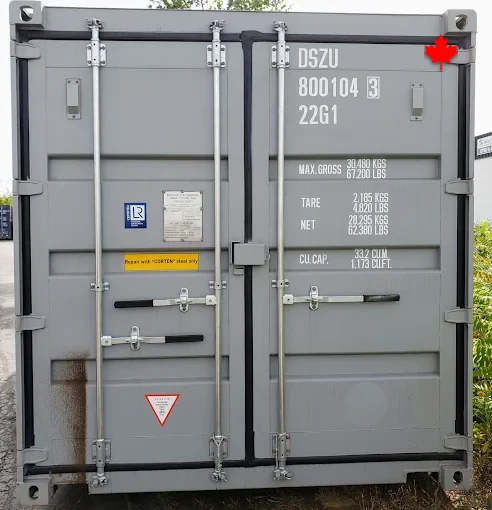
Quick Answer: To open a shipping container, rotate both handles on the right door up and out of their catches, swing the right door first, then release the left. The handles turn cam rods that lock into keepers top and bottom; work them in order and the doors open with one hand.
Nobody is born knowing how container doors work, and the yard sees the proof weekly: strong, capable people pulling handles the wrong way at a box that would have opened with two fingers in the right order. The mechanism is 1950s marine engineering, brilliant and completely unexplained anywhere on the door itself. Here is the whole system: opening, closing, what to do when a door fights back, and the two minutes of care that keep the hardware smooth for decades.
The Mechanism: Cam Rods and Keepers
Each container door carries one or two vertical lock rods running its full height. The handle in the middle rotates the rod, and cams welded to the rod’s ends rotate into keepers, steel catches, on the frame above and below. Handle down and seated in its catch means the cams are locked into the keepers and the door is sealed against its gaskets. Handle up and swung away means the cams are clear and the door is free. That is the entire machine: no springs, no secrets, just leverage and geometry that survives forty years of salt air, identical on every grade in the used rows, which is why the skill transfers between boxes. Once you can picture the cams turning at the top and bottom of the rod, every stiff door you ever meet becomes a diagnosis instead of a mystery.
The machine is the same across every modern door layout as well; the three handle configurations on new stock differ only in where the levers sit and how many motions they ask of you.
Opening, In Order
The right-hand door always opens first; its gasket overlaps the left door’s edge, which is why fighting the left door first gets you nowhere and a sore shoulder. Flip the handle retainers off both handles on the right door. Rotate each handle up and outward, feeling the cams turn free of the keepers, and swing the door wide. Repeat on the left door. On a well-kept box the whole sequence is ten seconds with one hand; on a unit that has sat locked through a winter, the first handle sometimes wants a firm pull, and the trick is pulling the door itself snug toward you with one hand while the other rotates the handle, unloading the cam so it turns freely. That one move, snug the door, then turn, resolves nine of every ten “stuck” containers we get called about.
Closing So It Seals
Closing runs the film backward with one addition: weather. Swing the left door closed and seat its handles loosely. Swing the right door closed against the left’s gasket, then work all handles down into their catches, snugging each so the cams draw the doors evenly against the seals. Finish by flipping the handle retainers down; they exist so vibration and curious hands cannot walk a handle open. The check that takes five seconds and saves a season: stand inside with the doors shut, and any daylight at the edges means a handle is not fully home or a gasket is folded under, and either takes a moment to fix now and a wet load to discover later.
When a Door Fights Back
Stiff doors have exactly four causes, in order of likelihood. The container is not level, and a box leaning even slightly racks its frame enough to bind the cams; the cure is blocking the corners, not forcing the steel. The unit was loaded to the ceiling against the doors, and pressure from inside is pinning the gaskets; there is no cure except caution as the tier releases. The hinges or cams are dry after years of weather; a shot of penetrating oil at the hinge pins and rod bearings changes the door’s personality in minutes. Or, rarely, a keeper took a knock and bent; that is a five-minute shop repair, not a reason to condemn a box. What is never the cause on a graded unit: the door itself. Container doors do not warp; frames rack and hardware dries, and both are fixable.
Doors Should Be This Easy
Every unit in our rows opens the way this page describes, and you are welcome to come test that claim. Size, grade, and postal code get you an honest quote with a real lead time, usually the same day.
Two Minutes of Care Per Season
Door hardware is the only part of a container that appreciates attention. Twice a year: penetrating oil at the hinge pins, a wipe of the gasket faces, and a hand’s inspection of the rubber for cracks. Gaskets are the doors’ actual seal, and they harden with sun and years; a tired set costs an afternoon to replace and we keep the door hardware and gasket stock at the yard. Add a lockbox, the welded shroud that shields a padlock from bolt cutters, and the door end of a container becomes simultaneously the smoothest and most secure part of the whole box, which is exactly what the marine engineers intended in 1956.
Container Door FAQ
How do you open a shipping container door?
Right door first: flip the handle retainers, rotate both handles up and outward to turn the cams free of their keepers, and swing the door. Then release the left door the same way. If a handle resists, pull the door snug toward you while turning; that unloads the cam.
Why will my container door not close properly?
Almost always level: a container off-level racks its frame and misaligns the cams with their keepers. Block the corners level and the door geometry returns. Folded gaskets and overpacked loads pressing from inside are the other two usual suspects.
Which container door opens first?
The right-hand door, always; its gasket overlaps the left door’s edge. The left door only releases after the right is open, which is the single most useful fact on this page for anyone standing at a container for the first time.
How do I stop container doors from seizing over winter?
Penetrating oil at the hinge pins and lock-rod bearings each fall, gaskets wiped clean, and the unit blocked level so frost heave cannot rack the frame. Doors maintained on that two-minute schedule open one-handed in February.
What is the bar and handle mechanism on container doors called?
Lock rods, or cam rods: vertical bars whose end cams rotate into keepers on the frame when the handle turns. The small clips over the handles are retainers, and the welded padlock shroud many units carry is a lockbox.
Can container doors be replaced or repaired?
Yes, every component: gaskets, handles, retainers, cams, keepers, and full door assemblies are all standard parts. Bent keepers and tired gaskets are the common repairs, both quick, and we stock the hardware at the Brantford yard.
Sources
- International Organization for Standardization. (2013). ISO 1496-1: Series 1 freight containers, specification and testing. iso.org
- Institute of International Container Lessors. (current). Dry van technical bulletins. iicl.org
- United Nations Treaty Series. (1972). International Convention for Safe Containers (CSC). treaties.un.org
- Levinson, M. (2016). The Box, 2nd ed. Princeton University Press. press.princeton.edu
Come Swing a Few
Van Blanc has kept container doors honest since 1995: family-run, 4.9 stars across 140+ verified Google reviews, 200+ units at 90 Morton Avenue East in Brantford. Every door in the rows opens for visitors, which is both our quality control and our favourite sales pitch.
Van Blanc Ent. Inc., 90 Morton Ave E Unit 1B, Brantford, ON N3R 7J7. 1-888-509-6658