
Quick Answer: What a shipping container costs in Canada in 2026 depends on grade first. One-Trip (new) sits at the top, then Cargo Worthy, then Wind & Watertight, then As-Is at the bottom. Size, delivery distance and the steel and freight markets move it from there, so an honest yard quotes each order rather than posting a number that goes stale.
Van Blanc has supplied containers from Brantford since 1995, ships from 4 Brantford yards, holds 4.9 stars across 140+ Google reviews, and delivers Ontario-wide in 1-3 days.
What This Container Price Guide Covers
- Price guides that disagree two to one
- The season you buy in is a lever you control
- Shipping container cost, delivered: five details to send
- How is a shipping container price built in Canada?
- How much does a sea can cost, by grade?
- Container grades and how grade moves price
- How big is a shipping container, and how does size affect price?
- Cost ladder from 20ft to 40ft to 53ft
- Does cosmetic wear on a used container affect the price?
- Are shipping containers cheaper in Quebec or BC than in Ontario?
- Market trends 2020 to 2026: from the spike to the new normal
- Container market snapshot: updated October 2026
- Why shipping cost sits inside the sticker price
- Modification cost markup: the layer most pricing guides skip
- Container rent-or-buy math from the owning side
- Container financing and total cost of ownership
- Delivery and add-on fees, line by line
- The Facebook trap and other Canadian scams
- Container price guides by grade, age and channel
- Frequently asked questions
Reading time: about 23 minutes. If you would rather skip straight to a number, the grade ladder with the price logic attached is the short version.
Price guides that disagree two to one
Search for what a shipping container costs in Canada and you will be handed confident numbers. Read two of those guides side by side, both published for 2026 and both about Canadian buyers. Something awkward emerges: their ranges for a new 20ft container do not overlap at all. The top of one sits below the bottom of the other, a gap of roughly two to one on the same product in the same country in the same year.
Neither guide is dishonest. Both are accurate snapshots of a system that will not hold still. Understanding the four forces underneath is worth more to a buyer than any single number either of them printed.
| Force | What it does to the number you are quoted |
|---|---|
| Steel input cost | Corten steel is roughly 60 percent of what it costs to build a container, so new-unit prices track global steel indices rather than local demand |
| The exchange rate | Canadian inventory is bought in US dollars. A weaker loonie raises the Canadian price with no change whatever to the container |
| Trade volumes | Availability follows international freight flows, so a slow shipping season tightens or loosens supply months later |
| Trade policy | Tariffs and customs treatment change landed cost independently of everything above |
Look at the second row for a moment, because it is the one that catches people. Take a container sitting in a Canadian yard, already imported, already inspected, unchanged in every physical respect. It is worth a different number of Canadian dollars this month than last, purely because the currency moved underneath it. Any guide that prints a range is publishing an exchange-rate position with a short shelf life, whether or not it says so.
That is the reason we quote rather than publish a price list. A number posted on this page would be a promise about steel indices and currency markets that we are in no position to make. You would find it out of date at exactly the moment it mattered. What Van Blanc can promise is a real figure for a real unit on the day you ask, which is why every enquiry goes through a direct quote. It is also why our plain-language guide to the four grades matters more than any range: grade moves the number further than the calendar does.
The season you buy in is a lever you control
One of the four forces is genuinely in the buyer’s hands. Demand is seasonal, and it is predictable. Prices firm through spring as construction season opens and yards compete for the same inventory, then soften through the colder months when the phone rings less. The trade guidance for construction firms is blunt about it, naming winter as the window in which a buyer has room to negotiate, particularly on volume.
For anyone whose need is not urgent, that is a real and free advantage. A container bought in February and left on the yard until April costs less than the identical container bought in April, and the only thing you spent was patience. If the job is fixed to a spring start, work backwards and buy early rather than into the peak. We will hold and deliver to your schedule, and that conversation is one we would rather have in January than in May.
Shipping container cost, delivered: five details to send
A shipping container’s delivered cost in Ontario is one number built from five details, and a quote can only be as accurate as the details behind it. Van Blanc prices every order from these five, so sending them up front gets you a real figure instead of a range. With all five in hand we can usually answer the same day.
The five details a delivered price is built from
- Size and height: 10ft, 20ft, 40ft, 45ft or 53ft, and standard height or High Cube. The size table further down shows the usable space each one gives you.
- Grade: new (one-trip), Cargo Worthy, Wind & Watertight or As-Is. Grade moves the box price more than any other detail.
- Your postal code: it sets the freight from our 4 Brantford yards to your site, and delivery runs 1 to 3 days across Ontario.
- Site access: whether a tilt-deck can back straight in on a path at least 12 ft wide with at least 14 ft of clear height overhead, or whether the box needs a crane truck to set it over a fence or into a tight lot.
- Modifications: man doors, vents, lockboxes, roll-up doors, shelving, insulation or paint, built at our yards before the box ships.
Send those five through the Van Blanc quote request page or call 519-754-6844 and describe the job. The answer comes back as one all-in figure, with the container, the freight and the placement each on its own line. You pay on delivery, once the box is sitting where you wanted it.
How is a shipping container price built in Canada?
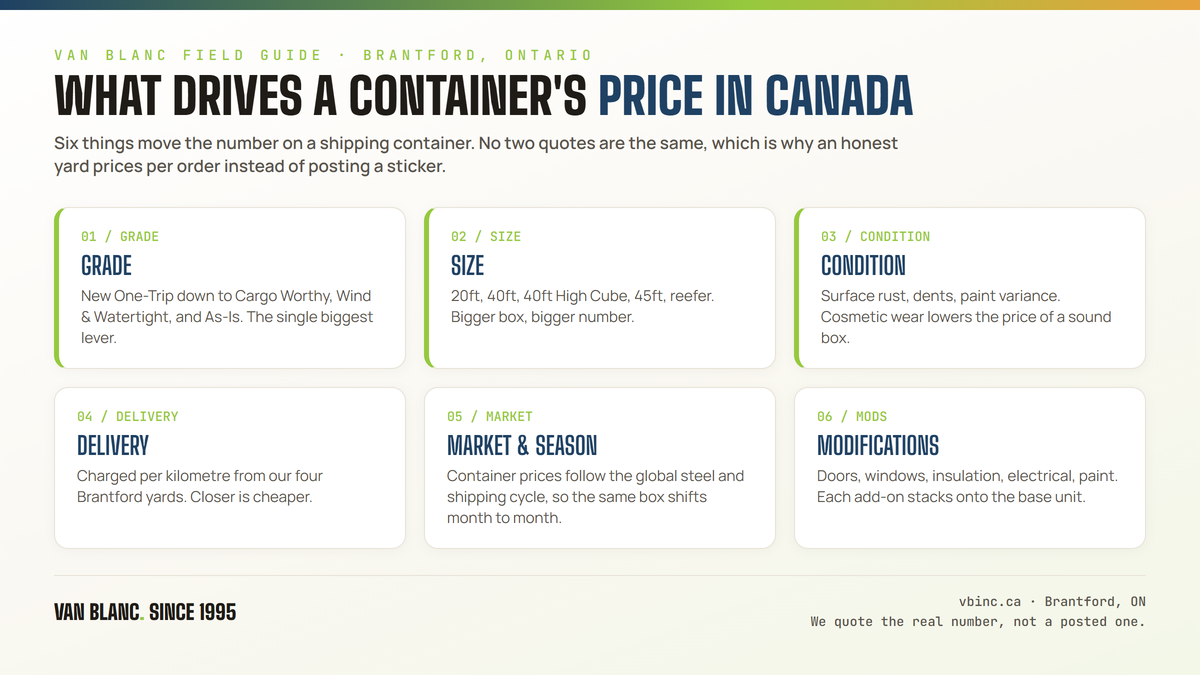
A shipping container price in Canada is not a single number. It is a stack. The steel cost at the factory in China or Vietnam sits at the base. On top of that, ocean freight from Asia to a North American port. Then drayage off the port to inland yards like ours in Brantford. Then yard handling, inspection, grading, and storage. Then any modification work the buyer wants. Then delivery to the buyer’s site. By the time a container reaches your driveway, every one of those layers has added cost. Two decisions set where you land on that stack: a new one-trip box or a used grade, and how far the box travels to your site.
Most pricing guides on the internet flatten this stack into a single sticker number. We do not, because buyers who only see the sticker number get burned when the bill at the gate is far higher than the listing they clicked on Facebook. The move is to lay the stack out, explain the grades, and tell you which box you actually need for your project before anyone takes a deposit.
This guide lays the whole stack out. The shorter reads listed near the end take one slice each: one-trip pricing, resale math, negotiation, container age, scrap value, auction prices, refurbished units and condition grading. Start here, then follow the one that matches the box you are pricing.
The five layers inside every container quote
1. Steel cost at origin (factory price, Asia). 2. Ocean freight to Canadian or US port. 3. Inland drayage to the supplier yard. 4. Yard handling, grading, and storage. 5. Last-mile delivery to your site. Reefers add a sixth layer (refrigeration unit cost). Modifications add a seventh. Every supplier should be able to break the quote into these layers if you ask. If they cannot, that is information.
How much does a sea can cost, by grade?
A sea can costs whatever the same shipping container costs, because sea can is simply the Canadian name for the identical ISO steel box. That means sea can prices run the identical ladder: new (one-trip) at the top, then Cargo Worthy, then Wind & Watertight, then As-Is. Five inputs set your number: grade, size, delivery distance from the yard, the current steel and freight markets, and any modifications. A 20ft Wind & Watertight is the cheapest way into container ownership; a new (one-trip) 40ft High Cube is the top of the ladder. Nobody can quote a sea can accurately without your postal code, which is why we price each order live. Call Van Blanc at 519-754-6844 or request a quote through the contact page, and we will send back a real, all-in number, usually the same day.
Container grades and how grade moves price
The four grades exist for a reason. For the full picture before you read on, our overview of how the grades and box types actually differ lays out the taxonomy in plain language. Each one is priced against the job it does well. A new (one-trip) unit earns its quote on anything people will see or work inside for decades. A used Wind & Watertight box suits dry storage that stays put. As-Is makes sense when the buyer knows exactly which defect they are buying around, because the floor or frame issue comes with the box.

Here is how the four grades rank on price in 2026, as Van Blanc sorts them across our 4 Brantford yards. Ontario Construction News lays out the same new and used split in its 2026 pricing guide for builders.
| Grade | Relative cost | Condition | Right use |
|---|---|---|---|
| One-Trip / New | Highest | Single ocean crossing, factory paint, no rust, 25+ year life | Office, retail, residential conversion, branded use |
| Cargo Worthy (CW) | Upper-middle | Multiple crossings, structurally sound, surface rust and paint variance | Export, heavy-duty industrial storage |
| Wind & Watertight (WWT) | Lower-middle | Cosmetic wear, doors seal, floor clean, not re-certified for export | Farm storage, equipment shelter, on-site reno |
| As-Is | Lowest | Known issues: floor, frame, or door problems | Scrap reuse, structural donor, low-stakes storage |
The gap between One-Trip and used is what most buyers misread. A One-Trip container has made a single ocean crossing loaded with cargo. It is essentially new. Original factory paint, no rust, doors that operate cleanly. A Cargo Worthy container has crossed the ocean multiple times and is still structurally sound for export. A Wind & Watertight container has cosmetic wear but the doors close, the panels seal, and the floor is clean. An As-Is unit has known issues, sold cheap for buyers who know exactly what they want to do with damaged steel.
None of these grades is dishonest if it is described accurately. A Wind & Watertight unit listed as WWT, with honest photos of the rust spots, is fair dealing. A WWT painted up to look like a one-trip and sold at a one-trip quote is the scam Paul has watched repeat for two decades.
Paul LeBlanc, owner: “I have watched the container market through every cycle since I entered the industry. The grades have not changed in thirty years. The prices move with steel, freight, and demand, but the grade taxonomy is the same one I learned in 2007. If anyone offers you a fifth grade that sounds too good to be true, walk away.”
How big is a shipping container, and how does size affect price?
Size compounds with grade on the price ladder. A One-Trip 40ft High Cube is a bigger box than a 20ft Standard. It is also the most popular configuration in North America, which means demand sits on top of demand, and the price reflects that. For the full dimensional breakdown of every length, see our complete container sizes and dimensions guide. A 10ft container, on the other hand, is a custom cut from a 20ft and ends up costing more per linear foot than the parent unit. The table below lines up every size we sell by footprint, usable space and pallet count, with the thing that moves each one’s price.
| Size | Outside (L x W x H) | Usable space | Pallets (48 x 40 in) | What moves its price |
|---|---|---|---|---|
| 10ft | 9’10” x 8′ x 8’6″ (2.99 m x 2.44 m x 2.59 m) | about 560 cu ft (16 m³) | 4 | Custom-cut from a 20ft, so it costs more per linear foot than its parent unit |
| 20ft Standard | 19’10” x 8′ x 8’6″ (6.06 m x 2.44 m x 2.59 m) | 1,172 cu ft (33.2 m³) | 10 | Baseline. Most flexible size, easiest to site, deepest supply |
| 20ft High Cube | 19’10” x 8′ x 9’6″ (6.06 m x 2.44 m x 2.90 m) | 37.4 m³ | Same floor as the 20ft | Less common; the extra foot of headroom carries a premium |
| 40ft Standard | 40′ x 8′ x 8’6″ (12.19 m x 2.44 m x 2.59 m) | 2,395 cu ft (67.8 m³) | 20 | Better value per cubic foot; the industry workhorse for high-volume storage |
| 40ft High Cube | 40′ x 8′ x 9’6″ (12.19 m x 2.44 m x 2.90 m) | 2,689 cu ft (76.1 m³) | 20 | Demand-driven premium; holds about 12 percent more than the standard 40 |
| 45ft High Cube | 45′ x 8′ x 9’6″ (13.72 m x 2.44 m x 2.90 m) | 3,040 cu ft (86.0 m³) | Ask the yard | Scarcity premium; fewer in circulation |
| 53ft High Cube | 53′ x 8’6″ x 9’6″ (16.15 m x 2.59 m x 2.90 m) | 3,901 cu ft (110.5 m³) | 30 | Domestic North American box; availability and the longer haul set the quote |
| 20ft Reefer | 20′ x 8′ x 8’6″ (6.06 m x 2.44 m x 2.59 m) | 978 cu ft (27.7 m³) | Ask the yard | Working Carrier or Thermo King genset sets the value, not the steel |
| 40ft HC Reefer | 40′ x 8′ x 9’6″ (12.19 m x 2.44 m x 2.90 m) | about 67 m³ | Ask the yard | Cold-chain workhorse; the refrigeration unit drives the cost |
Two patterns matter for sizing, and if you are still deciding between footprints, it helps to compare the dimensions side by side before you weigh the cost. First, the 40ft High Cube is now the global default because it adds a foot of height over a standard 40 on the same footprint. That demand keeps the price stable even when steel costs dip. Second, reefers carry a premium that has almost nothing to do with the steel and almost everything to do with the refrigeration unit. A reefer in good condition with a working Carrier or Thermo King genset is worth several times its dry-container equivalent.
For the deepest spoke on one-trip pricing in particular, see our breakdown of what actually justifies the premium on a new box.
Cost ladder from 20ft to 40ft to 53ft
Size moves the number less than most buyers expect, because the box is only one line in the quote. Here is how the ladder actually behaves.
- 20ft: the entry point and the easiest delivery. Shorter trailer, tighter driveways, the default pick for residential storage. Supply is deepest here, which keeps the grade spread tight.
- 40ft and 40ft High Cube: the workhorse commercial sizes. Per cubic metre of storage, one 40ft usually beats two 20fts: one steel box, one delivery, one set of doors. High Cube adds a foot of height for a modest premium and is the default shell for conversions.
- 53ft: a domestic North American size, scarcer than the ISO sizes, so availability drives the quote more than steel does. When a 53ft is the right call (long racking runs, dead storage for a full trailer load) the per-cubic-metre math lands in its favour; when it is not, two 40fts win on delivery flexibility.
Full measurements live in the sizes and dimensions guide. Every size also has its own spec page: the 20ft spec page, the 40ft spec page, the 40ft High Cube spec page and the 53ft High Cube spec page.
Does cosmetic wear on a used container affect the price?
Cosmetic condition is where most buyers get nervous and where good yards earn their reputation. A used container does not look like a new car. There will be rust spots. There will be paint variance from where prior owners stencilled and re-stencilled. There may be a small dent in a panel. None of that is structural damage. Structural damage means floor failure, frame distortion, door seal failure, or rust-through on a load-bearing member.
Christian LeBlanc walks every used container at Van Blanc’s Brantford yards before it lists. He is looking at six things: floor condition, door operation, panel rust depth (surface vs perforation), corner casting integrity, roof straightness, and seal contact. If a container fails any of those, it gets routed to As-Is or scrap, not WWT or CW. That sorting is what makes the price fair, and it is the same checklist we walk first-timers through in our step-by-step advice for buyers approaching their first purchase.
The cosmetic surcharge that does not exist
A charge for “good cosmetic condition” on a used box prices the paint, not the grade. Wind & Watertight already includes a cosmetic floor. If a quote adds a premium for “extra clean WWT,” ask which structural inspection earned it and how it differs from regular WWT. At Van Blanc the grade comes from the six-point structural check, and the paint is something you judge for yourself when you walk the box.
For the deeper breakdown on age and condition together, see our container age buying framework. It walks through how to read date plates, what an 8-year-old WWT actually means, and when paying more for a 15-year unit is still the right move.
Are shipping containers cheaper in Quebec or BC than in Ontario?
Canadian container pricing is not flat. Where the box landed affects what it costs. Containers entering through the Port of Montreal flow into Quebec inventory first, which is why CW and WWT quotes in Quebec can sit below Ontario’s. Containers entering through Vancouver flow into BC inventory first, with similar regional discount. Containers entering through Halifax flow into Atlantic Canada, sometimes with a long-haul markup if they cross provincial lines.
Ontario is the country’s primary logistics corridor. Rail intermodal terminals across the GTA mean inventory is dense, but density does not always mean cheaper. Buyers in southwestern Ontario, our home region, typically pay middle-band pricing because the freight cost from port to Brantford is built into every unit Van Blanc stocks.
| Region | Relative used-container cost | What drives it | Notes |
|---|---|---|---|
| Quebec (Montreal corridor) | Can sit below Ontario | Port-of-Montreal intake | Port-of-Montreal landed inventory |
| Ontario (Brantford / GTA) | Stable middle band | Densest inventory pool | Densest inventory, stable pricing |
| British Columbia (Vancouver) | Often below Ontario | Port-of-Vancouver intake | Port-of-Vancouver landed inventory |
| Alberta (Calgary / Edmonton) | Higher than coastal regions | Long-haul rail markup from coast | Inland, no direct port intake |
| Atlantic Canada (Halifax) | Varies with a smaller pool | Port-of-Halifax intake | Smaller inventory pool |
| Northern provinces / territories | Highest, freight-dominated | Freight premium dominates the stack | Distance is the largest cost line |
When a buyer in Sault Ste Marie or Thunder Bay calls us, freight is the biggest line in the quote. We price the route on its own and send one all-in number: the box from our 4 Brantford yards, the haul north and the placement. Northern routes are quoted per route, and the quote shows exactly what the haul costs before anything is paid.
Market trends 2020 to 2026: from the spike to the new normal
You cannot read 2026 pricing without understanding what happened between 2020 and 2024. The pandemic-era supply shock pushed 40ft One-Trip prices in Canada to roughly double their pre-pandemic level at the peak in mid-2021. New container production in Asia was constrained, ocean freight rates from Asia to North America hit historic highs, and demand for storage-in-transit spiked because supply chains were jammed everywhere. A buyer who walked into any Ontario yard in summer 2021 paid roughly double what the same unit costs today.
By late 2022 the spike had broken. Ocean freight rates fell back. Asian production came back online. North American yards that had bought inventory at peak prices were sitting on units they had paid too much for. They did not want to sell at a loss. That mismatch is why some yards still try to quote 2021 prices today. They are working through old inventory.
2024 and 2025 were the stabilization years. Prices came back to roughly pre-pandemic levels, adjusted for steel inflation. 2026 is the new normal: the market is balancing out after years of volatility, with prices higher than pre-COVID but well below the 2021 peak. Panama Canal, Suez Canal and Red Sea disruptions can still throw short spikes into freight, as the October snapshot below shows.
What a 2026 buyer should ignore
Any guide written before 2023 quotes peak-era prices that do not reflect today’s market. Any guide from late 2022 or early 2023 reflects the crash. Use 2025 or 2026 sources only when reading current pricing. The same applies to listings: a Facebook listing showing a 2021 photo with a 2021 price is not a deal, it is an inventory ghost.
Van Blanc has worked through four price cycles in the container business since the family opened in 1995. Paul watched more before that in his four decades of Asian trade. His read on 2026 is simple. The volatility is gone, the cost of steel is steady, the freight market is stable, and the buyer who waits for “another crash” is going to wait a long time. If you need the box now, the quote you get this week is the number to plan on.
| Year | One-Trip price direction | Market context |
|---|---|---|
| 2019 | Baseline | Pre-pandemic baseline, stable demand |
| 2020 | Rising | Early COVID supply disruption |
| 2021 (peak) | Peak, roughly double baseline | Global supply shock, ocean freight historic high |
| 2022 | Falling sharply late Q3 | Crash begins late Q3, inventory glut |
| 2023 | Settling | Stabilization year, yards working through old stock |
| 2024 | Near pre-pandemic, adjusted for steel | New normal forming, modest steel inflation |
| 2025 | Stable, brief spikes | Stable, with brief Red Sea routing spikes |
| 2026 | Stable, slow growth | Stable band, freight swinging week to week |
The historical band above is averaged across established Canadian supplier yards, not retail-listing prices on Facebook or Kijiji. Listing prices in 2021 occasionally went higher than the band shows because individual sellers tried to ride the spike. Yard pricing tracks the wholesale-replacement cost more closely. That is why the 2026 numbers reflect what it actually costs to land a fresh container in our Brantford yards. They also carry the margin a 30-year independent supplier needs to keep the doors open.
Container market snapshot: updated October 2026
Three third-party readings tell you which way container prices are leaning right now, with no stale sticker price required.
- Ocean freight: the Drewry World Container Index rose 2 percent in its October 22 reading, its second weekly rise in a row and its highest level in 15 weeks, on firmer Asia to Europe and Transpacific rates. Drewry expects Transpacific rates to hold steady the following week. Freight feeds the landed cost of every new (one-trip) box that reaches Ontario.
- Steel: Shanghai rebar futures slid to two-month lows in mid-October and closed October 23 about 1.8 percent lower than a month earlier (Trading Economics), after the World Steel Association cut its 2026 forecast to a 0.1 percent contraction in global steel demand. Container factory pricing in China tracks steel with a lag of one to two quarters.
- Port flow: Drewry also logged vessel waiting times at Shanghai falling from 97 hours in week 38 to 38 hours in week 42 (Daily Cargo News), so new boxes are leaving the factory ports faster even as rates firm. That matters most for the sizes that arrive new from Asia, like the 40ft High Cube buyers ask for first.
What that means for an Ontario buyer this quarter: steel is soft and ocean freight is firming. The box is holding steady at the factory, while the cost of shipping it here climbs. Quotes are moving week to week, in both directions. That is the whole argument for a live quote over a posted price.
Why shipping cost sits inside the sticker price
The container you buy in Canada was probably built in Qingdao, Ningbo, or Vietnam. To get from a factory in Asia to your Ontario driveway, that 20ft box of steel had to make four journeys. Factory truck to an Asian port, ocean ship to a North American port, drayage from the port to an inland yard, and finally delivery from that yard to you. Each leg adds cost. The quote you get when you browse the bins we have in our yards already carries those four legs, added up.
Ocean freight from Shanghai or Shenzhen to Toronto or Montreal remained a meaningful cost line through 2026. A 40ft costs more than a 20ft port to port, but far less than double, per Metropolitan Logistics’ 2026 freight cost guide. That is just the ocean piece. Add inland rail or truck drayage to the supplier yard, customs brokerage, terminal handling fees and the supplier’s own margin. That stack is why a One-Trip unit always lands well above the bare factory steel cost.
This is also why the last-mile delivery from the yard to the buyer’s site is quoted separately. Our delivery fee depends on distance, route, and tilt-deck access. Quoting last-mile inside the unit price would hide the variable. We quote it out so the buyer can see exactly what they are paying for.
The Brantford freight reality
From Van Blanc’s 4 Brantford yards, we deliver across Ontario in 1 to 3 days. Hamilton is a short last-mile haul. Toronto and the GTA proper vary with driveway access and tilt-deck requirements. Kitchener-Waterloo and Cambridge sit in the close-in band. Brockville and Kingston sit at the long end of the 401 run, so freight is a bigger share of the quote there. Delivery still lands inside the same 1 to 3 day window. Northern Ontario routes are quoted per route because freight dominates the price stack at that distance. Every quote includes a real lead time, not a hopeful one.
One layer that buyers sometimes miss is the cost of bringing a container off a tilt-deck onto a prepared pad versus craning it down onto a tighter site. A standard tilt-deck delivery needs a straight path at least 12 ft wide with at least 14 ft of clear height overhead, plus room for the truck to back in. If the site is tighter than that, a crane truck is the alternative, and a crane placement costs more than a standard tilt-deck drop. Cottage country and downtown urban deliveries hit this surcharge more often than rural farm deliveries do.
Modification cost markup: the layer most pricing guides skip
If you are converting a container into something useful, the unit price is half the conversation. The modification work is the other half, and most generic pricing guides skip it entirely because the markup varies wildly by shop.
| Modification | What’s included (drives the cost) | Who certifies |
|---|---|---|
| Personnel door cut and install | Steel cutting, frame, hinged door, weather seal | Built in Brantford |
| Window cut and install (per window) | Frame, sealed glazing, exterior trim | Built in Brantford |
| Roll-up door (man-door size) | Opening cut, frame, roll-up unit, install | Built in Brantford |
| Roll-up door (full end-wall) | Replaces cargo doors, common for retail conversions | Built in Brantford |
| Spray foam insulation (R-20+, full 20ft) | Closed-cell, condensation-blocking | Built in Brantford |
| Spray foam insulation (R-20+, full 40ft) | Closed-cell, condensation-blocking | Built in Brantford |
| Electrical (basic 100A panel, outlets, lights) | Panel, circuits, receptacles, lights | Roughed-in by us, finished and ESA-certified by a licensed electrician |
| HVAC mini-split (12,000 BTU) | Condenser, head, refrigerant line | Roughed-in by us, connected by a licensed trade |
| Interior framing and drywall (full 20ft) | Studs, vapour barrier, drywall, paint | Built in Brantford |
| Plumbing rough-in (single fixture) | Supply, drain, vent (cottage / off-grid scope larger) | Roughed-in by us, finished by a licensed plumber |
| Exterior paint (full container, 2 coats) | Industrial enamel; brand colour matching is more involved | Built in Brantford |
A fully converted 20ft container office, with a door, two windows, spray foam, electrical, HVAC, framing, drywall, and paint, adds a substantial layer on top of the One-Trip unit cost. A full container home build adds more again, depending on finish level. In both cases the container itself is the smallest line in the budget.
Modification work is priced on labour and parts, the welder’s hours, the fabricated frames, the licensed electrician and the engineered drawings when the space will be occupied. A modification quote that looks thin next to the others is worth reading line by line before you sign, because missing hours tend to come back later as extras. Van Blanc builds man doors, vents, lockboxes, roll-up doors and insulation before delivery, so those lines sit on the same quote as the container.
The reason modification cost surprises so many first-time buyers is that the container itself looks like the big purchase. Steel is heavy, the box is enormous on a delivery trailer, and the sticker on the unit feels substantial. Cut a single door into that steel and you are paying for a welder’s time, a fabricated frame, a weather seal, a hinged door and the touch-up paint. That sequence repeats for every window, every roll-up, every penetration for electrical or plumbing. The labour and parts stack up fast.
What a modification quote should itemize
Base container price, separated. Each cut and install, line by line, with hours and material listed. Spray foam coverage in board-feet or square-feet, with R-value spec. Electrical scope (panel size, number of circuits, receptacles, lights), with ESA certification fee broken out if needed. HVAC unit make/model and install. Engineered drawings if the conversion is occupied. Site delivery, separate. Tax line. A reputable shop will quote you all of that on a single page so you can see where every dollar goes.
Container rent-or-buy math from the owning side
Run the break-even test from the owning side. Monthly rent keeps adding up for as long as the job runs. A box you buy stops costing anything once it is paid for, and you still own it at the end with resale or buyback value left in the steel. Van Blanc sells outright and does not rent, lease or offer rent-to-own. When cash flow matters more than total cost, an equipment loan or line of credit through your own bank covers the purchase. We supply the invoice, grade and serial number the lender asks for, and how Ontario buyers finance a container walks through it. Tell us the job and the timeline and we will price the box that fits it.
Container financing and total cost of ownership
Paying in full is the simplest path. Paying on delivery is part of why customers like working with Van Blanc. The box is on your site before the money moves, and no interest sits on top of the price. But not every buyer can cover the full purchase in a single transaction, so understanding financing impact on total cost matters even when it is not your first choice.
Three financing paths and what they actually cost
- Business line of credit: Typically used by farms, contractors, and small businesses that already hold one at their bank. Interest runs only on the balance drawn, the container is owned from the day it lands, and a business deducts the interest plus capital cost allowance, which softens the bite.
- Bank or credit union loan (secured): Usually the lowest borrowing rate of the three, because the loan is secured against business assets. The interest over the term is the cost to weigh against paying on delivery.
- Rent-to-own programs: Sold by some national fleets, not by Van Blanc. Ownership transfers only after the last payment, and the total paid by then runs well above the purchase price.
If you have the cash, paying on delivery remains the cheapest path. If you need financing, a bank loan secured against business assets is usually the cheapest way to borrow, and the box is yours from the day it lands.
Total cost of ownership across a five-year horizon also includes maintenance, which most buyers underestimate. A working container does not need much, but it needs a little. Roof inspection annually for ponding-water rust. Hinge oiling every six months. Touch-up paint on cosmetic rust spots before they perforate. Floor sealant every three to five years if the container is occupied. None of these line items is large on its own. Added up over five years, they form a modest soft-maintenance cost that should sit alongside the purchase price in your budgeting.
Delivery and add-on fees, line by line
A container quote should have no surprises. In our 30 years operating Van Blanc, these are the fees most often left off a quote. The list: delivery, tilt-deck access, site-prep consultation, used-inventory inspection, paperwork, terminal handling at the source yard, and storage when the buyer cannot take delivery on the agreed date.
A Van Blanc quote breaks these out line by line. A 20ft WWT with a Brantford-to-Hamilton delivery fee and a tilt-deck access charge is a transparent quote. A 20ft WWT “delivered” is a quote that has hidden the same fees in the unit price, and the buyer cannot tell where the cost is going. The math ends up the same. The honesty is different.
For a clean way to work out what a used unit should actually cost you delivered, our resale calculator walkthrough does the math step by step.
What every quote should include
Unit price by grade. Delivery cost broken out by distance and access type. Tax line. Optional add-ons (lock box, lift handles, paint touch-up). Payment terms (cash, draft cheque, wire, credit card). Real lead time, not a hopeful one. Yard address you can visit before paying. If any of those are missing, ask. If the answer is vague, walk.
Price your container, delivered
Tell us the size and your postal code and we’ll send back an honest, all-in number, container, delivery, and placement, usually the same day. No pressure, no mystery fees.
Family-run in Brantford since 1995. 200+ containers in stock. 4.9★ across 140+ Google reviews. Every box graded by a person; walk it before it lands.
The Facebook trap and other Canadian scams
The Facebook trap is the single most common scam in the Canadian container market. Many people call Van Blanc saying they found a bin far cheaper on Facebook Marketplace. Two weeks later they call back saying they got scammed. Paul has seen this exact pattern weekly for two decades.
The mechanism is simple. A scammer lists a 20ft container well below going WWT pricing on Facebook Marketplace or Kijiji. The buyer asks for photos and delivery. The scammer sends generic yard photos pulled from real supplier websites, then asks for an Interac e-Transfer deposit. The buyer sends the deposit. The listing disappears, the scammer’s account closes, the container never arrives. We see the call-back two weeks later, every time.
Six red flags that mean walk away
1. A price well below every established Ontario yard’s quote. 2. Seller refuses to give a physical yard address. 3. Seller insists on Interac e-Transfer (untraceable, unrecoverable). 4. Photos look generic or pulled from another website (reverse-image search them). 5. Urgency pressure (“three other buyers are interested”). 6. No paperwork, no invoice, no CSC plate photo. If you see two of these, walk. If you see three, you are looking at a scam.
The Canadian Anti-Fraud Centre tracked record fraud losses in 2024, with online merchandise scams a significant share. Container scams are part of that picture, and they grew during the 2021 supply shock when buyers were desperate. The market normalized but the scammers did not leave.
For a deeper walkthrough on what is worth pushing back on at the quote stage, our guide to negotiating with a yard covers the moves that actually work.
Container price guides by grade, age and channel
Eight shorter reads on what a container is worth
Each of these takes one slice of the price and works it through with the same yard logic: one grade band, one calculation or one buying decision.
- One-Trip container cost in Ontario, what the premium buys and how long it lasts
- Container resale cost calculator Ontario, math for what a used unit is actually worth
- Negotiating a container price in Ontario, how a yard quotes and what to push back on
- Container age buying framework: 8-year vs 15-year Ontario, when paying more for younger steel pays off
- Scrap value of a container in Ontario, the floor under every used container price
- Auction and wholesale container prices in Canada, what wholesale and auction inventory actually trades for
- Refurbished against new, the Ontario version, the middle path between One-Trip and WWT
- How the condition grading system works in Canada, the IICL framework that sits behind every grade label
Sold outright. Delivered in 1 to 3 days.
Van Blanc sells new and used shipping containers outright from our 4 Brantford yards, with delivery in 1 to 3 days and payment on delivery. We do not rent, lease or offer rent-to-own. Request a sale quote or call the yard at 519-754-6844.
Frequently asked questions
How much does a 20ft shipping container cost in Canada in 2026?
A 20ft container in Canada in 2026 spans four grade bands, from As-Is at the bottom up to One-Trip at the top. Wind & Watertight is the most common choice for stationary storage, with Cargo Worthy sitting a step above it. Delivery is quoted separately and varies by distance and region. Send us the grade and your postal code for a real number.
How much does a 40ft shipping container cost in Canada in 2026?
A 40ft Standard in 2026 spans the same four grades as the 20ft, from As-Is up to One-Trip. The 40ft High Cube, the most popular size globally, runs higher than the Standard across every grade because of demand and the extra foot of headroom. Wind & Watertight is the working-band default for 40ft storage. Tell us the grade and postal code for a real quote.
Why is a One-Trip container so much more expensive than a used one?
One-Trip containers cost more than used units because they are essentially new: a single ocean crossing, original factory paint, a 25-plus year expected lifespan, and resale value that holds. Used CW and WWT units have multiple crossings and cosmetic wear, and their quotes reflect that.
Has the container market gone back to pre-pandemic prices?
Roughly, yes. 2026 pricing is back to pre-2020 levels adjusted for steel inflation, well below the 2021 peak when 40ft One-Trip units roughly doubled their pre-pandemic price. The box itself is stable now; freight still swings week to week, with occasional spikes from canal and Red Sea disruptions.
Is the container cheaper in Quebec or BC than in Ontario?
Quebec and BC can land used containers below Ontario because the Port of Montreal and the Port of Vancouver feed those markets first. Ontario inventory is denser, and freight-included pricing tends to be similar once you factor in inland delivery to your site. Van Blanc sells and delivers within Ontario.
How much extra does a High Cube container cost vs Standard?
A High Cube carries a modest premium over its Standard counterpart, the size of which depends on grade and size. The extra foot of height (9 feet 6 inches outside vs 8 feet 6 inches) makes HC the global default for the 40ft size. It is increasingly common for 20ft as well.
How much does a refrigerated (reefer) container cost?
A reefer costs several times what its dry-container equivalent does, with the 40ft HC reefer the most expensive of the common sizes. The refrigeration unit (Carrier or Thermo King) carries most of the premium. Reefer prices are driven by the condition of that unit far more than by the steel around it.
What does container modification cost on top of the unit price?
Modification adds a layer on top of the unit price that grows with scope. A basic conversion (one door, one window, paint) is the smallest. A mid-tier conversion (insulation, electrical, HVAC, framing) is larger. A full container home or office is the largest by far. In every case the container itself is the smallest line in the budget.
What is the lowest honest price for a 20ft container in 2026?
The floor for a 20ft container in 2026 is an As-Is unit with known structural issues (floor damage, frame distortion, or major rust). Anything priced well below the going As-Is band is either a scrap-only unit or, more likely, a scam.
Do container prices include delivery?
Honest quotes list unit price and delivery as separate lines. A quote that says ‘delivered’ without breaking out the freight is hiding the variable. Delivery in Ontario from our 4 Brantford yards is quoted by distance and tilt-deck access. It shows as its own line in the all-in total, so you can see exactly what the freight costs.
How can I tell if a container listing is a scam?
Six red flags: a price well below every established yard’s quote, no physical yard address, Interac e-Transfer only, generic or stolen photos, urgency pressure, no paperwork. Two of these mean caution. Three mean walk. Call the supplier and ask to visit the yard before paying.
Where can I see Van Blanc’s container pricing in person?
Van Blanc operates from four Brantford yards. Buyers across Ontario regularly drive to view bins before they pay. We deliver in 1 to 3 days across Ontario, with every quote including a real lead time, not a hopeful one. Call 519-754-6844 to book a yard visit.
How much does it cost to rent a shipping container in Canada?
Rental cost is set by size, term length, condition tier, delivery and pickup distance, and season. Short terms carry the highest effective monthly rate; long terms flip the math toward buying, because a bought box stops costing anything once it is paid for. Van Blanc sells rather than rents, so call 519-754-6844 for a real purchase number to set against it.
Can I rent-to-own a shipping container in Ontario?
No. Van Blanc sells containers outright and does not rent, lease, or offer rent-to-own. Past a few months, buying a used wind-and-watertight box normally costs less than renting one, and you can sell it on or ask us about buyback when you are done.
Sources
- Ontario Construction News. (2026, March 17). Ontario Construction News, Shipping container pricing in Canada: A 2026 guide for construction professionals, checked October 2026.
- Canadian National Railway. CN Intermodal, Overseas Equipment: 40-Foot Container (spec sheet), checked October 2026.
- Canadian National Railway. CN Intermodal, Domestic Equipment: 53-Foot Container (spec sheet), checked October 2026.
- Drewry. (2026, October 22). Drewry, World Container Index assessed by Drewry, checked October 2026.
- Daily Cargo News. (2026, October 22). Daily Cargo News, World Container Index, 22 October 2026, checked October 2026.
- Trading Economics. (2026, October 23). Trading Economics, Steel rebar futures, checked October 2026.
- Metropolitan Logistics. (2026). Metropolitan Logistics, How Much Does It Cost to Transport a Shipping Container? Drayage, FCL and LCL Costs from Toronto, checked October 2026.
- Canadian Anti-Fraud Centre. (2025). Canadian Anti-Fraud Centre, Annual Fraud Report, checked October 2026.
Delivered Container Quotes from Brantford
We have been supplying shipping containers across Ontario since 1995. Our warehouse is at 90 Morton Avenue E in Brantford, and we deliver right across Ontario in 1 to 3 days. You pay on delivery by draft cheque, cash, wire transfer or credit card. No surprise fees, no chase-the-paperwork.
Van Blanc Ent. Inc., 90 Morton Ave E Unit 1B, Brantford, ON N3R 7J7, 519-754-6844
Pricing questions are the call we love taking. Whether you need a 20ft WWT for a back-forty equipment shelter or a 40ft HC One-Trip for a retail conversion, we will quote you 2026 pricing with every line broken out. Worth the drive for unbeatable quality, family customer service with 30 years of experience.