
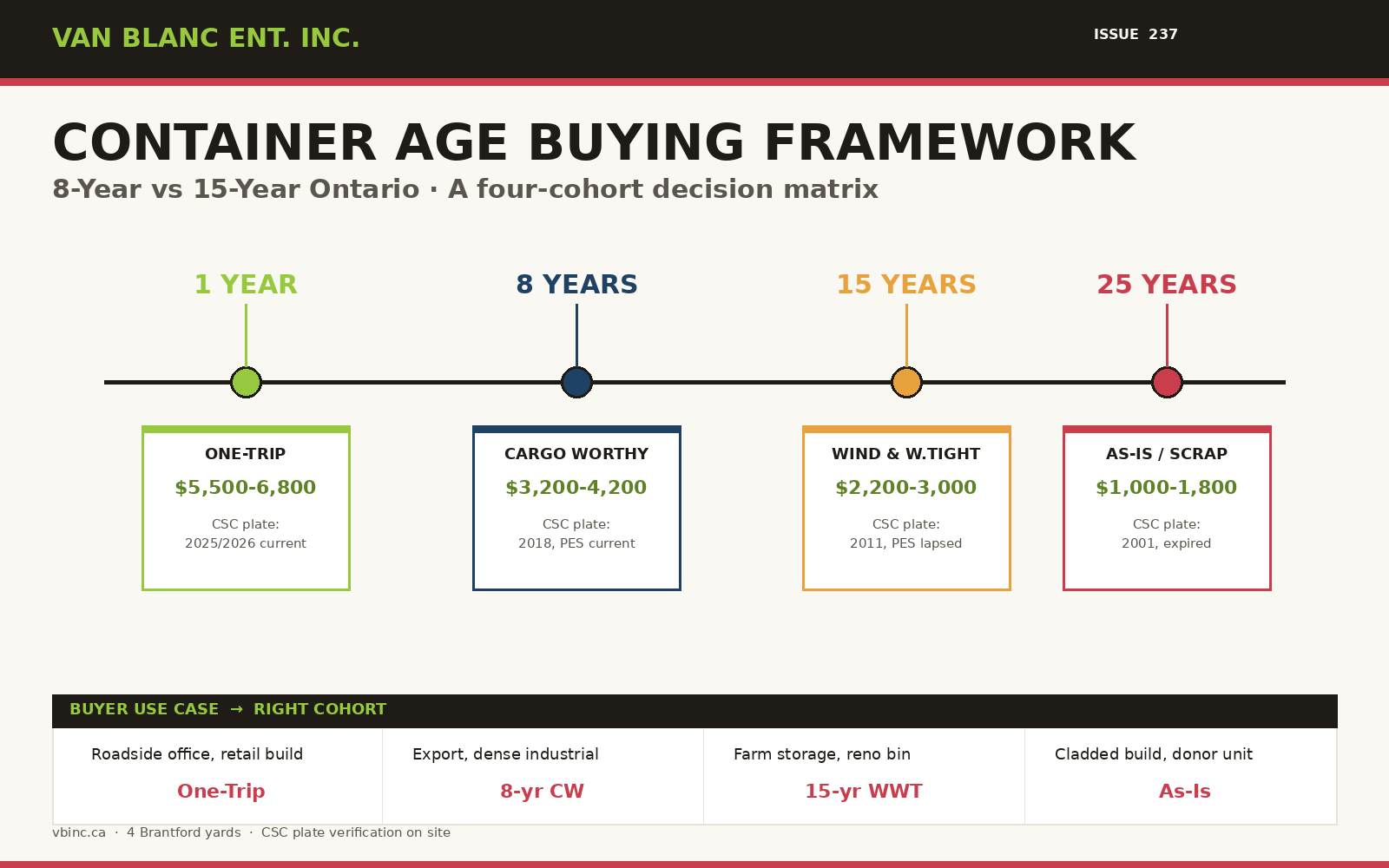
Quick Answer: The container age buying framework 8-year vs 15-year Ontario matches years-in-service to use case: one-trip for visible offices, 8-year Cargo Worthy for export plus dense storage, 12-15 year Wind & Watertight for farm and reno, 20-plus As-Is for cladding only. The CSC plate on the left door confirms the manufacture age. Real Brantford yards, real reviews (4.9 / 140+), real 1-3 day delivery across Ontario. Family-operated since 1995.
In This Guide
- Should you buy a shipping container by age or by grade?
- How do you read the CSC plate date in 30 seconds at the yard?
- What is the 1-year One-Trip cohort, and when is it worth the premium?
- Why is the 8-year Cargo Worthy cohort at its structural peak?
- Is a 15-year Wind & Watertight container good enough for storage?
- When is a 20-plus As-Is container the right cheap choice?
- Does container age always correlate with condition?
- Which container age should you buy for your use case?
- How does container age affect supply and price across Ontario?
- How long has Paul watched containers age through the cycle?
- Frequently asked questions
Reading time: about 13 minutes.
Should you buy a shipping container by age or by grade?
For a shipping container, age beats grade as the first thing to check, because age is the cause and grade is only the symptom. A container’s years in service reveal how many ocean crossings and freeze-thaw cycles the steel absorbed, while grade is one inspector’s snapshot from a single day. Match the age cohort to the use case first.
Most Ontario buyers walk into a container purchase thinking about grade. They want Cargo Worthy, or they read about Wind & Watertight, or they spotted As-Is at a lower price and they assume grade is the variable. It is not. Grade is the symptom. Years in service is the cause. A 15-year-old container has had three Atlantic crossings, two yard fights with a stacker, and roughly 18 winters of contraction and expansion in its corner castings. An 8-year-old container has had maybe one of each. The grade label is a snapshot of what an inspector saw on one Tuesday. The age tells you what the steel has actually been through.
This is the framework Ontario buyers ask about when they call our Brantford yards, and it sits right beside the bigger brand-new versus second-hand decision most of them are weighing at the same time. They want a structure, not a guess. A 20ft can is a 20ft can on the spec sheet. The buyer’s real question is: how many years has THIS one been working, and does that history match what I need next?
Paul puts it this way. “The grade tells you what the bin looks like today. The age tells you what it will look like in five years. If you are storing hay until 2031, you want to know the age. The grade can fool you.”
How do you read the CSC plate date in 30 seconds at the yard?
The CSC plate is how you read a container’s age in about 30 seconds. Every shipping container built for international service has a CSC plate riveted to the left door. The plate is required by the 1972 International Convention for Safe Containers, administered by the IMO. The plate carries a manufacture date, usually as month and year. That date is the single most important data point in this whole article. You can read it before you pay a dollar.
When a buyer comes to our 4 Brantford yards, the walk goes like this. We point at the bin. Buyer walks to the left door. Looks at the rivet plate. Reads the manufacture date. We then read the next-examination date together. Those two numbers tell you the cohort. A plate that reads “Manufactured 2017, Next Examination 2027” puts the bin at 9 years old with current PES certification. A plate that reads “Manufactured 2011, Next Examination expired 2024” puts the bin at 15 years old with no current cargo certification. Both can be perfectly sound purchases. They serve different jobs.
CSC plate inspection schedule, plain English
Per the CSC convention and the BIC, every container is examined no later than 5 years after manufacture under the Periodic Examination Scheme, then at intervals of no more than 30 months after that. Large operators run an Approved Continuous Examination Programme (ACEP) that reviews the program every 10 years instead of marking individual containers. A WWT-grade bin often has an expired PES or a lapsed ACEP marker. A Cargo Worthy bin must have a current one. The plate is the proof.
Christian walks buyers through this every week. Most have never been told the CSC plate exists. By the time they leave the yard they know how to spot manufacture year from the cab of a truck. That is the level of operational truth a Brantford visit gives you.
What is the 1-year One-Trip cohort, and when is it worth the premium?
The 1-year cohort is the One-Trip container. Built in China, Vietnam, or occasionally Korea. Loaded with cargo to offset the shipping cost of moving the empty steel across the Pacific. Lands at a North American port, gets unloaded, gets sold into the secondary market. The container has crossed an ocean exactly once. Inside, it looks essentially new. Outside, there may be a forklift scuff on the corner or a smudge from the cargo it carried. The doors operate the way the manufacturer intended. The paint is original. The floor has not been gouged by 15 years of forklift pads dragging across it.
The industry calls this cohort one-trip because the bin made exactly one loaded voyage, which is also why most buyers find it under the plainer search term: our freshly landed near-new stock at the Brantford yard is the same cohort described two ways. It is the right pick when the bin will be visible. Roadside office. Branded retail conversion. Backyard studio with windows the neighbour will see. Any container that becomes the public face of something. The premium over a 15-year-old bin is real, but the appearance gap closes that premium in one season of cladding work you do not have to do. Worth knowing: one-trip is not showroom-perfect, so we point out any minor handling marks when you walk it in the yard.
One-Trip carries the highest band of any cohort, and a 40ft High Cube One-Trip runs higher again than the 20ft, with the gap widening as delivery zone distance grows. What moves the number is size, the manufactured-this-year premium, and how far the bin travels from our 4 Brantford yards. The bin you buy in this cohort has a manufacture date on the CSC plate of late 2025 or early 2026, which is the definition of the cohort.
Why is the 8-year Cargo Worthy cohort at its structural peak?
The 8-year cohort is where Cargo Worthy lives. A container manufactured around 2018 has crossed the ocean four to six times. It has been re-inspected for PES at year five and is now mid-cycle on its second PES interval. The steel is past its early-life paint cycle (manufacturer paint does not last past year three or four of salt-air service) and into its first or second repaint. Surface rust spots have appeared and been addressed during PES inspection. The frame and corner castings are at their working peak. The floor has wear but not damage. The doors still seat properly because the corner posts have not yet started to torque from accumulated stack pressure.
This is the cohort that international exporters target. When a Welland exporter calls us for a CW 40ft to ship machine parts to Germany, they want an 8-year bin. The CSC plate is current. The structural inspection passed. The cosmetic wear does not matter to the receiving customs broker. The 8-year container is the workhorse of the global supply chain in its second act.
For dense Ontario storage, the 8-year cohort is also the right answer. Industrial yard with three sea cans stacked two-high. Farm equipment storage where the floor will carry weight. Workshop conversion that needs structural integrity at the corner posts for adding a window or door cut. The 8-year container holds up to modification because the steel has not yet entered the curve of slow stress-relaxation that arrives around year 13.
The 8-year sweet spot on Ontario pricing
A 20ft Cargo Worthy bin from the 8-year cohort sits a clear step below One-Trip, and a 40ft CW High Cube from the same cohort runs proportionally higher than the 20ft, delivered across most of southern Ontario. What you are paying for is the structural peak: current CSC certification and corner posts that still seat the doors cleanly. That makes it the second-best value per remaining year of useful life, after One-Trip. Most buyers who walk our yard and look at all four cohorts end up here.
Is a 15-year Wind & Watertight container good enough for storage?
A 15-year Wind & Watertight container is built for stationary storage on land, which is the job roughly 90 per cent of Ontario buyers bring to the yard. The 15-year cohort is the heart of the Wind & Watertight market. A container built in 2010 or 2011 has crossed the ocean seven to twelve times, depending on the trade lane. Its CSC plate may show a final PES inspection around 2020, after which the operator removed it from cargo service. The corner castings have absorbed thousands of stack-cycles. The paint has been refreshed two or three times. The floor has imprints from cargo pads. The roof has minor bows from where someone walked on it during a hurricane lashdown back in 2017.
None of that stops the bin from doing that job: stationary storage on land. The doors seal. The frame holds rectangular under wind load. Rain does not enter. Rodents cannot chew through 14-gauge Corten steel. The bin will sit on your Norfolk farm or your Cambridge driveway and do exactly what a storage building does, for another 10 or 15 years before any of those margins matter.
The comparison is this. A purpose-built backyard storage shed in Ontario, wears out in 12 to 15 years, requires roofing maintenance, has wood that rots, and offers a fraction of the security. A 15-year-old WWT 20ft, has another 15 years in it, requires almost zero maintenance beyond an occasional touch-up paint, will not rot, and is engineered to lift fully loaded by crane. The math is not subtle.
When is a 20-plus As-Is container the right cheap choice?
The 20-plus cohort is the As-Is market. Containers manufactured in 2003 or 2004 or earlier. The CSC plate is expired. The structural frame may have soft spots in the floor cross-members. Doors may have torqued and now require some persuasion to seal. Corner castings are at the end of their first stack-life. Rust is no longer “surface” in many places. The steel has earned its retirement from primary service.
An As-Is is the right cohort for exactly three buyer profiles, and Paul will tell you so before you pay. First, the cladding buyer. The bin will be skinned in pine or cedar or steel siding for an aesthetic build, and the underlying container’s appearance does not matter. The structural shell is still doing 80 per cent of its job, and the cladding handles the rest. Second, the donor-unit modifier. A custom shop cutting up containers for parts, where what they need is the corner castings and the roof panels and the door hardware, not a whole bin. Third, the scrap-metal arbitrage buyer. The steel in a standard twenty-foot box like the ones we sell weighs roughly 2,300 kg. At Ontario scrap rates, that has a floor value regardless of the container’s life as a container.
For storage, As-Is is a false economy in 80 per cent of cases. Whatever you save over a WWT on the front end tends to come back as roof patches and door welds within five years, often costing more than the gap you saved. Paul has watched buyers make this mistake for thirty years. “If the bin is sitting on your property as storage, do not save on the front end. You will spend far more on the back end. Get the WWT.”
Does container age always correlate with condition?
Container age does not correlate cleanly with condition, even though every buying framework is tempted to assume it does. Two containers from the same 8-year cohort can be in radically different condition based on what they did during those eight years. A container that ran the Pacific lane between Shanghai and Long Beach saw warm-water salt and steady cycles. A container that ran the North Atlantic between Hamburg and Halifax saw winter brine, ice-laden stack-loads, and storm-pitching that flexes the corner castings harder than any other trade lane. Same age. Different lives. Different remaining structural margin.
This is why Paul reads the manufacturer marking and the previous-owner code on the CSC plate, not just the date. A container whose previous shipping line was a major Asia-Pacific carrier has a known service profile. A container whose previous line was a North Atlantic specialist has a different one. We do not gate sales on this, but it factors into how Paul stacks the yard. The bins we sell into customer-facing roles (One-Trip equivalent or restored CW) tend to come from gentler lanes.
The Brantford yard advantage on age verification
Buyers from across Ontario drive to our 4 Brantford yards because the CSC plate is the only reliable answer to “how old is this bin.” A photo on Facebook does not show the plate clearly. A description that says “approximately 10 years old” carries no weight when the actual stamped date is 2008. Walk the yard, read the rivet plate, see the manufacture date with your own eyes. Worth the drive for the quality, family customer service with 30 years of experience.
Paul LeBlanc, owner: “I have thirty years in the container business. The single best thing I can teach a first-time buyer is to look at the CSC plate before they look at the price. The age on that rivet plate tells you more in three seconds than 20 minutes of sales talk ever will. A 2017 plate and a 2008 plate, sitting next to each other in our Brantford yards, are not the same bin even if they have the same paint job. The grade label is what the inspector wrote. The plate date is what the steel actually did. Read the plate first.”
Which container age should you buy for your use case?
The container age you should buy is set by your use case rather than your budget. Once you understand the cohorts, the buying decision becomes a matrix, not a guess. The use case sets the cohort. The cohort sets the price range. The price range matches the budget or it does not. If the budget conflicts with the cohort the use case demands, the answer is to widen the budget, not to drop the cohort. Buying down a cohort to save is the move that comes back to bite buyers two seasons later. If you want the full inspection walk-through that pairs with this age method, our step-by-step yard inspection method for second-hand bins covers what to check on the floor, doors, and seals once the cohort is settled.
| Use case | Right cohort | Why this match | Relative 20ft price band |
|---|---|---|---|
| Roadside office, branded retail, public-facing build | 1-year One-Trip | Appearance matters; cladding cost would erase any savings | Highest band |
| Backyard studio, container Airbnb, occupied conversion | 1-year One-Trip or 8-year CW restored | Structural integrity for modification cuts plus appearance | High to upper-mid band |
| International export, multi-stack industrial yard | 8-year CW | Current CSC certification, structural peak | Upper-mid band |
| Workshop conversion, secure tool storage with doors and windows added | 8-year CW | Frame holds modifications; doors still seat cleanly | Upper-mid band |
| Farm storage, hay shed, equipment shelter, rural reno bin | 12-15 year WWT | Best value per remaining year for stationary land use | Mid band |
| Driveway reno bin (3-12 month placement) | 12-15 year WWT | Sealed and lockable for the length of the job | Mid band |
| Cladded container build (steel hidden behind pine or siding) | 20-plus As-Is | Appearance does not matter; structural shell is doing 80 per cent | Lowest band |
| Donor unit for custom modification shop | 20-plus As-Is | Parts harvest; whole-bin integrity not needed | Lowest band |
Notice what is not on the matrix. There is no row for “buy the cheapest bin you can find regardless of use case.” That row leads to the Facebook trap and the panicked call-back two weeks later when nothing arrives. Many buyers call us saying they can get a bin far cheaper on Facebook. Two weeks later they call back saying they got scammed, because the bin priced well below the market is the bin that never arrives. The cohort framework above is the antidote to that whole scam pattern, because it forces the buyer to think in terms of fit, not price floor.
How does container age affect supply and price across Ontario?
Container age shapes both supply steadiness and delivered price across Ontario, because each cohort enters the market on a different rhythm. Ontario’s container supply does not arrive uniformly across cohorts. One-Trip stock pulses in batches when major Asian manufacturers release inventory through Vancouver and Montreal ports, then moves overland to the Ontario distribution network over four to eight weeks. The 8-year CW cohort is steadier, fed continuously by major shipping lines retiring units from their primary cargo fleets on a rolling basis. The 12-15 year WWT cohort is the broadest and most consistent, drawn from a deeper pool of containers that have already cycled out of primary cargo service into secondary leasing and now into final-sale.
For how those cohort price bands actually shake out, our breakdown of what drives Canadian container pricing walks the same size and grade variables; the practical takeaway here is timing. If you need One-Trip and the manufacturer cohort for that month is thin, the price climbs. If you need WWT, the supply is steady and the price holds month-to-month. CW falls between. Our 4 Brantford yards rotate through cohorts roughly every six weeks. Walking the yard on the right Tuesday means seeing the cohort you actually want, in person, before payment.
Northern Ontario freight adds a layer. A container shipped from Brantford to Sudbury or Thunder Bay carries a freight premium that scales with cohort price. The percentage matters less on a higher-cost One-Trip than on a low-cost As-Is, where the freight can equal the bin price. For long-distance Ontario buyers, that is one more reason to let the use case pick the cohort: on the One-Trip, 8-year and 15-year cohorts the freight stays a manageable fraction of the total.
The cottage country edge case
Muskoka, Kawartha, and Haliburton buyers often ask for One-Trip because cottage country aesthetic matters to neighbours and conservation-minded buyers. But the 8-year CW restored cohort can win on the same lot if it is wood-clad or painted to match the property. The cohort decision here interacts with cladding and modification budget, which is why a clear finish plan, and the paint, cladding, and conversion work finished at the yard, needs to be settled alongside the use case before the cohort lands.
How long has Paul watched containers age through the cycle?
Paul has watched containers age through the full cohort cycle since 1995, the year he started Van Blanc. The recurring conversation with suppliers was always about the containers as much as the cargo: the cargo was variable, the containers were always there. His son Christian grew up around the yard. The two of them have watched thirty years of containers age out from One-Trip through CW through WWT through As-Is, in real time, in real yards, with real buyers.
This article is an attempt to put thirty years of yard-walking into a framework a buyer can use in 13 minutes. The framework is real because the cohorts are real. The CSC plate is real. The use cases are real. The price bands track the inventory at our 4 Brantford yards. Every kind of Ontario buyer ends up at our family business eventually, and the conversation starts with the same question: how old is this bin, and is that the right age for what I am doing with it?
The Norfolk farmer wants 15-year WWT for the back forty. The Brampton contractor wants 8-year CW for the job site office. The Toronto retail entrepreneur wants One-Trip for the storefront. The Sudbury mining engineer wants 8-year CW for the bunkhouse. The Six Nations community partner wants 15-year WWT for the equipment cage. Different buyers, different worries, same yard, same family. The container age buying framework is what makes the conversation efficient. Walk the yard, read the plate, match the cohort to the use, drive home with the right bin.
Ready to price your container?
Tell us the size and your postal code and we’ll send back an all-in number, container, delivery, and placement, usually within 1-3 days. No pressure, no mystery fees.
Family-run in Brantford since 1995 · 200+ containers in stock · 4.9★ across 140+ Google reviews · every box graded by a person, walk it before it lands.
Sold outright. Delivered in 1 to 3 days.
Van Blanc sells new and used shipping containers outright from our 4 Brantford yards, with delivery in 1 to 3 days and payment on delivery. We do not rent, lease or offer rent-to-own. Request a sale quote or call the yard at 519-754-6844.
Frequently asked questions
How do I tell the age of a shipping container before I buy it?
Look at the CSC plate riveted to the left door. It carries a manufacture month and year. That date is the single most reliable age indicator. The container ID number does not encode the age, so do not rely on the BIC code. Walk the bin in person, read the plate, write down the date. Our Brantford Yards lets you do this before payment.
Is an 8-year-old container too old to buy?
An 8-year-old container is in its structural peak. The steel has cycled past early-life paint failure but has not entered the slow stress-relaxation that arrives around year 13. It is the cohort that international exporters target for CW grade. For Ontario storage, modification, or dense industrial use, 8 years is the second-best value per remaining year after One-Trip.
What is the typical age of a Wind & Watertight container in Ontario?
Wind & Watertight containers in Ontario typically run 12 to 15 years old, sometimes older. They have aged out of active cargo service but remain rectangular under load, with sealing doors and no perforations. At our 4 Brantford yards, WWT stock is the broadest and most consistent cohort by volume, and a delivered 20ft sits in the mid price band, below One-Trip and Cargo Worthy but well above scrap-grade As-Is.
Does container age correlate exactly with grade?
Not cleanly. Two containers from the same 8-year cohort can be in different condition based on which trade lane they ran. North Atlantic lanes flex corner castings harder than Pacific lanes. Age is the strongest single predictor, but the previous owner code and the inspection history on the CSC plate refine the picture. Paul reads all three when he stocks the yard.
How long is a CSC plate inspection valid?
Under the Periodic Examination Scheme set by the 1972 CSC convention, the first inspection happens no later than 5 years after manufacture, then at intervals of no more than 30 months. Large operators use the Approved Continuous Examination Programme instead, reviewed every 10 years. A Wind & Watertight bin often has an expired PES marker; that is part of why it left primary cargo service.
Should I buy a 20-year-old As-Is container for storage on my property?
Usually no, even though the lower price is tempting. Whatever you save on the front end typically comes back as roof patches and door welds within five years, often outweighing the saving. As-Is fits cladding-hidden builds, donor units for custom modification shops, and scrap-metal arbitrage. For storage that will sit on your land for a decade, the 12-15 year Wind & Watertight cohort is the right answer.
What does a One-Trip container cost in Ontario in 2026?
A 20ft One-Trip sits at the top price band of any cohort we carry from our 4 Brantford yards, and a 40ft High Cube One-Trip runs higher again, with delivery zone distance widening the gap. The premium reflects the manufactured-this-year cohort, with current CSC plates and essentially new condition. For an all-in delivered number for your size and postal code, ask the Brantford yard for a delivered quote.
Can a 15-year-old container still be used for international shipping?
Only if the CSC plate carries a current Periodic Examination Scheme or Approved Continuous Examination Programme certification. Most 15-year-old containers in the Ontario secondary market have aged out of active cargo certification, which is why they trade as Wind & Watertight rather than Cargo Worthy. For domestic land storage, the lapsed certification does not matter.
How does the container age buying framework apply if I am converting to a workshop?
Workshop conversions cut doors, windows, and sometimes ventilation through the container wall. Those cuts redistribute stress across the corner posts and roof panels. The 8-year Cargo Worthy cohort is the right match because the frame has not yet entered late-life stress relaxation. A 15-year Wind & Watertight bin can be converted, but the modifier needs to account for slightly more material flex during the cut and re-weld.
Why does Van Blanc let buyers read the CSC plate before payment?
Because the plate is the plain answer to the buyer’s first question. A photo on Facebook does not show it clearly. A description that says “approximately 10 years old” carries no weight when the actual stamped date is 2008. Walking our 4 Brantford yards and reading the rivet plate in person is the only way to verify age before money changes hands. That visibility is the brand we have built over 30 years.
Sources
- International Organization for Standardization. (2022). ISO 6346:2022, Freight containers, Coding, identification and marking. iso.org/standard/82754.html
- International Maritime Organization. (1972, amended). International Convention for Safe Containers (CSC). imo.org
- Bureau International des Containers. (2024). CSC Combined Data Plate Explained. bic-code.org/csc-combined-data-plate
- Container Surveyor. (2025). Used Shipping Container Grades: One-Trip, CWO, WWT, As-Is. containersurveyor.com/used-shipping-container-grades-explained
Reach Van Blanc in Brantford
We have been supplying shipping containers across Ontario since 1995. Our warehouse is at 90 Morton Avenue E in Brantford, and we deliver right across the province on a cash-on-delivery basis. No surprise fees, no chase-the-paperwork.
Van Blanc Ent. Inc. 90 Morton Ave E Unit 1B, Brantford, ON N3R 7J7 +1 888-509-6658
Walk our yard and read the CSC plate on every bin yourself. The 1-year, 8-year, 15-year, and 20-plus cohorts all live in our Brantford rows. We will show you which one fits your use case.