
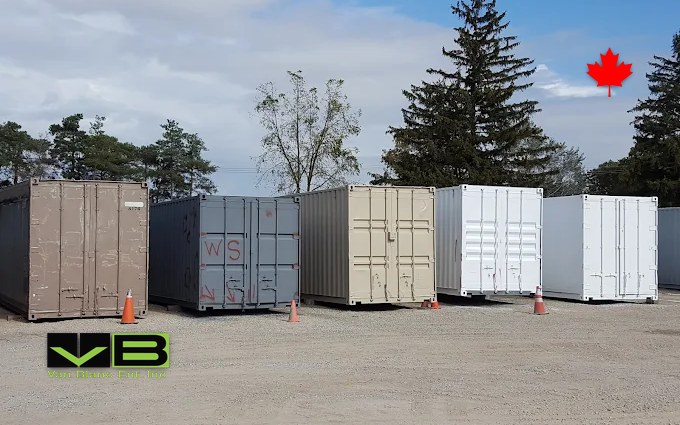
We sell containers. We do not rent.
Van Blanc sells shipping containers outright. We do not rent, we do not lease, and we do not offer rent-to-own. Go Mini’s is a rental and moving service, and it is on this page because Ontario buyers weigh a pod billed every four weeks against owning a sea can. That comparison is worth reading, but the only thing we can deliver is a container that belongs to you.
Quick Answer: Go Mini’s rents 12, 16 and 20-foot pods on 28-day cycles through Ontario franchises: one based in Mississauga serving the GTA, one covering Hamilton and Niagara. Buying a corten steel sea can outright wins once storage passes about two years, needs a 40-footer, or sits on gravel outside that map.
In This Guide
- Where We Stand (Read This First)
- What Go Mini’s Is, and Who Runs It in Ontario
- The Go Mini’s Container, Decoded
- The “Largest Container in the Industry” Claim, Measured
- What Go Mini’s Is Genuinely Good At
- Where the Trucks Go: The Ontario Service Map
- The Translucent Roof and the Roll-Up Door
- Twenty-Eight Days Is Not a Month
- Three Ontario Situations, Decided
- Who Should Rent Go Mini’s, and Who Should Buy
- The Sea Can You Would Buy Instead
- Go Mini’s FAQs
Reading Time: 14 minutes
Where We Stand (Read This First)
A shipping container yard in Brantford wrote this page. We have no connection to Go Mini’s, its franchisor or either Ontario franchise, we are paid nothing by anyone named here, and we sell the steel box a Go Mini’s customer might buy instead, which makes us an interested party and you should weigh every sentence accordingly. The company gets its strengths first below, plainly, because for a large share of the people who type the name into Google a pod for six weeks is the right purchase and a yard full of sea cans is the wrong phone call.
Everything said about Go Mini’s was read from gominis.com, gominis.ca and goministorage.ca on September 11, 2026 and is attributed where it matters. We did not scrape customer reviews and we make no claims about how either franchise treats its customers; the comparison is about the box, the map, the billing shape and the physics of getting a loaded container onto a piece of Ontario ground. The PODS-alternatives roundup is the wider frame if you are new to the category.
What Go Mini’s Is, and Who Runs It in Ontario
Go Mini’s is a portable storage and moving brand that started in 2002, moved to a franchise model in 2012, and now describes itself as a network of 114 franchise locations across 39 American states, Canada and Mexico, run from a head office in Fort Myers, Florida. Every location is a locally owned business trading under the brand, which, as with every dealer-run pod service, means the fleet, the service radius, the delivery calendar and the quote are set by the franchise you reach, and the national site is a door to whichever one covers your postal code.
Ontario has two franchises with their own websites. The larger is a Mississauga-based franchise and lists twenty communities it serves: Ajax, Bolton, Brampton, Burlington, Caledon, Etobicoke, Guelph, Halton Hills, Hamilton, Markham, Milton, Mississauga, Newmarket, North York, Oakville, Oshawa, Richmond Hill, Scarborough, Toronto and Vaughan, with a line inviting anyone outside the list to call and ask. The second, Go Mini’s of Hamilton / Niagara, describes its ground as Niagara Falls, Niagara-on-the-Lake, Hamilton and everything in between. Both rent the same three container lengths and both offer the same two shapes of service: the pod stays in your driveway while you fill it, or the franchise carries it, loaded, to its facility and back, or on to a new address.
The Go Mini’s Container, Decoded
| Go Mini’s size | Exterior (as published) | What the franchise pages say it holds |
|---|---|---|
| 12 ft | 12 ft long, 8 ft wide, 8 ft high | Two to three rooms of furniture; smaller moves |
| 16 ft | 16 ft long, 8 ft wide, 8 ft high | Three to four rooms; medium moves |
| 20 ft | 20 ft long, 8 ft wide, 8 ft high | Five to six rooms; large moves |
The construction, from the GTA franchise’s own container page: a vented, galvanized steel exterior that the company says reduces moisture and humidity inside while staying watertight; a translucent roof that lets light in; a locking roll-up door of the kind used in self-storage buildings; near-ground-level loading with a single step up; and eight inches of ground clearance, which the franchisor’s site explains as a hedge against water damage. The units ride on rubber-coated wheels, and the GTA FAQ says wood boards go under those wheels on a driveway to spread the weight. The lift onto and off the truck is described as smooth enough that the contents do not shift, which is the same promise every level-lift pod service makes and, on a paved surface, keeps.
Notice what is and is not in that description. Galvanized steel walls are a real step up from the aluminum-skinned panels other pod brands use, and the roll-up door is easier to work around in a driveway than swing doors. What the pages do not publish is interior dimensions, cubic capacity or floor construction; the GTA FAQ does give a weight limit of 8,000 pounds per container, and beyond that the “rooms” figures are the sizing guidance you get, and they are the franchise’s own estimates rather than a standard.
The “Largest Container in the Industry” Claim, Measured
Go Mini’s says it has the largest container in the industry, and that its 20-footer holds 25 percent more than a 16-footer. Both statements are true inside the industry they mean, which is portable storage pods: PODS tops out at 16 feet, Cubeit rents one 16-foot format, and MI-BOX dealers list 20 feet for moving. Against a shipping container the claim reads differently, because a 20-foot pod and a 20-foot ISO container share a length and part ways on everything after it.
| Go Mini’s 20 ft (rented) | 20 ft ISO sea can (owned) | 40 ft high cube sea can (owned) | |
|---|---|---|---|
| Exterior | 20 x 8 x 8 ft | 20 ft x 8 ft x 8 ft 6 in | 40 ft x 8 ft x 9 ft 6 in |
| Interior volume | Not published | About 1,170 cu ft | About 2,690 cu ft |
| Walls and roof | Galvanized steel walls, translucent roof | Corrugated corten steel, steel roof | Corrugated corten steel, steel roof |
| Floor | Not published | Marine plywood on steel cross-members | Marine plywood on steel cross-members |
| Door | Locking roll-up | Double cargo doors; roll-up available on modified units | Double cargo doors; roll-up available on modified units |
| Ground contact | Wheels, 8 in clearance, boards under wheels | Corner castings on blocks, pad or piers | Corner castings on blocks, pad or piers |
| Rated for | Franchise transport on its truck | Ocean freight, crane lifts, stacking | Ocean freight, crane lifts, stacking |
So the biggest pod in the pod industry is the smallest common size in the container industry. That is a fact about categories rather than a criticism of the pod: a household move rarely needs more than a 20-foot pod, and a farm or a trade rarely needs less than a 40-foot container. The sea can size chart, with the interior figures pod brands do not publish, and the dimensions guide carry the full table.
What Go Mini’s Is Genuinely Good At
Ground-level loading is the first strength and it is real. A pod that sits eight inches off the driveway with one step up is easier to fill with a sofa than a sea can standing on blocks, and easier again than a self-storage locker two floors up. The second is the driveway itself: wheels on boards on asphalt is a gentle footprint, and for a suburban household that is the difference between a pod and no pod at all. The third is the loaded transport: the franchise will lift the full unit, carry it to its facility, hold it, and bring it back or deliver it to the next address, which is a service no container yard offers and no self-storage building can.
The fourth strength is the billing shape for short jobs: a four-week cycle with the option to stop when the job stops. And the fifth is the size choice inside the pod category, three lengths where Cubeit has one and PODS stops at 16 feet, so a family clearing a whole main floor gets a 20-footer instead of two smaller boxes.
The Customer It Was Built For
A GTA, Hamilton or Niagara household with a paved driveway, a move or a renovation measured in weeks, no permanent place for a steel box, and a wish to have it gone the day the job ends, or carried to the new house without hiring a truck twice. For that customer Go Mini’s, or a comparable pod service, is the right category. We would tell them so on the phone.
Where the Trucks Go: The Ontario Service Map
Read the twenty-community list again and notice its shape. It is the GTA and the western lakeshore: Durham at one end, Halton and Guelph at the other, York and Peel in the middle. The Hamilton / Niagara franchise adds the peninsula. Everything else in Ontario, which is most of it by land and a great deal of it by population, is a “call and ask” address. The GTA site says it can deliver anywhere in southern Ontario from Mississauga, so a delivery outside the listed communities is quoted on request for the distance.
| Where you are | Go Mini’s (per its Ontario sites, Sept 2026) | Buying a sea can from Van Blanc |
|---|---|---|
| Toronto, Peel, York, Durham, Halton, Guelph | GTA franchise, listed community | Delivered in one to three days |
| Hamilton, Burlington | Listed by both franchises | Delivered in one to three days |
| Niagara Falls, Niagara-on-the-Lake, St. Catharines, Welland | Hamilton / Niagara franchise | Delivered in one to three days |
| Brantford, Norfolk, Haldimand, Cambridge, Kitchener-Waterloo | Not listed; call and ask | Delivered in a day, or picked up at the Brantford yard |
| London, Windsor, Sarnia, Owen Sound | Not listed; “southern Ontario” on request | Delivered in one to three days |
| Barrie, Muskoka, Ottawa, Kingston, the north | Not listed | Delivered across the province, longer runs quoted by the kilometre |
The pattern is the same one every pod brand shows in this province and it comes down to equipment: a wheeled pod and a level-lift truck are built for paved driveways in dense places, so the franchises live where the driveways are. A tilt-deck and a corten box are built for the opposite ground, which is why every Ontario address we run to has a page and why Norfolk County farms and London trades buy rather than rent.
The Translucent Roof and the Roll-Up Door
Two details in the Go Mini’s specification decide whether the pod or the container is the right long-term box, and both are honest trade-offs rather than flaws. The translucent roof is a real convenience: you can see what you are doing inside without a light. It is also a plastic panel in place of steel, which is fine for a season in a driveway and is the reason the pod is a short-term product; a corrugated steel roof is what lets a sea can sit in a field for twenty winters, take snow load, and be walked on to clear it.
The roll-up door is the other. It is the right door for a driveway, because it needs no swing room and it is what people know from self-storage. It is also a door with a seal along a coiling slat, and every roll-up door on every building in Ontario is where the draught and the dust get in, which is why a container yard fits a roll-up only where a customer asks for it and keeps the cargo doors, with their four locking bars and full gasket, on everything else. Replacing a roll-up door’s weatherseal is a page we wrote because those seals wear, and cargo door gasket replacement is its steel-door cousin. For a pod you hand back in six weeks none of this matters; for a box you will still own in 2036 it is most of what matters.
Paul LeBlanc, Van Blanc: “Thirty years of this and I can tell you the pod companies are good at the thing they do. A family in Oakville moving in July doesn’t want a sea can, they want a box on wheels that leaves with the truck. The customers who end up in my yard are the ones who found out at month twenty that the bill was never going to stop, or who live on a gravel lane nobody’s pod truck will drive down. For them the 20-footer they buy is the last storage bill they pay.”
Twenty-Eight Days Is Not a Month
The GTA franchise’s FAQ is clear that the rental period is four weeks and that payments come out every 28 days. That is a normal way to bill portable storage, Cubeit does the same, and the arithmetic is plain: a 28-day cycle turns over thirteen times in a 365-day year, where a monthly bill turns over twelve. Over a short job it changes nothing. Over a long one it is one extra cycle a year to count when a quote is compared against a monthly figure, and it moves the ownership crossover a little earlier than a months-based estimate suggests.
No dollar figures here, because the franchise quotes per postal code and a container quote moves with grade, size and distance, but the two shapes are fixed. A rental is a cycle rate, times the cycles, plus delivery, plus pickup, plus facility storage and its insurance if the pod leaves your property. A purchase is one price for the box, one delivery charge by the kilometre, and nothing after. BigSteelBox, which rents and sells, publishes that owning overtakes renting a little past two years in most of its cities, and the rent-or-own arithmetic works that mark through for an Ontario household while our PODS write-up runs it cycle by cycle. A used wind-and-watertight box, which the grade explainer explains, costs less than a new one and pulls the crossover earlier; the five-year resale value is the line the rental math never has, and what drives a container price is on its own page.
Three Ontario Situations, Decided
A Vaughan townhouse, staged for sale, six weeks. Rent the pod. Half the furniture goes into a 16-foot Go Mini’s on the driveway, the listing photos get taken, the house sells, and the pod either goes to the new address or back to the franchise. A sea can would hold the furniture and then have nowhere to live. This is the job the wheels and the one-step floor were designed for.
A Niagara-on-the-Lake vineyard, equipment and harvest bins, every year. Buy the container, and buy it big. The address is inside the Hamilton / Niagara franchise’s ground, so a pod is a real option for a season, but the need has no end date, the ground is gravel between the rows, and the box will get shelving and a second door within the year. A high cube in the 40-foot length from the used lot lands on a bed of compacted gravel off a tilt-deck and stays.
A Scarborough contractor, tools and materials, yard access, three years and counting. Buy. Inside the GTA franchise’s list, so the pod was the easy first call, and now the cycles have run past forty. A 20-foot unit from the one-trip rows takes a shelving system, a roll-up door fitted at the yard’s shop where the customer actually wants one, and a lock box over the padlock, and it is an asset on the books instead of a line on the statement.
Who Should Rent Go Mini’s, and Who Should Buy
Rent Go Mini’s, or a comparable pod, if you are on the GTA list or in Hamilton or Niagara, the job is weeks or a few months, the driveway is paved, you want the box gone at the end, you may want it held at the facility in the middle, or you are moving and want the loaded pod carried for you. That last case is worth underlining: our page on moving with an owned container explains why a loaded move is a job for a mover or a pod franchise and never for a container yard.
Buy a container if the storage will outlast about two years, the address is off the list, the ground is gravel, grass or a field, you want a 40-footer or anything with a steel roof, you intend to modify the box, or you want the money to end as an asset. If your real choice is a rental container against a locker in town, the rental-versus-locker comparison covers that pair, and the rental market guide explains how the Canadian rental market, franchise and local, sets its terms. Whether a container can sit on a given lot is your municipality’s call, so check with your local planning department before you order.
The grey zone is eighteen months to two and a half years. In it, the tie-breakers are the roof, the door and the ground: a translucent roof and a roll-up door on a paved driveway for a job that will end favours the pod; a steel roof on gravel for a need with no end favours the box.
The Sea Can You Would Buy Instead
For the buyer on the ownership side of that line, this is the section we can write from the yard. The storage answer is the standard 20-foot container: the same length as the biggest pod, six inches taller, corten steel walls and roof, a marine plywood floor, double cargo doors with a full gasket, and a payload rating far past anything a household or a trade will put in it. Buy it used and wind-and-watertight for storage, or one-trip if it is going to be cut for a window and become a site office in a container or a workshop, because straight steel cuts cleaner.
Every container we sell is picked by a person and can be picked by you. Drive to 90 Morton Avenue East, walk the rows with Paul or Christian, and choose the unit by its number before any money moves; payment is on delivery, after you have seen the box on your ground. Delivery is by tilt-deck in one to three days across the province, the drop-day walkthrough shows the sequence, and the pre-delivery checklist tells you what to have ready, including the straight run the truck needs. Everything is sold outright; Van Blanc keeps no rental fleet and offers no lease or rent-to-own, and if what you need is a pod for six weeks the right call is the franchise for your city, which we will say on the phone.
Past cycle twenty-six? Price the box once
Tell us the size, the grade you have in mind, and your postal code, and we will send an all-in number for the container delivered and placed, usually the same day. If your job is really a six-week pod job, we will say so. Or see the rows for yourself and pick the unit yourself.
If you are still comparing pod brands with each other, the MI-BOX page reads the other dealer-run service in the GTA the same way this page reads Go Mini’s, the BigSteelBox-versus-PODS page covers the two national names, and the supplier-review series hub lists every supplier we have looked at, ourselves included. The building-choice hub is the wider read for anyone still deciding whether a steel box is the right building at all.
Go Mini’s FAQs
Where does Go Mini’s operate in Ontario?
Two franchises with their own sites as of September 2026: a GTA operation based in Mississauga that lists twenty communities from Ajax and Oshawa across to Guelph, Halton Hills, Hamilton and Burlington, and Go Mini’s of Hamilton / Niagara covering Niagara Falls, Niagara-on-the-Lake, Hamilton and the ground between. Addresses outside those lists are “call and ask”; the GTA site says it can deliver across southern Ontario on request.
What sizes do Go Mini’s containers come in?
Three lengths, 12, 16 and 20 feet, each 8 feet wide and 8 feet high. The franchise pages describe the 12-footer as two to three rooms of furniture, the 16-footer as three to four rooms, and the 20-footer as five to six rooms. Interior dimensions and cubic capacity are not published on the Ontario pages; the GTA FAQ lists a weight limit of 8,000 pounds per container.
Is the Go Mini’s 20-foot container really the largest in the industry?
Within portable storage pods, yes: PODS stops at 16 feet and Cubeit rents one 16-foot format, so a 20-foot pod is the biggest rental pod commonly offered in Ontario. Against shipping containers it is the smallest common size; a 20-foot ISO container is the same length and six inches taller, and 40-foot and 40-foot high cube units hold more than double.
How is Go Mini’s billed?
The GTA franchise’s FAQ says the rental period is four weeks and payments are taken every 28 days, with delivery and pickup quoted separately and facility storage, if you use it, billed alongside. A 28-day cycle turns over thirteen times in a calendar year rather than twelve, which matters for a long rental and not at all for a short one.
Does Van Blanc rent containers like Go Mini’s does?
No. Van Blanc sells containers outright and does not rent, lease or offer rent-to-own. For a short job in the GTA, Hamilton or Niagara a pod franchise is usually the better call and we will say so. For storage that will run years, a farm, vineyard or trade site, a rural address, a bigger box, or a container you want to modify, buying a used 20 or 40-foot unit from the Brantford yard is the answer we can give.
Can a Go Mini’s container be placed on gravel or grass?
Ask the franchise for your address. The pod rides on rubber-coated wheels with eight inches of clearance and the FAQ describes boards under the wheels on a driveway, which is a paved-surface design. A tilt-deck delivery of an owned sea can is built for the other case: it slides an empty container onto gravel, a field or a lane with a straight run about twice the box’s length.
Go Mini’s vs PODS vs MI-BOX: which is better in Ontario?
They are one category with different maps and hardware. PODS Canada lists Toronto and Ottawa as its Ontario markets with 8, 12 and 16-foot units; MI-BOX dealers cover Niagara, Hamilton, Burlington, the Halton-Peel-York corridor and the Kitchener-Guelph-Cambridge area with 8 to 20-foot composite units; Go Mini’s covers the GTA list plus Hamilton and Niagara with 12, 16 and 20-foot galvanized steel units on 28-day cycles. Get the quote for your postal code from whichever serves it, and if the job will run past two years price a used container against all three.
Sources
- Go Mini’s. (2026). About Our Portable Storage Company. gominis.com
- Go Mini’s Toronto & GTA. (2026). Our Service Areas. gominis.ca
- Go Mini’s Toronto & GTA. (2026). Portable Storage Container Dimensions and Sizes. gominis.ca
- Go Mini’s Toronto & GTA. (2026). Our Container Sizes. gominis.ca
- Go Mini’s Toronto & GTA. (2026). Frequently Asked Questions. gominis.ca
- Go Mini’s of Hamilton / Niagara. (2026). About Go Mini’s Portable Storage. goministorage.ca
- BigSteelBox. (2026). Renting vs. Buying a Shipping Container. bigsteelbox.com
Reach Van Blanc in Brantford
We have been supplying shipping containers across Ontario since 1995. Our yard is at 90 Morton Avenue East in Brantford, and we deliver right across the province with payment on the day of delivery. No deposit, no upfront wires, no chase-the-paperwork.
Van Blanc Ent. Inc., 90 Morton Ave E Unit 1B, Brantford, ON N3R 7J7, 519-754-6844 (cell) or 1-888-509-6658 (toll-free).
If the cycles have been running longer than the job, or your address is off every pod list, call with the size and your postal code and we will tell you on the spot what is in stock and when it can land. Worth the drive for unbeatable quality, family customer service with 30 years of experience.