
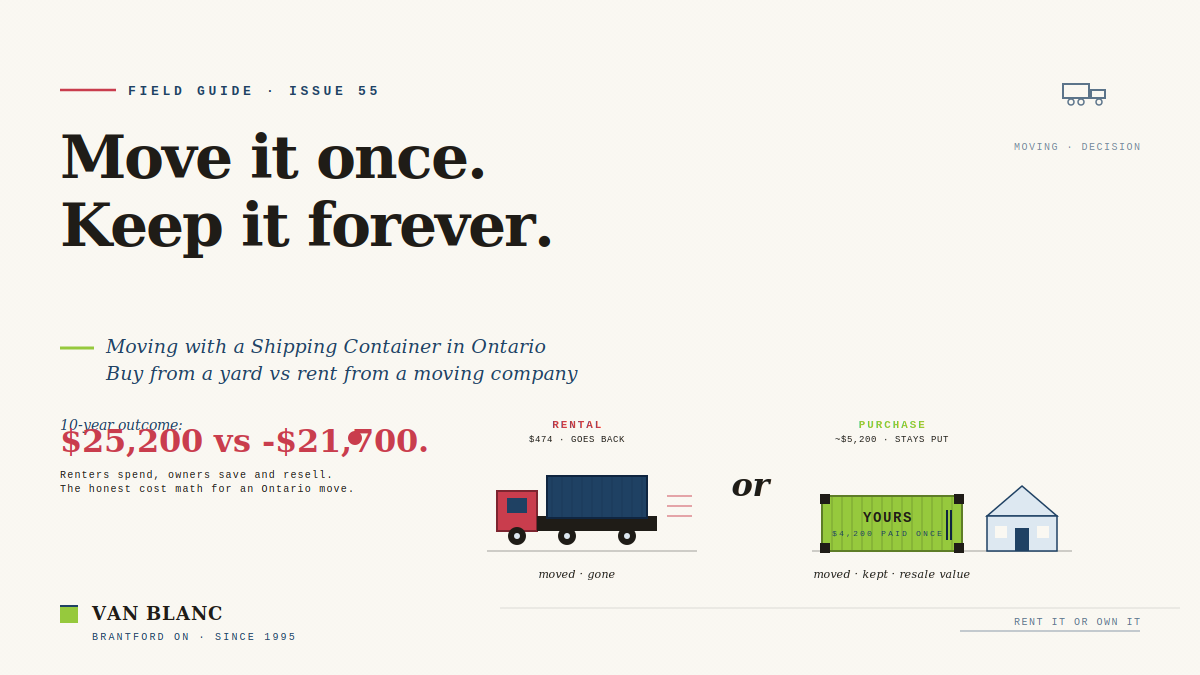
Quick answer. Moving with a shipping container in Ontario works best when the container is one you actually keep. Buy a container from Van Blanc’s 4 Brantford yards and we deliver it to your old address in 1 to 3 days, set on your driveway. You load it on your own schedule and unload it at the new place at your own pace. An independent hauler moves the loaded container between cities, booked like a furniture mover you would otherwise hire or a flat-deck freight carrier. Van Blanc supplies and delivers the box; the cross-town or cross-region haul of a fully loaded container is a separate, third-party job you book. If you have a driveway at the new address and want storage afterward, buying the container outright usually beats a one-month rental from a national company. You keep a 20 ft steel box when the move is done. If the box will double as home storage for years after the move, a new (one-trip) container is the longest-life pick. Tell us the size and your postal code and we will send back one written number for the container and our delivery.
The split up front: Van Blanc supplies and delivers the container, new (one-trip) or used. A licensed carrier moves it loaded. That division is the whole model.
What this container moving guide covers
- How shipping container moving works in Ontario
- Container supplier vs container movers
- Shipping container moving cost drivers
- 20 ft vs 40 ft sizes for a house move
- Loading on moving day
- Loaded weight and balance for a house move
- Moisture, vents and locks for the move
- Moving container options compared
- Choosing container movers for the loaded haul
- How long a container move takes
- Shipping container moving questions
How Shipping Container Moving Works in Ontario
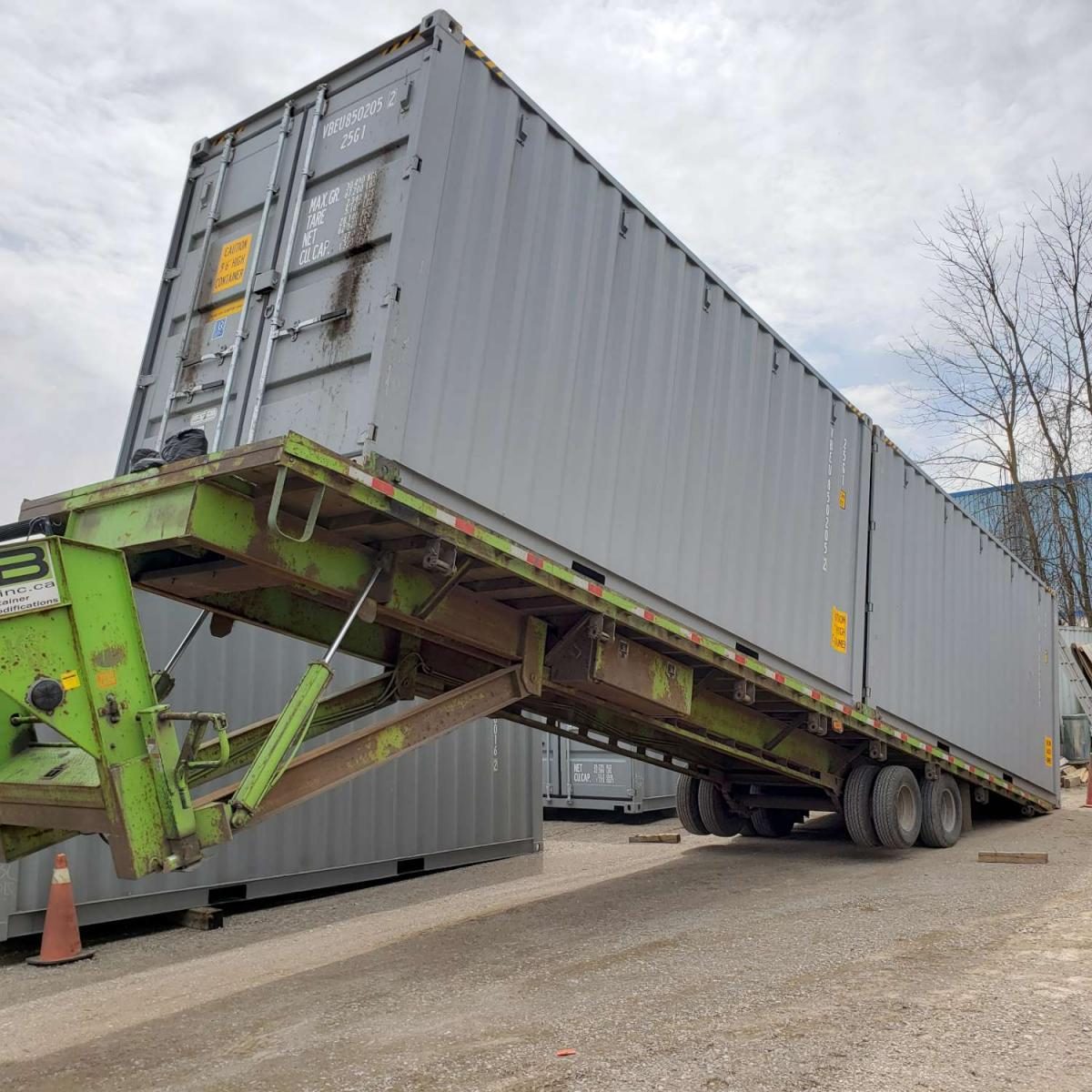
Moving with a shipping container means you load one steel box once, at your own pace, instead of cramming a rented truck on the clock. Van Blanc delivers the empty container from our Brantford yards to your old address and sets it on the driveway. You load it, an independent hauler transports the loaded box to the new address, and you unload it. Buy it and the container stays as storage you own.
Ask around for a container moving company in Canada and most of the names you hear are national rental chains. Their whole product is rent-a-container-for-a-month: they deliver it to your old place, you load it, they transport it to your new place, you unload it, they take it back. The pod fleets do roughly the same thing in smaller container sizes.
What those rental chains rarely mention is that you can buy the container from a yard like ours and use it for the move instead. We deliver it to your old place and set it down. You load it. When the loaded container needs to travel to the new address, an independent flat-deck or tilt-deck hauler moves it. That is the same kind of carrier any household relies on for long-distance freight. You unload it at the new place. And the box then stays on your property as a 20 ft storage container that is yours forever. Nobody picks it up. Nobody bills you next month. The same own-the-box logic works past Ontario. Our breakdown of long-distance moving options across Canada weighs the full-service van lines, the rental-pod services and the own-the-box freight route for every major interprovincial corridor.
A rental brand has no reason to raise the buy-it option, the same way a car-rental counter does not point you toward used-car dealers. It is a different business. Van Blanc sells containers and delivers the unit you choose; moving belongings is outside what we do. We are happy to point you to the haulers people use when a loaded box has to change cities. Most people only ever hear about the rental model, which is why this page lays out the buy side first.
Moving containers for sale are the buy side of this arrangement. A sea can you own outright gets loaded once and stays as storage at the new address after the move. That path is covered grade by grade on the sea cans for sale page.
Container Supplier vs Container Movers: Who Does What
A container move splits cleanly into two jobs, and it helps to keep them straight before you price anything. Van Blanc supplies the box and delivers it to your old address; an independent hauler handles the loaded haul from one property to another. Knowing who owns which leg keeps the quote honest. The same split holds if you need to move a shipping container that already sits on a lot: that is a hauler’s job, booked directly with them.
| The job | Who handles it | What it covers |
|---|---|---|
| Container supply (buy) | Van Blanc (us) | You pick the unit at our Brantford yards and buy it outright; we do not rent. |
| Delivery of the empty container | Van Blanc (us) | Tilt-deck drop or crane placement of the unit you chose, set on your driveway at the old address. |
| Loading and unloading | You, on your schedule | Pack it like a Tetris board over a weekend, a week, however long your move takes. |
| Transport of the loaded container between addresses | An independent hauler you arrange | A flat-deck or tilt-deck carrier moves the fully loaded box from the old city to the new one. |
| After the move (if you bought) | You | The container stays on your property as storage, a shop, a studio, or resells later. |
The national rental brands bundle all of that into one invoice, which feels simpler but means you never own the box and you pay their margin on every leg. Buying the container from a yard and arranging the loaded haul separately costs more on moving day, but it leaves you with an asset instead of a return label.
“People call us asking for a moving service and I have to gently correct them. We sell and deliver the box, that is our job, and we are good at it. The loaded haul between cities is a hauler’s job, and I will tell you exactly who to call. What you get out of it is a container that is still sitting on your driveway, paid for, a month after the truck is gone.”
Christian LeBlanc, second-generation operator, Van Blanc Ent. Inc., Brantford
Shipping Container Moving Cost Drivers, Local and Long Distance
The cost of moving with a shipping container is driven by six things. We do not post fixed prices, because a real number depends on your specifics and a posted price goes stale the moment the steel market moves. Here is what actually moves the figure, so you know what to expect when you call for a quote.
| Cost driver | Why it matters |
|---|---|
| Rent vs buy | Buying puts a box on your driveway that you keep after the move, resale value included. A short rental bills less on day one and leaves you nothing once it goes back. |
| Container size | A 20 ft holds a one to two-bedroom load; a 40 ft High Cube holds most of a three to four-bedroom house. Bigger box, bigger number. |
| Grade | One-trip (new) costs the most and looks the best; Cargo Worthy and Wind and Watertight are used grades that cost less for a stationary post-move life. |
| Delivery distance from Brantford | Our delivery charge is calculated per kilometre from our Brantford yards to your old address. Closer is cheaper. |
| The loaded haul (third party) | The independent carrier who transports the loaded box between cities quotes on distance and access. This is separate from what you pay us. |
| Season and steel market | Container prices follow the global steel and shipping cycle, so the same box is not the same number every month. The same drivers shape every purchase, laid out in our container pricing guide for Canada. |
Compared with a one-month national rental, buying the container costs more on the day of the move. So why would anyone do it? Because at the end of the rental path you have moved your stuff and you own nothing. At the end of the buy path you have moved your stuff and you also own a 20 ft container with real resale value. And if you keep using it as storage afterward, you save a self-storage stall every month for as long as you own it.
The further you move, the more the loaded haul costs, and that haul is the same third-party carrier whether you rented or bought the box. So the part that changes with distance is roughly equal on both paths. What does not change is ownership: on the buy path the container is yours forever once it lands, while on the rental path it goes back. The minute you think “I could use storage at the new place for a while,” the buying math takes over. The box you already moved into doubles as the storage you would otherwise have rented.
The broker-rental model is priced for a container you need for one month and zero days afterward. Any future use, from storage to a workshop full of gear you are keeping, turns the box you bought for the move into storage you no longer rent.
20 ft vs 40 ft Container Sizes for a House Move
Container size for a move comes down to bedroom count. A 20 ft holds a one to two-bedroom load; a 40 ft or 40 ft High Cube holds most of a three to four-bedroom house. If you are still deciding between lengths, our guide to container sizes and dimensions lays out every option. CN’s intermodal equipment sheets give the usable cube for each box, and the bedroom fit beside it is the industry rule of thumb for an Ontario move.
| Container size | Footprint | Usable cube (CN) | Real-world fit |
|---|---|---|---|
| 20 ft standard | ~160 sq ft | 1,169 cu ft | 1 to 2-bedroom apartment. Most of a 3-bedroom if you pack tight. |
| 40 ft standard | ~320 sq ft | 2,395 cu ft | 3 to 4-bedroom house. Tight on a 5-bedroom. |
| 40 ft High Cube | ~320 sq ft | 2,689 cu ft | 3 to 4-bedroom house with attic, or 3-bedroom plus garage stuff. |
| 20 ft (rough rule) | ~160 sq ft | 1,169 cu ft | About 1 standard moving truck load. |
| 40 ft (rough rule) | ~320 sq ft | 2,395 cu ft | About 2 standard moving truck loads. |
If you are in a one-bed apartment, get a 20 ft. If you are leaving a three-bed bungalow with a finished basement, you want a 40 ft or two 20s. For the dimensional specifics see our 20 ft container dimensions guide.
Loading a Shipping Container on Moving Day
Loading a shipping container on moving day is straightforward once the empty unit is placed. A few things still matter for the day we bring the empty box out and set it down.
- Driveway access. A tilt-deck truck needs a clear path at least 12 ft wide and at least 14 ft of overhead clearance all the way to the drop spot, so move the cars and trim low branches the day before. We can usually work around tight Toronto driveways, but the more turning room the easier the placement.
- Door swing space. Container doors swing 270 degrees. Make sure you have at least 8 ft of clearance at the back end where you will be loading.
- Ground. Level concrete or asphalt is ideal. Soft grass in spring is the worst case. We can leave the container on the truck’s runners for short-term loading if your driveway is small, or block it up if you are placing it longer.
- Pack tight. A 20 ft container holds more than people think, but only if you pack it like a Tetris board. Use furniture pads, fill voids, strap stacks. If you pack it like a rental truck you will only fit half a 1-bed apartment.
When the loaded container has to travel to the new city, the independent hauler arrives with a flat-deck or tilt-deck trailer and lifts the loaded box for transport. Our guide to the way containers get delivered covers tilt-deck operation and the placement logistics in more depth.
Loaded Weight and Balance for a House Move
A shipping container loaded for a house move weighs far less than the box is built to carry, so the steel is rarely what limits the move. The limits are the hauler’s trailer and how the load sits over the trailer axles. Hapag-Lloyd’s container specification lists a 20 ft dry box at a tare of 2,300 kg with a payload of 28,180 kg. That adds up to the 30,480 kg maximum gross on the plate. A 40 ft on the same plate rating weighs 3,780 kg empty. Before the loaded leg is booked, give the carrier the size, the tare from the CSC plate on the door, and a rough weight for what you packed. Our tare and gross figures for every container size cover the boxes not listed here.
| Container | Empty (tare) | Most it can carry (payload) | Plate maximum (gross) |
|---|---|---|---|
| 20 ft dry | 2,300 kg (5,071 lb) | 28,180 kg (62,126 lb) | 30,480 kg (67,196 lb) |
| 40 ft dry | 3,780 kg (8,333 lb) | 26,700 kg (58,863 lb) | 30,480 kg (67,196 lb) |
Balance matters more than the total. The CTU Code is the packing code the IMO, the ILO and UNECE publish for containers across the whole intermodal chain. It tells packers to spread heavy cargo across the floor, keep the centre of gravity near the middle, and never stow heavy goods on top of light ones. Its rule of thumb is 60% of the cargo’s total mass in 50% of the container’s length, so neither half of the box should carry much more than the other. Our notes on loading a container tier by tier show how that looks with real cargo. The same code rates the side walls of a general purpose container for a load equal to 60% of the payload and the door end for 40%. A wall of boxed books should never lean on the doors.
For a household load, that becomes a simple order. Appliances, the tool chest and boxed books go on the floor, spread along both halves of the box. Dressers and bed frames stand on top of them. The sofa, the mattresses and the light, bulky things finish the stack, and the boxes you need on the first night go in last at the door end. Strap or brace each tier to the lashing rings as you go, because a trailer brakes harder than your arms ever pushed.
Moisture, Vents and Locks for the Move
A steel container holding a household for a few weeks warms in the afternoon and cools overnight, and that daily swing is what makes a steel box sweat onto furniture. The CTU Code describes condensation as water vapour turning to liquid when air cools to its dew point against a cold surface. It draws the danger lines in relative humidity. Mould growth starts at about 75% relative humidity, and the risk of rust on steel goods (tools, appliances, bike chains) climbs from 40% upward. It also warns that drying bags fail when the goods packed around them are already damp, because the desiccant runs out of capacity.
- Pack only dry goods. A mattress from a damp basement or a mower caked in wet clippings brings its own water into the box.
- Lay a breathable sheet over anything that would mark, so a drip from the roof lands on cloth instead of a tabletop.
- Hang desiccant bags along the walls once the load is dry, as a top-up rather than a cure.
- Load and close the doors on a dry day where you can, and open them on a dry day at the other end.
Two modifications help any box that will sit loaded for more than a few days, and Van Blanc fits both at our Brantford yards before the truck leaves. Venting comes first: most containers ship with 2 to 4 vents, and we add more where the humidity calls for them, choosing between passive and mechanical vents for the use. Security comes second: lockboxes come standard on most new containers, and we add factory-style lockboxes to used ones so the padlock sits shielded from bolt cutters. Both sit on the list of vents, lockboxes and the other yard modifications you can add to the quote.
Picking the Exact Container Before You Load It
You are about to put everything you own in this box: your kitchen, your books, your kid’s bed, your wedding photos.
The national rental brands ship from a pool, and you meet your container when it shows up. If the unit has a soft spot in the floor or a leaky door gasket or worse, you find out after your stuff is inside.
Van Blanc lets you walk our row, read the CSC plate on each container, inspect the floor and doors, and pick the unit you want before paying. We have around 200 containers at our Brantford yards at any given time. Customers regularly drive in from Toronto, KW, Hamilton, and London to walk the inventory the day before they pay. For London buyers, shipping containers for sale in London, Ontario sets out the road distances and grades before that trip. The drive is worth it because you know what you are loading your life into.
If you cannot make the drive, that is fine. We will FaceTime the row, walk the units on camera, and deliver the one you picked. The point is that you picked.
National Container Moving Brands or a Box You Own
Three scenarios come up when callers compare a moving-brand rental, and each one has a container answer:
1. Out-of-Province Container Moves
Van Blanc supplies and delivers across Ontario. If your move ends in another province, you can still buy your container from us. We deliver it to your Ontario address, you load it, and you arrange an independent long-distance carrier for the leg that leaves Ontario. The box is yours when it lands in the new province.
2. No Driveway at the New Address
If your new home is a downtown condo or a third-floor walkup, you cannot keep a container there. The box needs somewhere to sit after the move, and a family property, a cottage lot or a business yard all work. A used box bought for the move can also be sold on once it is empty.
3. A One-Month Move With No Storage Afterward
If you are sure there is no future use for a container (storage, a shop, another move), buy a used box for the move and sell it on after. You still pack on your own schedule, and the resale value comes back to you instead of the box going back to a rental company. Ask about buyback on the quote call, too.
Moving Container Options Compared: Buy, Rent or Drive
An Ontario buyer weighing how to move has a handful of realistic options. You can buy a container from Van Blanc, rent from a national chain or a pod fleet, or drive a rented truck. The table below compares them on ownership, size range, who delivers, who hauls the loaded box, and what you are left with after the move.
| How they compare | Van Blanc (buy) | National chain (rent or buy) | Pod fleet (rent) | Regional pod service (rent) | Rental truck (DIY) |
|---|---|---|---|---|---|
| You can own it after | Yes | Yes, if bought | No | No | No |
| Container size | 20 / 40 / 45 ft ISO, plus 53 ft domestic | 8 / 10 / 20 / 40 ft | 16 / 12 / 8 ft | 16 ft | 10 to 26 ft truck |
| Pick the actual unit? | Yes (walk our rows) | Ask the brand | Ask the brand | Ask the brand | No |
| Pack on your schedule? | Yes | Yes (monthly) | Yes (monthly) | Yes (monthly) | No (daily) |
| Who delivers the box | Van Blanc, Ontario-wide from Brantford | The brand | The brand | The brand | You drive it |
| Who hauls it loaded between cities | Independent carrier you arrange | The brand (bundled) | The brand (bundled) | The brand (bundled) | You drive it |
| Out-of-province move | Independent carrier for the leg that leaves Ontario | Yes (their network) | Yes (their network) | Ask the brand | Yes, but you drive |
| After-move use | Storage, shop, studio, resale | Same uses if bought; rented units go back | Returned to the brand | Returned to the brand | None |
Four Checks Before You Buy a Container to Move
When a caller asks about moving using shipping containers, Van Blanc sorts it on the phone with four questions.
- Are you moving inside Ontario? If yes, we deliver the box to any of the Ontario towns we serve and a hauler moves it loaded. If you are leaving the province, we deliver at the Ontario end and you book a long-distance carrier for the rest.
- Do you have a driveway or yard at the new address? If no, line up where the box will sit after the move, such as a family member’s lot or a business yard. If yes, keep going.
- Do you have any use for a 20 ft container after the move? Workshop, storage, future tear-down material, a gift to your kid building their first house? If yes, buy from us and keep it. If no, a used box bought for the move sells on afterward.
- Do you mind driving to Brantford to pick your container? If no, you are exactly the buyer we want. If yes, we will FaceTime the row.
Plenty of callers who start out asking for a moving service end up buying a container. They realize they have wanted a storage unit at home for two years anyway. The rest are leaving the province, and for them we deliver the box at the Ontario end. Van Blanc does not move belongings or deliver outside Ontario, so a long-distance carrier takes it from there.
“You walk our yard, pick a box that is yours forever, we deliver it to your door, and you keep it long after the move is done.”
Paul LeBlanc, founder, Van Blanc Ent. Inc., Brantford
Container Ownership Ten Years After the Move
Imagine two identical families moving from a smaller Mississauga rental to a larger house in Hamilton. Family A rents a container from a national brand for the move. Family B buys one from us.
Family A pays the national brand for the move window. The container leaves at the end. Done, and they own nothing.
Family B buys a 20 ft Cargo Worthy container and we deliver it to Mississauga. An independent carrier hauls the loaded box to Hamilton, where the container stays on the property. Family B uses it as garage overflow for the next ten years, saving a self-storage stall every month they would otherwise have rented. Ten years later the box, now a decade older, still has real resale value.
The exact figures shift with your specifics, but the structure holds. When storage is part of your post-move life, buying beats renting, and the gap widens every year you keep the box.
Choosing Container Movers for the Loaded Haul
Ask any carrier moving shipping containers four questions before the loaded leg is booked. What equipment: a loaded 40ft exceeds most tilt-decks, so the long boxes ride flatbeds or HIAB crane trucks while a loaded 20ft has more options. What insurance: cargo-in-transit coverage for the contents, not just the carrier’s liability, in writing. What access: the carrier should ask about both driveways before quoting, and walk away from one who does not. What timeline: real carriers give a pickup window, not a promise. We hand Ontario buyers to carriers we have watched work for years, and the tilt-deck vs HIAB guide explains the equipment fork.
How Long Does a Container Move Take in Ontario?
Plan in three windows. Container delivery from our 4 Brantford yards: 1 to 3 days anywhere in Ontario. Loading: most households take a weekend, most shops take longer than they think. The loaded haul: booked carriers typically run within a one-to-two-week window for in-province moves, tighter in winter’s slow season and looser in the June-to-September rush. Book the loaded leg when the delivery date is set, not after the box is full, and the whole move holds its schedule.
Shipping Container Moving Questions Answered
How much does it cost to move with a shipping container in Ontario?
It depends on the container size, the grade, and how far you are from our Brantford yards. Buying leaves you owning a 20 ft steel box after the move, with resale value, where a short rental goes back the day you unload. On top of either, the transport of the loaded container between cities is quoted separately by an independent hauler. How a pod rental stacks up against owning is laid out in our side-by-side of renting a pod and owning the box. Tell us the size and your postal code and we will send back an honest, all-in number for the container and our delivery, usually the same day.
Is a shipping container cheaper than a moving company?
For local Ontario moves, using a container often costs less than full-service movers because you do the loading on your own schedule. Buying one leaves you with a 20 ft steel structure you keep after the move. If it carries on as storage, it saves a monthly storage bill for as long as you own it.
Can I buy a shipping container instead of renting one for moving?
Yes. Most Ontario buyers who use a container for a move buy it outright from a yard like Van Blanc. We deliver the unit to your old address, you load it, an independent carrier transports the loaded box to the new address, and you unload it. The container then stays on your property after the move as storage you own. See our buy-versus-rent breakdown for the deeper math.
How big a container do I need to move a 3-bedroom house?
A 40 ft High Cube container holds 2,689 cubic feet on CN’s sheet, which fits most 3-bedroom homes if packed properly. A 40 ft standard at 2,395 cubic feet works for a tight 3-bedroom. Two 20 ft containers totalling about 2,340 cubic feet are also a valid option. For a 4-bedroom you want a 40 ft High Cube or two 40 ft standards.
What is the difference between a moving pod and a shipping container?
Pod containers are 8, 12 or 16 ft purpose-built moving boxes made of a steel frame with a translucent roof and removable side panels. They are not ISO shipping containers. Real ISO containers (which is what we sell, alongside 53 ft domestic units) are 20, 40 or 45 ft and built for ocean cargo. ISO containers are larger, heavier-duty, weather-rated for decades, and meaningfully cheaper per cubic foot of capacity. Pods are sized for short-distance, lighter moves and go back to the brand afterward. An ISO container handles the same move and then stays on your property.
Does Van Blanc move a container between two Ontario addresses?
Van Blanc supplies and delivers containers; we set the unit you buy on your driveway. Transporting a fully loaded container from one address to another, or relocating a container that is already placed, is handled by an independent flat-deck or tilt-deck hauler that you arrange. We are happy to explain what that haul involves and point you in the right direction, but the relocation itself is a third-party service, not ours. See our guide to delivery and site placement.
How long does a shipping container last after a move?
A Cargo Worthy 20 ft container has another 25 to 35 years of useful life left when you receive it. The marine coating was built for ocean service. A backyard storage application after a move is among the easiest jobs that container will ever do. Many customers report containers still watertight after 30 years on the same property.
What if I already need a storage container at the new house too?
This is the scenario where buying clearly beats renting. Say you would have needed storage at the destination anyway: a self-storage stall, a shed, or a container parked there regardless. Then the container you used for the move was free storage. Compare against our self-storage vs container Ontario guide for the cumulative math.
What an ISO Shipping Container Was Built For
Containers exist to carry trade between continents. UNCTAD’s Review of Maritime Transport puts the sea’s share of international goods trade at around 80% by volume. The boxed part of that trade rides in ISO containers like the ones in our rows. A used container from our yards has lived its first decade or two inside that system. It was engineered to survive Atlantic crossings with eight other containers stacked on top of it. Using it for a one-time move and then leaving it on your driveway as storage is the easiest job that container will ever do. The hard work was done by the time it reached our yards. Read our container terminology glossary if you want the rest of the vocabulary.
Walk Our Brantford Yards Before Your Move
If you are moving inside Ontario and you have a driveway at the new place, the cheapest 10-year outcome is almost always to buy from us and keep the box. The walking-the-yard part is free. We are at 90 Morton Ave East in Brantford. Drop us a line first so we can have Christian or me ready, and bring measurements of your new driveway if you have them.
Call Van Blanc, Brantford, Ontario, 519-754-6844
Van Blanc Ent. Inc. has been delivering containers across Ontario since 1995. 4.9-star rating across 140+ Google reviews. Brantford yards with 200+ containers in stock, and you walk the row before you pay.
Moving with a shipping container comes down to one advantage: the box loads once, at your pace, and travels once. If the move has a gap between homes, owning a used container outright lets it sit loaded through the in-between weeks, which usually beats double-handling everything into storage.
Container and Delivery Quote for Your Move
Tell us the size and your postal code and we’ll send back an honest, all-in number for the container, delivery, and placement, usually the same day, with delivery in 1 to 3 days. No pressure, no mystery fees.
Family-run in Brantford since 1995 · 200+ containers in stock · 4.9★ across 140+ Google reviews · every box graded by a person, walk it before it lands.
Sources
Authoritative external sources cited or referenced in this guide:
- CN Intermodal, 40-foot container equipment sheet and 20-foot container sheet, checked October 2026.
- Hapag-Lloyd, Container Specification (general purpose containers), checked October 2026.
- IMO, IMO/ILO/UNECE Code of Practice for Packing of Cargo Transport Units (CTU Code), checked October 2026.
- UNCTAD, Review of Maritime Transport, checked October 2026.