
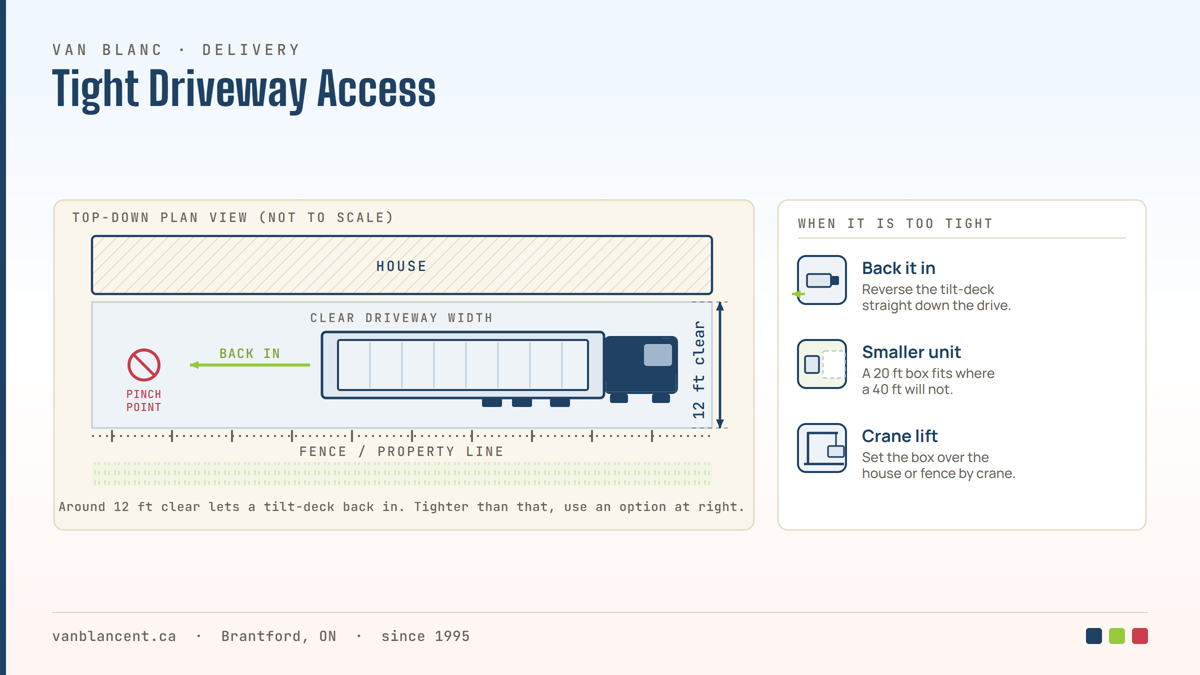
Quick Answer: If your driveway is too narrow or your backyard is too tight for a shipping container, you usually have four options: back the truck in, drop close and reposition the container on site, choose a smaller 20ft unit, or book a crane lift over the obstacle. A tilt-deck wants about 12 feet of width and a clear straight run. When it cannot reach, a HIAB crane often can. Send a photo and call.
Reading Time: 12 minutes
In This Guide
- My driveway looks too narrow. Is it hopeless?
- Option one: backing the truck down a narrow driveway
- Option two: drop close, then reposition on site
- Option three: a smaller unit that fits where a 40ft cannot
- Option four: a crane lift over the fence or into the courtyard
- Can a container be delivered into a tight backyard at all?
- What actually stops a delivery (and what does not)
- How to tell us about your site in one photo
- FAQs
The call we take most often at Van Blanc starts the same way. Someone stands at the end of a tight driveway, looks at the gap between the house and the hedge, looks at the truck-sized container they want back there, and assumes the answer is no. Most of the time it is not no. It is “here are your options, let us figure out which one fits your lot.” We have been threading containers onto Ontario properties from our Brantford yard since 1995, and the narrow driveway you are worried about is a puzzle we solve most weeks.
So this is the options page. Not a list of measurements you fail, but the real menu of ways a container gets onto a constrained site: backing the truck in, dropping close and shifting the box the last bit, sizing down to a unit that fits, or lifting it over the obstacle with a crane. We will walk each one honestly, including the cases where the honest answer really is that a particular spot cannot take a particular box. Then we will tell you the fastest way to find out which option is yours, which is almost always a quick phone call with a photo.
My driveway looks too narrow. Is it hopeless?
Usually not, and the reason is worth understanding before you panic about the width. The number people fixate on is how wide their driveway looks compared to a container. The number that actually decides a standard delivery is whether a tilt-deck truck can travel a roughly 12-foot-wide path with a clear straight run, and whether the spot you want is somewhere the truck can physically back to and pull forward from. A driveway can look alarmingly tight to the eye and still pass, or look generous and fail because of a single pinch point you stopped noticing years ago.
On a tilt-deck delivery the container slides off the back of the trailer at ground level while the truck eases forward out from under it. That means the box ends up along the line the truck can drive, not wherever you would like to point. When the geometry works, a tilt-deck is the cleanest delivery there is, with nothing lifted and no crane. When it does not, you move down the options ladder. The width of your driveway is just the first gate, not the whole verdict.
Width is one gate of three
A loaded delivery truck needs roughly 12 feet of clear width along the whole approach, not just at the spot, plus a straight pull-out (about 75 to 100 ft for a 20ft container, 120 to 130 ft for a 40ft) and 14 to 16 feet of overhead during the tilt (16 for a high cube, which stands 2.90 m tall under ISO 6346). A gatepost, a parked car halfway down the lane, or a hydro line over the driveway can stop a truck that had plenty of length. Narrowness is rarely the only factor, which is exactly why a single yes-or-no guess is the wrong tool. The options below exist for every way a site can be tight.
Option one: backing the truck down a narrow driveway
The first thing a good driver tries on a constrained site is simply backing in. A container truck is long and heavy, but the driver does not have to drive forward into your lot. Backing the trailer down a narrow driveway is routine work, and it often gets the trailer deeper and straighter than driving in nose-first would, because the cab can stay out near the road and use the street to line up the angle.
Backing down a narrow driveway works best when the lane is reasonably straight and the entry off the street is not a sharp ninety-degree corner. The driver reverses the trailer to the placement spot, tilts the bed, and slides the container off while pulling the truck forward back up the driveway to clear. The straight pull-out you need is measured along that line: from the spot, up the driveway, in the direction the truck will drive out. If the lane is long, straight, and 12 feet of usable width with clear overhead, a tight-looking driveway is frequently a non-event for an experienced driver.
The pinch points that decide a back-in
Before you assume a narrow lane fails, check the three spots that actually stop a back-in: the entry corner off the street (can a long combination swing in without clipping the far curb), the narrowest single point along the lane (gateposts, a retaining wall, the corner of the garage), and the overhead along the whole driveway (wires, branches, the eave). A driveway that is a steady 12 feet wide for 90 feet is easier to deliver to than a wide one with a four-foot gate at the mouth. Measure the tightest point, not the average.
Option two: drop close, then reposition on site
When the truck can get onto your property but cannot quite reach the final spot, the second option is to set the container as close as the truck can safely manage and move it the rest of the way on the ground. This is one of the most common real-world solutions for a tight backyard, and it is worth knowing before you write off a spot the trailer cannot line up to.
Repositioning on site is done with equipment, not muscle: a forklift with the capacity for a loaded box, a skid steer with the right attachment, roller bars and pinch bars for a short shift, or a pick-and-carry machine for a longer move. For a few feet around a corner, a capable operator can walk a 20ft container into place. For a longer move across soft or sloped ground, you are usually into a small equipment-handling crew. The trade-off is straightforward: you pay for the extra handling, but you get the box exactly where you want it on a site a truck could never have reached directly.
When repositioning is the right call
Drop-and-reposition fits the classic tight backyard: the truck can reach the driveway or the side of the house, but the container needs to end up behind the garage, past a soft lawn, or around a corner the trailer cannot turn. We set it at the closest firm point the truck can reach, and either we arrange the on-site move or you bring in a local equipment handler to finish the last stretch. Either way it gets planned before delivery day, not improvised in your driveway. Tell us where the box needs to end up versus where the truck can stop, and we will tell you whether a short reposition does it.
Option three: a smaller unit that fits where a 40ft cannot
Sometimes the cleanest fix is not a different delivery method, it is a different container. A 40ft unit needs around 120 to 130 feet of straight pull-out; a 20ft needs only about 75 to 100. On a short urban lot, dropping from a 40 to a 20 can be the difference between a straightforward tilt-deck drop and an impossible one, and two 20ft units placed end to end or side by side can give you the same storage with half the runway needed per delivery.
This is where it pays to tell us what the container is actually for before you settle on a size. A homeowner who wants storage during a three-month renovation, a contractor who needs a secure tool box on a cramped infill site, or a shop owner squeezing a unit behind the building rarely needs the full 40 footprint. A 20ft sea can holds a remarkable amount (its interior runs about 33 cubic metres), it sits on a roughly 20 ft by 8 ft pad, and it asks far less of your driveway on delivery day. Right-sizing the box to the access is often the quietest, cheapest option of the four.
How container size maps to a tight site
- 40ft (standard or high cube): the most storage per delivery, but it wants ~120 to 130 ft of straight pull-out and a forgiving turn. Best for open lots, farms, and yards with room to maneuver.
- 20ft: needs ~75 to 100 ft of pull-out and turns into tighter lanes far more easily. The workhorse choice for narrow urban driveways and small backyards.
- Two 20ft units: same total space as a 40, delivered in two simpler drops, and you can place them apart if one corner of the yard is easier to reach than another.
- Tight access overall: a 20ft plus a possible short reposition usually beats forcing a 40 onto a lot that cannot take the runway.
Not sure which option fits your lot?
Tell us the container size you have in mind and your postal code, and send a photo or two of the driveway, the entry off the street, and the spot you want the box. We will tell you on the spot whether the truck can back in, whether you want a smaller unit, or whether a crane lift is the move, and we will give you a real lead time, not a hopeful one. The fastest answer is a call to the Brantford yard.
Van Blanc Ent. Inc. · 90 Morton Ave. East, Unit 1-B, Brantford, ON · Family-run since 1995 · 4.9 stars across 140+ Google reviews · Fast 1-3 day delivery across Ontario.
Option four: a crane lift over the fence or into the courtyard
When the truck genuinely cannot back to the spot, when the box has to clear a fence, drop into an enclosed courtyard, or land somewhere a trailer can never line up, the answer is a lift. The everyday version is a HIAB, the truck-mounted knuckle-boom crane. It lifts the container off its own deck and swings it into place, so the truck can park where the access ends and still set the box past the obstacle.

A HIAB has real reach, commonly in the range of 6 to 7 metres from the truck on the units used for containers, which is enough to set a 20ft over a six-foot fence or into a spot the trailer cannot touch. There are limits worth knowing up front. The crane cannot hold full height while it stretches to full reach, so lifting high and far at the same time eats into capacity, and the truck needs firm footing under its outriggers to lift safely. For a box that has to go over a house or into a spot beyond a HIAB’s reach, the job moves to a larger mobile crane, which is a bigger and more involved booking.
Tilt-deck versus crane, in plain terms
A tilt-deck slides the container to the ground with no lifting, and it is the default whenever the truck can reach the spot, simplest, cleanest, no crane needed. A HIAB or mobile crane lifts the box and sets it down, and it is the answer when access blocks the truck from reaching the spot at all. The deciding question is never the size of your driveway in the abstract; it is whether the trailer can line up to where the box must land. If it can, tilt-deck. If it cannot, you lift. Tell us about the obstacle when you ask for a quote and we will tell you which method your site needs before anyone is dispatched.
Can a container be delivered into a tight backyard at all?
Yes, in most cases, as long as you accept that “tight backyard” almost always means one of the last three options rather than a straight tilt-deck drop. A backyard is by definition behind the house, and a tilt-deck truck cannot drive through a house. So a backyard delivery comes down to one of these: a side yard or a wide enough gate the truck can back through to reach the spot, a close drop at the driveway followed by a reposition around to the back, or a crane that lifts the box over the house or fence and into the yard.
Which one fits depends on three things we will always ask about: how the truck gets onto the property, how wide and clear the route to the back is, and what stands between the closest point the truck can reach and the spot you want. A gate the truck can back through changes everything. A fence with no gate points you toward a lift. A soft lawn between the driveway and the back corner points toward a reposition on firm ground. None of these is exotic; they are the everyday geometry of getting a steel box where a truck cannot drive.
Ontario lots, Ontario ground
Across Brantford and southern Ontario the tight-site issue we plan around most is not just the width, it is the ground. A loaded delivery truck and container together can run past 45,000 to 50,000 lbs, and once the box is down its weight concentrates on four corner castings. Soft lawn after a wet week or spring thaw will not carry a truck, and a container set on soft ground keeps settling and can sit out of level so the doors stop sealing. On a tight backyard delivery that often tips the plan toward a firm close-drop and a reposition rather than driving a heavy truck across the grass. When you book, tell us the surface (gravel, lawn, asphalt, fresh fill) and roughly how it drains, and we factor it in from the Brantford yard.
What actually stops a delivery (and what does not)
It helps to separate the things that genuinely defeat an approach from the things that just look intimidating. A narrow-looking driveway, a long back-in, a turn that needs care, none of these stop a delivery on their own. What stops a given approach is usually one of a short list of hard limits, and most of them have a workaround on the options ladder.
The real hard stops, and the option that answers each
- A pull-out cut short by a building, fence, or treeline: the truck cannot finish the slide on that line. Answer: back in from a different direction, size down, or lift.
- Overhead wires or branches below 14 to 16 feet over the approach: a hard stop during the tilt. Answer: a different approach or a crane that does not tilt a long bed.
- A pinch point narrower than the truck (tight gate, gatepost, parked car): the truck cannot pass. Answer: clear the obstacle, go smaller, or lift over it.
- Soft or saturated ground the truck would sink into: unsafe to drive. Answer: close drop on firm ground, then reposition, or time the date for dry ground.
- A spot fully enclosed (fenced yard, courtyard, behind the house): no truck route in. Answer: a HIAB or mobile crane lift.
Notice that every hard stop has at least one answer, which is the whole point of treating this as an options problem instead of a pass-fail test. The only time we will tell you a particular box genuinely cannot go in a particular spot is when none of the four options can bridge the gap, for example a spot that is both beyond crane reach and behind an impassable route. That is rare, and when it happens the honest move is often a smaller unit or a slightly different spot, which we will say plainly rather than send a truck on a wasted trip.
Christian LeBlanc, second-generation operator: “I grew up around this, traveling with my dad before I ever worked the yard. The driveway a customer is sure will never work is usually the one the driver backs into without breaking a sweat, and the one they think is wide open sometimes has a hydro line over the gate nobody clocked. We have been threading these onto Ontario lots since 1995. Send a couple of photos and your postal code, and we will tell you the option that fits. The fastest answer is a phone call, not a guess.”
How to tell us about your site in one photo
You do not need to measure your lot to the inch before you call, though a tape helps. What lets us tell you the right option in one conversation is a small set of photos and a couple of facts. A photo answers in seconds what a paragraph cannot, and it lets the person who actually dispatches the truck see the pinch point you might describe differently than they would picture it.
The one-call site picture
- The entry: a photo from the street showing where the truck would turn in. Sharp ninety-degree corners are the most common pinch.
- The approach, looking up: a photo down the driveway with the camera tilted up to catch any wires, branches, or eaves over the route.
- The spot: a photo of where you want the container, and what stands between it and the closest point a truck could reach.
- The surface: tell us if the route and spot are gravel, asphalt, concrete, lawn, or fresh fill, and roughly how they drain.
- The basics: container size you have in mind and your postal code, so we can pair the right method with a real lead time.
With that, we can usually tell you on the phone whether the truck backs in, whether a 20ft makes a hard lot easy, whether a close drop and reposition gets it to the back, or whether you want a crane. If you are also planning the ground the box will sit on, our companion guide to how a container actually gets delivered in Ontario walks the whole journey from quote to drop, including the site-prep that keeps a box level and sealing for years.
Frequently Asked Questions
My driveway is too narrow for a shipping container delivery. What are my options?
You generally have four. The driver can back the truck down the narrow driveway, which often works even on tight lanes. The container can be dropped at the closest firm point and repositioned on site with equipment. You can choose a smaller 20ft unit that needs far less room than a 40ft. Or a HIAB crane can lift the box over the obstacle. Send a photo and your postal code and we will tell you which fits.
Can a shipping container be delivered in a tight backyard space?
In most cases, yes, but rarely by a straight tilt-deck drop, since a truck cannot drive through a house. A backyard delivery usually means backing through a wide enough side gate, dropping close at the driveway and repositioning the container around to the back, or lifting it over the fence or house with a crane. Which one fits depends on the route to the back and what stands in the way. Tell us where the box must end up versus where a truck can reach.
Can a delivery truck back down a narrow driveway with a container?
Yes, backing in is routine and is usually the first thing a driver tries on a tight lot. Backing the trailer down keeps the cab near the street to line up the angle and often gets the trailer deeper than driving in nose-first. It works best when the lane is reasonably straight, holds about 12 feet of usable width, has clear overhead, and the entry off the street is not a sharp ninety-degree corner. The tightest single point along the lane decides it, not the average width.
Would a smaller container fit my site better than a 40ft?
Often, yes. A 40ft needs about 120 to 130 feet of straight pull-out, while a 20ft needs only about 75 to 100 and turns into tighter lanes far more easily. On a short urban lot or small backyard, a 20ft can turn an impossible delivery into a simple one, and two 20ft units give the same total space as a 40 in two easier drops. Tell us what the container is for and we will recommend a size that suits both your storage and your access.
How does a crane delivery work when the truck cannot reach the spot?
A HIAB, the truck-mounted knuckle-boom crane, lifts the container off its own deck and swings it into place, so the truck parks where access ends and still sets the box past the obstacle. Typical reach is around 6 to 7 metres, enough to set a 20ft over a six-foot fence or into a tight courtyard. The crane needs firm footing for its outriggers, and lifting high and far at once reduces capacity. For a box that has to clear a house, a larger mobile crane is used instead.
Why does the ground matter for a delivery to a tight space?
A loaded delivery truck and container together can exceed 45,000 to 50,000 lbs, and that weight has to travel your access route and then rest on four corner castings. Soft, saturated, or thawing ground will not carry the truck safely and lets a placed container keep settling out of level, which can stop the doors sealing. On tight sites this often points to a firm close drop and a reposition rather than driving a heavy truck across a soft lawn. Mention your surface when you call.
Sources
- International Organization for Standardization. (2022). ISO 6346:2022, Freight containers: Coding, identification and marking. iso.org
- Hiab. (2025). Shipping Container Moving Equipment: Loader Cranes and Hooklifts (Application Overview). hiab.com
- SuperCubes. (2025). Container Delivery Basics: Tilt-Bed, Flat-Bed, or Chassis. supercubes.com
- Transport Canada. (2025). National Safety Code Standard 10: Cargo Securement. tc.canada.ca
- Aztec Container. (2025). Understanding Container Delivery and Pickup Options. azteccontainer.com
Reach Van Blanc in Brantford
We have been supplying shipping containers across Ontario since 1995. Our warehouse is at 90 Morton Avenue E in Brantford, and we deliver right across the province. No surprise fees, no chase-the-paperwork.
Van Blanc Ent. Inc., 90 Morton Ave E Unit 1B, Brantford, ON N3R 7J7, 519-754-6844
Send us the container size, your postal code, and a photo of the driveway and the spot. We will work out the access with you before delivery day and tell you which option fits your lot, with a real lead time, not a hopeful one.