
Last updated: May 25, 2026
Quick answer. Frost protection for unheated foundations follows NRC Codes Canada guidance on frost-protected shallow foundations (FPSF). Most Ontario shipping containers can sit on a level gravel pad or four concrete piers without further foundation. Frost depth in Southern Ontario is 4 feet; in Northern Ontario, 5-6 feet. Anchoring is required for high-wind exposure or stacked builds. Soft ground, slopes, or any conversion build needs more substantial site prep. Most failures trace to skipped pad preparation. 30+ years operating, 4.9 stars on 140+ Google reviews. 1-3 day delivery Ontario-wide from our Brantford yards.
Why is container site prep the most-skipped and most-regretted step?
The container itself is sound steel. Properly prepped underneath, a shipping container lasts thirty years on the same spot without structural issue. Prepared poorly, the same container develops floor moisture problems, door-frame distortion, and water pooling within two to three years. The site prep work is what separates a container that ages well from one that ages badly.
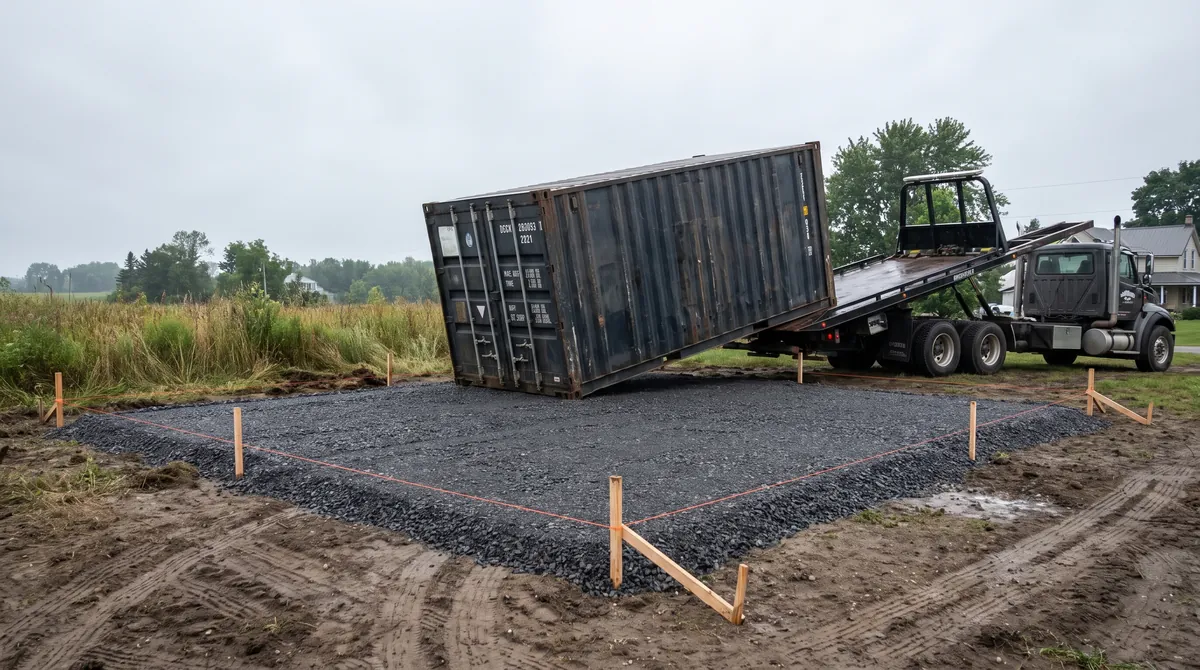
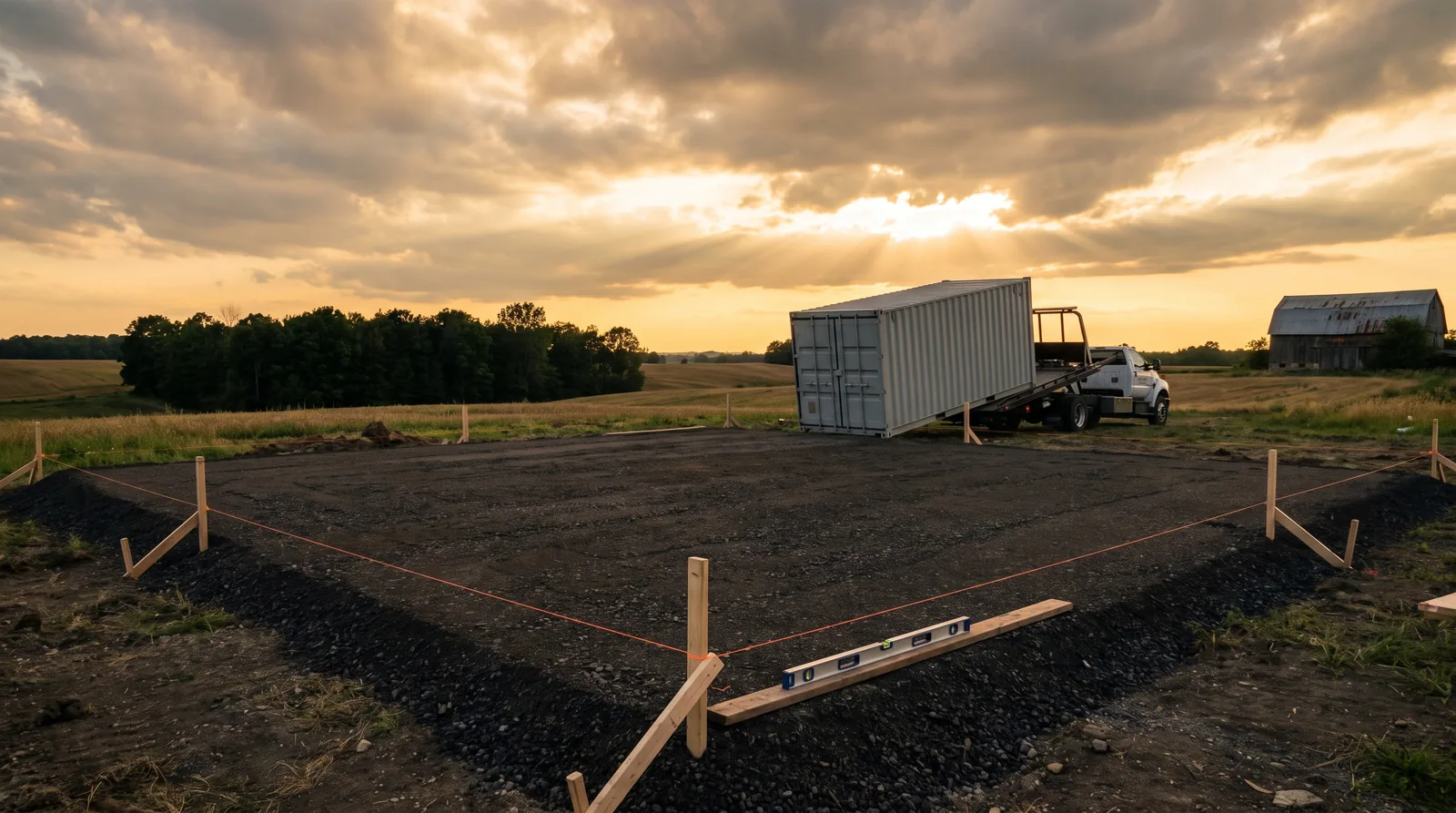
This guide covers the four real site-prep decisions Ontario buyers face: pad selection (gravel vs concrete vs piers), frost-depth considerations, anchoring requirements, and drainage. Each has a deep-dive article linked below. The guide is written for buyers who are placing a container for the first time or who want to verify their planned site prep before delivery.
Gravel, concrete, piers, or full slab: which container pad fits your site?
Four real options in increasing order of cost and longevity.
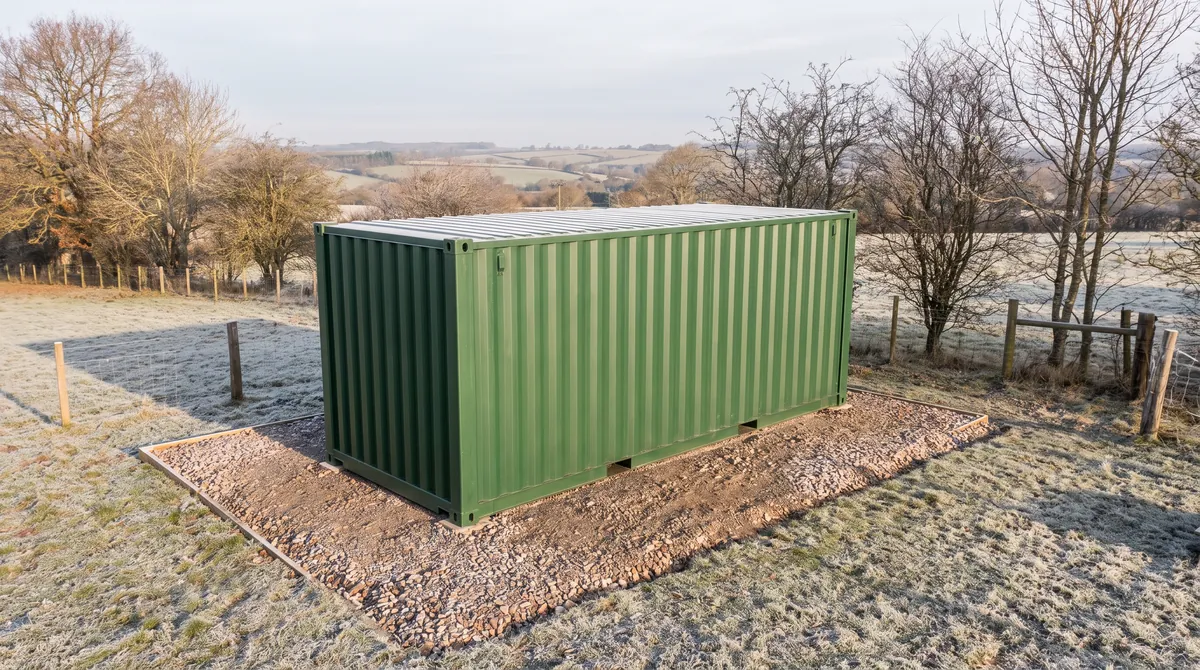
Level gravel pad. The default for most Ontario container placements. Six to eight inches of compacted gravel on a leveled native ground surface. The container sits on the gravel pad. Allows drainage underneath, prevents direct ground contact (which causes floor rust), and provides reasonable load distribution. Cost: in Southern Ontario for a 20ft footprint for a 40ft. Suitable for storage use on stable ground.
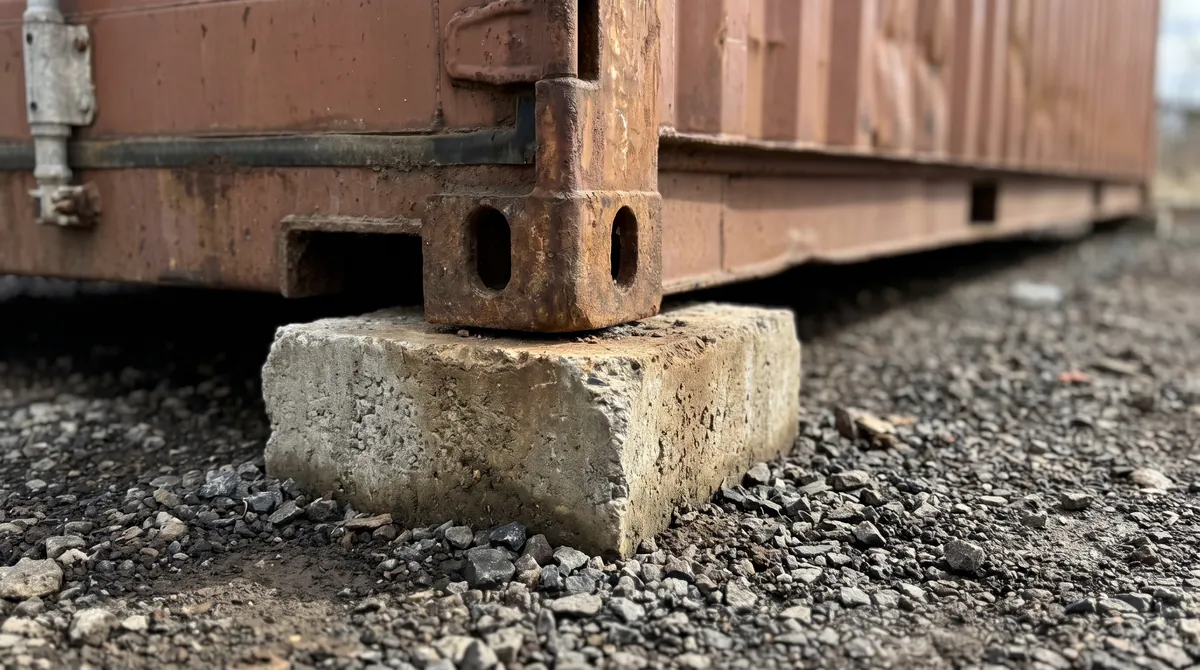
Concrete piers (sonotube). Four concrete piers at the container corners, sized for frost depth and load. Sonotube forms filled with concrete, set below frost depth, with steel bracket on top to receive the container. Allows the container to sit clear of the ground. Suitable for sloped sites, soft soils, or any container that will be modified for occupancy. Cost: installed.
Helical anchors (screw piles). Engineered steel screw piles driven below frost depth with a hydraulic torque head. Provide both vertical support and anchoring resistance to wind uplift. Best for high-wind exposure (coastal, ridgetop) or stacked builds. Cost: for a 20ft footprint, more for larger.
Full concrete slab. Reinforced concrete slab at the full container footprint, formed and poured to engineered specs. Required for any container build subject to the Ontario Building Code (occupied space, commercial use, residential conversion). Cost: depending on size, reinforcement, and finish requirements. A container pool is the extreme case: once filled, the water outweighs the steel several times over, which is why both paths in our Modpool and custom container pool decision guide begin with an engineered pad.
How does Ontario frost depth affect a container foundation?
Ontario frost depth varies by region. Southern Ontario (Windsor through Brantford to Ottawa) is 4 feet. Central Ontario (Muskoka, Algonquin region) is 4-5 feet. Northern Ontario (Sudbury, Timmins, Thunder Bay) is 5-6 feet. Foundation elements that need to resist frost heave must be set BELOW these depths.
Containers placed directly on the ground without a frost-rated foundation can heave during winter freeze-thaw cycles. The container does not necessarily move uniformly – one corner may rise more than another, creating a twist. The twist distorts the door frame and the container stops sealing properly. Repair after the fact is expensive (often a re-leveling that requires lifting the container off the ground). Prevention via proper pad is cheap by comparison.
The honest reality: a level gravel pad on stable native soil rarely heaves enough to cause container distortion in Ontario. The exceptions are high-water-table sites, soft clay sites, or any site where the pad was not actually leveled before placement. Buyers who skip the pad and place directly on grass or topsoil are the ones who develop problems.
Anchoring: when it is required and what to use
Most Ontario container placements do not require anchoring beyond the container’s own weight (4,800-9,500 lbs empty). The container is heavy enough to stay where it is placed under normal Ontario weather conditions.
Anchoring becomes necessary in three scenarios. Stacked builds (two or more containers stacked vertically) require structural twist-lock anchoring at the corner fittings. High-wind exposure sites (open lakefront, exposed ridgetops, agricultural fields without windbreaks) benefit from helical anchors or ground-anchored straps. Tornado-prone applications (rare in Ontario but applicable in some Southwestern Ontario zones) may justify additional anchoring per local risk.
For most Ontario container buyers, the answer is: no additional anchoring required. The container’s own weight is sufficient. For the exceptions, see the helical anchor and seismic bracket deep-dives linked below.
How do you prevent long-term container moisture problems?
The most common Ontario container failure mode is not heave or anchoring – it is moisture under the container that causes floor rust over a decade. Prevention requires three things at site prep:
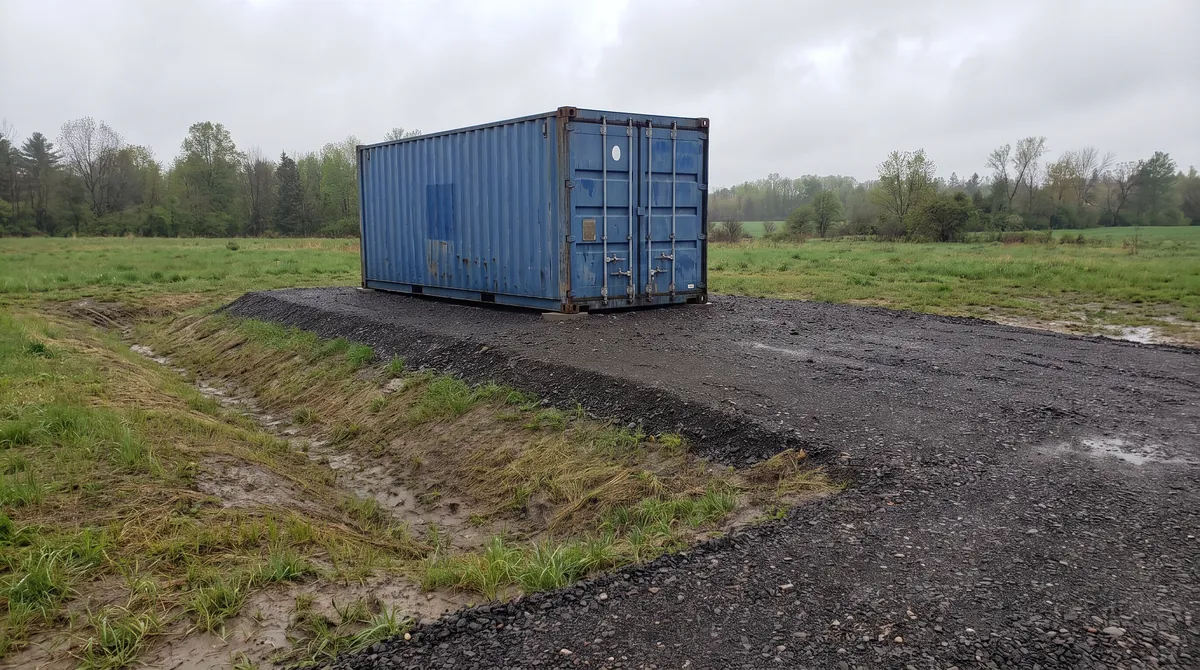
Grade the pad to shed water. A slight slope (1-2%) away from the door end of the container prevents water pooling at the cargo doors during heavy rain. Door seals are designed to be weathertight against wind-driven rain, not against standing water. The same grading rule under a wood or resin shed, and the five shed bases compared for Ontario frost, is in the shed foundations guide.
Lift the container off direct ground contact. Even an inch of clearance between the container floor and the ground allows air circulation that prevents moisture build-up. Sitting directly on grass or soil traps moisture and accelerates floor rust.
Watch for tree-canopy drip lines. Containers placed under mature trees collect organic debris in the door tracks, which traps moisture against the door seals and degrades them. Either trim back the canopy or place clear of the drip line.
Featured deep-dives in the site prep family
the basics of container pads and footings
The complete Ontario foundation guide. All four pad options in detail, with regional frost depth maps, cost comparisons, and the buyer-decision tree that points to the right foundation type for each use case.
Shipping Container Frost Heave in Ontario: Physics, Frost-Depth Map, and Prevention Methods
The four prevention methods for Ontario frost heave with the regional frost-depth thresholds. Covers why containers heave (it is not the container, it is the ground underneath), how to spot early signs of heave damage, and which foundation type prevents which heave mechanism.
Shipping Container Anchoring Ontario: Helical Anchors, Twist Locks, Tornado Resistance
The complete anchoring guide for Ontario containers. When anchoring is required, when it is optional, and the engineering specifications for each anchoring method. With Ontario-specific wind-load math and the regions where additional anchoring is justified.
Helical Anchor Sizes for Shipping Containers Ontario
The helical anchor sizing guide. Soil-type considerations, torque rating requirements, helix diameter and depth for different load and uplift scenarios, and the installation process. The deep-dive for buyers planning a helical-anchored container build.
Sonotube Pier Shipping Container Foundation Ontario
The sonotube concrete pier foundation method. The most common Ontario approach for containers that need more than a gravel pad but less than a full slab. Sizing, depth requirements, rebar specs, bracket selection, and the practical install steps.
The full site prep spoke index
Foundation methods
Frost heave prevention
Anchoring
- Anchoring Ontario: Helical, Twist Locks, Tornado
- Helical Anchor Sizes
- Ground-Mount Anchor
- Seismic Bracket
Stacking and structural
What customers actually say
“I made a deposit, asked for a flexible delivery date because of site conditions, had several discussions on timing, and when ready had delivery on a couple of days notice. The container is pristine and exactly what I wanted.”
– Phil G., December 2025, Google review
The “asked for a flexible delivery date because of site conditions” pattern is what proper site prep looks like in practice. The buyer waits for the ground to be ready – dry, leveled, the gravel pad placed – before scheduling delivery. We accommodate that wait. The two days of patience prevents twenty years of moisture problems.
Frequently asked questions about container site prep
What foundation does a shipping container need?
For most Ontario storage placements, a level compacted gravel pad (6-8 inches deep) is sufficient. For sloped sites, soft soil, or any conversion involving human occupancy, concrete sonotube piers or helical anchors are appropriate. Full concrete slabs are required only for Ontario Building Code compliance on permanent occupied space.
Does a shipping container need a permit in Ontario?
Placement requirements vary by municipality. A quick call to your local planning office before delivery is the easiest way to confirm what works for your property. Storage-use placements often do not require permits; occupied conversions trigger the Ontario Building Code regardless of municipality.
What is the frost depth for shipping container foundations in Ontario?
Southern Ontario (Windsor through Brantford to Ottawa): 4 feet. Central Ontario (Muskoka, Algonquin region): 4-5 feet. Northern Ontario (Sudbury, Timmins, Thunder Bay): 5-6 feet. Foundation elements meant to resist frost heave must be set below these depths.
Can a shipping container sit directly on the ground?
Technically yes, in the short term, but not recommended for long-term placement. Direct ground contact traps moisture against the container floor and accelerates rust. Even a basic gravel pad lifting the container an inch off the ground extends container life by a decade. Direct-on-grass placement is the most common Ontario site-prep mistake.
Do shipping containers need anchoring?
Most Ontario placements do not require anchoring beyond the container’s own weight. Anchoring becomes necessary for stacked builds (twist locks at corner fittings), high-wind exposure sites (helical anchors or strap-downs), and any tornado-risk application. For typical residential or farm storage on stable ground, the container weight is sufficient.
What size gravel pad do I need for a 20ft container?
The pad should extend at least 12 inches beyond the container footprint on each side (so 22ft x 10ft for a 20ft container, 42ft x 10ft for a 40ft). Depth: 6-8 inches of compacted gravel over leveled native ground. Slope: 1-2% away from the door end to shed water. Total volume: roughly 5-7 cubic yards for a 20ft pad.
How long does container site prep take?
A basic gravel pad: 4-6 hours for a small operator, 1-2 days for a larger contractor including delivery of gravel. Concrete sonotube piers: 2-3 days including cure time. Helical anchors: 4-8 hours for installation, no cure time. Full concrete slab: 5-10 days including curing. We coordinate delivery timing once the pad is ready.
What happens if I skip site prep and place the container directly on grass?
Three problems within 2-3 years. Floor moisture buildup (the grass traps water against the container floor). Differential settling (the container sinks unevenly into soft topsoil, causing door-frame distortion). Pest access (rodents and insects nest under containers in direct ground contact). Repair after the fact requires lifting and re-leveling the container – expensive. Prevention via a simple gravel pad is cheap by comparison.
Does Van Blanc do the site prep work?
No. We deliver containers but do not do excavation, gravel pad work, sonotube pier installation, or full foundation work. We refer to Ontario contractors who handle site prep professionally. The reason: container delivery is a specialized truck operation, and site prep is a specialized excavation operation. Different equipment, different skill set. Hiring the right people for each yields the best result.
Can a shipping container be moved after the foundation is built?
Yes, but with planning. A container on a gravel pad can be lifted off easily – the pad stays, the container moves. A container on sonotube piers can be lifted off the piers. A container on helical anchors can be unscrewed from the anchors. A container on a full concrete slab is more involved because the container may have been welded or bolted to embeds in the slab. Most Ontario containers stay where they are first placed, but the option to relocate exists.
Plan site prep before the container arrives
Site prep is the upstream decision that determines whether the container ages well or badly. Most buyers do not think about it until delivery day, then either rush a pad together or accept direct-on-ground placement and regret it within two years. The fifteen-minute conversation at order time about your specific site conditions saves twenty years of moisture problems.
Browse our current inventory when you are ready to order, after the pad is prepped or scheduled. Call us to discuss site conditions before delivery: 519-754-6844 or 1-888-509-6658. Paul and Christian have driven into more Ontario container sites than most contractors, and the upfront conversation is part of what we do.
Where Van Blanc delivers across Ontario
Frost heave and ground prep matter most in Ontario colder zones. We deliver from our four Brantford yards to communities right across the province, including Sudbury, North Bay, Bracebridge, Peterborough, Barrie and Orillia. See the full Ontario service-area map to find your town.
Ready to price your container?
Tell us the size and your postal code and we’ll send back an honest, all-in number, container, delivery, and placement, usually within 1-3 days. No pressure, no mystery fees.
Family-run in Brantford since 1995 · 200+ containers in stock · 4.9★ across 140+ Google reviews · every box graded by a person, walk it before it lands.
The Four Ontario Foundations, and How Long Each Lasts
Across thirty years of deliveries, four foundations cover nearly every Ontario placement. Railway ties are the most common: cheap, fast, and good for a decade or more when the grade drains. A compacted gravel pad is the workhorse, twenty-plus years of service and the best drainage-to-cost ratio on most soils. Concrete piers and full pads run longest, often thirty years and more, and are the right call under permanent or occupied builds. The soil under them matters as much as the choice: clay-heavy ground in the Golden Horseshoe holds water and heaves harder in freeze-thaw than the sand belts, which is why the frost-heave section above is the most-read part of this page. If you tell us what is under the grass when you order, the delivery crew arrives ready for it.
Deeper in the Site Prep Field Guide
The hub above covers the decisions; these field guides go deeper on the specifics.
Foundations
Anchoring and Stacking
- Roof Kits Between Two Containers
- Hurricane and Tornado Rated Anchors
- Twistlocks and Corner Castings for Stacking
- Cargo Strap Anchor Installation
Seasonal
Sources & References
Authoritative external sources cited or referenced in this guide:
- NRC Codes Canada, Building Code Publications
- Canadian Geotechnical Society, Foundation Engineering Manual
- CSA A23.1/A23.2:24, Concrete materials and methods
- Natural Resources Canada, Permafrost & Frost Mapping
- What Size Gravel Pad for a Shipping Container? (And How Level It Needs to Be)
- Railroad Ties vs Blocks vs Gravel Under a Shipping Container