
We sell containers. We do not rent.
Van Blanc sells shipping containers outright. We do not rent, we do not lease, and we do not offer rent-to-own. Stocked units deliver from our Brantford yards in 1 to 3 days. Request a sale quote or call the yard at 519-754-6844.
Quick Answer
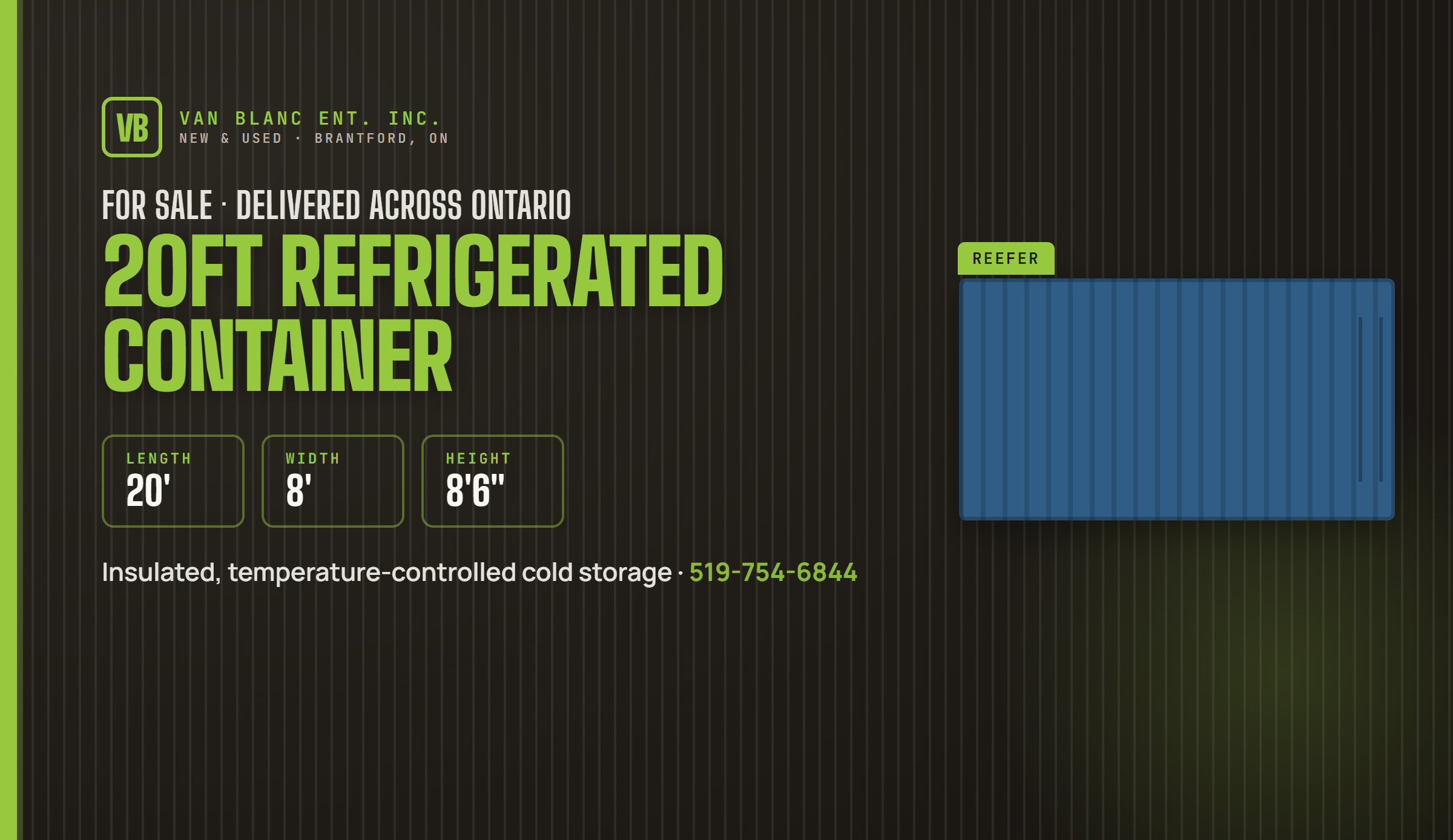
A 20ft refrigerated shipping container (reefer) is a thermally insulated steel box with an integrated refrigeration unit at one end, holding cargo at any temperature between -30 and +30 degrees Celsius. ISO 22R1 standard, 5.44 m internal length (17 feet 10 inches), 2.27 m wide, 2.24 m tall, 27.7 cubic metres of internal volume, max payload 27,700 kg. Carrier or Thermo King refrigeration unit, 30-amp 240-volt electrical plug-in for road operation (or genset for off-grid). We stock both Cargo Worthy and One-Trip 20ft reefers at our Brantford yards. Honest per-order CAD quotes, with the power and condition walk-through included. Delivery in 1 to 3 business days across Ontario.
The 20ft reefer is the smallest refrigerated container in the global fleet and the most-asked-about specialty product on our Brantford yard. Operations that outgrow it step up to the 40ft High Cube reefer, and anyone still mapping cold-chain basics can start with our field guide to refrigerated containers before picking a size. Buyers calling about one usually fall into one of six categories: a florist needing post-harvest cool-down for cut flowers, a craft brewery cellaring fermentation tanks, a mushroom grower running a temperature-stable substrate room, a Holland Marsh vegetable operation staging harvest overflow, a restaurant or food-service group needing seasonal cold-storage expansion, or a Health Canada licensed cannabis facility running climate-controlled cultivation or post-harvest cure rooms.
Every one of those buyers has the same underlying problem: they need a specific temperature held inside a sealed box, day in and day out, and they want the box on their site within a week. The 20ft reefer solves that. Where it gets complicated is the power source. A reefer pulls 30 amps at 240 volts continuous when the unit is cycling. Most residential properties cannot supply that load without an electrical panel upgrade. Industrial sites with three-phase 480-volt service can plug in directly, and the three-phase supply question for a reefer is its own short read. Off-grid or temporary sites run a diesel genset. We walk through the power question during every reefer quote because getting it wrong is the most expensive mistake a first-time reefer buyer makes.
20ft Reefer Specifications, ISO 22R1 Standard
The figures below are the reefer’s own, and they run smaller than the dry box of the same length because the thermal envelope takes its share of the inside; what each set-point actually asks of the unit matters more to most buyers than the last centimetre of cargo length.
| Measurement | Imperial | Metric |
|---|---|---|
| External length | 20 ft 0 in | 6.058 m |
| External width | 8 ft 0 in | 2.438 m |
| External height | 8 ft 6 in | 2.591 m |
| Internal length (cargo zone) | 17 ft 10 in | 5.440 m |
| Internal width | 7 ft 5 in | 2.270 m |
| Internal height | 7 ft 4 in | 2.240 m |
| Door opening width | 7 ft 6 in | 2.290 m |
| Door opening height | 7 ft 3 in | 2.210 m |
| Internal volume | 978 cu ft | 27.7 m³ |
| Tare weight (with refrigeration unit) | 6,613 lb | 3,000 kg |
| Maximum payload | 61,062 lb | 27,700 kg |
| Maximum gross weight | 67,675 lb | 30,700 kg |
| Temperature range | -22°F to +86°F | -30°C to +30°C |
| Electrical (continuous) | 30 A @ 240 V single-phase, 3-pole 4-wire plug (NEMA L15-30) | |
| Insulation | 80-100 mm polyurethane foam, U-value below 0.4 W/m²K | |
| Floor | T-bar aluminium air-channel decking | |
| ISO 6346 size + type code | 22R1 (20ft, refrigerated) | |
The R in 22R1 designates “refrigerated” with the refrigeration unit integral to the container. The interior dimensions are smaller than a standard 22G1 dry container because the insulation occupies ~10 cm of wall thickness on all sides, the refrigeration unit takes about 90 cm of length at the front end, and the T-bar aluminium floor adds a few centimetres of structural depth above the steel substrate. Net cargo volume is approximately 27.7 m³ versus 33.2 m³ for the dry equivalent, a 16 percent reduction in payload capacity for the thermal envelope.
Carrier vs Thermo King vs Daikin Refrigeration Units
Three brand families dominate the global reefer market. We carry units from all three on our yard at different times. The choice usually comes down to what is available in our standing inventory at the moment of order, but the brand differences are worth knowing.
| Brand | Strengths | Typical Find |
|---|---|---|
| Carrier Transicold | Largest installed base globally. Parts and service network in Ontario is strong (Vehcom, Carrier dealers in Mississauga and Hamilton). PrimeLINE family is the modern unit, ThinLINE older. Reliable, well-documented. | Most One-Trip 20ft reefers ship with a Carrier PrimeLINE or equivalent. |
| Thermo King | Strong in road transport (Thermo King is also the trailer-reefer leader). MAGNUM PLUS family is the modern unit. Slightly higher initial cost, slightly lower running cost. Parts via Maxitrans in Ontario. | Common on Cargo Worthy used reefers because Thermo King runs hard and lasts. |
| Daikin | Engineering-quality Japanese-built units. ZESTIA family is the modern unit. Strong in temperature-stability for sensitive cargo (cannabis, pharma). Smaller installed base in North America. | Less common on used inventory; show up periodically. |
For most Ontario buyers (florists, breweries, mushroom growers, restaurants), the brand on the unit matters less than the unit’s hours-of-use history and the local parts availability. We disclose unit make, model, and approximate hours during the quote, and we recommend a pre-purchase inspection by a refrigeration technician if your application demands proven reliability (cannabis, pharma, food-service compliance). The inspection is an hour of a technician’s time against a machine that will run for years; nobody who has paid for one regrets it.
“The most expensive mistake a first-time reefer buyer makes is forgetting about power. Customer calls in, wants a 20-footer for their backyard brewery cellar, all excited. We deliver the unit, they plug it in, the breaker pops, and now they need an electrician to add a 30-amp 240-volt circuit before they can use it. That conversation has to happen during the quote, not on delivery day. We always ask about the electrical service before the bin leaves Brantford.”
Christian LeBlanc, second-generation operator, Van Blanc Ent. Inc.
20ft Reefer Grades We Stock
Grade on a reefer means two things at once, the box and the machine, and the machine is the one that decides the price: a cargo worthy reefer with a low-hours unit is a better buy than a one-trip box that has run hard. The one-trip against cargo worthy comparison covers the box side; the hours on the quote cover the rest.
| Grade | What It Is | Best Use Cases |
|---|---|---|
| One-Trip | Essentially new. Single voyage from Asia. Paint clean, refrigeration unit under 5,000 hours, doors and gaskets factory-tight. | Florist post-harvest cool-down. Cannabis cultivation. Pharma storage. Cellaring breweries where temperature stability matters most. Long-term residential cottage food storage. |
| Cargo Worthy (CW) | Used 8 to 15 years. Refrigeration unit serviced and CSC re-certified. Insulation intact. Surface rust on exterior steel acceptable. Refrigeration unit hours typically 30,000 to 60,000. | Mushroom growing. Holland Marsh harvest staging. Restaurant overflow cold storage. Food bank distribution. The default reefer for working operations. |
| Wind and Water Tight (WWT) | Older unit (15+ years). Refrigeration may need rebuild or recent rebuild already done. Insulation intact. Heavier exterior rust. Most reefer WWT we sell has had a recent compressor or fan replacement. | Above-zero only (4-12°C) operations where the refrigeration unit does not have to work hard. Brewery cellaring, root-cellar replacement, off-grid cabin cold storage. |
| As-Is | Refrigeration unit may be non-functional or removed entirely. Insulation envelope intact. Suitable for buyers who want to install their own custom cooling system, or for static insulated storage with no active refrigeration, which is the non-operating reefer most buyers mean when they ask for an insulated box. | Custom cooling builds. Insulated workshops. Container homes where the thermal envelope matters but mechanical refrigeration is not needed. |
Every reefer quote is landed: the unit at our Brantford yard plus delivery priced by distance and access, stated together in one number. Multi-bin orders get a per-box discount on delivery starting at three units. Installation of a 30-amp 240-volt electrical circuit at the destination site is a separate cost paid to a licensed Ontario electrician, quoted against your panel and the length of the run; how ESA inspection works on a container circuit is worth reading before that quote arrives.
Six Common 20ft Reefer Use Cases in Ontario
1. Florist post-harvest cold chain
Cut flowers need 2-4°C within hours of harvest to extend vase life. Wholesale florists serving the GTA, the Toronto Flower Auction supply chain, and Niagara region greenhouse operations use 20ft reefers for on-site cool-down and short-term storage between cutting and shipment. One-Trip grade is typical because cleanliness for product contact matters, and the Niagara greenhouse belt is where most of those units go. Electricity is the running cost, and it moves with cycle time and ambient temperature far more than with the brand on the unit.
2. Craft brewery fermentation cellar
Lager fermentation requires 8-12°C for two to four weeks. Conditioning runs 0-4°C for another month or longer. A 20ft reefer holds 4-6 stainless fermenters or 8-10 cornelius kegs in conditioning. Cargo Worthy grade is the default because the reefer sits inside the brewery building, exterior aesthetic does not matter. Multiple Ontario craft breweries from Cambridge to Welland run 20ft reefers as fermentation cellars, and the ones that outgrow the box move to a glycol-cooled brewery container next.
3. Mushroom growing substrate room
Most commercial mushroom species (button, oyster, shiitake, lion’s mane) require 12-18°C with high humidity (85-95% RH) for fruiting. A 20ft reefer with a humidifier add-on holds the temperature and humidity stable while a separate dehumidifier handles excess moisture during the spawn-run phase. Norfolk County and Wellington County host several Ontario mushroom operations using reefer fleets; the fruiting-room build in a container covers the humidity side that the reefer alone does not.
4. Holland Marsh harvest staging
The Holland Marsh produces carrots, onions, celery, leeks, and Asian greens at scale. During peak harvest (August through October), permanent cold-storage capacity at the farm fills before the produce can move to the Ontario Food Terminal. A 20ft reefer at the field edge holds harvested product at 4°C for 24 to 72 hours, providing critical buffer time; the Bradford and Marsh growers are the reason our trucks know Highway 400 in October. Multi-bin orders of 3 to 6 reefers per large Holland Marsh operation are routine.
5. Restaurant and food-service overflow
Multi-location restaurant groups, catering companies serving large-event venues, and seasonal food-service operations (festival catering, wedding catering, golf course kitchens) use 20ft reefers as portable overflow walk-in cooler capacity. The reefer arrives in 1 to 3 days, plugs in, and provides immediate refrigeration without the construction cost of a permanent walk-in.
6. Health Canada licensed cannabis cultivation and post-harvest
Federally licensed cannabis cultivators use 20ft reefers for vegetative-stage propagation rooms (18-20°C, lower humidity), flowering rooms (with custom HVAC retrofit), and post-harvest cure rooms (15-18°C, 60-65% RH for 30 to 60 days). The Health Canada licensing process requires specific documentation of temperature stability and access control; our reefer specifications match what the standard licence application asks for. We work with several Ontario cannabis operators on facility-expansion reefer purchases, usually alongside a grow room built in a dry container for the vegetative stage.
The Power Question, Solved Three Ways
Every 20ft reefer needs continuous electrical power to run. There are three ways to provide it in Ontario:
1. Plug-in to existing site power (most common). The reefer’s 30-amp 240-volt single-phase plug (typically NEMA L15-30 or similar locking-type) connects to a matching outlet at the site. For commercial properties with three-phase 480-volt service, a 60-amp three-phase outlet is the equivalent. Residential properties typically need a dedicated 30-amp 240-volt circuit installed by a licensed electrician, plus the local utility may require a panel upgrade if the existing service is at capacity.
2. Diesel genset (off-grid or temporary). A 15-20 kW diesel generator powers the reefer continuously. Fuel consumption runs roughly 1.5 to 2.5 litres of diesel per hour depending on ambient temperature and cycle frequency. Best for remote sites (off-grid cottages, mining camps, remote agricultural operations) or short-term temporary use. Operating cost is significantly higher than grid electricity (roughly 3 to 5 times the equivalent kWh cost).
3. Solar plus battery (specialty). A 6-10 kW solar array plus 30-40 kWh battery bank can run a 20ft reefer continuously if the duty cycle is favourable (above-zero operation, mild ambient temperature, daylight-heavy season). Capital cost is the highest of the three by a wide margin and operating cost is near zero; the off-grid solar container build sets out the array and battery math. Best for permanent off-grid cottage food storage or specialty operations where grid power is not available.
Real 2026 Pricing for a 20ft Reefer Landed in Ontario
Reefer quotes include the power talk
A reefer is a purchase plus an electrical plan. Tell us what you are keeping cold and where it sits, and we will quote the unit and walk you through the power requirement and condition report before you commit a dollar.
Quotes hold 14 days. Honest 2026 numbers. The bare reefer is what we sell; electrical installation is paid to a licensed Ontario electrician separately, and we recommend getting two quotes from electricians familiar with reefer applications before the reefer arrives; the defrost cycle and set-point controls are the first thing to learn once it is running.
The 1,000 Dollar Facebook Reefer Scam
The 20ft reefer is occasionally targeted by Facebook Marketplace scams, although less frequently than the 20ft or 40ft dry containers because the price point is higher and the scam ask is more conspicuous. Listings claim a one-trip or cargo worthy 20ft reefer at a fraction of any yard’s price, with delivery included from a Toronto, Vaughan, or Mississauga seller. Same deposit ask of about a thousand dollars, same disappearing seller account 48 hours after the e-transfer clears. The reefer does not exist.
Defence: come walk our Brantford yard. We hold reefers in stock and can show you the refrigeration unit running, the temperature display reading, the gasket condition, and the hours-of-use logged on the unit. No supplier in Ontario whose price is half of market is going to start the refrigeration unit for you to inspect, because there is no unit to start. Our policy is no deposit on phantom inventory.
Frequently Asked Questions
What temperature range does a 20ft reefer hold?
The standard range is -30 to +30 degrees Celsius. Most Ontario applications run between +2 and +18 Celsius (florists, breweries, mushrooms, produce, restaurants). Below-zero operation (-18°C for frozen storage, for example) is fully supported by the refrigeration unit but requires the unit to work harder, increasing electrical draw and reducing component life. We disclose the running condition of the refrigeration unit during every quote.
How much electrical power does a 20ft reefer consume?
Continuous draw is approximately 30 amps at 240 volts single-phase when the refrigeration compressor is cycling. Cycle frequency depends on ambient temperature, set-point, and cargo thermal mass. Electricity is the running cost, and below-zero (frozen) duty draws well over half again what above-zero storage does, because the compressor cycles that much more. Three-phase 480-volt commercial service equivalents are available on some Daikin units.
How much does a 20ft reefer cost in Ontario in 2026?
From Van Blanc in Brantford, 20ft reefer pricing is quoted per order by grade and machinery condition: One-Trip for product-contact cleanliness, Cargo Worthy for working cold chain, WWT for above-zero duty with a recently serviced unit. Every quote includes the condition report and the power walk-through, so you know the electrical requirement before you spend a dollar.
What refrigeration unit brand is on the reefer I’m buying?
We disclose the make, model, and approximate hours-of-use on every reefer during the quote conversation. Common brands are Carrier Transicold (PrimeLINE family), Thermo King (MAGNUM PLUS family), and Daikin (ZESTIA family). All three have parts and service networks in Ontario. We do not pre-select the brand for you; the unit we have in stock determines what’s available the week you call. For applications where brand-specific reliability matters (cannabis, pharma), we recommend a pre-purchase inspection by a licensed refrigeration technician.
Can a 20ft reefer run off solar power?
Yes, with a properly sized solar array (6-10 kW) and battery bank (30-40 kWh) for continuous above-zero operation. Below-zero operation requires significantly more solar capacity due to the higher continuous draw. A solar-plus-battery reefer power system is the most expensive way to power one up front and the cheapest to run. Best for permanent off-grid applications (Muskoka cottages, remote agricultural operations, off-grid homesteads) where grid power is not available or extending grid service is impractical.
How long does delivery take from your Brantford yard?
One to three business days for in-stock units. We typically hold 2 to 4 reefers on our Brantford yard at any time. If your specific grade and temperature spec is not in stock, we source-to-order with a 2 to 4 week lead time. We tell you honestly during the quote whether your unit is in stock or coming in.
What foundation does a 20ft reefer need?
Same as a standard 20ft container for static placement: railway ties, pressure-treated 6×6 cribbing under the four corner castings, or concrete piers below the frost line for permanent placement. The 20ft reefer is approximately 1,000 kg heavier than a standard 20ft (refrigeration unit + insulation), but the four corner castings still carry the load. The pad must also accommodate the cable run from the reefer’s electrical plug to the site outlet, typically a 30 to 60 foot run depending on site layout.
How does Van Blanc compare to BigSteelBox for a 20ft reefer order?
We can only speak for our side of it. Van Blanc carries a standing 20ft reefer inventory at our Brantford yards, sells every unit outright, discloses make, model and hours-of-use on the quote, starts the unit for you in the yard or on a video call, and delivers in-stock reefers in 1 to 3 days with payment on delivery. BigSteelBox is a legitimate national company with its own model for reefers; check its current terms on its site and put the two quotes side by side.
Can a reefer be used in a Health Canada licensed cannabis facility?
Yes. Our 20ft reefers meet the temperature-stability and access-control requirements typical for Health Canada licensed cannabis cultivation, vegetative-stage propagation rooms, flowering rooms (with HVAC retrofit for humidity and CO2 management), and post-harvest cure rooms. We work with several Ontario licensed cannabis operators on facility-expansion reefer purchases. Documentation of unit specifications matching the standard licence application requirements is available on request.
Do you offer rent-to-own on 20ft reefers?
No. Van Blanc sells outright only: no rentals, no leases, and no rent-to-own. If spreading the cost matters, a purchase loan through your own bank or equipment financer is the route, and we will supply the invoice, specifications, and serial number they ask for.
Sources
Placement requirements vary by municipality. A quick call to your local planning office before delivery is the easiest way to confirm what works for your property.
Reach Van Blanc in Brantford
Van Blanc Ent. Inc.
90 Morton Ave. East, Unit 1-B, Brantford, ON N3R 7J7
Cell: 519-754-6844
Toll-free: 1-888-509-6658
Family-owned and operated since 1995. Thirty years in Ontario shipping containers, four Brantford yards, 200-plus boxes in inventory including a small standing inventory of refrigerated containers.