
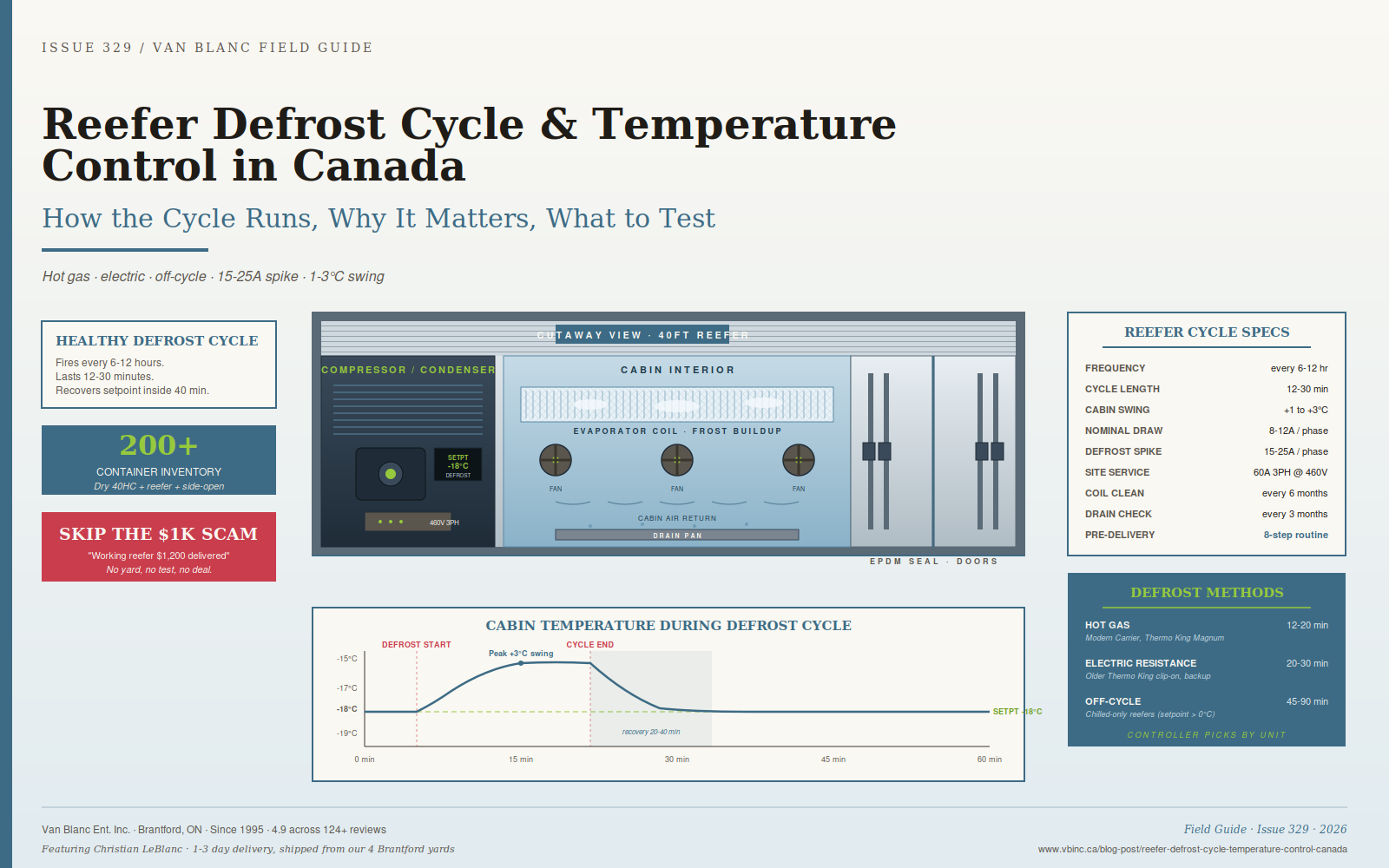
Quick Answer: The defrost cycle on a reefer container is an automatic evaporator ice-management routine that runs every six to twelve hours, lasts about fifteen to thirty minutes, and uses either hot-gas or electric resistance heat to clear frost off the coil. During the cycle, the evaporator fans stop, the cabin temperature can swing by one to three Celsius degrees, and the electrical draw spikes from a nominal eight to twelve amps up to fifteen to twenty-five amps on a 460V three-phase reefer. A healthy reefer recovers setpoint within twenty to forty minutes of cycle end. We have run reefer cycles inside our 200+ container Brantford yard for thirty years and can walk Ontario buyers through how to read the controller, log the cycle, and decide whether a strange reading means service or normal operation. Real Brantford yards, real reviews (4.9 / 140+), real 1-3 day delivery. Family-operated since 1995.
In This Field Guide
- Why Do Reefer Containers Ice Up in the First Place?
- The Automatic Defrost Cycle: Hot Gas, Electric, and Off-Cycle
- How Often Does a Reefer Defrost Cycle Run?
- Temperature Stability During the Cycle (the 1 to 3 Celsius Swing)
- Why Does a Reefer’s Electrical Draw Spike During Defrost?
- Setpoint Reality vs the Displayed Cabin Temperature
- How Do You Maintain a Reefer Coil and Drain Line?
- Defrost Troubleshooting (When Ice Will Not Clear)
- What We Test on Every Reefer Before It Leaves Brantford
- Frequently Asked Questions
Reading time: 14 minutes
Why Do Reefer Containers Ice Up in the First Place?
A reefer container ices up because cabin air carrying moisture passes across a sub-freezing evaporator coil, and the water vapour freezes onto the coil fins. The colder the setpoint and the more humid or frequently opened the cabin, the faster frost builds. The defrost cycle exists to clear that frost automatically before it chokes airflow and heat transfer.
A refrigerated container is a heat pump that runs in reverse. The evaporator coil sits inside the cabin and the condenser sits outside, with a compressor and an expansion valve moving refrigerant through the loop. The evaporator coil is the cold side. Whenever cabin air at any humidity above roughly 30 percent passes across a sub-freezing coil, water vapour in that air condenses and then freezes on the coil fins. That is the entire mechanism. The colder the coil and the more humid the cabin, the faster the frost lays down.
Frost on the coil is a working problem, the same way a dripping dry-box ceiling is. Once the layer reaches one to two millimetres of thickness, three real problems start in parallel:
- Insulation against the heat transfer the coil exists to do. Frost is a poor conductor compared with bare aluminium fin. Each millimetre of frost cuts the coil’s effective heat-transfer rate measurably.
- Restriction of airflow through the fin pack. Cabin air needs to pass between the fins. Once frost bridges the gaps, the evaporator fans push less air, the cabin stratifies, and the coldest layer pools at the floor while the top of the load drifts warm.
- Increased compressor run time to compensate. The unit demands more cycles to chase the setpoint, the compressor runs harder, electrical draw climbs, and component life shortens.
The defrost cycle exists to head all three problems off before they cascade. It is on every Carrier, Thermo King, Daikin, and Starcool reefer container built in the last forty years because the physics demand it.
Christian LeBlanc, second-generation operator at Van Blanc Ent. Inc.: “Buyers walking the yard for the first time think the defrost cycle is something they have to remember to trigger. They do not. The controller handles it. What buyers do need to remember is what a healthy cycle looks like, what a sick cycle looks like, and when to call a refrigeration tech. Thirty years of running reefers has taught us the pattern: a healthy defrost is boring, predictable, and brief. Anything dramatic is a service call.”
The Automatic Defrost Cycle: Hot Gas, Electric, and Off-Cycle
Three defrost methods cover almost every container reefer on the Ontario market. Each works, each has trade-offs, and the controller picks the method based on how the unit was built.
Hot-Gas Defrost (most container reefers)
The controller reverses the refrigerant flow. Hot gas leaving the compressor is routed directly back through the evaporator coil instead of the condenser. The coil warms quickly from the inside out, the ice melts, the meltwater runs down the fins, drips off into the drain pan at the bottom of the coil enclosure, and exits the cabin through a heated drain line. Cycle time is typically twelve to twenty minutes. Energy efficiency is excellent because the heat source is the compressor’s existing waste heat. Almost every Carrier Container, Thermo King Magnum, Daikin LXE10E, and Starcool SC-7 container reefer uses hot-gas defrost as the primary method.
Electric Resistance Defrost
The controller switches power to a set of electric resistance bars positioned in or behind the evaporator coil. The bars heat directly, the coil warms by conduction and radiation, ice melts, water drains. Cycle time is roughly twenty to thirty minutes. Energy use is higher because the electric draw is purely additive rather than recycling compressor heat. Some older Thermo King clip-on units and some legacy container reefers use electric defrost as either the primary method or a backup if hot-gas defrost fails to clear the coil within an allotted time.
Off-Cycle Defrost
The simplest method: the controller shuts the compressor off and lets the evaporator fans push cabin air across the now-warming coil. Ice melts passively. Cycle time stretches to forty-five to ninety minutes and the cabin warms more than with active methods. Off-cycle defrost shows up on smaller chilled-only reefers (setpoint above zero Celsius) where the coil is rarely cold enough to ice up severely. Almost no frozen-capable container reefer relies on off-cycle defrost as the only method.
| Method | Heat source | Cycle length | Cabin temperature swing | Where you see it |
|---|---|---|---|---|
| Hot-gas | Reversed refrigerant from compressor | 12-20 min | 1-3°C | Modern Carrier, Thermo King Magnum, Daikin LXE, Starcool |
| Electric resistance | Dedicated heater bars at evaporator | 20-30 min | 2-4°C | Older Thermo King clip-on, legacy reefers, backup mode |
| Off-cycle | Cabin air across warm coil with fans | 45-90 min | 4-8°C | Chilled-only reefers (setpoint above zero) |
Whichever method is in use, the cycle initiation logic is broadly similar across manufacturers: the controller monitors coil temperature and the time since the last defrost, then triggers the cycle when either a coil temperature threshold (typically the coil reading drifting more than four to six Celsius degrees below the setpoint suction temperature) or a maximum interval (often six to twelve hours since the last defrost) is met. Some newer units add humidity sensing and adapt the interval downward when the cabin humidity is high or when the doors have been opened recently.
How Often Does a Reefer Defrost Cycle Run?
The factory default on most container reefers schedules a defrost every six hours, which sounds frequent until you remember that the controller is allowed to skip a scheduled defrost if the coil temperature shows the unit does not actually need one. In real operation, the cycle fires when the coil needs it, not strictly on the calendar.
The two variables that drive frequency hardest:
- Ambient humidity reaching the cabin. A reefer parked outdoors in a humid Ontario summer with a marginal door seal will pull moisture into the cabin every hour. The coil ices faster, the controller defrosts more often. A well-sealed reefer in a dry indoor environment can run eight to ten hours between defrosts.
- Door-opening frequency. Every door opening lets warm humid outside air rush in. On a frozen-cargo reefer (minus eighteen Celsius setpoint or colder), each door event drops twenty to fifty grams of water into the cabin. Five door events per shift will roughly double the defrost frequency over a closed-door operation.
Buyers who plan high door-opening duty cycles (frozen-food distribution, ice-cream depot, multi-pick frozen pharma) should expect defrost cycles every three to five hours instead of every six to twelve. The controller handles it automatically; the operational implication is electrical draw and a higher share of run time spent in the cycle rather than in cooling.
Field Tip: Read the Data Logger Before You Trust the Controller Display
Every modern container reefer logs setpoint, supply air, return air, cargo probe, defrost activity, power-on events, and alarm states to internal memory. The data logger is the truth and the front-panel display is a snapshot. Before accepting a used reefer or signing off on a service ticket, pull the data log, look for the defrost frequency in the last seven days, and confirm cycle length stayed inside the manufacturer’s window. A unit that defrosts every two hours is iced up because of a leaking seal, a stuck damper, or a tired compressor. A unit that has not defrosted in twenty hours has a stuck defrost relay or a failed coil thermistor.
Temperature Stability During the Cycle (the 1 to 3 Celsius Swing)
The hardest fact for new reefer buyers to internalise is that the cabin temperature does not hold flat during defrost. It moves. The healthy swing on a frozen-cargo reefer running a hot-gas defrost is roughly one to three Celsius degrees warmer than setpoint for the duration of the cycle, with recovery to setpoint within twenty to forty minutes after the cycle ends. On a chilled-cargo reefer the swing is similar or slightly smaller because the smaller temperature differential between cabin and ambient gives the cycle less work to do.
The mechanism: during defrost the evaporator fans stop (so the warming coil does not blow heat into the cabin), the refrigerant either reverses or is interrupted depending on the method, and the cabin stratifies briefly. The supply air sensor and the return air sensor read the same value because no air is moving, which is the same reason the cabin can warm a couple of degrees without the controller chasing it. Once the cycle completes, the fans restart, the refrigerant resumes normal flow, and the cabin pulls back down inside the manufacturer’s recovery window.
For most cargo, the one to three Celsius swing is well inside the acceptable storage envelope. Frozen meat, frozen produce, ice cream, and frozen pharma stay frozen with margin to spare during a normal defrost, and matching the unit to your product is mostly a question of what temperature band your cold chain has to hold. The exceptions are cargoes with very tight temperature requirements (some clinical-trial pharma, some monoclonal antibody shipments, certain seafood under USDA-equivalent rules) where the brief swing matters and a buyer should specify a unit with a tighter recovery profile or pair the reefer with a recording probe at the product layer.
| Cargo type | Typical setpoint | Acceptable defrost swing | Action if swing exceeds |
|---|---|---|---|
| Frozen meat / produce | -18°C to -23°C | up to +3°C from setpoint | None required; physics |
| Ice cream | -23°C to -25°C | up to +3°C from setpoint | None required at -25; spec colder unit if at -23 |
| Frozen pharma (most) | -20°C | up to +2°C from setpoint | Add product-layer probe |
| Clinical-trial / ultra-cold | -70°C or colder | not applicable | Container reefer wrong tool; use ULT chest or dry ice |
| Chilled produce / dairy | +2°C to +4°C | up to +2°C from setpoint | None required |
| Tropical / banana mode | +13°C to +14°C | up to +1°C from setpoint | Verify defrost rarely fires at this range |
Why Does a Reefer’s Electrical Draw Spike During Defrost?
The electrical profile of a working reefer is one of the most useful diagnostic tools available to an operator, and the defrost cycle is the most prominent feature on the profile.
On a 460V three-phase reefer (the standard supply for most 40-foot container reefers in North America, and the reason we walk every Ontario buyer through what three-phase power a reefer actually needs on site), nominal cooling draw runs roughly eight to twelve amps per phase when holding setpoint, climbing to fifteen to twenty amps during initial pull-down from ambient. The defrost cycle spikes draw to roughly fifteen to twenty-five amps per phase for the cycle duration if the unit uses electric resistance defrost, or to a somewhat lower spike (typically twelve to eighteen amps) on hot-gas defrost because the compressor is doing the work and the dedicated resistance bars are off. A 20ft reefer or a smaller chilled-only reefer scales the same pattern proportionally.
The implications for site planning:
- The site service must be sized for the spike rather than the nominal. A 30-amp three-phase service is sufficient for nominal hold but undersized for pull-down and for defrost on a hot day. The right service for a single 40-foot reefer is typically a 60-amp three-phase breaker on a dedicated drop.
- Multi-reefer yards need coordinated defrost timing. If six reefers all hit their scheduled six-hour defrost simultaneously, the combined draw can overwhelm a shared service. Newer controllers offer staggered defrost initiation; older units may need an operator to manually offset the scheduled start times.
- Generator-powered reefers need surge headroom. A generator rated to nominal draw will brown out during a coincident defrost-plus-pull-down event. Diesel reefer gensets in the trade are typically rated 25 to 50 percent above nominal expected draw for exactly this reason.
The site electrical work for any Ontario reefer install must be done by a licensed electrical contractor and signed off by the Electrical Safety Authority before the unit goes live. We co-ordinate with electrical contractors regularly because the right answer for a multi-reefer yard is rarely the cheapest answer, and we would rather a buyer get the install correct the first time than chase tripping breakers for the first three months.
Setpoint Reality vs the Displayed Cabin Temperature
The controller display shows three temperatures on most modern container reefers: setpoint, supply air, and return air. New operators read the display and assume the cabin is at the displayed temperature uniformly, the same mistake buyers make reading a single thermometer in a dry box. That is rarely literally true.
The supply air sensor sits at the evaporator outlet and reads the air that just left the coil. The return air sensor sits at the evaporator inlet and reads the air pulled back through the cabin. The difference between supply and return tells you how hard the unit is working. A tight differential (one to two Celsius degrees) means the cabin is at uniform temperature and the unit is barely needing to cycle. A wide differential (four to seven Celsius degrees) means the cabin is stratified, the load is generating heat (respiration in fresh produce, body heat in livestock, exothermic chemistry in some industrial cargo), or the airflow is restricted.
For pharma, food-safety, and any cargo with documented temperature requirements, the controller display should never be the only record. Place an independent data-logger probe inside the load at a representative point, accept the controller display as a useful operational summary, and treat the probe log as the cargo’s actual temperature record. Most regulatory inspectors expect both.
Christian LeBlanc: “I have spent more time over thirty years explaining the difference between the controller display and the cargo temperature than almost any other reefer topic. The display is a system summary. The product temperature is what regulators care about and what the cargo experiences. The two usually agree. When they disagree, the probe is the truth. Buyers who put probes in their reefers from day one save themselves a lot of arguments later.”
How Do You Maintain a Reefer Coil and Drain Line?
The defrost cycle handles ice. It does not handle dust, biological growth, or drain-line clogs. Those need scheduled maintenance, and the schedule is shorter than most buyers expect.
The maintenance items worth keeping on a calendar:
- Evaporator fin cleaning, every six months (or every three months in heavy food service). Pull the evaporator covers and inspect the fin pack. Dust, lint from cardboard cases, fibre from textile cargo, and biological residue from food cargo will all accumulate. Cleaning is normally a soft brush plus a mild coil-cleaner spray rinsed with potable water and allowed to dry before restart. Aggressive solvents or pressurised water can bend the aluminium fins and make the problem worse.
- Drain line patency, every three months. The defrost meltwater has to leave the cabin through a small drain line that exits through the floor or sidewall. Drain lines clog with biological residue, hair from livestock or pet-food cargo, and occasionally insect or rodent ingress. A clogged drain backs water up into the drain pan, then into the cabin floor, where it refreezes and creates an ice slab. Clear with low-pressure water flush and a vinegar or dilute bleach solution if biological growth is suspected.
- Door gasket inspection, monthly. The EPDM gasket on the reefer door is the single biggest variable in cabin humidity intake. A torn, hardened, or compressed gasket lets warm humid outside air in continuously, accelerates ice buildup, drives the defrost cycle harder, and stresses the compressor. Inspect monthly, replace at the first sign of compromise.
- Condenser coil cleaning, every six months. The condenser sits outside the cabin and rejects heat to the surrounding air. It collects dust, pollen, road salt residue, and bird debris. A dirty condenser can run hot enough to trip a high-pressure cutout in summer and increases overall energy use year-round.
- Refrigerant charge check, annually or when symptoms appear. A reefer that takes longer than the manufacturer’s window to pull down from ambient, that runs the compressor near-continuously to hold setpoint, or that throws periodic low-suction alarms is showing symptoms of low refrigerant. Charge checks must be done by a refrigeration technician with the appropriate environment-handler certification in Ontario.
The annual cost of properly maintained reefer operation is modest compared with the cargo loss from a failed unit. Operations that store significant inventory in reefers should keep a refrigeration service contract with a credentialed local technician.
Defrost Troubleshooting (When Ice Will Not Clear)
Most defrost cycles complete on their own and the operator never has to think about it. When a cycle does not complete, the symptoms cluster into a recognisable pattern.
The five most common defrost failures and what they mean:
- Cycle starts but cabin temperature climbs and stays high. The defrost heater (electric) or the hot-gas reversing valve is stuck open or the coil thermistor that should signal “defrost complete” has failed. The cycle never terminates and the cabin warms unbounded. Service call required; do not let the cycle run more than ninety minutes without intervention.
- Cycle starts every two hours instead of every six to twelve. The cabin is taking on humidity too fast. Check door seal, check that the doors are actually being closed between events, check that no internal water source (dripping cargo, melted ice from previous load) is sitting in the cabin. The defrost is doing its job; the underlying problem is moisture intake.
- Cycle starts and stops almost immediately. The coil thermistor reads the coil as already warm when the cycle begins, often because the sensor is broken or installed in the wrong location. The defrost terminates falsely and the ice keeps building cycle over cycle. Service call required.
- Cycle completes but ice slab remains on cabin floor. The defrost cleared the coil but the meltwater could not exit. Drain line is clogged or the drain heater (a small heat trace that keeps the drain line above freezing) has failed. Clear the drain and verify the heater.
- Cycle fires, electrical breaker trips. The site service is undersized, the cycle is drawing more than the breaker rating, or a winding inside the heater bars has shorted to the unit chassis. If a freshly delivered reefer trips the breaker on the first defrost, the site service is the most likely cause; if a reliable reefer suddenly starts tripping after years of normal operation, suspect the heater bars or compressor.
The diagnostic principle is simple: a single anomaly is rarely a verdict, two related anomalies usually identify the failure mode, and three or more should trigger a refrigeration tech visit before the cargo is at risk. We do not service reefers under warranty for buyers, but we maintain a referral list of credentialed Ontario refrigeration technicians and route customers to the closest available specialist when the symptoms warrant.
What We Test on Every Reefer Before It Leaves Brantford
Pool suppliers and online-only brokers move reefers from a generic depot to the buyer’s site without a meaningful pre-delivery inspection. The model assumes the unit will work and relies on the buyer to discover problems after delivery. We do the opposite. Every reefer that leaves our 200+ container Brantford yard has been pulled down, monitored, and signed off by name, and buyers are welcome to run their own pre-purchase checks on a used reefer right beside us in the yard before they commit.
The pre-delivery reefer test routine we run on every unit:
- Visual inspection of compressor, condenser fins, evaporator covers, refrigerant lines, electrical service connection, door seals, drain line, and cabin floor for any physical damage or signs of leak.
- Power-on and controller boot. Verify the controller display lights, the alarm history is reviewable, and the data logger has the last service tech entry on file.
- Two-hour pull-down test from Brantford ambient down to a target setpoint (typically minus eighteen Celsius for frozen-capable units, plus four Celsius for chilled-only units). A healthy unit pulls down twenty-five to thirty Celsius degrees in the first ninety minutes.
- One-hour hold at setpoint, with supply-return differential logged. A healthy hold runs less than one Celsius degree differential with the door closed and the cabin empty.
- Forced defrost cycle initiated through the controller. We watch the entire cycle: time to coil-temperature peak, ice clearance, drain flow, fan restart, recovery to setpoint. Cycle inside manufacturer window confirms hot-gas valve, evaporator coil, drain line, drain heater, and coil thermistor are all functional.
- Refrigerant charge check by gauge. Low side and high side both inside manufacturer pressure ranges for the ambient.
- Door seal verification. Walk the cabin perimeter with the door closed, looking for daylight at the gasket. Any compromise gets a fresh gasket before the unit ships.
- Final sign-off against a written checklist, signed by the yard hand running the test. The checklist travels with the unit and is filed with the order on our end.
Christian LeBlanc: “We will not put a reefer on a truck without running the pull-down and the defrost cycle. Every time. The reefer is the most expensive single unit we sell, and it is the most consequential failure for the buyer if it does not work on delivery. A bakery losing a pallet of frozen croissants to a bad defrost cycle is not the same as a dry container with a sticky door. We treat the responsibility accordingly.”
Ready to price your container?
Tell us the size and your postal code and we’ll send back an all-in number, container, delivery, and placement, usually within 1-3 days. No pressure, no mystery fees.
Family-run in Brantford since 1995 · 200+ containers in stock · 4.9★ across 140+ Google reviews · every box graded by a person, walk it before it lands.
Related Reefer and Cold-Chain Guides
- Reefer Container Canada: cost, use cases, and power requirements
- Reefer Container Pre-Purchase Inspection in Ontario
- Using a Non-Operating Reefer as an Insulated Storage Shell
- The sizes and configurations behind each container type
- CSC Plate Verification: Reading a Reefer’s Certification
- Container Delivery in Ontario: Methods and Site Access
Frequently Asked Questions
How often does a reefer container defrost cycle run?
The factory default on most container reefers schedules a defrost every six hours, though the controller will skip a scheduled cycle if the coil temperature shows the unit does not need it. In real operation, a well-sealed reefer in a dry environment can run eight to ten hours between defrosts, while a high-door-opening operation (frozen distribution, multi-pick pharma) can see cycles every three to five hours. The unit handles scheduling automatically.
How long does a reefer defrost cycle take?
Hot-gas defrost (the most common method on modern container reefers) runs twelve to twenty minutes. Electric resistance defrost runs twenty to thirty minutes. Off-cycle defrost on smaller chilled-only units can stretch to forty-five to ninety minutes. A healthy unit recovers setpoint within twenty to forty minutes after the cycle ends. Cycles that exceed ninety minutes without terminating indicate a failure and require a service call.
How much does the cabin temperature change during defrost?
A healthy hot-gas defrost on a frozen-cargo reefer produces a one to three Celsius degree warming above setpoint for the duration of the cycle, with recovery to setpoint within twenty to forty minutes of cycle end. Electric defrost cycles can swing slightly wider (two to four Celsius degrees) and off-cycle defrost on chilled units swings four to eight degrees. The swing is well inside the acceptable storage envelope for almost all frozen and chilled cargo.
Why does the electrical draw spike during defrost?
The electrical draw on a 460V three-phase reefer climbs from a nominal eight to twelve amps per phase up to fifteen to twenty-five amps during the defrost cycle. Electric defrost methods push the high end of that range because the resistance heaters draw additive current; hot-gas defrost spikes lower because the compressor is doing most of the work. Site electrical service must be sized for the spike (typically a 60-amp three-phase breaker for a single 40-foot reefer), rather than for the nominal hold draw.
What happens if the defrost cycle does not complete?
The cabin temperature climbs and stays high, the ice does not clear, and the cargo is at risk. The most common failure modes are a stuck hot-gas reversing valve, a failed coil thermistor that cannot signal “defrost complete”, or a clogged drain line that backs meltwater into the cabin. Do not let the cycle run more than ninety minutes without intervention; trigger an alarm shutdown and call a credentialed refrigeration technician.
Can I manually trigger a defrost cycle?
Yes. Every Carrier, Thermo King, Daikin, and Starcool container reefer controller offers a manual defrost initiation through the front panel menu. Manual defrosts are useful for pre-cycle testing on a new or recently serviced unit, before a high-priority load to ensure the cycle does not fire mid-transit, or as a diagnostic when the operator suspects the automatic schedule has stalled. Manual cycles run the same routine as scheduled cycles.
Does the controller display show the actual cargo temperature?
Not directly. The display shows setpoint, supply air at the evaporator outlet, and return air at the evaporator inlet. The cargo temperature is typically close to the average of supply and return, but stratification, respiration heat from fresh produce, and other variables can make the cargo run a degree or two warmer than the display indicates. For regulatory and food-safety records, place an independent data-logger probe inside the load at a representative point and treat the probe log as the cargo’s actual temperature record.
How do I clean the evaporator coil on a reefer container?
Every six months for normal use, every three months for heavy food service. Pull the evaporator covers, inspect the fin pack, brush dust and debris off with a soft brush, apply a mild commercial coil-cleaner spray, rinse with potable water at low pressure, and allow to dry before restart. Do not use aggressive solvents or high-pressure water; both can bend the aluminium fins and make airflow worse than before cleaning.
What does it mean if the drain line is clogged on a reefer?
Meltwater from the defrost cycle cannot exit the cabin, backs up into the drain pan, overflows onto the cabin floor, and refreezes there. The result is an ice slab on the floor that the next defrost cycle cannot reach and that grows with every subsequent cycle. Clear the drain by low-pressure water flush and a vinegar or dilute bleach solution for biological growth, then verify the drain heater (the small heat trace that keeps the line above freezing) is functional.
Do you test the defrost cycle on every reefer before it leaves your Brantford yard?
Yes. Every reefer that ships from our 200+ container Brantford yard runs an eight-step pre-delivery routine: visual inspection, controller boot, two-hour pull-down test, one-hour hold, forced defrost cycle, refrigerant charge check, door seal verification, and final sign-off against a written checklist. The reefer is the most expensive single unit we sell, and a defrost failure on delivery is the most consequential failure mode for the buyer, so we treat the pre-delivery test as non-negotiable. That is the kind of attention that has earned us 4.9 stars across 140-plus Google reviews.
Sources and Further Reading
- International Organization for Standardization. (2013). ISO 1496-2:2013, Series 1 freight containers – Specification and testing – Part 2: Thermal containers. iso.org
- Carrier Transicold. Container Refrigeration Operation and Service Manual: Reefer Defrost Cycle. carrier.com
- Thermo King Container. Magnum Plus Container Refrigeration Unit Specifications. thermoking.com
- Daikin Reefer. LXE10E Container Refrigeration Unit Technical Manual. daikinreefer.com
- Electrical Safety Authority Ontario. Notification and Inspection Requirements for Electrical Work. esasafe.com
- U.S. Department of Agriculture. Handbook 66: The Commercial Storage of Fruits, Vegetables, and Florist and Nursery Stocks (USDA Agricultural Handbook 66). usda.gov
- ScienceDirect (Renewable and Sustainable Energy Reviews). A Review of Defrosting Methods in Cold Storage. sciencedirect.com
Talk to Van Blanc About a Reefer for Your Ontario Operation
We have supplied reefer containers across Ontario since 1995, with a rotating stock of dry and refrigerated 40-foot high cube units in our 200+ container Brantford yard. If you are still weighing whether a reefer is the right call, our broader rundown of how refrigerated containers work and what they cost to run in Ontario covers the use cases and power side in plainer terms. Operations managers running food processing, frozen distribution, ice-cream depots, climate-sensitive aerospace components, or pharma-adjacent cold-chain are welcome to drive up, walk the row of refrigerated and dry units we currently have for sale, watch a pull-down and a defrost cycle run on the candidate unit, and approve the exact box before money changes hands. We deliver Ontario-wide in one to three days, shipped from our 4 Brantford yards, with the electrical service co-ordinated against your site contractor and the ESA inspection on the calendar before the unit goes live.
Van Blanc Ent. Inc. 90 Morton Ave E Unit 1B, Brantford, ON N3R 7J7 +1 888-509-6658