
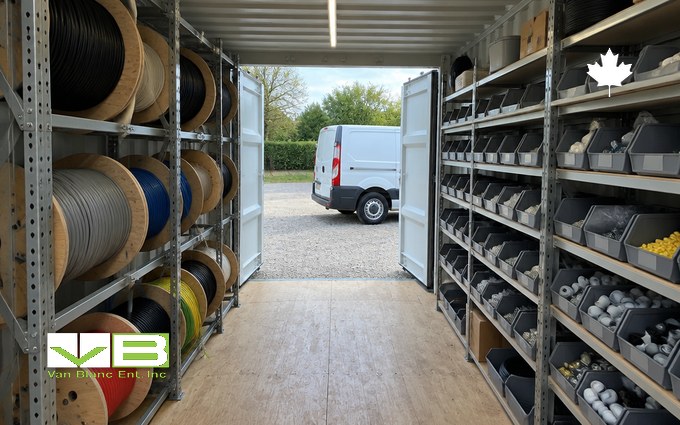
Quick Answer: An electrical contractor’s container setup is a wire spool rack along one wall, bin shelving for fittings opposite, and a clear aisle so a van loads in one pass. In Ontario it is a copper vault: Bell counted 579 copper thefts in the province in the first half of 2026.
In This Guide
- What an electrical contractor actually stores
- The copper problem, by the numbers
- The spool wall
- The fittings wall
- The one-pass van wall
- Damp: why reels die in a sealed box
- The security spec for a copper store
- Twenty or forty?
- Power and light inside the store
- Buying the box
- The contractor’s setup checklist
- Electrical contractor container FAQs
Reading Time: 13 minutes
What an electrical contractor actually stores
An electrical contractor stores two kinds of things, and they want opposite rooms. The first kind is heavy, round and few: reels and coils of NMD90 building cable, single-conductor T90 on spools, armoured Teck cable on reels the size of a truck tire, and ten-foot sticks of EMT conduit bundled by size. The second kind is light, square and countless: boxes, connectors, breakers, staples, straps, receptacles, cover plates, wire nuts by the thousand, and the fixtures for whichever job is open this week. The first kind needs a rack that carries weight and pays out cable without a fight. The second kind needs a wall of bins a person can read from the aisle. That split is why the trade hub’s electrical contractor entry describes the setup as a spool rack on one wall and fittings shelved opposite, and it is the whole logic of the room. Everything else on this page follows from it.
The reason the room is a shipping container rather than a corner of the shop is the third thing an electrician stores, which is copper. Copper is the only material on a job site that walks off by itself, and the cost of losing a week of reels is not the reels. It is the crew standing idle on Monday while the supplier fills the order again.
The copper problem, by the numbers
Copper theft in Ontario is not a rumour and it is not flat. Bell Canada’s mid-year 2026 report, covered by the Daily Commercial News on August 14, 2026, recorded 993 copper theft and vandalism incidents across Canada between January and June, a 78 percent increase over the same six months of 2025. Ontario accounted for 579 of them, 58 percent of the national total, with the activity concentrated in Hamilton, Niagara and Milton. Arrests rose 32 percent nationally. New Brunswick’s count rose 235 percent, and Ontario and New Brunswick together made up 85 percent of the national growth. That report counts telecom plant, but the same scrap market pulls wire off construction sites: ConstructConnect reported in March 2026 that site theft had become big business with copper near record highs, and the OPP asked scrap dealers for tips after a million dollars’ worth of copper wire disappeared from a workplace in St. Clair Township in Lambton County. The Toronto Construction Association’s estimate of annual losses across Ontario sites, and Paul’s own memory of the 1998 scrap spike that emptied barns across Brant County, are both in the camera build for a parked box. The point for a contractor is simpler than the statistics. Reels in a van, a job trailer or an open shop bay are a target. Reels in a locked steel box with a shrouded padlock are a chore, and thieves choose the easier truck.
Paul LeBlanc, Van Blanc Ent. Inc.: “Copper is the one thing on a site that walks by itself. The electricians who buy from us stopped leaving reels in the trailer years ago. The box is the vault, the van loads out of it in the morning, and the reels sleep behind steel.”
The spool wall
A spool wall is a rack of horizontal rods on which reels hang and turn, so cable pays out straight into the van or the measuring wheel without lifting the reel off the rack. The industrial version is the A-frame reel rack, a steel frame with heavy brackets and removable rods sized to the reel bore, sold floor-standing, wall-mounted or on casters; large shops run motorised carousels that hold hundreds of reels, which is more rack than a two-van contractor will ever need. Inside a container the wall-mounted version wins, because the corrugated wall and the floor cross-members carry the weight and the rack stays clear of the aisle. The rods go at three heights: heavy Teck and large NMD90 reels low, where a full reel of 6/3 that runs past what one person should lift never has to come off the rod, the everyday 14/2 and 12/2 reels at waist height, and the light T90 spools up top. Coils that come without a reel sit on a shelf above the rods with the tail out. What the rack sits on matters as much as the rack: racking rated for reel weight explains why the bottom beam and the floor take the load, and why a rack screwed to plywood alone is a rack that leans by spring.
Where the spool wall goes
Put the reel rack on the wall opposite the personnel door and run it from the cargo doors back, so the heaviest reels are the ones nearest the doors and the van. Leave the last four feet of the box, at the blind end, for the conduit rack and the bench. Ten-foot sticks of EMT fit a 20-foot container lengthwise with room to spare, laid on a two-tier pipe rack at the far end where nobody trips over them. E-track on the walls above the rack gives you strap points for ladders and the reels that ride to the job on a dolly.
The fittings wall
The fittings wall is the opposite problem: thousands of small parts that have to be findable by a person standing in the aisle with a takeoff sheet. The setup that works is open-front bin shelving, tilted bins on the lower shelves for the parts you pick by the handful and lidded bins on the upper shelves for the parts you pick by the box, labelled in the order they appear on a job: boxes and brackets, then cable fittings, then devices, then plates, then breakers. Bin shelving that hooks the corrugation is the container-specific version; it hangs off the wall’s own profile without drilling and it comes down the day the box moves. Two rules keep the wall honest. Nothing lives in an unlabelled box, because an unlabelled box is where the fittings go to be reordered, and the wall is restocked from the supplier’s invoice, not from memory. The ratio between the two walls is the decision that makes or breaks the layout: a service contractor with two vans wants more bin wall than reel wall, and a contractor wiring new houses wants the reverse.
The one-pass van wall
The whole room exists so a van loads in one pass at 6:30 in the morning. That means the van backs to the cargo doors, the aisle is clear from the doors to the bench, the reel rack pays out toward the van, the fittings wall reads left to right in the order of the day’s takeoff, and the light comes on with the door. A contractor who has to move the ladder to reach the reel rack, or walk to the shop for the breakers, has a storage container rather than a setup. The layout is the same one the tool crib’s charging wall uses for batteries and power tools, with the reels where the chargers would be. The bench at the blind end is where the day’s takeoff sheet gets checked against the load, and it is the reason the light at the back of the box matters as much as the light at the door.
| Zone | Where | What lives there | Why |
|---|---|---|---|
| Loading aisle | Cargo doors to the bench, 3 feet clear | Nothing stored; the dolly and the measuring wheel live here | The van loads without unloading the box first |
| Reel rack | Long wall, doors back | Heavy reels low and near the doors, everyday reels at waist height, light spools up top | Weight never has to come off the rods; the light levels a pick wall needs apply here first |
| Fittings wall | Opposite long wall | Bin shelving in takeoff order, labelled, restocked from the invoice | Read from the aisle, picked by the handful |
| Conduit rack | Blind end, low | Ten-foot EMT and PVC by size, fittings for each above | Fits lengthwise in a 20-foot box; out of the walking line |
| Bench | Blind end, above the conduit | Takeoff sheet, label printer, the day’s paperwork, a charger strip | The load gets checked against the sheet before the doors close |
Damp: why reels die in a sealed box
Cable does not mind damp; reels, boxes and labels do. A cardboard reel that sits in a puddle collapses, a paper label that gets wet becomes a mystery, and a box of connectors that lives under a roof drip becomes a box of connectors with a green tinge that a customer notices. A container is a sealed steel room, and in an Ontario spring it sweats: warm damp air meets a cold roof at night and the roof rains inside, which is the single most common complaint from anyone who stores paper-wrapped stock in an unvented box. The fix is air, and the vents that keep reels dry lay out the sizing: a louvred vent low on one side and one high on the other, so the box breathes and the roof stays close to the outside temperature. The roof drip that ruins a cardboard reel covers what to do about an existing box that already drips. Beyond the vents the habits are cheap: reels off the floor on the rods, boxes on the shelf and never on the plywood, and a desiccant bucket in the blind corner through March and April. A contractor who wants the store heated for a winter of service work is into insulation and a liner, which is a different fit-out and is covered where the welding shop’s cylinder store decides the same question for a different trade.
The security spec for a copper store
A copper store sits at the high end of the container security spec, above a landscaper’s mower vault and beside a tool crib full of cordless kits. The spec has four parts, and the order matters. The first is the padlock and the shroud: a shroud welded around the padlock puts the lock body inside a steel box that a pry bar cannot reach and a cutting disc cannot get square to, and the lock choices that beat a cordless grinder narrow the padlock itself to a disc or a puck with a shielded shackle. The second is where the box sits: doors toward the shop or the house, under a light, visible from the road but not reachable by a truck backing up to it unseen. The third is the camera, and a cellular camera with motion alerts is the part of this spec that has changed most in five years; on a rural yard with no power, a solar camera on a box with no power runs on its own panel. The fourth is the habit that beats every product, which is the Friday-night routine: reels in, doors locked, camera armed, and nothing of value left in the van. The Friday-night checklist for a loaded site box is the same routine written for a site, and it applies word for word to a copper store behind the shop.
The box on the site versus the box at the shop
Contractors run this setup two ways. The shop box is the permanent store: the reel rack, the fittings wall and the bench, parked behind the shop on a pad. The site box is a second, plainer twenty-footer that travels with the crew on a big job and holds the week’s reels and the crew’s tools, locked at night, beside the site office that sits beside the store. The shop box gets the fit-out; the site box gets the lock and the camera. Most two-van contractors buy the shop box first and the site box the year a multi-month job comes in.
Twenty or forty?
A twenty-foot container holds a two-van service contractor’s entire store: a reel rack on one wall, a fittings wall opposite, a conduit rack and a bench at the blind end, and a three-foot aisle. A forty-foot high cube is the residential or commercial contractor’s store, with room for two reel racks, a full bin wall, a conduit rack that holds twenty-foot lengths, a fixture shelf for the current job and a bench, and the extra foot of headroom that lets the top rod carry spools without a stepladder. Inside dimensions decide it: a twenty-foot box behind the shop gives you about 19 feet 4 inches by 7 feet 8 inches, and a forty-foot high cube with the conduit rack gives you 39 feet 5 inches by 7 feet 8 inches with 8 feet 10 inches of height. Width is the constraint in both. A reel rack and a bin wall each take about 18 inches off the 7-foot-8 interior, which leaves a 4-foot-8 aisle, and that is enough for a dolly and a person. It is not enough for a pallet jack, so reels that arrive on a skid get broken down at the doors.
| Contractor | Box | Reel wall | Fittings wall | Conduit | Notes |
|---|---|---|---|---|---|
| One or two service vans | 20-foot standard | One rack, 12 to 16 feet | One wall, tilted bins low | Ten-foot EMT at the blind end | The most common setup we deliver |
| Residential wiring crew | 20-foot or 40-foot high cube | Long rack, NMD90 heavy | Shorter; devices and boxes by the case | PVC and EMT | Reel weight decides the rack, not the count |
| Commercial and industrial | 40-foot high cube | Two racks incl. Teck reels | Full wall plus a fixture shelf | Twenty-foot lengths | Often paired with a site box; how contractors buy in multiples |
| Site box on a long job | 20-foot standard | The week’s reels on a short rack | Tool crib bins | None | Lock, camera and the Friday routine; no fit-out |
Power and light inside the store
An electrical contractor is the one buyer who does not need to be told how to wire a box, so this section is short. The store wants a lighting circuit with fixtures over the aisle and a task light at the bench, a duplex or two at the bench for the label printer and the chargers, and, if the box will run tool chargers all day, a small panel for lights and a charger fed from the shop. The connection is an ESA-inspected job like any other, which for an electrician is paperwork rather than a mystery, and the ESA process the contractor already knows covers how the inspection treats a container. A site box on a job with no service runs its lights off a generator inlet for a remote site or a small solar kit, and both are fitted at the yard before delivery if the contractor wants them there.
Pricing the shop box or the site box?
Tell us how many vans, whether the reels are NMD90 or Teck, and where the box will sit. We will tell you twenty or forty, the grade, which wall gets the door and the vents, and one honest all-in number with a real lead time.
Family-run in Brantford since 1995 · 200+ containers in stock · 4.9★ across 140+ Google reviews · every box graded by a person, walk it before it lands.
Buying the box
The grade for a working parts store is cargo-worthy: structurally certified, doors that seal, surface rust that nobody minds behind a shop. A wind-and-watertight unit does the same job for less if the doors close tight, and the grade for a working parts store is spelled out against the other three grades on one page. A one-trip box is the choice for a contractor whose store faces the customer parking lot and carries the company colours; a one-trip box for the yard is the newest steel we sell and it takes paint and a wrap better than anything used. Whichever grade, checking a used box before paying takes ten minutes in the row: doors, floor, roof, the CSC plate, and a look at the corner castings.
The fit-out happens at the yard. The man door and the vents cut before delivery are done under engineered drawings with the header framed, and the reel rack can be fitted before the truck leaves or after the box lands, depending on whether the contractor wants to supply the rack. What moves the number is size, grade, the fit-out list and the distance from Brantford, and what moves a parts-store quote is that list in that order on every quote we write. We sell outright, never rent; a contractor who wants to spread the cost does it through an equipment loan through the contractor’s bank, and we supply the invoice, the grade and the serial number the lender asks for. Delivery is the tilt-deck that sets it behind the shop, in one to three days from our four Brantford yards, onto a pad the box sits square on, because a reel rack on a box that sits out of level is a rack whose reels roll to one end.
Where the copper walks
Bell’s map of Ontario copper theft names Hamilton, Niagara and Milton, and it matches where these setups go. Hamilton’s contractors and the Niagara side buy shop boxes with the full security spec; the shops around the St. Catharines end of the QEW buy site boxes for the condo work; and all of them are within an hour of our own yard in Brantford, where the twenty-footers on the ground can be walked before the truck is booked. Worth the drive for unbeatable quality, family customer service with 30 years of experience.
The contractor’s setup checklist
Before the box is ordered
- Count the reels by weight class, not by number. That decides the rack, and the rack decides the wall.
- Decide the ratio of reel wall to bin wall from the work you actually do: service is bins, new construction is reels.
- Pick the door: cargo doors only for a site box, cargo doors plus a man door for a shop box that gets opened forty times a day.
- Spec the vents before the rack. A sealed box ruins reels; louvres against a fan for a parts store is a five-minute decision that saves a spring of cardboard.
- Write the security spec: shrouded padlock, disc lock, camera, light, position, and the Friday routine on a card by the door.
- Decide whether the store is heated. If yes, it is a lined box and the rack goes on the liner’s studs; if no, bare steel and the rack goes on the corrugation.
A store specified in that order is specified once, and the van loads in one pass on the first Monday. The alternative most contractors are running today, an enclosed trailer in the yard, is compared against the box in a container against an enclosed trailer, and the short version is that the trailer is the thing thieves tow away with the copper still inside.
Frequently Asked Questions
How do you store wire spools in a shipping container?
On a wall-mounted reel rack with horizontal rods, heavy reels low and near the doors, everyday reels at waist height, light spools up top, so cable pays out without lifting the reel. Rack to the corrugation and the floor cross-members, keep reels off the plywood, and vent the box low on one side and high on the other so cardboard reels stay dry.
How bad is copper theft in Ontario?
Bell Canada’s mid-year 2026 report counted 993 copper theft and vandalism incidents across Canada from January to June, up 78 percent on 2025, with Ontario accounting for 579 of them, or 58 percent, concentrated in Hamilton, Niagara and Milton. Construction sites and contractors’ yards see the same scrap-driven pattern, which is why reels belong behind a shrouded padlock.
What size container does an electrical contractor need?
A twenty-foot container holds a one- or two-van service contractor’s full store: a reel rack, a fittings wall, a conduit rack and a bench with a three-foot aisle. A forty-foot high cube suits a residential or commercial contractor with two reel racks, a fixture shelf and twenty-foot conduit. Width is the constraint; both give about 7 feet 8 inches inside.
Does wire go bad in a storage container?
The copper and the jacket do not, but cardboard reels collapse, labels wash off and boxed fittings corrode when an unvented steel box sweats in spring. A louvred vent low on one wall and one high on the opposite wall, reels on rods rather than the floor, and a desiccant bucket through March and April keep the stock dry without heating the box.
Can I put lights and receptacles in a storage container?
Yes, and an electrician does the work: a lighting circuit over the aisle, a task light at the bench, receptacles for chargers and a label printer, fed from the shop through an ESA-inspected connection, or from a generator inlet or a small solar kit on a site box with no service. We rough in the openings at the yard; the contractor makes the connection and calls the inspection.
Is a shipping container more secure than a job trailer for copper?
Yes. A trailer is towed away with the copper inside; a container is a two-tonne steel room on a pad with cam-lock doors, a padlock inside a welded shroud, and a camera on the corner. The remaining risk is habit, which is why the Friday routine, reels in, doors locked, camera armed, matters as much as the hardware.
Sources
- Daily Commercial News, DCN-JOC News Services. (2026, August 14). Bell reports copper thefts surge 78% at the mid-year mark. constructconnect.com
- Daily Commercial News. (2026, March). Copper thefts spike as construction site crimes become big business. constructconnect.com
- CBC News Windsor. (2026). OPP investigate million-dollar copper wire heist in St. Clair Township. cbc.ca
- CBC News Sudbury. (2026). Copper wire theft spiking nationally, and across northeastern Ontario. cbc.ca
- Speedrack West. (2026). Wire Reel Racks: the storage solution for electrical contractors. speedrackwest.com
- American Van Equipment. (2026). Wire Reel and Spool Rack. americanvan.com
Reach Van Blanc in Brantford
We have been supplying shipping containers across Ontario since 1995. Our yard is at 90 Morton Avenue East in Brantford, and we deliver right across the province with payment on the day of delivery. No deposit, no upfront wires, no chase-the-paperwork.
Van Blanc Ent. Inc., 90 Morton Ave E Unit 1B, Brantford, ON N3R 7J7, 519-754-6844 (cell) or 1-888-509-6658 (toll-free).
If the reels are still sleeping in the trailer, call with the number of vans, the kind of cable you run and your postal code, and we will tell you on the spot which boxes are on the ground and when a fitted one can land. Worth the drive for unbeatable quality, family customer service with 30 years of experience.