
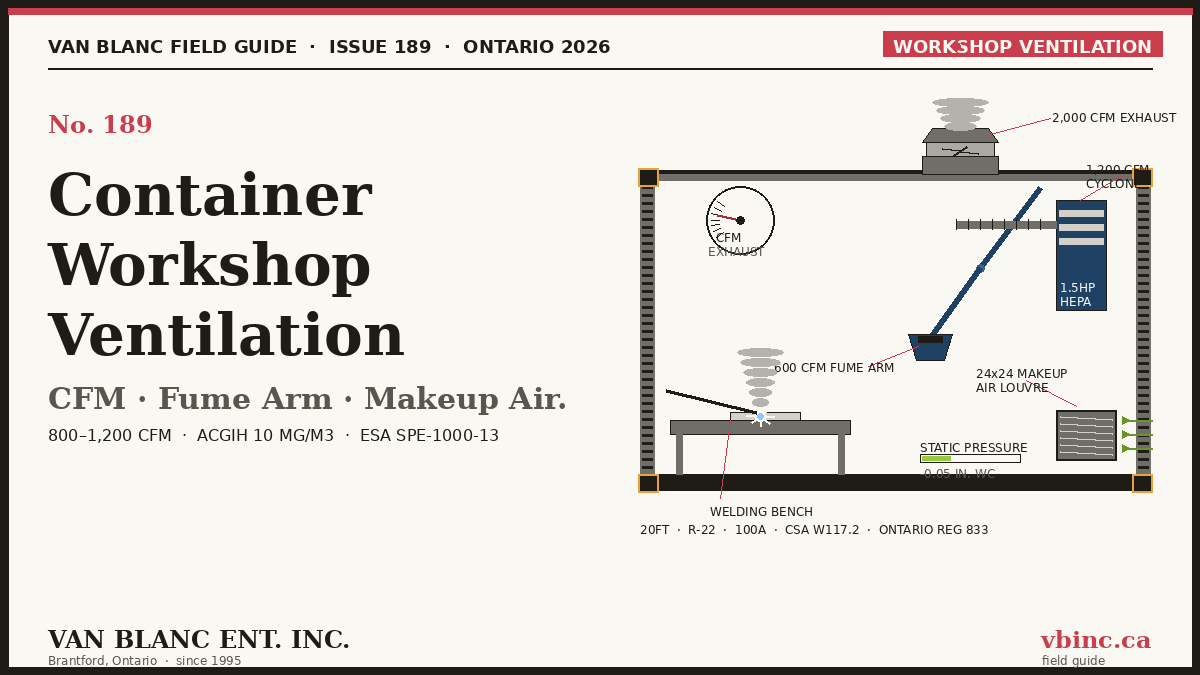
Quick Answer: Per ASHRAE 62.1. A 20ft container workshop needs roughly 800 to 1,200 CFM of exhaust plus an equal-CFM makeup-air intake for welding or sanding. Container workshop ventilation fume extraction in Ontario must hit ACGIH 10 mg/m3 inhalable and 3 mg/m3 respirable particulate limits under Regulation 833, sourced at the weld puddle. Brantford-based since 1995, family-operated, 4.9-star verified (140+ Google reviews). 1-3 day delivery Ontario-wide.
In This Guide
- Why Does a Steel Container Trap Welding Fumes More Than a Wood Shop?
- How Many CFM Does a 20ft, 40ft, or 40ft HC Container Workshop Need?
- What Are the Ontario Reg 833 and ACGIH Fume Limits for a Container Workshop?
- Is Source Capture or Dilution Better in a Container Workshop?
- What Is the Makeup-Air Problem That Sinks Most Container Builds?
- How Big a Dust Collector Does a Wood-Heavy Container Shop Need?
- Where Should You Cut the Exhaust Fan and Intake Louvre on a Container?
- What Electrical Service Does a Ventilated Container Workshop Need?
- What Does Van Blanc’s Own Container Shop Ventilation Setup Look Like?
- What Goes Into a Real 40ft HC Welder’s Container Workshop Build?
- Frequently Asked Questions
Reading time: about 14 minutes.
Why Does a Steel Container Trap Welding Fumes More Than a Wood Shop?
A converted shipping container traps welding fumes because spray-foam insulation seals it nearly airtight, and steel walls reflect the rising fume plume back into the breathing zone within about 20 seconds. A wood-framed shop leaks fumes through soffit vents and wall seams, so the same weld inside a sealed steel box needs mechanical source-capture extraction to stay safe.
A framed wood shop loses fumes through every weep and sheathing seam. A converted shipping container does not. Once the roll-up is closed and the man-door latched, the box is essentially airtight after spray-foam insulation. Great for thermal performance, terrible for welding fumes. The same physics that lets a 12,000 BTU mini-split hold setpoint in February keeps every milligram of manganese, hexavalent chromium, and zinc oxide hanging in the breathing zone until you push it out mechanically.
Steel walls reflect convective plumes back down. In a wood shop a fume column rises and disperses through soffit vents. In a 20ft container the same plume hits cold steel and rolls back into the breathing zone within 20 seconds. Welders report headaches and metal-fume fever within an hour, even on light TIG work that looks visually clean.
Volume is the third issue. A 20ft holds roughly 1,200 cubic feet after framing; a 40ft HC about 2,400. OSHA defines confined-space welding as anywhere under 10,000 cubic feet per welder. Every container workshop in Ontario is by definition confined, which triggers stricter ventilation requirements under both U.S. guidance and Ontario Ministry of Labour interpretation.
What Container Geometry Does to Fume Behaviour
After 2 inches of closed-cell spray foam plus framing, a 20ft loses roughly 12 inches of length, 8 of width, 6 of height. The remaining 1,100 to 1,200 cubic feet has steel boundary on five of six sides. The acoustic and thermal reverberation that engineers love about containers becomes a fume-trapping liability when arc welding starts. Plan for source capture, not dilution.
Paul LeBlanc, owner: “People treat a converted container like a small garage, and it is not. After 19 years in containers I can tell you a sealed steel box behaves like a tank. The fume has nowhere to go but back at the welder. Sort out where the air leaves and where the clean air comes in before you ever strike an arc, and the rest of the build gets easy.”
How Many CFM Does a 20ft, 40ft, or 40ft HC Container Workshop Need?
Container workshop ventilation fume extraction in Ontario comes down to two numbers: source-capture CFM at the work, plus general-exhaust CFM for the room. You need both. A fume arm alone does not handle background haze; a roof exhaust alone does not pull a plume off a vertical fillet fast enough to protect the welder.
| Container Size | Interior Volume | Source Capture (Fume Arm) | General Exhaust (Roof Fan) | Makeup-Air Intake |
|---|---|---|---|---|
| 20ft standard | ~1,100 cu ft | 600 to 800 CFM | 800 to 1,000 CFM | 800 to 1,000 CFM (matched) |
| 20ft HC | ~1,200 cu ft | 600 to 800 CFM | 800 to 1,200 CFM | 800 to 1,200 CFM (matched) |
| 40ft standard | ~2,200 cu ft | 800 CFM | 1,200 to 1,500 CFM | 1,200 to 1,500 CFM (matched) |
| 40ft HC | ~2,400 cu ft | 800 CFM | 1,500 to 2,000 CFM | 1,500 to 2,000 CFM (matched) |
| 40ft HC heavy welding | ~2,400 cu ft | 1,000 CFM | 2,000 CFM (OSHA confined floor) | 2,000 CFM (matched) |
The source-capture column is the fume-arm rating at the hood, not at the fan. A welder-grade arm rated 800 CFM at the motor delivers 600 to 700 CFM at the hood depending on elbows and arm extension. Spec one 10 to 15 percent higher than target to absorb the pressure-drop penalty.
The general-exhaust column targets 6 to 8 ACH for hobby work, 10 to 15 ACH for production. A 20ft container at 1,200 cubic feet times 10 ACH equals 200 CFM continuous; push to 800 to 1,000 CFM when actively welding and the room clears every 90 seconds, which is what OSHA confined-space guidance demands.
Most container builds go wrong sizing the exhaust without matching makeup air. A 1,200 CFM exhaust running against zero intake area pulls the box into roughly -0.3 inches water column negative, doors slam, and the fan loses about 25 percent of capacity fighting its own back-pressure.
What Are the Ontario Reg 833 and ACGIH Fume Limits for a Container Workshop?
Ontario Regulation 833, Control of Exposure to Biological or Chemical Agents, sets the legal ceiling for workplace fumes. Section 4 requires employers to keep worker exposure below the time-weighted average for each listed agent. Welding fume is not separately listed, so it defaults to the ACGIH TLV table, which classifies welding particulate as Particulates Not Otherwise Regulated.
For PNOR, ACGIH publishes a TLV-TWA of 3 mg/m3 respirable and 10 mg/m3 inhalable over an 8-hour shift. Specific metals are tighter: manganese 0.02 mg/m3 respirable, hexavalent chromium 0.0002 mg/m3 inhalable, zinc oxide fume 2 mg/m3. A welder running flux-cored on galvanized inside a 20ft without extraction blows through every limit in under five minutes of arc time.
The regulation specifies a hierarchy of controls: engineering controls come first. That language is why source capture at the weld puddle, not a P100 respirator, is the legally correct first move for any commercial container workshop in Ontario.
What Ontario Ministry of Labour Inspectors Actually Look For
Field inspectors check three things first: is there a documented source-capture system at each active weld station, is the system actually running when work happens, and does the employer have current air-quality testing on file showing exposure under the ACGIH limits. A container shop with a fume arm visible in the corner but no testing record fails the audit as readily as one with no extraction at all.
Is Source Capture or Dilution Better in a Container Workshop?
Source capture is the better strategy for a container workshop, and industrial hygiene research settled the comparison two decades ago. Source capture removes fume within 12 to 18 inches of the arc before the plume reaches the breathing zone. Dilution works in a 50,000 cubic foot building, not in a 1,200 cubic foot container without absurdly oversized fans.
The math is unforgiving. A welder generates 200 to 800 mg of particulate per minute. MIG on mild steel sits around 400 mg/min; flux-cored on galvanized hits 700 to 800 mg/min. To dilute 400 mg/min to the ACGIH 10 mg/m3 inhalable limit you need 1,400 CFM continuously. Galvanized doubles it. You cannot get there inside a container with general exhaust alone.
Source capture cheats the math. Pulling 800 CFM at the hood 14 inches from the arc captures roughly 95 percent of generated particulate before it enters the room air. The remaining 5 percent is what your roof exhaust handles, dropping the room target to 200 to 400 CFM with a single 12-inch roof fan and a matched intake louvre.
What Is the Makeup-Air Problem That Sinks Most Container Builds?
This is where 80 percent of owner-built container workshops in Ontario fail their first MOL inspection. Owner installs a beautiful 1,500 CFM roof exhaust, ducts in a 1,000 CFM fume arm, hits the switch, and within 30 seconds the box is under negative pressure. Doors stick, the mini-split short-cycles, and the welder still has visible haze in the breathing zone because the exhaust is pulling against zero supply air.
A spray-foamed container has roughly 0.05 to 0.1 air changes per hour of natural infiltration, essentially a sealed pressure vessel. Above 0.2 inches WC negative, doors become hard to operate, gas-fired equipment back-drafts (carbon monoxide risk), and fans operate well off their published performance curves.
The fix: a matched makeup-air opening sized to the exhaust. Rule: one square inch of free area per CFM, doubled for grille and weather-louvre back-pressure. A 1,200 CFM exhaust needs roughly 2,400 square inches of intake (one 24-by-100-inch louvre or two 24-by-50-inch on opposite walls). Heated makeup-air units duct intake through inline propane or electric heat so the box does not draft -30C air across the welder’s neck in January.
Money-Saving Note on Makeup Air
A heated makeup-air unit (HMAU) is the priciest part of the intake, and what it costs in Ontario depends on heater fuel and CFM rating. For seasonal or hobby-grade operations, a fixed louvre with insulated shutter and manual operation costs a small fraction of an HMAU in materials. Skip the louvre entirely and you lose more in fan inefficiency and door slamming than the louvre would have cost.
How Big a Dust Collector Does a Wood-Heavy Container Shop Need?
For a wood shop the math shifts. Dust collection runs higher CFM at lower static pressure than fume extraction. A table saw needs 350 to 450 CFM, a planer 700 to 900, a 6-inch jointer about 400, a router table 300. Sized to the largest tool plus 20 percent margin, a wood-shop container needs a 1,000 to 1,200 CFM dust collector with 5 or 6 inch main duct and 4 inch branches.
Minimum transport velocity for chips is 3,500 to 4,000 feet per minute. Drop below and chips settle out in the run. In a container the run from back wall to wall-mounted collector (12 to 36 feet) is short enough to maintain velocity easily. Skip a cyclone separator and the bag filter clogs in two weekends.
Fine dust is the harder problem. The under-5-micron fraction floats and is the dangerous one for long-term lung exposure. A 1.5 hp cyclone with HEPA filter handles bulk capture. A ceiling-mounted ambient filter (600 to 800 CFM through MERV-13) scrubs airborne fines continuously. Together they meet the OSHA respirable-dust target of 5 mg/m3 for silica-free wood.
The Hybrid Wood-and-Metal Container Shop
Many small contractors run hybrid container workshops: welding bench on one wall, table saw and planer on the other. Dual system: 1,200 CFM dust collector to the wood tools, 800 CFM fume arm at the welding bench, single 1,500 to 2,000 CFM roof exhaust for background, makeup-air louvre interlocked to either. We rough in this kind of dual extraction as part of our at-yard conversion program before the box leaves Brantford, with the final gas and trade connections left for the customer’s licensed trades on site. Budget for the equipment plus the labour to duct and interlock it. Far cheaper than a 24×24 frame-built shop with the same capability.
Where Should You Cut the Exhaust Fan and Intake Louvre on a Container?
On a container workshop, the exhaust fan goes in the roof opposite the bench and the makeup-air louvre goes low on the far wall, because fan placement matters as much as sizing. The standard Ontario container layout puts the exhaust in the roof opposite the bench, with the intake louvre on the far wall low to the floor. This creates a cross-draft past the welder, across the work, out the roof. Reverse the geometry and you pull fume across the operator before it leaves.

Roof penetration on a Corten container is straightforward. A 12-inch exhaust fan needs a 14-inch round cut, framed with a 14 gauge steel collar welded around the perimeter to restore structural continuity. The fan sits on a curb 6 to 8 inches above the roof skin to clear standing water. Flash with high-temperature silicone and a stainless rain hood. Most of this line item is the welded fabrication of the collar and curb plus the install labour, not the fan itself.
The intake louvre cuts through the side wall, 12 to 18 inches off the floor, so cold makeup air falls and warms before reaching breathing height. A 24×24 louvre with insulated shutter and motorized actuator interlocked to the exhaust handles cold-weather operation, and the motorized actuator is what pushes that line above a plain fixed grille. Avoid cutting corner castings (voids residual CSC, removes stacking-load integrity) or floor cross-members. Roof and side-wall cuts away from those structural members do not affect wind-and-watertight rating once flashed.
What Electrical Service Does a Ventilated Container Workshop Need?
A ventilated container workshop usually needs 100A service once you run extraction, dust collection, and a welder at the same time. A welding-only container with a 200 amp MIG, 1.5 hp dust collector, and 12,000 BTU mini-split runs about 45 amps continuous at 240V. A 60A subpanel handles it with margin. Add a fume arm motor (3 to 5 amps) and roof exhaust fan (8 to 12 amps for a 1,500 CFM unit) and the load tops 65 amps. The 60A breaker trips on starting in-rush every time the planer kicks on, which is the same trade-off we walk through in our guide to sizing a container service panel.
For any shop running ventilation plus dust collection plus a welder simultaneously, 100A is the practical floor. The cost difference between 60A and 100A is modest, mostly the larger panel and heavier wire. We have seen too many builds spec’d at 60A and retrofit to 100A within 6 months.
ESA inspection requires SPE-1000-13 compliance, the Ontario standard for special construction electrical. Plan for an ESA rough-in inspection and a final inspection. Budget for ESA fees plus licensed electrician labour. Non-optional for any commercial container.
What Does Van Blanc’s Own Container Shop Ventilation Setup Look Like?
At our yard on Morton Avenue we use containers for our own fabrication, so 19 years in we have figured out what works for ventilation in a steel box. Paul started the company in 1995, pivoted into containers around 2007, and we have built workshop conversions for farmers, contractors, hobby welders, and small manufacturers across Ontario.
The bench-welder bay is a 20ft standard with R-22 walls, R-30 ceiling, a 12-inch roof exhaust rated 1,200 CFM, a 600 CFM fume arm at the bench, and a 24×24 motorized louvre on the opposite wall. The louvre interlocks to the fan via a static-pressure controller, opening when exhaust hits 0.05 inches WC negative. Doors operate cleanly, the mini-split holds setpoint in February, and welders inside test under 1 mg/m3 inhalable on independent air-quality testing.
For the wood-side container we run a 1.5 hp cyclone with HEPA filter, 6-inch main duct, 4-inch branches to the table saw, planer, and router table, plus a shared 1,200 CFM roof exhaust paired with a MERV-13 ambient filter. If you are scoping a whole conversion and not just the air system, our complete container workshop build and layout guide walks through how the ventilation fits the rest of the shop.
Paul LeBlanc, owner: “I have watched welders walk out of a container after 20 minutes with a headache because the previous owner skipped the makeup-air louvre. They install a exhaust and a fume arm and forget the hole on the opposite wall. The hole is what makes the system work. Without it the fans choke against themselves and the welder breathes the same air twice. Buy the louvre, cut the hole, then turn the fans on.”
What Goes Into a Real 40ft HC Welder’s Container Workshop Build?
Here is how a working welder’s 40ft HC workshop breaks down, part by part. A Brant County contractor bought this build in 2024, MIG mostly, occasional stick. It started with a 40ft HC one-trip out of our yard, the single largest line on the build. A factory-fresh one-trip unit is the usual starting point for a workshop conversion because the panels are straight and the paint takes a clean cut for the roof fan. Then came spray foam (2 inches walls, 3 inches ceiling), and framing, T1-11 cladding, and LVP floor. The cylinder store that belongs beside this bay, and the four ways an Ontario welder houses a shop, are covered in the welding shop setup piece.
Ventilation covered a 14-inch roof exhaust rated 2,000 CFM with rain hood and install, two 24×24 motorized intake louvres, a 600 CFM swing-arm fume hood plus ductwork, and a static-pressure controller with interlock relay. Together the ventilation came to roughly 16 percent of the build. Skip the ventilation and the box becomes uninsurable.
Electrical covered a 100A subpanel via direct-bury 4/0 aluminum, the ESA filing and inspections, a 12,000 BTU Mitsubishi cold-climate mini-split installed to CSA F280, and lighting plus exterior receptacles. The result was a turnkey conversion, container and all, that still landed well under what a frame-built 320 sq ft detached shop would have run in southern Ontario in 2026. The container build also sits on six concrete piers instead of a frost-protected slab, which saved another chunk.
Frequently Asked Questions
How many CFM does a container workshop need for welding?
A 20ft welding bay needs 600 to 800 CFM at the fume arm hood plus 800 to 1,000 CFM general roof exhaust, matched by an equal-CFM makeup-air intake. A 40ft HC for heavier work needs 800 to 1,000 CFM source capture and 1,500 to 2,000 CFM general exhaust. Commercial welding operations also need to demonstrate compliance with Ontario Regulation 833 exposure limits via air-quality testing. Tell us your container size and how you weld and we will scope the fan, fume arm, and matched intake on one phone call.
What is the ACGIH exposure limit for welding fume in Ontario?
Welding fume in general falls under Particulates Not Otherwise Regulated (PNOR) with a TLV-TWA of 10 mg/m3 inhalable and 3 mg/m3 respirable over an 8-hour shift. Specific metals are tighter: manganese 0.02 mg/m3 respirable, hexavalent chromium 0.0002 mg/m3 inhalable, zinc oxide fume 2 mg/m3. Ontario Regulation 833 references the ACGIH TLV table directly.
Why does my container welding shop have negative pressure problems?
Spray-foam-insulated containers are essentially airtight. Running an exhaust fan without a matched makeup-air intake louvre pulls the box into negative pressure, which makes doors hard to open, drops fan efficiency by 25 percent or more, and risks back-drafting any combustion appliance. Cut a louvre of roughly 1 square inch of free area per CFM of exhaust, doubled for grille and weather-louvre back-pressure.
Can I use a P100 respirator instead of source-capture ventilation?
No. Ontario Regulation 833 explicitly states that employers shall protect workers from chemical agents without requiring them to wear a respirator. Respirators are PPE of last resort, allowed only when engineering controls cannot achieve compliance. The MOL inspection will fail if respirator use substitutes for required ventilation.
How big a dust collector do I need for a container wood shop?
A 1,000 to 1,200 CFM cyclone handles a single-operator container shop with table saw, planer, jointer, and router table. Spec 1.5 hp minimum with HEPA filter, 6-inch main duct, 4-inch branches. Maintain 3,500 to 4,000 FPM duct velocity to keep chips from settling. Add a ceiling-mounted MERV-13 ambient filter for fine dust during shop hours.
Where should the exhaust fan and makeup-air louvre go on the container?
Exhaust fan on the roof, opposite the workbench. Makeup-air louvre on the far wall, low to the floor (12 to 18 inches off the deck), positioned so fresh air crosses through the welder and out the roof. This creates a cross-draft past the work. Reversing the geometry pulls fume through the breathing zone and makes the system worse than no ventilation at all.
Does cutting a roof exhaust hole void the container?
It voids the CSC plate if the container still had a valid one (most used do not), and ends the wind-and-watertight rating until properly flashed. Done correctly with a welded steel collar, high-temperature silicone, and a rain hood, the modification restores structural and weather integrity. Done with a Sawzall and roof tar, it leaks within one Ontario winter. Use a qualified welder for the cut and flash.
What is the difference between a fume arm and a portable fume extractor?
A fume arm is a fixed-mount swing arm with a hood positioned 12 to 18 inches from the arc, pulling 600 to 800 CFM at the hood. A portable extractor is a wheeled unit with flexible hose and similar hood, typically 80 to 150 CFM at the hood inlet. Fume arms work for fixed-bench production; portable units suit field welders moving between locations.
How much does container workshop ventilation cost in Ontario?
Cost is driven by which package you need, the CFM rating of the fans, whether the makeup air is a plain louvre or a heated unit, and how much install labour the build takes. A complete welding-container package (roof exhaust, fume arm, makeup-air louvre, controls, ducting, installation) sits at the low end. A wood-shop package (cyclone dust collector, duct network, ambient filter, roof exhaust, louvre) runs a bit higher because the dust collector and ducting are larger. A hybrid metal-and-wood shop combines both systems, so it carries the most equipment and the highest install cost. For a quote scoped to your exact build, the fastest route is a quick call to the Brantford yard.
Sources
- Government of Ontario. (current). Regulation 833 under the Occupational Health and Safety Act: Control of Exposure to Biological or Chemical Agents. ontario.ca/laws/regulation/900833
- American Conference of Governmental Industrial Hygienists. (2025). 2025 TLVs and BEIs Threshold Limit Values for Chemical Substances. ACGIH.
- Canadian Standards Association. (2025). CSA W117.2-25 Safety in welding, cutting, and allied processes. CSA Group.
- Occupational Safety and Health Administration. 29 CFR 1910.252(c) Welding, Cutting and Brazing – General Requirements: Ventilation. U.S. Department of Labor.
- Electrical Safety Authority of Ontario. (2024). SPE-1000-13 Code for Field Evaluation of Electrical Equipment. ESA Ontario.
Reach Van Blanc in Brantford
We have been supplying shipping containers across Ontario since 1995. Our warehouse is at 90 Morton Avenue E in Brantford, and we deliver right across the province on a cash-on-delivery basis. No surprise fees, no chase-the-paperwork.
Van Blanc Ent. Inc. – 90 Morton Ave E Unit 1B, Brantford, ON N3R 7J7 – +1 888-509-6658
Come walk our yard and see the workshop conversions we run for our own fabrication. We will show you the fume-arm setup, the louvre placement, and the exhaust-fan mounting that actually works in an Ontario steel box. Container workshop ventilation is not optional on a commercial build. See how the air system fits the wider job in our step-by-step container shop conversion before you pour money into a setup that does not move air.
Related Reading
Ready to price your container?
Tell us the size and your postal code and we’ll send back an honest, all-in number, container, delivery, and placement, usually within 1-3 days. No pressure, no mystery fees.
Family-run in Brantford since 1995 · 200+ containers in stock · 4.9★ across 140+ Google reviews · every box graded by a person, walk it before it lands.