
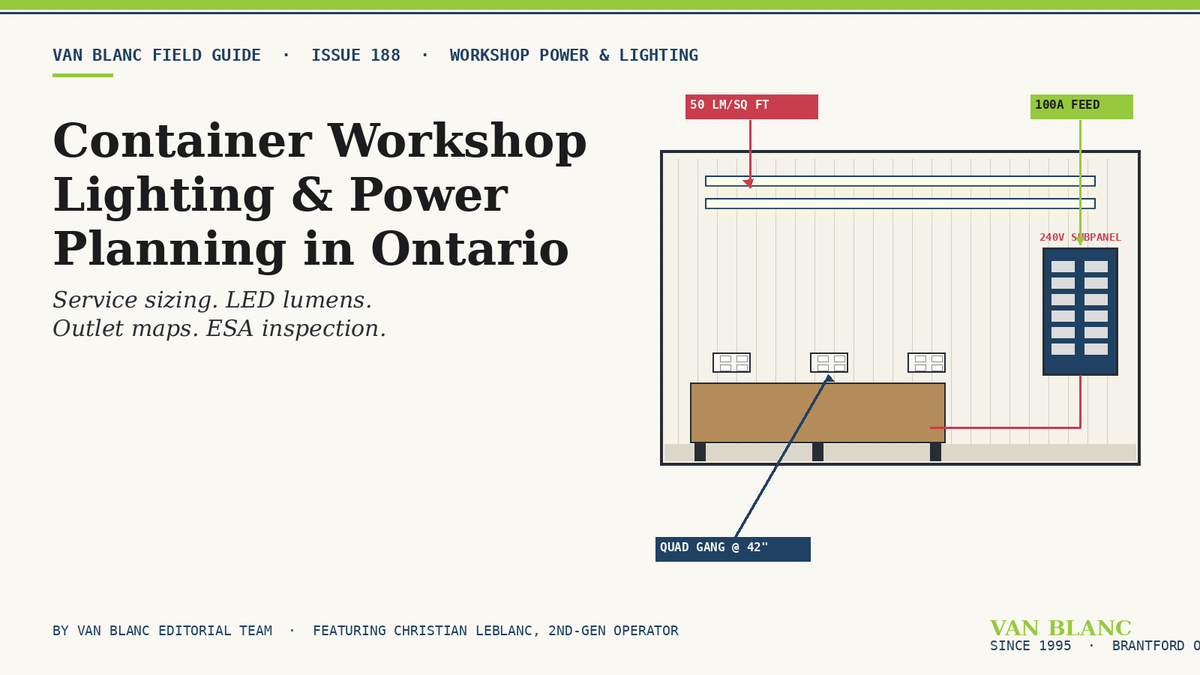
Quick answer. A container workshop in Ontario typically needs a 100 A subpanel fed from the main panel, with 240 V circuits for stationary tools, 50 lumens per square foot of ambient LED lighting plus 75 to 100 at task benches, and outlet quad gangs spaced every 4 feet at bench height. The whole installation has to be wired and inspected under the Ontario Electrical Safety Code by the Electrical Safety Authority. The container itself varies by grade, size, and freight zone, so call Christian or Paul for a same-day quote. Family-run since 1995, 4.9 stars across 140+ verified Google reviews. Delivery in 1-3 days from our 4 Brantford yards.
In this guide
- How much electrical service does a container workshop actually need?
- 60 A vs 100 A vs 200 A: which subpanel matches your tool list?
- What does a typical Ontario workshop circuit map look like?
- How much LED lighting does a container workshop need?
- Where should the outlets go in a container workshop?
- How do you wire safely inside a steel container shell?
- How does ESA inspection and SPE-1000 work in Ontario?
- What drives the cost of wiring a 40 ft container workshop?
- What do most owners get wrong in their first electrical sketch?
- Frequently asked questions
Reading time: about 14 minutes.
Most Ontario buyers calling our Brantford yard about a workshop build already know they want a 40 ft High Cube. The size decision is the easy part. The hard part comes 30 minutes into the first electrician site visit, when somebody asks how many circuits the table saw, dust collector, compressor, and welder will pull simultaneously, and whether the 60 A feed they already pulled from the house panel is going to cover any of it. The answer is usually no. This is the workshop power planning we walk through with buyers before they pay a dollar, because changing the feed wire after the slab is poured and the panel is mounted costs more than getting it right on day one.
Power planning sits at the centre of every workshop build because every other decision flows through it. Lighting design depends on how many fixture circuits you can spare. Heating choice depends on whether you have 240 V capacity for a Modine hanger or are stuck with 120 V baseboards. Insulation thickness changes the heat load that the panel has to feed. Even where the outlets land on the wall depends on which side of the container the feed enters. Get the service sizing wrong in the first sketch, and you spend the next two years working around it.
How much electrical service does a container workshop actually need?
A container workshop in Ontario usually needs a 100 A subpanel fed from the main panel. That size covers LED lighting, a few 240 V circuits for stationary tools, a heater or mini-split, and a welder receptacle, with headroom to grow. A 60 A feed suits light hobby use only; 200 A is for heavy commercial shops.
The starting question for a container workshop is “what tools, what runtime, what overlap.” The amperage follows from that. Workshop electrical load is bursty. A table saw pulls hard for 8 seconds at the cut, idles otherwise. A dust collector runs the whole session at a steady draw. A compressor cycles on for 60 seconds every five minutes. A welder dumps 30 to 50 amps for the duration of a bead, then nothing. Sizing a workshop subpanel means estimating what will be running at the same time, not what every tool draws on the spec plate added together.
For an Ontario container workshop, the practical service tiers settle into three buckets:
| Tier | Service size | What it covers | Typical wire to container |
|---|---|---|---|
| Storage plus a bench | 60 A subpanel | LED lighting, 8 to 10 receptacle circuits, one 240 V circuit (small heater), corded hand tools, light hobby use | #6 AWG copper, 4 wire |
| Serious hobby or single-trade workshop | 100 A subpanel | LED lighting, dust collection, table saw, drill press, mitre saw, planer or jointer (one at a time), 240 V heater, light welding, one HVAC mini-split | #3 AWG copper, 4 wire |
| Heavy commercial workshop | 200 A subpanel | Multiple stationary tools running together, MIG plus stick welding stations, 5 hp compressor, large dust collector, full HVAC, EV charging tied in | 2/0 AWG copper, 4 wire |
The 100 A subpanel is the right answer for 80 percent of the workshop builds we deliver containers for. It runs a little more in materials than a 60 A feed but leaves enough headroom that you do not have to ration tool use during a busy weekend. It also future-proofs the build for adding a small HVAC unit or a second 240 V circuit five years in, without re-pulling the feeder.
Paul LeBlanc, owner: “The number I hear most often at the yard is 60 amps, because that is what somebody already pulled from the house before they thought about tools. Then they list a table saw, a dust collector, a compressor, and a heater, and the math falls apart in front of them. I have watched this same conversation play out for the last fifteen years. Size the feed for the shop you will have in five years, not the bench you are starting with today.”
The 80 percent rule
Continuous loads (anything running 3 hours or more without a break, like dust collection or HVAC) cannot exceed 80 percent of the breaker rating per Canadian Electrical Code. A 100 A breaker is good for 80 A continuous. Add up your continuous loads first, then layer in the bursty stuff. If the continuous number alone is over 60 A, the 60 A subpanel is already wrong.
60 A vs 100 A vs 200 A: which subpanel matches your tool list?
The right workshop subpanel comes straight off your tool list, so walk through that list before signing off on a service size. The three tiers split cleanly along these lines:
60 A subpanel: light hobby or storage shop
A 60 A feed handles roughly 7 to 10 general-purpose circuits. That works for LED lighting (one or two 15 A circuits), 4 to 6 receptacle circuits along the walls, and one 240 V circuit for a small wall heater or a 30 A welder receptacle that gets used occasionally. If your workshop is a tool storage cabin with a bench for occasional projects, 60 A is enough. If you plan to run any stationary woodworking equipment alongside dust collection and HVAC, you will outgrow it within the first year.
Wire from the main panel: #6 AWG copper, 4 conductor (two hots, neutral, ground). Voltage drop at 100 feet from the house panel sits around 3 percent on a 60 A load, which is acceptable but starts to matter past 150 feet of run.
100 A subpanel: the workshop default
This is what we recommend on most quotes. A 100 A subpanel comfortably feeds 18 to 24 circuits in a 30-space panel, which is more than enough room to lay out a workshop the way you actually use it. You get dedicated 240 V circuits for the table saw, the dust collector, a wall-mounted heater, and an HVAC mini-split, plus 8 to 12 individual 20 A receptacle circuits for the bench wall, ceiling drops, and outlet quad gangs.
Wire from the main panel: #3 AWG copper or #1 AWG aluminum, 4 conductor. The feed carries a modest per-foot cost for copper, plus the conduit. A 60 foot run from the house panel to the container, in EMT or PVC underground, adds a reasonable materials cost before labour.
200 A subpanel: heavy commercial
If you are running a metalworking shop with simultaneous MIG and stick welding, a 5 hp compressor that cycles constantly, full HVAC with electric resistance heat as backup, and you might add a Level 2 EV charger off the same panel down the road, then 200 A is justified. The wire size jumps to 2/0 AWG copper, which is expensive and stiff to work with. Commercial fabrication shops and serious side businesses are the usual buyers of this tier.
Worth knowing: if your house has a 200 A main panel, you cannot just drop a 200 A breaker into it for the workshop feeder. The total connected load has to balance against the house. Most 200 A workshop feeds need the house service upgraded to 300 A or 400 A first, which is a separate utility conversation with Hydro One or your local distribution company.
Container shells need different grounding than wood-frame workshops
A shipping container is one continuous steel structure, which means it carries fault current along the entire shell if something goes wrong. The subpanel ground bond gets a separate 8 foot copper-clad ground rod driven into the earth at the container, with #6 AWG bare copper from the rod to the panel ground bus. The ground and neutral bars inside the subpanel must be isolated from each other, because the subpanel is in a separate structure from the main panel, and the bond happens at the service entrance only. This is the rule electricians who do mainly residential interiors most often miss.
What does a typical Ontario workshop circuit map look like?
A typical Ontario container workshop on a 100 A subpanel ends up with a 12-circuit map that keeps surfacing across build after build. After laying out hundreds of workshop conversions through customer feedback, the same arrangement settles in for a 40 ft High Cube. Use this as a starting frame and adjust for your tool list:
| Circuit | Breaker | Purpose | Wire |
|---|---|---|---|
| 1 | 15 A | Ceiling LED lighting (4 to 6 fixtures, ambient) | 14/2 NMD90 |
| 2 | 15 A | Task lighting (under-cabinet, bench-mounted) | 14/2 NMD90 |
| 3 and 4 | 20 A each | Bench wall outlets (quad gangs every 4 ft, 42 in off the floor) | 12/2 NMD90 |
| 5 and 6 | 20 A each | Tool wall outlets (opposite the bench, same spacing) | 12/2 NMD90 |
| 7 | 20 A | Ceiling drop receptacles (retractable cord reels) | 12/2 NMD90 |
| 8 | 20 A | Door-side convenience plus exterior receptacle | 12/2 NMD90 |
| 9 | 30 A double-pole 240 V | Table saw or large stationary tool | 10/3 NMD90 |
| 10 | 20 A double-pole 240 V | Dust collector or planer | 12/3 NMD90 |
| 11 | 30 A double-pole 240 V | Wall heater or HVAC mini-split | 10/3 NMD90 |
| 12 | 50 A double-pole 240 V | Welder receptacle | 6/3 NMD90 |
That layout uses 12 circuits in a panel that can hold 24 to 30, so there is plenty of room to add a sub-circuit for a compressor, a second welder, or an EV charger later without re-pulling anything. The total connected load on this map adds up around 180 A nominal, but the diversity factor (how much actually runs simultaneously) brings the demand load down to roughly 65 to 75 A peak, well within the 100 A feed.
How much LED lighting does a container workshop need?
LED lighting in a container workshop is one of the easiest wins in the whole conversion. LED shop lights have come down in price and up in output to the point where a lighting budget transforms a dim cargo box into something brighter than most home garages. The specifications that matter:
Ambient target: 50 lumens per square foot for general workshop lighting. A 40 ft High Cube has roughly 320 square feet of floor area, which calls for 16,000 lumens total ambient. That is four 8 ft LED strip fixtures at 4,000 lumens each, or two 8 ft high-output fixtures at 8,000 lumens each. We see both layouts deployed regularly.
Task target: 75 to 100 lumens per square foot at workbench surfaces. Add under-cabinet LED strips above the main bench and a directional bench-mounted task light for fine work. Budget another 4,000 lumens of task lighting on top of the ambient.
Colour temperature: 4000K to 5000K for accurate colour rendering. Lower kelvin (3000K warm white) looks comfortable but distorts paint, stain, and metal colour judgment. Higher kelvin (5500K plus) reads as clinical and creates glare on glossy surfaces.
Fixture placement: Mount fixtures perpendicular to the long axis of the container, spaced every 6 to 8 feet along the length. This creates even cross-illumination rather than long shadow bands. In a 40 ft container, four fixtures at 10 ft intervals (one near each end, two in the middle) handle the ambient layer.
Switching: Two-zone switching at minimum. Door-side switch controls front half, back wall switch controls back half. Means you can shut off the front lights while finishing at the back bench, or leave only the door zone on for quick tool retrieval.
Watch the colour rendering index, not just the lumens
A fixture rated 8,000 lumens with a CRI under 80 makes wood grain look muddy and metallic finishes look flat. Spend the extra per fixture for CRI 90 plus units. Workshop colour matching, stain selection, and tool wear inspection all improve when the light source renders colour accurately.
Where should the outlets go in a container workshop?
Outlet placement in a container workshop is the single biggest day-two regret owners report. Owners who go too sparse on day one spend years running extension cords across the floor or daisy-chaining surge strips. The fix is to over-deploy outlets at the framing stage, when running another circuit in wire instead of in retrofits.
The Ontario workshop standard we recommend:
- Bench wall. Quad gangs (four receptacles per box) spaced every 4 feet along the wall, mounted at 42 inches off the finished floor. That puts the outlets above the bench surface rather than behind tool storage. Two separate 20 A circuits feeding alternating gangs, so adjacent tools draw from different circuits.
- Tool wall. The wall opposite the bench gets the same treatment. Quad gangs every 4 feet, 42 inches up, two more 20 A circuits alternating.
- Ceiling drops. Two or three drop boxes mounted in the ceiling between fixtures, each holding a duplex receptacle. Connect a retractable cord reel to each. Means corded tools (orbital sanders, drills, heat guns) reach any spot in the shop without a cord running across the floor.
- 240 V outlets. Mount each 240 V receptacle at the planned location of the tool it serves. Do not pile 240 V receptacles in one corner and run extension cords. The 30 A receptacle for the table saw goes where the table saw lives.
- Exterior receptacle. One GFCI-protected receptacle on the exterior wall near the cargo doors, weather-rated cover. Handy for pressure washing, charging power tools outside, or running a portable lamp during outdoor work.
Total receptacle count for a fully outfitted 40 ft High Cube workshop typically lands at 24 to 32 individual outlets across 6 to 8 circuits. That sounds high until you start using it. Most owners say it is the single configuration choice they are most grateful for two years in.
How do you wire safely inside a steel container shell?
Wiring inside a steel container shell is not the same job as wiring a wood-frame workshop, and that is where electricians without container experience get themselves into trouble. The Canadian Electrical Code section dealing with metal structures has specific rules that change which methods are allowed:

NMD90 inside framed cavities is allowed, but only if the cable is fully enclosed within wood or steel stud framing and stays at least 32 mm from the metal shell. That means once you frame and insulate the interior with 2×4 stud walls (standard for a workshop conversion), the wire runs inside the cavities behave like a regular wood-frame interior. Most container workshops are wired this way after framing, and the framing-then-finishing sequence is the same one we walk through for turning a cargo box into a finished interior space.
Exposed NMD90 against the steel shell is prohibited. If you are running wire across an unframed wall, along the underside of the corrugated ceiling, or above the framing line, it must be in electrical metallic tubing (EMT), armoured cable (AC90), or another approved raceway. EMT is the most common choice because it bends cleanly around the container ribs and accepts standard fittings.
Bonding to the shell. The container steel itself must be bonded to the equipment grounding system in the subpanel. A #6 AWG bare copper conductor lugged to a corner casting (the heavy steel block at each container corner) and run to the subpanel ground bus accomplishes this. The bond gives any stray voltage on the shell a path back to ground rather than waiting for a body to touch it.
Ground rod placement. Drive an 8 foot copper-clad ground rod into undisturbed earth within 6 feet of the subpanel location. Connect to the ground bus with #6 AWG bare copper. The rod is a separate ground reference for the workshop structure, even though neutral and ground remain isolated inside the subpanel itself.
Penetrations. Every cable entry through the container shell gets a bushed fitting, sealed with caulk on both sides. Bare wire through a drilled hole is prohibited because the steel edge will eventually cut the insulation. Use approved cable connectors and torque them to spec.
The 1995-to-now reality on Ontario container wiring
Paul started Van Blanc in 1995, and container conversions for workshops have been part of the order book for the last 15 of those 30 years. The wiring method has not changed much in that time, but the inspector knowledge has. Electrical Safety Authority inspectors in Brant, Norfolk, Wellington, and Hamilton are now familiar with container builds and ask the same predictable questions. We tell every workshop buyer to use an electrician who has done at least three container builds before, because the second-time mistakes are usually around grounding, bonding, and conduit routing past the corrugations. A first-timer figures it out, but charges extra hours doing so.
How does ESA inspection and SPE-1000 work in Ontario?
ESA inspection covers every electrical installation in Ontario, a container workshop included, so the work must comply with the Ontario Electrical Safety Code and be inspected by the Electrical Safety Authority. The process is straightforward when planned correctly:
Permit. Your electrician (the licensed Electrical Contractor on the job) files a Notification of Work with ESA before starting. The permit fee for a residential workshop subpanel and circuit installation is modest and varies depending on scope.
Inspection visits. Most workshop installations get one inspection, scheduled near the end of the work when the panel is wired, the circuits are run, and the receptacles are installed but final cover plates are not yet attached. The inspector verifies grounding, bonding, breaker sizing, wire type and gauge, GFCI and AFCI protection where required, and proper labelling. A second visit only happens if there is a deficiency to correct.
SPE-1000 field evaluation. This applies when you have unlisted electrical equipment in the workshop, meaning a tool or appliance that does not carry a recognized certification mark (CSA, cUL, ETL, and so on). Imported equipment from overseas often falls into this category. The SPE-1000 process, conducted by an accredited Field Evaluation Agency such as eSAFE, UL Solutions, or Intertek, inspects and labels the individual piece of equipment so it meets Ontario Electrical Safety Code Rule 2-024. The label, once applied, makes the equipment compliant for use in the province. SPE-1000 evaluation costs vary by equipment type and are quoted per piece by the evaluating agency.
What you almost certainly do not need. If you are buying standard tools from Canadian retailers (Lee Valley, Busy Bee, Princess Auto, Home Depot), they already carry CSA or cUL marks. No field evaluation required. SPE-1000 only enters the picture for European or Asian tools without recognized Canadian marks, or for custom-fabricated electrical equipment.
Final inspection sign-off. Once the inspector signs off, you receive an ESA Certificate of Inspection. Keep this with your property records. If you ever sell the property or refinance, the certificate is the proof that the workshop electrical was done properly. Insurance companies sometimes ask for it.
What drives the cost of wiring a 40 ft container workshop?
The cost of wiring a 40 ft container workshop comes down to a handful of line items, and seeing their relative weight helps you plan the budget. Here is how those items stack up in actual quotes from licensed Ontario electricians for a 100 A subpanel, 12 circuit, fully wired 40 ft High Cube workshop with LED lighting:
| Line item | Relative share of the job |
|---|---|
| 100 A subpanel and breakers | Moderate |
| Feeder wire from house panel (#3 AWG copper, 60 ft) | Moderate |
| EMT conduit and fittings (interior and feed) | Moderate |
| NMD90 cable for 12 interior circuits | Moderate |
| Receptacles, switches, boxes, cover plates (24 to 32 outlets) | Moderate |
| LED shop lights (4 to 6 fixtures, ambient plus task) | Moderate |
| Ground rod, bonding conductors, container shell bond | Small |
| ESA permit and inspection | Small |
| Total fully wired workshop | Quoted per build |
A clean workshop electrical job lands in a predictable range once the scope is set. Add more if you want a Modine hanger heater installed and wired as part of the same job, a 50 A welder circuit if it is not in the base list, and a wall-mounted HVAC mini-split (compressor outside, head unit inside, refrigerant line set, electrical tie-in). If your shop will see welding, paint, or solvent work, plan the power around the exhaust fans too; we cover that side in our guide to keeping workshop air clear of fumes, and a couple of those circuits belong on this same panel.
A fully outfitted 40 ft container workshop adds heating, HVAC, and 100 A electrical for the electrical and mechanical portion. That sits on top of the container purchase (a Cargo Worthy 40 ft High Cube delivered from our Brantford yard), insulation (spray foamed), and interior finish work (variable depending on whether you finish drywall and flooring or leave the framing exposed). Much of that interior build-out, from man doors and windows to insulation and electrical rough-in, can be finished at our yard before the unit ships, so the container shows up closer to workshop-ready. A full 40 ft High Cube workshop built this way still comes in roughly 40 to 60 percent under the cost of a conventional wood-frame workshop of the same square footage built fresh. Tell us your build and we will quote it.
What do most owners get wrong in their first electrical sketch?
Christian takes most of the workshop calls at the yard, and the sketch below is the one he redraws most often. The full build sequence shows where the electrical rough-in lands in the order of work.
Christian LeBlanc, second-generation operator: “Buyers walk into the yard with the size figured out, the doors figured out, the foundation figured out, and the electrical sketched as ‘a few outlets and some lights.’ Then they get home, the electrician shows up, and the first question is what’s running off the panel. The turning point is when somebody admits they want a 240 volt heater, a dust collector, a table saw, and an air compressor, and the 60 amp sub they thought would be enough is suddenly under-sized. Going from 60 to 100 amps before the wire is in the ground costs only a little extra in materials. Doing it after the slab is poured costs many times more. I tell everyone the same thing: spend an hour with your tool list, count the 240 circuits you actually want, then go one tier above what you calculated. The container is going to last 25 years. The panel size is the cheapest part of future-proofing it.”
Frequently asked questions
What size electrical subpanel do I need for a container workshop in Ontario?
For most container workshop builds in Ontario, a 100 A subpanel is the right size. It supports LED lighting, multiple 240 V circuits for stationary tools, a heater or HVAC mini-split, and a welder circuit, with room to add more later. A 60 A subpanel is only adequate for light hobby use or pure storage with a bench, and 200 A is reserved for heavy commercial workshops running multiple high-draw tools simultaneously. The workshop power planning we walk through with customers at our Brantford yard almost always lands on 100 A as the practical sweet spot.
How much does it cost to wire a 40 ft container workshop?
A fully wired 40 ft High Cube container workshop with a 100 A subpanel, 12 circuits, LED lighting, 24 to 32 outlets, ground rod, container shell bonding, and ESA permit and inspection prices out as a single clean electrical package in Ontario. Adding heating, HVAC, and a welder circuit pushes the total electrical and mechanical line higher. Materials are about a third of that, labour two-thirds. Tell us your build and we will quote it.
Can I run NMD90 cable inside a shipping container workshop?
Yes, but only inside framed stud cavities where the cable is at least 32 mm from the steel shell. NMD90 is prohibited on exposed exterior surfaces of metal structures. Any wire running across an unframed wall or against the corrugated ceiling must be in EMT conduit, armoured cable (AC90), or another approved raceway. Most workshop conversions frame and insulate the interior first, then wire inside the cavities like a regular wood-frame interior.
Do I need a special permit for container workshop electrical in Ontario?
You need a standard Electrical Safety Authority Notification of Work permit, the same one used for any residential or accessory-structure electrical installation. Your licensed Electrical Contractor files it before work starts, at a modest fee that varies with scope. The ESA inspector visits when wiring is done, verifies code compliance, and issues a Certificate of Inspection on sign-off. There is no special container-specific permit.
What is SPE-1000 and does my container workshop need it?
SPE-1000 is the Canadian Standards Association code for field evaluation of unlisted electrical equipment. It applies when you have a tool or appliance in the workshop that does not carry a recognized Canadian certification mark (CSA, cUL, ETL). Most tools from Canadian retailers are already certified and need no field evaluation. SPE-1000 only enters the picture for imported European or Asian equipment, or custom-fabricated electrical equipment. Cost is quoted per piece, conducted by an accredited Field Evaluation Agency such as eSAFE.
How many LED shop lights does a 40 ft container workshop need?
For ambient lighting at 50 lumens per square foot, a 40 ft High Cube (320 sq ft) needs about 16,000 total lumens. That is four 8 ft LED strip fixtures rated 4,000 lumens each, or two high-output 8,000 lumen fixtures. Add another 4,000 lumens of task lighting under cabinets or at workbench surfaces, where the target rises to 75 to 100 lumens per square foot. Look for fixtures with colour rendering index 90 or higher and colour temperature between 4000K and 5000K.
What wire size do I need for a 100 A subpanel feeder?
For a 100 A subpanel feed in Ontario, use #3 AWG copper or #1 AWG aluminum, 4 conductor (two hots, neutral, ground). At runs longer than 100 feet from the main panel, voltage drop becomes a factor, and your electrician may upsize to #2 AWG copper to keep drop under 3 percent. The feed runs in PVC conduit if underground, or EMT if above ground.
Does the container shell itself need to be grounded?
Yes. The steel shell of a shipping container must be bonded to the equipment grounding system in the subpanel using a #6 AWG bare copper conductor lugged to one of the corner castings and run to the ground bus. This gives any stray fault current on the shell a path back to ground. A separate 8 foot copper-clad ground rod is also driven within 6 feet of the subpanel and connected with #6 AWG bare copper, serving as the local ground reference for the workshop structure.
Can I add an EV charger to my container workshop subpanel later?
If you sized the original subpanel at 100 A or larger, yes. A Level 2 EV charger pulls 32 to 48 A continuous on a dedicated 40 to 60 A breaker. Adding it to a 100 A workshop subpanel typically works if the rest of your workshop load is moderate (under 50 A peak demand). If you are running heavy welding plus HVAC plus stationary tools, you may exceed the panel capacity. Plan the EV charger circuit into the original load calculation if it is in your 3 to 5 year plan.
Do I need an electrician for the container workshop or can I do it myself?
Ontario law requires that electrical work in a building structure, including a converted shipping container workshop, be performed by a licensed Electrical Contractor or a homeowner working on their own property under direct supervision and obtaining their own ESA permit and inspections. Most homeowners hire a licensed electrician because the inspection requirements are easier to navigate that way. Insurance and resale considerations also weigh in favour of using a licensed contractor. Our recommendation is to use an electrician who has done at least three container builds before, because the bonding and conduit-routing nuances trip up first-timers.
Sources
- Electrical Safety Authority. (2025). Field Evaluation Program (eSAFE) and SPE-1000 Compliance under Ontario Electrical Safety Code Rule 2-024. esafe.org
- CSA Group. (2024). CSA SPE-1000:21 Model Code for the Field Evaluation of Electrical Equipment. CSA Group standards catalogue.
- Government of Ontario. (2024). Ontario Electrical Safety Code (O. Reg. 164/99 under the Electricity Act). ontario.ca
- Illuminating Engineering Society. (2023). IES Recommended Practice for Industrial and Commercial Lighting (RP-7-23). Light levels by task and space type, including workshops at 30 to 100 fc.
- Canadian Standards Association. (2024). CSA C22.1 Canadian Electrical Code, Part I, 25th edition. Section 12 wiring methods, Section 26 panelboards and equipment, Rule 10-700 grounding electrodes.
Reach Van Blanc in Brantford
We have been supplying shipping containers across Ontario since 1995. Our warehouse is at 90 Morton Avenue E in Brantford, and we deliver right across the province on a cash-on-delivery basis. No surprise fees, no chase-the-paperwork.
Van Blanc Ent. Inc. 90 Morton Ave E Unit 1B, Brantford, ON N3R 7J7. +1 888-509-6658
If you are planning a 40 ft High Cube workshop and want to see how the corrugation lines up with a stud-wall framing layout, drive out to the yard. Christian or Paul will walk you through a Cargo Worthy unit in person before you commit, and we can talk through the electrical sketch with the actual container in front of you. Call ahead from our contact page so we can pull a few units to the front for comparison.
Related reading
Ready to price your container?
Tell us the size and your postal code and we’ll send back an all-in number, container, delivery, and placement, usually within 1-3 days. No pressure, no mystery fees.
Family-run in Brantford since 1995 · 200+ containers in stock · 4.9★ across 140+ Google reviews · every box graded by a person, walk it before it lands.