
How Does Property Insurance Cover A Shipping Container?
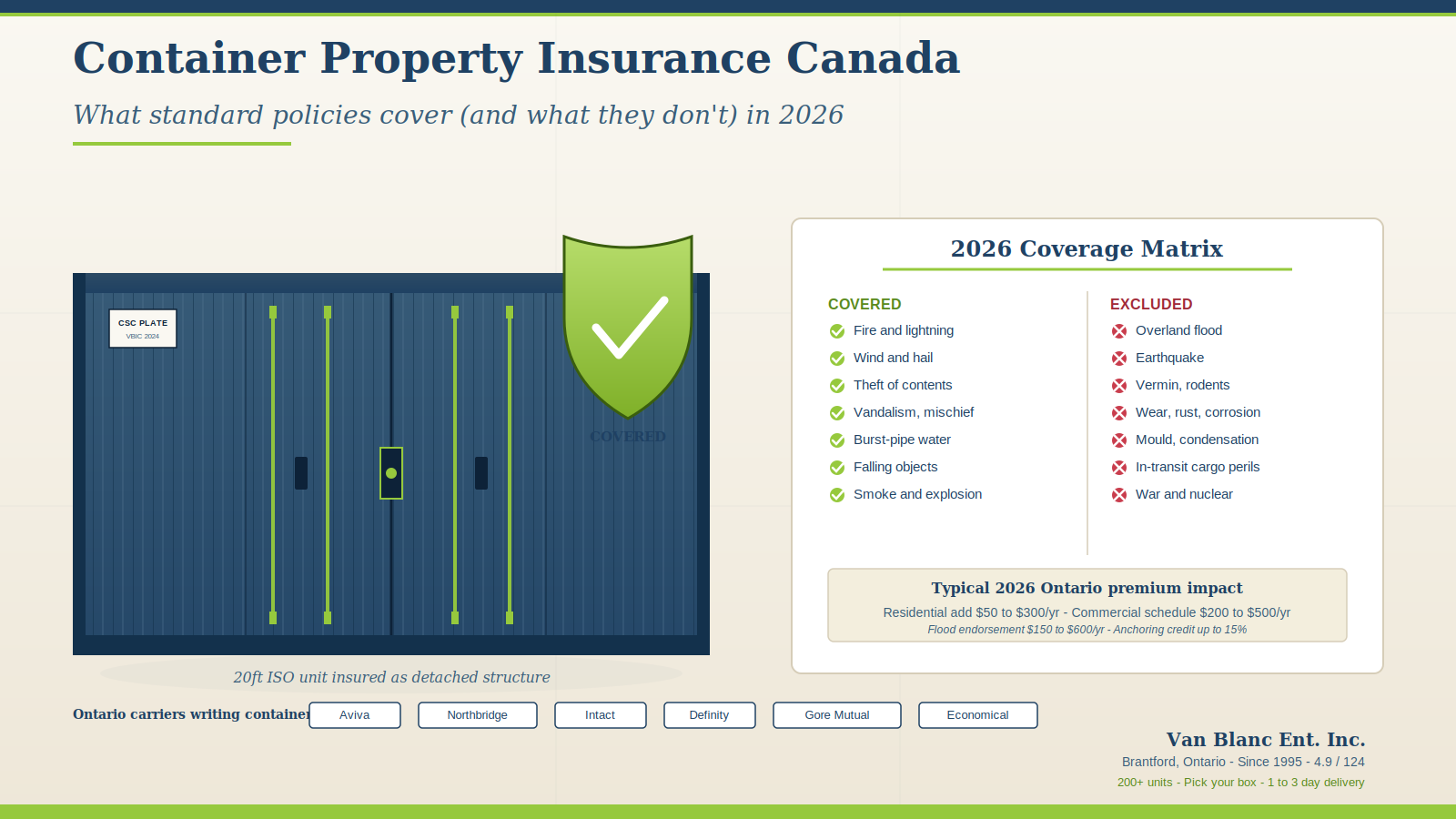
A standard Canadian property policy treats a shipping container on your land as a detached structure or business property and covers the container itself against common named perils (fire, wind, hail, lightning, vandalism, water from a burst pipe). Contents inside the container are covered separately under the personal property or business contents portion of the policy, subject to off-premise limits (typically ten percent of personal property on a homeowner policy) and a list of exclusions (flood, earthquake, vermin, gradual wear). Most Ontario buyers add the container by phoning the broker, describing the unit (size, value, contents, secured locking), and paying a modest premium increase. For high-value contents (tools, ATVs, restaurant inventory) you ask the broker for a contents endorsement or a separate inland marine schedule. Van Blanc holds 200 plus units across our four Brantford yards, ships in 1 to 3 days, and provides the certification documents that prove the unit is a real ISO container plus the invoice your insurer needs. Call 519-754-6844 to get the documentation you will need. Family-run since 1995, 4.9 stars across 140+ verified Google reviews. Delivery in 1-3 days from our 4 Brantford yards.
This guide is for an Ontario container buyer who has placed the unit on their land (residential lot, farm parcel, contractor yard, small commercial site) and now needs to add it to an insurance policy. The question is not whether you can insure the container (you can), but which part of the policy actually pays out, what counts as a covered peril, and how much the premium moves. Van Blanc has been in the container trade for roughly twenty years and has walked plenty of buyers through the documents a broker asks for at policy bind. None of what follows is regulated insurance advice; brokers and underwriters set the actual terms.
Does Standard Property Insurance Cover The Container Itself?
A standard property policy covers the shipping container itself as a detached structure on a homeowner policy or as scheduled business property on a commercial policy. The steel unit is insured against the policy’s covered perils once the broker has it listed. Tell the broker the container exists before any claim, and provide the documents the underwriter asks for.
Take a residential example. A homeowner places a 20ft shipping container on a gravel pad behind the house for tool and seasonal-gear storage. Under a standard Ontario homeowner policy the container reads as a detached structure, the same coverage category as a shed or a detached garage. Most standard policies cover detached structures up to ten percent of the dwelling Coverage A limit. On a typical Ontario home that detached-structure allowance runs into the tens of thousands, so the replacement cost of a used storage container fits easily inside that envelope.
Paul LeBlanc, who founded Van Blanc in 1995, puts the first step plainly: “The mistake we see is the buyer who parks the bin and never tells the broker it is there. Phone them the day it lands, send the plate photo, and the unit is on the policy. The bin nobody told the insurer about is the bin that does not get paid out.”
On the commercial side the framing is different but the answer is similar. A contractor with a yard policy lists the container as business personal property or as a yard structure on the schedule of locations. Commercial property carriers in the Ontario market (Aviva, Northbridge, Intact, Definity, Gore Mutual, Economical) all write policies that accommodate a shipping container as covered property, provided the unit is listed on the schedule and the underwriter has reviewed how it is anchored, locked, and used. If you are still choosing a unit, our guide to brand-new container stock covers the new versus used decision that shapes the replacement-cost figure on the policy.
The two practical steps for the container itself: (1) tell the broker the unit exists before any claim, and (2) provide the documentation the underwriter will ask for (CSC plate photo, purchase invoice from Van Blanc, photos showing the unit on site).
Are The Contents Inside The Container Covered Too?
Contents inside a shipping container are covered, but under a different part of the policy than the container shell, and that is where Ontario buyers get caught. Insuring the steel is the easy part; the belongings, tools, and stock inside follow the personal-property or business-contents rules. The default rules a residential underwriter applies:
- Off-premise personal property limit. Most homeowner policies cover personal property anywhere in the world up to ten percent of the personal property limit. A container behind the house is technically on the insured premises, but some carriers treat a detached structure beyond a set distance as off-premise. Confirm with the broker.
- Single-article limits. Standard policies cap single-article payouts on certain categories (jewellery, watches, fine art, business property at the residence). A container used for tool storage by a self-employed contractor may hit the business-property cap before the contents value is reached.
- Garaging and use. Contents that are part of a home-based business typically do not get full coverage under a residential policy. The fix is a commercial inland marine policy or a contractor tools floater.
On the commercial side, business contents inside the container fall under business personal property or stock-and-equipment coverage on the commercial policy. The schedule of locations needs to name the container address, and the underwriter will ask about lock specification (factory cargo door plus lock-box scores best) and whether the contents inventory is fixed or rotating.
Christian LeBlanc, second-generation operator: “Contractors tell me they have ten thousand dollars of tools in the container. I ask whether the commercial policy schedules ten thousand at that location. Half the time they have not added the container address yet. The wrong day to find out the contents are not on the schedule is after the break-in.”
Which Perils Are Covered: Fire, Wind, Hail, Water, And Vandalism?
A shipping container and its contents are typically covered against fire, wind, hail, water from named sources, and vandalism under a standard Canadian property policy. Canadian property policies fall into two structures: named-perils (the policy lists every covered peril) and all-risks (the policy covers all sudden accidental loss except the named exclusions). Most modern homeowner and commercial property policies are all-risks for the dwelling or building and named-perils or broad-form for personal property and contents. The named perils a container and its contents are typically covered against:
- Fire and lightning. A grass fire, wiring fire, or lightning strike that damages the container or contents is a covered loss. Steel containers resist fire well from outside (the corten skin holds up to about 600 degrees Celsius), but interior contents are vulnerable.
- Wind and hail. Ontario windstorm and hail damage to the container roof, paint, or roll-up door is covered. Corrugated steel takes hail with cosmetic dents that rarely rise to a claim, but a derecho-level event that bends a corner post is a covered loss.
- Vandalism and malicious mischief. Spray paint, broken locks, forced entry, smashed locking bars are covered under most policies. The policy deductible often eats a small repair, but a forced-entry break-in plus contents loss is a real claim.
- Theft. Theft of the contents from inside a properly locked container is covered. Theft of the container itself is rarer but covered. Anchoring with twist-locks to ground points reduces both the risk and the premium signal to the underwriter.
- Water damage from named sources. Burst-pipe water, accidental discharge from a plumbing fixture inside the container, or a covered roof leak from a wind event are all covered. Standing groundwater or flood is excluded (see next section).
- Falling objects, smoke, and explosion. Trees or debris falling on the container, smoke damage from a nearby fire, and explosion damage from a propane or vehicle fuel source are all covered.
The Insurance Bureau of Canada publishes consumer guidance on what residential and commercial property policies cover and most of the named perils above match its standard list. See our container buying in Canada guide for the broader purchase context that a buyer needs before the insurance conversation.
Which Perils Are Excluded: Flood, Earthquake, Vermin, And Wear?
Standard property policies on a shipping container exclude overland flood, earthquake, vermin and pest damage, and gradual wear such as rust and mould. These are the named exclusions that catch Ontario buyers off-guard:
- Overland flood. Standard homeowner and commercial property policies in Ontario do not cover overland flood (water from a river, lake, or storm sewer entering the property). Optional flood endorsement is available from most Canadian carriers, but the rider is a separate purchase and the buyer must elect it.
- Earthquake. Standard policies exclude earthquake. Optional endorsement is cheap in Ontario (low seismic risk) but is not on the policy by default.
- Vermin, rodents, insects, and birds. Mice chewing wiring, raccoons damaging contents, wasps building a nest in the door gasket are all excluded as gradual loss or pest damage.
- Wear and tear, rust, gradual deterioration. Rust on the floor, gasket failure from age, corrosion at corner posts is excluded as expected wear. A claim for a rusted-out floor is denied as wear, even if the failure causes contents damage.
- Mould and mildew. Most policies exclude mould unless it results from a covered water-damage event. Condensation inside an uninsulated container that grows mould over a season is not covered.
- War, terrorism, nuclear hazard, and cargo perils. Standard exclusions. A container in transit on a truck or ship is not covered by property insurance; cargo insurance is a separate product.
The flood exclusion is the one that costs Ontario buyers the most money in real claims. A container on a low-lying parcel during a storm-sewer backup or river overflow is not covered without the flood rider. For buyers in known flood-risk areas the rider is worth pricing.
How Do Commercial And Residential Container Policies Differ?
A commercial policy and a residential policy insure the same physical shipping container in different ways: a homeowner policy treats it as a detached structure rated as a percentage of the dwelling limit, while a commercial policy schedules it at a stated value with its own underwriting rules. The differences buyers should understand before they call the broker, at a glance:
| Coverage point | Residential (homeowner) policy | Commercial (yard / business) policy |
|---|---|---|
| How the container is rated | Detached structure, a percentage of the dwelling Coverage A limit | Scheduled location at a stated value you choose |
| Contents valuation basis | Usually replacement cost on personal property | Often actual cash value (replacement cost minus depreciation) unless upgraded |
| Co-insurance penalty | Rare on personal property | Common (often 80 to 90 percent); under-scheduling cuts the payout |
| Liability and income | Personal liability for injuries at the container | General liability scheduled separately; business interruption available |
| Underwriting questions | Size, value, contents category | Anchoring, lock spec, key access, fencing, cameras, inventory |
Broken out in full, the differences look like this:
- Coverage limits scale differently. A residential policy covers a detached structure as a percentage of the dwelling limit. A commercial policy schedules each location with a stated value. A buyer with a serious tool inventory needs the commercial schedule to carry that stated value, not a percentage of some other limit.
- Replacement cost versus actual cash value. Most modern residential policies cover personal property at replacement cost. Commercial contents are sometimes scheduled at actual cash value (replacement cost minus depreciation), which produces a smaller payout. Confirm which basis the policy uses.
- Co-insurance clauses. Commercial property policies often carry a co-insurance clause (typically 80 or 90 percent) that penalizes the insured if the scheduled value is below the actual replacement cost. A contractor who schedules only a fraction of the true tool value can collect just cents on the dollar after a partial loss. Schedule the real number.
- Business interruption and liability. A commercial policy can add business-interruption coverage that pays lost income while contents are being replaced. Residential policies carry personal liability for injuries at the container; commercial policies schedule general liability separately. Confirm both at policy bind.
- Underwriting questions. Commercial underwriters ask more: how is the unit anchored, what is the lock specification, who has key access, what is the contents inventory, is the site fenced, are there cameras. Residential underwriters typically ask only about unit size, value, and contents category.
The Aviva Canada commercial property line and the Northbridge Insurance transportation and yard-property lines both write Ontario container risks regularly. Intact, Definity, and Gore Mutual write the broader commercial market. The choice of carrier is the broker decision. The buyer decision is to have the conversation before the unit is on site, not after.
How Much Does Insuring A Container Move Your Premium?
The premium change for adding a shipping container to a property policy is usually modest, and what Ontario buyers report in 2026 tracks a handful of factors, many of the same ones that shape what you pay for the container itself. What drives it up or down:
- Residential add (homeowner policy, container as detached structure with routine contents): the smallest move of all. Some carriers add nothing if the container fits inside the existing detached-structure envelope and the contents are ordinary household and seasonal gear.
- Residential add with a high-value tools or business contents endorsement: a step up from the routine add, because the endorsement extends coverage past the standard caps.
- Commercial yard schedule (contractor with one container of tools and stock): a larger adjustment than either residential case, varying by carrier, anchoring, lock specification, and yard security.
- Anchoring and camera credit: some underwriters offer a premium credit of five to fifteen percent for documented anchoring (twist-locks to ground points) and surveillance with off-site recording, which pulls the number back down.
- Flood endorsement (high-risk parcel): an added rider cost for overland flood, varying by parcel risk grade. An earthquake endorsement adds very little in Ontario given the low seismic risk.
The math we walk through at the yard: the premium on a well-scheduled commercial container typically lands near one percent of the insured value, in line with normal Canadian commercial property rates. If the broker quotes meaningfully more, ask why. The common reasons are an unanchored unit, a remote site without security, or contents categories the carrier treats as higher-risk (alcohol, lithium battery inventory, fuel).
When Do High-Value Contents Need A Separate Endorsement?
High-value contents inside a shipping container need a separate endorsement or floater once their value passes the standard policy caps. The exact threshold is buyer-specific, but these are the rough lines we see:
- Tools inventory above the standard cap. A contractor needs a tools and equipment floater that names specific high-value items (mitre saws, generators, welding rigs) and pays replacement cost on a stated basis. Without the floater the contents land against the policy’s business-property cap, which is often far below what the tools are actually worth.
- ATVs, dirt bikes, snowmobiles, riding mowers. Motorized recreational vehicles or commercial equipment usually need a separate vehicle policy or off-road equipment endorsement. They do not ride on a homeowner contents schedule.
- Restaurant inventory, alcohol, resale stock. Refrigerated contents need a commercial spoilage endorsement. Liquor inventory is often capped low on a homeowner policy. Stock held for resale is business personal property and needs the commercial policy with the right business class.
- Firearms. Firearms have specific storage requirements under federal law and most carriers require a separate firearms endorsement or floater.
The conversation with the broker that prevents most coverage gaps is the inventory walk-through. The broker reads the schedule and the buyer talks through what is actually inside the container today (categories, dollar values, replacement basis, single-article values). Twenty minutes on the phone with the broker is the cheapest insurance you will buy. For container security context that affects the underwriting outcome see our container security and lock guide.
What Documentation Will The Underwriter Ask For?
The underwriter insuring a shipping container will ask for a CSC plate photo, a purchase invoice, site photos, a lock and anchoring statement, and a contents inventory. That is the exact folder we send buyers home with from the Van Blanc yard so the insurance file is ready:
- CSC plate photo. The CSC plate on the door-end carries the container serial number, year of manufacture, classification grade, and certification date. A close-up of the plate is the single most useful document for an underwriter (it proves the unit is a real ISO container, not a homemade box).
- Purchase invoice from Van Blanc. Date of sale, unit specification, sale price. This is the replacement-cost baseline.
- Site photos. Two or three photos showing the container in place on the property, doors closed, locks visible.
- Lock specification and anchoring statement. Describe the locking hardware (factory cargo door with welded lock-box and high-security padlock scores best). If the unit is anchored with twist-locks to ground points or a concrete pad, document it. Many commercial underwriters offer a credit for documented anchoring.
- Contents inventory. A categorized list (or photo set) of what is inside, with rough dollar values. The inventory is the basis for the contents schedule and proof-of-loss documentation after a claim.
- Maintenance log (commercial yards). Invoices for replaced gaskets, locks, or roof seals. The maintenance record disarms the wear-and-tear exclusion argument after a claim.
The buyer who walks into the broker meeting with this folder gets through underwriting in one phone call. See our container buying checklist guide for the broader buying-day documentation pattern, and our container as asset vs expense guide for how the same purchase invoice supports tax treatment.
Frequently Asked Questions: Container Property Insurance In Canada
Does my homeowner insurance automatically cover a shipping container in my backyard?
Usually yes for the container itself (as a detached structure under the Coverage B detached-structure limit) and partially for contents (subject to off-premise limits and single-article caps). Always phone the broker before the unit arrives and ask them to confirm in writing that the container is on the policy. Some carriers want a description and photos before they will confirm coverage. The wrong day to find out the unit is not on the policy is after a claim.
How much does it cost to add a shipping container to my insurance policy in Ontario?
In 2026 a residential add on a homeowner policy with routine contents is usually a modest premium increase, and adding a high-value contents or tools endorsement raises it a step further. A commercial yard policy with business contents scheduled costs more again, varying by carrier, anchoring, lock specification, and yard security. Anchoring and surveillance credits can reduce the commercial number by five to fifteen percent. Ask the broker for the exact figure on your policy.
Is theft of contents from a shipping container covered by my insurance?
Yes, theft is a standard covered peril on Canadian property policies, provided the unit was properly locked at the time of loss. Forced-entry theft (cut locks, pried locking bars) qualifies. The policy deductible still applies before any payout. High-value tools or inventory may need a separate contractor tools floater or inland marine schedule to reach full coverage rather than the standard business-property cap.
Is flood damage to a shipping container covered by standard property insurance?
No. Overland flood (water from rivers, lakes, or storm sewer backup) is excluded by standard Canadian homeowner and commercial property policies. Optional overland flood endorsement is available from most major Canadian carriers as a separate rider, priced according to the parcel’s flood risk. Buyers on low-lying or known flood-risk parcels should price the rider.
Will my insurance company require me to anchor the container?
Sometimes for commercial underwriters, rarely for residential. Anchoring (twist-locks to ground points or to a concrete pad) reduces theft risk and wind-uplift risk, and several Ontario commercial carriers offer a five to fifteen percent premium credit for documented anchoring. The credit usually exceeds the anchoring cost in year one. For residential buyers anchoring is recommended but not typically required.
What documentation will my insurance broker ask for when adding a container?
The standard ask is a CSC plate photo (proves the unit is a real ISO container with a serial number and certification date), a purchase invoice from the supplier (replacement-cost baseline), site photos showing the unit in place, a lock specification description, an anchoring statement if applicable, and a contents inventory with dollar values. Van Blanc provides the CSC plate photo and purchase invoice at the yard so the buyer leaves with the folder ready.
Do I need separate insurance if I run a home-based business out of the container?
Usually yes. Standard homeowner policies cap business property kept at the residence at a low limit and may exclude commercial activity entirely. A small home-business endorsement or a separate commercial general liability and business property policy is the fix. Talk to the broker about the activity (storage, light assembly, occasional client visits) so the policy is rated correctly. Misrepresenting business use on a residential policy can void coverage at claim time.
Does insurance cover damage from rust, mould, or condensation inside the container?
No. Rust, gradual corrosion, condensation, and mould are excluded as wear-and-tear or maintenance items. The exception is mould that results directly from a covered water-damage event (a burst pipe or covered roof leak), which is typically covered. To prevent condensation damage in an uninsulated container, ventilate, use desiccant, and consider closed-cell spray foam interior insulation that breaks the dew point at the wall surface.
Will my insurance pay to replace the container itself if it is destroyed by fire?
Yes, on a covered loss the container is paid out on the basis specified by the policy. Most residential detached-structure coverage is replacement cost (we buy you a new one). Some commercial schedules use actual cash value, which deducts depreciation. Confirm the basis at policy bind. The CSC plate photo and original purchase invoice from the yard are the documents that establish the replacement-cost number after a loss.
Why does Van Blanc give buyers the CSC plate photo and invoice at the yard?
Because every Ontario buyer who insures the container will need both documents within the first year. The CSC plate photo proves the unit is a certified ISO container with a real serial number and year of build. The invoice establishes the replacement-cost number for the policy schedule. We learned years ago that buyers were phoning us back weeks after delivery asking for those documents. Sending them home with the folder on the buying day saves the buyer a phone call and the broker a delay. It is the same reason we let buyers walk the row and pick the exact unit before any money moves: real documentation beats hopeful documentation, every time.
Sources
- Insurance Bureau of Canada. Home Insurance Coverage In Ontario: Standard Perils, Exclusions, And Endorsements.
- Aviva Canada. Comprehensive Business Insurance Solutions, Aviva Canada.
- Northbridge Insurance. Container Transportation Insurance, Northbridge Canada.
- Insurance Bureau of Canada. Overland Flood Insurance In Canada: Endorsement Options And Eligibility.
- Discover Containers. Shipping Container Home Insurance: Companies, Coverages, And Considerations.
- ALIGNED Insurance. Container Insurance Coverage Types For Canadian Operators.
- International Organization for Standardization. ISO 668: Series 1 Freight Containers, Classification, Dimensions And Ratings.
Related Reading
Buy from Van Blanc with the documentation your insurer needs
Standard 20ft and 40ft units ship from our four Brantford yards in 1 to 3 days, and every buyer leaves with the CSC plate photo and a purchase invoice ready for the broker file. Walk the row, read the CSC plate, inspect the gasket and lock-box mount, and pick the exact unit before any money moves. That is the pick-your-box rule, and it is the strongest scam-protection in the Ontario market.
Van Blanc Ent. Inc. | Brantford, Ontario | Call 519-754-6844 | Request your insurance-ready documentation
Ready to price your container?
Tell us the size and your postal code and we’ll send back an honest, all-in number, container, delivery, and placement, usually within 1-3 days. No pressure, no mystery fees.
Family-run in Brantford since 1995 · 200+ containers in stock · 4.9★ across 140+ Google reviews · every box graded by a person, walk it before it lands.