
We sell containers. We do not rent.
Van Blanc sells shipping containers outright. We do not rent, we do not lease, and we do not offer rent-to-own. Renting comes up on this page because buyers compare it against owning, and that comparison is worth reading, but purchase is the only arrangement we offer. Stocked units deliver from our Brantford yards in 1 to 3 days. Request a sale quote or call the yard at 519-754-6844.
for 2026
Last updated: May 25, 2026
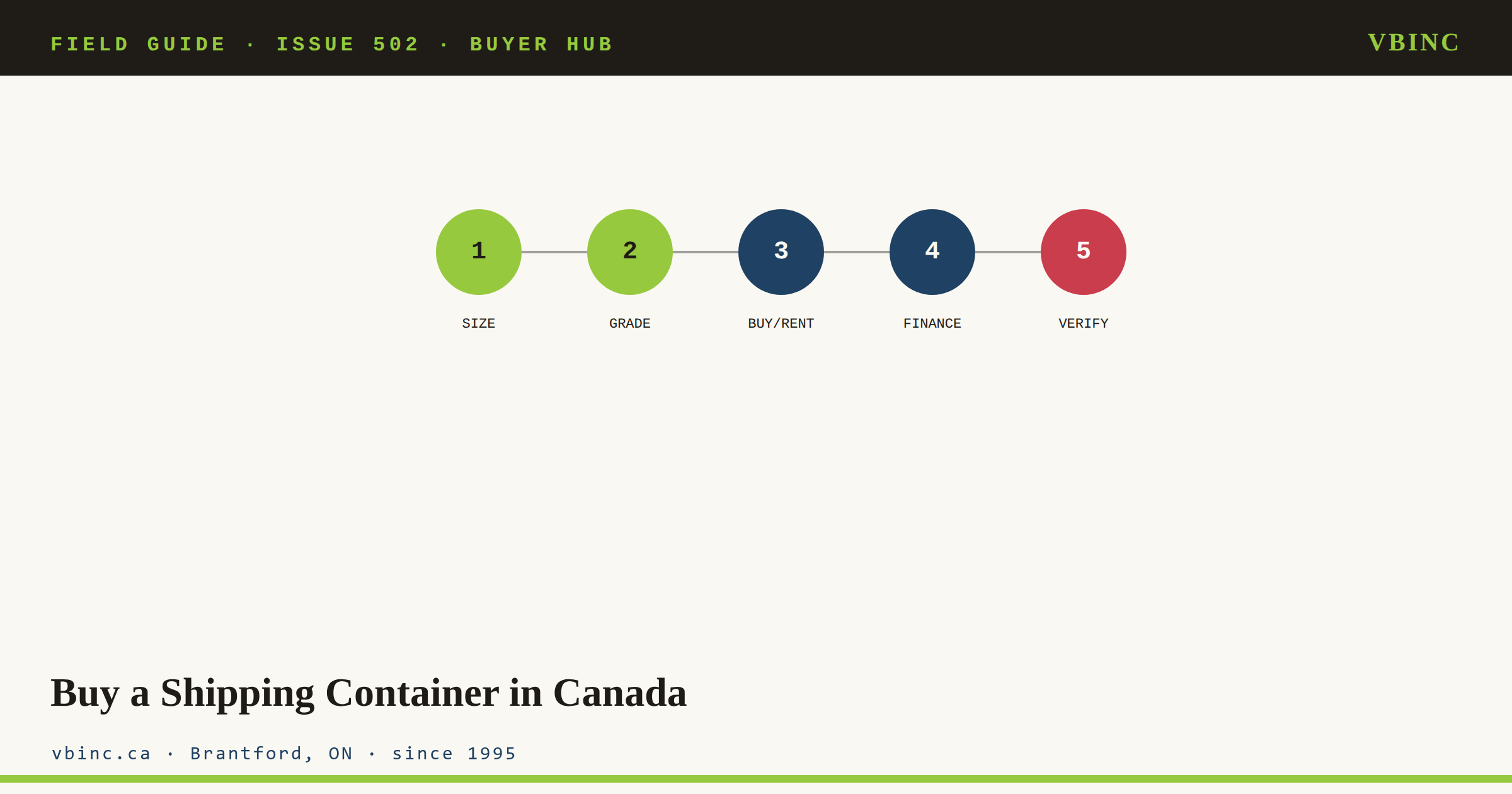
Quick answer. The Canadian Anti-Fraud Centre online-purchase fraud database logged a 38% YoY rise in heavy-goods scams (2023→2024), with shipping containers a recurring category. Buying a shipping container in Canada in 2026 means making five decisions in order: size (20ft vs 40ft vs 45ft vs 53ft vs reefer), grade (One-Trip vs Cargo Worthy vs Wind-and-Watertight), buy vs rent, cash vs financing, and supplier (verified yard vs unverified seller). What you pay moves with size, grade, delivery distance from Brantford, the season, and the global steel market, so a used 20ft sits well below a new 40ft High Cube reefer rather than at any single posted figure. The biggest risk is not price, it is wiring a deposit to a yard that does not exist. Real lead times and COD-honest pricing, quoted to your specific address – call us at 519-754-6844.
Buying a container in Canada is mostly a series of decisions, not a price comparison
Most first-time Canadian container buyers approach the purchase as if it were a commodity: open three browser tabs, compare prices, pick the cheapest. That framing produces the worst possible outcomes. The market does not work that way. The lowest price on a Canadian container listing is, almost without exception, a fraud listing where the deposit goes to a numbered company that closes within sixty days.
The buyers who end up satisfied take a different approach. They make five distinct decisions in order, and each decision narrows the supplier pool toward a sane purchase. This guide walks through each decision, links to the deep-dive article on our site that covers that decision in detail, and lands you at the supplier conversation properly prepared.
Van Blanc Ent. Inc. has been buying and selling shipping containers in Ontario since 1995. Paul started the business thirty years ago in Brantford. Christian, his son, runs day-to-day operations now. We have walked thousands of Canadian buyers through these five decisions on the phone and in person at our yards. The guide below reflects the conversations we actually have.
One thing worth clearing up before the decisions: the product has a pile of names, and buyers land on this page searching all of them. A shipping container is the same steel box whether you call it a sea can (the common Canadian term; the sea cans for sale page speaks it fluently), a conex (the old US military name), a steel storage container, or a metal storage container. When someone calls the Brantford yard asking for “steel box containers” or “metal storage containers,” they are describing the exact same ISO-standard units we sell as 20ft and 40ft dry boxes. The grade and size language below applies no matter which name you arrived with.
Decision 1: What size do you actually need?
The size question is the first commitment and the hardest to undo. Most first-time buyers default to 20ft because it is the size they have seen on a residential driveway. Most operations buyers default to 40ft because it is the size they have seen at industrial yards. Both defaults are sometimes right and sometimes wrong.
The honest size-decision questions: How much volume do you actually need to store (cubic feet, not vague impressions)? What is the longest single item you need to fit (a 40ft container’s interior is 39 feet 5 inches usable)? How tight is the delivery access at your property? Is there any chance you will need more storage in 2-3 years, where adding a second 20ft would be cleaner than upgrading to a 40ft? Will the container ever need to move?
For most Ontario residential and small-business storage buyers, a 20ft Cargo Worthy is the right answer. For working farms, contractors, and small-manufacturing operations, a 40ft Standard Dry or 40ft High Cube wins on cost-per-cubic-foot. For the buyer with a single large item or a need for the longest available secure span, a 45ft or 53ft High Cube exists. For refrigerated storage, the 20ft or 40ft HC reefer is its own category.
Decision 2: What grade do you need?
The grade question can change what you pay by half or more for the “same” 20ft container, because condition, CSC certification, and cosmetic wear all move the number. The three real grades on the Canadian market:
One-Trip (sometimes called “new”): single voyage from the manufacturer in China or Korea, essentially new condition. Clean exterior paint, no rust, fully functional door seals and gaskets. The premium grade. Right answer for high-visibility residential placement, presentation-conscious commercial use, and any conversion build where the box’s appearance matters to the final product.
Cargo Worthy (CW): CSC-plated and surveyable for ocean cargo. Sound structure, no leaks, intact seals, cosmetic wear consistent with normal freight use. The mid-grade. Right answer for most Canadian buyers most of the time – working storage, farm use, commercial backlot, hobby-farm equipment lockup.
Wind-and-Watertight (WWT): sound structure, no daylight, no leaks, but the exterior shows real cosmetic age (dings, surface rust, fading paint). The budget grade. Right answer for hidden placements (behind buildings, at the back of yards) where appearance does not matter and the box is doing pure storage work.
As-Is: the bottom tier. Sold as it stands, no warranty, may have holes in the roof or sides, may have floor damage, may have door operation issues, structural integrity not guaranteed. Right answer for buyers planning major modifications who are going to cut new openings anyway, for art and conversion projects where the box’s defects can be repaired or designed around, or for DIY buyers with welding capability who can fix issues themselves. Priced 30-50% below WWT. NOT the right answer for anyone who needs the container to actually keep weather out on day one without further work. We sell As-Is units honestly when they exist on the lot, with photos documenting the specific defects.
What does NOT exist as a real grade: “Used Like New,” “Refurbished,” “Premium Used,” and other marketing terms. If a seller uses these instead of One-Trip / Cargo Worthy / Wind-and-Watertight / As-Is, ask which of the four real grades the unit actually is.
Decision 3: Buy or rent?
The buy-vs-rent math is one of the most-asked Canadian container questions and almost always answered wrong by sales-driven content. The honest framing:
Look at a mobile-storage pod or a self-storage unit if your need is genuinely short-term (a few weeks) and pickup logistics are part of the value. Van Blanc does not rent. If the box will work for months or years but you cannot commit capital up front, a business can finance the purchase through its own bank or equipment financer, where a fixed monthly payment on a 20ft Wind-and-Watertight unit runs 24 or 36 months against a box it already owns, subject to the lender’s approval.
Buy if your need is longer than six months, if you have any chance of reselling the box later, or if the operational use is ongoing. The break-even point against a typical Ontario rental hits at roughly 18-24 months, after which buying is cheaper net even after eventual disposal cost. For most farm, business, and serious residential buyers, the math favours buying within the first two years of need.
The hidden third option: buy and resell at end-of-need. We buy back boxes regularly from customers whose operation changed. The discount from your purchase price reflects depreciation, transport back to Brantford, and refurb – typically 25-40% of original. For a 5-year buy-then-resell cycle, the net cost of secure on-site storage can approach zero.
Decision 4: Cash or financing?
The cash-vs-financing question becomes real once a purchase is large enough that paying outright would strain working capital. The Canadian options:
Cash (or debit / draft cheque / COD on delivery): the simplest path. Most Canadian container yards including ours accept payment on delivery via certified cheque or e-transfer. No interest. No paperwork. Lowest total cost.
Business line of credit: appropriate for working businesses with established banking relationships. Interest rates typically 6-9% in 2026, no asset securing required. Useful when the container is operationally productive (a contractor’s tool depot, a farm’s input storage).
BDC equipment loan: the Business Development Bank of Canada offers equipment financing that explicitly covers shipping containers as business equipment. Terms 5-7 years, rates often competitive with traditional banks, application process more involved but the loan-officer guidance is genuinely useful for first-time business buyers.
Credit union financing: smaller credit unions sometimes offer better rates than the Big Five banks for equipment purchases, particularly in rural Ontario where the credit union knows the local operating environment.
Rent-to-own: marketed heavily, math rarely favourable for the buyer. We have run the numbers on dozens of these arrangements over the years and the total cost typically exceeds straight purchase by 30-50% over the term. Use rent-to-own only if cash flow constraints genuinely prevent any other path, and read the full contract before signing.
Decision 5: Verified yard or unverified seller?
This is the decision that determines whether you receive a container at all. The Canadian container market in 2026 is split into two populations: real yards with physical inventory and accountable operators, and a sprawling shadow market of fraud listings on Facebook Marketplace, Kijiji, and Craigslist where the “seller” takes a deposit and disappears.
The fraud listings are easy to identify in retrospect and harder to identify upfront. The patterns: a price 50-70% below the real market floor (a 20ft listing priced far under what any verified yard could honestly deliver), urgency in messaging, requests for e-transfer deposit before any verification, photographs lifted from other yards’ inventory pages, phone numbers that are mobile-only and stop working after the deposit clears.
The verification check is simple. Ask for the seller’s physical yard address and CRA business number. Drive past the address on Google Maps street view. Call the phone number and ask how long it has been theirs. Search for the business name plus “review” – a real seller has reviews going back years; a fraud listing has no review trail. Ask for a specific unit serial number on the invoice. Any seller refusing those answers is not someone to send money to.
Van Blanc has been at 90 Morton Avenue East in Brantford since 1995. Two hundred containers on the ground. The phone number on the truck is the same one that has been in the family business for thirty years. The 4.9-star Google rating is built from 140-plus reviews going back six years. None of this is unique to us – any real Canadian container yard has equivalent verifiable history. The fraud listings have none of it.
Featured deep-dives for the buying decision
The articles below answer the five-decision sequence above in detail. Each one carries the operational story Paul and Christian have built up over thirty years of Ontario container deliveries.
Shipping Container For Sale Canada: 2026 Buying Guide
The canonical buying guide for Canadian shipping containers in 2026. Covers the full five-decision sequence with current pricing, the verified-supplier checklist, and the red flags that signal a fraud listing. The starting point for anyone serious about a first purchase.
How Much Does a Shipping Container Cost in Canada? 2026 Pricing Guide
The honest current pricing reality for every container size and grade combination in Canada. Includes the rent-vs-buy break-even math, regional delivery cost variations, and the real-market floor that fraud listings price below to look attractive.
First-Time Shipping Container Buyer Mistakes 2026
The decisions Canadian first-time buyers most often regret in the first 12 months. Covers wrong-size purchases, the grade-trap (buying below your actual need), placement mistakes that require expensive repositioning, and the financing decisions that look reasonable at signing but cost double over the term.
Cash vs Financing a Shipping Container in Canada: 2026 Honest Buyer’s Math
The real Canadian options for paying for a container purchase: cash on delivery, business line of credit, BDC equipment loan, credit union financing, and rent-to-own. Includes the interest-rate math at 2026 levels and the conditions under which each option actually makes sense for your operation.
our breakdown of used container inspection
The pre-purchase inspection checklist for used containers in Ontario. Covers door operation, gasket integrity, floor condition, roof seam inspection, the CSC plate read, and the cosmetic-vs-structural distinction that separates a Cargo Worthy from a Wind-and-Watertight unit. Also the scam-warning patterns specific to used-container listings.
The full container-buying spoke index
Every article in our container-buying cluster, grouped by the decision it answers. If you have a specific question, this is the fast path.
Pricing and cost reality
- How Much Does a Shipping Container Cost in Canada? 2026 Pricing Guide
- Shipping Container Cost in Ontario 2026: Complete Price Guide
- How Much Does a 40ft Shipping Container Cost in Canada?
- Shipping Container Cost by Size: Canada 2026
- Shipping Container Price Negotiation Ontario
Buying guides and process
- Shipping Container For Sale Canada: 2026 Buying Guide
- Sea Can For Sale Canada: 2026 Pricing + Buying Guide
- what buyers ask about container shopping
- Shipping Container Inspection Checklist Ontario: 10 Points Before You Buy
- Used Shipping Container Buying Guide: How to Inspect Before You Pay
- When to Walk Away From a Used Shipping Container
First-time buyer and avoiding mistakes
- First-Time Shipping Container Buyer Mistakes 2026
- First-Time Shipping Container Buyer Mistakes Ontario
Rental versus purchase decision
- Rent vs Buy a Shipping Container in Ontario: Total-Cost-of-Ownership Math
- Sea Can Rental vs Purchase Canada: 2026 Break-Even
- Shipping Container Rental Cost in Ontario: 2026 Monthly Rates and Terms
- Sea Cans for Rent in Ontario: 2026 Monthly Rates & Decision Guide
- Rent-to-Own Shipping Containers in Ontario: How It Works
Financing options
- Cash vs Financing a Shipping Container in Canada
- Shipping Container Financing Ontario: Loans, Lines of Credit, Equipment Lenders
- Shipping Container Business Line of Credit Ontario
- Shipping Container Credit Union Financing Ontario
- BDC Equipment Loan for Shipping Containers Canada
- Lease Buyout Shipping Container End-of-Term Canada
Specialized buyer types
- Small Business Container Buying Guide Canada 2026
- Contractor Container Bulk Discount Strategy Canada 2026
- Industrial Buyer Container Procurement Guide Canada 2026
- Rental Fleet Business Container Buying Canada 2026
- Government RFP Shipping Container Procurement Canada
- Non-Profit Charity Container Procurement Canada 2026
What customers actually say
“We bought 2 containers from them and the service and the whole process from quote to delivery and every process in between was really easy. There was no stress at all. We called to other places and there are a lot of scammers out there. VB is the best around and the most honest.”
– Jodi M., May 2024, Google review
The “we called to other places” pattern shows up in dozens of our customer reviews. Canadian container buyers do their research first, encounter fraud listings, then call us. The reviews then say what surfaced after the call: the supplier was verifiable, the quote was honest, the delivery happened on schedule, and the box arrived as described. That is the buying-process pattern we have built the business.
Frequently asked questions about buying a shipping container in Canada
How much does a shipping container cost in Canada in 2026?
There is no single sticker number, because the delivered Ontario price moves with size, grade, your distance from Brantford, the season, and the global steel market. As a rule of thumb, a Wind-and-Watertight 20ft is the budget end, a Cargo Worthy 20ft sits in the middle, and a One-Trip (near-new) 20ft is the premium. A 40ft costs more than a 20ft of the same grade, and refrigerated units carry the highest premium of all. The honest way to get a real figure is a quote to your exact address and spec, and any listing priced far below the verified-yard range is almost certainly a fraud listing.
What size shipping container should I buy?
For most residential, hobby-farm, and small-business storage, a 20ft is the right starting point. For working operations, contractors, and farms with significant equipment, a 40ft is usually the better cost-per-cubic-foot. The honest size question is not what is biggest available but what will serve your real need without leaving expensive empty volume.
What grade of container should I buy?
Four real grades on the Canadian market. For most Canadian buyers most of the time, Cargo Worthy (CW) is the right grade – CSC-plated, surveyable for ocean cargo, sound structure with intact seals. One-Trip is the right answer for high-visibility placements and conversion builds. Wind-and-Watertight is the budget grade for hidden working storage where appearance does not matter. As-Is is the bottom tier (sold without warranty, may have damage) and is only right for buyers planning major modifications or DIY repair.
Is it better to buy or rent a shipping container?
Rent if your need is genuinely under six months. Buy if your need is longer than six months, you have any chance of reselling later, or the operational use is ongoing. The break-even against a typical Ontario monthly rental hits around 18-24 months. For most working farms, businesses, and serious residential buyers, the math favours buying.
How can I avoid shipping container scams in Canada?
The single defence: ask for the seller’s physical yard address and visit it or verify via Google Maps street view. Real Canadian sellers have a physical yard with inventory you can walk through. Ask for the CRA business number, the phone number’s history, the years of review history. Ask for a specific unit serial number on the invoice. Any seller refusing these answers is not someone to send a deposit to.
What financing options exist for shipping containers in Canada?
Five real options: cash or COD on delivery (simplest, lowest total cost), business line of credit (6-9% rates in 2026, no asset securing), BDC equipment loan (5-7 year terms specifically covering shipping containers), credit union financing (sometimes better rates than the Big Five for equipment), and rent-to-own (usually the worst math for the buyer). For most working business buyers, cash or business line of credit are the practical paths.
Can I inspect a shipping container before I buy it?
Yes, and you should. Real Canadian yards welcome buyer visits. At our Brantford yard we have roughly two hundred containers on the ground at any time and customers regularly walk through them, read the CSC plate on specific units, and pick the exact serial number that goes on their invoice. Any seller who refuses an in-person inspection is signalling the inventory does not exist.
What is the difference between One-Trip, Cargo Worthy, and Wind-and-Watertight?
Three real grades with real condition differences. One-Trip is single voyage from manufacturer, essentially new. Cargo Worthy is CSC-plated and surveyable for ocean cargo, mid-grade condition. Wind-and-Watertight is sound structure with no leaks but cosmetic exterior age. Marketing terms like “refurbished” or “premium used” are not real grades – ask which of the three real categories the unit belongs to.
How long does container delivery take in Ontario?
One to three business days from confirmed order is standard for most Ontario destinations. Brantford-area deliveries can sometimes happen same-day. Longer hauls (Northern Ontario, Eastern Ontario, Essex County) typically run two to three business days. The delivery is the easy part. The harder part for most buyers is selecting the right unit and grade upfront.
Can I sell the container back if my needs change?
Yes, often. If the unit is in serviceable condition, we quote a buyback price reflecting depreciation, transport back to Brantford, and any refurb required. The result is usually 25-40% of original purchase price for a unit that has been used 3-5 years. For longer-tenure customers the buyback math can make the net cost of ownership remarkably low.
Do you have used sea cans for sale in Ontario?
Yes. We stock used sea cans (used steel boxes and metal storage containers) in Cargo Worthy, Wind-and-Watertight, and As-Is grades at our Brantford yard, in 20ft and 40ft sizes. The right used grade depends on whether the box will be inspected or shipped (Cargo Worthy), sit stationary as weather-tight storage (Wind-and-Watertight), or be modified heavily (As-Is). Used availability changes with the stock on the ground, so call 519-754-6844 or submit a quote request at /contact-us/ for what is on the lot today and an honest delivered price.
Used sea cans for sale in Ontario: what is actually on the lot
When buyers search “used sea can for sale,” they want three honest answers: which grades exist, what to check before paying, and how to buy without getting burned. Here is the short version, with the deeper inspection detail linked where it lives. A used sea can (a used steel box or metal storage container, same thing) is simply a shipping container that has finished its ocean-freight life and been graded for a second career on Ontario land.
On a used steel box, three real grades show up on our Brantford lot, and the right one depends on the job, not just the budget:
- Cargo Worthy (CW): used, but re-inspected and CSC-plated for ocean cargo. Sound frame, intact seals, honest cosmetic wear. The grade most Ontario buyers pick when they want a used metal storage container that will still pass a survey.
- Wind-and-Watertight (WWT): used and sealed against weather, no daylight and no leaks, but more surface rust and dings and an expired CSC plate. The value pick for stationary storage on a farm, a back lot, or behind a building where appearance does not matter.
- As-Is: the clearance tier, sold exactly as it stands with the specific defects documented in photos. Right only for buyers planning heavy modification, cladding stock, or a donor box, never for someone who needs the unit weather-tight on day one.
What to check before you buy a used sea can, in the order that matters: read the CSC plate inside the door to confirm the grade and inspection history; open and close both doors to feel the gasket seal and hinge swing; step inside and check the floor for soft spots, rot, or rust-through; and look up at the roof and seams for patches or pooling. Surface rust on the panels is normal on any used box and is cosmetic; a soft floor or a roof that has been patched badly is structural and changes what the unit is worth. The full point-by-point walk-through lives in our new vs used shipping container guide, which explains all four grades and how to read a CSC plate properly.
How to buy is the easy part. Tell us your size, your grade, and your delivery address, and we quote the real number for your spec and your distance from Brantford. Used pricing moves with grade, age, and the live stock on the ground, so we do not publish a fixed figure that would be wrong by the time you call. You can also walk the rows yourself at 90 Morton Avenue East and pick the exact serial number that goes on your invoice, the same way customers have done here since 1995. Call 519-754-6844 or submit a quote request at /contact-us/ for current used sea can availability and an honest delivered price. To see the specific units and sizes we stock, browse our container options.
Ready to buy? See current inventory or get a quote
The five decisions above land you at the supplier conversation properly prepared. If your decisions point toward a 20ft Cargo Worthy for residential storage, or a 40ft Standard Dry for farm equipment, or a 45ft High Cube for a contractor’s mobile depot, or any reefer for cold-chain use, the current Van Blanc inventory shows what is on the ground today.
Browse our full catalog: Shipping Containers For Sale. Or jump directly to the size you have decided on: 20ft Standard Dry, 40ft Standard Dry, 40ft High Cube, 45ft High Cube, 53ft High Cube, 20ft Refrigerated, or 40ft High Cube Refrigerated.
If you want to talk through the decisions before committing, call us. Phone is 519-754-6844 or toll-free 1-888-509-6658. Paul and Christian are usually both on site at the Brantford yard, Monday to Thursday 9:30 AM to 5 PM, Friday 9:30 AM to 4 PM. 90 Morton Avenue East, Unit 1-B, Brantford, Ontario, N3R 7J7.
Where Van Blanc delivers across Ontario
Buyers drive to our Brantford yard from right across the province. We deliver from our four Brantford yards to communities right across the province, including Mississauga, Kitchener, London, Barrie, Oshawa and Brantford. See the full Ontario service-area map to find your town.
Ready to price your container?
Tell us the size and your postal code and we’ll send back an honest, all-in number, container, delivery, and placement, usually within 1-3 days. No pressure, no mystery fees.
Family-run in Brantford since 1995 · 200+ containers in stock · 4.9★ across 140+ Google reviews · every box graded by a person, walk it before it lands.
Where Canadians Actually Buy Containers
Every container in the country reaches its buyer through one of six channels, and knowing which one you are standing in explains the price and the risk. Direct yards like ours own inventory you can walk. National dealers sell the same steel through a sales office and a freight partner. Brokers sell containers they have never seen, which works until a grading dispute starts. Auction platforms move port surplus with no recourse and no inspection. Classifieds are a mixed market that rewards the careful. And social marketplaces are, in 2026, the scam channel often enough that we wrote a separate field guide for them. None of this is a sales pitch for one channel: it is the map we wish every first-time buyer had before the deposit conversation.
Honest comparisons and reviews
Choosing between renting and owning, or comparing suppliers? We lay it out honestly.
Sources & References
Authoritative external sources cited or referenced in this guide: