
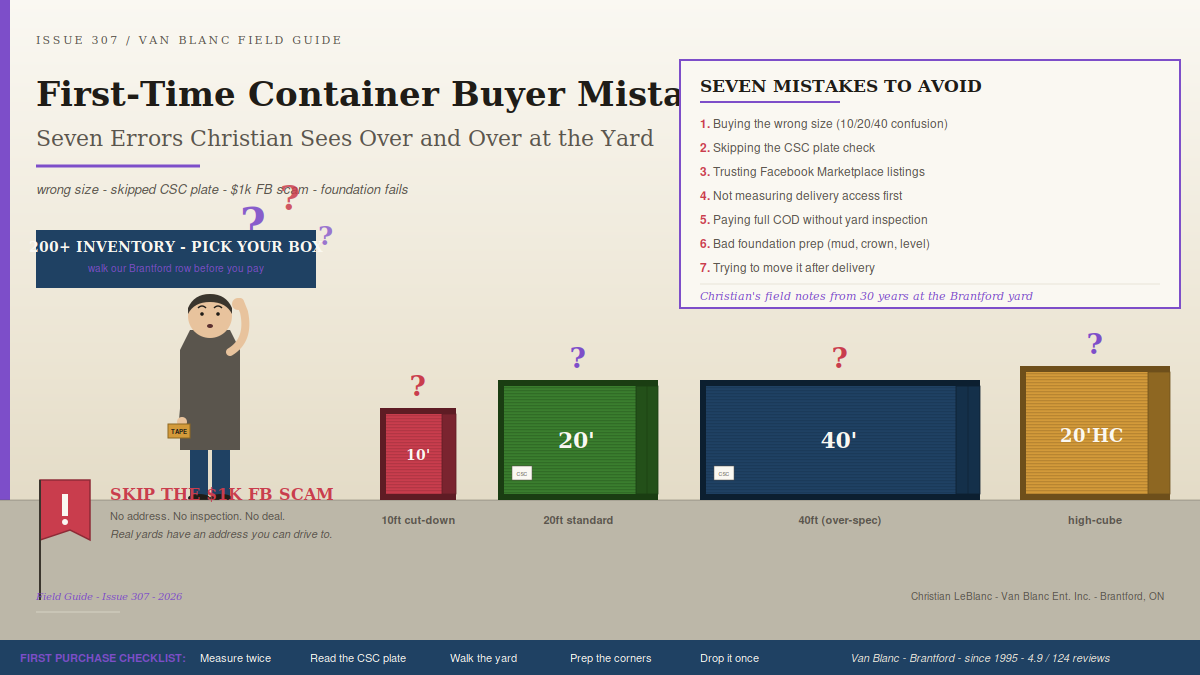
Quick Answer: The three mistakes Christian sees most often at the Van Blanc yard from first-time Canadian container buyers are buying the wrong size for the use case (a 10ft when the job needed a 20ft, a 40ft when the driveway only fits 20ft), skipping the CSC plate and gasket inspection before paying (which is how passed-survey and door-leak units get sold sight-unseen), and trusting a Facebook Marketplace listing with no physical yard address (the take-the-deposit-and-disappear scam pattern that hit Ontario buyers hard in 2025 and 2026). The seven full mistakes also cover delivery access, payment terms, foundation prep, and the post-delivery move-it problem. Buyers walk our 200+ inventory in Brantford and read each CSC plate before paying. Real 1-3 day lead time, not a hopeful one. Tell us your delivery address and we will quote real costs, no anchored numbers, just the delivered figure.
In This First-Time Buyer Field Guide
- What Size Shipping Container Should a First-Time Buyer Get?
- What Should You Check on a CSC Plate Before Paying?
- How Do You Spot a Fake Facebook Marketplace Container Listing?
- How Much Delivery Access Does a Shipping Container Need?
- Should You Pay COD Without Inspecting the Container First?
- What Foundation Does a Shipping Container Need in Ontario?
- Can You Move a Shipping Container After It Is Delivered?
- Why Does the Facebook Container Scam Target First-Time Buyers?
- First-Time Buyer FAQs (10)
- Inspect at Our Brantford Yard Before You Pay
Reading time: about 20 minutes. This is the first-time-buyer mistakes spoke. If you are still mapping out the whole purchase, our walk-through of how to buy a container without getting burned frames the broader decision; if you are weighing how to pay for it, the breakdown of paying up front versus spreading the cost out covers that question.
What Size Shipping Container Should a First-Time Buyer Get?
Most first-time buyers should match the container size to the cubic volume of what they are actually storing, not to instinct. A 20ft container holds roughly 33 cubic metres and suits most residential and small-commercial jobs. A 40ft holds about 67 cubic metres and earns its keep only when the use case actually fills it. A 10ft cut-down fits tight lots but costs the most per cubic foot.
Container sizing is where first-time buyers go wrong most often, and in our 30 years selling containers across Ontario, the single most common mistake is picking the wrong size on the first call. The 10ft, 20ft, and 40ft footprints are not interchangeable, and the cost of getting it wrong is rarely the container itself. It is the second delivery, the second yard trip, and the lost time waiting for the right unit to come available.
Standard ISO dimensions are fixed and worth knowing before you call any supplier. A 20-footer measures 6.06 m long, 2.44 m wide, and 2.59 m tall, with roughly 33 cubic metres of internal cube and a payload of 28,200 kg. A 40-footer doubles the length to 12.19 m, holding roughly 67 cubic metres of cube and a similar payload (the limit is not weight, it is volume). A 10-footer is the half-size: 2.99 m long, useful for tight residential properties and small commercial back-of-house but limited to 16 cubic metres of cube. High-cube units add a foot of vertical height on either 20ft or 40ft.
| Footprint | External length | Internal cube | Straight-line swing space to deliver | Best first-time use case |
|---|---|---|---|---|
| 10ft (cut-down) | 2.99 m | ~16 m³ | ~50 ft | Tight lots and small back-of-house storage |
| 20ft standard | 6.06 m | ~33 m³ | ~60 ft | Most residential and small-commercial jobs |
| 40ft standard | 12.19 m | ~67 m³ | 100 to 110 ft | High-volume storage that fills the box |
The mistake is rarely choosing too small. First-time buyers almost always over-spec on length. The instinct is to buy the bigger box “just in case,” which sounds rational until the buyer realizes the bigger box costs more to buy and deliver, takes 100 to 110 feet of straight-line swing space to deliver (vs 60 feet for a 20ft), and never fills up because the use case did not need that much cube.
Christian LeBlanc, second-generation operator: “I had a homeowner in Cambridge last fall who insisted on a 40-foot because his neighbour had one. His use case was lawn equipment, two snowmobiles, and a workbench. He needed a 20-foot at most. We ran him through the math: a 40-foot at his place would have cost him noticeably more, eaten 110 feet of his back yard, and never been more than half full. He took the 20-foot. Six months later he texted me a picture of it half-empty. The buyer who says ‘go bigger to be safe’ is almost always the buyer who pays for cube they never use.”
The other size mistake runs the opposite direction: buying a 10-footer because the website price is cheapest. 10-footers are not standard ISO production and they are surprisingly hard to source in volume. Most 10-foot units in the Ontario market are cut-downs: a 20-foot or 40-foot container that has been shortened in a fabrication shop, with a new end wall welded in place. Cut-down 10s are perfectly serviceable for static storage, but the per-cubic-foot cost is roughly 60 to 80 percent higher than a 20ft because the labour to shorten is fixed regardless of the donor unit. If your use case is more than 12 cubic metres of cube, the 20ft is almost always the better value.
If you want to see what a single 20-footer can actually swallow before you commit, we walk through the jobs that footprint handles well, and the same exercise for the larger box covers what drives the cost of doubling your length. For the half-size unit specifically, we cover when shortening down to ten feet is worth the premium and when it is not.
What Should You Check on a CSC Plate Before Paying?
The CSC plate is the second thing first-time buyers skip, and skipping it is how passed-survey units get sold at cargo-worthy prices. The Convention for Safe Containers (CSC), administered by the International Maritime Organization, requires every container that moves in international cargo trade to carry a CSC safety-approval plate, embossed and bolted to the left-hand cargo door. The plate lists the manufacturer, build date, max gross weight, stacking strength, racking strength, and the next examination date. Two routes keep that plate valid: the Periodic Examination Scheme (PES) with surveys every 30 months, or an Approved Continuous Examination Program (ACEP) tied to a fleet operator. The Bureau International des Containers et du Transport Intermodal (BIC) maintains the global database.
Here is what first-time buyers miss: the CSC plate is not just a customs document, it is a structural-integrity record. A unit with a passed examination date is not automatically scrap, but it cannot legally re-enter international cargo trade until re-surveyed, and the price has to reflect that. The same unit sold as “Cargo-Worthy” with a current CSC plate is worth more than the same unit sold as “Wind-and-Watertight” with a passed plate. First-time buyers who pay the CW price for a passed-CSC unit are overpaying by exactly that delta.
The Convention for Safe Containers requires the plate to be embossed or stamped into the metal, never printed or stickered. A printed plate is either a replacement that has not yet been certified or a fraud. BIC flags printed plates as the single clearest forgery signal.
What to Read on a CSC Plate Before You Pay
Walk to the left-hand cargo door and find the rectangular plate. Read in this order: (1) manufacturer name and country (CIMC, Singamas, Maersk Container Industry are the common builders), (2) build date (look for “Date Manufactured” or “Year of Manufacture”), (3) max gross weight in kg, (4) next examination date (this is the NED line, often shown as a month-and-year stamp), (5) the ACEP number or PES inspector mark. If any line is missing, faded beyond reading, or printed rather than embossed, the unit is being sold outside the CSC framework. That is fine for static storage, but it should be priced as WWT or As-Is, not Cargo-Worthy.
The BIC combined-data-plate explainer walks through what each line means and is worth reading before any first purchase. The five-minute plate check at the yard is the single highest-value step in the inspection process: it tells the buyer whether the price they are being quoted matches the grade they are actually buying.
For the full inspection sequence (CSC plate, gaskets, lockbox, floor, roof, corner castings, exterior walls), we lay out every item to check, in the order a seasoned buyer runs them. To understand why a passed plate drops a box from one grade to the next, read what the cargo-worthy label really certifies.
How Do You Spot a Fake Facebook Marketplace Container Listing?
A fake Facebook Marketplace container listing is spotted by five tells: a price well under the Ontario market, no physical yard address, a demand for e-transfer before inspection, photos that reverse-search to another company, and a profile younger than six months. The single biggest financial mistake first-time buyers make in 2026 is paying a Facebook Marketplace deposit to a seller who does not own a physical yard. The pattern is documented, it is consistent across Ontario, and it has hit Toronto, Hamilton, Ottawa, Kitchener-Waterloo, and London buyers in the last 18 months for losses that range from a single deposit to the full purchase amount per incident.
How it works: A Facebook profile less than six months old posts a listing for a 20ft or 40ft shipping container at a price below the going Ontario rate. The photos are professional. The “company name” sounds plausible. The seller insists on e-transfer or wire deposit before any inspection. The seller refuses to share a physical address that the buyer can drive to. The seller has stolen photos and content from a legitimate container company’s website (several established Ontario suppliers have had their photos lifted). Once the buyer transfers the deposit, the listing disappears, the Facebook profile blocks the buyer, and the money is gone. CBC News documented the same pattern in its 2020 coverage, and supplier fraud alerts across Ontario repeat it.
The five signals to check on any container listing, in any Canadian province, in any market:
- Below-market pricing. If the listing sits well under the going Ontario rate for that grade, that is the first red flag. Real yards do not undercut by 25 percent because they cannot.
- No physical yard address. Ask: “What is the address of your yard? I would like to walk the inventory before paying.” A real yard answers immediately. A scammer redirects to “we will deliver, no need to visit.”
- Wire or e-transfer demanded before inspection. Real yards take a deposit by e-transfer or credit card, but they let buyers inspect first. A seller who refuses inspection is a scammer.
- Reverse-image search hits. Right-click any container photo in the listing and run a reverse image search on Google or TinEye. If the same photo appears on another company’s website, the listing is using stolen content.
- Young Facebook profile. Click the seller’s profile. If the page was created less than six months ago, has fewer than 50 followers, or has no posts before the container listing, the profile is a throwaway.
Christian LeBlanc, second-generation operator: “We get a call almost every week from someone in Ontario who already sent the deposit and now cannot reach the seller. By the time they call us, the money is gone. I tell them the same thing every time: there is no legitimate container yard in this province that operates without a physical address. We have been here since 1995. We have 200-plus units in our Brantford yard. Anyone who refuses to let you walk the row before paying is selling you nothing.”
Supplier fraud alerts across Ontario cover the same pattern with their own field examples, and the original wave dates back to 2020 and has only grown since. The pattern has not changed in five years because it works on first-time buyers who do not know what a real yard looks like.
How Much Delivery Access Does a Shipping Container Need?
Delivery access for a tilt-deck drop needs three measured clearances: 60 feet of straight-line swing space for a 20ft (100 to 110 feet for a 40ft), 16 feet of overhead clearance, and 14 feet of lane width at the narrowest pinch point. The fourth mistake costs less money than the Facebook scam, but it costs more time. First-time buyers regularly order a container without measuring the delivery route, and the truck arrives to find the access is wrong. The driver either tries the drop and gets stuck (which exposes the buyer to tow-truck and re-delivery fees) or refuses the drop and leaves with the container still on the deck (which means a re-delivery fee and another 1 to 3 business day wait).
The numbers, written down, before you order anything: A tilt-deck trailer carrying a 20ft container needs 60 feet of straight-line clearance from the back of the truck to the final container rest position, plus 16 feet of overhead clearance, plus 14 feet of lane width at the narrowest pinch point. For a 40ft container, those numbers grow to 100 to 110 feet of clearance and the same overhead and lane width minimums. HIAB crane delivery needs less straight-line room because the swing arm reaches over obstacles, but it carries a higher delivery rate than a tilt-deck drop.
What goes wrong is rarely the math. It is the corner. The driveway looks fine on Google satellite view and turns out to have a parked truck, a hydro pole, or a tree branch at the pinch. A tilt-deck driver who cannot make the turn at 14 feet of effective width will not attempt the drop. The cost of a stuck truck on a residential street is not on the supplier; it is on the buyer who ordered without measuring.
The 10-Minute Access Check Before You Order
Walk the route at the same time of day the truck will arrive. Bring a tape measure, not just your eye. Check: narrowest lane width at the pinch (you need 14 feet for a tilt-deck, no exceptions), overhead obstacles below 16 feet (wires, branches, archways, awnings, garage doors), straight-line swing space from the truck’s drop position to the final container spot (60 feet for 20ft, 110 feet for 40ft), ground composition (compacted gravel, asphalt, or concrete pass; soft soil and wet grass fail), and turning radius at the entry to your property (a 53-foot tractor-trailer needs a wide enough sweep to enter without crossing the curb). Send us photos of all four points before booking, and we will give you a yes-no answer the same day.
For the deeper engineering walk-through of how a tilt-deck trailer sets the box down, see how the drop actually works step by step. When a site fails that clearance check, we explain when reaching over the obstacle with a crane is the smarter call. And for properties out past the pavement, we cover getting a truck down a soft farm lane or a gated concession road.
Should You Pay COD Without Inspecting the Container First?
Paying cash-on-delivery for a container you have never seen is the fifth mistake, and the answer is no whenever you can avoid it, because the unit a dispatcher assigns from a holding pool is not always the unit you pictured. The fifth mistake is paying cash-on-delivery for the full container price without ever inspecting the actual unit. This is different from the Facebook scam: the seller is legitimate, the yard exists, the container will arrive. The problem is that the specific unit on the truck is not always the unit the buyer pictured.
Many large suppliers dispatch from holding pools rather than picking yards. The buyer sees photos of “a 20-foot Cargo-Worthy unit” on the website, places an order, pays the deposit, and the dispatcher assigns whichever 20ft CW unit happens to be the next available in the pool. The unit that arrives might match the photo or it might be a different unit with a passed CSC date, a dented end wall, or a corner casting that has been welded back together. The buyer sees the unit for the first time when the tilt-deck driver pulls up to their property. Buyers who want the cleanest possible box avoid the lottery entirely by ordering a factory-built unit on its first and only loaded voyage, where the industry term is one-trip and the handling marks are minor and pointed out in the yard.
At that point, the buyer has two bad options. Option one: refuse the delivery, pay the failed-delivery fee, and wait another 1 to 3 days for the next attempt. Option two: accept the unit, pay the COD balance, and live with whatever showed up. Most buyers, having already committed mentally to the delivery, take option two and discover the problems later.
The alternative is to inspect the actual unit in the actual yard before any money changes hands. Van Blanc lets buyers walk our 200-plus container inventory in Brantford, read each CSC plate, push on the gaskets, turn the lockbox keys, and pick the specific box that is going on the truck. The drive is 60 to 120 minutes from most Southern Ontario population centres on the 401, 403, or QEW. The cost of a wrong unit on a purchase is too high to skip the yard visit.
Christian LeBlanc, second-generation operator: “Anyone who tells you ‘you do not need to come see it, we will pick a good one’ is asking you to trust their dispatcher’s definition of ‘good.’ Our definition and theirs are not always the same. The trip to our yard is the cheapest insurance policy on the entire purchase. Buyers who walk our row pick a better unit, every time, than buyers who buy sight-unseen. That has been true for 30 years and it is still true.”
For the full hands-on routine (CSC plate, gaskets, lockbox, floor, roof, corner castings, exterior dents, door cam-rod movement), we hand you the same point-by-point list our yard staff run on a twenty-footer. Even buyers who cannot drive to the yard should at minimum demand 6 to 8 specific photos of the unit they are to receive, including the CSC plate, both door faces, all four corners, the roof, and the interior floor.
What Foundation Does a Shipping Container Need in Ontario?
A shipping container foundation only has to carry four points, because the four corner castings take the entire load, not the bottom rails. For short-term static storage, patio blocks or compacted gravel under each corner are enough; for permanent placement through Ontario freeze-thaw, sonotube piers below the frost line keep the doors square. A 20ft shipping container weighs roughly 2,300 kg empty and loads up to 28,200 kg gross. A 40ft weighs roughly 3,800 kg empty and loads up to 30,480 kg gross. All of that weight sits on four corner castings, not on the bottom rails. The mistake first-time buyers make is treating the container like it sits on its whole floor: it does not. The four corner castings are 7 inches by 7 inches each, and they are where every newton of load concentrates.
What goes wrong with bad foundation prep, in roughly the order it happens:
Soft soil settlement. If the container is dropped on bare grass, packed clay, or wet topsoil, the four corner castings will sink into the ground unevenly over the first six to twelve months. Spring thaw is the worst event: the ground softens, the casting on the wetter corner drops half an inch, the container racks slightly, and the cargo doors no longer line up at the bottom. Buyers discover this in April when they cannot close the doors anymore.
Crown and slope. A driveway with a 2-percent crown (normal for water drainage) is fine for a vehicle but problematic for a container. If the four corners are not co-planar, the racking forces concentrate at the high-corner casting and the door frame slowly twists. The fix is to shim the low corners with steel plates or compacted gravel under each casting at delivery, not after the fact.
Frost heave. In Ontario, frost line runs roughly 1.2 m (4 feet) below grade. A container sitting on bare ground without footings will lift and drop with the freeze-thaw cycle. Multi-year placement requires either concrete sonotubes at each corner driven below the frost line, or a continuous compacted gravel pad at least 6 inches thick over a permeable base.
Practical Foundation Minimums by Use
Short-term static storage (under 12 months): Four 16×16 inch patio blocks or 4 inches of compacted 3/4″ crushed limestone under each corner casting. This is the lightest, lowest-effort prep and uses only off-the-shelf materials. Permanent placement (multi-year): Four concrete sonotubes (8 inch diameter, 4 foot deep) at the corner casting positions, poured with rebar, levelled to the same elevation. This costs more than patio blocks because it adds materials plus the labour to dig, pour, and cure. Driveway placement on existing asphalt or concrete: Verify the slab is at least 4 inches thick and rated for the gross load; most residential driveways pass. Wet or low-lying ground: Build up the pad 6 to 12 inches above grade with compacted granular fill, then add the patio blocks or sonotubes on top.
For the permanent-placement build with real Ontario installs, we detail pouring concrete piers below the frost line at each corner. For the cold-weather variant (frost protection, ice underneath the box, snow load on the roof), we cover keeping a unit usable through a Canadian winter.
Can You Move a Shipping Container After It Is Delivered?
Moving a placed shipping container yourself is the seventh mistake, and the answer is that you cannot do it safely without the same tilt-deck or crane equipment that set it down. A container has no wheels and no forgiving lift points, so drag-and-roll attempts twist door frames and bend rails. The seventh and last mistake is the most expensive in absolute terms. Buyers who drop a container in the wrong spot and then try to move it themselves almost always end up with a stuck container, a damaged door frame, and a tow bill.
A 20ft container weighs more than a small SUV (2,300 kg empty). A 40ft weighs more than a full-size pickup with a trailer (3,800 kg empty). The weight is not what gets first-time buyers in trouble. The geometry does. A container has no wheels, no axles, no suspension, and no centre of gravity that is forgiving of partial lifts. The only legitimate way to move a placed container is the same way it was delivered: a tilt-deck trailer or a HIAB crane truck.
What first-time buyers try, in roughly the order they try it:
Drag it with a pickup or tractor. The corner castings catch on the chain, the bottom rails dig into the ground, the container slides 6 inches and stops. The chain breaks, snaps back, or pulls the bumper off the truck. We have seen this attempted in our 30 years more times than we can count. It has never once worked cleanly.
Roll it on PVC pipes or rollers. This is the YouTube method that works in the videos and fails in real driveways. PVC pipe collapses under 2,300 kg of point load at the corner casting. Steel pipe rollers can work, but only on a perfectly level paved surface and only with a winch pulling from a fixed anchor. On gravel or sloped ground, the roll-it-yourself approach is a fast way to wedge a container at a 5-degree angle and discover it cannot be rolled or dragged any further.
Hire a forklift. A container can be moved by a 15,000-pound forklift with extended tines, but only if the operator is rated for it and the lifting points are at the bottom corner castings (never at the centre of the bottom rails, which will bend). A 15,000-pound forklift with a rated operator in Ontario bills by the hour and usually carries a 2-hour minimum. By the time the buyer has paid for the forklift, the move costs more than the original delivery.
Christian LeBlanc, second-generation operator: “We get the call about once a month from a buyer who dropped a container in the wrong spot and tried to move it themselves. By the time we get there with a tilt-deck to re-position, the door frame is twisted, the bottom rail is bent, and the buyer has already burned money on broken chain, a snapped winch cable, and tow-truck visit fees. The right answer is to measure twice, drop once. The second-best answer is to call us back to re-position before you try anything yourself.”
The fix for the wrong-spot drop is a re-positioning delivery, priced by travel distance, on the same tilt-deck or HIAB that placed it originally. That is significantly cheaper than the cost of trying to move it with the wrong equipment. For longer-distance moves (changing properties, moving from one job site to another), the full delivery rate applies because the truck is hauling the same load over the same distance.
Why Does the Facebook Container Scam Target First-Time Buyers?
The Facebook container scam targets first-time buyers because they are the people who do not yet know what a legitimate Ontario container yard looks like and who shop purely on price. The economics work in the scammer’s favour: a first-time buyer searching for a cheap 20ft on Facebook Marketplace, sorting by lowest price, lands on a listing engineered to undercut every real yard. The alternative is to compare units at a yard that actually has a walkable row of containers ready to buy, where the price ties to a box you can stand in front of.
The scam playbook, broken down by step:
Step 1: Stolen photos. The scammer scrapes professional product photos from a legitimate container company website (several established suppliers’ photo libraries have been used). The photos look real because they are real. They are just not the scammer’s photos.
Step 2: Below-market pricing. The listing prices the container below the going Ontario rate. The price is low enough to look like a deal but not so low that it looks fake. A 20ft WWT listed a clear notch under the prevailing market rate is the sweet spot.
Step 3: Plausible “company” name. The Facebook profile uses a generic container-industry name: “Ontario Container Direct,” “GTA Shipping Containers,” “Maritime Container Sales.” The page bio mentions “family-owned” and “since 2015.” None of it is verifiable because none of it exists.
Step 4: Refuse inspection. When the buyer asks to inspect, the scammer offers reasons: “the yard is busy this week,” “the unit is already loaded for delivery,” “we are based out of Hamilton and you are in Ottawa, just easier to deliver.” Any refusal of inspection is the deal-breaker red flag.
Step 5: Demand e-transfer. The scammer asks for a deposit by Interac e-Transfer (irreversible) or wire (also irreversible). Credit card and PayPal are refused because they offer chargeback protection. The amount demanded is usually a deposit, and sometimes the full container price for higher-stakes scams.
Step 6: Disappear. Once the transfer clears, the Facebook page goes inactive, the buyer is blocked, and the money is unrecoverable. Interac e-Transfer specifically does not have a fraud recovery mechanism for transfers to bank accounts the buyer authorized.
CBC News covered the same scam in 2020 and noted that one Toronto victim lost the entire amount sent for a container that never arrived. Supplier fraud alerts across the province list the same five-signal test we use at our yard. The pattern has not changed because first-time buyers are still being made every day.
The defence is simple and free. Every legitimate Ontario container yard has: a physical street address you can drive to, a Google Business profile with reviews older than two years, photos of their actual inventory (not stock photos), and a willingness to let you walk the yard before paying. Van Blanc has all four. Our Brantford yard is at 90 Morton Ave E Unit 1B, our Google profile holds a 4.9 rating across 145 reviews, our 200-plus container inventory is photographed monthly, and we encourage every buyer to visit before paying.
Ready to price your container?
Tell us the size and your postal code and we’ll send back an all-in number, container, delivery, and placement, usually within 1-3 days. No pressure, no mystery fees.
Family-run in Brantford since 1995 · 200+ containers in stock · 4.9★ across 140+ Google reviews · every box graded by a person, walk it before it lands.
Frequently Asked Questions
What is the most common mistake first-time Canadian shipping container buyers make?
The most common mistake is buying the wrong size, almost always over-spec’ing on length because the instinct is to buy bigger “just in case.” First-time buyers regularly order a 40-foot when a 20-foot would have done the job, then pay more to buy and deliver it, eat 110 feet of swing space they did not need, and never fill the box. Picking the right size starts with measuring the use case in cubic metres, not in instinct.
What should I check on the CSC plate before paying for a shipping container?
Read these five lines in order: (1) manufacturer name and country, (2) build date, (3) maximum gross weight in kg, (4) next examination date (NED), and (5) the ACEP number or PES inspector mark. The plate must be embossed or stamped into the metal, never printed or stickered. A printed plate is either a non-certified replacement or a forgery. If the next examination date has passed, the unit cannot legally re-enter international cargo trade and the price should reflect WWT or As-Is grade, not Cargo-Worthy.
How do I know if a Facebook Marketplace shipping container listing is a scam?
Run the five-signal test: (1) is the listing priced well below the going Ontario market rate, (2) does the seller refuse to share a physical yard address you can drive to, (3) is the seller insisting on wire or e-transfer before inspection, (4) do the photos reverse-image-search to another company’s website, (5) is the seller’s Facebook profile younger than six months. If any one signal is true, walk away. The money you appear to “save” through Facebook is the money that vanishes with the seller.
How much delivery access space does a shipping container actually need?
A tilt-deck trailer carrying a 20ft container needs 60 feet of straight-line swing clearance, 14 feet of lane width at the narrowest pinch, and 16 feet of overhead clearance. A 40ft container grows the straight-line clearance to 100 to 110 feet and keeps the same overhead and lane minimums. HIAB crane delivery carries a higher rate but works on sites that fail the tilt-deck check because the swing arm reaches over obstacles. Always measure the actual narrowest pinch, not the average lane width.
Should I pay cash-on-delivery without inspecting the container in person?
Not if you can avoid it. Many large suppliers operate from holding pools, which means the unit on the truck is not necessarily the unit pictured on the website. By the time the driver arrives, you either accept what shows up or pay a failed-delivery fee and wait another 1 to 3 days. Driving 60 to 120 minutes to inspect the actual unit at the actual yard before paying is the cheapest insurance policy on a purchase this size. Van Blanc lets buyers walk our 200-plus container inventory in Brantford and pick the specific unit before any money changes hands.
What foundation do I need for a shipping container in Ontario?
For short-term static storage (under 12 months): four 16×16 inch patio blocks or 4 inches of compacted 3/4 inch crushed limestone under each corner casting. For permanent placement (multi-year): four concrete sonotubes (8 inch diameter, 4 foot deep, poured with rebar) at the corner positions. The four corner castings carry the entire load, so the foundation only needs to support those four points, not the whole footprint. Bare grass and unstable soil will settle unevenly within 6 to 12 months and twist the door frame.
Can I move a shipping container after it has been delivered?
Only with the same equipment that delivered it: a tilt-deck trailer or HIAB crane truck. Re-positioning by chain-drag with a pickup, PVC-pipe rollers, or under-rated forklifts almost always ends in a twisted door frame, a bent bottom rail, or a stuck container. The right answer is to measure the placement carefully before delivery so you do not need to move it. The second-best answer is to call us back for a re-positioning delivery, priced by travel distance, rather than attempt the move yourself.
Why does the 10ft container cost so much per cubic foot compared to a 20ft?
Because 10-footers are not standard ISO production. Most 10-foot units sold in the Ontario market are cut-downs: a 20ft or 40ft container shortened in a fabrication shop with a new end wall welded in. The labour to cut down is fixed regardless of the donor unit, which pushes the per-cubic-foot cost roughly 60 to 80 percent higher than a 20ft. If your use case needs more than 12 cubic metres of cube, the 20ft is almost always the better value. The 10ft makes sense only when site geometry truly forbids the longer footprint.
How long is the lead time on a first container delivery in Ontario?
Our standard lead time at Van Blanc is 1 to 3 business days from order to delivery, shipped from our 4 Brantford yards. WWT and As-Is grade units are usually 1 to 2 days; CW takes 2 to 3 days because we re-inspect before truck pickup; New One-Trip is 2 to 3 days for in-stock colours or 2 to 4 weeks for custom paint codes. Modified units with cut-ins or electrical run 2 to 8 weeks. Those numbers are real because we dispatch directly from our own yards without an intermediary.
Should I drive to Brantford to pick my container instead of buying online?
Yes, if you can spare the 60 to 120 minutes from most Southern Ontario locations. Buyers walk our 200-plus container inventory, read each CSC plate, push on the door gaskets, and turn the lockbox keys before any deposit changes hands. The buyer who picks their own box always ends up with a better unit than the buyer who accepts whichever one a remote dispatcher assigns. The 4.9 across 140+ Google reviews is from buyers who made that drive. We have been doing this since 1995.
Sources and Further Reading
- International Maritime Organization. International Convention for Safe Containers (CSC), 1972, as amended. imo.org
- Bureau International des Containers et du Transport Intermodal. The Container CSC Combined Data Plate Explained. bic-code.org
- CBC News. More companies, consumers caught in shipping container scam. cbc.ca
Reach Van Blanc in Brantford
We have been supplying shipping containers across Ontario since 1995, with a 200-plus container inventory at our Brantford yard. First-time buyers are welcome to walk the row, read the CSC plates on every unit, push on the door gaskets, and pick the specific box they want before any money changes hands. We deliver Ontario-wide in 1 to 3 business days on a cash-on-delivery basis: no surprise fees, no chase-the-paperwork.
Van Blanc Ent. Inc. 90 Morton Ave E Unit 1B, Brantford, ON N3R 7J7 +1 888-509-6658
If this is your first container purchase, call us before you order anywhere else. We will tell you what is in stock today, what is available, and what your site geometry can actually receive. The most expensive container is the one that gets delivered to the wrong driveway, dropped on the wrong pad, or paid for through Facebook to a seller who does not exist.