
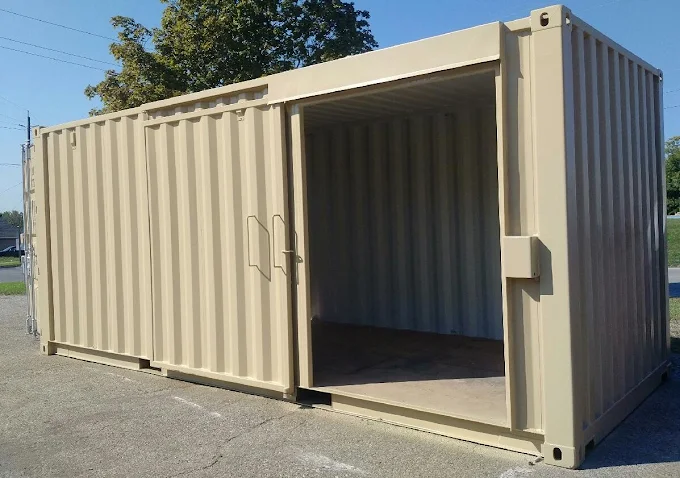
We sell containers. We do not rent.
Van Blanc sells cargo containers outright. We do not rent, we do not lease, and we do not offer rent-to-own. Stocked units deliver from our Brantford yards in 1 to 3 days. Request a cargo container quote or call the yard at 519-754-6844.
Quick Answer: A cargo container is a steel ISO shipping container, the same box Ontario calls a sea can. Van Blanc sells new one-trip and used cargo containers from 10ft to 53ft at our Brantford yard, graded and CSC-plated, delivered across Ontario in 1 to 3 days and paid for on delivery.
The people who type cargo container into a search box are not the people who type sea can. They run freight, they cross the border for work, they learned the word on a base or in a warehouse in Buffalo, or their procurement system has a field that says cargo container and nothing else. They arrive at a Canadian results page full of sea cans and c-cans and wonder whether they have found the right product. They have. A cargo container for sale in Ontario is the same corrugated corten box that every other name on this site describes, and this page is written in the vocabulary of the buyer who came in the freight door.
It covers what is in the Brantford rows this season, the one place where the word cargo causes real confusion (a cargo container and a cargo worthy container are not the same statement), the other names that land here, the sizes, what moves the price, how delivery works, and the extra questions a buyer who intends to ship the box again has to ask. The full inventory, by size and grade, sits one click away for anyone who already knows what they need.
Cargo Containers for Sale: What Is in the Brantford Rows
Van Blanc keeps 200 or more cargo containers on the ground at 90 Morton Avenue East in Brantford, across the sizes and grades in the table. Every unit carries its own container number on the door, so the box you pick on a yard walk or a video call is the box that lands on your site, and every quote names that number. The 20ft and 40ft standard units are the depth of the stock; the 10ft, the 45ft and 53ft High Cubes and the reefers are held in smaller numbers and turn over faster, which is why the honest answer to “do you have one” is always a phone call rather than a web page.
| Cargo container | Outside | Inside, roughly | Grades usually in the rows | Bought for |
|---|---|---|---|---|
| 10ft standard cargo container | 10 x 8 x 8 ft 6 in | 560 cu ft | One-trip, used; factory tens and cut-downs, labelled | Tight lots, gate houses, side yards |
| 20ft standard cargo container | 20 x 8 x 8 ft 6 in | 1,170 cu ft | One-trip, cargo worthy, wind and watertight, as-is | Driveways, jobsites, farms, export loads |
| 40ft standard cargo container | 40 x 8 x 8 ft 6 in | 2,390 cu ft | One-trip, cargo worthy, wind and watertight | Yards, contractor compounds, warehouse overflow |
| 40ft High Cube cargo container | 40 x 8 x 9 ft 6 in | 2,700 cu ft | One-trip, cargo worthy | Racked stock, conversions, tall equipment |
| 45ft High Cube cargo container | 45 x 8 x 9 ft 6 in | 3,040 cu ft | One-trip, cargo worthy, smaller numbers | Long equipment, mobile depots |
| 53ft High Cube cargo container | 53 x 8 ft 6 in x 9 ft 6 in | 3,901 cu ft | Domestic, cargo worthy, smaller numbers | Industrial overflow, domestic freight staging |
| 20ft and 40ft HC reefer cargo containers | As above | Insulated, less inside | One-trip and used, working machinery | Cold chain, food service, pharma buffer |
Two things in that table decide most cargo container orders. The first is the grade column, explained in full below, because a buyer who wants a box for a gravel pad and a buyer who wants a box for a ship need different rows. The second is the “smaller numbers” note on the long units: if a 45 or a 53 is the answer, call before you plan the delivery day, because the size guide for every container we sell can tell you the dimensions but only the yard can tell you what is on the ground this week.
Cargo Container or Cargo Worthy? The Word and the Grade Are Not the Same
This is the one place the word cargo does real damage, and it is worth three paragraphs. A cargo container is a noun: any ISO steel box, in any condition, that was built to carry cargo. Cargo worthy is a grade: a used container that has been inspected and found fit to carry cargo again, under the Convention for Safe Containers, with a valid plate to prove it. Every cargo worthy container is a cargo container. Most cargo containers for sale in Ontario are not cargo worthy, because they have been retired from shipping into storage, their plates have lapsed, and nobody intends to lift them by the corners again.
That distinction only matters if the box is going to travel. A container that will sit on a farm pad, hold a contractor’s tools or become a workshop never needs a valid plate, and paying for cargo worthy certification on it buys nothing you will use; a wind and watertight unit is the right product and the lower number. A container that will be loaded and shipped, trucked with a crane lift, stacked two high in a yard, or sent overseas has to be cargo worthy, because the plate is what the shipping line, the crane operator and the insurer look for, and a lapsed one is a box they will not touch. Reading the CSC plate on the door is the two-minute check that tells you which you are looking at, and the re-inspection that renews a lapsed plate is a real cost that the CSC re-certification guide puts in proportion.
Christian LeBlanc, second-generation operator: “A buyer will call and ask for a cargo container and mean a box for his backyard, and the next call will ask for a cargo container and mean one he is loading for Ghana next month. Same words, two different products, and the only way I know which is to ask what the box is going to do. Nobody should pay for a plate they will never use, and nobody should ship a box without one.”
The four grades, in the order they are priced from the top down: one-trip, which made a single loaded voyage from the factory and is as close to new as a used container gets; cargo worthy, eight to fifteen years old, inspected, plated, doors and floor sound; wind and watertight, older, dry and lockable, plate usually expired, the grade most storage buyers should be buying; and as-is, sold with its defects written down, for donors and projects. The grade guide, grade by grade, has the full inspection detail, and how long each grade lasts on a pad puts years on the choice.
Conex Box, Metal Container, Steel Container: the Other Names That Land Here
The buyer who searches conex box for sale usually served, or works beside someone who did. Conex is the U.S. Army’s Container Express program of the 1950s and 1960s, and the word survived the program by sixty years; the conex box in Canada is the history and the buyer guide together. The buyer who searches metal container for sale or steel container for sale has usually never heard the trade words at all and is describing what they see: a big steel box with doors. All three arrive at the same rows. So does freight container, intermodal container, ISO container, sea container and the rest of the list that the Canadian container vocabulary guide walks through name by name. What none of the names change is the product: corten steel corrugated walls, marine plywood or bamboo floor on steel cross-members, eight corner castings, double cargo doors with four locking bars, and a CSC plate that is either valid or not.
One name that is not the same product is worth flagging because it shares a word. A cargo trailer is a wheeled box that tows; a cargo container has no axles and sits on the ground or a chassis. Buyers who want something that moves between sites every week want the trailer, and we will say so; buyers who want a box that stays put, locks like a vault and outlasts the shed beside it want the container, and the trailer against container comparison is the honest head-to-head for anyone in between.
Which Size Cargo Container Fits the Job
The size decision is usually shorter than buyers expect. The 20ft is the box that fits a residential driveway, holds a one-bedroom apartment or a full contractor tool set, and is the size we sell most of; what Ontario buyers do with a 20ft runs to several dozen uses. The 40ft holds twice the volume for well under twice the money and is the working default for a yard, a farm or a warehouse overflow; the 20 against 40 decision turns almost entirely on whether the site can take the longer tilt-deck approach. The High Cube adds a foot of height that matters the moment the box is racked, insulated or lived in. The 10ft is for the lot that cannot take a 20, and it costs more per cubic foot than either of its bigger siblings. The 45 and 53 are industrial. A reefer is a cargo container with a refrigeration unit on the end wall, and the reefer guide is where a cold-chain buyer should start.
The Two-Minute Size Test
- Will it fill a two-car garage? Buy the 20ft. A one-bedroom apartment, a trades crew’s tools, a season of equipment, a single car nose-in.
- Will it fill a bungalow? Buy the 40ft. A three-bedroom house, a contractor compound’s full inventory, two cars nose to tail.
- Anything inside taller than a fridge, or a person working in it? Take the High Cube.
- Cannot get a 20ft down the lane? The 10ft, factory or cut-down, labelled as which.
- Shipping it again? Cargo worthy, whatever the size.
What a Cargo Container Costs in Ontario, Without a Sticker
We quote every cargo container by its number rather than posting a price list, and the reason is not coyness: four inputs move the figure enough that a list would be wrong within the month. The grade moves it most, one-trip at the top of the ladder and wind and watertight at the bottom with cargo worthy between, and a lapsed plate versus a valid one is a real step on that ladder for the export buyer. The size moves it next, and a 40ft is nowhere near double a 20ft. The delivery distance from Brantford is quoted per kilometre and written into the same number as the container. And the steel and freight markets shift the whole ladder up and down through the year, which is why a quote holds for a stated window and then gets refreshed. How the grade ladder prices a container in Canada is the long explanation; the short one is that you send the size, the grade, whether the box will ship again and your postal code, and a written, all-in figure comes back, usually the same day.
Price Your Cargo Container
Size, grade, whether it travels again, postal code. One written number back, container plus truck plus drop, usually the same day, with a real lead time attached.
Delivery From Brantford: 1 to 3 Days, Tilt-Deck, Paid on Delivery
A cargo container leaves the yard on one of our own tilt-deck trucks and reaches most of Ontario in 1 to 3 business days, Windsor to Kingston and up into cottage country, with the longer northern runs quoted with a real lead time up front. The truck backs to the drop spot, the deck tilts, and the box slides onto its corner castings on the pad you prepared; how a tilt-deck sets a container down covers the manoeuvre and the straight run the truck needs to pull out is the one measurement to take before you order. The pad is compacted gravel with a block, a patio stone or a railway tie under each corner, and a slab is only worth pouring when the box becomes a building. Payment is on delivery, by cash, draft cheque, wire or credit card authorization, once the container is on your ground and you have read its number against the quote. There is no deposit, on any unit, for any buyer. Permits are managed by your municipality, so check with your local building or planning department before you order.
Buying a Cargo Container for Export or Freight Use
A buyer who intends to load the container and ship it, whether to a Caribbean island, an African port or a jobsite three provinces away by rail, is buying a different product from the storage buyer and should ask four more questions. Is the CSC plate valid, and what is the next inspection date on it? Is the container number legible on all four sides and the door, because the shipping line will read it? Has the floor been checked for the soft spots and the pesticide-treatment stamp that some destination ports refuse? And is the unit cargo worthy by inspection, not by the seller’s say-so? We answer all four on the quote, and how to secure a load inside a cargo container is the next thing to read once the box is chosen. A one-trip container answers every one of those questions by default, which is why exporters who can afford it buy new; a cargo worthy used unit answers them with an inspection, at a lower number; a wind and watertight box does not answer them at all and should not go to a port.
The Listing With No Yard Behind It
The cargo container buyer meets the same trap the sea can buyer meets, with an American accent: a Marketplace or classified listing for a 20ft cargo container at less than half of any yard’s price, photographs borrowed from a real dealer, a seller in Toronto or Hamilton who cannot show you the box, and a deposit by e-transfer to hold it. The container does not exist. The scam field guide, pattern by pattern, has the full story and the reporting steps; the short version is that a real seller has a yard you can drive to, quotes a container number you can read on the door, and takes payment when the box is on your ground. Anyone who needs money first has nothing to sell.
Paul LeBlanc, owner: “Cargo is the word I heard for forty years in Asia before I sold a single box in Brantford. It means the container has a job to do. When a buyer tells me what the job is, the grade picks itself, and the price follows the grade. That is the whole conversation, and it is why we ask what the box is for before we say a number.”
Cargo Container Buying FAQ
Is a cargo container the same as a shipping container?
Yes. Cargo container, shipping container, sea can, c-can, conex and intermodal container are names for the same ISO steel box: corten corrugated walls, a plywood floor on steel cross-members, eight corner castings, double cargo doors and a CSC plate. The name follows the trade the buyer came from; the container does not change.
How much does a 20ft cargo container cost?
The grade sets most of the figure: a used wind and watertight 20ft is the lowest number in the yard, cargo worthy sits above it with a valid plate, and a one-trip costs the most and holds the most resale value. Delivery from Brantford is quoted per kilometre on top and the steel market moves the whole ladder by the month. We quote each container by its number rather than posting a list price; send the grade and your postal code and the all-in figure comes back in writing.
What is the average cost of a 40ft cargo container?
There is no useful average, because a one-trip 40ft and a wind and watertight 40ft can sit far apart on the same day. What holds is the proportion: a 40ft is nowhere near double a 20ft of the same grade, a High Cube carries a modest premium over the standard height, and a cargo worthy unit with a valid plate costs more than the same box with a lapsed one. Send the grade and your postal code for the written number.
Do you need a concrete slab for a cargo container?
No. A container carries its weight on four corner castings, so a compacted gravel pad a foot larger than the box with a block, patio stone or railway tie under each corner, and two more under the middle of a 40ft, is the standard base. A slab is only worth pouring when the box becomes a workshop or a dwelling with a floor load.
Can I buy a cargo container in Ontario and ship it overseas?
Yes, if it is cargo worthy: a valid CSC plate with a future inspection date, a legible container number, a sound floor and doors that seal. A one-trip container meets all of that by default; a used cargo worthy unit meets it by inspection; a wind and watertight box with a lapsed plate will not be accepted by a shipping line. Tell us the box is travelling and the quote will name the plate date.
New or used cargo container: which should I buy?
Used, for storage on a pad: a cargo worthy or wind and watertight unit is dry, lockable and rodent-proof at a fraction of a one-trip and outlasts any shed. New, for a conversion, a street-facing placement or an export load, where straight walls, a clean floor and a fresh plate earn the premium. Buy by container number from a yard you can walk, and either choice is a good one.
Where can I buy a cargo container near me in Ontario?
From the rows at 90 Morton Avenue East in Brantford, in person or on a video call, with delivery to 160 or more Ontario communities in 1 to 3 days on our own tilt-deck trucks. Check your city on the service areas map, or drive in Monday to Thursday 9:30 to 5 and Friday 9:30 to 4 and read the plates yourself.
How long does a cargo container last?
A container retires from ocean service at ten to fifteen years old with twenty to thirty years of land life left in it. On a drained gravel pad, a wind and watertight unit outlasts most of what is stored inside it; a one-trip on the same pad is a fifty-year box. Grade and site prep decide the timeline more than the age on the plate does.
Sources
Reach Van Blanc in Brantford
Van Blanc Ent. Inc., 90 Morton Ave. East, Unit 1-B, Brantford, ON N3R 7J7. Cell 519-754-6844, toll-free 1-888-509-6658, office 519-751-1651. Open Monday to Thursday 9:30 to 5 and Friday 9:30 to 4. Bring the job, not the vocabulary; the grade and the size follow from what the box is going to do.