
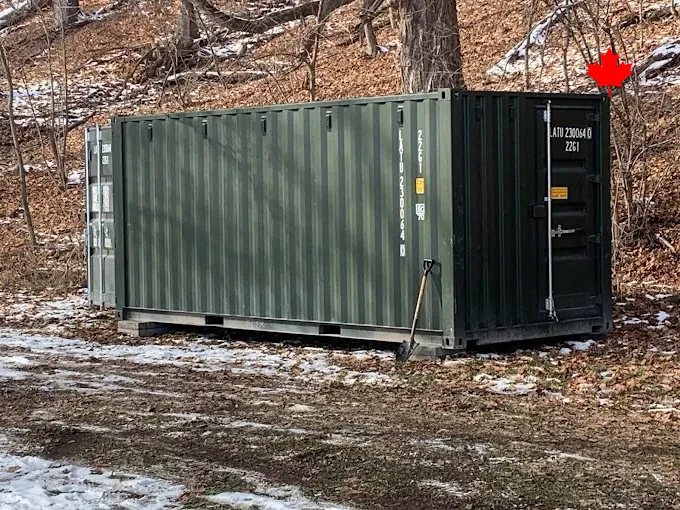
We sell containers. We do not rent.
Van Blanc sells shipping containers outright. We do not rent, we do not lease, and we do not offer rent-to-own. Renting comes up on this page because buyers compare it against owning, and that comparison is worth reading, but purchase is the only arrangement we offer. Stocked units deliver from our Brantford yards in 1 to 3 days. Request a sale quote or call the yard at 519-754-6844.
Quick Answer: A used shipping container is the best value in steel storage when the grade is called honestly. Van Blanc stocks Cargo Worthy, Wind and Watertight, and As-Is units at our Brantford yard, every flaw pointed out before you pay, delivered across Ontario in 1 to 3 days.
Most of the steel storage working in Ontario right now is used steel, and that is not a compromise story; it is a value story. A container retired from ocean service has decades of stationary work left in it, at a meaningful saving over new, provided one thing holds: the seller told you the truth about the box. For the step-by-step version of that truth-telling, the used buying guide pairs with this page. This page is the whole truth-telling apparatus in one place, written the way we run the yard. The grades and what they actually promise, the two-minute inspection that separates honest wear from real problems, the market’s traps, and why buying used steel you have walked beats buying any steel you have not.
Why Used Is the Working Default
The economics are simple and mostly unknown to first-time buyers. A container’s ocean career ends long before its structural life does; shipping lines retire boxes on schedules driven by certification cycles and fleet logistics, not because the steel is done. What arrives at our yard is a unit built to survive salt spray and nine-high stacking, now facing a retirement of holding a renovation’s furniture or a farm’s seed, which is roughly the workload difference between an airline pilot’s career and driving to the cottage. For stationary storage, the used box does everything the new box does. What it does not do is look new, and the entire art of buying used is knowing exactly how much that matters for your job, which is usually less than the price difference.
The Grades, With Nothing Hidden
Cargo Worthy (CW) is used steel re-inspected and certified structurally fit for international shipping. Multiple crossings behind it, surface rust and paint variance on display, frame and floor confirmed sound under inspection criteria the leasing industry publishes. Buy it when the box might ship again, or when you want the most structurally documented rung of the used ladder.
Wind and Watertight (WWT) is the workhorse of on-site storage and the honest recommendation for most jobs on this page. The promise is exactly what the name says: panels shed weather, gaskets seal, rodents stay out. The certification for further ocean work is behind it, which for a box spending its life behind a shop is like a retired pilot losing a licence he never planned to use again. Cosmetic history is fully on display and priced in.
As-Is closes the ladder honestly: units with declared floor, frame, or door questions, sold cheap to buyers who know what they are getting into. Cladding stock, welding-project donors, sacrificial site boxes. We carry As-Is and rarely recommend it, but a ladder missing its bottom rung makes every other rung look dishonest, so it stays on the page and in the yard.
New (one-trip) is the rung above this page: a single loaded crossing from the factory, essentially new. When appearance, branding, or conversion is in the plan, that is the box, and the new container stock covers it properly. The honest seller’s job is telling you when your use case does not need it, and that sentence has talked more buyers down a rung than any discount ever has.
The Two-Minute Walkaround That Settles Everything
Thirty years of used-container inspection compresses into five checks anyone can run in work gloves, and the fact that a seller lets you run them at all is itself the sixth and most telling check.
Walk the box:
- Doors first. Swing both. They should open with one hand and close with a seal you can feel. Fighting doors means a racked frame or dead gaskets, and both mean negotiate or walk.
- Gaskets. Press the rubber around each door. Supple seals; cracked and flattened leaks. Gaskets are replaceable, but the price should already know that.
- Light test. Step inside, doors closed. Any daylight through roof or walls is a hole, whatever the listing said. Pinholes at panel seams are the classic WWT failure.
- Floor. Walk the length, heel-first. Soft spots, delamination near the door end, and chemical staining are the floor’s three confessions. Marine plywood is repairable; surprise floors are not a discount you agreed to.
- Sills, headers, castings. Water sits at the door sill and top header, so real corrosion starts there, and the corner castings tell you about crane hits. Surface bloom is history; flaking scale at the sills is a future.
What the walkaround deliberately ignores: honest surface rust on panels, faded paint, dents that do not crease a corrugation, and the general biography of a box that worked for a living. Corten steel forms its own protective oxide skin; cosmetic weathering is the finish behaving as engineered, and paying to avoid it on a farm box is decorating a tractor.
Reading the Box’s Biography: The CSC Plate
Every legitimate container carries its passport riveted to the left door: the CSC plate, mandated by the International Convention for Safe Containers. On a used unit it tells you the build year, the original owner’s code, and the inspection scheme the box lived under; many carry an ACEP decal marking a continuous-examination program from their working life. Two practical readings for a used buyer. First, the build year calibrates the price conversation, though the walkaround outranks it; steel ages by treatment, not birthdays. Second, an expired plate means nothing for storage. Certification governs ocean shipping, and your driveway is not an ocean. A missing plate, though, is a different signal: it usually marks an As-Is unit or a box with an undocumented past, and the price should already reflect that. Ask any seller to photograph the plate; a yard that hesitates has answered a question you did not ask yet.
The Two Wear Parts, and the Economy Around Them
A used container is mostly parts that do not wear and two that do. Door gaskets harden with age and sun, and a full gasket set is an afternoon’s work that returns a decade of seal; a structurally tight unit with tired rubber is often the best value on the lot, priced for a flaw that costs little to cure. Floors are the second economy: marine plywood panels are individually replaceable, so a box with one soft board near the door is a repair, while a floor gone spongy end to end is a donor. We stock gaskets, handles, and lockboxes off the shelf at the yard, and the honest quote on a used unit tells you which parts, if any, it will want in its first five years. Buyers who understand the two wear parts stop fearing used steel entirely, because everything else on the box is engineered for a career it already survived.
Who’s Buying Used, and For What
The farm succession. The second bin, bought the year the operation splits between siblings: WWT, 40ft, set beside the first one Dad bought in 2009, which is the longest-running product review we can offer.
The contractor’s expansion. The second and third site boxes, bought used once the first proved the model. CW when the fleet crosses between provinces on contracts, WWT when it stays local, lockboxes on all of them.
The first-time household buyer. A renovation or a hobby outgrowing the garage, and sticker-shocked by new. The WWT 20ft is the entry point, and the walkaround education takes ten minutes because there is nothing to hide.
The Used-Market Traps, Named
The thick-paint special. A fresh coat over unprepped scale hides exactly the corrosion the walkaround finds, for exactly as long as the sale takes. Fresh paint on a used box is a question, not a feature: ask what is under it, and prefer honest weathering to mystery gloss.
The “refurbished” ambiguity. Refurbished has no standard behind it. It can mean new gaskets and a proper floor, or it can mean the thick-paint special. Grades have published criteria; adjectives do not. Buy the grade, not the adjective.
The mystery history. Containers carry cargo, and a rare few carried things you would not want under your stored furniture. Chemical staining on floors is the tell, and a yard that walks you inside the box has nothing to hide about it.
The phantom bargain. Many people call us saying they found a bin for a thousand dollars less on Facebook. Two weeks later, some call back to say the seller and the deposit are both gone. The Canadian Anti-Fraud Centre logged its worst year on record in 2025, and too-cheap used containers run through the middle of it. The whole category of fraud dies against one habit: see the box, pay on delivery, never wire a deposit into the void. Our scam checklist covers the full pattern.
Price a Used Container Honestly
Tell us the job, the size you are leaning toward, and your postal code. You get grade-by-grade numbers with every flaw described up front and a real lead time, usually the same day. Or walk the rows at Brantford and let the boxes speak for themselves.
What Moves a Used Container’s Price
No dollar figures here, because posted used-steel prices age even faster than new ones; what you get instead is the honest driver list. Grade does the heavy lifting: the certification and inspection behind CW carries a premium over WWT, which carries a premium over As-Is. Size is next, with the 40ft costing more but rarely double the 20ft. Age and condition within a grade move the number at the margins; a tight ten-year-old WWT can out-price a rough six-year-old one, which is why the walkaround matters more than the birth year. Delivery distance rides on top, billed per kilometre from Brantford. And underneath everything, the used market breathes with the global steel and freight cycles: when new boxes get expensive, used follows at a respectful distance. An all-in quote to your postal code is the only number that means anything, and ours come with the flaws described before you commit.
Renting Used Steel Instead
We do not rent, and our rental-intercept page explains why that is good news for the wallet: a used wind-and-watertight unit costs about what a season or two of rented space would, and it is still yours afterward. Needs measured in a few weeks belong with a mobile-storage pod or a self-storage unit; past a few months, buying used wins the arithmetic; and a business that needs to spread the cost does it through an equipment loan or line of credit at its own bank, with the invoice, grade and serial number from us that the lender asks for. The grade conversation is identical either way, and so is the walkaround invitation.
How the Yard Grades Incoming Steel
The grading on this page is only as honest as the intake behind it, so here is ours. When a load of retired units arrives at Brantford, every box gets walked before it gets a row: doors swung, floors walked, light test run, sills and castings read, plate photographed. Units that hold their certification stay CW. Units that seal but carry cosmetic history land in WWT. Anything with a structural question gets marked As-Is and priced like it, and a box that fails even that honesty test does not get a row at all; it gets parted or refused. Christian runs most intakes now, the same checks his father taught him, and the practical result for a buyer is that the grade on your quote was assigned by someone who touched the box, not by the wholesaler’s manifest. That is the difference between a grade and a guess, and it is most of what a family yard actually sells.
The Arithmetic, Without the Fantasy
The used-versus-new decision is total cost of ownership wearing work clothes. For stationary storage, both boxes deliver the same decades of service, so the used unit’s lower entry price is mostly pure saving; the new unit’s premium buys appearance, a documented single-owner history, and stronger resale, which matter enormously for conversions and street-facing placements and hardly at all behind a barn. The fantasy to avoid runs in both directions: new steel does not store furniture better, and used steel is not a gamble once the walkaround and the grade have spoken. Match the rung to the job, and the arithmetic mostly finishes itself. When it does not, the tiebreaker is resale: used steel bought right holds its value stubbornly, and a WWT unit cared for on blocking sells on years later for a surprising share of what it cost.
Buy It Where You Can Walk It
Everything above compresses into one buying rule: the used container you can inspect beats the used container you cannot, at any price gap the market actually offers. Listings show angles; yards show boxes. Our rows at 90 Morton Avenue East hold 200-plus units across every grade, the doors swing for anyone who visits, and on used steel we point at the dents before you ask, because a flaw you heard about from the seller is a negotiation and a flaw you found at delivery is a grievance. Buyers drive in from across Ontario for exactly this, and the ones who cannot make the trip get the same honesty by phone, photo, and video before a dollar moves. You pay on delivery, not in advance, which is the oldest fraud protection in the trade and still the best.
Used Sea Cans, Second-Hand C-Cans: Same Rows
Search the used market under every name it wears: used shipping containers, used sea cans, second-hand containers, used c-cans. Identical steel, identical grades, same rows at our yard. The vocabulary variety matters only because the listings are split across it; the buying rules on this page do not change with the spelling. Whichever term brought you here, the rows answer to all of them, and so does the quote line: size, grade, postal code, honest number, real lead time. Thirty years in, that formula has not needed a second draft.
The spelling that has grown fastest this year is the shortest one. A 2nd hand shipping container, a second-hand sea can and a used storage container are one listing under three headings, graded on the same four-step ladder and inspected on the same two-minute walkaround this page describes. If you searched for used storage containers because the container is going to sit in a yard rather than cross an ocean, the wind-and-watertight grade is the one to read first; it is the grade built for exactly that job, and the grade ladder explained shows why it usually beats paying for cargo-worthy certification you will never use.
Conex Boxes for Sale: The Military Name, Answered
A conex box is the same used shipping container under its military name, short for Container Express, the logistics system the U.S. Army built in the 1950s that the modern ISO box descends from. Veterans and ex-forces buyers still search the term, and they are buying exactly what this page describes.
Every conex box for sale at our yard is graded on the same four-step ladder as the rest of the rows, and the buyers who learned the word in uniform tend to walk straight to the plate and check it themselves, which we respect. The full family tree of the vocabulary, and where conex, sea can, and ISO box part ways, lives in the naming guide; the steel itself is waiting in the rows either way.
Used Container FAQ
What should I check before buying a used shipping container?
Five things: doors that swing and seal with one hand, supple gaskets, no daylight inside with the doors shut, a solid floor with no soft spots or chemical staining, and clean sills, headers, and corner castings. Honest surface rust on panels is history, not a problem.
What is the difference between Cargo Worthy and Wind and Watertight?
Cargo Worthy is certified structurally fit for further ocean shipping; Wind and Watertight seals against weather and rodents but carries no shipping certification it will never need on land. For stationary storage, WWT is usually the honest recommendation at a real saving.
How long will a used container last?
Decades, stationary. Corten steel forms a protective oxide layer, and a sound WWT unit placed on blocking with water shedding away from the sills routinely outlives the sheds and garages around it. The floor and gaskets are the parts that age; both are maintainable.
Is a repainted used container a good sign?
It is a question to ask, not a feature to pay for. Paint over properly prepped steel is fine; a thick fresh coat over unprepped scale hides exactly what an inspection would find. Prefer honest weathering you can read over mystery gloss you cannot.
Are cheap used containers on marketplace sites legitimate?
Some are; the dangerous ones are priced a thousand dollars under market to harvest deposits. Canada logged record fraud losses in 2025, and containers are a recurring lure. Protect yourself with one habit: see the box or verified proof of it, and pay on delivery, never by advance deposit.
Can I see used containers before buying from Van Blanc?
That is the point of the yard: 200+ units at 90 Morton Avenue East in Brantford, rows open during yard hours, every grade represented. Walk the boxes, run the five checks, and pick the exact unit that shows up on the truck.
What size used container should I buy?
The 20ft carries most household and site jobs; the 40ft doubles the floor for farms and business overflow. Three decades of deliveries say buyers regret small far more often than big, and the price step between sizes is smaller than most expect.
Do used containers come with any guarantee?
Grade is the guarantee’s honest language: CW carries current inspection certification, WWT promises sealed weather-tight condition, As-Is declares its faults up front. Ask any seller to put the grade and its meaning in writing on the quote; we do.
Can a used container be modified?
Yes, and used shells are the standard base for workshops, site lockups, and storage conversions. The conversion work our yard does, doors, windows, vents, insulation, lockboxes, goes onto CW and WWT shells daily; only occupied-dwelling builds push the grade conversation up to one-trip.
Does the CSC plate matter on a used container?
For storage, only as biography: it gives the build year and the box’s inspection history. An expired plate is irrelevant on land. A missing plate usually signals an As-Is unit or an undocumented past, and the price should already say so.
Is a 2nd hand shipping container different from a used one?
No. A 2nd hand shipping container, a second-hand sea can and a used storage container are the same thing under different headings: an ISO container that has finished its ocean service and is graded as-is, wind-and-watertight or cargo-worthy on the ladder above. Inspect it the same way regardless of the listing title: floor, doors, gaskets, roof, CSC plate.
Sources
- Institute of International Container Lessors. (current). Container inspection criteria and technical bulletins. iicl.org
- United Nations Treaty Series. (1972). International Convention for Safe Containers (CSC). treaties.un.org
- Canadian Anti-Fraud Centre. (2026). Fraud trends and annual reporting. antifraudcentre-centreantifraude.ca
- Drewry. (2025). Container Census and Leasing Annual Report. drewry.co.uk
- International Organization for Standardization. (2020). ISO 668: Series 1 freight containers, classification, dimensions and ratings. iso.org
The Rows Are Open
Van Blanc has sold used steel honestly from Brantford since 1995: family-run, 4.9 stars across 140+ verified Google reviews, every grade in the rows at 90 Morton Avenue East, and every flaw pointed out before you pay. Ontario-wide delivery in 1 to 3 days, payment on delivery.
Van Blanc Ent. Inc., 90 Morton Ave E Unit 1B, Brantford, ON N3R 7J7. 1-888-509-6658