
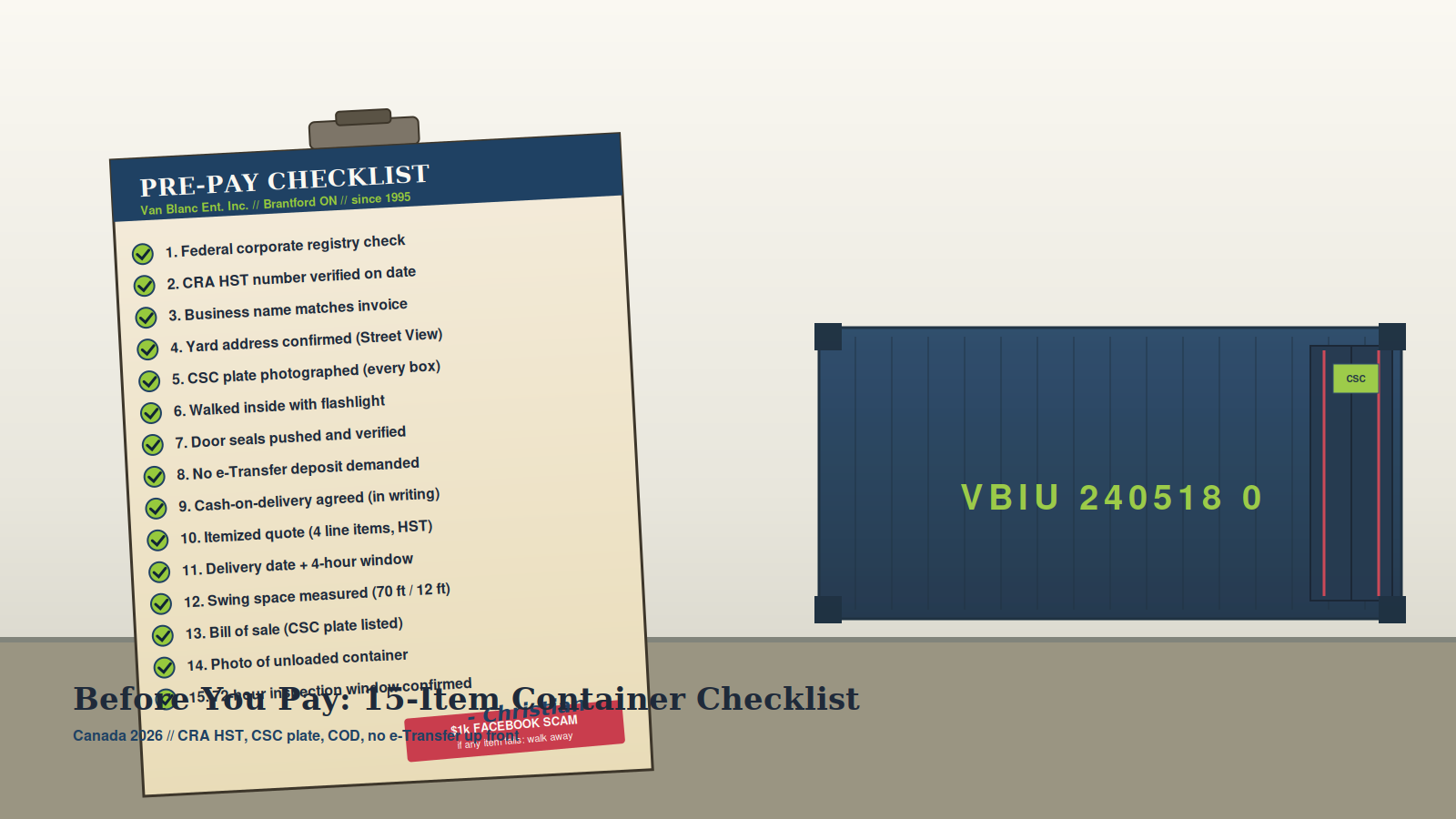
Quick Answer: Per ISO Container Standards. Before you pay for a shipping container in Canada in 2026, work through 15 verification items in order: confirm the seller’s business registration through the federal corporate registry, verify their GST/HST number against the Canada Revenue Agency registry on the transaction date, match the registered business name to the invoice exactly, drive to the yard address listed on Google Maps and confirm the container is physically there, photograph each CSC plate, walk inside every container with a flashlight, decline any e-Transfer deposit demand, agree to cash-on-delivery (COD) terms in writing, get an itemized quote showing container price, delivery, and HST as separate line items, confirm the delivery date and 4-hour time window, confirm you have at least 70 feet of straight swing space, receive a signed bill of sale at delivery, photograph the unloaded container before the driver leaves, and confirm your inspection window for hidden defects. Skipping any of these 15 steps is how the Facebook container scam keeps catching Ontario buyers every spring. Every quote is real-address specific. Reach Paul or Christian for honest delivered pricing. Three decades family-run, 140+ verified Google reviews. 1-3 day delivery from our 4 Brantford yards across Ontario.
The 15-Item Pre-Pay Checklist
- Pre-visit: Business registration and CRA HST verification
- Confirm the yard address before you drive
- At the yard: CSC plate photo on every container you consider
- Walk inside with a flashlight (no exceptions)
- Payment: Cash on delivery, not e-Transfer up front
- Invoice line items: container, delivery, HST, zero hidden fees
- Delivery: Date, 4-hour time window, swing space confirmed
- Paperwork: Signed quote, bill of sale, delivery receipt
- After delivery: Inspection window and recourse
- Frequently asked questions
Reading time: about 14 minutes. This article sits one click below our parent walkthrough on choosing a sound used box without overpaying and assumes you have already narrowed your seller shortlist. It is the final checklist Christian LeBlanc runs through with first-time buyers at the yard on the day money changes hands.
How Do I Verify a Container Seller Before I Pay?
You verify a container seller with two free registry checks before any money moves: confirm the company in the federal corporate registry, then confirm its GST/HST number is active in the CRA registry on your transaction date. If a seller refuses either number, or the names do not match the invoice, walk away.
Seller verification is the part of buying a used shipping container that catches nearly every scam in Canada, and the two checks above are free and take five minutes. We have walked dozens of first-time buyers through this routine after they arrived at our Brantford yard with horror stories from the Facebook side of the market. The pattern is always the same: the buyer never verified the seller existed.
Step one is the federal corporate registry. The seller you are to wire several thousand dollars to should have a registered Canadian business name and a corporation number you can look up on the Government of Canada corporations search tool. A legitimate Ontario yard files annual returns and shows up in seconds. If a search returns zero results, or returns a company that does not match the website you have been emailing with, walk away.
Step two is the GST/HST account number check. Every Canadian business above the CRA’s small-supplier threshold in annual taxable supplies must register for GST/HST, and the CRA runs a free GST/HST Registry tool that confirms an account number is active. Inputs: nine-digit GST/HST number, full legal business name as registered, and the transaction date. A mismatch between the invoice name and the registered name is grounds for the CRA to deny your input tax credit and is also a near-perfect fraud indicator.
Christian LeBlanc, second-generation operator: “I tell every first-time buyer to do the CRA HST registry check before they call us back the second time. Our number checks clean every time. The bad operators either refuse to give the number, give you a number that does not match their business name, or give you a number that is not registered on the transaction date. Five-minute check. Saves people from losing thousands to a seller who was never real.”
Save screenshots of both verifications: the corporate registry result and the CRA registry result. Time-stamped. Two minutes of work that becomes your strongest evidence if anything goes sideways later. The Canadian Anti-Fraud Centre recommends keeping a digital paper trail of seller verification for any significant online purchase.
Confirm the Yard Address Before You Drive
A real container yard has a physical address with containers stacked two or three high, gravel ground, a fence line, and a service road wide enough for a tilt-deck. Type the seller’s address into Google Maps Street View. If Street View shows a residential lot, empty warehouse parking, or a generic industrial unit with no containers visible, you have found one of the most common red flags in the Ontario market.
Better, drive to the address before purchase day. Our Brantford yards are at 90 Morton Ave E and three additional locations across the city, all walkable, all stacked with the 200-plus container inventory you can see from the street and walk the rows of before you pick your box. The corollary is the call test: phone during business hours, a real yard picks up (or returns the call within an hour) and someone can tell you, right now, how many 20-footers in Wind and Water Tight grade are on the ground. If the seller communicates only through Facebook Messenger or WhatsApp, that is the scam in plain English.
At the Yard: CSC Plate Photo on Every Container You Consider
The CSC plate is the metal data plate riveted to a door column on every legitimate shipping container. CSC stands for the International Convention for Safe Containers, the 1972 ISO-administered treaty that sets structural and inspection standards for all ocean-going containers. The plate carries manufacturer, manufacture date, owner code (four-letter prefix ending in U), max gross weight, tare weight, and structural inspection history.
Three reasons the CSC plate is your single most powerful pre-pay verification tool. The manufacture date tells you the container’s true age (most “used” Ontario stock is 12 to 18 years old). The owner code lets you trace the container’s legitimate exit from the shipping pool. The BIC-code identifier is internationally unique. Walk every container, photograph the plate full-frame in daylight, note the number on your phone. We break down how to read each line stamped into that data plate in a separate walkthrough on decoding the rivet-on plate. A seller who refuses to let you photograph plates is not a legitimate operator.
| CSC Plate Field | What It Tells You | Red Flag |
|---|---|---|
| Owner code (4 letters + U) | Original shipping line | Plate scratched off or repainted over |
| Manufacture date | True container age | Date stamps re-punched or altered |
| Max gross weight | Structural rating | Field missing or illegible |
| Tare weight | Empty weight (verifies delivery) | Mismatch with body stencil |
| ACEP / inspection history | Last structural inspection | No ACEP marking at all |
| Country of manufacture | Quality reference (CN/KR/JP standard) | Plate riveted with mismatched fasteners |
What Should You Check Inside a Used Container?
Inside a used container, you check three things in order: the roof for daylight (any pinhole is a leak), the floor for soft or corroded spots, and the door seals for compression. The most common defect on a used Ontario container is a small hole in the roof you cannot see from outside. The second most common is a corroded floor section under the back left corner where rainwater pools. The third is door-seal compression failure. All three are invisible from the lot and show up the first time you step inside and close the doors.
The walk-in routine takes four minutes. Step inside. Close both doors. Stand ten seconds while your eyes adjust. Look up: any daylight through the roof is a hole. Walk each corner. Push the floor with the flashlight in your other hand. Soft spots are floor failures. Run the beam along the bottom rail seam, both sides. Rust scale that flakes off easily is structural; surface rust that does not flake is cosmetic.
Then push the door seals. A good Wind and Water Tight seal compresses about 60 percent under hand pressure and springs back. A failed seal stays flat or crumbles. If you want the longer version, we lay out how to tell surface rust from the kind that ends a container step by step. Bring your own 500-lumen flashlight. A seller who rushes you, locks the doors, or says “we only show containers Monday” is hiding something. Real operators welcome the inspection because real inventory survives it.
Payment: Cash on Delivery, Not E-Transfer Up Front
The single most important sentence in this article: do not e-Transfer a deposit to anyone you have not met in person at their physical yard. Interac e-Transfers are functionally non-traceable for fraud. Once funds are claimed, your bank cannot reverse the transaction and the recipient can disappear in minutes. The Canadian Anti-Fraud Centre reports thousands of dollars in monthly losses from container e-Transfer scams in Ontario alone.
The legitimate Ontario payment pattern in 2026 is cash on delivery. You pay when the container is on the ground at your property and you have walked around it. Some yards accept e-Transfer at the moment of delivery, after unload, after signing the delivery receipt. The order matters. Money moves last, not first. We deliver every Van Blanc container on COD terms: no deposit, no money up front, no “hold” payments. If a competitor demands a deposit before you have seen the container at their yard, you are funding a scam.
| Payment Method | Reversible? | Use Case | Risk Level |
|---|---|---|---|
| Cash on delivery | N/A (in person) | Standard Van Blanc terms | Lowest |
| Certified cheque on delivery | Limited | Larger purchases (40HC, multi-unit) | Low |
| E-Transfer at delivery | No | Acceptable after container unloaded | Low (if timed right) |
| E-Transfer deposit before delivery | No | Never with new sellers | High |
| Wire transfer to “agent” | No | Never (classic scam pattern) | Critical |
| Cryptocurrency | No | Never for containers in Canada | Critical |
If you must pay a deposit (rare, and only with established yards), insist on credit card. Credit-card chargebacks are your only practical recourse against a seller who disappears. Debit cards, e-Transfer, and wire transfers offer no such protection. For the wider list of warning signs to watch for, we cover the tells that give a fake seller away.
Invoice Line Items: Container, Delivery, HST, Zero Hidden Fees
The legitimate Ontario container invoice has four line items at most: container, delivery, HST (13 percent in Ontario), total. Five if the buyer adds a hardened lock-and-lockbox upgrade. Anything beyond that should be examined before you agree.
Watch for these illegitimate line items: “yard handling fee,” “documentation fee,” “delivery surcharge above quoted,” “fuel adjustment,” “broker fee,” “inspection fee.” Some are legitimate on cross-border imports or custom modifications, but on a straightforward used 20ft Wind and Water Tight delivered within 200 km of our Brantford yards, the invoice is four lines. Get the quote in writing before you commit. Verify the business name and GST/HST number on the quote match the registry checks from section one. Save the PDF.
How Much Space Do You Need for Container Delivery?
For container delivery you need roughly 70 feet of straight clearance for a 20-footer on a tilt-deck, 100 feet for a 40-footer, plus 12 feet of width and 14 feet overhead. A confirmed delivery is three pieces of information: a date, a four-hour time window, and confirmation that you have prepared that swing space. All three should be in writing before delivery day. Vague verbal commitments (“we will be there sometime Thursday”) are a sign of a disorganized seller and a likely fight on delivery day when the truck shows up at 4 PM after you took the day off work.
Our standard delivery promise across the four Brantford yards is one to three days from booking, Ontario-wide. Niagara, Hamilton, Burlington, the GTA, London, and most of southwestern Ontario fall inside a same-day or next-day delivery window. The driver calls you 60 minutes before arrival. You meet them on site. The tilt-deck unloads the container onto level ground. The whole drop takes about 20 minutes for a 20-footer.
Your job before delivery day is to verify the swing space. A tilt-deck delivery for the 20-footer most first-time buyers choose, the same size we cover in our first-timer’s primer on what to ask before you commit, needs roughly 70 feet of straight clearance to back the truck in and tilt the container off. A 40-footer needs 100 feet. Width clearance is 12 feet. Overhead clearance is 14 feet (watch for tree limbs and power lines). If your property cannot accommodate these dimensions, you need a crane delivery, which adds to the cost. Confirm this before delivery. The driver showing up to a too-tight site and turning around is a failure that costs you the delivery charge.
Christian LeBlanc, second-generation operator: “Half the delivery problems I see come from buyers who said yes to the swing-space question without going outside to measure. Take a measuring tape. Walk it out. 70 feet of straight, 12 feet wide, 14 feet overhead. If you are tight on any of those, tell us before delivery and we plan for a crane drop. The truck cannot fit means the truck cannot drop, and a wasted delivery is a wasted day.”
Paperwork: Signed Quote, Bill of Sale, Delivery Receipt
Three documents change hands across the purchase cycle. The signed quote at booking. The bill of sale at delivery, showing the container’s CSC plate number, price paid, date, buyer name, and seller business registration. The delivery receipt at unload, signed by both you and the driver, confirming the container was delivered in agreed condition.
All three must reference the same CSC plate number. This is the chain of custody that protects you against missing accessories, undisclosed defects, or post-sale claims. A bill of sale without the CSC number is incomplete. Photograph all three documents at signing. Keep originals for at least five years per Canadian Anti-Fraud Centre retention guidance. A reputable Ontario yard keeps your file on its own systems for seven years for warranty and resale.
What Recourse Do You Have After the Container Is Delivered?
Your recourse after the container is delivered is the inspection window: a defined number of days to report a hidden defect and have it remedied. A legitimate sale always carries one. Ours is 72 hours: if you find a defect within three days of unload that was not disclosed and was not visible during your yard walk-through, we send a driver back to swap the container at no charge. Industry standard is 48 to 72 hours. Anything less is a yellow flag.
During the window, repeat the walk-in routine: doors closed, flashlight, roof, floor, walls, seals. The most common post-delivery surprise is a tiny roof pinhole that did not show under the yard’s awning but is visible at home at noon. Report it inside the window and get it remedied. If a seller refuses to honour the window: file a complaint with the Ontario Ministry of Public and Business Service Delivery (consumer protection), document everything in writing. For e-Transfer fraud, the Canadian Anti-Fraud Centre is the first call.
Reach Van Blanc in Brantford
We have been supplying shipping containers across Ontario since 1995, with a 200-plus container inventory at our 4 Brantford yards and 1-3 day delivery anywhere in the province on cash-on-delivery terms. You are welcome to walk every yard row, photograph CSC plates, step inside any container with a flashlight, and pick the exact box that comes home to your property. No deposit. No e-Transfer up front. No surprise fees on delivery day.
Van Blanc Ent. Inc. 90 Morton Ave E Unit 1B, Brantford, ON N3R 7J7 +1 888-509-6658
Before you pay anyone for a shipping container in Canada in 2026, run the 15-item checklist above. If a seller fails any one of the items, walk away. The honest operators welcome the verification because the verification protects us as much as it protects you.
Frequently Asked Questions
How do I verify a shipping container seller’s GST/HST number in Canada?
Use the CRA’s free GST/HST Registry tool. Enter the first nine digits of the GST/HST account number, the full legal business name, and the transaction date. CRA confirms the number is active on that date for that name. A mismatch between the invoice business name and the registered name is grounds for the CRA to deny your input tax credit and is also a strong fraud indicator. Call CRA Business Enquiries at 1-800-959-5525 if the result is unclear.
What is the Facebook container scam and how do I avoid it?
Scammers post 20ft Ontario containers on Facebook Marketplace at a price far below the market and demand an e-Transfer deposit to “hold” the container. The buyer pays, the seller disappears, no container arrives. The bin that is suspiciously cheaper on Facebook is the bin that never arrives. Avoid it by refusing all e-Transfer deposits to sellers you have not met at their physical yard, by checking the federal corporate registry, and by verifying the CRA HST number. Any Ontario 20ft priced well under the going rate from a Facebook seller demanding pre-pay is almost certainly a scam.
Should I pay cash, e-Transfer, or credit card for a shipping container in Canada?
Cash on delivery is the standard at established Ontario yards. The container arrives, you walk around it, you sign the delivery receipt, then you pay. E-Transfer at the moment of delivery (after unload) is acceptable. E-Transfer as a pre-delivery deposit is the highest-risk container-fraud method in Canada because it is non-reversible. Credit card pre-delivery offers chargeback recourse but most yards do not accept it on container-sized purchases.
What information should appear on a legitimate Ontario container invoice?
Four line items: the container (with grade), the delivery charge (with tilt-deck or crane noted), HST at 13 percent for Ontario, and the total. The seller’s full legal name, address, GST/HST number, and phone go in the header. The CSC plate number of the specific container appears on the bill of sale at delivery. Anything beyond these on a straightforward used 20ft within Ontario is an upsell and worth questioning before agreeing.
How much swing space do I need for a 20ft container delivery?
Roughly 70 feet of straight clearance for a tilt-deck delivery, 12 feet of width, and 14 feet overhead (watch tree limbs and power lines). A 40-footer needs 100 feet of straight run. If your property cannot fit tilt-deck, a crane delivery is required and adds to the cost. Measure with a tape before delivery and confirm in writing. A driver who arrives at a too-tight site and turns around still charges the fee.
How long is the inspection window after a container is delivered?
Industry standard at established Ontario yards is 48 to 72 hours. Ours is 72: if you find a defect within three days of unload that was not disclosed and was not visible during your yard walk-through, we send a driver to swap the container at no charge. Less than 48 hours is a yellow flag. No window at all is a buy-at-your-own-risk sale and should be priced 15 to 20 percent below market. Confirm the window in writing before paying.
What is the CSC plate and why does it matter when buying a container?
The CSC plate is a metal data plate riveted to a door column on every legitimate shipping container, named after the 1972 International Convention for Safe Containers. It lists manufacturer, manufacture date, owner code, max gross weight, tare weight, and inspection history. It verifies the container is real, tells you the true age, and provides a unique identifier that ties the bill of sale to the physical asset. Always photograph the CSC plate before paying.
Can I trust a Facebook Marketplace shipping container listing in Ontario?
Sometimes, but not without verification. Some legitimate yards advertise on Marketplace. The verification routine is identical: federal corporate registry, CRA HST registry, drive to the yard, walk the inventory, photograph CSC plates, decline pre-pay deposits, use cash on delivery. If the seller fails any check, the listing is fraudulent regardless of how legitimate the photos look. Photos can be stolen. Business registration and HST cannot be faked.
What paperwork should I receive when buying a shipping container in Canada?
Three documents. A written quote before booking, itemizing container, delivery, HST, total. A bill of sale at delivery showing the CSC plate number, price paid, date, buyer name, and seller business registration. A delivery receipt signed by you and the driver at unload confirming the container was delivered in agreed condition. All three must reference the same CSC plate number. Photograph each at signing. Keep originals for at least five years.
Why drive to the yard instead of having a container delivered sight-unseen?
Because trust is built before the truck rolls. Buyers walk a 200-plus container inventory at our 4 Brantford yards, read every CSC plate, step inside with a flashlight, push the door seals, and pick the exact box. National chain operators ship from a generic pool. The drive to Brantford pays for itself the first time a competitor unloads a pinholed container and you have to fight to swap it. The visit also lets you verify business address, real inventory, real staff in person.
Ready to price your container?
Tell us the size and your postal code and we’ll send back an honest, all-in number, container, delivery, and placement, usually within 1-3 days. No pressure, no mystery fees.
Family-run in Brantford since 1995 · 200+ containers in stock · 4.9★ across 140+ Google reviews · every box graded by a person, walk it before it lands.
Sources and Further Reading
- Canada Revenue Agency. Confirming a GST/HST account number. canada.ca
- Canada Revenue Agency. Register for a GST/HST account. canada.ca
- Canadian Anti-Fraud Centre. Online purchase scam reporting and prevention. antifraudcentre-centreantifraude.ca
- International Organization for Standardization. (2013). ISO 1496-1:2013, Series 1 freight containers – Specification and testing. iso.org
- Bureau International des Containers et du Transport Intermodal. The Container CSC Combined Data Plate Explained. bic-code.org
- Government of Canada. Corporations Canada – Search for a federal corporation. ised-isde.canada.ca
- Ontario Ministry of Public and Business Service Delivery. Consumer protection in Ontario. ontario.ca