
We sell containers. We do not rent.
Van Blanc sells shipping containers outright. We do not rent, we do not lease, and we do not offer rent-to-own. Renting comes up on this page because buyers compare it against owning, and that comparison is worth reading, but purchase is the only arrangement we offer. Stocked units deliver from our Brantford yards in 1 to 3 days. Request a sale quote or call the yard at 519-754-6844.
Quick Answer: GTA industrial warehouse leasing in 2026 sits in the mid-teens per square foot per year, per CBRE Canada Industrial MarketView. Container storage runs a small fraction of that per square foot per year equivalent when you amortize a one-time container purchase over 15 to 20 years on land you already own. Once you add Triple-Net charges, the fully loaded warehouse number climbs higher still. Containers win when you own the dirt. Honest delivered pricing, confirmed before payment, get a real quote from Paul or Christian. Van Blanc has shipped containers across Ontario since 1995. Honest 4.9-star service, 1-3 day delivery from 4 Brantford yards.
E-commerce operators paying a fulfilment partner should also read the 3PL overflow math, because the per-pallet storage line is the lease problem in miniature.
In This Guide
- How much does GTA warehouse leasing cost in 2026?
- Is buying a container a one-time cost?
- What does container storage cost per square foot vs a warehouse?
- Do I need to own land for container storage to pay off?
- Can I run a warehouse and containers together?
- When is leasing a warehouse the better choice?
- When do containers beat a warehouse lease?
- What is the real ROI on container storage in 2026?
- FAQs
Reading Time: 13 minutes
How Much Does GTA Warehouse Leasing Cost in 2026?
GTA industrial warehouse leasing in 2026 runs in the mid-teens per square foot per year in base rent, plus Triple-Net charges (property taxes, insurance, common-area maintenance) that add roughly a quarter again on top. Amortized container storage on land you already own costs a small fraction of that, because a one-time purchase spreads across 15 to 20 years.
If you are running a small or mid-sized business in the Greater Toronto Area and you need somewhere to put 1,000 to 5,000 square feet worth of inventory, equipment, or seasonal stock, your default answer is usually a warehouse lease. That default is worth re-examining in 2026, because the cost-per-sqft math has shifted enough to make container storage a serious option for businesses that own land.
GTA industrial rates came off their 2024 peak and have settled in the mid-teens for Q1 2026. Asking rents eased off the highs of mid-2024 across most of the market, and Class A new-build warehouse space is quoted at the upper end of that band. The Pearson corridor and GTA West run a little below the regional average, while York Region holds the top of the market.
That number is just the per-square-foot lease rate. The actual cost you pay each month also includes Triple-Net charges (TMI), which cover property taxes, building insurance, and common-area maintenance. TMI on a GTA industrial lease typically adds a further chunk on top of the base rent, often a quarter to a third again of the lease rate. Heat, hydro, water, alarm monitoring, and your own insurance ride on top of that.
So a small business renting 2,000 square feet at base plus TMI is writing a sizeable cheque every year in occupancy cost before they even turn the lights on. Five years in, that money is gone to a landlord. Ten years in, it has roughly doubled. None of which builds an asset.
Paul LeBlanc, who founded Van Blanc in 1995 and has spent 19 years in the container industry on top of four decades in Asian trade, watches GTA businesses run this number every spring. “A warehouse renewal is the cheque you write forever,” Paul says. “The first time an owner amortizes a container against ten years of that rent, they stop seeing steel and start seeing the lease they cancelled.”
Is Buying a Shipping Container a One-Time Cost?
A shipping container flips that equation from operating expense to capital expense. You pay once. You own the asset. The cost amortizes across the container’s working life, which for a One-Trip or Cargo Worthy unit is realistically 15 to 25 years on land in Ontario, longer if you maintain it.

Container purchase economics, 2026 Ontario pricing
A One-Trip 20ft container from a real Ontario yard carries the highest sticker because it is nearly new, single-voyage steel. The industry calls these units one-trip because they made exactly one loaded voyage, and they are the newest steel we sell from the yard: essentially showroom condition, with minor handling marks we point out before you pay. A One-Trip 40ft High Cube sits above the 20ft again on the strength of size and headroom. Older cargo-worthy and wind-and-watertight grades sit lower, with Wind & Watertight the most affordable of the watertight grades. We walk through the cost factors behind a container quote in a companion guide, and a fuller walk-through of buying without getting burned covers the rest.
The footprint of a 20ft container is 160 square feet (8ft × 20ft). The footprint of a 40ft is 320 square feet. A 40ft High Cube gives you 76 cubic metres of usable volume thanks to the extra 12 inches of headroom over a standard 40ft.
Now do the math. Take a One-Trip 20ft container and spread its one-time purchase across a 20-year working life. Divide that annual figure by the 160-square-foot footprint and the cost per square foot per year lands at a small fraction of warehouse rates. A used Cargo Worthy 20ft amortized over 15 years works out lower still per square foot, and a Wind & Watertight unit over 15 years drops to the lowest per-square-foot annual rate of the lot.
Christian, working the yard with his father Paul, sees the calculation play out in customer behaviour. “The contractors and small manufacturers who buy six or eight bins from us at once aren’t doing it for the steel. They’re doing it because they ran the numbers and the warehouse renewal came in higher than they could stomach. We just delivered ten bins to a Brampton landscape company that priced a 5,000-sqft warehouse against ten 40ft containers on their existing yard. The containers paid for themselves in 14 months.”
What Does Container Storage Cost Per Square Foot Versus a Warehouse?
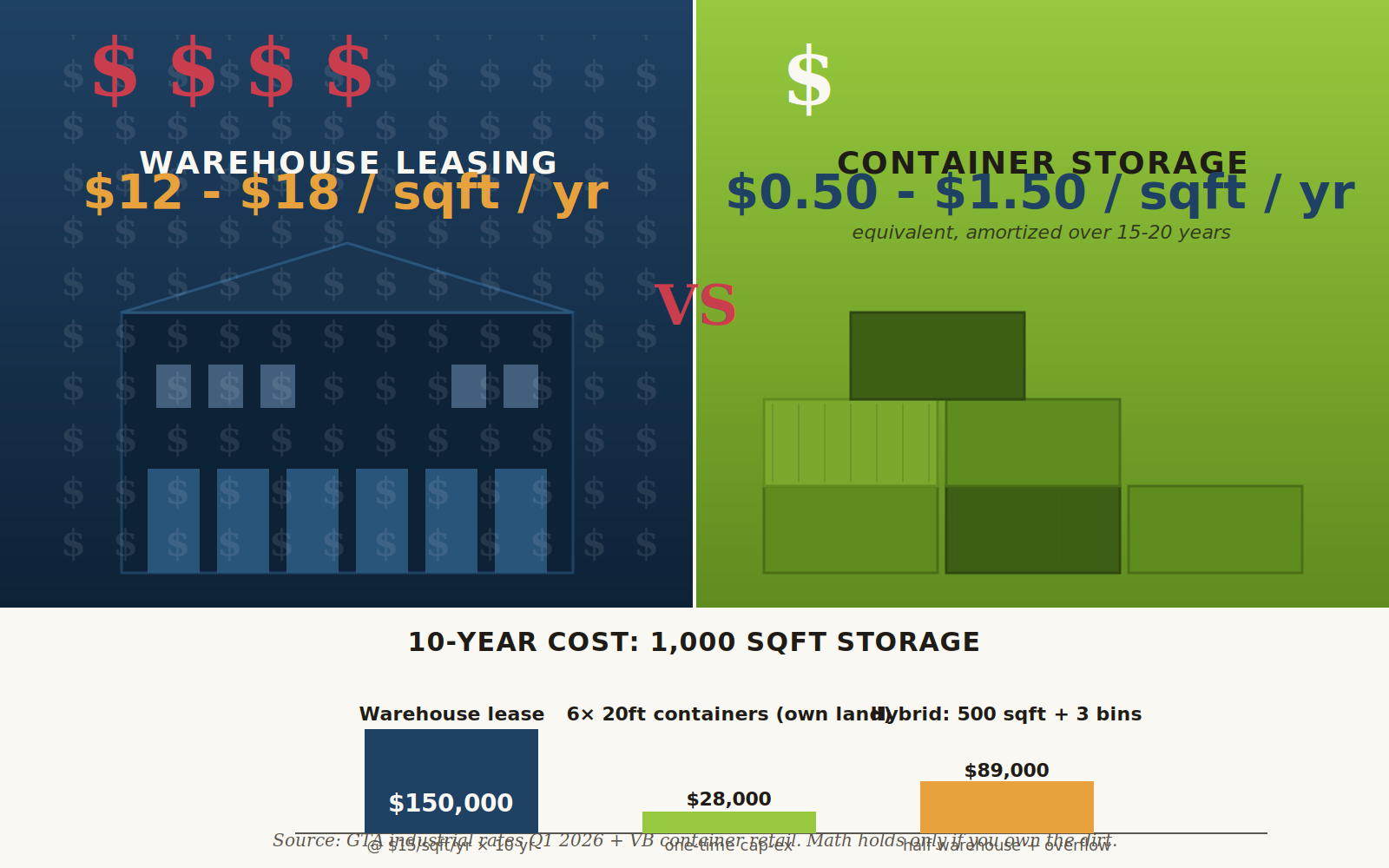
Here is the apples-to-apples math for a business that needs 1,000 square feet of dry storage in the GTA. We will run it three ways: pure warehouse, pure container, and hybrid.
| Scenario | Setup | Cost type | Recurs every year? | Builds an asset? | 10-year cost trend |
|---|---|---|---|---|---|
| Pure warehouse lease | 1,000 sqft @ base + TMI | Operating expense | Yes, plus 2 to 4 percent annual escalation | No | Rises year over year with escalation |
| Pure container (own land) | 6 × One-Trip 20ft = 960 sqft footprint | One-time capital expense + delivery | No, only occasional maintenance | Yes, you own the steel | Flat after purchase, lowest per-sqft over the decade |
| Pure container, used CW | 6 × Cargo Worthy 20ft = 960 sqft footprint | One-time capital expense (lower than One-Trip) | No, only occasional maintenance | Yes, you own the steel | Flat after purchase, lower entry cost than One-Trip |
| Hybrid: warehouse + bins | 500 sqft warehouse + 3 × 20ft One-Trip containers | Reduced lease + one-time cap-ex | Partly, only the smaller lease recurs | Partly, the container portion is owned | Lower than pure lease, escalation applies to less floor area |
The headline takeaway: pure-container storage on land you already own costs you a small fraction per square foot per year over a decade, while pure warehouse leasing costs many times that per square foot over the same decade, plus whatever the landlord adds at renewal time. The break-even point on a container purchase comes inside the first 18 months for most cap-ex scenarios.
Where the warehouse math gets worse
The per-square-foot warehouse figure assumes flat rent for 10 years. Real GTA leases include 2 to 4 percent annual escalation clauses. Run a 3 percent compound escalation against your starting rate and your year-10 occupancy cost is roughly 30 percent higher per square foot than where you started. A container does not have an escalation clause. Steel does not get more expensive to own once you have paid for it.
Do I Need to Own Land for Container Storage to Pay Off?
All of this math collapses if you do not own (or have long-term control of) the land the container is sitting on. That is the honest qualifier. Containers are not a magic warehouse-replacement product. They are a cap-ex storage solution for businesses that have outdoor yard space, an industrial-zoned lot, an acreage on the edge of town, or a back parking lot they can carve a bin row out of.
If you are renting your business premises and the landlord will not let you place containers on the property, the math does not help. You are back to leasing warehouse square footage, or you need to lease yard space somewhere that allows container placement, which exists in most Ontario industrial corridors but adds another lease line item.
What kind of land actually works in Ontario
The buyers who use containers as a warehouse alternative are almost always one of: a contractor with a service yard, a landscaping company with an equipment compound, a small manufacturer who owns their building and has back-lot space, a farm operation with acreage, a rural retailer with a parking lot that has unused corners, an event-rental business with off-season storage needs, or a multi-site operator who places one bin per site instead of leasing satellite warehouses. Urban downtown businesses with no yard are not the buyer for this.
The buyers who win this comparison are the ones who already control where the bin will sit: an owned industrial lot, a service yard, an acreage, or a back parking lot with corners to spare. If you have the ground, the math in this guide is yours to use. If you are renting your premises, square the placement with whoever owns the property before you order, then call the yard and we will help you pick the right size for the footprint you have.
Can I Run a Warehouse and Containers Together?
The smartest play for many growing GTA businesses is not pure-container or pure-warehouse. It is a hybrid. You keep a smaller warehouse footprint for the inventory that needs climate control, dock-level access, or order-picking workflow, and you put the overflow into containers on your yard.
This works because warehouse space is not fungible. The first 1,000 square feet of your warehouse is doing high-value work: receiving, shipping, picking, packing, climate-sensitive storage, finished-goods staging. The last 1,000 square feet is usually doing low-value work: seasonal stock, slow-moving inventory, backup equipment, archived files, returns awaiting disposition. That last 1,000 square feet is the worst dollar you spend each month, because you are paying full warehouse rate for storage that does not need a warehouse.
Pull that last 1,000 square feet out of your warehouse and put it in three or four 20ft containers on your yard. Your warehouse renewal conversation suddenly looks different. Instead of negotiating 3,000 square feet at fully loaded warehouse rates, you are negotiating 2,000 square feet. That is a full third of your warehouse occupancy cost back in your business each year, against a one-time container cap-ex. Year-two onward, the savings compound.
This is why pulling buffer stock out of a leased Mississauga unit, trimming a Brampton lease down to its working floor, and parking off-rack inventory beside an Etobicoke shop have become some of our highest-volume buyer categories. The pitch is not “replace your warehouse.” The pitch is “stop paying per square foot for inventory that does not need that real estate.” If you want to sanity-check the swing yourself, our rundown of what drives the number lays out the factors before you ever ask for a quote.
When Is Leasing a Warehouse the Better Choice?
Containers are not the answer for every storage problem. Warehouses keep their place in the cost stack for specific use cases:
Use cases where warehouse leasing still beats containers
- Climate-controlled inventory: pharmaceuticals, electronics, food-grade, fine art, archival paper. You can add insulation and HVAC to a container, but a properly conditioned warehouse with redundant HVAC, humidity control, and backup power is the right answer when the inventory genuinely requires it.
- Dock-level loading: if you are receiving full truckloads of palletized freight multiple times a week, you need dock doors and a dock-level floor. A container sits at ground level, which means you are forklifting from a tilt-deck delivery or moving pallets one at a time. Fine for low-velocity storage, painful for high-velocity throughput.
- Vertical stacking and racking: a 40ft High Cube container gives you 9’6″ of interior height. Modern warehouses give you 28 to 36 feet of clear height with engineered pallet racking. If your inventory wants to live three levels high on selective rack, you want a warehouse.
- Order-picking and fulfilment workflow: if you are picking individual SKUs for ecommerce orders, you need open layout, pick paths, and conveyor or cart access. A row of containers does not support that workflow.
- Office and showroom adjacency: warehouses can integrate office, showroom, and customer-facing space under one roof. Containers separate storage from operations.
The honest answer for many businesses is that they need some warehouse and some container storage. The warehouse handles the working inventory. The containers handle the buffer.
When Do Containers Beat a Warehouse Lease?
For the storage problems that are not the list above, containers usually win on cost, and they often win on convenience too.
Equipment storage is the most obvious win. A landscaping company storing mowers, blowers, trimmers, snow equipment, and a fleet of trailers does not need climate control or dock-level access. They need a secure, weather-tight box that locks at night. A 40ft High Cube container does the job at roughly a tenth of the per-square-foot cost of warehouse equivalence. Most landscape contractors we deliver to run three to six bins on their compound.
Seasonal inventory is the second obvious win. A retailer with Christmas decor that sits idle from January to October, or a pool company with off-season inventory, or an event-rental business with tents and tables, has expensive working capital sitting in space that costs warehouse rates. Move it to containers on your yard. Pull what you need when the season starts. The container is doing the same job a warehouse corner was doing, at a fraction of the cost.
Tool and supply storage for trades is the third. Plumbing supply, electrical, HVAC, drywall, framing crews all need lockable site or yard storage. A 20ft container bought outright is cheaper than five years of paying for warehouse corner space, and it can move to a job site if needed.
Real-world container-replaces-warehouse scenarios from our Brantford yard
A Cambridge auto-parts redistributor swapped a 4,000 sqft secondary warehouse for 12 × 40ft High Cubes on their main lot. One-time cap-ex, no recurring lease. Break-even point: 20 months. By year three, they were well into net savings, and by year five those savings had multiplied, with the bins still good for another decade.
A Hamilton landscape contractor stopped renewing a 1,500 sqft warehouse and put four 40ft containers on their yard for tools, equipment, and seasonal stock. A single one-time cap-ex replaced a recurring annual lease. The math worked in year two and kept working.
A St. Catharines wine-country event company runs six containers for off-season tent, table, and chair storage. They chose Used Wind & Watertight grades to keep the entry cost down. The one-time cap-ex replaced a recurring season of warehouse rental, and year one paid for itself.
What Is the Real ROI on Container Storage in 2026?
Here is what the actual return on investment looks like for the most common business cases we deliver to, with no marketing varnish.

| Business scenario | Container setup | Warehouse footprint replaced | Cost structure shift | Break-even point | Payback after break-even |
|---|---|---|---|---|---|
| Small contractor, 1 × 20ft One-Trip | 160 sqft footprint | Lockable 400 sqft warehouse corner | Recurring lease to one-time cap-ex | 10 months | Pure savings for the rest of the container’s 20+ year life |
| Landscape co., 4 × 40ft One-Trip | 1,280 sqft footprint | 1,500 sqft warehouse | Recurring lease to one-time cap-ex | 17 months | Savings compound every year after payback |
| Mid-sized distributor, 12 × 40ft HC | 3,840 sqft footprint | 4,000 sqft secondary warehouse | Recurring lease to one-time cap-ex | 20 months | Net savings multiply by year five, bins good another decade |
| Seasonal retailer, 3 × 20ft CW | 480 sqft footprint | Seasonal 750 sqft | Recurring lease to one-time cap-ex | 11 months | Off-season storage paid for, then free for years |
| Event rental, 6 × 20ft WWT | 960 sqft footprint | Off-season warehouse storage | Recurring lease to one-time cap-ex | 11 months | Year one pays for itself, then steady annual savings |
Two things hold all of these scenarios together. First, the business owned the land. Second, the inventory did not need climate control or dock-level workflow. When both are true, containers win the cost comparison decisively. When either is false, the math gets murkier and a warehouse is often still the right answer.
The Facebook scam pattern is worth a sentence here too, because every business owner running these numbers eventually sees a listing that looks too cheap. “Many people call us saying they can get a bin far below market on Facebook,” Christian says. “Two weeks later they call back saying they got scammed. The suspiciously cheap bin is the one that never arrives. We see the call-back every week. Don’t fall for it.” A real cap-ex savings comes from buying a real bin you can walk first, not from chasing a listing that does not exist.
Frequently Asked Questions
How does container cost per square foot compare to warehouse leasing?
Container storage on land you own runs a small fraction of warehouse rates per square foot per year when amortized over a 15 to 20 year container lifespan. GTA warehouse leasing carries a mid-teens per-square-foot base rent in 2026 plus another layer in TMI charges, putting its fully loaded annual cost per square foot far above what owning works out to. Containers win by 3x to 8x on raw cost when you own the dirt.
What is the break-even point for buying a container vs renewing a warehouse lease?
For most small business scenarios, the break-even point falls between 10 and 20 months. A One-Trip 20ft container replacing a year of equivalent warehouse storage pays for itself in about 10 months. A one-time cap-ex for four 40ft containers replacing a recurring annual warehouse lease pays back in 17 months. After break-even, every subsequent year is pure operating savings.
Do I need to own the land for container storage to make financial sense?
Yes, or have long-term control of it. The cost advantage of container storage depends on amortizing a one-time purchase against years of avoided lease payments. If you are renting yard space to put containers on, that lease line item eats into the savings. Pure-container math works for businesses with their own industrial lot, service yard, rural acreage, or back parking lot they can dedicate to storage.
How long does a shipping container last as business storage?
A One-Trip or Cargo Worthy container on land in Ontario lasts 20 to 25 years with minimal maintenance, sometimes longer. A Wind & Watertight grade lasts 15 to 20 years. Periodic surface-rust touch-up and door-seal maintenance extends the lifespan. Containers are built to survive ocean crossings, so a stationary land posting is the easiest job they will ever do.
Can I get climate control inside a shipping container?
Yes, with modifications. Spray-foam insulation to R-25 plus a wall-mount HVAC unit will give you climate-controlled storage inside a container. The modification cost per 20ft depends on the insulation spec and the HVAC unit you choose. For temperature-sensitive but not lab-grade storage, this is competitive with warehouse equivalence. For pharma or fine-art-grade conditioning, a purpose-built warehouse is still the safer answer.
What about pallet racking inside a container?
You can install single-level pallet racking inside a 40ft High Cube container, which gives you 9’6″ of interior height. You will not get the multi-level vertical stacking that a warehouse with 28 to 36 feet of clear height supports. If your inventory wants to live three levels high on selective rack, you want a warehouse. If single-level pallet storage works, containers are fine.
Does container storage hurt resale value of business property?
Generally no, especially on industrial-zoned land where containers are an expected use. On commercial or mixed-use properties, screened or fenced placement preserves curb appeal. Some buyers actually pay a small premium for industrial yards with established container storage because it signals the lot can support that workflow. Class 8 (20 percent declining balance) is the typical CCA class for storage containers used in business. Talk to your accountant for your specific situation, but the depreciation schedule still produces tax efficiency over a multi-year horizon compared to deducting lease payments.
How fast can Van Blanc deliver a container to my GTA business location?
1 to 3 days from our 4 Brantford yards to most of the GTA. Mississauga, Brampton, Etobicoke, Toronto, Vaughan, Markham, Oakville, Burlington all sit inside our standard 1 to 3 day window. Every quote comes with a real lead time, not a hopeful one. Tilt-deck delivery places the container exactly where you want it.
What if I need warehouse space now but expect to scale to containers later?
That is the right way to think about it. Many growing businesses start in leased warehouse space, then move overflow inventory to containers as soon as they have yard space. The phased move lets you keep dock access and climate control for working inventory while pulling buffer stock out of expensive square footage. This hybrid is the most common path among our larger business buyers.
Ready to price your container?
Tell us the size and your postal code and we’ll send back an honest, all-in number, container, delivery, and placement, usually within 1-3 days. No pressure, no mystery fees.
Family-run in Brantford since 1995 · 200+ containers in stock · 4.9★ across 140+ Google reviews · every box graded by a person, walk it before it lands.
Sources
- JoeRosati. (2026). Q1 2026 GTA Industrial Real Estate Market Report. joerosati.ca
- RENX. (2026). GTA industrial market shifts: Large users now have options. Real Estate News Exchange. renx.ca
- IBISWorld. (2026). Storage & Warehouse Leasing in Canada Industry Analysis. ibisworld.com
- Government of Canada, Canada Revenue Agency. (2025). Capital cost allowance (CCA) classes. canada.ca
- Statista. (2025). Warehouse rent in Canada by market. statista.com
- International Organization for Standardization. (2022). ISO 6346:2022 Freight containers, Coding, identification and marking. iso.org
Reach Van Blanc in Brantford
We have been supplying shipping containers across Ontario since 1995. Our warehouse is at 90 Morton Avenue E in Brantford, and we deliver right across the province on a cash-on-delivery basis. No surprise fees, no chase-the-paperwork.
Van Blanc Ent. Inc. · 90 Morton Ave E Unit 1B, Brantford, ON N3R 7J7 · 519-754-6844 or 1-888-509-6658
If you are running the warehouse-vs-container math for your business, come to our Brantford yard and walk a few bins before you decide. Worth the drive for unbeatable quality, family customer service with 30 years of experience.