
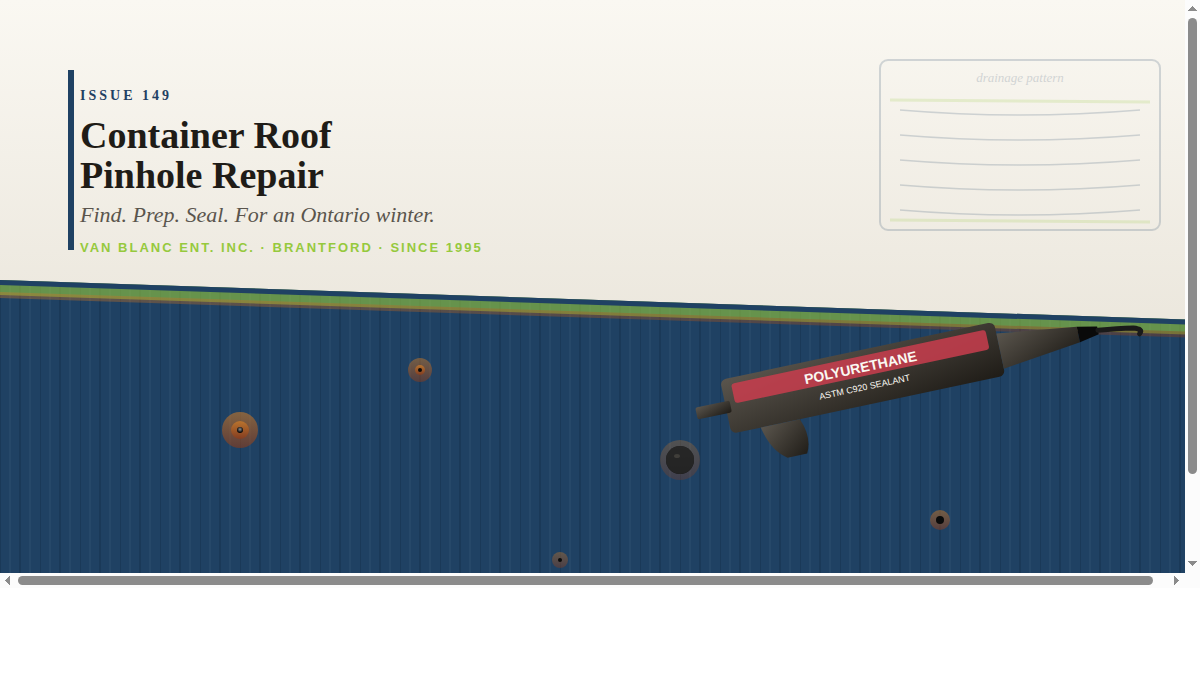
Quick Answer: Shipping container roof pinhole repair in Ontario starts with finding the hole from inside on a sunny day, wire-brushing the topside to bright steel, drying it, and sealing with a polyurethane sealant rated to ASTM C920 or an EternaBond tape patch. Most pinhole repairs use a handful of off-the-shelf materials and last 8 to 12 years, especially if you re-coat the roof seam line every five winters. Inspection standards from the Institute of International Container Lessors (IICL) classify anything under 6 mm as a pinhole rather than a structural perforation. Family-run since 1995, call the Brantford yard for a same-day quote tailored to your site.
In This Guide
- Why do pinholes appear on Ontario container roofs?
- How do you find a pinhole in a container roof?
- What surface prep makes a pinhole patch last?
- Which sealant is best for a container roof pinhole?
- How do you repair a container roof pinhole step by step?
- How is a container roof seam repair different from pinhole work?
- How do you prevent the next container roof pinhole?
- When does pinhole repair stop being enough?
- Which container grades show pinholes first?
- What drives the cost of a pinhole repair kit?
- FAQs
Reading Time: 14 minutes
Why Do Pinholes Appear on Ontario Container Roofs?
Pinholes appear on Ontario container roofs where three forces meet over one spot: surface rust pooling in a corrugation trough, a dent that flexes the steel, and worn factory primer. Ontario freeze-thaw cycling then widens the pit. On a neglected used roof, the first pinhole shows in roughly a decade.
A shipping container roof is a single sheet of 1.6 to 2 mm Corten steel folded into shallow corrugations that drain rain toward the side rails. That sheet is thinner than the side walls (2 mm) and thinner than the floor cross-members (4 mm and up), so the roof is the part most exposed to slow weather-cycling.
Pinholes form where three forces meet: surface rust in one of the corrugation troughs where rainwater sits longest, a dent from a forklift fork or stacked corner-casting that flexes the same spot through hundreds of freeze-thaw cycles, and the original factory primer wearing off after ten to fifteen years of UV exposure. When those three forces line up over a single square centimetre of steel, the first slow drip starts.
Ontario climate accelerates this. Brantford sees roughly 70 freeze-thaw cycles a winter, the daily oscillation across 0 Celsius. Water seeps into a tiny pit, freezes overnight, expands roughly 9 percent, and pries the pit slightly wider. Repeated 70 times in a winter, the pit grows into a visible pinhole within about a decade on a neglected WWT-grade container. One-trip containers with intact factory paint can run 25 years before the same process starts. A real pinhole the size of a pencil tip is a 30-minute repair if you catch it early.
Christian LeBlanc, second-generation operator: “Almost every roof leak we get called about started as a pinhole somebody walked past two springs in a row. I grew up in this trade, and the lesson is the same every time: the steel is rarely the problem. The owner who checks the roof each April catches a pencil-tip hole. The one who waits ends up replacing a roof sheet.”
That early-catch habit is the whole game. The same logic runs through every step in our year-by-year care routine for Ontario owners: small, cheap, on-schedule work beats a big repair bill later. Now to the practical question every owner asks next.
What a “pinhole” actually means in container terms
In the industry, “pinhole” means a hole smaller than a Bic pen cap, typically 1 to 4 mm across: it leaks but does not affect structural integrity. Holes larger than 6 mm are “perforations” and trigger a Wind & Watertight failure on inspection. Anything larger than a thumbnail needs a welded steel patch. Our roof-coating and repair walkthrough covers the larger-hole patching workflow.
How Do You Find a Pinhole in a Container Roof?
You find a container roof pinhole with one of three methods: the sun test, the water test, or the soap test. Most owners notice a roof problem the same way: a wet spot on the floor, a damp box in the corner, a faint mildew smell after rain. The leak point is rarely directly above the puddle. Water runs down a corrugation, hits a side rail, travels along the rail to a low spot, then drips. The pinhole can be 8 feet from where the water lands.
Method 1: Sun test (fastest)
On a bright Ontario afternoon, walk inside the container and close the doors. Stand still two minutes to let your eyes adjust. Pinholes show as bright pinpoints of daylight on the ceiling. Mark each one with painter’s tape on the inside ceiling, then locate the matching spots on the topside from outside. A single 20ft container often shows three to seven pinholes.
Method 2: Water test (when sun is uncooperative)
On an overcast day, spray the roof with a garden hose in slow zones, working high to low. A helper inside with a flashlight marks where drips appear. Slower than the sun test but works in fall and winter.
Method 3: Soap test (for borderline pinholes)
For pinholes too small to see during the sun test but suspected from a small leak, brush a 1:10 dish-soap-and-water solution on the suspect topside area, then pump gentle compressed air against the suspect spot from inside. Bubbles form where air escapes. Borrowed from automotive radiator pressure-testing.
Mark every pinhole before you start sealing
The single biggest DIY mistake is sealing one pinhole, declaring victory, and finding three more after the next rain. Walk the whole roof, do the sun test or water test in full, mark every leak with weather-resistant tape (gaffer, not painters’) before you mix a drop of sealant. Treat the whole roof at once.
What Surface Prep Makes a Pinhole Patch Last?
Surface prep is the single factor that decides whether a container roof pinhole patch lasts a decade or fails in a season. Polyurethane adheres to clean, bright, dry steel. It does not adhere to rust, paint flakes, dirt, or moisture. Prep is where most amateur patches fail within two seasons. Christian sees the same pattern at the yard every spring: a container sealed last year, the sealant hanging in flakes, the pinhole leaking again. The fix went onto rust instead of steel.
Tools for proper prep
- Wire brush on an angle grinder (4.5-inch, twisted-knot cup): fastest way to reach bright steel. A 5 cm radius each hole is the minimum prep zone.
- 120-grit emery cloth: final pass to remove micro-rust and add grip texture.
- Acetone or methyl hydrate: final degrease wipe.
- Clean cotton rags: lint-free, for the degrease step.
- Compressed air: blow out the pinhole itself or you trap dust and the seal fails from the inside.
Step-by-step prep
- Grind a 10 cm circle each pinhole to bright steel (shiny gray, not orange).
- Sand with 120-grit emery cloth to remove tool marks.
- Blow out the pinhole with compressed air or hard puffs through a soda straw.
- Wipe with an acetone-dampened rag. Flash-dry one minute.
- Weather window: 4 hours above 10 Celsius, no rain forecast for 24 hours.
Why factory primer is not enough on its own
New containers leave Asia with a thin red-oxide primer plus two coats of marine enamel. That primer is designed for the 30-day ocean voyage and the first three to five years of service. By the time a container reaches WWT grade (typically 10 to 15 years old in Ontario inventory), the original primer is gone in patches and the steel underneath needs the prep-and-seal cycle described here. ISO 6346:2022 governs container markings but not roof coating, which is left to the owner.
Which Sealant Is Best for a Container Roof Pinhole?
The best sealant for a container roof pinhole is a polyurethane caulk meeting ASTM C920 for scattered single holes, with EternaBond tape for clustered or seam-line holes. The Ontario hardware shelf has dozens of products that could theoretically seal a container pinhole. Most are wrong for steel-on-steel marine-grade work. Here is the short list that actually performs in Brantford’s freeze-thaw climate.
| Product type | Ontario brand example | Pinhole size | Expected life | Best application |
|---|---|---|---|---|
| Polyurethane sealant (ASTM C920) | DAP Premium Polyurethane (Home Depot Canada) | Up to 4 mm | 8 to 12 years | The everyday workhorse for scattered single pinholes |
| Self-adhesive bituminous tape | EternaBond RoofSeal, Henry Blueskin | Up to 8 mm or seam length | 10 to 15 years | Clustered holes along a corrugation or roof-to-rail seam |
| Elastomeric roof coating | Kool Seal Elastomeric (Home Depot Canada) | Up to 2 mm (preventive) | 5 to 7 years per coat | Aging WWT roof: seals the whole topside at once |
| Two-part epoxy putty | JB Weld SteelStik, Permatex Cold Weld | Up to 6 mm | 15 to 25 years | A single isolated hole where you want the longest life |
| Cold-galvanizing spray (primer) | ZRC Cold Galvanizing Compound | Not a sealer, a primer | 3 to 5 years | First coat over fresh-ground steel before the sealant goes on |
Polyurethane sealant: the workhorse
For 80 percent of Ontario container pinholes, polyurethane sealant in a caulking-gun cartridge is the right answer. It cures by reacting with moisture, stays flexible through freeze-thaw, bonds to clean steel, accepts paint after 7 days. Look for products meeting ASTM C920. DAP Premium Polyurethane is the most common in-stock option at Home Depot Canada, and one cartridge covers eight to twelve pinholes.
EternaBond and bituminous tape: for seams and clustered holes
When pinholes cluster along a corrugation or follow the roof-to-rail seam, individual cartridge work gets tedious. EternaBond is a self-adhesive rubberized strip in 2-inch and 4-inch widths on 50-foot rolls. Clean with acetone, peel-and-stick, roll firmly with a J-roller. Henry Blueskin is the Canadian equivalent.
Elastomeric roof coating: the whole-roof option
For an aging WWT roof where pinholes keep appearing, brush-on or roll-on elastomeric coating turns the entire roof into a continuous waterproof membrane. Kool Seal at two coats extends roof life 5 to 7 years and pre-empts holes you have not yet found. Downside: it takes more product than spot work and two dry days with no rain.
JB Weld: the workshop pick
For a single isolated pinhole, two-part epoxy putty offers the longest service life (15 to 25 years) but is awkward over a row of holes. Knead the stick 60 seconds, press into the prep zone, cure 24 hours. Heat resistance to 260 Celsius handles summer roof temperatures.
Cold-galvanizing spray: the prep partner
ZRC Cold Galvanizing Compound is a zinc-rich spray that re-establishes the sacrificial galvanic protection of the original factory primer. Not a sealant by itself but a good first coat over a freshly ground prep zone before polyurethane goes on. The zinc layer keeps rust from creeping back under the patch.
How Do You Repair a Container Roof Pinhole Step by Step?
A container roof pinhole repair runs over one working day plus a cure week: find and mark, grind to bright steel, sand and degrease, prime, seal, then cure. The full sequence below assumes a polyurethane-sealant repair on a typical Ontario WWT 20ft container with three to five pinholes.
- Morning: Sun-test inside the container. Mark every pinhole with painter’s tape inside, then transfer the marks to the topside.
- Mid-morning: Climb the roof (step on corrugation ridges, not troughs). Grind each prep zone to bright steel with a wire-brush cup wheel.
- Late morning: Sand each prep zone with 120-grit emery cloth. Blow out the pinholes with compressed air.
- Noon: Wipe each prep zone with acetone. Let flash for one minute.
- After lunch: Optional but recommended, spray ZRC cold-galvanizing primer on each prep zone. Cure 30 minutes.
- Afternoon: Apply polyurethane sealant. Press a bead directly over each pinhole, tool the edges with a gloved finger. The bead should sit about 3 mm proud of the steel and span 4 cm around the pinhole.
- End of day: Cover with plastic if rain is forecast within 4 hours. Polyurethane needs 4 hours to skin over.
- Days 2 to 7: Cure phase. No heavy weather or hose-down. Full cure is reached at 7 to 14 days depending on temperature.
- Day 8: Inspect with a fingernail. The patch should feel firm, slightly rubbery, fully bonded. Paint with rust-inhibiting enamel for UV protection.
- Year 5: Walk the roof, re-seal any patch perimeters that look feathered or cracked.
Save money on prep tools
If you do not own an angle grinder, a corded model from Canadian Tire handles all the prep work plus a dozen other yard jobs. One good twisted-knot wire cup brush lasts ten times longer than the cheap radial type, so it is worth paying for the better one. A basic prep-tool kit pays for itself the first time it keeps a patch from failing.
How Is a Container Roof Seam Repair Different From Pinhole Work?
A container roof seam repair follows the same prep-and-seal logic as a pinhole, but it covers far more linear distance along the welded roof-to-rail joint, so tape often beats cartridge work. Most container roof leaks that owners blame on pinholes are actually seam leaks. The roof sheet is welded to the top rail along the two long edges, the longest weld on the container and the one most exposed to stacking and trucking flex. After 15 to 20 years, fatigue cracks open and water finds a path down the wall into the box.
Seam repair follows the same prep-and-seal logic but covers more linear distance:
- Under 6 inches and dry: grind, prep, bead polyurethane sealant, tool a clean line.
- More than 6 inches or multiple discontinuities: grind, prep, apply EternaBond RoofSeal tape over the full length plus 6 inches of overlap each end. J-roll firmly.
- Visible rust scaling, roof sheet delaminating from the rail: welded re-attachment is the only durable answer. Expect an Ontario repair shop to quote a mig-welded 10-foot seam by the length of weld and the prep involved. Van Blanc’s network includes Brantford and Hamilton shops that handle this.
Why welding the roof is not always the right answer
A welded patch is the strongest repair, but it requires removing or protecting cargo (spatter ignites paper and fabric), leaves a heat-affected zone that needs touch-up paint, and costs five to ten times what a polyurethane bead costs. For pinholes and short seam cracks, sealant or tape balances durability and effort better.
How Do You Prevent the Next Container Roof Pinhole?
You prevent the next container roof pinhole with a five-step Ontario routine: a spring inspection, a drainage check, touch-up paint every five years, a seam re-coat every seven to ten, and snow-load awareness. Owners who follow it see their first pinhole 10 to 15 years later than owners who ignore the roof.
- Spring inspection (mid-April): Walk the roof after snow melt. Look for paint blisters, rust streaks running down the side walls, and seam fatigue.
- Drainage check: Container roofs drain to the side rails. Clear leaves, twigs, and bird nests from the rail gutters so water does not sit on the corrugation.
- Touch-up paint every five years: Wire-brush rust spots, prime with ZRC, top-coat with marine enamel.
- Seam re-coat every seven to ten years: Fresh polyurethane or EternaBond on the roof-to-rail weld before cracks open. Prevention beats repair.
- Snow load awareness: Container roofs handle roughly 300 kg per square metre, well over Ontario’s heaviest winter, but a packed ice cap adds freeze-thaw stress. Broom heavy drifts after big snow events.
What Ontario weather does that other climates do not
Brantford sees roughly 1,500 mm of annual precipitation, 70 freeze-thaw cycles, and humidity swings from 30 percent in February to 90 percent in August. That mix is harder on container roofs than the dry-cold of Saskatchewan or the warm-humid of Florida. A WWT container that lasts 30 years in Phoenix may last 18 in Brantford without preventive maintenance. Preventive maintenance is cheap, and the coating, rather than the steel, is the limiting factor.
When Does Pinhole Repair Stop Being Enough?
Pinhole repair stops being enough once a 20ft roof passes about 15 holes, a perforation grows larger than a thumbnail, or the roof sheet starts sagging: at that point welding or replacement beats more patches. Sealant and tape handle small holes and short seam cracks. At some point the roof has so many failure points that piecemeal work stops making sense:
- More than 15 pinholes on one 20ft roof: the steel is past WWT and into As-Is. Replace the roof or the container.
- Perforation larger than a thumbnail: sealant cannot bridge the gap. Weld in a steel patch.
- Roof sheet sagging between corrugation peaks: structural failure. End of life as weatherproof storage.
- Rust scaling that flakes in palm-size pieces: the steel under the scale is wafer-thin. Patching only delays the inevitable.
- Seam crack longer than 24 inches: tape will work short-term but the underlying weld is failing. Plan for welded re-attachment.
Paul’s rule of thumb: if the pinhole repair list runs longer than a half-page, the math favours selling the old container for As-Is salvage and rolling the cash into a Cargo Worthy upgrade. That comparison usually saves three years of repeated patches.
Paul LeBlanc, owner: “I watched the same 20ft sea can sit on a Norfolk farm for 22 years through everything Ontario could throw at it. The farmer painted the roof every five years with the same bucket of marine enamel. Two decades, in paint, an afternoon a year. The container next to his, owned by the neighbour who never touched it, was scrap-yard ready at 14 years. Same steel. Maintenance is everything.”
Which Container Grades Show Pinholes First?
Container grade decides how soon and how often pinholes appear: As-Is and Wind & Watertight roofs show them first, Cargo Worthy later, and one-trip steel latest of all. Match the grade to the use case:
| Grade | Typical age at purchase | Expected first pinhole | Annual pinhole rate after year 10 | Right use case |
|---|---|---|---|---|
| One-Trip (essentially new) | 0 to 1 year | 15 to 20 years | 0 to 1 per year after age 20 | Office, retail, residential conversion, premium storage |
| Cargo Worthy (CW) | 8 to 12 years | 3 to 8 years from purchase | 1 to 3 per year after age 15 | High-density storage, export, working farm, contractor yard |
| Wind & Watertight (WWT) | 12 to 18 years | Possibly present at purchase | 2 to 5 per year | Farm storage, household reno storage, equipment shelter, low-stakes use |
| As-Is | 20+ years | Already present, multiple | 5+ per year | Cladding, scrap metal, modification donor, structural reuse |
The takeaway: starting on a roof that has only crossed the ocean once buys a 15-to-20-year head start on pinhole work, with the longest service life and the best resale value down the road. WWT delivers the steel-shell value cheaply but you should budget for pinhole repair as part of ownership. As-Is is a bargain only if pinholes do not matter for your use.
Reefer container ceilings drip differently
Refrigerated containers have an insulated ceiling: 75 mm of polyurethane foam between two thin steel skins. A reefer drip usually means a damaged outer skin, water tracking through the foam, condensation on the inner skin. Outside-only sealing will not fix it; the inner skin needs to be opened, the foam dried, then both sides resealed. Our guide to refrigerated unit care and power needs covers what changes once a roof has foam behind it.
What Drives the Cost of a Pinhole Repair Kit?
The cost of a pinhole repair kit is driven by how many holes you have, whether there is a seam crack to tape, and whether you are buying reusable tools or only consumables. A 20ft WWT roof with five pinholes and a 4-foot seam crack needs the materials below, all stocked at Home Depot Canada, Canadian Tire, and Princess Auto. What you spend depends on how many products the job calls for and whether you are buying tools you will reuse for years.
| Item | Where to buy | What it covers on this job |
|---|---|---|
| DAP Premium Polyurethane (300 mL, 2 cartridges) | Home Depot Canada | Seals all five pinholes with one cartridge to spare |
| EternaBond RoofSeal tape (4-inch by 10-foot) | Amazon Canada or roofer supply | Covers the 4-foot seam crack plus overlap |
| 120-grit emery cloth pack | Canadian Tire | Final sanding pass on every prep zone |
| Acetone (1 L) | Home Depot Canada | Degrease wipe before sealing, with plenty left over |
| ZRC Cold Galvanizing Spray (1 can) | Home Hardware | Zinc primer coat over each ground prep zone |
| Twisted-knot wire cup brush (4.5-inch) | Princess Auto | Grinds to bright steel and lasts many jobs |
| Caulking gun | Canadian Tire | Dispenses the sealant cartridges, reusable |
| Whole kit (excluding grinder) | Various Canadian retailers | Everything needed for a five-pinhole, one-seam repair |
For a single-pinhole job without the seam, drop the EternaBond and the second cartridge and your material list shrinks to a single tube of sealant, some emery cloth, and acetone. A five-pinhole roof using polyurethane alone stays inexpensive, and the work itself takes an afternoon. A pro repair-shop roof-section weld-in costs many times more than the materials. For small problems, the DIY math is obvious.
What we keep in the yard kit at Brantford
We keep a sealant kit at the yard: two cartridges of polyurethane, a small roll of EternaBond, a wire brush, and a tube of acetone wipes. The kit handles minor pinhole work that a customer points out while walking the row, and it has saved more than one customer the cost of a return trip. If you see a pinhole during your in-yard inspection at Brantford, we will usually spot-seal it before the box goes on the tilt-deck for delivery. Worth the drive, every time.
The pinhole problem and the Facebook trap
Pinhole work is one of the places where the Facebook Marketplace scam shows up most often. The listing photo shows a clean roof. The seller is suspiciously cheap. The buyer wires a deposit. The container that arrives (if it arrives) has 20 pinholes the seller knew about and never mentioned.
Paul LeBlanc, owner: “Many people call us saying they found a bin far cheaper on Facebook. Two weeks later they call back saying they got scammed, or the bin arrived and the roof is a colander. Walk our Brantford yard before you pay a dollar. Look at the roof, run a hand along the seam, stare at the ceiling. Every defect we find, we will tell you about. The Facebook listing will not.”
Van Blanc has been the family-run alternative to pool suppliers since 1995. Real Brantford yard, real Paul or Christian on site, quotes in plain language. For the full pattern of wire-fraud deposits and vanishing sellers, read how we spot a deposit-fraud listing before you wire a dollar.
Ready to price your container?
Tell us the size and your postal code and we’ll send back an all-in number, container, delivery, and placement, usually within 1-3 days. No pressure, no mystery fees.
Family-run in Brantford since 1995 · 200+ containers in stock · 4.9★ across 140+ Google reviews · every box graded by a person, walk it before it lands.
What Other Maintenance Lives Next to Pinhole Repair?
Pinhole repair is one task in a broader Ontario ownership routine that also covers hinge and lock lubrication twice a year, floor sealing every five years, condensation control, and a full topside repaint every decade. The companion piece on keeping rust and condensation in check ties those jobs together on one calendar. For owners weighing whether to coat the whole topside rather than chase individual holes, the deeper look at coatings, snow load, and secondary roofs lays out the strategy. Buyers still choosing a grade to start with can run through how to inspect a roof and seams before you pay for CSC plate checks and grade definitions.
Frequently Asked Questions
What is the best sealant for a shipping container roof pinhole in Ontario?
A polyurethane sealant meeting ASTM C920 (DAP Premium Polyurethane at Home Depot Canada) is the workhorse for pinholes up to 4 mm. It stays flexible through freeze-thaw, bonds to clean steel, and lasts 8 to 12 years. For clustered holes along a seam, EternaBond RoofSeal tape is the better option.
How do I find a pinhole in my container roof?
Walk inside on a sunny day, close the doors, let your eyes adjust two minutes. Pinholes show as bright pinpoints of daylight. Mark each with painter’s tape inside, then locate the matching spots topside. On overcast days, run a garden hose while a helper inside watches with a flashlight.
Can I use silicone caulk on a container roof?
You can, but polyurethane lasts longer on steel. Silicone bonds well to glass and tile but peels from steel after a few freeze-thaw cycles. Use polyurethane for steel-on-steel work; reserve silicone for window or skylight installs where it borders a non-metallic surface.
How long does a container roof pinhole repair last?
Polyurethane on properly prepped steel lasts 8 to 12 years. EternaBond tape lasts 10 to 15. JB Weld epoxy putty lasts 15 to 25 on a single hole. The limiting factor is prep; a patch on rusty steel can fail in one season.
Do I need to grind the roof before applying sealant?
Yes, non-negotiable. Polyurethane adheres to clean, bright steel and not to rust or paint flakes. Grind a 10 cm circle each pinhole to shiny steel, sand with 120-grit emery, then degrease with acetone. Skipping any step cuts patch life by 60 to 80 percent.
Can I repair a container roof in winter in Ontario?
Polyurethane cures down to about 4 Celsius given a week of dry weather. Below that, prep is harder and the sealant may skin without curing through. Best practice is May through October. For winter emergencies, EternaBond tape over a wire-brushed surface warmed with a heat gun is a workable bridge.
How much does professional container roof pinhole repair cost in Ontario?
A mobile container-repair technician in southern Ontario typically charges a service call plus a per-pinhole rate, so the total scales with how many holes you have and how far the truck travels. Doing it yourself costs only the materials, which is a fraction of a pro visit for a handful of pinholes. Hire out when the container sits on a job site you cannot spare for a day, or when you want a warranty on the work.
Will pinhole repair affect my container’s CSC plate?
For storage-grade use in Ontario, no. The CSC plate certifies international shipping; sealant patches do not affect inland storage status. For containers going back into international service, only welded steel patches by an IICL-approved shop maintain CSC certification.
Should I paint over the pinhole patch?
Yes, for cosmetic and UV protection. After 7 days of cure, apply marine-grade enamel matching the container colour. Polyurethane accepts paint well, and paint shields it from UV degradation (the main long-term failure mode for exposed polyurethane).
Does Van Blanc offer pinhole repair on the containers we sell?
Yes. We keep a sealant kit at the Brantford yard and spot-seal any pinhole noted at the in-yard inspection before the box ships. For older WWT or As-Is with multiple pinholes, we work with two Brantford shops that handle seam welds and roof-section replacements. Walk our yard, point out anything, get a real quote.
Sources
- ASTM International. (2018). ASTM C920-18 Standard Specification for Elastomeric Joint Sealants. astm.org/c0920-18.html
- International Organization for Standardization. (2022). ISO 6346:2022 Freight containers: Coding, identification and marking. iso.org/standard/82754.html
- The Roof Repair Guys. (2024). How to Patch a Leaky Shipping Container Roof. theroofrepairguys.com
- Home Depot Canada. (2026). DAP Premium Polyurethane Sealant product specifications. homedepot.ca
Reach Van Blanc in Brantford
We have been supplying shipping containers across Ontario since 1995. Our warehouse is at 90 Morton Avenue E in Brantford, and we deliver right across the province on a cash-on-delivery basis. No surprise fees, no chase-the-paperwork.
Van Blanc Ent. Inc., 90 Morton Ave E Unit 1B, Brantford, ON N3R 7J7. Call +1 888-509-6658.
If your roof is starting to weep or you want a Cargo Worthy upgrade rather than another season of patching, walk our Brantford yard. Paul or Christian will open the doors, point a flashlight at the ceiling, and give you a straight read on pinholes, seams, and remaining service life. Worth the drive for unbeatable quality and family customer service with 30 years of experience.