
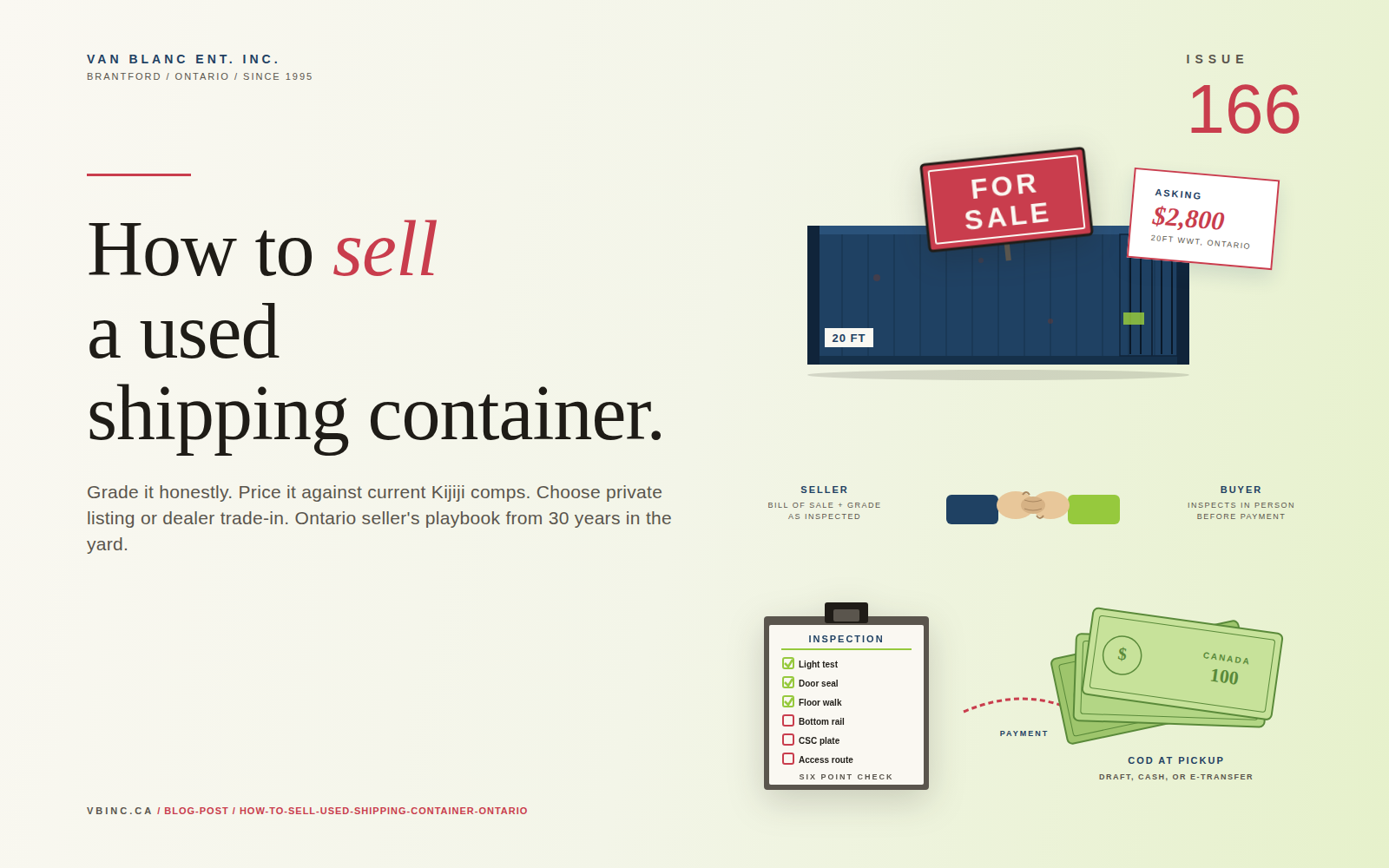
Quick Answer: To sell a used shipping container in Ontario, grade it honestly, price it against current Kijiji comps, and choose a private listing or a dealer trade-in based on your timeline. What your box fetches depends on its grade, its size, and how easily a truck can reach it. Pricing varies by grade, size, and freight zone, so call Christian or Paul for a same-day read on the number. Family-run since 1995, 4.9 stars across 140+ verified Google reviews. Delivery in 1-3 days from our 4 Brantford yards.
In This Guide
- Where should I start when selling a used shipping container in Ontario?
- How do I grade a used shipping container before I sell it?
- How do I price a used shipping container against Ontario comps?
- Should I sell my container on Kijiji or Facebook Marketplace?
- When does a dealer trade-in beat a private listing?
- What should my used container listing actually say?
- What photographs do I need to sell a used container?
- What will a buyer inspect when they visit my container?
- How does payment and paperwork work when selling a container?
- Who arranges pickup and delivery after the container sells?
- FAQs
Reading Time: 14 minutes
Where should I start when selling a used shipping container in Ontario?
Selling a used shipping container in Ontario takes three steps in order. Grade the box honestly against the four industry standards, price it against current Kijiji comps in your region, then pick a channel: a private listing for the top of the market, or a dealer trade-in for speed. Get the grade wrong and every later step inherits the error.
Most of the people who phone Van Blanc about selling a used shipping container start the call the same way. They bought a 20ft for the back of the property eight years ago. The reno wrapped, the equipment moved on, the kids grew up, and the bin is taking up space they want back. They want a number. They want to know what it is worth in Ontario in May 2026, not what it cost when they bought it, and they want to know which listing channel will move it fastest without dragging them into a scam.
That phone call is the same one Christian fields three or four times a week. Sellers are usually somewhere between confused about the grade and worried about the price. Some have been quoted scrap money by a salvage dealer for a box that still carries real resale value in retail. Others have been told their 1998-vintage Wind and Watertight 20ft is worth a premium because someone showed them a Facebook screenshot. Both numbers are wrong. The work of selling a used bin in Ontario starts with knowing where the truth actually lives, and that is the work this guide does.
Van Blanc has been supplying shipping containers across Ontario since 1995. Paul started the business after four decades in Asian trade. Christian grew up in the yard and runs the second-generation operation now. We sell new and used bins every week and we also buy back containers from customers who are downsizing, retiring out of a property, or clearing an estate. That dual perspective is what the advice below is built on. We see what listings actually move at, we see what dealers actually pay, and we see what buyers actually walk away from at the inspection. For the full pricing picture behind every number here, our deeper breakdown on how Ontario resale prices are actually set walks through grade, size, and freight one factor at a time.
Christian LeBlanc, second-generation operator: “When someone calls about selling a used box, the first thing I ask is not what they want for it, it’s what condition the doors and the floor are in. Sellers come in convinced their bin is worth more than it is, or worth less than it is, and almost nobody has graded it honestly first. Get that right and the price answers itself.”
What this guide will not do
It will not promise you a number on your specific box. Price depends on grade, modifications, location, road access, and the week of the year. It will give you the framework to figure out the number yourself, and it will tell you which channels to use to find a real buyer. If after reading you want a real quote on a trade-in to Van Blanc, call us with photos and we will give you a written offer the same day.
How do I grade a used shipping container before I sell it?
To grade a used shipping container before selling, walk it against the four Canadian industry standards and let its real condition, not its age or its purchase price, set the tier. The single most expensive mistake Ontario sellers make is listing a Wind and Watertight container as if it were a Cargo Worthy one, or a Cargo Worthy as if it were one-trip. Buyers in 2026 are sharper than they were five years ago. They have read the same Reddit threads and YouTube tear-downs as everyone else, and they will walk a bin in person before they pay. If the listing said CW and the bin reads WWT at inspection, the deal collapses and your phone fills up with new tire-kickers starting from zero.
Grade your box honestly against the four standards the Canadian industry actually uses. One-Trip is essentially new: one ocean crossing from the manufacturer in Asia to a North American port, original factory paint, doors close cleanly, minor cosmetic scuffs from the single voyage. Cargo Worthy is a re-inspected used unit certified for further international shipping, with surface rust spots, paint variance, and occasional small dents but a structurally sound frame and floor. Wind and Watertight is weather-resistant and rodent-proof but no longer certified for ocean shipping. Doors close and seal, no light leaks through the roof or sidewalls, but visible cosmetic wear on the panels. As-Is is the lowest tier: structural questions on the floor or door operation, sold cheap for cladding, scrap value, or modification donor work.
Walk your container before you photograph it. Open both doors and look up at the roof from inside. Daylight through any panel pulls the box down a grade. Step on the floor and look for soft spots. Look at the door gaskets, the lockboxes, and the corner posts. Run your hand along the bottom rail and see how much rust scale comes off. None of these checks needs a professional. They take fifteen minutes and they save you the embarrassment of having a buyer point them out at the inspection.
Quick self-grade walk
- One-Trip: Original factory paint, single port-to-port voyage, no rust, doors swing clean, sealed CSC plate within 5 years.
- Cargo Worthy: Multiple crossings, surface rust spots, small dents, frame sound, floor flat, CSC valid or recently expired.
- Wind and Watertight: Visible cosmetic wear, no daylight through panels, doors seal, suitable for storage only, CSC may be expired.
- As-Is: Floor damage, door issues, or structural questions. Sold for parts, cladding, or modification donor.
If your box has been sitting on grass or dirt for years instead of railway ties or sleepers, look at the bottom rail closely. Ground contact is the single fastest way to drop a container from CW to WWT or from WWT to As-Is. The rust starts at the rail, eats inward through the corrugated sidewall, and once a panel pits through, the grade is gone. A bin that lived on proper sleepers under a tarp will read a full grade higher than the same bin that lived flat on muddy ground for a decade.
How do I price a used shipping container against Ontario comps?
To price a used shipping container against Ontario comps, find listings of the same size and grade in your region, watch which ones actually move, and land your number inside that moving cluster. Once you have the grade, the second step is pricing. The Ontario market in May 2026 sits in a known range per grade, and the spread between tiers is what you need to understand. Used 20ft WWT bins occupy the value end of the Kijiji private listings, with the high end of that band reserved for clean panels and recently-replaced door gaskets. A 20ft Cargo Worthy sits a step above WWT because it still holds a valid inspection. A 20ft One-Trip in clean stock commands the top of the 20ft range, swinging with the time of year. The 40ft High Cube runs higher again, with a clear gap between used WWT stock and fresh one-trip units. Refrigerated containers, called reefers, hold their value differently and need their own conversation because a working condensing unit carries a meaningful premium over the dry-container price.
The comp work matters. Open Kijiji and search “used 20ft shipping container” or “40ft container for sale” with your region filter set. Note the asking prices, the photo quality, and the days the listing has been up. A listing that has sat for 90 days with stale photos is not a comp, no matter what number it carries. A listing that closed in two weeks with clear inspection photos is a comp. Adjust your asking price to land in the cluster of moving listings, not the asking-price ceiling of stale ones. If you want to sanity-check the band before you post, our step-by-step worksheet for estimating a used container’s value walks the same grade-size-freight inputs we use in the yard.
| Size and grade | Where it sits in the resale range | Dealer trade-in vs private retail | Best channel |
|---|---|---|---|
| 20ft One-Trip | Top of the 20ft band, near-new condition | 20 to 30 percent below private retail | Kijiji or Facebook Marketplace |
| 20ft Cargo Worthy | Upper-middle, valid CSC holds value | 20 to 30 percent below private retail | Kijiji |
| 20ft Wind and Watertight | Value end of the 20ft band | 20 to 30 percent below private retail | Kijiji |
| 40ft Standard or High Cube One-Trip | Top of the 40ft band, biggest spread over WWT | 20 to 30 percent below private retail | Kijiji or dealer |
| 40ft High Cube WWT | Value end of the 40ft band | 20 to 30 percent below private retail | Kijiji |
| As-Is any size | Lowest tier, priced as parts or scrap | Scrap value, sold direct | Direct to dealer or scrap |
| Reefer (refrigerated, working) | Dry price plus a working-unit premium | 20 to 30 percent below private retail | Direct to refrigerated specialist |
Two factors shift the price in either direction. Modifications are the first. A bin with a man-door cut in correctly, vents added, or interior lining installed can lift the value if the work was done by a professional, the kind of clean conversion we build at our Brantford yard under engineered drawings before a box leaves the gate. Bad cuts, holes punched for power that were not flashed, or unfinished framing actually subtract value because the next owner has to undo your work before they can use the box. Location is the second factor. A bin sitting on a property with truck-accessible level ground sells for more than the same bin sitting on a sloped lot with no tilt-deck approach. Buyers price in the difficulty of getting the box out. (To see which configurations buyers actually shop for, the full range of sizes and builds Van Blanc stocks is a useful reference point.)
The ceiling rule
If you price your container well over the moving-listing cluster on Kijiji, expect zero serious inquiries. We hear the mirror image of this every week from the other side of the table. Buyers calling Van Blanc say they found a bin suspiciously cheaper on Facebook, and two weeks later they call back saying they got scammed: the bin that was priced far below the market is the bin that never arrives. Don’t fall for it as a seller either. The buyer pool walks past listings priced well above comparable units because they assume something is wrong with you, not with the comps.
Should I sell my container on Kijiji or Facebook Marketplace?
For a private container sale, list on both: use Kijiji as your serious-buyer channel and Facebook Marketplace for speed of exposure. Kijiji and Facebook Marketplace are the two Ontario channels that move used containers between private sellers and end buyers. They behave differently and the right choice depends on your timeline, your willingness to filter messages, and the kind of buyer you want.
Kijiji concentrates buyer intent. Someone who searches “used shipping container Ontario” on Kijiji is almost always actively shopping. Listings are organized, searchable, location-filtered, and the platform attracts the contractor, farmer, and small-business buyer base that knows what they are looking for. The trade-off is that Kijiji listings get less impulse interest. Your phone will ring less but the calls that come will be serious.
Facebook Marketplace is the opposite. It surfaces your listing to a wider audience, including people who were not actively shopping but who are scrolling and stop on a container photo. You get more inquiries, more tire-kickers, and a higher proportion of scam attempts. Facebook is where you go if you want speed-of-exposure and you are willing to do the filtering work. The serious buyers there exist but they are buried under a layer of low-effort messages.
The practical playbook for most sellers is to list both. Post the same photos and copy to Kijiji and Facebook simultaneously. Use Kijiji as your serious-buyer channel and Facebook as the volume-of-leads channel. Adjust the price on both if the first week of inquiries cluster around objections. Take the first listing down the day the box is sold to avoid the inevitable “is it still available?” texts six weeks later.
Brantford and Grand River corridor sellers
Sellers in Brantford, Cambridge, Kitchener, Waterloo, Paris, and the surrounding Grand River corridor often phone us first before listing publicly because Van Blanc is the closest container yard and the resale conversation can happen face to face. If your container is within a 40-minute drive of our Brantford yard at 90 Morton Avenue East, swing by or send photos. We will tell you what your bin is worth in private sale and what we would offer for trade-in. Either number gives you the floor you need before you post on Kijiji.
When does a dealer trade-in beat a private listing?
A dealer trade-in beats a private listing when speed matters more than the last few percent of value: a tight timeline, an estate or property-sale deadline, or an upgrade to a different size. A dealer trade-in is faster, easier, and pays less than a private sale. Those three facts are connected and they govern the decision. If you need the box gone in seven days and the headache of private listings is worse than the price gap, trade-in is the right call. If you have a month and you want the top of the market, private is the right call.
Dealer offers typically come in 20 to 30 percent below private retail. That gap pays for the dealer’s pickup logistics, the resale risk on their inventory floor, and the time their staff spends inspecting and re-listing the bin. It is not a rip-off. It is the cost of converting your container to cash in 48 hours instead of 30 days. The seller has to decide which version of that trade is right for the situation. Every offer we write is built on the same factors covered in our guide to what drives a box’s resale value, so the number is never a mystery.
Two scenarios make trade-in clearly the right move. First, when you are upgrading. If you are selling a 20ft to buy a 40ft High Cube, every dealer we know will roll the trade into the new purchase and net out the difference. You hand back the small box and drive home with the bigger unit you are shopping for next, so the trade keeps you off the private market entirely and turns one transaction into one phone call. Second, when the box is an estate or a property-sale forced move. Time pressure makes private listing painful and dealer pickup makes the property close on schedule. The 20 to 30 percent discount is worth it for the schedule predictability alone.
How Van Blanc handles a trade-in
Send photos to the email on our contact page or call 519-754-6844 with the size, grade, and address. We give a written offer the same day. If accepted, we schedule the tilt-deck pickup within the week, pay on the spot at pickup by draft cheque, cash, or wire transfer, and roll the bin into the yard for resale. The seller signs a one-page bill of sale and the transaction is done. The same cash-on-delivery terms we run on the buy side run on the trade-in side.
What should my used container listing actually say?
A used container listing should lead with grade and dimensions, describe the cosmetic condition honestly, name the city and access conditions, and state your contact preference. A good Kijiji or Facebook listing for a used container reads like a serious operational note, not like a marketing pitch. The goal is to filter the inbox. Every scam attempt that gives up at the listing copy is one less message you have to delete.
Lead with the grade and the dimensions. “20ft Wind and Watertight, 6.06 metres long, 2.44 metres wide, 2.59 metres tall” is the first line. Buyers reading that line know immediately whether your box matches their use case. Then describe the cosmetic condition honestly. “Doors seal, no daylight at roof, surface rust on south-facing sidewall, original factory paint faded to dull green.” That sentence does the work of five emails. It tells the serious buyer they are in the right place and tells the bargain hunter looking for a one-trip bin priced like WWT to scroll past.
Include the city or major intersection where the container sits, the asking price, and the access conditions. “Located in rural Brant County, gravel approach suitable for tilt-deck pickup, available weekends for inspection.” If the bin has modifications, list them. If it has a CSC plate, note the expiry. If it has been on sleepers, mention that. Each specific detail filters out the wrong buyer and accelerates the right buyer.
What to leave out of the listing
- Your full address. Use city or nearest intersection. Trade the exact address with the buyer by phone after the first serious call.
- Sob stories about why you are selling. Reno wrapping up or moving is fine. Detailed life circumstances open the door to lowball offers framed as sympathy.
- Promises you cannot keep. If you have not had the floor inspected, do not write “floor is perfect.” Write what you can see.
- Urgent-sale language. Phrases like “must go this weekend” tell scam buyers to lowball you. Set a fair price and hold it.
Close the listing with the contact preference. Most sellers prefer text or Kijiji message for first contact and a phone call for the second. That sequence filters out almost all scams because scam buyers refuse phone calls. If a “buyer” only wants to communicate through email and offers to send a check for more than the asking price with a separate transport arrangement, that is the textbook overpayment scam. Decline politely and move on. For the pattern playbook from the buying side, see our breakdown of Facebook Marketplace container scams.
What photographs do I need to sell a used container?
To sell a used container you need eight to twelve clear daylight photos: every face of the box, the open and closed doors, the interior, the roof, close-ups of the gaskets and CSC plate, and a wide shot of the access route. Container photographs are where most private listings undersell themselves. A blurry phone shot of one side of the box from 40 feet away does not let the buyer make a decision. Eight to twelve clear photos that show every face of the bin, the interior, the doors, and the access route make the buyer comfortable enough to drive out for the inspection.
The shot list is short. Photograph the front (door end) with both doors closed, then again with both doors open showing the interior. Walk to each long side and shoot from a corner so the full length is in frame. Shoot the back (closed end) head-on. Then the roof from a stepladder showing the full top surface. Then the interior from the open door looking back, with natural light flooding in. Then a close-up of each door gasket, the lockbox, and the CSC plate if present. Finally, a wide shot showing the bin in its current site with the access route visible.
Shoot in daylight, ideally overcast cloud cover that softens shadows. Direct midday sun creates harsh contrast that hides surface conditions. Wipe the cobwebs and lift the snow or leaves off the roof if possible. Do not stage the bin to hide problems. A buyer who shows up and finds a problem you photographed around will walk and trash your reputation in the same breath.
The fluorescent flashlight inspection shot
The single most valuable photo in a used container listing is the light test from the inside. Close both doors with you standing inside, switch on your phone flashlight to light the floor, and have your camera ready. Then have someone open the doors and shoot the moment they swing wide. If the interior shows zero pinpricks of daylight through walls and roof during the closed phase, document it on video. Post the 10-second video alongside the photos. Serious buyers know exactly what they are looking at and the trust signal saves you four inspections.
What will a buyer inspect when they visit my container?
A buyer inspecting your container will run a four-step sequence: the door test, the interior light test, the floor walk, then a slow look around the exterior corner posts, bottom rail, and roof. When a serious buyer drives out, they will run a quick inspection sequence. Knowing it in advance lets you prepare the bin and the access. The inspection takes 20 to 40 minutes for a careful buyer and 10 minutes for someone in a hurry.
Step one is the door test. Both doors should swing open without binding, the gaskets should compress evenly when closed, and the locking rods should engage smoothly into the upper and lower cams. A buyer will close both doors and run their fingers along the seal looking for daylight gaps. Step two is the interior light test that you photographed for the listing. The buyer will stand inside with the doors closed and look up at the ceiling and around the walls for pinprick light. Step three is the floor. They will walk the full length, listen for hollow spots, and look at the corner welds where the floor meets the wall. Step four is the exterior corner posts, the bottom rail, and the roof, checked from outside the bin with a slow walk around the perimeter.
If the bin is a Cargo Worthy and the buyer plans to ship it overseas, they may also check the CSC plate validity. The Container Safety Convention plate is a riveted metal tag near the right-hand door that shows the next inspection date. An expired CSC plate downgrades a CW bin to WWT for resale purposes because no shipping line will load a container without a current plate. If the plate is expired, expect the buyer to renegotiate or to request the discount before they agree to take it. The same checks run in reverse when people are buying, so seeing the process through the eyes of a careful buyer tells you exactly what your own inspection visit will turn up.
What buyers do not check (but should)
Most buyers forget to check the underside of the floor. The container floor is plywood or bamboo plywood on top of steel cross-members, and water sitting under the bin can rot the underside even when the visible interior looks fine. If your bin has been on grass or dirt, take a flashlight under one end and look at the cross-member condition before the buyer arrives. If there is rust scale flaking off, mention it in the listing rather than have it surface during the inspection.
How does payment and paperwork work when selling a container?
Payment and paperwork on a private container sale come down to two things: confirmed funds before the box leaves the property, and a signed one-page bill of sale. The Ontario private-sale norm for containers is cash on pickup, or e-transfer with funds confirmed in the seller’s account before the box leaves the property. Both work. Neither requires a notary or a registered transfer. Containers are not registered vehicles in Ontario and there is no provincial title document. The bill of sale is what matters.
Write a one-page bill of sale before the buyer arrives. Include the seller’s full name and address, the buyer’s full name and address, the container size and serial number, the sale price, the date, and a one-line statement that the buyer is taking the container as-inspected and as-described in the listing. Both parties sign two copies. The buyer keeps one, the seller keeps one. This document protects you if the buyer later claims the bin was misrepresented and it protects the buyer if you ever need to prove the transfer of ownership.
For larger sums, a wire transfer is cleaner than cash. A big cash payment can trigger banking questions for either party and the convenience is not worth the conversation. Draft cheques are acceptable but only if your bank confirms the funds before the buyer arranges pickup. Personal cheques from strangers are a no. If the buyer insists on a cheque, write into the bill of sale that the container will not be released until the cheque clears, and hold the bin until your bank confirms.
What goes on the bill of sale
- Both parties’ full legal names and addresses.
- Container details: size, type (Dry, HC, or Reefer), grade as described, BIC serial number from the CSC plate or door.
- Sale price and payment method.
- Date and location of transfer.
- As-inspected clause: “Buyer has inspected the container and accepts it in current condition.”
- Both signatures and two original copies.
Ready to price your container?
Tell us the size and your postal code and we’ll send back an all-in number, container, delivery, and placement, usually within 1-3 days. No pressure, no mystery fees.
Family-run in Brantford since 1995 · 200+ containers in stock · 4.9★ across 140+ Google reviews · every box graded by a person, walk it before it lands.
Who arranges pickup and delivery after the container sells?
After a private container sale, the buyer arranges and pays for removal. The seller’s responsibility ends at the property line. The buyer either picks up the box themselves with a tilt-deck truck, hires a third-party container hauler, or has the dealer they bought it from arrange the move. The seller should not promise delivery as part of the sale price unless they own and operate the truck. Hauling a 20ft container requires a Class A licensed driver with a tilt-deck or rollback trailer rated for the load. Most sellers do not have that equipment, and renting it for a one-off move costs more than the freight portion of the sale.
If the buyer wants the seller to coordinate hauling, the cleanest answer is to recommend a local container hauler and let the buyer pay that hauler direct. Van Blanc does not relocate a privately sold box between two third parties, that is a hauler’s job, not ours. Where Van Blanc fits is on the buy side: if you trade the container in to us instead of selling it privately, we collect it from your site on the buyback, and any container you purchase from Van Blanc we deliver ourselves. Fast 1-3 day delivery to every region across Ontario, shipped from our 4 Brantford yards, and every quote comes with a real lead time, not a hopeful one.
One more access detail. Confirm the hauling truck can actually reach the box. A tilt-deck truck needs about 100 feet of straight run to drop the trailer and load the container. Soft ground, low-hanging wires under 14 feet, tight gate openings under 12 feet wide, and steep grade approaches all interfere. If your bin is in a backyard with a narrow side-yard access, the buyer’s hauler may need to crane it over the house, which adds to the job and can collapse the deal. Disclose access conditions in the listing and confirm them again on the inspection visit so the buyer goes in eyes open.
Christian LeBlanc, second-generation operator: “Half the sellers who phone me about trading in a container are people who tried Kijiji for two weeks and burned out on the inbox. The other half are people who want the top of the market and are willing to do the work. I tell both groups the same thing. Decide which version of the trade you want before you list, and then commit. The worst outcome is starting on Kijiji at private-sale prices, getting frustrated, and dumping the bin to a scrap dealer for a quarter of what it was worth. Pick a lane on day one.”
Frequently Asked Questions
How much is my used shipping container worth in Ontario?
It depends on size and grade. A used 20ft Wind and Watertight bin sits at the value end of the Ontario private-sale range, a 20ft Cargo Worthy sits a step higher because it still holds a valid inspection, and a used 40ft High Cube runs higher again. Modifications, access, and current grade move the number within these bands. Dealer trade-in offers come in 20 to 30 percent under private retail.
Is it better to sell on Kijiji or Facebook Marketplace?
List both. Kijiji concentrates serious buyer intent and produces fewer but better-qualified inquiries. Facebook Marketplace produces more volume of leads including scammers and tire-kickers. Most Ontario sellers post identical listings to both platforms on day one, use Kijiji as the serious-buyer channel, and use Facebook for speed of exposure.
Can I sell my container to a dealer instead of going private?
Yes. Most Ontario container dealers including Van Blanc accept trade-ins and direct buy-backs. Expect an offer 20 to 30 percent below private retail in exchange for fast pickup and same-day payment. Trade-ins are best when you are buying a different size, when an estate forces a deadline, or when you want the headache of private listing to end.
Do I need a bill of sale to sell a shipping container in Ontario?
There is no provincial title requirement for shipping containers in Ontario but a one-page bill of sale is strongly recommended. List both parties, the container size and serial number, the price, the date, and an as-inspected clause. Both sides sign two originals and keep one each. This protects both parties if questions arise after the sale.
How do I price my container against current Kijiji comps?
Search Kijiji for the same size and grade in your region and note the listings that closed quickly versus those sitting stale. Stale listings are not comps. Move-quickly listings are. Land your asking price in the middle of the moving cluster, not at the asking-price ceiling of stale ones. A listing priced well above the moving cluster will not generate serious inquiries.
What grade is my container if it has been sitting on grass for years?
Direct ground contact for years usually drops a bin one grade. A container that was Cargo Worthy when bought is probably Wind and Watertight now, and a Wind and Watertight may be As-Is depending on bottom rail rust. Check the bottom rail and cross-members under the floor with a flashlight before grading and pricing.
How do I avoid scams when selling on Facebook Marketplace?
Insist on phone contact after the first message, refuse overpayment offers paired with separate transport arrangements, require cash or e-transfer at pickup, never accept cheques from strangers, and confirm the bill of sale is signed before the bin leaves your property. Almost every scam attempt collapses if you require a phone call before any committed conversation.
Who arranges hauling when I sell a used container?
The buyer arranges and pays for hauling. The seller’s responsibility ends at the property line. Sellers who own a tilt-deck truck can include delivery in the sale price, but most do not, and recommending a local container hauler to the buyer is the cleanest approach. If you trade the container in to Van Blanc instead, we collect it from your site as part of the buyback, and any container you buy from us we deliver across Ontario from our 4 Brantford yards on a 1-3 day lead time.
What should I include in my Kijiji listing for a used container?
Lead with grade, dimensions, and price. Include 8 to 12 clear daylight photos covering all sides, the interior, the doors, and the access route. Describe cosmetic condition honestly, list modifications, note the CSC plate status, give the city and access conditions, and state your contact preference. Leave out sob stories, urgent-sale language, and your full street address.
Should I clean or paint my container before selling?
Light cleaning is worth the time. Sweep the interior, lift any debris off the roof, wipe cobwebs from the door corners, and clear access. Painting is usually not worth it unless the existing paint is severely faded and your asking price is at the top of the Cargo Worthy band. A fresh paint job costs real money and often does not return that outlay in resale because buyers prefer original factory paint as a tell of authenticity.
Sources
- Ontario Construction News. (2026). Shipping container pricing in Canada: A 2026 guide for construction professionals. ontarioconstructionnews.com 2026 pricing guide
- International Maritime Organization. (1972, amended). International Convention for Safe Containers (CSC). CSC plate inspection cycles for resale grading. imo.org CSC convention
- Kijiji Marketplaces. (2026). Used shipping container listings, Ontario. Active Ontario private-sale comp data, retrieved May 2026. kijiji.ca Ontario used container listings
- Metropolitan Logistics. (2026). Shipping container rates in Canada: 20ft and 40ft prices in 2026. National 2026 pricing context. metropolitanlogistics.ca 2026 rates
- Institute of International Container Lessors (IICL). Inspection criteria for container grading. Reference framework for One-Trip, Cargo Worthy, and Wind and Watertight grades. iicl.org
Reach Van Blanc in Brantford
We have been supplying shipping containers across Ontario since 1995. Our warehouse is at 90 Morton Avenue E in Brantford, and we deliver right across the province on a cash-on-delivery basis. No surprise fees, no chase-the-paperwork.
Van Blanc Ent. Inc. 90 Morton Ave E Unit 1B, Brantford, ON N3R 7J7. +1 888-509-6658
If you have a used container you want to sell and you want a written trade-in offer before you list publicly, call us with photos or send them through the Van Blanc contact page. We give same-day numbers, collect the box on the buyback within the week, and pay at the truck. Every offer is grounded in the factors we lay out when we explain why two similar boxes sell for very different numbers, so you can see exactly where the figure came from.