
Quick Answer: When it comes time to sell a 5-to-15 year old shipping container in Canada, two paths exist: private sale through Facebook Marketplace, Kijiji, or Craigslist, or trade back to a yard for credit toward a new unit or a cash buyout. Private sale typically nets a higher gross, but trade back is cleaner, faster, COD-safe, and avoids the seller-side scam waves we have watched run since 2017. For most owners selling one or two units, the trade-back math wins on net dollars per hour spent. Private sale wins only when the unit is in unusually strong condition, the seller has time to vet twenty inquiries, and the location is buyer-accessible without paid pickup. We buy back containers at our Brantford yard. Bring it in, we inspect it, and we write the cheque the same day. A real offer, not a hopeful one. Tell us the size and your postal code and we will quote it, no anchored numbers. Real Brantford yards, real reviews (4.9 across 140+), real 1-3 day delivery. Family-operated since 1995.
In This Resale Field Guide
- Should you sell privately or trade it back?
- Where do you list a used container, and how do you price it?
- Do container sellers get scammed too?
- How does a trade-back work at our Brantford yard?
- What do we look at when we value your trade-in?
- What is the real net difference between the two paths?
- How long does it take to sell a container privately?
- How do you price a used container by condition?
- Which resale path fits your situation?
- Resale FAQs (10)
Reading time: about 18 minutes. This is the seller-side companion piece to our resale-value-after-5-years guide and our container buying guide. If you are buying rather than selling, those are the right starting points.
Should You Sell a Container Privately or Trade It Back?
Selling a used shipping container in Canada comes down to two paths. A private sale on Facebook Marketplace, Kijiji, or Craigslist usually clears a higher gross but costs weeks of listing and payment-fraud exposure. A trade back to a yard pays less on paper but closes in 24 to 72 hours with one call, one inspection, and a cheque.
Almost every container resale conversation that comes through our yard starts the same way. An owner has a 20ft or 40ft unit that has been on their property for 5 to 15 years. The original use case is done. The farm has consolidated equipment storage. The contractor finished the job that needed a site office. The cottage has been winterized differently. The reno project ended. The container is in the way, or the cash from selling it would be useful, or both.
Two paths exist. Private sale through Facebook Marketplace, Kijiji, or Craigslist puts the unit in front of thousands of buyers and lets market demand set the price. Trade back to a yard for credit (toward a new unit) or cash buyout converts the container into money in 24 to 72 hours with one phone call and one tilt-deck pickup. Both paths work. They produce different outcomes. The right choice depends on your unit, your time, your location, and your tolerance for buyer-side dishonesty.
Here is the math we walk every selling owner through. Private sale typically clears a higher gross than trade back for a comparable unit. That gap is the seller’s effective hourly rate for the work of listing, fielding inquiries, vetting buyers, negotiating, arranging payment, and managing pickup. If the work takes 8 hours of your time across two weeks of listing activity, the private-sale premium pays a healthy effective rate per hour. If it takes 40 hours because the unit sits unsold and you re-list four times, the same premium is spread so thin that the effective rate per hour collapses, and you have a container still on your property. The hourly rate is the lever, not the gross price.
Christian LeBlanc, second-generation operator: “We see owners try the private-sale path first because the listing price feels higher. Three weeks later they call us to take it off their hands. The math is not bad on paper, it is bad on calendar. By the time they have answered fifty Marketplace messages and walked three buyers around the unit, they would have made more money working overtime at their day job. We pay less than Facebook does on a good day. We pay more than Facebook does once you count the hours.”
The other variable nobody factors in: location. A container sitting on a working farm 40 minutes off Highway 401 is hard to sell privately because buyers cannot get a tilt-deck onto the lane easily. A container on a flat commercial lot 2 km from a major highway is easy. If your unit requires a buyer to arrange and pay for crane pickup, your effective gross drops by whatever that pickup costs them, and you are now competing on price with units that have driveway access. Trade back to our yard means we send our own tilt-deck. The pickup logistics are our problem, not yours.
One more frame to set before we walk through each path in detail. Container resale demand in Canada is structurally different from the buy side. Buy-side demand is huge: 9,900 monthly searches for the phrase sea can alone, 2,900 for “shipping container for sale,” tens of thousands of Canadians actively shopping. Sell-side supply is the bottleneck. There are far more buyers than there are owners ready to sell. That asymmetry is good news for sellers in 2026, but it does not mean every unit moves quickly at peak price. Condition, grade, paint, and seal integrity all compress the actual offer range hard.
Where Do You List a Used Container, and How Do You Price It?
A private container sale in Canada runs on three platforms. If you decide private sale is the right path for your unit, those three platforms account for roughly 95 percent of Canadian container resale activity: Facebook Marketplace, Kijiji, and (to a smaller degree) Craigslist. Each has different traffic, different scam patterns, and different buyer-vetting tools. We have watched the seller-side experience on all three for the last decade and the differences matter.

Facebook Marketplace. Highest traffic volume in 2026. Local-radius search means GTA buyers see GTA listings first, which helps if your unit sits in Hamilton, Brantford, Mississauga, or anywhere with delivery reach to the dense buyer pool. The platform’s friction-low messaging means you will get 30 to 80 messages on a fairly-priced listing in the first 72 hours, and 70 percent of those messages are timewasters, lowballers, or outright scams (we cover the scam patterns in the next section). Facebook also has the weakest seller-protection of the three platforms. There is no built-in escrow, no verified-payment system, and no formal dispute resolution. Cash on pickup is the only safe payment path on Facebook.
Kijiji. Lower traffic than Facebook but higher buyer-intent. The 3,678 active container ads in Ontario as of May 2026 mean buyers searching Kijiji are deeper in the funnel than Facebook scrollers. Kijiji’s listing fees for “Top Ad” placement) filter out some lowballers because lowballers do not pay to boost. The platform has a slightly better history of supporting sellers in disputed-payment situations, but their dispute resolution is still slow and informal. Kijiji’s official safety guide recommends face-to-face pickup with verified-cash payment, which is the right play.
Craigslist. Traffic has been dropping for years, but it remains a useful third platform for cross-listing. Most container buyers who use Craigslist are commercial: contractors, farmers, and small fleet operators who learned the platform a decade ago and still check it. The buyer quality is often higher than Facebook, but the listing volume is lower, and your message-response rate will be one-tenth of Facebook’s.
Pricing Your Private Listing (The Anchor Number Matters)
Set your listing price 10 to 15 percent above your target net. Buyers expect to negotiate. A 20ft Wind-and-Watertight unit in solid condition should list near the top of its verified market range, not the bottom. A 40ft High Cube CW unit should be listed the same way, anchored toward the upper end of its range. Listing at the bottom of the range invites lowballers; listing at the top of the range filters serious buyers and leaves negotiation room. Never list “OBO” without a specific number. The number is the anchor. Without it, buyers feel free to offer.
Vetting buyers is where private sale gets exhausting. The screening sequence we recommend: ignore any message that does not include a specific intended use (“for the cottage” beats “asking for a friend”). Ignore any message that asks “what is your lowest price?” before viewing the unit. Ignore any message that wants to send payment before viewing. Ignore any message offering to pay above asking price (this is a classic seller-side scam setup; we cover the mechanics next section). Respond to messages that include a name, a location within 200 km of your unit, and a question about specifications.
For pricing your specific unit by condition, our look at where a container sits on the depreciation curve walks through value by age, grade, and visible wear. For the question of which grade your unit currently qualifies as (one-trip, CW, WWT, As-Is), the same checklist a careful buyer runs before they pay spells out the inspection criteria they will be applying to your unit. Reading that piece from the buyer’s perspective helps you price it right.
Treat photo quality as a price multiplier. A clean 12-photo listing with the build-and-certification plate by the doors visible, all four corners shot, both ends opened to show the floor, and one wide shot of the unit on your lot will outsell an identical unit with 3 cellphone photos by 20 to 30 percent on net price. Most private-sale failures are photo failures. The container did not lose value, the listing did.
Do Container Sellers Get Scammed Too?
Container sellers get scammed too, and the patterns differ from the buyer side. Most container scam writing focuses on the buyer side. We have a long-form piece on that: our walkthrough of how to spot a fraudulent marketplace ad before you buy. The seller-side patterns are their own animal. Five of them account for the bulk of what owners report to us when they come into the yard after a failed private sale.
The overpayment scam. A buyer offers more than your asking price, often hundreds or thousands above. They send a cheque, money order, or wire transfer for the inflated amount. They ask you to refund the difference in advance to “their shipping agent” via Interac e-Transfer or wire. The original payment bounces 5 to 10 business days later. You are out the refund. Money We Have’s Kijiji scam guide documents this pattern as the most common seller-side scam on Canadian marketplace platforms in 2026.
The “ship before pickup” scam. A buyer says they cannot come in person, but they have arranged a shipping company to pick the container up. They ask you to release the container to the shipping driver, with payment to follow once the buyer has “verified delivery.” The container leaves your property. The promised payment never lands. You have no recourse because the chain of custody is broken.
The fake e-Transfer scam. A buyer sends a screenshot of an Interac e-Transfer with your email address and a confirmation number. They ask you to release the container while the transfer “processes.” The screenshot is fabricated. Interac does not pre-confirm transfers that have not been initiated. Always check your bank app directly, not the buyer’s screenshot.
The deposit-and-vanish scam. A buyer puts down a small deposit via e-Transfer with a promise to pay the balance on pickup. The deposit is reversed by the buyer’s bank after pickup is scheduled, sometimes after the container is already loaded. Interac e-Transfers can be reversed in a narrow window if the sending bank determines fraud. Treat deposits as non-binding until they have settled at least 5 business days.
The fake company representative scam. Someone claiming to represent a container company offers to “buy your inventory” wholesale. They ask for a price quote, then offer to send a “bid document” that includes their banking details for you to invoice. The bid document is real-looking but the company doesn’t exist, or it is a real company being impersonated. Conterm’s industry fraud alert documents the corporate-impersonation pattern that has been running through Facebook Marketplace since 2022.
The Single Safest Seller Rule
Cash on pickup, in person, in your driveway, in daylight. Buyer brings tilt-deck or HIAB at their cost. You count the bills (or verify the bank draft with the issuing bank, in business hours, before the truck loads). The container does not leave the property until the money is verifiably yours. Every other payment method has a reversal window. Cash does not. This rule eliminates four of the five scam patterns above. The fifth requires you to ignore any “wholesale buyer” approach that is not a yard you can drive to and inspect.
Paul has watched the container resale fraud landscape evolve over thirty years in the industry. The volume of seller-side scams has roughly doubled since 2022, tracking the same increase in buyer-side scams. The reason is structural: marketplace platforms are large enough that scammers run them at industrial scale, and the platforms’ takedown systems are reactive rather than preventive. The platforms are not going to fix this. The only defence is seller awareness and a hard rule about payment method.
How Does a Container Trade-Back Work at a Brantford Yard?
A container trade-back is the path many owners are not aware exists. Many container sellers do not buy back. They sell to you once and you are on your own when you want to sell. Independent regional yards in Ontario, including ours, run a trade-back program because used inventory is part of how we keep our 200-plus container stock stocked. When you trade back to us, your container goes through our reconditioning workflow and gets resold at a properly inspected grade through our used container inventory to another Ontario buyer. The transaction works for both sides.
Here is the workflow when you call us about trading a container back. We ask four questions on the first call. Size and type (20ft, 40ft, high cube, reefer). Approximate age (a 5-year-old unit prices very differently from a 12-year-old unit). Current condition in plain language (dents, rust, door seal status, paint, any modifications). Pickup location (within our normal Ontario delivery radius from our Brantford yards). With those four data points we give you a same-day phone estimate: a price range, not a firm offer, because the firm offer needs an inspection.
You then have two choices for the inspection. You can drive the unit to our Brantford yard at 90 Morton Avenue E, where our crew walks it with you and confirms the offer in person. Most local-region owners do this because driving an empty container 40 km is faster than scheduling a yard visit. Or, if the unit is too far from us or you do not have a tilt-deck-equipped trailer, we send our truck out to inspect on site. The on-site inspection is free within our standard delivery radius and adds a tilt-deck pickup fee that we negotiate against the buyback price.
Once the inspection is done, the offer becomes firm. We pay by certified cheque, bank draft, or direct deposit, the same day for in-yard inspections, next business day for off-site inspections. You can also take the value as credit toward a single-voyage unit straight off our yard. The credit option matters most when the trade is part of an upgrade: a farmer cycling out of an old WWT 20-footer into a one-trip 40HC for a cannabis grow op, a contractor swapping a CW unit for a reefer for a food-truck conversion, a cottage owner trading two 20ft units in for one 40ft.
Christian LeBlanc, second-generation operator: “We buy back roughly two units a week from owners across our delivery zone. Half of them turn into upgrade orders, where the owner is cycling into a newer or bigger unit. The other half are owners just done with the container, taking the cash. We pay below what they could clear on Facebook in a perfect-buyer scenario, and we pay above what they would clear in the realistic-buyer scenario. The difference is we close the transaction in 24 hours and they do not get scammed.”
The trade-back path is COD-safe by definition. We come to you, we pay you, we leave with the container. There is no payment-reversal window, no fake e-Transfer screenshot, no buyer who flakes after a deposit. The transaction structure is the same one we have run since 1995 on the buyer side, just inverted. Owners who have bought from us before often choose trade-back precisely because they already know how the COD model works.
For the buyer-side angle on what becomes of traded-back containers (we recondition, regrade, and resell), our breakdown of how a second-hand unit gets graded before resale walks through the inspection process that every trade-in goes through before it goes back on the lot. The grades that come out of trade-in are typically WWT or As-Is on the resale side, because once a unit has been on private property for 5+ years its CSC plate is usually expired and it no longer qualifies as cargo-worthy for international shipping.
What Do We Look At When We Value Your Trade-In?
Trade-in valuation is not arbitrary. Our crew runs through a structured inspection that takes 20 to 30 minutes per unit, and the offer flows from the inspection results. Knowing what we look at helps you predict the offer range and (if you have time) do the small fixes that increase your number.
Six inspection points drive the valuation. Each one is a price modifier that moves the offer up or down depending on the result.
1. Door operation and seal integrity. Both swing doors should open, close, and lock without binding. The four rubber gaskets should compress when the doors close. If you can see daylight through a closed door, the gasket is shot, and that is a downward modifier on a used unit. Replacement gaskets cost us materials plus labour, so the modifier is roughly proportional to that repair cost.
2. Floor condition. The original marine plywood floor should be intact, dry, and free of soft spots. Walking the full length of the floor heel-toe reveals soft spots fast. A unit with a damaged floor section drops in trade-in value because floor replacement is a reconditioning job at scale.
3. Roof integrity. No standing water rust, no patches over crack lines, no daylight visible from inside. A pinhole-free roof keeps the unit at full value. A repaired roof drops in value depending on the patch quality. A roof that leaks under inspection is a significant downward modifier because we have to redo the patch properly.
4. Corner casting and frame condition. The eight ISO corner castings (one at each top and bottom corner) must be intact and undamaged. The corrugated steel walls should not show buckling, major dent damage, or punctures. Surface rust on the panels is normal and does not affect value. Through-rust on the panels (a hole) is a downward modifier. Frame damage is a different conversation: we sometimes do not buy back units with frame damage at all, because the reconditioning cost exceeds the resale ceiling. For the long-term rust prevention angle, our rust spot treatment guide walks through the surface-rust vs through-rust distinction in detail.
5. Modification status. Owner-cut roll-up doors, owner-installed windows, owner-built insulation packages, and owner-added vents all affect value. A professionally-installed roll-up door at a sensible working height adds to the value. An owner-cut window with sloppy edges and visible rust around the cut subtracts because we have to either weld the hole closed or properly re-frame it. The general rule: clean professional modifications add value, owner-shop modifications subtract value. There is no in-between.
6. Paint and cosmetic condition. Original factory paint or one clean repaint adds. Faded paint, multiple paint layers, peeling or alligatored paint, or graffiti subtracts because we either repaint the unit before resale (a labour-intensive job) or sell it as As-Is with a discount. A unit that has been kept in a barn or covered area its whole life almost always paints to top-grade resale appearance and earns the high end of the offer range.
The Pre-Inspection Owner Checklist (Adds to Your Offer)
If you have a week of lead time before you bring the unit in, three small fixes consistently raise the offer. First, clean the unit out completely. An empty unit inspects faster and lets us read the floor clearly. Second, replace any obvious door gasket damage with inexpensive replacement seal stock from a building-supply store; the labour adds an afternoon to your weekend but recovers on the offer. Third, hose down the exterior and let it dry. A clean unit photographs better for our resale listing and we pay the premium back to you. None of these are required. They each pay back 3-to-5 times their cost.
One question we get a lot: does the original sale receipt or any documentation help? Honestly, no. We inspect what is in front of us. The container’s history is interesting for understanding why it is the condition it is, but the valuation comes from the inspection, not the paperwork. The CSC plate (if still attached) tells us the build year and original manufacturer, which is occasionally useful for grading, but a missing CSC plate does not lower our offer.
What Is the Real Net Difference Between Private Sale and Trade-Back?
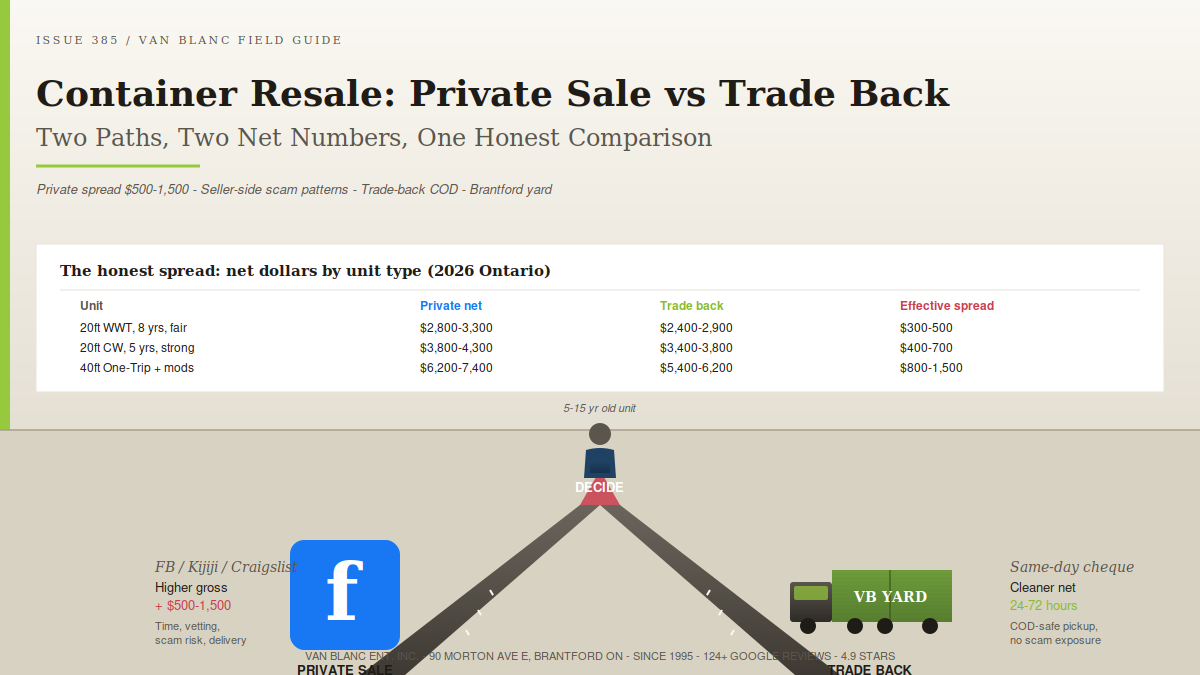
The real net difference between a private sale and a trade-back is smaller than the listing price suggests. The spread between private-sale net and trade-back net varies by unit type, condition, and seller location. Here are realistic 2026 ranges for the four most common resale scenarios, after discounting for time spent, payment risk, and pickup logistics.
| Unit type and age | Private buyer pool | Typical time to sell | Payment-fraud exposure | Where the spread usually lands |
|---|---|---|---|---|
| 20ft WWT, 8 years old, fair condition | Large (storage buyers) | 2 to 6 weeks | High (most-targeted grade) | Narrow, trade-back usually wins on time |
| 20ft CW, 5 years old, strong condition | Large plus export buyers | 1 to 3 weeks | Moderate | Moderate, seller’s calendar decides |
| 40ft HC WWT, 10 years old, fair | Smaller (needs land and access) | 4 to 10 weeks | Moderate to high | Wider, but holding cost erodes it |
| 40ft One-Trip, 3 years old, like-new with modifications | Small but motivated | 6 to 16 weeks | Lower (vetted, deliberate buyers) | Widest, private sale can pay off |
Read that table carefully. The “private buyer pool” column tells you how many serious buyers actually exist for your grade, which sets how fast competitive offers arrive. The “typical time to sell” column is the realistic calendar from listing to a settled, paid pickup, not the optimistic version. The “payment-fraud exposure” column reflects how heavily each grade is targeted by the seller-side scams covered earlier, because the fair-condition 20ft is the bin scammers chase hardest. The last column, where the spread usually lands, is the relationship between private net and trade-back once you discount for time, risk, and pickup logistics (your own result will shift based on the six inspection points above).
That last column is the real decision number. When the spread is narrow, trade-back almost always wins on time value. When the spread is moderate, the call depends on the seller’s situation: someone with weekend hours and a clean unit might choose private; someone with a busy week or a unit that needs work might choose trade-back. When the spread is widest, on a high-end one-trip with modifications, private sale starts to make real sense, because the buyer pool for premium units is small but motivated, and the time-cost dilution is lower on a single transaction.
One more variable: holding cost. Every week your container sits unsold is a week of opportunity cost on whatever you would do with the proceeds. If you are selling to fund a new purchase (a new container, equipment, anything), every week of private-sale delay is a week the new purchase is not happening. The trade-back math gets stronger the more time-sensitive your situation is.
Our team will tell you which path fits your unit when you call. If your container is a 3-year-old one-trip with professional modifications, we will tell you to list it privately first; you will likely clear a meaningful premium. If your container is a 12-year-old WWT with a damaged floor, we will tell you trade-back is the right call because the private buyer pool for that unit is small and full of lowballers. The straight answer is brand-protective for us. Steering an owner toward trade-back when private is the right path costs us the relationship long-term.
How Long Does It Take to Sell a Container Privately?
Private container sale timelines in Ontario run from one week to four months depending on grade and location. Time-to-sale is the variable most owners underestimate. Average private-sale timelines in Ontario as of May 2026, based on what owners report when they come into our yard after a failed listing:
WWT 20ft in fair condition, fairly priced, GTA-accessible: 2 to 6 weeks. The buyer pool is large and competitive. A well-photographed listing usually sells in the first wave.
CW 20ft in strong condition, fairly priced, GTA-accessible: 1 to 3 weeks. Cargo-worthy units have export-capable buyers in addition to storage buyers, which roughly doubles the inquiry pool.
40ft HC WWT, fairly priced, rural location: 4 to 10 weeks. The buyer pool drops because 40-footers require buyers with land and tilt-deck access, and rural location filters out the urban-staging buyers.
One-trip with modifications, premium-priced: 6 to 16 weeks. Premium-unit buyers are slower-moving and price-sensitive at the high end. The right buyer exists but takes time to find.
As-Is units of any size: 1 to 4 weeks if priced right, indefinitely if priced like CW. Buyers know what As-Is looks like and they will not pay CW prices for it.
Trade-back timeline by comparison: 24 to 72 hours from the first call to the cheque in your hand. The phone estimate happens on the first call. The inspection happens within 24 to 48 hours. The payment happens same-day on yard inspection or next business day on off-site inspection. There is no buyer-vetting cycle.
The Hidden Holding Cost Most Owners Miss
If your container is on land that has any opportunity cost (a rental property where the container blocks parking, a farm where the pad could be used for something else, a residential property where the unit is in a neighbour-dispute risk zone), the holding cost while you wait for a private sale is real money. A container occupying roughly 160 square feet of otherwise rentable parking ties up that footprint for as long as it sits, so every month of delay is a month of foregone rent on that space. Stretch a private-sale timeline across 12 weeks and that foregone rent compounds into a real-money holding cost. That number is rarely on the seller’s spreadsheet, and it should be.
The other holding-cost variable: weather damage. A container sitting unsold through one Ontario winter can accumulate in cosmetic damage (paint check, additional rust on the corners, new sealant degradation) that lowers its next-cycle resale value. If the unit is going to sell privately in March or April, listing it in October is the better play. If the timeline pushes into a second winter, the math starts to invert.
Ready to price your container?
Tell us the size and your postal code and we’ll send back an honest, all-in number, container, delivery, and placement, usually within 1-3 days. No pressure, no mystery fees.
Family-run in Brantford since 1995 · 200+ containers in stock · 4.9★ across 140+ Google reviews · every box graded by a person, walk it before it lands.
How Do You Price a Used Container by Condition?
You price a used container by starting from its grade and stacking condition modifiers on top. Pricing accurately is the single biggest predictor of private-sale success or failure. The base ranges by grade in 2026 Ontario are:
| Grade and size | Where it sits in the 2026 Ontario market | Notes on the range |
|---|---|---|
| 20ft As-Is | Entry tier, widest variance | Wide range because condition variance is huge in As-Is |
| 20ft WWT | Lower-mid tier, highest volume | Most common resale grade for 5-15 year units |
| 20ft CW | Mid tier, export-capable premium | Requires valid CSC plate or recent re-inspection |
| 20ft One-Trip (1-3 yrs old) | Top of the 20ft band | New-condition resale; rare in private market |
| 40ft HC As-Is | Best cube-for-the-money entry tier | Cube-per-dollar leader in As-Is |
| 40ft HC WWT | Mid tier, highest 40ft volume | Most common 40ft resale grade |
| 40ft HC CW | Upper-mid tier, export-capable | Requires valid CSC plate |
| 40ft HC One-Trip (1-3 yrs) | Top of the market | Premium tier; modifications add 20-40 percent |
From the base range, condition modifiers stack:
Plus modifiers (add to price): Recent paint within the last 24 months (adds). All four door gaskets sealing tight (adds). Professional roll-up door installed (adds). Professional vent installations (adds, each, up to two). Stored under cover or in a barn for half its life or more (adds). Documentation of original purchase and any maintenance (adds, mostly as a buyer-confidence signal).
Minus modifiers (subtract from price): Through-rust on panels or floor (subtracts, depending on severity). Bent or buckled corner posts (subtracts). Floor soft spots (subtracts). Owner-cut openings without professional re-framing (subtracts). Graffiti or heavy paint damage (subtracts). Missing CSC plate (subtracts, mostly relevant if the buyer wants CW grading). Visible water damage inside (subtracts, because the buyer assumes hidden floor damage).
Set your listing price by starting at the middle of the base range and applying the modifiers as a buyer would. Buyers will inspect. If your modifiers add up to a premium and the unit does not visibly justify the price when the buyer arrives, you will lose the sale and waste both parties’ time. Right pricing is faster pricing.
Christian LeBlanc, second-generation operator: “Owners who price their units inside our range almost always sell. Owners who price 30 percent above the range sit unsold for months. The math is the same one we run on our own buyback offers. There is no premium for hoping. The market knows what a unit is worth, and the market does not negotiate against you, it just walks away from over-priced listings. If you want to sell fast, price it right the first time. If you want to maximize gross at the cost of time, list it 15 percent high and accept the long calendar.”
For the buy-side perspective on what a buyer is actually paying for at each grade, our notes on what serious buyers check before they hand over cash walk through the inspection criteria. Reading that piece from the seller’s seat is the single best preparation for setting the right price. If you want the wider context of how grades and condition shape numbers across the whole market, our rundown of what actually moves a quote in this country is the companion read, and the broader walkthrough of the entire purchase from the buyer’s chair rounds out the picture from the other side of the same transaction.
Which Resale Path Fits Your Situation?
Which resale path fits you depends on three things: your unit’s condition, your access, and your tolerance for time and risk. The decision tree, in plain language:

Private sale is the right call when: Your unit is in unusually strong condition (recent paint, all gaskets sealed, no rust through, professional modifications). Your location is buyer-accessible (commercial lot or wide rural driveway within 100 km of GTA, KW, or Hamilton). You have 4 to 12 weeks of patience and 8 to 20 hours of available time across that calendar. You are comfortable with cash-on-pickup payment discipline. You are selling a single unit, not multiple.
Trade-back to our yard is the right call when: Your unit is in average to fair condition (any 5-to-15-year-old unit with normal wear). Your location is rural, hard-access, or beyond reasonable tilt-deck range for most private buyers. You need the cash on a specific calendar (closing a property, buying a new unit, funding equipment). You are not comfortable managing payment-fraud risk on Facebook or Kijiji. You are selling two or more units (we negotiate fleet trades, which private sale never offers). You have no time to manage a listing.
The hybrid path: List privately for 2 to 4 weeks at a fairly aggressive price. If you get serious offers within range, take them. If you do not, call us. We honour our phone-estimate range for owners who tried the private market first. The hybrid path captures upside if the right buyer is in market right now, and provides a defined exit if they are not. Most of our buyback transactions are hybrid-path arrivals: the owner tried private, the market answered, and trade-back closes the cycle.
Whichever path you choose, the underlying decision is the same: time, money, or risk. You cannot optimize all three. Pick the one you can spend the most of, and let the other two compress accordingly.
Resale FAQs (10)
Will Van Blanc buy back a container I did not originally purchase from you?
Yes. The buyback program runs on the unit’s current condition, not on who originally sold it. We have bought back containers from owners who purchased them from BigSteelBox, Storstac, Royal Wolf, online wholesalers, and direct-import shippers. The valuation inspection is the same six-point process regardless of original source. Bring it to our Brantford yard or call to arrange off-site inspection. Same-day phone estimate, firm offer after inspection.
How much can I expect to net by selling a 5-to-10 year old 20ft container privately in Ontario in 2026?
Realistic private-sale net for a fair-condition WWT 20ft unit lands in the lower part of the resale band once you subtract your time and any payment-risk discount. A strong-condition CW 20ft unit nets meaningfully more because it draws export-capable buyers as well as storage buyers. Premium one-trip units with modifications clear the most. The net moves up or down depending on whether your location is GTA-accessible or rural-only.
What is the safest way to receive payment for a private container sale on Facebook or Kijiji?
Cash on pickup, counted in your driveway in daylight, before the container leaves the property. For larger amounts where carrying that much cash is impractical, a bank draft verified in person at the issuing bank during business hours is acceptable. Avoid Interac e-Transfer (reversible by the sending bank within a narrow window), cheques (clearing windows of 5 to 10 business days), and any payment that arrives before pickup is scheduled. The single-rule version: container does not leave until cash is verifiably yours.
How fast can Van Blanc complete a buyback once I call?
Same-day phone estimate on the first call (with size, age, condition, and location). Inspection within 24 to 48 hours, either at our Brantford yard or on-site within our delivery radius. Firm offer at end of inspection. Payment same-day for in-yard transactions, next business day for off-site. Total elapsed time from first call to cheque: 24 to 72 hours depending on inspection logistics.
What are the most common scams aimed at container sellers on Facebook Marketplace in 2026?
Five patterns account for most seller-side losses. The overpayment scam (buyer sends inflated amount, asks for refund of the difference, original payment bounces). The ship-before-pickup scam (buyer arranges shipping, container leaves, payment never arrives). The fake e-Transfer screenshot scam (buyer shows fabricated confirmation, container released against unsettled payment). The deposit-and-vanish scam (small deposit reversed after pickup scheduled). The wholesale-buyer impersonation (fake company offers to buy inventory, asks for banking details). Cash-on-pickup discipline eliminates four of the five.
Does my container need a valid CSC plate to be worth anything in the resale market?
No. CSC plates only matter for cargo-worthy grading, which only matters to buyers planning international shipping. The vast majority of Ontario resale buyers (storage, jobsite, farm, cottage, residential) do not need CSC certification. A missing or expired CSC plate drops the unit from CW to WWT grade in pricing, but WWT still has strong demand and clear market ranges. Your unit is worth what its condition supports, not what its paperwork supports.
Should I repaint my container before selling?
Depends on condition. Light surface rust and minor paint check on an otherwise solid unit benefits from a modest paint refresh that typically recovers more than it costs in sale price. Heavy through-rust and structural damage are not fixed by paint and the cost will not be recovered. The test: if the unit is mostly cosmetic-condition issues, repaint pays back. If the unit needs structural work, sell it As-Is at the lower price and let the buyer or our yard handle the reconditioning.
Can I trade two or three containers in at once for credit toward a new unit?
Yes. Fleet trade-ins are part of how we keep our used inventory cycling. The valuation is per-unit (each container gets its own inspection and offer), but the credit applies in aggregate against the new purchase. Owners cycling out of older WWT units into new one-trip units, or owners consolidating two 20-footers into one 40-footer, do this regularly. Call ahead so we can schedule the multi-unit inspection in one yard visit or one off-site trip.
What if my container is in worse condition than I thought when you inspect it?
The phone estimate is a range, not a firm price, exactly because conditions vary. If the inspection reveals damage we did not catch in the phone description (frame damage, hidden floor rot, modifications we cannot resell), the firm offer comes in below the phone-estimate range. We will explain why and walk you through the inspection findings. You are under no obligation to accept the offer; you can take the unit back to private market. Most owners accept the revised offer because the revised number is still better than continued holding cost.
Is it worth selling a container privately to save money versus trading back?
Sometimes yes, sometimes no. The answer depends on your unit, your time, and your risk tolerance. Strong-condition units with premium features in GTA-accessible locations often clear a worthwhile premium privately. Fair-condition units in rural locations rarely justify the time. The hybrid path (list privately for 2-4 weeks, then call us if it does not sell) captures the upside without indefinite calendar exposure. Run the numbers on your specific unit before deciding. Our team will tell you which path fits when you call.
Where Is Van Blanc, and How Do You Reach Us?
Van Blanc Ent. Inc. is in Brantford, Ontario, and we have been supplying shipping containers across Ontario since 1995, and the buyback side of our business has run for almost as long. Our warehouse is at 90 Morton Avenue E in Brantford, and we deliver and pick up right across the province on a cash-on-delivery basis. No surprise fees, no chase-the-paperwork.
Van Blanc Ent. Inc. 90 Morton Ave E Unit 1B, Brantford, ON N3R 7J7. Call 519-754-6844 or toll-free 1-888-509-6658.
If you are selling a container and want a same-day phone estimate, give us a call with size, age, condition, and location. If you want to inspect our inventory at the same time (because you are upgrading rather than just cashing out), the yard is open Monday to Friday, Saturdays by appointment, and we will walk you through whatever you want to see.
Sources
- Conterm Container Solutions. (2024). Fraud Alert: Shipping Containers for Sale on Facebook Marketplace. conterm.ca
- Kijiji Canada. (2025). Safety at Kijiji: The Ultimate Guide to Spotting a Scam Online. help.kijiji.ca
- Money We Have. (2025). Scams on Kijiji: How to Avoid Being a Victim. moneywehave.com
- Container xChange. (2025). Shipping Container Price Canada: Buy New and Used Units. container-xchange.com
- International Maritime Organization. (1972, amended). International Convention for Safe Containers (CSC). imo.org
- International Organization for Standardization. (2022). ISO 6346:2022 Freight containers: Coding, identification and marking. iso.org