
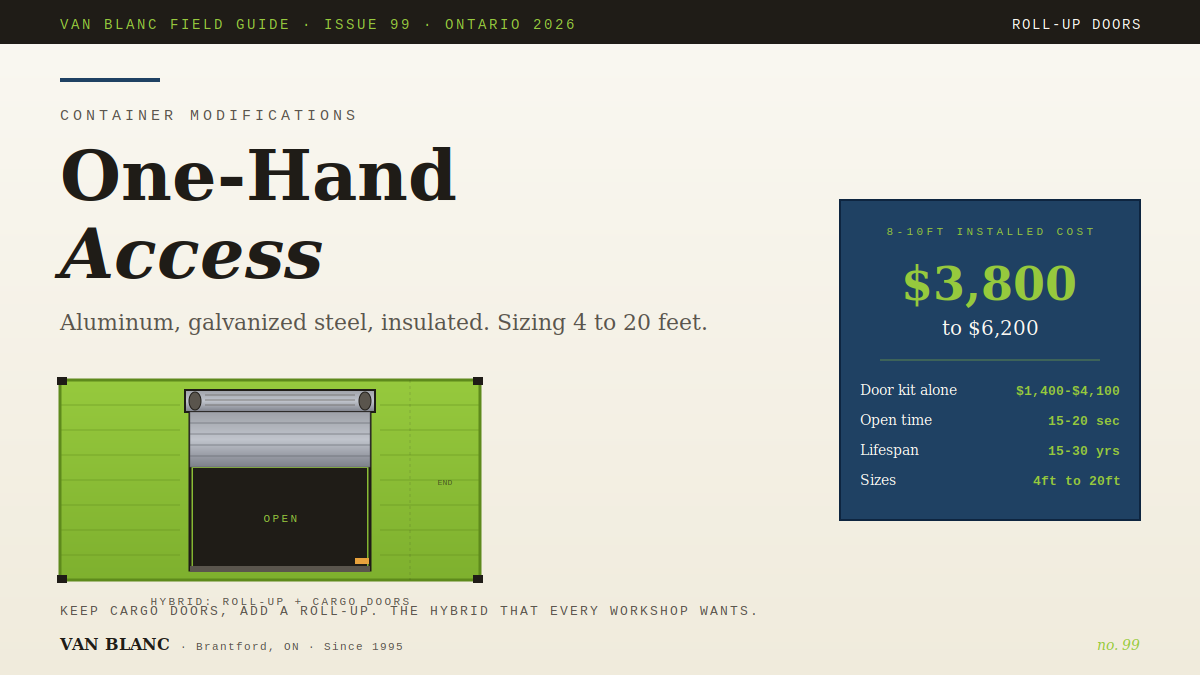
Quick Answer: A roll-up door retrofit on a shipping container in Ontario is priced by door width, slat material (aluminum, galvanized steel, or insulated), and whether you DIY the cut or contract the full install including the door kit, steel framing, weatherstripping, and labour. Roll-up doors give 4 to 20-foot opening widths and one-handed daily access. They are less secure than cargo doors but better for workshops, retail, and equipment loading. It is one of the most requested jobs in our yard’s modification program. Pick up the phone and we will quote your real cost in 5 minutes, Christian or Paul, 519-754-6844. Family-run Ontario shipping container supplier since 1995. 4.9 stars across 140+ Google reviews, 1-3 day delivery.
In This Guide
- Why Add a Roll-Up Door to a Shipping Container?
- Cargo Door vs Roll-Up Door: Which Is Right for You?
- What Roll-Up Door Sizes Fit a Shipping Container?
- Which Roll-Up Door Type Is Best for Ontario Use?
- How Is a Roll-Up Door Installed on a Container?
- What Drives the Cost of a Container Roll-Up Door in Ontario?
- Do Roll-Up Doors Work in Ontario Winter?
- Which Industries Use Container Roll-Up Doors?
- What Do Brantford-Yard Customers Actually Buy?
- FAQs
Reading time: about 12 minutes.
Why Add a Roll-Up Door to a Shipping Container?
A roll-up door is added to a shipping container to replace slow swing-out cargo doors with fast, one-handed daily access. It coils into a compact drum above the opening, opens in 15 to 20 seconds, needs no outside clearance, and can be cut into the side wall rather than only the end, turning a freight box into a usable room. Buyers who want the box and the door as one purchase can start from the roll-up door container we build and sell, quoted as a single number.
The factory cargo doors on a shipping container were designed for one purpose: secure transport of freight across oceans. They swing outward on heavy hinges, take 30-60 seconds to fully open, require 5-6 feet of clearance behind them, and create a wide-open opening for cargo loading. For shipping use they are excellent. For daily-access workshops, retail conversions, equipment storage, or any use where the doors get opened multiple times per day, they are clunky.
The roll-up door retrofit changes the entry experience. A roll-up door operates like a residential garage door: panels roll up into a compact coil above the opening, the door opens in 15-20 seconds with one hand, and the opening can be sited anywhere on the container side wall (not just at the end). For Ontario workshops, retail kiosks, hunting cabins, and any container used as a working space, the roll-up door is usually the very first job buyers ask us to do when they change a plain steel box into a working space.
Christian LeBlanc, second-generation operator: “Roll-up doors are the call we get most. Somebody buys a 20-footer for a workshop, uses the cargo doors for a week, and phones the yard asking how fast we can cut a roll-up into the side. I tell them the same thing my dad taught me: the door goes in fast, but cutting and framing the steel right is what makes it last twenty years instead of rusting out in three.”
The single most common roll-up door use case in Ontario
Workshop or man-cave conversions. A 20-foot container with a 10-foot roll-up door on the long side wall creates a small garage-style workshop that fits a snowblower, a couple of motorcycles, or a small woodworking bench with room to work. The roll-up beats the swing-out cargo doors because the user enters and exits dozens of times per session and the cargo doors get tiresome by the third visit.
Cargo Door vs Roll-Up Door: Which Is Right for You?
Choosing between a factory cargo door and a retrofit roll-up door comes down to security versus daily convenience. Cargo doors are heavier steel and lock down tighter for unattended storage. Roll-up doors open faster and one-handed for spaces you enter many times a day. The table below lays the two side by side so you can match the door to how the container actually gets used.

| Attribute | Factory cargo door | Retrofit roll-up door |
|---|---|---|
| Construction | 14-gauge steel double-leaf, 2-3 inch thick assembly | Galvanized steel or aluminum slat curtain, 1-2 mm thick |
| Operation | Swing outward on 4 hinges per leaf | Roll up vertically into coil above opening |
| Open time | 30-60 seconds two-handed | 15-20 seconds one-handed |
| Opening width | ~7ft 8in on standard 20ft, 40ft | 4ft, 6ft, 7ft, 8ft, 10ft, 12ft, 16ft, 20ft options |
| Clearance required outside | 5-6 feet for fully open doors | Zero outside; needs 10-14 inches headroom inside |
| Security rating | Excellent (steel, double-locking, lockbox-compatible) | Moderate (lighter material, lockable but more accessible) |
| Weather seal | Compression gasket all around | Brush seal top and sides, threshold rubber at bottom |
| Cold-weather operation | Stiff in winter but functional | Springs and rollers can stiffen at -20°C; lubrication required |
| Lifespan | 25-30 years with seal replacement at 12-15 years | 15-25 years; springs and rollers wear with cycle count |
| Relative cost (retrofit on existing container) | n/a (already installed) | Driven by opening width, slat material, and DIY vs contracted install |
| Best for | Long-term storage, security-first use, jobsite tool storage overnight | Workshop, retail, daily-access workspace, equipment loading |
The honest framing: cargo doors win on security. Roll-up doors win on convenience. Most Ontario buyers who retrofit roll-up doors keep the cargo doors at one end and add the roll-up to the side wall, giving both options on the same container. This is the optimal hybrid for workshops where the cargo doors lock the box overnight and the roll-up handles daily access.
What Roll-Up Door Sizes Fit a Shipping Container?
Roll-up doors for shipping containers come in widths from 4 feet to 20 feet. The choice depends on what you need to put through the opening: a person and a handcart at 4 feet, a vehicle at 10 feet, a full-side pallet load at 20 feet.
| Opening width | What fits through | Typical use case | Structural reinforcement needed |
|---|---|---|---|
| 4ft wide | Person + handcart | Single-person workshop, pedestrian-only access | None beyond a perimeter frame; smallest, lightest kit |
| 6ft wide | Person + small ATV | Small ATV storage, riding mower access | Perimeter frame only; no header beam |
| 7ft wide | Mid-size ATV, snowblower | Common workshop standard, fits most yard equipment | Perimeter frame; header optional near the upper limit |
| 8ft wide | Compact car, ATV with trailer | Compact garage, motorcycle storage | Welded steel frame; header beam recommended |
| 10ft wide | Mid-size car, small SUV | Garage conversion, workshop with vehicle | Welded steel frame plus header beam |
| 12ft wide | Full-size SUV, mid-size truck | Equipment storage, larger workshop | Welded frame, header beam, reinforced side posts |
| 16ft wide | Full-size truck, RV access | Industrial loading, RV winter storage | Heavy header beam and reinforced posts both sides |
| 20ft wide (full-side opening) | Pallets, large equipment, full-side load | Industrial, agricultural, contractor storage | Full structural rebuild of the cut side wall |
The 8-foot and 10-foot widths are the most common Ontario retrofits. They give vehicle clearance, equipment access, and full visibility into the container for inventory or display purposes. If you are torn between the two, we walk through picking between the two most popular widths in a dedicated comparison. The 16 and 20-foot widths require additional structural reinforcement because cutting that much side wall removes load-bearing capacity.
The wider-the-door structural truth
Container side walls carry roof load and contribute to overall structural integrity. Cutting a 4 or 6-foot opening is fine without additional reinforcement. Cutting an 8 to 12-foot opening requires a steel frame around the door that replaces the structural capacity of the cut steel. Cutting 16 or 20 feet requires header beams above the door and reinforced posts at each side. Skipping the reinforcement makes the container roof sag over time, and that is irreversible damage.
Which Roll-Up Door Type Is Best for Ontario Use?
Roll-up doors for shipping containers come in four practical types for Ontario buyers: galvanized steel, aluminum, insulated, and high-cycle industrial. Galvanized steel is the workhorse for farm and commercial storage, aluminum suits lighter residential use, insulated is for heated or climate-controlled containers, and high-cycle industrial is for very high turnover. Here is how each one performs.
Galvanized steel roll-up door
Heavier-duty option. Slat thickness typically 0.6-1.0 mm. Cycle life 30,000+ open/close cycles. Best for industrial use, equipment storage, security-conscious applications. Heavier door means stiffer winter operation and a higher kit price than aluminum. The standard choice for Ontario commercial and farm storage. The steel kit sits mid-range among roll-up options.
Aluminum roll-up door
Lighter, cheaper, easier to install. Slat thickness typically 0.8-1.2 mm aluminum. Cycle life 20,000+ open/close cycles. Best for residential, light commercial, retail, and workshop use. Aluminum performs slightly better in cold weather because the metal does not stiffen as much. The aluminum kit is the most affordable of the roll-up options.
Insulated roll-up door
Either galvanized steel or aluminum with foam insulation between layers. R-value 6-9 per inch (typically 1.5-2 inches thick total). Premium option for climate-controlled containers, reefer conversions, or occupied workspaces in Ontario winter. The added foam core makes this the priciest kit of the three core types.
High-cycle / heavy-duty industrial
Specialized for very high cycle counts (50,000+ opens) or extreme widths (over 16 feet). Used in food distribution, courier sorting centers, automotive shop applications. Built for container buyers with very high turnover. The heavy-duty kit commands the highest price of any roll-up door type.
How Is a Roll-Up Door Installed on a Container?
Installing a roll-up door on a shipping container is a steel-fabrication job, not a quick bolt-on. The marketing line that a roll-up door installs in 15 minutes is technically true for hanging the curtain, but the full project takes 1 to 2 days because cutting the side wall, welding a structural frame, and priming the bare edges is the real work. Here is the sequence we follow at the Brantford yard.
Step-by-step installation sequence
- Measure and mark the opening. Locate the side wall position, mark the rectangular opening to the door manufacturer’s spec (typically the rough opening is 1-2 inches wider and taller than the finished door size).
- Cut the steel. Plasma cutter or oxy-acetylene torch. Two skilled workers, 2-4 hours of cutting for a 10-foot opening. Smoke and noise; outdoor or well-ventilated only.
- Remove the cut steel panel. Lift out and dispose. Most installers recycle the cut steel for its scrap value, which varies with the size of the panel removed.
- Weld the structural frame. Steel angle iron (typically 3x3x3/8 inch) or rectangular tube around the perimeter of the opening. This frame restores structural capacity and provides anchor points for the door track. Welding time: 4-8 hours for a 10-foot opening.
- Add header beam if opening is over 8 feet wide. Steel I-beam or rectangular tube spans the top of the opening, transferring roof load around the door.
- Install threshold plate. Heavy-duty steel plate welded to the bottom rail, providing the seal surface and wear resistance for the door bottom.
- Prime and paint the cut edges. Zinc-rich primer plus topcoat. Bare cut steel rusts quickly; this step is non-negotiable for long-term durability.
- Install the door. Track on each side, drum and torsion spring above the opening, curtain panels assembled, weather seals applied, lock mechanism installed. 30 minutes to 2 hours for a competent installer.
- Test cycle. Open and close 5-10 times to verify smooth operation, adjust spring tension if needed, test lock engagement.
Total project time: 1-2 days for a single 8 to 12-foot door, plus paint cure. Two doors on the same container: 2-3 days total.
Brantford-yard reality on retrofit timing
Christian: “We get the call almost every week: ‘how fast can you cut a roll-up door into my 40-footer?’ The answer is the door part is fast but the rest is real work. Cutting steel cleanly, welding the frame, priming the edges, and curing the paint takes 2 days of shop time minimum. Customers who want it done in a day are usually disappointed unless the container is delivered for retrofit weeks in advance. We schedule these properly and they last 20 years; we rush them and they rust at the cut edges in 3 years.”
What Drives the Cost of a Container Roll-Up Door in Ontario?
The cost of a container roll-up door in Ontario is driven by three things: the opening width, the slat material (aluminum, galvanized steel, or insulated), and whether you DIY the cut or have us handle the full contracted install. A wider opening means more cutting, a welded frame, and sometimes a header beam, which is where most of the labour lives. The full yard conversion and door-cutting work we quote per job rather than off a posted number, because every container and site is a little different. The table below shows how the DIY and contracted paths compare across common configurations.
| Configuration | DIY path (kit + your own labour) | Contracted path (what the full install adds) |
|---|---|---|
| 4ft aluminum roll-up, basic kit | Lightest kit; one person can hang it once the opening is cut | Cut, perimeter frame, prime, and hang; lowest contracted tier |
| 6-7ft aluminum, standard | Single-person handling; modest cutting and framing | Cut, weld perimeter frame, prime edges, hang and seal |
| 8ft galvanized steel, standard | Heavier panels; two people and a welder needed | Welded steel frame plus header beam, prime, hang, seal |
| 10ft galvanized steel, standard | Two-person lift; header welding adds shop time | Welded frame, header beam, prime, hang, seal, test cycle |
| 10ft insulated, premium | Foam-core panels are heaviest to handle for DIY | Frame, header, plus careful seal work for the insulated curtain |
| 12-16ft heavy-duty steel, header beam included | Beyond most DIY skill; rigging and beam work required | Engineered header, reinforced posts, full structural rebuild |
| 20ft full-side opening with structural reinforcement | Not a realistic DIY job; structural risk if rushed | Full side-wall rebuild: beams, posts, multi-day shop work |
Most Van Blanc roll-up door customers fall in the 8 to 10-foot range and have us handle the full contracted install. The DIY path costs less because you supply the labour, but it requires plasma cutting capability, welding skill, and the willingness to spend a weekend on the project. Most customers contract the work.
Do Roll-Up Doors Work in Ontario Winter?
Roll-up doors work in Ontario winter when installed and maintained correctly. The metal, springs, and seals all stiffen in deep cold, so a roll-up door needs a little seasonal care that swing-out cargo doors do not. A few specific cold-weather realities apply.
- Spring tension and roller seizure. Below -15°C, torsion springs and curtain rollers can stiffen. Annual lubrication with cold-tolerant silicone or graphite spray (NOT WD-40, which thickens in cold) keeps operation smooth all winter.
- Brush seal stiffness. Top and side brush seals can flatten and stiffen below -20°C. They still seal but require more pull-force to break the seal on first opening of the day. Replace every 5-7 years.
- Snow accumulation above the door coil. The drum sticks out 8-10 inches above the door opening on the inside. Snow on the roof that drifts into this area can block operation. Roof clearance and a small drip-cap shield prevent the issue.
- Ice on the threshold plate. Water drains down the door face during winter thaws and refreezes at the threshold. A small heated mat or salt application keeps the bottom seal clear of ice buildup.
- Painted cut edges. Cut steel around the frame is the rust-prone area in Ontario freeze-thaw. The container rust prevention guide covers proper coating for these edges.
The single annual maintenance task that doubles roll-up door lifespan
Lubricate the torsion spring and curtain hinges every fall before first frost. Use a cold-tolerant silicone spray or graphite powder. Five minutes of work per door. This single habit takes a typical 15-year roll-up door to a 25-year roll-up door because the springs do not fatigue from forced operation in stiff conditions.
Which Industries Use Container Roll-Up Doors?
Container roll-up doors show up across residential, agricultural, construction, retail, and industrial use in Ontario, with the door width matched to the load that has to pass through it. A backyard workshop runs an 8 to 10-foot door, a farm runs 10 to 16 feet for implements, and an industrial loading bay runs 12 to 20 feet. The table below maps the common industries to a typical door size and why the roll-up fits.
| Industry / Use | Typical door size | Why roll-up fits |
|---|---|---|
| Residential workshop / man-cave | 8 to 10ft wide | Daily access, vehicle clearance, garage-style operation |
| Self-storage rental unit | 4 to 8ft wide | Renter access, secure overnight, quick open/close |
| Construction site tool storage | 8 to 10ft wide | Equipment loading, daily contractor access |
| Retail pop-up shop | 10 to 12ft wide | Open storefront face, secure overnight |
| Hunting cabin / lakefront recreation | 6 to 8ft wide | Sea-Doo or snowmobile storage, seasonal closure |
| Agricultural / farm storage | 10 to 16ft wide | Tractor and implement loading, hay bale access |
| Cannabis cultivation / greenhouse | 10ft wide insulated | Equipment access, climate control retention |
| Industrial / manufacturing | 12 to 20ft wide | Pallet and equipment loading, high-cycle access |
| Food truck / commissary kitchen | 6 to 8ft wide insulated | Serving window, daily setup, weather seal |
What Do Brantford-Yard Customers Actually Buy?
Brantford-yard customers buy mostly mid-size galvanized steel roll-up doors. Across Van Blanc’s 30 years of Ontario container deliveries, the roll-up door retrofits we install break out roughly:

- 50 percent: 8-foot or 10-foot galvanized steel. Workshop, residential garage, contractor storage. The workhorse spec.
- 20 percent: 6 or 7-foot aluminum. Smaller workshop, ATV storage, equipment shed.
- 15 percent: 10 or 12-foot insulated. Climate-controlled workshops, reefer conversions, occupied spaces.
- 10 percent: 16 or 20-foot industrial. Agricultural, manufacturing, multi-bin operations.
- 5 percent: 4-foot pedestrian / specialty. Self-storage, security gatehouse, kiosk applications.
Christian LeBlanc, second-generation operator: “The single most common question we get is ‘should I add a roll-up door instead of using the cargo doors?’ The answer is almost always: keep the cargo doors, add a roll-up on the side wall. You end up with the best of both. Cargo doors lock the box at night, roll-up handles your daily access. The hybrid is what most workshops actually want.”
Worth the drive to Brantford
Buyers planning roll-up door retrofits regularly visit our Brantford yard at 90 Morton Avenue East to see finished examples on demo containers. You can compare 8-foot to 10-foot openings, see what a properly framed and primed cut edge looks like, and walk through which type fits your use case in person. With 200 plus containers in stock you pick the bin and we coordinate the modification work. Most Ontario container suppliers do not let you choose. We do.
Go Deeper on Roll-Up Doors
If you want more depth on a specific part of the roll-up door decision, these go further:
Frequently asked questions
How much does it cost to install a roll-up door on a shipping container in Ontario?
The contracted price depends on door width, slat material, and how much structural reinforcement the opening needs, and it covers the door kit, structural frame, cutting and welding, paint, and labour. The door kit on its own is a fraction of the full install. A DIY install costs the kit price plus your own labour. Most Ontario buyers contract the work because it requires plasma cutting and welding skill.
What sizes of roll-up doors fit a shipping container?
4 to 20 feet wide. Common Ontario sizes: 6ft, 7ft, 8ft, 10ft. The 8 and 10-foot widths are most common because they fit vehicles and ATVs through. Wider openings (12 to 20 feet) require structural reinforcement with header beams.
Are roll-up doors as secure as cargo doors?
No. Cargo doors are heavier 14-gauge steel with double-locking gear and lockbox compatibility. Roll-up doors are lighter slat construction with hasp or T-lock security. For overnight or unattended security, cargo doors are stronger. For daily-access workshops where security is enforced by site security, roll-up doors are acceptable. Many Ontario buyers keep cargo doors plus add a roll-up to the side.
Can I install a roll-up door myself?
Yes, if you have plasma cutter or oxy-acetylene torch access, MIG or stick welding capability, and a weekend of work time. Total DIY material cost scales with door size and the reinforcement needed, with the kit being the largest single line item. The door kit itself installs in 30 minutes to 2 hours; the cutting and welding take 1-2 days.
What is the difference between aluminum and galvanized steel roll-up doors?
Aluminum: lighter, cheaper, easier winter operation, 20,000+ cycle life. Galvanized steel: heavier, more durable, better security, 30,000+ cycle life. Aluminum suits residential and light commercial; steel suits industrial and farm use. The steel kit carries a modest price premium over aluminum for the same width.
Do roll-up doors work well in Ontario winter?
Yes with annual maintenance. Lubricate torsion springs and curtain rollers each fall with cold-tolerant silicone spray. Brush seals stiffen below -20°C but still function. Aluminum operates slightly better than steel in extreme cold. Snow on the roof can block the drum housing above the door if not cleared.
How long does it take to install a roll-up door?
1-2 full days of shop work for a single 8 to 12-foot door including cutting, framing, welding, priming, and door install. The door kit itself takes 30 minutes to 2 hours; the container preparation takes the rest. Larger openings (16 to 20 feet) take 2-3 days.
Will cutting a roll-up door opening weaken the container?
If properly reinforced, no. Openings up to 6 feet wide need minimal additional structure. Openings 8 to 12 feet wide need a welded steel frame around the opening (angle iron or rectangular tube). Openings 16 to 20 feet wide need a header beam above and reinforced posts at each side. Skipping the reinforcement causes the roof to sag over time.
Can I have a roll-up door AND cargo doors on the same container?
Yes, this is the most common Ontario retrofit. Keep the original cargo doors at one end (typically the end with the highest security need) and add a roll-up door to the side wall. You get a secure lock-down at one end for overnight storage and fast one-handed access on the side for daily work. Most workshop and contractor customers we deliver to choose exactly this hybrid.
How long does a roll-up door last on a shipping container?
Aluminum: 15-25 years with annual lubrication. Galvanized steel: 20-30 years. Industrial high-cycle doors: 25-35 years. Lifespan is limited by torsion spring fatigue (15,000-50,000 cycles depending on grade) and curtain wear rather than corrosion. Replacement door costs are similar to original install.
Can roll-up doors be insulated?
Yes. Insulated roll-up doors have foam between steel or aluminum layers, achieving R-6 to R-9 per inch (typically 1.5-2 inches total). Used in climate-controlled workshops, reefer conversions, occupied spaces. The insulated kit costs more than a standard steel or aluminum curtain, and the contracted install adds frame, header, and seal labour on top. Worth it in heated buildings; not necessary for unheated storage.
Sources
- Door & Access Systems Manufacturers Association International (DASMA). (2024). Rolling Steel Door Performance Standards: ANSI/DASMA 102 and 105. dasma.com
- Canadian Standards Association. (2023). CSA A123.21 Standard for Rolling Steel Door Wind Load Resistance. csagroup.org
- Conexwest. (2024). How to Choose Between Cargo Doors vs Roll-Up Doors. conexwest.com
- Container Technology Inc. (2024). Roll Up Doors vs Cargo Doors: A Comparison. containertech.com
- Falcon Structures. (2024). 6 Types of Shipping Container Doors and When to Use Each. falconstructures.com
Reach Van Blanc in Brantford
We have been supplying shipping containers across Ontario since 1995. Our warehouse is at 90 Morton Avenue East in Brantford, and we deliver across Ontario in 1 to 3 days from our four Brantford yards. No surprise fees, no chase-the-paperwork. Every quote comes with a real lead time, not a hopeful one.
Van Blanc Ent. Inc. 90 Morton Ave E Unit 1B, Brantford, ON N3R 7J7. +1 888-509-6658
Walk our yard before you commit. We can show you finished 8-foot and 10-foot roll-up door retrofits on demo containers, walk through which spec fits your workshop or storage use, and coordinate the modification work end-to-end. With 200 plus containers in stock you pick the bin and we deliver. Most Ontario container suppliers do not let you choose. We do.
Related Reading
Ready to price your container?
Tell us the size and your postal code and we’ll send back an honest, all-in number, container, delivery, and placement, usually within 1-3 days. No pressure, no mystery fees.
Family-run in Brantford since 1995 · 200+ containers in stock · 4.9★ across 140+ Google reviews · every box graded by a person, walk it before it lands.