
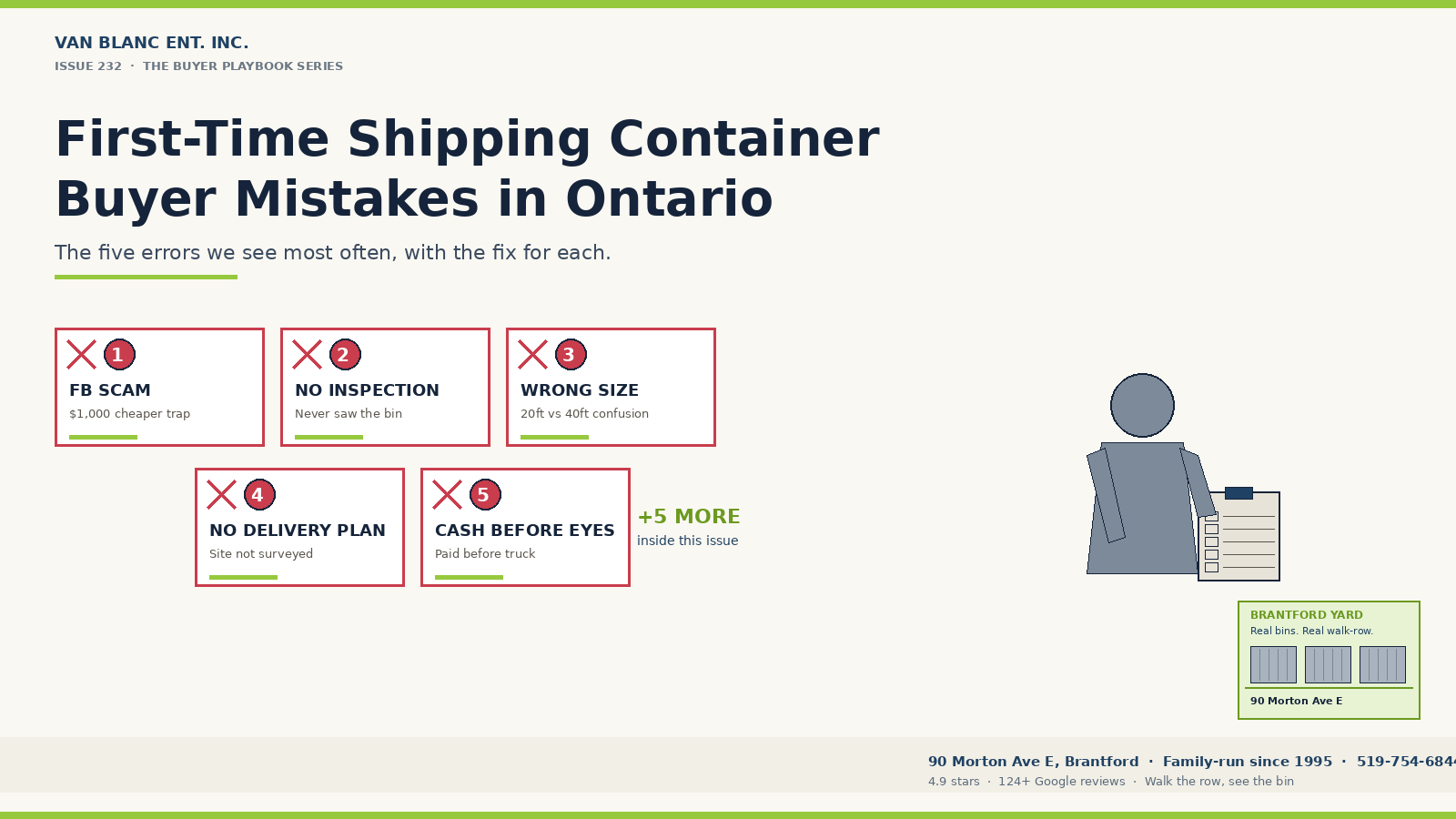
Quick Answer: The ten first-time shipping container buyer mistakes in Ontario we see most often are price-only shopping, the Facebook scam trap, skipping yard inspection, picking the wrong size, ignoring grade, no delivery plan, paying cash before seeing the bin, missing site prep, forgetting tilt-deck clearance, and chasing same-day promises. Pricing depends on your site, your grade choice, and your freight zone, call for a real quote. Brantford-based since 1995, family-operated, 4.9-star verified (140+ Google reviews). 1-3 day delivery Ontario-wide.
In This Guide
- Mistake 1: Why is shopping on sticker price alone a problem?
- Mistake 2: How do you spot the Facebook Marketplace trap?
- Mistake 3: Should you see the container before you pay?
- Mistake 4: How do you pick the right container size?
- Mistake 5: What is the difference between one-trip, CW, and WWT?
- Mistake 6: What does a site and delivery plan need?
- Mistake 7: Should you wire money before seeing the steel?
- Mistake 8: What foundation does a shipping container need?
- Mistake 9: How much tilt-deck clearance do you need?
- Mistake 10: Can a supplier really deliver a container same-day?
- Frequently asked questions
- Sources
- Visit our Brantford yard
Reading time: about 14 minutes.
If you have never bought a shipping container before, the Ontario market in 2026 looks confusing on purpose. Facebook listings undercut real suppliers by roughly a thousand dollars, just enough to look like a deal. Phone quotes swing widely from one yard to the next. Photos get reused across half a dozen “companies” run by the same scammer. Van Blanc has been delivering bins across Ontario since 1995, and the buyer-mistake patterns we see most often repeat every week with almost predictable timing. This guide is the walk-through Christian gives first-timers when they call the yard.
Mistake 1: Why is shopping on sticker price alone a problem?
Shopping on sticker price alone is the most common first-time shipping container mistake because the listed unit number is never the delivered number. Five separate drivers move the real total: container size, grade, delivery distance, ground conditions, and the season you buy in. The honest way to compare suppliers is an all-in delivered quote, not a teaser figure.
The single biggest first-time error is comparing two listings on sticker price and ordering from whichever is lower. A 20ft shipping container looks like a commodity. It is not. The listed unit number in Ontario in 2026 is one figure; the delivered, sited, usable bin is a different figure once freight and access are added.
Delivery distance, tilt-deck access, ground conditions, grade, and paint all change the real cost. A Greater Toronto Area drop adds freight on top of the unit number. A Sudbury route carries premium freight on top of that. A bin that needs a forklift swap because the truck cannot tilt onto soft ground adds a service call too. Those are the price drivers, and they move enough that two listings with the same sticker can land well apart by the time the steel is on your pad.
Ask for the all-in price before you compare
When you call any Ontario container supplier, ask for the bin price plus the delivery price plus any equipment fee, all in one number, before tax. The supplier who hesitates is the one whose listed price is hiding something. The supplier who gives you a clean total in under sixty seconds is the one who has done this thousands of times. Every Van Blanc quote comes with a real lead time, not a hopeful one, and a delivered total, not a teaser.
The honest rule for first-time buyers: the listed unit number is only part of what you will actually spend. Freight is lightest in the Highway 403 corridor near our Brantford yard, climbs across the rest of southern Ontario, and runs highest on premium northern routes. No written all-in total means no real quote, just a guess. If you want to understand which levers a supplier can flex before you commit, our breakdown of where there is real room to negotiate on an Ontario container covers it without the sales theatre.
Mistake 2: How do you spot the Facebook Marketplace trap?
The Facebook Marketplace container trap happens so often we can almost write the call-back script. A first-time buyer finds a 20ft container listed for about a thousand dollars below any legitimate Ontario supplier. Photos, logo, phone number that picks up. Money moves. Two weeks later the buyer calls our yard saying they got scammed, the seller has gone dark, and the payment will not be reversed.
Christian LeBlanc, second-generation operator: “When a first-time buyer calls saying they got scammed, the first thing they always tell me is that the price seemed fair, not crazy low. That is the trick. The scammers price themselves a thousand below us, not five thousand. Just enough to look like a deal, not enough to look fake. The lesson is simple: if there is no yard you can drive to, there is no bin.”
The pattern is well documented. Conterm has a fraud alert about it. CBC has covered Ontario cases where buyers lost everything they paid in a single transaction. Boxtainer lists the red flags Van Blanc sees every week: stolen photos lifted from real container companies, fake invoices with real company logos, urgency language, payment by e-transfer or wire only, and a phone number that goes dead once the money clears. For the full anatomy of how these listings are built, our breakdown of the way container fraud actually unfolds in this province walks through each tactic.
The defence is structural. No physical yard to drive to, no payment on delivery accepted, photos repeating across multiple “company” names: walk away.
Mistake 3: Should you see the container before you pay?
Seeing the container before you pay is the simplest buying habit, and the one almost nobody uses the first time. Listings show a hero photo. The actual unit may have rust streaks, a sticking door, paint variance, a dent in the rear wall, or a soft floor plank. None are deal-breakers on a used unit at the right price, but you need to know about them before the truck arrives.
Big national chains and pod fleets dispatch from regional inventory, so ask whether you can view the specific unit before it ships. A real local yard lets you walk the row, open the doors, check the seal, and pick the specific bin you are paying for.
Why buyers from across Ontario drive to Brantford
Our Brantford yard at 90 Morton Avenue East sits a short hop off Highway 403, halfway between the Hamilton industrial corridor and the southwestern Ontario agricultural belt. Buyers from London, Cambridge, Burlington, Niagara, and even as far as Owen Sound regularly drive in to pick their own container. They tell us the same thing every time: “I wanted to see it before I paid for it.” That single sentence is the most valuable thing any first-time buyer can say.
If you cannot drive in, the next best thing is a live video walk-around of the specific unit, with the seller showing the CSC plate, the door operation, the floor, and the four corners. A supplier who refuses a live video should not get paid.
Mistake 4: How do you pick the right container size?
Picking the right container size is where first-time buyers slip most often: they under-size or over-size and almost never land it right. The under-sizers grab the cheaper-looking 20ft and assume they will make it work. Six months later they are looking at a second bin because the snowblower, the lawn tractor, and the renovation drywall would not all fit. The over-sizers go straight to a 40ft because bigger feels safer, then realise they have a forty-foot steel box on a residential lot they cannot reposition without a crane.
A 20ft shipping container is six metres long, holds about 33 cubic metres of interior volume, sits on a standard tilt-deck truck, and fits most driveways with a few feet of clearance. It is the lower-cost of the two standard sizes and the one most first-time Ontario buyers should start with. Buying a 40ft to “future-proof” storage rarely pays off unless you genuinely need the length. Adding a second 20ft later if you outgrow the first is usually the smarter play. The table below sets the two standard sizes side by side so you can match the box to the job.
| Feature | 20ft standard dry | 40ft standard dry |
|---|---|---|
| External length | 6.06 m (19’10”) | 12.19 m (40’0″) |
| External width | 2.44 m (8’0″) | 2.44 m (8’0″) |
| External height (standard) | 2.59 m (8’6″) | 2.59 m (8’6″) |
| Interior volume | about 33 cubic metres | about 67 cubic metres |
| Tilt-deck clearance behind truck | about 60 feet | about 80 feet |
| Fits a typical driveway | Usually, with a few feet to spare | Often tight, may need a crane to place |
| Best first-time fit | Reno storage, garage extension, workshop, cottage | Farm equipment, bunkhouse, high-volume commercial |
Mistake 5: What is the difference between one-trip, CW, and WWT?
Container grade is the topic that confuses first-time buyers more than any other. There are four grades (one-trip, cargo worthy, wind and watertight, as-is) and listings often describe units as “good condition” or “new” without naming which one. By the time the truck arrives with a 20ft showing surface rust and a dented door, the buyer thought they had bought essentially new, and they did not.
One-trip means one ocean voyage from the Asian factory loaded with cargo, then resold in North America. The industry calls these one-trip because the box made exactly one loaded voyage, but buyers search for them as new, and that is how we list them too. Essentially new: original paint, no rust, doors operate cleanly, twenty-five-plus years of functional life. One-trip is not showroom-perfect, minor handling marks are possible, and we point them out in the yard. Right for offices, retail conversions, anywhere the bin is visible from the road. If a like-new box is what your project needs, our range of new (one-trip) units for sale is the place to start.
Cargo worthy is used: multiple ocean crossings, surface rust, paint variance, re-inspected and certified for one more international shipment. Right for export or high-density industrial storage. Wind and watertight is used and cannot be re-certified for shipping, just keeps weather and rodents out. Right for farm, reno, and shed-alternative storage.
As-is is the fourth grade suppliers tend to skip. Older units with floor damage, frame issues, or door problems, sold cheap for cladding, scrap value, or structural reuse. Van Blanc carries as-is units but rarely recommends them unless a buyer knows exactly what they need.
Always ask the grade by name
When you call any Ontario container supplier, do not ask “what condition is it in?” Ask “what grade is it: one-trip, cargo worthy, wind and watertight, or as-is?” The four-word answer tells you what you are actually buying. A supplier who hesitates or invents a fifth grade (“premium used,” “select grade,” “showroom condition”) is fudging the truth. The four grades come from IICL inspection standards, which are the industry baseline used by every honest container company in Canada.
Mistake 6: What does a site and delivery plan need?
A site and delivery plan needs to be settled before you pay, not the day the truck rolls out. The call we get most often goes: “Hi, I bought a container, it is being delivered tomorrow, can you tell me what I need to do?” Wrong order. Clearance, ground, and door orientation all get decided up front.
A tilt-deck truck delivering a 20ft needs about sixty feet of straight-line clearance behind the truck. A 40ft needs eighty. Power lines, tree branches, eaves, and basketball nets can stop a delivery cold. Soft ground after rain will sink the truck’s stabiliser pads. Narrow driveways will not let the truck swing the tilt arc. None are deal-breakers, but they all have to be planned. Van Blanc’s drivers will video-walk a site with you before the day if you ask.
Pre-delivery site checklist
- Clearance: Sixty feet (20ft container) or eighty feet (40ft) of straight-line approach from truck back to drop spot
- Overhead: No branches, power lines, or eaves within fifteen feet of the placement
- Ground: Firm, level, not freshly rained on. Gravel pad ideal, hard-packed dirt acceptable, lawn risky
- Driveway slope: Severe slope can prevent tilt; walk it before the truck arrives
- Door orientation: Know which way you want the doors before delivery. Repositioning later is expensive
- Permission: If the container goes on a property you do not own, get written permission from the owner
Mistake 7: Should you wire money before seeing the steel?
Wiring money before you see the steel is the deeper version of the Facebook trap, and the answer is no for a stock unit. Even with a legitimate-looking supplier, paying in full by wire or e-transfer before you see the bin is the riskiest posture a first-time buyer can take. If the supplier is real, you have no leverage when something is wrong. If the supplier is fake, the money is gone.
Van Blanc takes payment on delivery. Cash, cheque, wire transfer, or credit card via authorisation form. Homepage reviews put it directly: “Most of all they deliver on a COD basis, can’t get more honest than that.” Payment-on-delivery is the strongest honesty signal because it puts the supplier at risk, not the buyer.
Some suppliers do require partial deposits for one-trip containers ordered to spec, which is fair: those units are special-ordered from Asia. A reasonable deposit in Ontario is ten to twenty-five percent. Anyone asking for full payment in advance on a stock unit is asking for too much trust.
Mistake 8: What foundation does a shipping container need?
A shipping container needs a level base under its four corner castings, because that is where all the weight sits. The body of the container does not bear weight. On uneven ground, the unit flexes, doors shift, and the seal fails. On soft ground, the corner castings sink unevenly and twist the frame.
Foundation depends on use. Seasonal cottage storage: four railway ties or four 12-inch concrete pads at the corners. Daily workshop or office: poured concrete slab or compacted gravel pad with at least four inches of base. Long-term agricultural: treated cribbing on level gravel. ContainersX and securecontainer.ca buying guides both warn that placing a unit on grass or soft soil leads to differential settling within months. Doing the foundation before the truck arrives prevents the call where the doors will not close anymore.
Foundation rule of thumb
If the container is staying in one spot for more than two seasons, put four concrete pads under the four corner castings. Twelve inches by twelve inches by four inches deep, level to each other within half an inch. The materials are inexpensive at any building-supply yard, and doing it prevents almost every long-term placement headache we see. Buyers who skip this step are the ones calling us three years later asking why their door will not close.
Mistake 9: How much tilt-deck clearance do you need?
Tilt-deck clearance is the technical site-prep detail that hides until the truck arrives. A tilt-deck truck delivers by lifting the bed, sliding the container off the back onto the ground, then pulling forward. The bed needs to clear overhead before it can tilt. Most trucks need at least seventeen feet of vertical clearance during the tilt sweep.
Power lines crossing the driveway. Tree branches at the curb. Eaves at the corner of the house. A wood-frame carport. Any of these in the tilt arc, the delivery aborts. The driver will not risk catching a utility line. Stand at the placement spot and look straight up. If anything overhead breaks your view for sixty to eighty feet behind you, that is the tilt-arc problem. Christian estimates about one in twenty deliveries needs a re-route on arrival because of overhead clearance. Tight urban driveways, balcony overhangs, low gates, and narrow rear-yard alleys are the common offenders; when tilt-deck cannot work, a crane or hi-ab truck places the unit instead, which carries an added cost depending on the lift. Tell us about overhead obstacles when you call and we price the right truck into the quote up front.
Mistake 10: Can a supplier really deliver a container same-day?
Same-day delivery on a stock container is almost never real, and believing the supplier who promises it without asking what you need is the last common mistake. Container delivery in Ontario in 2026 runs on a one-to-three-day rhythm from a legitimate local yard. Northern routes can take five to ten days. Anyone promising same-day on a stock unit without verifying truck, route, and site is either guessing or lying.
“Real lead time, not a hopeful one” goes on every Van Blanc quote for this reason. The buyers we hear from describe their worst supplier experiences the same way: a promised date the supplier never hit. When the truck did not show, they were left rearranging their lives around a phantom appointment.
Plan a week from quote to delivery for a standard 20ft or 40ft in southern Ontario. Two weeks for one-trip units. Three weeks or more for refrigerated containers, modifications, or anywhere north of Sudbury. For broader context on how a full purchase comes together, the hub article on what to know about second-hand container buying walks through pricing, grading, inspection, and delivery in one place.
Frequently asked questions
What is the single most common first-time shipping container mistake in Ontario?
Shopping on price alone. First-time buyers compare two listings on sticker price and pick the cheaper one, then discover the delivery fee, the wrong grade, the soft floor, or the site prep was not factored in. The fix is to get an all-in delivered price with the grade named before you commit. Real Ontario container suppliers will give you a clean total in writing.
How do I avoid the Facebook Marketplace shipping container scam?
If the listing has no physical yard you can drive to, walk away. If the seller will not accept payment on delivery, walk away. If the photos appear identically on multiple listings under different company names, walk away. The legitimate Ontario alternative is to buy from a supplier with a real Brantford or local yard, pay on delivery, and walk the bin before money changes hands.
Should a first-time buyer get a 20ft or a 40ft container?
Start with a 20ft unless you genuinely need the length. A 20ft fits standard driveways, is the lower-cost of the two standard sizes, and handles most household reno storage, garage extensions, workshops, and cottage seasonal needs. A 40ft makes sense for farm equipment storage, mining bunkhouses, and high-volume commercial use where length is required.
What does shipping container grade mean and which grade should I buy?
The four grades are one-trip (essentially new, made one ocean voyage), cargo worthy (used, re-certified for shipping), wind and watertight (used, weather-resistant but not re-certified), and as-is (older units sold cheap for non-storage use). Pick one-trip for offices and visible conversions, cargo worthy or wind and watertight for storage and farm use.
Do I need to inspect a shipping container in person before buying?
If you can drive to a real yard, yes. Walking the bin lets you check rust, doors, seals, the floor, and the CSC plate before you pay. If you cannot drive, the next best step is a live video walk-around of the specific unit you are buying. Photos alone are not enough, and any supplier who will not do a live video should not be trusted.
How much clearance do I need for shipping container delivery in Ontario?
A tilt-deck truck needs about sixty feet of straight-line clearance behind it for a 20ft container, eighty feet for a 40ft, plus at least seventeen feet of vertical clearance for the bed during the tilt sweep. Power lines, tree branches, and eaves can stop a delivery cold. Walk the placement site and look straight up before you book the delivery date.
Should I pay for a shipping container before delivery?
Not for a stock unit. A legitimate Ontario supplier accepts payment on delivery: cash, cheque, wire transfer, or credit card via authorisation. One-trip containers special-ordered from Asia may require a ten to twenty-five percent deposit. Anyone asking for full payment in advance on a stock 20ft or 40ft is asking for too much trust, and is the most common scam pattern in the Ontario market.
What kind of foundation does a shipping container need?
For seasonal storage, four railway ties or four 12-inch concrete pads at the four corner castings are enough. For a workshop or office, a poured concrete slab or compacted gravel pad with at least four inches of base is worth the investment. The container’s weight is carried entirely by the four corner castings, not the body, so a level foundation under those four points is what matters.
How long does shipping container delivery take in Ontario?
Standard delivery is one to three days from Van Blanc’s four Brantford yards across most of southern Ontario. Eastern Ontario routes take one to three days too. Northern Ontario routes take five to ten days at premium freight. Anyone promising same-day delivery on a stock unit without verifying truck availability and site readiness is either guessing or lying. Every quote should come with a real lead time, not a hopeful one.
What is the difference between buying from a national chain and a local Ontario yard?
National chains and pod fleets dispatch from regional inventory, so ask whether you can view the specific container before it ships. A local Ontario yard like Van Blanc’s lets you walk the row, pick your specific bin, pay on delivery, and deal with the same family that has been operating since 1995. For first-time buyers, the ability to see the steel before you pay is the strongest defence against every other mistake on this list.
Sources
- International Organization for Standardization. (2022). ISO 6346:2022 Freight containers Coding, identification and marking. iso.org/standard/82754.html
- Conterm. (2025). Fraud Alert: Shipping Containers for Sale on Facebook Marketplace. conterm.ca/en/news/fraud-alert-shipping-containers-for-sale-on-facebook-marketplace
- Ontario Construction News. (2026). Shipping container pricing in Canada: A 2026 guide for construction professionals. ontarioconstructionnews.com
- Boxtainer Ontario. (2025). The Container Scam Alert: How to Buy Safely in Ontario. boxtainer.ca/the-container-scam-alert-how-to-buy-safely-in-ontario
- Institute of International Container Lessors. (current). Container inspection criteria and grading standards. iicl.org
Reach Van Blanc in Brantford
We have been supplying shipping containers across Ontario since 1995. Our warehouse is at 90 Morton Avenue E in Brantford, and we deliver right across the province on a cash-on-delivery basis. No surprise fees, no chase-the-paperwork.
Van Blanc Ent. Inc. 90 Morton Ave E Unit 1B, Brantford, ON N3R 7J7 +1 888-509-6658
If you are buying your first container, drive in and walk the row with Christian or Paul before you pay a dollar. An hour at the yard prevents every one of the ten mistakes in this guide.
Related Reading
Ready to price your container?
Tell us the size and your postal code and we’ll send back an honest, all-in number, container, delivery, and placement, usually within 1-3 days. No pressure, no mystery fees.
Family-run in Brantford since 1995 · 200+ containers in stock · 4.9★ across 140+ Google reviews · every box graded by a person, walk it before it lands.