
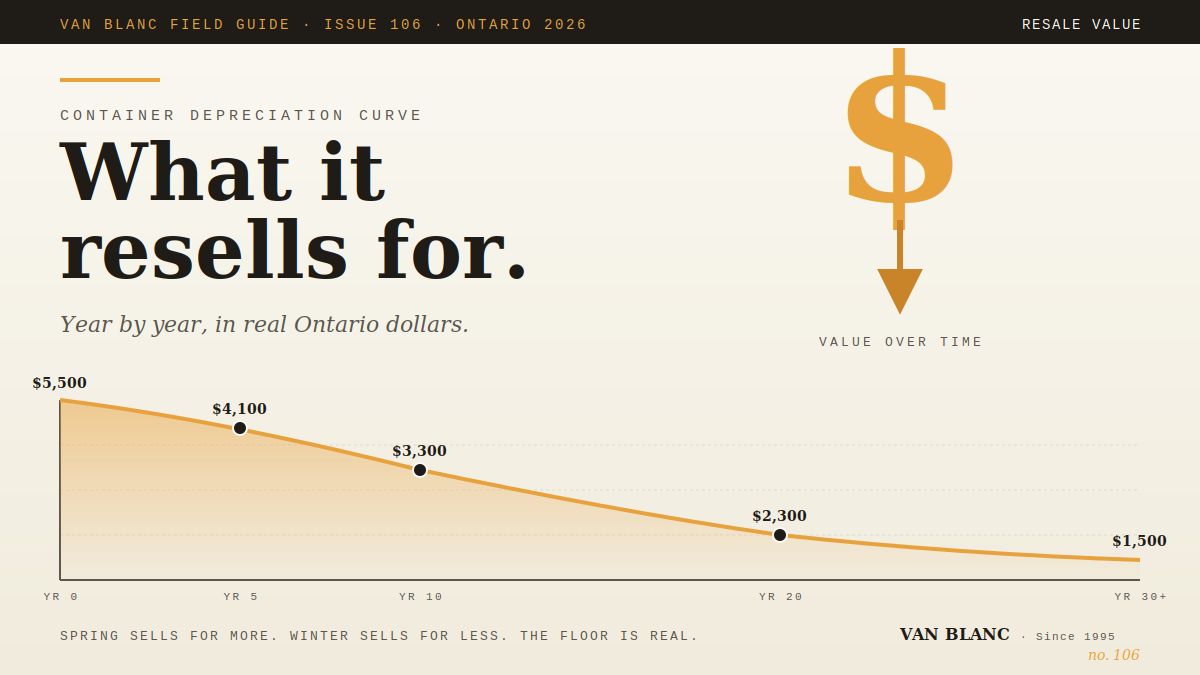
Quick Answer: The container resale value Ontario market follows a roughly 4 to 6 percent annual depreciation curve on used Wind and Watertight stock and 6 to 8 percent on newer One-Trip units, so a used 20 ft container holds most of its value through year 5, sheds roughly a quarter to a third of it by year 10, and settles onto a firm working-storage floor by year 20 if it has stayed wind and watertight. Pricing depends on your site, your grade choice, and your freight zone, so call for a real quote. Brantford-based since 1995, family-operated, 4.9-star verified (140+ Google reviews). 1-3 day delivery Ontario-wide.
In This Guide
- What does container resale value actually measure?
- How fast does a container depreciate in Ontario?
- What do used containers resell for in Ontario in 2026?
- How does CRA Class 8 affect your resale tax?
- What actually holds container resale value?
- What destroys resale value the fastest?
- When is the best time of year to sell?
- Does a new One-Trip or used unit resell better?
- Do modifications add or destroy resale value?
- Where can you sell a used container in Ontario?
- What paperwork do you need to resell a container?
- What do buyers actually pay for?
- Frequently asked questions
- Reach Van Blanc in Brantford
Reading time: about 13 minutes.
What Does Container Resale Value Actually Measure?
Container resale value is the cash price a buyer or yard will pay for a used shipping container today, in its current condition, ready to load onto a truck. It is set by three things: the going market price for a comparable unit, a deduction for visible wear, and the cost to move it off your site.
Container resale value is the price a private buyer or yard will pay for your used shipping container today, in its current condition, ready to load onto a truck. Replacement cost, insured value, and the depreciated book value on a tax return are all different numbers. Resale value is the cash number a buyer hands over when the unit changes hands. In Ontario the resale market is mature, fragmented, and easy to read, because every buyer can walk around the box and read the roof, the floor, the door seals, and the corner castings before they pay.
Three independent numbers shape the resale value of any container in Ontario. The first is the open market price for a comparable used container at a working yard, which sets the ceiling. The second is the condition deduction, which is the dollar value of every dent, soft floor patch, leaking gasket, and rust through that a buyer can see. The third is the location adjustment, which is the cost a buyer would pay to move the container off your property to theirs. Add those together and you get within roughly 10 percent of what a real cash buyer will offer on a real Tuesday afternoon.
Many Ontario owners overestimate their resale value because they remember what they paid in 2021 or 2022 when used 20 ft Wind and Watertight stock briefly traded at multiples of its normal inland value. That spike was a supply shock from pandemic shipping disruption, not a fair-market baseline. The 2026 baseline has reset, with declining wholesale prices reported at Toronto and Vancouver entering early 2025 and a steady inland demand for storage, agricultural, and conversion use cases keeping the floor firm.
How Fast Does a Container Depreciate in Ontario, Year by Year?
Used container depreciation in Ontario does not follow a flat line. It follows a soft curve. The first 5 years lose value fastest, then the rate slows, and after about 25 years the curve nearly flattens because the container has reached its working-storage floor, a plateau tied directly to how long a steel box stays sound in our climate. The numbers below assume a Wind and Watertight 20 ft High Cube container bought at fair market, used for static storage on a yard, with basic upkeep of roof seam paint and door seal grease.
| Age | Value retained (% of purchase) | Cumulative loss | Annual rate |
|---|---|---|---|
| Year 0 (purchase) | 100% | 0% | baseline |
| Year 1 | 92 to 94% | 6 to 8% | 6 to 8% |
| Year 3 | 80 to 83% | 17 to 20% | ~6% |
| Year 5 | 72 to 75% | 25 to 28% | ~5% |
| Year 10 | 55 to 60% | 40 to 45% | ~4% |
| Year 15 | 40 to 45% | 55 to 60% | ~3.5% |
| Year 20 | 32 to 38% | 62 to 68% | ~2.5% |
| Year 25 | 26 to 32% | 68 to 74% | ~2% |
| Year 30+ | 20 to 28% | 72 to 80% | floor |
The curve flattens because at a certain age the container stops being valued as a container and starts being valued as a steel storage box. A 30 year old wind and watertight 20 ft on a southern Ontario farm still delivers the same storage value as a 5 year old unit if it keeps the rain out. The buyer pays for function, not age. That is the resale floor and it is firm.
“People always ask me what their box is worth, and my first question back is the same one a buyer will ask: does the roof leak and does the floor flex? Age barely moves the needle once a unit is past about year ten. A sound 20 ft from the early 2000s and a sound one from last decade fetch close to the same money on a farm, because both keep the rain off the same hay.”
Christian LeBlanc, second-generation operator, Van Blanc Ent. Inc.
What Do Used Containers Resell For in Ontario in 2026?
Ontario is the largest used container market in Canada because it sits on the country’s main intermodal corridor. Containers move through CN Brampton, CPKC Vaughan, and the Hamilton port complex in volume every week. That volume keeps inland Ontario prices roughly lower than Maritime or Prairie equivalents in any given quarter. Below is the actual 2026 resale band our yard sees on the buy side, by grade and size, for containers sold from private owners back into the secondary trade.
| Container type | Wind and Watertight | Cargo Worthy | One-Trip (recent) |
|---|---|---|---|
| 20 ft Standard | baseline (index 100) | +30 to 40% over WWT | +85 to 110% over WWT |
| 20 ft High Cube | +8 to 12% over Standard | +35 to 48% over WWT | +95 to 120% over WWT |
| 40 ft Standard | +55 to 70% over 20 ft | +90 to 115% over 20 ft WWT | +160 to 200% over 20 ft WWT |
| 40 ft High Cube | +65 to 80% over 20 ft | +100 to 130% over 20 ft WWT | +175 to 220% over 20 ft WWT |
These are buyer-side resale numbers, not retail prices. A retail yard like Van Blanc adds operating margin, lift costs, yard storage, prep work, and delivery on top of these acquisition prices when reselling to the next buyer. If you are selling a used container in 2026 Ontario, the resale band above is what you should expect from a yard offering cash on the spot. Private buyer-to-buyer sales can sometimes clear above these numbers, but they take 4 to 12 weeks of listing time on average and exclude buyers without a tilt-deck truck.
How Does CRA Class 8 Capital Cost Allowance Affect Your Resale Tax?
For Canadian business owners, the resale value conversation has a tax overlay. The Canada Revenue Agency treats returnable shipping or cargo containers as Class 8 depreciable property under the capital cost allowance rules, which carries a 20 percent declining balance rate and the standard half-year rule in year one. That gives a predictable book depreciation schedule that often does not match real-market resale value, which is useful to understand before you sell.
| Year | Class 8 UCC (% of original cost) | Typical real resale (% of original cost) | Gap |
|---|---|---|---|
| End of Year 1 | 90% (half-year rule) | 92 to 94% | book is low |
| End of Year 3 | ~58% | 80 to 83% | resale is high |
| End of Year 5 | ~37% | 72 to 75% | resale is high |
| End of Year 10 | ~12% | 55 to 60% | resale is high |
| End of Year 20 | ~1 to 2% | 32 to 38% | resale is high |
The practical takeaway is that after about year 3, the real-market resale value almost always exceeds the CRA undepreciated capital cost. When you sell, the difference between sale proceeds and remaining UCC triggers a recapture on Schedule 8, which becomes taxable business income in the year of sale. Claim the depreciation regardless. The point is that the container is one of the few business assets that depreciates faster on paper than in the real Ontario yard, and selling it back into the market is almost always a positive recapture event. Talk to a CPA before the calendar year-end if the recapture matters to your tax planning.
What Actually Holds Container Resale Value?
Five factors keep resale value firm. Every other variable rounds down to these.
1. Watertight roof
The roof is the single most-inspected surface during any resale walk-around. Buyers shine a flashlight up at every panel seam and corner weld, looking for pinholes, ponding stains, and prior patch jobs. A clean roof commands a clear premium on a 20 ft resale versus a roof with visible repairs. Pinholes from interior condensation, which start at the rear corners on long-stored units, are the most common failure point and the first thing a buyer will use to negotiate down.
2. Dry, solid hardwood floor
Original 28 mm marine plywood or apitong hardwood floors are graded with a steel awl or screwdriver tip. A buyer will tap the floor at four to eight points listening for hollow sound and pressing for soft spots. Water intrusion into the floor is the second most common value killer, often invisible from above until tested. A clean dry floor across a 20 ft container preserves a meaningful share of resale value compared to a unit with one soft section.
3. Working door gaskets and lock rods
Door gaskets that compress evenly and lock rods that close without binding are signs of light use and good storage. Hardened gaskets that no longer compress, or lock cams that need a hammer to close, signal years of outdoor storage with sun exposure or repeated forced closure on a frame that has settled. New gaskets are inexpensive to install, but resale buyers price them like a deduction not an opportunity.
4. CSC plate validity (for export-eligible resale)
A valid Container Safety Convention plate is required for any container moving in international intermodal service. CSC plates expire 5 years after manufacture and then on a recertification cycle. For resale into the Ontario inland market, keeping that little safety-convention data plate readable is not strictly required, but its presence signals the container has been inspected to international structural standards and supports a Cargo Worthy premium over equivalent Wind and Watertight grade.
5. Original ISO 6346 markings intact
Per ISO 6346:2022, every freight container carries a unique 11 character BIC identification: 3 letter owner prefix, 6 digit serial, and one check digit. When that marking is still legible on the door panel, a resale buyer can verify the container’s age, manufacturer, and prior owner through public BIC code records. An overpainted or scrubbed ID is a soft flag for buyers because it removes their ability to verify the unit’s history and signals possible attempts to disguise prior damage or repair work.
What Destroys Container Resale Value the Fastest?
The opposite of the five above are not symmetrical. Some condition issues take a small bite. Others cut the resale price in half. Understanding the severity ranking helps owners decide which problems are worth fixing before sale.
| Condition issue | Severity | Approximate resale hit (% of value) | Worth fixing before sale? |
|---|---|---|---|
| Rust-through on roof panel | Severe | 25 to 40% | Yes, weld patch and paint |
| Soft or rotted floor section | Severe | 20 to 35% | Often yes, partial replacement |
| Bowed side walls (over 2 inches) | Severe | 30 to 50% | No, very rarely economic |
| Failed door gaskets | Moderate | 5 to 10% | Yes, simple gasket replacement |
| Surface rust on side panels | Light | 0 to 3% | No, this is normal patina |
| Faded or peeling original paint | Light | 2 to 5% | Sometimes, depends on cost |
| Missing CSC plate | Moderate | 8 to 15% | No, recertification is expensive |
| Damaged corner casting | Severe | 30 to 50% | No, structural repair is costly |
| Interior odour (chemical or organic) | Moderate | 8 to 15% | Yes, deep clean and ventilate |
| Missing or unreadable ISO 6346 ID | Light to moderate | 3 to 10% | Sometimes, careful repaint of code |
The rule of thumb a working yard uses: any repair that costs less than half of the resale uplift it produces is worth doing. A door gasket replacement that recovers several times its cost in resale is obvious. A corner casting weld that barely returns its cost is not, because the buyer’s risk premium against a hidden structural issue eats most of the gain. Surface rust is fine and over-painting it often hurts more than it helps because fresh paint flags to a buyer that something underneath is being hidden.
When Is the Best Time of Year to Sell a Container in Ontario?
Ontario container demand is seasonal. Resale prices flex roughly 8 to 15 percent across the calendar year, with predictable peaks and troughs that owners can plan. The seasonality is driven by construction cycles, agricultural cycles, and retail-storage cycles.
| Season | Demand strength | Resale pricing | Why |
|---|---|---|---|
| March to May | Strongest | Peak, +8 to 15% | Construction season opens, farms prep for spring, contractors stock up |
| June to August | Strong | Above average | Active build season, summer retail, agricultural storage |
| September to October | Moderate | Average | Harvest storage demand, before-winter buying |
| November to February | Weakest | Trough, -5 to 12% | Frozen ground, no construction, no farm equipment movement |
The best window to sell a used container in Ontario is mid-March through late May, when buyers are gearing up for the construction season and farm operators are buying for spring. The worst window is late November through mid-February, when frozen ground makes delivery harder and most buyers postpone purchases until thaw. If you can hold a unit through one Ontario winter to hit a spring listing window, expect 10 to 15 percent better pricing.
Timing tip from our yard. If you are selling because you are downsizing a farm or closing a job site, list mid-February with a March 1 pickup window. Spring buyers are aggressive and they will lock in pickup 4 to 6 weeks ahead to secure the unit. You get the spring price without holding the container through another full winter.
Does a New One-Trip or a Used Container Resell Better?
One-Trip containers depreciate faster than used containers in the first 3 years because they start from a much higher purchase price. A One-Trip 20 ft High Cube bought in Ontario today, the kind of single-voyage unit we stock with factory paint at the Brantford yard, typically sheds in the high single digits of its value in year one, then settles to roughly four to six percent a year, so by year five it has given back something close to a third of what you paid. The percentage loss is steeper than the WWT curve, but the resale floor after about 10 years is roughly the same because both grades converge into the working-storage market.
The math gets interesting when you compare the cost-per-year-of-service of buying One-Trip versus buying used and reselling later. A One-Trip resold after 5 years has absorbed a larger absolute loss against its higher entry price. A Wind and Watertight resold after the same 5 years gives back far less because it was bought lower on the curve. On a cost-per-year-of-ownership basis, the used route works out to roughly half the annual carrying cost. But the One-Trip route delivers a near-pristine container with original paint, clean interior, and 25 to 35 years of remaining service life, which matters if the container is doing any kind of customer-facing or conversion work.
For pure resale arbitrage, used Wind and Watertight is the better trade, and the fuller new versus used trade-off shows why. You buy at the bottom of the depreciation curve, the curve flattens, and the resale loss is small relative to the holding period. For a conversion project where you eventually want to sell the modified container, One-Trip is the better start because the resale buyer of a modified container values clean original steel more than they value original paint.
Do Modifications and Conversions Add or Destroy Resale Value?
This is where Ontario resale gets complicated. A standard container has a clear resale price. A modified container has a price that depends entirely on what the modification is, how well it was executed, and whether the next buyer wants the same use case. Some modifications add significant resale value. Others destroy it.
| Modification | Resale impact | Recovery on cost |
|---|---|---|
| Personnel door (single, residential-style) | Strong positive | 50 to 80% of cost |
| Roll-up door (large, commercial-grade) | Strong positive | 40 to 70% of cost |
| Windows (fixed, residential) | Positive, per window | 40 to 60% of cost |
| Spray foam insulation, professional | Strong positive | 50 to 75% of cost |
| Electrical, CSA-compliant, with panel | Positive | 40 to 65% of cost |
| HVAC unit, installed | Moderate positive | 30 to 55% of cost |
| Interior framing and drywall | Modest positive | 20 to 40% of cost |
| Custom paint, professional | Positive | 40 to 60% of cost |
| Stainless or food-grade interior | Positive, niche buyers | 40 to 70% of cost |
| DIY conversion, unfinished | Strong negative | negative, buyer will strip and restore |
The general rule is that professional modifications recover roughly 40 to 75 percent of their cost at resale. DIY conversions, especially unfinished ones, often destroy value because the next buyer prices in the cost to either finish the work or strip it back to bare steel. If you are buying a container with resale in mind, hire a qualified team for any modification work. For a deeper look at how to scope and budget the modification side of the project, see our guide on modifying your container.
Where Can You Sell a Used Container in Ontario?
Four practical channels move used containers in Ontario. Each has different speed, price, and effort tradeoffs, and our step-by-step walkthrough of listing and closing a sale covers the legwork each one takes.
1. Established container yards
Yards that retail used stock will quote a buy-side cash price within 24 to 48 hours of seeing photos and basic specs. The price is usually 20 to 35 percent below retail because the yard pays for lift, transport, prep, and resale margin. Speed is the advantage: payment on pickup, no listing time, no flake risk. This is the standard exit for owners who want a fair price and no headaches. Van Blanc buys back used containers from Ontario owners when our inventory mix needs replenishing.
2. Online classified listings (Kijiji, Facebook Marketplace)
The highest-price route but the slowest and most variable. Expect 4 to 12 weeks of listing time, 30 to 60 inbound messages of which 80 percent are tire-kickers, and 2 to 5 serious cash buyers per listing. Pricing 5 to 15 percent above yard buy-back is realistic. Watchout: Ontario has a documented surge of container scams on these platforms, the suspiciously cheap listing that never arrives, targeting both buyers and sellers, so verify any buyer in person and never accept partial deposits or third-party logistics arrangements.
3. Trade-in toward a new container
Some yards (including Van Blanc) will accept a trade-in toward a new One-Trip or upgraded used unit. The trade-in credit is typically slightly higher than the cash buy-back price because the yard captures the new container margin alongside the trade. If you are upgrading anyway, this is often the cleanest exit, and you can browse what we currently have on the ground before deciding what your old box rolls into.
4. Container wholesalers and broker networks
For multi-unit fleets (5+ containers), wholesale broker networks like Container xChange or direct broker contacts move stock by the truckload at wholesale rates. Pricing is the lowest of the four channels (often 35 to 45 percent below retail), but volume and speed are unmatched.
What Paperwork Do You Need to Resell a Container?
The paperwork side of container resale is simpler than most owners assume, but a few documents materially affect the price.
The original purchase invoice is helpful but not required for resale. Most used containers move in Ontario without a chain-of-title document because containers are personal property, not titled assets. The container’s identity is verified through its ISO 6346 BIC code, which is the 11 character alphanumeric on the door panel and corner. That code can be cross-referenced against the BIC owner database to confirm the originating shipping line, year of manufacture, and any flagged issues. A buyer who cannot read the BIC code, because it has been overpainted or damaged, will discount the price or walk away.
The CSC plate is the small data plate mounted to the door near the lock-rod hardware. It records the manufacturer, date of build, maximum gross weight, allowed stacking weight, racking test load, and the date of the most recent periodic inspection. For inland Ontario resale, an expired or missing CSC plate trims the price modestly but does not block the sale. For any export-eligible resale, a valid CSC plate (current within its periodic inspection cycle) is mandatory, and bringing a lapsed plate back into compliance means recertification through a qualified surveyor.
For business sellers, the only additional paperwork is the bill of sale (recommended for HST handling and CRA recapture documentation), the buyer’s pickup contact for logistics, and a confirmation of the buyer’s truck specs (tilt-deck flatbed for most 20 ft loads, hi-boy or roll-off for 40 ft). For private sellers, a simple invoice or bill of sale dated and signed by both parties is sufficient.
What Do Buyers Actually Pay For?
Paul has priced more used boxes on the buy side than anyone at the yard, and whether the exit is a private sale or a trade back to the yard, the checklist he runs is the same.
“After 30 years buying and selling containers out of this yard, the thing I tell every seller is the same. Buyers pay for what they can see and what they can verify. They pay for a roof that does not leak, a floor that does not flex, a door that does not need a hammer, and a code on the panel they can look up. Everything else is negotiable. Faded paint, surface rust on the side, a small dent in the corrugation, that is character, not damage. Do not spend money trying to polish it. Spend money fixing what actually fails. And if you are not sure whether something is character or damage, bring it down to the yard and we will tell you straight. Worth the drive to Brantford for a fair look.”
Paul LeBlanc, owner, Van Blanc Ent. Inc.
If you want a number before you drive out, run the resale figure yourself against the grade and age tables above.
Ready to price your container?
Tell us the size and your postal code and we’ll send back an all-in number, container, delivery, and placement, usually within 1-3 days. No pressure, no mystery fees.
Family-run in Brantford since 1995 · 200+ containers in stock · 4.9★ across 140+ Google reviews · every box graded by a person, walk it before it lands.
Frequently asked questions
What is the resale value of a used 20 ft shipping container in Ontario?
A used 20 ft Wind and Watertight container sits at the base of the Ontario resale market in 2026, with the exact figure depending on age, condition, and grade. Cargo Worthy units with valid CSC plates carry a clear premium over that grade, and recent One-Trip units sit higher again. Prices flex 8 to 15 percent across the calendar year with spring peaks and winter troughs.
How much does a container depreciate per year in Ontario?
Used Wind and Watertight containers depreciate at roughly 4 to 6 percent per year on a declining basis. One-Trip containers depreciate faster in the first 3 years (6 to 8 percent) because they start from a higher purchase price, then converge with the WWT curve. After about 25 years the curve flattens because the container has reached its working-storage floor.
How does CRA Class 8 affect shipping container resale tax?
CRA classifies shipping containers as Class 8 depreciable property with a 20 percent declining balance capital cost allowance and the standard half-year rule in year one. The book value depreciates faster than real-market resale value, so most resales after year 3 generate a recapture event on Schedule 8 that becomes taxable business income in the year of sale. Discuss with a CPA before year-end if material.
When is the best time of year to sell a used container in Ontario?
Mid-March through late May is the strongest resale window in Ontario, with pricing typically 8 to 15 percent above the November to February trough. Construction season opening and spring agricultural demand drive the seasonal premium. List 4 to 6 weeks ahead of the desired sale date to lock in spring pricing.
Does the CSC plate affect resale value in Ontario?
For inland Ontario resale, an expired or missing CSC plate trims the resale price modestly but does not block the sale. For export-eligible resale or international shipping use, a valid CSC plate is required, which means recertification through a qualified container surveyor.
Do shipping container modifications increase resale value?
Professional modifications typically recover 40 to 75 percent of their cost at resale. Roll-up doors, spray foam insulation, and CSA-compliant electrical add the most resale value. DIY or unfinished conversions usually destroy value because the next buyer prices in the cost to finish or strip the work. Quality of execution matters more than the modification type.
What does a 30 year old shipping container sell for in Ontario?
A 30 year old wind and watertight 20 ft container in Ontario typically resells near its working-storage floor if the roof and floor are still sound. After about 25 years the depreciation curve flattens because the container is being valued as a steel storage box rather than a freight asset. Floor integrity is the single biggest variable at this age.
Where should I sell my used container in Ontario for the best price?
The four channels are established container yards (fast, fair, 20 to 35 percent below retail), online classifieds (slow, variable, 5 to 15 percent above yard buy-back), trade-in toward a new unit (clean exit when upgrading), and wholesale broker networks for multi-unit fleets. Yards are the standard exit for single-unit sellers prioritizing speed and certainty.
Is selling a container subject to HST in Ontario?
For HST-registered business sellers, the sale of a used container is a taxable supply and HST applies on the sale price. For non-registered private sellers, HST does not apply. The buyer is responsible for HST on the purchase from a registered seller. Documentation of HST collected is required for the business seller’s HST return.
What container condition issue destroys the most resale value?
Bowed side walls (over 2 inches deflection), damaged corner castings, and rust-through on roof panels each strip a large share off the resale price of a 20 ft unit and are rarely economic to repair before sale. Floor rot and soft floor sections are nearly as bad. Surface rust, faded paint, and minor dents are normal and almost never worth fixing before sale.
How do I check the age of a container before resale?
The CSC plate records the date of manufacture directly. If the plate is missing or unreadable, the ISO 6346 BIC code on the door panel can be cross-referenced against the BIC code owner database to identify the operator and approximate age. A working container yard can decode the BIC code on site in under 5 minutes.
Should I repaint a used container before selling it?
Usually no. Fresh paint signals to experienced buyers that something underneath is being hidden, and most discount accordingly. Paint refresh only makes sense if the existing paint is severely peeling and the buyer pool is non-expert (residential or aesthetic-focused). For yard-to-yard resale or B2B transactions, leave original paint alone and price the unit on its condition.
Go Deeper: Detailed Topic Guides
For more depth on specific aspects of this topic, see our spoke articles:
More from this cluster
Deeper reads we’ve added since the original guide:
Reach Van Blanc in Brantford
We have been supplying shipping containers across Ontario since 1995. Our warehouse is at 90 Morton Avenue East in Brantford, and we deliver across Ontario in 1 to 3 days from our four Brantford yards. No surprise fees, no chase-the-paperwork. Every quote comes with a real lead time, not a hopeful one.
Van Blanc Ent. Inc. 90 Morton Ave E Unit 1B, Brantford, ON N3R 7J7. +1 888-509-6658
If you are buying a container with resale value in mind, or selling one back into the Ontario market, our yard is the right place to start. We hold 200+ containers in stock across One-Trip, Cargo Worthy, and Wind and Watertight grades, and we buy back used Ontario stock when our inventory mix needs replenishing. Picking your own unit is standard at our yards. Walk the row, read the CSC plates, and see what the resale market actually pays for.
Sources
- International Organization for Standardization. ISO 6346:2022 Freight containers: Coding, identification and marking. iso.org/standard/83558.html
- Canada Revenue Agency. Capital Cost Allowance Class 8 Property (IT-472). canada.ca
- Canada Revenue Agency. Capital cost allowance (CCA) classes. canada.ca/cca-classes
- Container xChange. Shipping container price Canada: 2025 buy new and used wholesale prices. container-xchange.com
- SAFETY4SEA. Container price trends of late 2024 to persist into Q1 of 2025. safety4sea.com
- Statistics Canada. Containing the price of shipping. statcan.gc.ca