
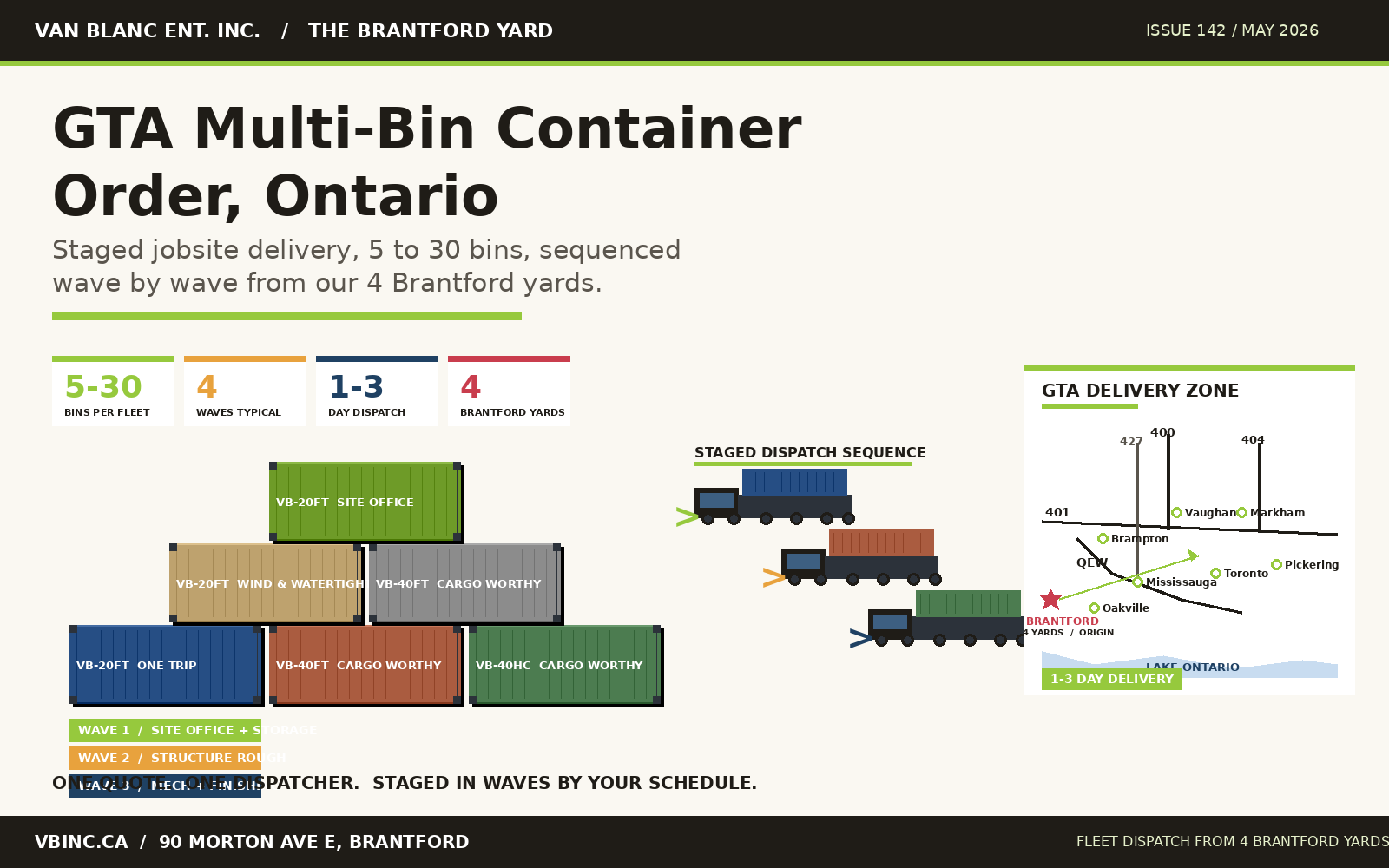
Quick Answer: A GTA multi-bin container order Ontario from Van Blanc covers 5 to 30 staged container deliveries across Toronto, Mississauga, Brampton, Vaughan, and Markham. We dispatch from our 4 Brantford yards in 1-3 days, sequence drops by your podium-to-finishing schedule, and price the freight per consolidated route, not per individual truck.
In This Guide
- What Counts as a Multi-Bin Container Order in the GTA?
- Why Do GTA Sites Stage Containers in Waves?
- How Many Containers Does a GTA Project Actually Need?
- How Fast Can We Deliver a Fleet From Brantford to the GTA?
- How Do You Sequence Fleet Drops Around the Build Schedule?
- What Does Tilt-Deck Delivery Need on a Downtown Toronto Site?
- How Does Bulk Pricing Work on a Multi-Bin Order?
- Christian on Running a 22-Bin Order Through a Mississauga Subdivision
- What Happens to the Fleet When the Project Closes?
- How Do You Avoid a Fleet-Order Scam?
- Frequently Asked Questions
Reading Time: 13 minutes
What Counts as a Multi-Bin Container Order in the GTA?
A GTA multi-bin container order is any job that needs five or more shipping containers delivered to one site, or to related sites under a single general contractor. Van Blanc plans these as a fleet: one routing map, one dispatch sequence keyed to the build schedule, one consolidated freight calculation, and one yard contact.
A multi-bin order is any project that needs more than four shipping containers delivered to the same site, or to a cluster of related sites under one general contractor. Van Blanc has been quoting and delivering these across the Greater Toronto Area since the late nineties, and the shape of the order changes the moment you cross from four to five bins. Below four, we treat each container as a single dispatch. From five upward we plan the order as a fleet: one routing map, one dispatch sequence, one freight calculation, one point of contact at the yard.
The threshold matters because GTA buyers ask us for the same five things on every fleet order, and they ask in the same order. How fast can you put them on the ground? Can you sequence the drops so we are not paying for a bin to sit on the boulevard for six weeks? Can the trucks fit our laydown? Are the bins consistent in grade so the trades stop asking which one has the good doors? And what happens at the end, when we want them off the site by the day the topping-out crane comes down?
This guide answers those five in order, with the operational reality of running fleets from our Brantford yards into Toronto, Mississauga, Brampton, Vaughan, Markham, Oakville, Pickering, and the rest of the region. For the wider framework that sits behind the staging logic here, our writeup on sizing and securing storage on an active build site covers the province-wide basics first.
Paul LeBlanc, owner: “On a fleet order the question is never just how many bins. It is which bin lands which week. I have watched contractors pay to store steel on a boulevard for two months because someone shipped the whole order on day one. We sequence the drops so you are paying for what is on the ground, not what is waiting. Nineteen years in containers taught me that the schedule is the product, not just the box.”
Why GTA construction crews come to Brantford for fleet orders
Many GTA general contractors started by calling national chains with online quote forms. They came back to us after the second project because a real yard answers the phone, the same dispatcher knows their site by the third bin, and the Brantford-to-GTA drive is shorter than the wait for a return call from a head office in another province. Worth the drive for unbeatable quality, family customer service with 30 years of experience.
Why Do GTA Sites Stage Containers in Waves?
GTA sites stage containers in waves because construction projects in the region are space-starved. Toronto core sites measure their laydown in linear feet of hoarding, not square feet of yard. A 30-storey podium build might have room for three containers at framing, six at mechanical rough-in, and ten through finishing. The whole fleet on day one is not a strategy. It is a liability.
Staging is the answer. We bring the first wave when excavation closes, the second wave when the trades start rolling in, and the third wave when the finishing subs need their lock-up tool cages. Each wave is its own dispatch from the Brantford yards. You pay for what is on the ground, not what is sitting in storage at our cost.
Sequencing matters even more in suburban GTA, where the laydown is wider but the neighbours notice every container that lands. In Vaughan, Markham, and Mississauga we have delivered enough fleets to know which subdivisions have HOA pressure on visible storage and which industrial parks let you stack two-high without anyone raising a fuss.
The four grades you should know before you order a fleet
Even on a 20-bin order, the grades still matter. Buyers who order in volume often assume they need to commit to a single grade for the whole fleet. They do not. A common pattern for GTA sites is six one-trip bins for the offices and front-of-site secure storage, twelve cargo-worthy bins for general material storage, and four wind-and-watertight bins for low-value bulk that lives at the back of the site. The fourth grade, as-is, almost never makes sense on an active GTA project because cosmetic problems become security problems when the bin is visible from the street. If you want the full breakdown of what to look for before you commit a single bin to a fleet, our guide on inspecting a used unit before you pay spells out each grade and what it is built for.
| Grade | Condition | Best fleet role | Visible from street? |
|---|---|---|---|
| One-trip (new) | Single ocean voyage, factory paint, doors seal clean | Site office, security shack, front-of-site secure storage | Yes, the bins people see |
| Cargo-worthy (CW) | Multiple crossings, surface rust, structurally re-inspected | General trades tools and material storage, the workhorse | Either, the bulk of the fleet |
| Wind-and-watertight (WWT) | Weather-tight and rodent-proof, visible cosmetic wear | Low-value back-lot bulk and stationary storage | Back of site only |
| As-is | Older units with possible floor or door questions | Rarely recommended on an active GTA build | No, we steer fleets away from it |
How Many Containers Does a GTA Project Actually Need?
The number of containers a GTA project needs depends on the project, not the size of the lot. We have delivered six bins to a 14-acre site that only needed front-of-site tool storage, and twenty-two bins to a half-acre Mississauga subdivision build that was sequencing the entire trades package out of containers because there was no other secure space. The table below is a rough guide drawn from the orders we have actually run through the GTA, not theoretical maximums.
| Project type | Typical fleet | Mix of grades | Project length |
|---|---|---|---|
| Custom home, residential infill | 1 to 3 bins | One-trip front, CW back | 6 to 14 months |
| Small commercial fit-out | 2 to 4 bins | One-trip office, CW material | 4 to 9 months |
| Subdivision build (10 to 30 lots) | 5 to 12 bins | Mostly CW with two one-trip | 12 to 24 months |
| Mid-rise condo or commercial podium | 8 to 18 bins | Six grades by trade requirement | 18 to 36 months |
| High-rise tower or mixed-use complex | 15 to 30 bins | Full staged grade plan | 24 to 48 months |
| Industrial plant or warehouse build | 10 to 25 bins | CW heavy, two reefers if food-grade | 10 to 24 months |
The high-rise number always surprises first-time buyers. Thirty bins on one tower sounds excessive until you walk a Toronto downtown site at month eighteen of a 42-storey build. Concrete forms in eight bins. Trades tools in six. Owner-supplied finishes in four. Site office and meeting room conversion in two. Hoarding-adjacent secure storage in another five. Then the project manager wants two more for waste segregation and you are at twenty-seven before lunch.
How Fast Can We Deliver a Fleet From Brantford to the GTA?
A GTA fleet from Van Blanc moves fast because every bin we dispatch leaves from our 4 Brantford yards. That is the public face of our operation and it is also the operational reality for GTA orders. The drive is roughly an hour to West Toronto, eighty minutes to the core, and ninety to Markham or Pickering. Inventory sits across four yards so fleet orders can be assembled from multiple grades and sizes in parallel, with no single gate to queue through.
For a GTA buyer, what this means in practice: when you call to place the order, we walk the four yards mentally with you. If the order is fifteen bins, we know within five minutes whether the mix you need is sitting in our current stock or whether we are pulling some of it from incoming arrivals. The answer drives your lead time honestly. Most GTA fleet orders ship in 1-3 days. The longer end of that range is the order that asked for fifteen one-trip 40HCs in a colour the manufacturer does not have on the water that week. Every quote comes with a real lead time, not a hopeful one.
Order the office bin first if the project is long
On any GTA project running longer than nine months, order the site-office bin two weeks before the rest of the fleet. The site office becomes the dispatch point for all subsequent deliveries: trades use it as their address for tool drop, the project manager uses it for site coordination, and the security firm uses it as their check-in point. Ordering it early also means you can put a factory-paint office bin at the front of the site without holding up the rest of the fleet while you wait on lower-grade availability.
How Do You Sequence Fleet Drops Around the Build Schedule?
We sequence fleet drops by keying each wave to the construction calendar, so a staged fleet typically lands in three or four waves rather than all at once. The pattern below is the one we see most often on GTA mid-rise and high-rise sites, and it generalises down to suburban subdivision and commercial fit-out work with smaller bin counts.
The four-wave delivery pattern for a typical GTA fleet
- Wave 1 (excavation close): Site office bin plus one secure storage bin. Usually one one-trip and one cargo-worthy. Lands on the day the hoarding goes up.
- Wave 2 (structure rough): Four to eight bins for trades tool storage, owner-supplied materials, and concrete-form storage. Mostly cargo-worthy. Lands when the first three trades are on site full-time.
- Wave 3 (mechanical and finishing rough): Four to twelve additional bins for finishing trades, high-value owner-supplied finishes, and waste segregation. Mix of cargo-worthy and one-trip. Lands when the building envelope is closed.
- Wave 4 (close-out and decommission): No new bins arrive. Existing bins begin to leave in reverse order: lowest-value first, site office last. The site office bin often stays through occupancy turnover.
Each wave is its own dispatch from us. We schedule them with your project manager four to six weeks out, then confirm a 48-hour window in the week before each drop. The honest part: we do not promise hour-of-day delivery on a fleet because GTA traffic between Brantford and the core makes that a hopeful lead time, not a real one. We deliver morning or afternoon, you tell us which window your site can receive, and we stage the truck within that window.
What Does Tilt-Deck Delivery Need on a Downtown Toronto Site?
Tilt-deck delivery on a downtown Toronto site needs approximately 80 to 100 feet of straight, level approach to deposit a 40-foot container. This is the single biggest logistical constraint on GTA fleet orders and it is not negotiable. A bin will not fit through a 60-foot approach because the geometry of the tilt forces it to land in a curve that mostly is not the curve your site allows.
For Toronto downtown sites, the boulevard is often the only realistic placement, and the contractor coordinates the street access with their own site logistics plan. For Mississauga and Brampton sites with proper laydown, the placement is usually inside the hoarding. For Markham and Vaughan industrial parks, the placement is on the pad and the truck has room to manoeuvre.
The placement requirements your contractor needs to know
A tilt-deck delivery needs roughly 65 to 80 feet of clearance on the approach side, level ground within the placement footprint (a four-inch slope across the length is the maximum we are comfortable with for a long-term placement), no overhead obstructions within 20 feet of the centre of the placement zone, and unobstructed access for the truck to back in and pull straight out. Our dispatcher walks every fleet order through this checklist before the first wave leaves the Brantford yard. If the site does not pass, we tell you on the call, not at the curb.
How Does Bulk Pricing Work on a Multi-Bin Order?
Bulk pricing on a multi-bin order works differently than buyers expect, because most callers open with a question about volume discounting. The answer is honest and a bit more nuanced than the answer national chains give. Yes, we offer bulk pricing on multi-bin orders. No, it is not a flat percentage off a single-bin price multiplied by the number of bins. Bulk pricing on a real fleet order comes from three places.
First, freight consolidation. A truck running from Brantford to a single GTA site carrying three bins per wave costs less per bin than three trucks each carrying one. That savings is real, it is calculable, and we pass most of it through to the buyer because freight is the line item where dishonest competitors hide markups.
Second, grade-mix flexibility. A fleet order lets you mix grades to match use, which means you are not paying one-trip prices for back-of-site cargo-worthy work. Because we keep all four grades in stock across the four yards, the order can be assembled from whatever the trades actually need rather than a one-size price. National chains that quote a single price across the fleet are quoting their average, which means you overpay on the cargo-worthy bins to subsidise the one-trip pricing.
Third, multi-wave dispatch scheduling. Spreading the order over four waves over twelve months means your cash sits in your bank account, not ours, until the bin is on the ground. That is not a discount in the technical sense, but it is a real cost-of-capital advantage versus paying for the whole fleet up front and watching the bins depreciate on the boulevard.
What bulk pricing does not do
Bulk pricing on a fleet order does not magically turn a wind-and-watertight bin into a one-trip bin, does not get the truck through traffic faster, and does not change the factors that move a single unit’s price in the first place. The lower per-bin number you see on a 20-bin order is honest math: freight savings + grade-mix optimisation + scheduling efficiency. If a competitor is offering 35% off list on a 20-bin order with no schedule, no grade mix, and no site walkthrough, that is the offer that does not arrive. We have taken the call-back too many times to count over thirty years.
Christian on Running a 22-Bin Order Through a Mississauga Subdivision
Christian LeBlanc, second-generation operator: “The Mississauga order that I keep coming back to was 22 bins over fourteen months on a townhouse subdivision. The general contractor walked our yard the week before he signed. He picked out the actual bins. Two one-trip 20s for the trailer office and the security shack. Sixteen cargo-worthy 40s for the trades. Four wind-and-watertight 20s for the back-lot bulk. We staged the drops over six weeks, then over the project we did decommission in reverse. Last bin off the site was the office, the day the model home opened. He told me the worst part of the whole project was the day the bins came down because the site felt empty. That is the kind of fleet order we run.”
What Happens to the Fleet When the Project Closes?
When a GTA project closes, the fleet has to come off the site, and the savvier buyers plan that exit as carefully as the deployment. A 20-bin fleet that needs to be cleared by a fixed occupancy date is a logistics problem with the same shape as the initial dispatch, in reverse. The province-wide version of this pattern lives in our weekend pickup and lock-down checklist, but GTA close-out has its own constraints around weekend road access and the narrow windows a downtown site allows for truck movements.
We handle decommission three ways. The buyer keeps the fleet for a future project and arranges the relocation through their own hauler, then calls us when they need to top the fleet up (about 30% of GTA repeat customers). The buyer sells the fleet back to us at fair-market based on grade and remaining life (about 40%, mostly cargo-worthy bins that have one or two more projects in them). The buyer keeps some, sells some back, and we coordinate the buy-back side of that split (the remaining 30%). The point is we plan the decommission with you during the initial fleet quote, not in the panicked phone call ten days before the site has to be cleared.
Sell-back valuations are honest, not flattering
If you sell bins back to us at project close, we value them on real condition, not on what you paid. A cargo-worthy 40HC that spent two years on a Toronto downtown site exposed to salt spray and trade abuse is worth less than a wind-and-watertight bin that lived in a Markham industrial park. We tell you the number on the spot, you accept or decline, and there is no surprise renegotiation at pickup. That is the COD honesty applied to the back end of the transaction.
How Do You Avoid a Fleet-Order Scam?
You avoid a fleet-order scam by recognising the pattern, because fleet orders attract a particular kind of fraud. The pattern: a contractor receives an unsolicited email from a “container broker” offering a fleet of 15 bins at less per bin than the legitimate quote, with the catch being a 30% deposit wired upfront to lock in pricing. The bins never arrive. The broker disappears. The contractor calls us asking if we can rush a replacement fleet because the schedule is now compressed and the site is bleeding a week in idle trades.
Many people call us saying they can get a fleet less per bin on Facebook or through a broker. Two weeks later they call back saying they got scammed. Do not fall for it. The contractor who picked out his 22 bins in our Mississauga story walked our yard, watched the bins come off the trucks, and paid on delivery. That is what a real fleet quote looks like. Before you wire a deposit to anyone, walk through how the wire-the-deposit fraud unfolds and how buyers recover from it.
Frequently Asked Questions
What is the minimum order to qualify as a multi-bin fleet?
We treat any order of five or more containers to the same site or related sites as a fleet order. From five upward, we plan the order as one dispatch with sequenced waves, one freight calculation, and one yard contact. Orders of two to four bins still get volume freight savings but are dispatched as individual deliveries.
Can you stage delivery of 20 containers over multiple months in the GTA?
Yes. Most GTA fleet orders of fifteen bins or more are delivered in three or four waves keyed to the construction calendar, with the first wave landing at excavation close and the last wave landing when the building envelope is sealed. We hold the rest of the fleet in our Brantford yards at no carrying cost to you.
How fast can Van Blanc deliver a fleet of 10 containers to a Toronto site?
If the grade mix is in our current Brantford inventory, the first wave of three to four bins lands within 1-3 days and the full fleet completes within ten business days. If the order includes one-trip bins not currently in stock, we quote a realistic lead time honestly, usually two to four weeks depending on incoming arrivals.
Do you offer multi-container discounts on GTA fleet orders?
Yes, but the discount comes from three real places, not a flat percentage. Freight consolidation across waves, grade-mix flexibility so you pay one-trip prices only where you need one-trip bins, and scheduling efficiency that keeps your cash with you until each wave lands. The savings are calculable and we show the math on the quote.
Can you deliver containers to a downtown Toronto highrise site?
Yes, with the understanding that placement is usually on the boulevard and that tilt-deck trucks need about 80 feet of straight approach to set a 40-foot bin. We walk the site with your project manager before the first wave to confirm the placement footprint is workable. If it is not, we say so on the call before the truck leaves Brantford.
What is the typical fleet size for a mid-rise condo build in Mississauga?
A typical mid-rise condo or commercial podium project in Mississauga runs eight to eighteen bins over the project life, with the mix split roughly two one-trip bins for site office and security, eight to twelve cargo-worthy bins for trades and material storage, and two to four wind-and-watertight bins for back-of-site bulk. We adjust the mix to your trade package.
Can you buy back the fleet when the project closes?
Yes. Most GTA fleet buyers sell at least part of the fleet back to us at project close, valued honestly on actual condition and remaining life. We give the valuation on the spot during the decommission walkthrough, you accept or decline, and there is no surprise renegotiation at pickup. About 70% of repeat GTA contractors sell some bins back.
What grades should I order for a high-rise tower in Toronto?
A typical high-rise fleet of twenty bins might run six one-trip bins for the site office, security shack, and front-of-site visible storage, ten cargo-worthy bins for general trades and material storage, and four wind-and-watertight bins for back-lot bulk. We rarely recommend as-is grade on an active downtown site because cosmetic problems become security problems when the bin is visible.
Is Van Blanc a national-chain alternative for GTA fleet orders?
Yes. We are the family-run Ontario alternative to national chains for fleet orders. Real Brantford yard you can walk before signing, 4.9 stars across 140+ verified Google reviews, fleet dispatch from four yards in 1-3 days. National chains route GTA fleet orders through head-office quote forms; we route them through a real dispatcher who knows your site by the third bin.
What is the difference between renting and buying a fleet for a GTA project?
Buying makes sense for projects over eighteen months because purchase plus eventual sell-back beats cumulative rental cost. Between twelve and eighteen months, the answer depends on the grade mix and the buy-back valuation. Our quote shows both scenarios so the math is honest, not hopeful.
Sources
- Ontario Construction News. (2026). Shipping container pricing in Canada: A 2026 guide for construction professionals. ontarioconstructionnews.com
- International Organization for Standardization. (2022). ISO 6346:2022 – Freight containers, coding, identification and marking. iso.org
- Transport Canada. (2025). Cargo Securement Standard 10, Containerized Cargo. Transport Canada Motor Vehicle Safety. tc.canada.ca
- Real Estate News Exchange. (2024). Intermodal facilities vital for GTA industrial growth. renx.ca
- Container Sales Group. (2026). Bulk Shipping Containers for Sale: 2026 Guide for Business Buyers. containersalesgroup.com
Reach Van Blanc in Brantford
We have been supplying shipping containers across Ontario since 1995. Our warehouse is at 90 Morton Avenue E in Brantford, and we deliver right across the province on a cash-on-delivery basis. No surprise fees, no chase-the-paperwork.
Van Blanc Ent. Inc. 90 Morton Ave E Unit 1B, Brantford, ON N3R 7J7 +1 888-509-6658
If you are scoping a multi-bin fleet order for a GTA project and want a dispatcher who walks the site with you before the first wave leaves, call us. We will give you a real lead time, a real grade mix, and a real freight number, all in one conversation.
Related Reading
Ready to price your container?
Tell us the size and your postal code and we’ll send back an honest, all-in number, container, delivery, and placement, usually within 1-3 days. No pressure, no mystery fees.
Family-run in Brantford since 1995 · 200+ containers in stock · 4.9★ across 140+ Google reviews · every box graded by a person, walk it before it lands.