
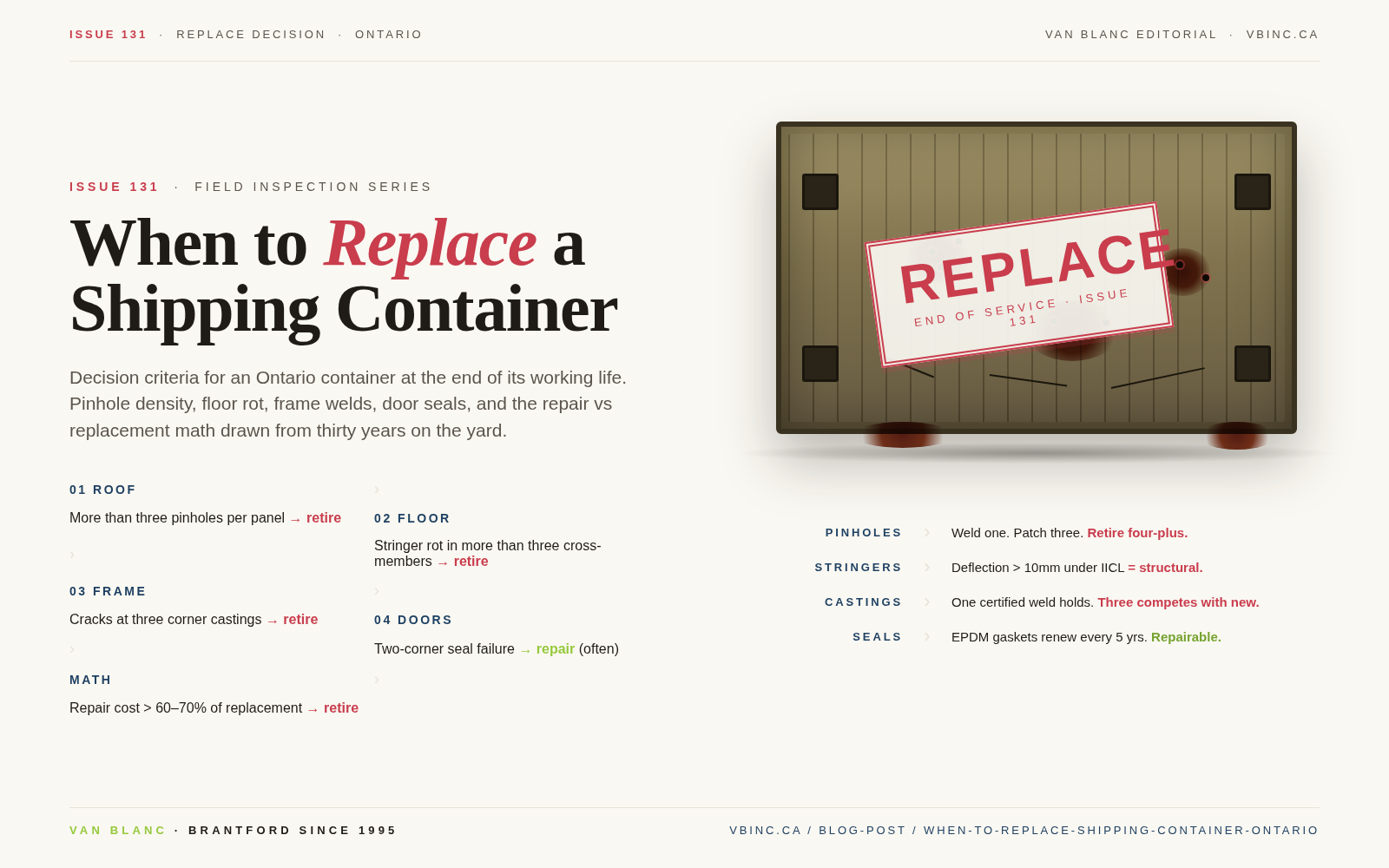
Quick Answer: Following IICL container inspection standards, replace your shipping container in Ontario when the cost of keeping a tired bin patched and weatherproof approaches 60 to 70 percent of a replacement bin, when floor stringers fail, when more than three roof pinholes appear in one panel, or when door seals leak in two or more corners. Most Ontario containers retire between year 18 and year 30. Three decades family-run, 140+ verified Google reviews. 1-3 day delivery from our 4 Brantford yards across Ontario.
In This Guide
- When Should You Replace a Shipping Container in Ontario?
- How Many Roof Pinholes Mean a Container Needs Replacing?
- How Do You Know If a Container Floor Has Failed?
- What Frame Damage Means a Container Is Done?
- Do Failed Door Seals Mean You Need a New Container?
- When Is It Cheaper to Replace Than Repair a Container?
- Why Do Ontario Containers Wear Out Faster?
- How Do You Inspect a Shipping Container Yourself?
- Can Modification Save a Worn-Out Container?
- What Should You Do With a Retired Container?
- Frequently Asked Questions
Reading Time: 12 minutes
When Should You Replace a Shipping Container in Ontario?
Replace a shipping container in Ontario once repair cost reaches 60 to 70 percent of a better replacement bin, or sooner if floor stringers fail, more than three roof pinholes cluster in one panel, the frame twists, or door seals leak in two corners. Most Ontario containers retire between year 18 and year 30.
An Ontario shipping container is a working asset. It holds inventory, feed, tools, or finished product. The day it stops doing that job, every hour of downtime costs money. The trick is recognising the failure window before the roof gives out in February or the floor drops out under a forklift in August.
Most buyers in Ontario assume a container either works or it does not. The reality, after thirty years of watching them age across Brant, Norfolk, Niagara, and the GTA, is that containers fail in stages. A pinhole appears. Then three pinholes. Then a stringer rusts through. Then a door seal lets in snow on the north side. Each stage has a fix. The replacement question is about when the cumulative fix cost crosses the line where a different bin becomes the smarter spend.
This guide gives you the criteria to make that call. It draws on IICL inspection standards, the four-grade industry taxonomy (One-Trip, Cargo Worthy, Wind & Watertight, As-Is), and the operational reality of running working containers through Ontario winters. If you want the longevity side first, our companion piece on how long Ontario containers actually last sits one step up the tree from this article. That hub covers expected service life. This piece covers what to do when yours is reaching the end.
From the Yard
Christian LeBlanc, second-generation operator: “People call us in a panic when the roof leaks, but a leak is rarely the whole story. By the time I get under the box with them on a tilt-deck, the stringers are usually telling the real tale. We would rather walk your container with you and give you the math than sell you a replacement you do not need yet.”
How Many Roof Pinholes Mean a Container Needs Replacing?
Roof pinholes are the first replacement signal on almost every retired container in Ontario, and the rule is density: more than three in a single corrugation panel tips a bin toward retirement. The roof is the first plane to go. Snow load, freeze-thaw cycling, and the corrosion that follows ponding water all attack the top panel from above. Used containers spent their working ocean lives with seawater pooling on the roof every voyage. By the time they reach a storage yard in Brantford, the roof is already the weakest plane of the box.
The decision rule is density, not the presence of any single pinhole. One pinhole in a roof corrugation is normal aging on a fifteen-year-old box. You weld it, you re-coat the patch, you carry on. Three or more pinholes in the same panel suggests the panel has lost its structural skin. At that point you are looking at section replacement, not patch work.
Roof Pinhole Repair Tiers
Tier 1: a single pinhole under 3mm. Marine-grade silicone or a small spot weld. Minimal material and a short labour call. Container stays in service for another five to seven years.
Tier 2: two to three pinholes within one corrugation panel. Localised welding or a single overlay patch, a half-day of professional labour.
Tier 3: more than three pinholes per panel, or pinholes across multiple panels. Roof panel section replacement, the most expensive of the three tiers per section, per industry repair guidance. If two or more sections need replacement, the math usually tips toward retiring the unit.
The reason density matters more than depth is what corrosion does to the surrounding metal. A pinhole is the visible tip of a rust front that spread across the panel under the paint. By the time you can see it from below, the steel two inches around it is also compromised. Patching one hole on a panel with three more brewing is fixing the symptom while the cause keeps working. Most experienced container yards will retire a bin once three or more visible pinholes appear in one corrugation, because the next three are usually six months away.
How Do You Know If a Container Floor Has Failed?
A container floor has failed when the marine plywood delaminates or the steel stringers beneath it rust through, and you confirm it with a tap test and a deflection check. Floor failure is the second failure mode and the more serious one. A leaky roof costs you the cargo inside. A failed floor can cost you the forklift driver standing on it. Floor failure in shipping containers has two distinct flavours that matter for the replace decision.
The first is plywood delamination. The 28mm marine plywood floor of a standard ISO container absorbs moisture over years. Once the layers begin to separate, the load-bearing capacity drops fast. Per IICL Technical Bulletin 004, plywood delamination and rot are recognised as wear and tear. The criteria for floor repair under IICL is straightforward: plywood cannot be welded, it can only be replaced. The cost of a new section of certified marine plywood depends on the thickness, the bonding spec, and how much of the floor area has to come out.
The second is stringer rot. The stringers are the steel cross-members under the plywood that carry the floor load to the side rails. Stringers are the structural skeleton of the floor. When they rust through from below, no amount of plywood replacement will fix it. The container is now sitting on a compromised frame.
Floor Inspection Checklist
- Tap test: tap the floor with a steel rod every two feet across the length. A solid sound means intact stringer below. A hollow or muffled sound means stringer failure or delamination.
- Deflection check: walk across the floor under load. Per IICL, deflection greater than 10mm at any point means reduced load capacity and structural attention.
- Visual under-inspection: get under the container (a tilt-deck truck can lift one end). Look for rust streaks running down the stringers and orange staining around the cross-members.
- Plywood edge check: the floor edges where they meet the side rail are the first place delamination shows. If the edge crumbles between your fingers, the centre is already worse.
Once stringer rot is confirmed in more than three or four cross-members, you are past the repair line. Replacing stringers requires cutting open the side rail, welding new steel in place, and re-plating. The labour cost on a job like that climbs fast, and the result is still a thirty-year-old bin with a fresh patch. At that spend you are usually inside the price range of a clean Wind & Watertight 20ft from a real Ontario supplier.
What Frame Damage Means a Container Is Done?
Frame damage means a container is done when you see cracks at the corner-casting welds, bowing in the side walls, or twist that lifts one corner off level ground. The frame is what makes a shipping container a shipping container. Eight corner castings, four bottom rails, four top rails, two end frames, and the corrugated sides that share load with all of them. When the frame degrades, you no longer have a structural box. You have a tin shed with a steel skeleton you cannot trust.
The signal for frame replacement is not subtle. Look for cracks at the welds where the corner castings meet the bottom rails. Look for bowing in the side wall, where the corrugation has lost its compression resistance and the wall is starting to drift outward. Look for twist in the box, where one corner sits higher than the other three when the container is set down on level ground. Per IICL inspection criteria, any of these three signs means the container has lost the structural integrity that defines its grade.
Brantford Yard Reality
At our 4 Brantford yards, we set every used container down on level pads before we sell it. The first thing we check is whether all four corner castings are touching the pad evenly. If one corner sits high, the frame is twisted. We send those units to As-Is or scrap them. The buyer never sees a twisted box on our lot, because a twisted box is a tomorrow problem we will not pass on. Same standard applies whether the buyer is in Brantford or driving up from London.
Crack repair at the corner castings is technically possible. A certified welder can grind out the crack, re-weld with the right rod, and re-certify the unit. But certified structural welding for a single corner is skilled work that carries a premium rate, and most failed frames have multiple stress points by the time one crack shows. Three cracked corner castings means the cumulative repair runs high with no guarantee the fourth corner is not next. That spend goes toward a replacement instead.
Do Failed Door Seals Mean You Need a New Container?
Failed door seals rarely mean you need a new container on their own, because gaskets are replaceable, but they signal water damage worth chasing through the rest of the box. The doors are the most-used moving part on a shipping container. Hinges flex every time the doors open, gaskets compress every time they close. Over fifteen or twenty years of working life, the EPDM rubber that seals the door against the frame loses its elasticity. Cracks appear. The gasket flattens permanently. Daylight starts to show through the closed seam.
The replace decision on door seals is gentler than the others. Gaskets are replaceable. A full set of door gaskets for a 20ft container is a modest parts cost plus a couple of hours of labour. EPDM rubber is designed for a long service life, but the industry guidance from Seashore Rubber, Delta Mark, and similar manufacturers is to renew the seal every five years on a used container that is doing real work outdoors.
The Two-Corner Rule
One bad corner gasket on a container door is a part. Two bad corners on the same door means the locking bar geometry has shifted, the door is no longer pulling square, and a new gasket alone will not seal. At two-corner failure, you are also looking at hinge re-set or locking bar adjustment, which doubles the labour spend. If both doors show two-corner failures, the cumulative repair starts to compete with a replacement bin in Wind & Watertight grade.
Door seal failure rarely justifies retiring a container on its own. What makes door seals matter for the replacement decision is what they signal about the rest of the box. A container with collapsed gaskets has usually been working through years of rain ingress at the doors. The plywood floor near the door end is often the first place delamination shows. The bottom rails near the door corner castings are the first place rust shows. So when you see door seals failing badly, walk the rest of the box with fresh eyes. The seal is rarely the only problem.
When Is It Cheaper to Replace Than Repair a Container?
The repair versus replacement math comes down to one rule that ties all the failure signals together: the 60 to 70 percent threshold. When the cumulative repair cost for a container approaches 60 to 70 percent of the price of a replacement bin in better condition, retire the old one.
The math depends on what grade you compare against. A clean Wind & Watertight 20ft sits at the value end of the Ontario market, varying with cosmetic condition. A Cargo Worthy 20ft costs more again, and a One-Trip 20ft sits at the top of the range. The replacement grade you choose sets the ceiling for your repair budget on the old one. If you are still deciding between the grades, the breakdown in how each grade ages over its working life walks through what separates them.
| Replacement grade | Relative price position | Typical remaining service life | Best fit when you replace |
|---|---|---|---|
| One-Trip (new) | Highest | 25+ years | Road-visible, branded, or converted to office or living space |
| Cargo Worthy (CW) | Upper-middle | 15 to 20 years | Export-ready or heavy, high-density industrial storage |
| Wind & Watertight (WWT) | Value end | 10 to 15 years | Stationary farm, reno, or equipment storage on land |
| As-Is | Lowest | Project-dependent | Modification donor or non-storage reuse, rarely recommended |
Worked Example
You own a 1998 used 20ft that you bought as Wind & Watertight in 2008. It has done seventeen years of farm storage in Brant County. Inspection reveals four cost lines: three roof pinholes in one panel to weld and overlay, plywood delamination at the door end across two panels, one cracked corner casting needing a certified weld, and full door gasket renewal. The certified weld is the single largest item, the plywood the second, with the roof patch and gaskets adding the rest. Add them up and the cumulative repair is substantial.
Compare that total against a clean WWT replacement from a real Ontario supplier and the repair works out to 60 to 77 percent of replacement. That is exactly the threshold. At that ratio, the right move depends on the bin’s other condition signals. If the side walls are sound and the frame is square except for the one corner casting, the repair makes sense for another five to eight years of service. If the side walls show pitting and the frame has any twist, retire it.
The 60 to 70 percent rule is not absolute. It is a starting point for a conversation about residual life. A container that needs a moderate repair bill and has ten more good years left is a better spend than a replacement with twenty-five years left, because the working life per dollar is comparable and you save the delivery cost and the transition friction. The same repair bill on a bin with only three more good years left is a worse spend than a replacement, because the working life per dollar is roughly half.
Most experienced buyers, when faced with a tired bin, choose to retire it earlier than the strict math allows, because the cost of downtime when the patched container finally fails is rarely calculated into the repair budget. Replacing on your schedule beats replacing on the container’s schedule.
Why Do Ontario Containers Wear Out Faster?
Ontario containers wear out faster than the same boxes sitting in Arizona because of three local forces: freeze-thaw cycling, road salt, and ponding water on the roof. Each one opens paths for corrosion that a dry climate never creates.
The factors are familiar to anyone who has owned steel outdoors in Brantford or Sudbury for more than five years.
Freeze-thaw cycling drives most of it. Water finds a microscopic gap in the paint, freezes overnight, expands, and widens the gap. Forty cycles per winter, sustained over twenty winters, opens up paths for moisture into the steel that simply do not exist in a desert climate. The result is faster pitting on side walls and faster pinholing on roof panels.
Salt from winter road treatment travels on truck tires and lands on container yards. The chloride accelerates corrosion at any exposed steel. Containers stored within fifty metres of a salted highway show measurably more rust at the bottom rails than containers stored further back.
Ponding water on roofs is the third factor. ISO container roofs have a slight crown but very little camber. After ten or fifteen years, even small dents from forklifts or stacking create pools that hold water for days. The pool is where pinholes start.
Regional Wear Patterns
Southwestern Ontario containers (Brantford, Hamilton, Cambridge) see the most freeze-thaw cycling, with mid-winter thaws that lift the rust window further. Northern Ontario containers (Sudbury, North Bay) see fewer cycles but harsher cold extremes, with brittle paint cracking the dominant failure. Cottage country containers (Muskoka, Haliburton) see less salt but more lake-effect humidity, with bottom rail rust dominating. Niagara fruit belt containers see chemical exposure from agricultural sprays alongside freeze-thaw, accelerating side wall pitting.
Paul has watched the same patterns repeat across thirty years of Brantford yard work. Containers that get stored on gravel or sleepers, kept off the dirt, and inspected once a year typically reach the upper end of their service life. Containers that sat in mud for fifteen years are usually retired by year twenty. The placement decision at year one drives the retirement decision at year twenty-five.
How Do You Inspect a Shipping Container Yourself?
You inspect a shipping container yourself with a seven-step walk-around that covers the roof, walls, floor surface, floor underside, frame, corner castings, and doors. A full inspection of an Ontario shipping container takes about forty minutes if you know what to look for. The goal is a complete walk-around that catches the failure signals before they become emergencies. Run this sequence once a year on any container older than fifteen years.
Annual Container Inspection Sequence
- Step 1 : Roof from above: climb up with a ladder. Look for ponding water marks (orange staining where water sat), pinholes visible from above, dents that hold water. Run your finger along the corrugation peaks. Soft metal is corroded metal.
- Step 2 : Roof from below: stand inside on a sunny day with the doors shut. Look up. Any pinhole shows as a pinpoint of daylight. Count them per panel.
- Step 3 : Walls inside and out: look for pitting (small craters in the paint and steel), bowing (any wall that no longer reads flat), and rust trails from upper rivets running down.
- Step 4 : Floor surface: walk every plank. Tap with a hammer if you have one. Listen for solid versus hollow. Watch for soft spots where the plywood gives more than usual under your weight.
- Step 5 : Floor underside: use a tilt-deck lift or jacks to raise one end. Look at the stringers for rust trails, particularly at the cross-rail welds. Look at the bottom of the plywood for rot from below.
- Step 6 : Frame and corner castings: check each of the eight corner castings for visible cracks at the welds. Check the bottom rails for rust-through points. Check the top rails for any bend or twist.
- Step 7 : Doors: open and close each door. Listen for grind in the hinges. Inspect the gaskets for cracks. Run a finger along the seal line with the door closed (from inside) to feel for any draft.
Document what you find. A photo log year over year tells you which problems are accelerating and which are stable. A pinhole that has not grown in two years is a stable defect. A pinhole surrounded by three new pinholes in one year is a structural front. The pace of failure matters more than the count of failures at any single moment.
Can Modification Save a Worn-Out Container?
Modification can save a worn-out container when the rebuild side-steps the failure mode entirely, matching the bin’s remaining capability to a lower-stakes use case. Not every aging container has to be retired. Some tired bins find a second life through modification that side-steps the failure mode entirely. A container with a failing roof can be re-purposed as a covered open-front shelter where roof integrity matters less. A container with floor rot can be re-floored for storage of dry goods that do not need certified flooring. A container with cosmetic side wall damage can be clad in wood, vinyl, or steel siding for a residential-aesthetic application.
The principle is matching the bin’s remaining capability to a use case where the failure modes do not bite. A WWT-grade bin with a soft floor is a great equipment shelter for a snowmobile or a workshop. The same bin is the wrong choice for a forklift-trafficked feed store. The replace decision then becomes a use-case decision: keep the tired bin for a lower-stakes role and buy a fresh bin for the role that needs structural certainty.
Modifications also extend life by addressing the root cause of failure. A solid roof overhang built across the top panel will solve the pinhole problem permanently by keeping water off the roof. A concrete pad with proper drainage under the container will arrest bottom rail corrosion. A skirt around the base will slow side wall pitting from splash and salt. We handle this kind of work at the yard before delivery, and our in-house conversion and reinforcement options let you build the protection into a fresh bin from day one rather than chasing rust later.
What Should You Do With a Retired Container?
A retired container that is past service life still has value, with four common outcomes: scrap steel, modification donor, stationary low-stakes storage, or an aesthetic cladding project.
The four common outcomes for a retired bin:
Scrap steel. A 20ft container weighs roughly 2,300 kg of steel. What that returns at the scrap yard depends on the day’s ferrous price and the grade of the steel, both of which move with the wider metals market. The scrap yard takes the unit, you collect the proceeds. Cleanest outcome for a structurally failed bin.
Modification donor. Container builders use older bins for cladding panels, container-stacking sub-structures, and parts. A bin that cannot work as a sealed unit can still contribute its doors, its corner castings, its corrugated panels to other projects. Some specialty builders will collect old units for parts cost.
Stationary low-stakes storage. A WWT bin past its export and forklift days can still hold dry goods for another five to eight years. The bin stays on your property, you accept that it is no longer load-rated, and you use it for what it can still do.
Aesthetic cladding project. Some retired bins find homes as garden sheds, beach pavilions, or rustic backdrops where the patina is the point. The structural function is gone but the visual remains.
Paul LeBlanc, owner: “I have customers who bought their first bin from us in 1998 and are still using it in 2026. I also have customers who beat a container to death in eight years because they parked it in mud and drove a loaded telehandler across the floor every morning. The replace decision is rarely about the calendar. It is about what the bin has done, where it sat, and what comes next. Walk it once a year and you will know.”
Ontario buyers comparing a tired bin against a fresh one come to us because they want the math worked out in front of them, not delivered as a pitch. The 60 to 70 percent threshold gives you the line. The inspection sequence above gives you the evidence. When the numbers point to a fresh box, you can see what we currently have ready in the yard and we will quote a real lead time, not a hopeful one, with a walk through our 4 Brantford yards so you see the new bin before the old one goes.
Ready to price your container?
Tell us the size and your postal code and we’ll send back an all-in number, container, delivery, and placement, usually within 1-3 days. No pressure, no mystery fees.
Family-run in Brantford since 1995 · 200+ containers in stock · 4.9★ across 140+ Google reviews · every box graded by a person, walk it before it lands.
Frequently Asked Questions
How long does a shipping container last in Ontario before it needs replacement?
Most Ontario shipping containers retire between year 18 and year 30, depending on placement, maintenance, and use intensity. Containers stored on gravel pads and inspected annually reach the upper end of that range. Containers stored in mud and used as forklift-trafficked storage retire earlier. The marine steel itself can last 50 years with proactive care.
What is the cheapest fix for a pinhole in a shipping container roof?
A single pinhole under 3mm can be sealed with marine-grade silicone or a small spot weld for very little in materials, and professional patch work adds only a short labour call. The fix is durable for five to seven more years if the surrounding panel is otherwise sound. Three or more pinholes in one panel means section replacement, not patch work.
How do I tell if my container floor needs replacement?
Tap the floor every two feet with a steel rod. Solid sounds mean intact stringers below. Hollow or muffled sounds mean delamination or stringer rot. Per IICL guidance, deflection greater than 10mm at any point under load means reduced capacity and immediate attention. Soft spots underfoot or visible rot at the plywood edges are also clear signals.
At what point does it make more sense to replace a container than repair it?
When the cumulative repair cost approaches 60 to 70 percent of a replacement container in better condition, retire the old one. The natural benchmark in Ontario is a clean Wind & Watertight 20ft. If your repair quote lands in that 60 to 70 percent band and the bin has fewer than five good years left, replacement is the better spend.
Can a structural weld on a shipping container corner casting be trusted long term?
A certified structural weld on a single corner casting will hold under normal use. The concern is rarely the weld itself, it is what other stress points are next. Most containers with one cracked casting show two or three more within eighteen months. If three corner castings need certified welding, the cumulative cost competes with a replacement bin.
What does door seal failure on a shipping container indicate beyond the gasket itself?
Cracked or flattened gaskets are usually replaceable for a modest parts cost plus labour. The signal beyond the gasket is what has happened inside the box during years of seal failure: plywood delamination near the door end, rust at the bottom rails by the door corners, and locking bar geometry shifts. Inspect the rest of the box before deciding the seal is the only problem.
Does Ontario weather make containers fail faster than other climates?
Yes. Freeze-thaw cycling, salt from winter road treatment, and lake-effect humidity all accelerate corrosion compared to dry or warm climates. Southwestern Ontario containers see the most cycling. Northern Ontario sees harsher extremes. Cottage country sees more humidity. Each region drives a slightly different dominant failure mode, but all reach retirement faster than equivalent containers in Arizona or southern California.
Should I scrap my old shipping container or keep using it for low-stakes storage?
That depends on the failure mode. A bin with structural frame failure should be scrapped because the safety risk is real. A bin with cosmetic side wall damage and a soft floor can keep working for dry, non-trafficked storage for another five to eight years. Match the remaining capability to a use case where the failure modes do not bite. We see plenty of working WWT bins still doing useful work in their thirties.
How much does a replacement shipping container cost in Ontario?
Price climbs with grade: a Wind & Watertight 20ft is the value option, a Cargo Worthy 20ft costs more, and a One-Trip 20ft sits at the top. A 40ft container in the same grades runs roughly 1.5 to 1.8 times the 20ft price. Delivery from our 4 Brantford yards is 1 to 3 days across most of Ontario, with longer routes for Northern Ontario quoted per route. Tell us the size and your postal code and we’ll send an all-in number.
Can Van Blanc inspect my old container and quote a replacement at the same visit?
Yes. When customers across Ontario are weighing the replace decision, we offer to inspect the existing bin during the delivery survey for the replacement. That lets you compare a real condition report on your current container against a real lead time and a real quote on the new one. Real numbers on both sides, no chase-the-paperwork. Call 519-754-6844 or visit the 90 Morton Avenue East yard.
Sources
- Institute of International Container Lessors. (2021). IICL Technical Bulletin 004 : Revised Dowel Repair in Container Floors. iicl.org/technical-documents/dry-van-technical-bulletins/
- International Organization for Standardization. (2022). ISO 6346:2022 : Freight containers : Coding, identification and marking. iso.org/standard/82754.html
- Seashore Rubber Industries. (2024). Shipping Container Door Seals: Fundamentals and Replacement Guide. seashorerubber.com
Reach Van Blanc in Brantford
We have been supplying shipping containers across Ontario since 1995. Our warehouse is at 90 Morton Avenue E in Brantford, and we deliver right across the province on a cash-on-delivery basis. No surprise fees, no chase-the-paperwork.
Van Blanc Ent. Inc. : 90 Morton Ave E Unit 1B, Brantford, ON N3R 7J7 : +1 888-509-6658
If you are weighing whether to replace a tired container, bring photos of the failure points to the yard or call us with the inspection results. We will quote a replacement against the repair math and you can decide from there. Worth the drive for unbeatable quality and 30 years of family customer service.