
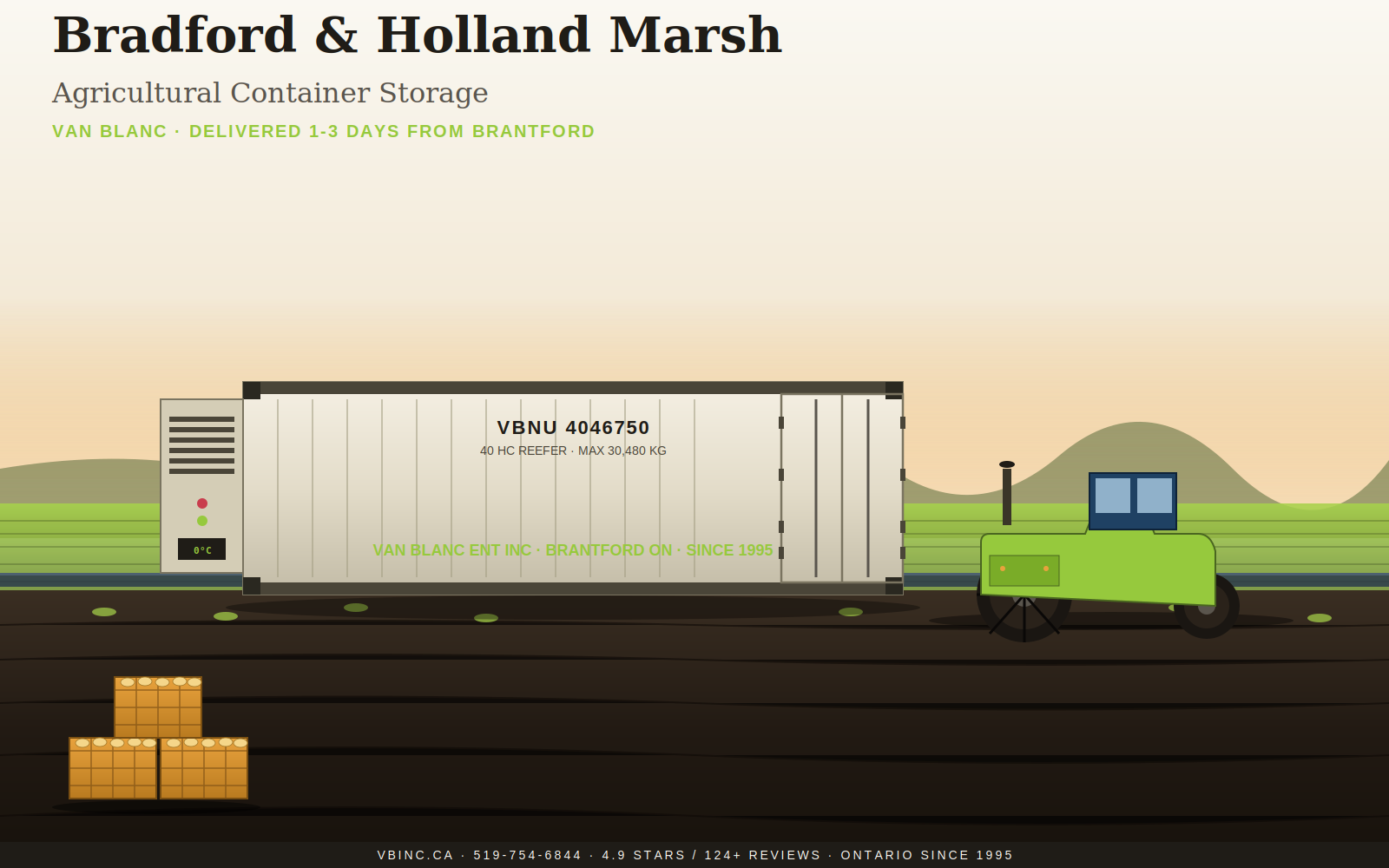
Quick Answer: Bradford’s Holland Marsh produces a significant share of Ontario’s muck-soil vegetables per OMAFRA statistics. Holland Marsh cash-crop farms in Bradford West Gwillimbury use 40ft high-cube reefer containers for onion and carrot cold storage at harvest, 20ft Wind & Watertight bins for seed and tool storage, and 40ft dry units for winter implement shelter. Van Blanc delivers tilt-deck on muck soil in 1-3 days from our Brantford yards.
In This Guide
- What is the Holland Marsh, and how fast can we reach it?
- Which reefer container fits the vegetable cold chain?
- What does a 20ft sea can store on a Marsh farm?
- Why use a 40ft dry unit for winter implement storage?
- What drives the price of a farm storage container?
- Can a tilt-deck truck deliver on muck soil?
- How does the Marsh container fleet change by season?
- Why are Facebook container deals a trap?
- Reach Van Blanc in Brantford
- FAQs
Reading Time: 13 minutes
What Is the Holland Marsh, and How Fast Can Van Blanc Reach It?
The Holland Marsh is a 2,900-hectare bowl of drained organic muck soil in Bradford West Gwillimbury and King Township, Ontario, home to roughly 125 farms that grow much of the province’s carrots, onions, and salad greens. Van Blanc delivers shipping containers there from its Brantford yards in one to three days.
The Holland Marsh sits in a shallow black-soil bowl just south of Lake Simcoe, straddling the boundary between Bradford West Gwillimbury and King Township. It is 2,900 hectares (about 7,000 acres) of organic muck soil that was drained for agriculture in the 1930s, and today it carries 125 working farms that grow the bulk of Ontario’s storage vegetables. Locals call it “the salad bowl of Canada” for a reason. Carrots and onions lead the Marsh’s farm-gate value each year, with salad greens close behind, and together they account for a substantial share of Ontario’s storage-vegetable output, according to the Holland Marsh Growers Association.
From our Brantford yards, the run up Highway 403 east to the 401 and then north on the 400 to Bradford is about 130 km, give or take depending on traffic at the 400/9 split. A tilt-deck loaded with a 40ft high-cube can be off our yard by 7 a.m. and have the wheels lifted in a Marsh laneway before lunch. That is what 1-3 day delivery actually looks like for a Marsh grower who calls us at the wrong end of August.
The reason this matters: the Marsh has a sharp seasonal storage problem. Onions and carrots come out of the ground in a six-week sprint from late August through early October, and they need to be moved into climate-controlled space before the first hard frost or they go to waste. Built cold storage in the Marsh is finite. Reefer containers fill the gap.
What grows in the Marsh, and where it goes
Holland Marsh muck soil is particularly suited to root crops: carrots, onions, beets, parsnips, celery, potatoes, lettuce, cauliflower, and cabbage. The Ontario Crops Research Centre at the corner of Highway 400 and Highway 9 (run by the University of Guelph) maintains long-term cold storage trials for Marsh-grown onions and carrots, with the explicit goal of giving Ontario residents access to Ontario-grown vegetables year-round. Marsh produce is grown, stored, packed, and shipped from within a few kilometres of the field. That short chain is the Marsh’s economic moat.
Which Reefer Container Fits the Vegetable Cold Chain?
A reefer container is the unit that handles the Marsh vegetable cold chain. It is an insulated 20ft or 40ft high-cube container with an integrated refrigeration unit, capable of holding precise temperatures from -25°C up to about +25°C. We walk through how the refrigeration unit, set points, and power options differ in our deeper look at how reefers hold temperature. For Marsh growers, the relevant set point depends on the crop. Mature topped carrots hold for 7 to 9 months at 0°C with 98 to 100% relative humidity. Storage onions want 0°C as well but at much drier humidity, 65 to 75%, so the units run separate cycles. Cabbage and celery fall in between.
The economic case for a reefer on a Marsh farm is straightforward. A 40ft high-cube reefer holds about 25 to 27 metric tonnes of bagged or palletised root vegetables, depending on stacking. If your packing shed is already full at harvest and you need temporary cold storage to bridge a shipment delay, a reefer pays for itself in the spoilage it prevents on a single shipment. Most Marsh operators run their reefer fleet hardest from late August through November, then sometimes through the winter for staged shipments to Ontario Food Terminal, packers, and grocery DCs.
Reefer specs that matter for Marsh growers
- 40ft HC reefer: 12.19 m × 2.44 m × 2.90 m external, about 67 m³ usable after insulation. Sets between -25°C and +25°C, draws 3-phase 460V or runs off a clip-on diesel genset.
- 20ft reefer: 6.06 m × 2.44 m × 2.59 m external, about 28 m³ usable. Same temperature range, smaller footprint, useful when you need a second set point for an onion-only or carrot-only cycle.
- Power: most Marsh farms run 3-phase service into the yard near the packing shed. If you don’t have 3-phase, a Carrier or Thermo King genset bolts to the reefer’s nose box and runs on diesel. We can quote both setups.
- Defrost cycles: a properly tuned reefer runs an automatic defrost every 4 to 12 hours. Monitor the discharge temperature, not just the return air temperature, to catch sensor drift before product is affected.
Christian LeBlanc, second-generation operator: “Most of my Marsh reefer calls come the same way: a grower has run out of cold space mid-harvest and needs a 40 high-cube at the packing shed within days. We set it on a level pad as close to the loading door as the laneway allows, because forklift travel time multiplied across a hundred pallets at peak harvest is real money. The driver positions the box so the doors open toward the shed.”
That placement detail matters more than growers expect, and it is the kind of thing you only learn from putting reefers on the same Marsh farms for the better part of two decades.
What Does a 20ft Sea Can Store on a Marsh Farm?
Not every Marsh storage problem needs a reefer. The 20ft sea can is the workhorse for everything that has to stay dry and locked but does not need temperature control. Seed inventory between seasons. Crop-protection chemicals (locked, ventilated, away from the well). Hand tools, irrigation fittings, drip-tape rolls. The kit a market garden accumulates over a decade and has nowhere to keep.
For this job, a Wind & Watertight (WWT) 20ft is usually the right pick. WWT is a used grade we walk through in plain language, with surface rust spots and the occasional small dent, but the doors seal, the floor is sound, and it is rodent-proof. What you pay for a WWT 20ft tracks its cosmetic condition: cleaner units cost more. A bin that has made only a single loaded voyage from Asia (the industry calls it one-trip because it made exactly one cargo crossing) carries a premium over WWT and makes sense if the container is visible from the road, branded, or going to live near your farmstand storefront.
Real Marsh 20ft use cases
A Bradford-area onion grower bought a WWT 20ft from us a few years back to hold sets and seed garlic between January and April. The unit sits at the back of his packing yard on four railway ties, and he opens it twice a week through planting season. The same operator added a second 20ft three years later strictly for crop-protection chemicals: lockable, ventilated, far enough from the well to satisfy his crop insurance. That kind of split, one bin per role, is common across the Marsh. It is cheaper and safer than one large building with mixed contents.
Why Use a 40ft Dry Unit for Winter Implement Storage?
Marsh implements are expensive and weather-sensitive. Onion harvesters, carrot toppers, mulch layers, plastic-lifters, precision seeders. Most growers run them hard from April through October and then need somewhere to park them through five months of freeze-thaw cycling, snow load, and field water table swings. A 40ft dry container (standard or high cube) is a closed, lockable shelter that protects the hydraulics, the electronics, and the paint, and it stays movable, so it never ties up the working footprint the way a poured-foundation building would.
A 40ft standard dry runs about 12.19 m long × 2.44 m wide × 2.59 m high. A 40ft high cube adds a foot of headroom (2.90 m) which is the difference between fitting a folded mulch layer or topper and not fitting it. If you are still deciding between footprints, it helps to measure your largest implement against each length and height before you order. For most implement storage, the high cube is the answer. On a per-foot basis the pricing logic mirrors the 20ft: a WWT 40ft HC is the value pick, while a One-Trip 40ft HC commands a premium that varies with the spec.
If you want to combine implement storage with a small workbench area, we cut a man-door and add a vent at our Brantford conversion shop before delivery. That is the closest a sea can gets to functioning as a small farm workshop without crossing into the territory of needing engineered drawings.
What Drives the Price of a Farm Storage Container?
Marsh growers ask us for pricing more than anything else, and we answer the same way every time: it depends on grade, size, delivery distance, and whether you want a reefer or a dry. Before you pin a number, it is worth understanding how grade, condition, and timing move a quote, because those four factors explain almost every price difference between two boxes that look the same from the road. You can also see the dry and reefer units we currently keep in the yard while you think it through. Here is the honest range for a Bradford delivery in 2026, assuming a tilt-deck drop on a prepared pad.
| Container | Grade | Relative Price Position | Best Marsh Use |
|---|---|---|---|
| 20ft Dry | WWT (used) | Entry point, lowest 20ft cost | Seed, tools, chemicals |
| 20ft Dry | Cargo Worthy | Modest step up over WWT | High-density storage, export-ready |
| 20ft Dry | One-Trip | Premium 20ft, near-new | Roadside-visible, branded, farmstand |
| 40ft HC Dry | WWT (used) | Best value per foot at 40ft | Implement winter storage |
| 40ft HC Dry | One-Trip | Premium 40ft, near-new | Pristine shelter, longer service life |
| 20ft Reefer | Used / refurb | Higher: refrigeration unit added | Single-crop cold cycle (onions OR carrots) |
| 40ft HC Reefer | Used / refurb | Highest: largest reefer, most capacity | Harvest-bridge cold storage, larger volumes |
Delivery from our Brantford yards to a Bradford / Holland Marsh address adds a freight line. Quote that one separately because it depends on your laneway, ground conditions, and whether a tilt-deck can swing the box without crossing a soft drainage ditch. Every quote we send comes with a real lead time, not a hopeful one.
The grades you should know before you call anyone
There are four buyer-facing grades: One-Trip / New (single voyage, essentially new, premium), Cargo Worthy (CW) (used, re-certified for international shipping, surface rust acceptable), Wind & Watertight (WWT) (used, no longer export-certified but doors seal and rodent-proof), and As-Is (older units sold cheap for non-storage uses, rarely recommended). If a supplier quotes you a “20ft container” without naming the grade, ask. The grade is what determines the price, the look, and the lifespan.
Can a Tilt-Deck Truck Deliver on Marsh Muck Soil?
Holland Marsh ground is not normal ground. It supports a tractor across a field at 6 km/h. It does not always support a fully loaded tilt-deck with a 40ft high-cube on the back, especially after April thaw or a wet October.

That changes how we deliver. We use tilt-deck trucks for almost every Marsh drop because tilt-deck lets the driver set the container in one continuous slide instead of needing a crane or a Hiab truck on soft ground. The truck approaches with the bed level, tips the deck up, and the container slides off as the truck pulls forward. If your laneway is firm gravel or a packed lane to a yard, the drop is clean. If the laneway is muck-on-muck from a wet week, the driver will tell you on site whether he can safely back in, or whether the box needs to drop at the road edge for you to move with your own loader.
Site prep that prevents a muck delivery from going sideways
- Level pad: four pressure-treated railway ties or six concrete deadmen, set on compacted gravel. The container sits on the four corner castings, not on the floor, so the four corners need bearing.
- Approach: 13 ft of overhead clearance for a 40ft HC on a tilt-deck (the deck tips up during unload). Watch for low-hanging hydro and irrigation lines crossing the laneway.
- Laneway width: 14 ft minimum for the truck plus mirrors. Marsh laneways are sometimes narrower because they were cut for tractors. Measure before you order.
- Ground bearing: if you can drive a half-ton pickup over the spot without spinning a tire, the tilt-deck can usually make it. If the pickup spins, call us first and we’ll talk about a road-edge drop instead.
How Does the Marsh Container Fleet Change by Season?
A pattern we see across the Marsh: growers run a different container fleet at harvest than the rest of the year. From August through November, the reefer fleet is full and a couple of dry units handle overflow seed and packed-good staging. From December through July, the reefers idle (or get returned if rented), the dry units shift to implement winter storage, and a 20ft holds the seed inventory for spring.
Some operators rent reefers seasonally and buy dries permanently. Others buy reefers outright if they ship year-round to a stable customer base. The decision usually comes down to two questions: how many shipping weeks per year do you actually run the reefer, and what is the cost of electricity or diesel at your set point versus the rental cost. Both math out in different directions for different operations. Christian or Paul will walk you through it on a real quote, no pressure to decide on the call.
Christian LeBlanc, second-generation operator: “Marsh growers know exactly what they need. The call I get in late August is ‘I need a 40 reefer at my packing shed by Friday because I’m running out of room.’ That’s a 1-3 day delivery from our Brantford yard, tilt-deck, real lead time. We’ve been doing it for the same families for the better part of two decades.”
Why Are Facebook Container Deals a Trap for Marsh Growers?
Every year, more Marsh growers call us in October with the same story. They saw a 40ft container on Facebook Marketplace priced well below our quote. They sent a deposit. The container never arrived. Now harvest is two weeks in and they are paying full freight to get a real unit on a rush order.
Paul has been in the container trade for 19 years and in Asian trade for 40 before that. He has watched the scam pattern stay almost exactly the same: a Facebook listing, a too-good price, a deposit demand, a vanished seller. We do not name the listings because that invites legal trouble. We just point at the pattern. If a 40ft is priced below our quote on Facebook, that is not a discount, that is the trap.
The honest version: we deliver from our 4 Brantford yards, you can drive to Brantford and walk the unit you are to buy before a dollar changes hands, and the container moves on a real truck with a real driver who has been to the Marsh before. That is what 140+ verified Google reviews (4.9 stars) describe. More on the scam pattern if you want the full breakdown.
Reach Van Blanc in Brantford
We have been supplying shipping containers across Ontario since 1995. Our warehouse is at 90 Morton Avenue E in Brantford, and we deliver right across the province on a cash-on-delivery basis. No surprise fees, no chase-the-paperwork.
Van Blanc Ent. Inc. 90 Morton Ave E Unit 1B, Brantford, ON N3R 7J7. Cell: 519-754-6844. Toll-free: 1-888-509-6658.
If you grow on the Marsh and you want to walk a 40ft high-cube reefer before harvest, drive down the 400 to the 403 west and you are at our Brantford yard in about 90 minutes. Worth the drive for unbeatable quality, family customer service with 30 years of experience.
Frequently Asked Questions
How fast can Van Blanc deliver a shipping container to a Holland Marsh farm in Bradford?
We deliver in 1-3 days from our Brantford yards to Bradford West Gwillimbury and the Holland Marsh. The run is about 130 km up Highway 403, the 401, and the 400. A truck off our yard at 7 a.m. is usually wheels-up in a Marsh laneway before lunch. Every quote includes a real lead time, not a hopeful one.
What size reefer container do I need for onion or carrot cold storage?
A 40ft high-cube reefer holds about 25 to 27 tonnes of palletised root vegetables, which fits most mid-size Marsh harvest bridges. If you run a single-crop cycle (onions OR carrots) on a smaller scale, a 20ft reefer works at about 28 m³ usable. The differentiator is power: a 40ft HC pulls more amps and is more efficient per tonne stored.
Can a tilt-deck truck deliver a 40ft container on Holland Marsh muck soil?
Yes, on most days. Muck-soil delivery works when the laneway is firm (gravel or compacted), the approach has 13 ft of overhead clearance, and you can drive a half-ton pickup over the drop spot without spinning. After a wet October or April thaw, we sometimes have to drop at the road edge instead. The driver decides on site.
How much does a 40ft reefer container cost delivered to Bradford?
The cost of a used 40ft high-cube reefer depends on the refrigeration unit’s hours and overall condition, plus a separate freight line for delivery from Brantford to the Marsh. The exact freight figure depends on your laneway and ground conditions. Call us for a real quote that includes both the unit and the delivery.
Do I need 3-phase power to run a reefer container on my farm?
Most reefers run on 460V 3-phase grid power, which most Marsh farms already have at the packing shed. If you don’t have 3-phase, a clip-on diesel genset bolts to the reefer’s nose box and runs on diesel fuel. Genset is more expensive to run long-term but skips the electrical upgrade cost. We quote both.
What’s the difference between a Wind & Watertight and a Cargo Worthy container for farm storage?
Wind & Watertight (WWT) is used, doors seal, no rust holes, no longer export-certified. Cargo Worthy (CW) is used, re-inspected for international shipping, structurally graded for heavy loads. For seed, tool, or implement storage that stays put on a farm, WWT is the right pick for a 20ft and the more economical of the two. CW costs more without giving you a benefit for stationary storage.
Can a shipping container store crop-protection chemicals safely?
Yes, with the right setup. The container should be ventilated (a passive vent or two louvered vents), locked with a heavy hasp or lockbox, and sited away from the well and surface water per crop insurance requirements. Many Marsh growers dedicate a single 20ft to chemicals only, separate from seed and tools, to keep storage clean.
Where is the closest container store to Bradford, Ontario?
Van Blanc Ent. Inc. is the closest family-run container yard with full inventory to Bradford. Our warehouse is at 90 Morton Avenue E in Brantford, about 130 km south. We deliver to the Marsh, Newmarket, Schomberg, Aurora, and the rest of York and Simcoe counties in 1-3 days. National chains and pod fleets operate at the regional and national scale; we operate as a real Ontario yard you can walk.
Can I rent instead of buy a reefer for a single harvest season?
Rental works well for growers who only need cold storage 10 to 14 weeks a year and don’t want to carry the unit through the winter. Rental is billed as a monthly rate for a 40ft reefer plus delivery and pickup freight. If you run the reefer six months or more a year, buying usually works out cheaper within two to three seasons.
How long do shipping containers last on a Holland Marsh farm?
A One-Trip container properly sited on a level pad lasts 25+ years with minimal maintenance. A WWT used container with surface rust at purchase lasts 15 to 20 years on the same setup. Muck-soil sites benefit from extra attention to drainage under the corner castings, since standing water at the corners is what shortens lifespan. Spray-touch-up paint on rust spots every five years extends service life.
Ready to price your container?
Tell us the size and your postal code and we’ll send back an honest, all-in number, container, delivery, and placement, usually within 1-3 days. No pressure, no mystery fees.
Family-run in Brantford since 1995 · 200+ containers in stock · 4.9★ across 140+ Google reviews · every box graded by a person, walk it before it lands.
Sources
- Holland Marsh Growers Association. (2024). Profile of Agriculture. hmga.ca/projects/profile-of-agriculture
- University of Guelph, Ontario Crops Research Centre Bradford. (2024). Research Sites and Cold Storage Facilities. Holland Marsh Water Management. lsrca.on.ca/hollandmarsh
- Cornell Cooperative Extension. (2024). Vegetable Cold Storage Chart and Reference Guide. cornell.edu/cold-storage-chart
- International Organization for Standardization. (2022). ISO 6346:2022 Freight containers: Coding, identification and marking. iso.org/standard/82754
- Coppolino, A. (2016). The Holland Marsh, Ontario’s vegetable patch. CBC News. cbc.ca/holland-marsh