
Quick Answer: A shipping container trade-in value dealer in Ontario credits you roughly 20 to 30 percent under retail for your old container against a replacement bin, with the exact figure set by grade, door function, floor condition, and rust, the same condition factors the IICL container inspection criteria use. Van Blanc has handled this dealer-trade math from Brantford since 1995. Three decades family-run, 140+ verified Google reviews. 1-3 day delivery from our 4 Brantford yards across Ontario.
In This Guide
- How Does a Container Trade-In Actually Work at a Brantford Dealer?
- Dealer Trade-In vs Private Sale: Which Pays Off in Ontario?
- How Much Does Your Container’s Grade Change the Trade Number?
- How Does Van Blanc Assess an Incoming Trade in the Yard?
- How Do Age and Rust Affect a Container’s Trade Value?
- What Do Buyers Usually Trade Their Container Into?
- Can You Pick Up the Old Bin and Drop the New One Same Day?
- What Paperwork Does a Container Trade-In Need in Ontario?
- When Does a Container Trade Make Sense and When Doesn’t It?
- Why Walk the Brantford Yard Before You Trade?
- Frequently Asked Questions
Reading time: about 14 minutes.
How Does a Container Trade-In Actually Work at a Brantford Dealer?
A shipping container trade-in is when an Ontario dealer takes your old container in on partial credit and applies that credit against a replacement bin, so you pay only the difference plus delivery. It is a credit toward a new purchase, not a cash buyback. Van Blanc has run trades like this from Brantford since 1995.
A shipping container trade-in is straightforward in concept and full of variables in practice. You own a sea can. It still works, but maybe it has surface rust, a sticky door, or a use case you have outgrown. You want a different bin, a different size, or a different grade. A dealer takes your old container in on partial credit, applies that credit against the replacement, and you pay the difference plus delivery. Van Blanc has been running trades like this from our Brantford yard since 1995. We have seen every condition of bin that rolls off a flatbed, and we know what a fair trade number looks like.
The first thing to understand is that a trade-in is not a buyback. A buyback is when a dealer purchases the container outright with cash. A trade-in is a credit applied to a new transaction. The dealer recovers their margin on the replacement sale, which is why trade credit usually beats outright buyback by 10 to 15 percent. If you are not buying anything else, ask for a buyback quote. If you are upgrading, the trade is the better lever.
The second thing to understand is that not every dealer takes trades. Pool suppliers run on tight inventory turnover and rarely want a used unit sitting in the lot. Independent Ontario yards like ours have the space and the yard time to make a trade pencil out. That asymmetry is part of why buyers from across the province end up calling Brantford for the trade conversation.
The trade-in math, in plain language
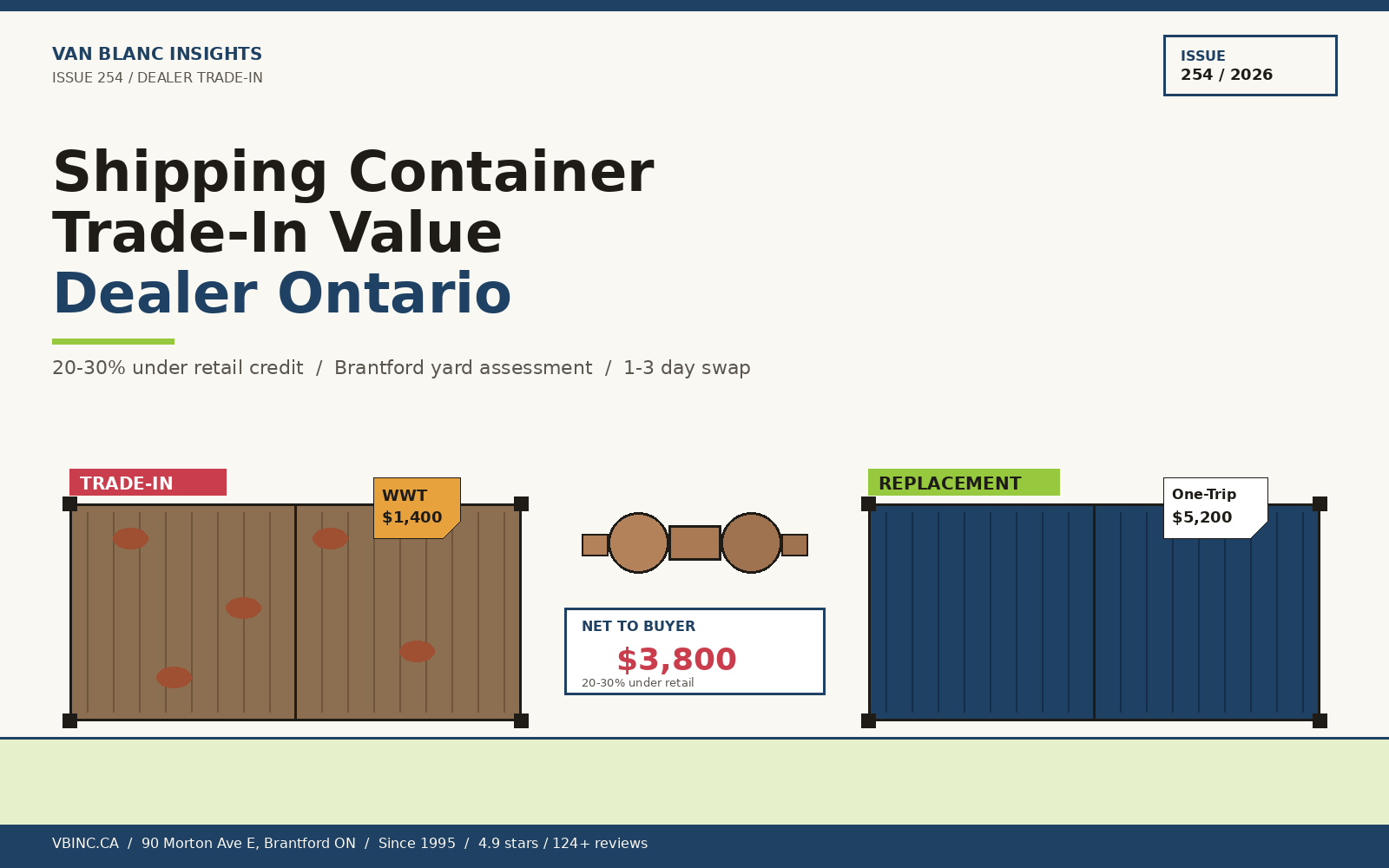
Your container has a wholesale recovery value to the dealer. Call that figure W. The dealer needs to refurbish, store, and resell it, which costs R. The trade credit you see is roughly W minus R, with a small dealer margin baked in. For a typical WWT 20ft bin, that credit lands well below outright retail because of the refurb and resale carry we absorb. For a One-Trip 20ft in clean condition, the credit climbs because the refurb cost is minimal. The replacement bin you are upgrading to gets its full retail price, so your net out-of-pocket is replacement retail minus trade credit minus any delivery offset.
Dealer Trade-In vs Private Sale: Which Pays Off in Ontario?
A dealer trade-in versus a private sale comes down to speed and certainty against top-line dollar with friction. A trade with Van Blanc closes the same week and credits you 20 to 30 percent under retail with zero fraud risk. A private listing on Kijiji or Facebook can net a little more cash but takes weeks and carries scam exposure. Buyers ask us this question constantly. Should I trade in with Van Blanc or list the bin on Kijiji or Facebook Marketplace and try to maximise cash? The answer depends on what you value: speed and certainty, or top-line dollar with friction. Both are legitimate paths. Here is the comparison.
| Factor | Dealer Trade-In (Van Blanc) | Private Sale (Kijiji / Facebook) |
|---|---|---|
| Time to close | Same week, often same day if we are delivering the replacement | 2 to 8 weeks average across Ontario listings |
| Net dollars in hand | 20 to 30 percent under retail trade credit | 10 to 20 percent under retail if listing is clean and priced right |
| Pickup logistics | We send a tilt-deck on the same trip as your replacement | You coordinate buyer’s hauler or eat the freight |
| Risk of fraud | Zero. Trade credit is invoice-applied, not a wire transfer | Real. Bad-cheque scams and pickup-theft attempts are common in 2026 |
| Inspection burden | We assess at our yard or from your photos, document, and credit | You handle showings, photos, tire-kickers, no-shows |
| Tax handling | HST netted on the replacement invoice | You handle private-sale tax exposure yourself |
For most working buyers the math comes out as a wash on the dollar, but the time savings push them toward the trade. A contractor who is mid-project does not have eight weekends to host buyer visits. A farmer who needs the new 40ft HC for harvest cannot wait for a Kijiji buyer to materialise. That is where understanding how Ontario bins actually depreciate over time lands hardest: convenience plus certainty often wins, even when the cash number is slightly lower.
Christian LeBlanc, second-generation operator: “The buyers who trade with us are usually the ones who already tried Kijiji once. They had three no-shows, one lowball offer, and one guy who showed up with a moving truck instead of a flatbed. After that, they call us. We do the swap in one trip. The math works because their time is worth something too.”
How Much Does Your Container’s Grade Change the Trade Number?
Container grade is the single biggest lever on your trade-in value, ahead of age or rust. A One-Trip bin in clean condition can recover most of what you paid; a Wind and Watertight bin trades at roughly half; an As-Is unit lands near scrap value. We assess every incoming bin against the same four grades we sell: One-Trip, Cargo Worthy, Wind and Watertight, and As-Is.
Grade is the single biggest lever on your trade-in value. We assess every incoming container against the same four-grade framework we use on our outbound inventory: One-Trip, Cargo Worthy, Wind and Watertight, and As-Is. Each grade carries a different recovery curve, and being accurate about which one your bin actually sits in protects everybody.
One-Trip retention. A One-Trip 20ft that you bought two or three years ago and kept under tarp or in a barn can still trade at 60 to 70 percent of what you paid. The factory paint holds, the doors still operate cleanly, and we can resell it at near-One-Trip price after a wash and a touch-up. If you paid for a One-Trip in 2023, expect a trade credit that recovers most of what you spent in 2026, depending on storage conditions.
Cargo Worthy retention. A CW 20ft that came to you with an active CSC plate trades down faster because the plate likely has expired in your ownership window. We still take it gladly, but the value lands closer to 50 to 60 percent of your purchase price. CSC re-certification is expensive enough that most CW units we resell trade into WWT category for storage buyers anyway.
Wind and Watertight retention. WWT is where most trade-ins live. A WWT 20ft will typically trade back at roughly half its original purchase value if the doors still seal and the floor is sound. The discount is steeper because there is less margin for us to refurb out, but the volume of WWT transactions makes it the most-traded grade in our yard.
As-Is retention. An As-Is bin with floor damage, frame issues, or persistent leaks trades at scrap-adjacent value, just a small fraction of original cost for a 20ft. We rarely recommend buyers trade in an As-Is unit because the cost of trucking it back to our yard sometimes exceeds the credit. In those cases we suggest the buyer hold the bin for cladding or workshop use and trade in a different unit they own.
The grade-accuracy rule
Do not describe your container as One-Trip if it has visible rust on three or more panels. Do not call it Cargo Worthy if the CSC plate is expired. We will reassess it at the yard, and an inflated self-grade just delays the trade by a day while we redo the paperwork. An accurate self-grade up front gets you a firm number on the first call.
How Does Van Blanc Assess an Incoming Trade in the Yard?
Van Blanc assesses an incoming trade in five steps, the same checks worth knowing what to look for on a used bin before you ever resell one: doors and gaskets, floor, roof, corners and frame, then paint, rust, and the CSC plate. The walk-through takes about 15 minutes at our Brantford yard, or runs from your photos if the bin cannot travel, and we never charge for it.
The assessment runs in five steps and takes about 15 minutes if you have driven the bin to our Brantford yard; if it cannot travel, the same five steps run from your photos and the driver’s notes at pickup. We do not charge for assessment. Christian or one of our yard crew walks the container with you and flags everything that affects the number.
Step one: doors. We open and close both door leaves, check the gasket compression, and look for daylight from inside. A bin with functional doors and intact gaskets gets full grade credit. A bin with one stuck door or a torn gasket comes down 10 to 15 percent.
Step two: floor. We climb inside with a flashlight. Marine plywood floors should be solid underfoot with no spongy spots. Replacement floor sections cost us in materials and labour, and that cost comes off the trade credit if the floor is compromised.
Step three: roof. We look for pooling damage from snow load, soft spots from corrosion, and any roof patches that previous owners applied. A clean roof gets full credit. A roof that needs a re-coat comes down.
Step four: corners and frame. The four corner castings and the bottom rails are structural. A bent rail or a cracked corner casting drops the bin to As-Is regardless of how good the rest looks. We document everything with photos before we make the offer.
Step five: paint, rust map, and CSC plate. Surface rust is normal and gets a wash-and-spot-treat discount. Through-wall rust holes are different and need plate welding. The CSC plate, if present and current, adds value for CW grade. An expired plate is removed before resale.
Why Brantford yard assessment beats remote assessment
We will quote you a trade range from photos and a phone call, but the firm number happens when we see the bin. If you can drive it to our 90 Morton Avenue yard, the assessment is faster and the offer is final on the spot. If you cannot, we work from your photos and confirm the number when the carrier loads it. Either way, the offer is final once we have seen the bin. No surprise deductions after delivery.
How Do Age and Rust Affect a Container’s Trade Value?
Age and rust drive the rest of the trade number after grade is established. Most of a container’s depreciation happens in its first seven years of Ontario use, then the curve flattens until structural fatigue sets in near year 20. A bin’s Corten weathering steel forms a protective surface oxide, so plain surface rust costs far less in trade value than through-wall rust or a soft floor.
Age and rust drive the rest of the trade number after grade is established. A container’s body steel is Corten weathering grade, designed to develop a stable surface oxide that protects the underlying metal. That works at sea where the air is salty and constantly moving. In Ontario, where bins sit stationary on gravel pads for years at a time, the oxide layer behaves differently depending on whether the bin is exposed, tarped, or in a barn.
The curve we apply at Van Blanc:
| Age in Ontario use | Typical visible condition | Trade credit vs original purchase |
|---|---|---|
| 1 to 3 years | Light surface rust, faded paint | 65 to 75 percent |
| 3 to 7 years | Moderate surface rust, some panel oxidation | 50 to 65 percent |
| 7 to 12 years | Heavy surface rust, possible spot-through | 35 to 50 percent |
| 12 to 20 years | Through-wall risk, gasket failure common | 20 to 35 percent |
| 20+ years | Likely As-Is or scrap-adjacent | 10 to 20 percent |
Note the curve flattens after year seven. Most of the depreciation happens in the first half of a bin’s Ontario life, and the second half is fairly stable until structural fatigue sets in around year 20. That stability is why a 10-year-old WWT bin in fair condition still trades respectably.
What Do Buyers Usually Trade Their Container Into?
Most Ontario buyers trade their container into a larger size, a higher grade, or a high-cube for more headroom, almost always because the use case shifted rather than because the bin wore out. The five paths below cover nearly every trade we run, and you can browse the replacement bins on our lot before you commit to one.
Most Ontario buyers trade in because of a use-case shift rather than depreciation. They bought a bin for one purpose, the project finished or evolved, and they need a different bin for the next phase. Here are the upgrade paths we see most often.
20ft to 40ft. The most common trade. A homeowner bought a 20ft for a renovation, the reno is done, and now they want a 40ft for a workshop or a garage extension. The trade credit on the 20ft usually covers 35 to 50 percent of the 40ft replacement.
WWT to One-Trip. A buyer who started with a used WWT for rough storage now wants a One-Trip for a visible-from-road conversion or a branded site office. The trade-up makes sense because the One-Trip retains its value better long-term and looks the part for client-facing applications. This is the most common reason buyers step up to a factory-new build when they trade.
Standard to High Cube. Buyers who tried to live with 8’6″ of interior headroom and need the extra foot for cabinetry, racking, or a mezzanine. The 40ft HC trade-up is common in workshop and home-office conversions.
Dry to Reefer. Rarer but real. A buyer who started with a dry container for general storage needs cold storage for a commercial expansion. The trade-in dry unit offsets a portion of the reefer price, though the reefer’s premium pricing means the buyer still writes a substantial cheque.
20ft to multiple smaller bins. Sometimes the buyer wants two 20ft bins on different parts of the property instead of one. The trade-in 40ft credit goes against two replacement 20ft One-Trips. We have done this configuration enough times that it is a standard quote at our yard.
Norfolk farm trade example
A Norfolk County farmer bought a WWT 40ft in 2018 to store hay and feed. Eight years later, the farm is running a cannabis grow operation and needs a 40ft HC Reefer for climate-controlled drying. The trade-in 40ft WWT, in fair 8-year condition with a sound floor, credits at roughly half its original cost. The 40ft HC Reefer carries a premium over a dry box because of the refrigeration unit. Net out-of-pocket is the reefer retail minus that trade credit, plus delivery. The whole swap happened in one tilt-deck trip from our Brantford yard.
Can You Pick Up the Old Bin and Drop the New One Same Day?
Yes, Van Blanc can pick up your old bin and drop the replacement on the same trip whenever your site can take two tilt-deck moves in a day, which most can. The driver places the new bin, loads the old one onto the same trailer with the tilt action, and brings it back to our Brantford yard. Total time on site is usually 90 minutes to two hours, and you pay one trip of delivery, not two.
The logistics piece of a trade is what makes Van Blanc’s offer different from a wholesale buyout. We can pick up your old bin and drop the replacement on the same trip if your site can handle two tilt-deck moves in a day. Most can, and that is the cleanest version of the trade for the buyer.
The mechanics: our driver arrives with the replacement on the tilt-deck. He places the new bin in your preferred location. He then loads your old bin onto the same trailer using the tilt action and a chain rig. He drives both bins back to our Brantford yard. Total time on site is usually 90 minutes to two hours.
The delivery charge is one trip’s worth, not two, which is part of how the trade math works out for buyers across Ontario. We deliver in 1 to 3 days across the province from our 4 Brantford yards, and every quote comes with a real lead time, not a hopeful one.
Site requirements:
- Stable, level pad at least 12 feet wide for the tilt-deck approach
- Clear path for the truck to back in and reposition without overhead obstructions
- Both the old bin and the new bin’s planned spot need to be accessible on the same approach angle
- Empty old bin. We cannot legally carry a container loaded past flatbed weight limits
If your old bin is empty and your site allows the swap, the whole trade closes in one visit. If the site requires two trips, we charge for the second trip at our standard regional rate.
What Paperwork Does a Container Trade-In Need in Ontario?
A container trade-in needs very little paperwork in Ontario, because shipping containers carry no registered title the way vehicles do. There is no MTO ownership document and no VIN registry. We ask for your original bill of sale if you have it, the container serial number stamped on the door and roof, and disclosure of any known issues. The trade credit is then netted onto your replacement invoice as a single line.
Shipping containers in Ontario do not carry registered title the way vehicles do. There is no MTO ownership document, no VIN registry, no provincial paperwork to transfer. What does exist is the bill of sale from your original purchase, the CSC plate (if One-Trip or CW), and the container’s serial number stamped on the side and top doors.
For a Van Blanc trade-in, we ask for:
- Your original bill of sale or proof of purchase, if available. Not required, but helpful for confirming grade history.
- The container serial number, visible on the right-hand door and the roof. We photograph it before pickup.
- Your name, address, and HST number if applicable. The trade credit appears on the replacement invoice as a line item.
- Disclosure of any known issues. Floor damage, prior modifications, paint over rust. Surprises after we get the bin to the yard reduce trust, and we do not buy from people who try to hide structural issues.
The trade credit is documented on your replacement invoice. There is no separate trade-in cheque. The number is netted into the transaction, which simplifies HST treatment and keeps the paperwork to a single sheet. If you need a separate document showing the trade value for accounting purposes, we can issue one.
Why VINs and registry are not part of container ownership
Containers are classified as cargo equipment under Transport Canada, not as registered vehicles. The serial number serves as the unique identifier for the container’s manufacturing and ocean-shipping history. Outside the ocean-freight context, the serial number is mainly for our internal inventory tracking and any future buyer’s reference. Container theft is rare in Ontario, but documented serial numbers help recovery if it happens.
When Does a Container Trade Make Sense and When Doesn’t It?
A container trade makes sense when you are buying a replacement within 30 days anyway, your old bin is WWT or better, and you value time over squeezing out the last dollar. It does not make sense when you have a secondary use for the old bin on the property, when the trade credit comes in low because the unit is too far gone, or when you have weeks to sell privately. A trade is not always the right move.
Sometimes the better play is to keep the old bin and just buy the replacement outright. Sometimes the better play is to sell privately if you have time. Here is when each path wins.
Trade in if:
- You are buying a replacement bin within 30 days anyway
- Your old bin is in WWT or better condition with sound doors and floor
- You value time savings over maximising every last dollar
- Your site can handle a same-trip swap and you do not want to coordinate separate moves
- The replacement bin is at least 1.5x the trade credit so the dealer margin is reasonable
Keep the old bin if:
- You have a secondary use case on the property (workshop, equipment shelter, dump)
- The trade credit comes in low because the bin is too far gone to refurb
- Selling privately for full market value would meaningfully change your project budget
- You are emotionally attached to the bin. We have heard this one. It counts.
Sell privately if:
- You have 4 to 8 weeks of time
- You can take clean photos and handle multiple buyer visits
- You are comfortable verifying buyer payment and arranging pickup
- The bin is in clean enough condition that private-buyer demand exists for it
The Facebook scam pattern, applied to trade-ins
Many people call us saying they were offered well above our trade credit for their old bin on Facebook. Two weeks later they call back saying the buyer ghosted them after they paid for a freight company to pick the bin up. The trade with a real dealer is almost always the better total outcome once you factor in the failed-private-sale tax on your time and certainty. We see this story repeat enough that it is part of what we do.
Ready to price your container?
Tell us the size and your postal code and we’ll send back an all-in number, container, delivery, and placement, usually within 1-3 days. No pressure, no mystery fees.
Family-run in Brantford since 1995 · 200+ containers in stock · 4.9★ across 140+ Google reviews · every box graded by a person, walk it before it lands.
Why Walk the Brantford Yard Before You Trade?
Walking the Brantford yard before you trade turns the whole swap into one conversation. Before you commit, it helps to know what comparable bins fetch at auction so you can see how our trade credit stacks up. Then drive out to our Brantford yard if you can. The trade conversation goes faster when you have already seen the replacement bin you are upgrading into and walked our inventory with one of our crew. You leave with a firm trade range, a firm replacement quote, and a delivery window.
We open at 9:30 in the morning. Christian or Paul or one of our yard team is usually around to walk it with you. Bring your container serial number and a few photos of your old bin. Walk the yard, look at our One-Trips, our CW units, our HC inventory, the reefers. Sit down at the office and we will run the trade math with you on paper.
The drive from most of Southern Ontario is 90 minutes or less. Buyers from Toronto, Hamilton, Kitchener, London, Niagara, and the Grand River Valley make the trip routinely. Northern Ontario buyers usually do the trade by phone and photos, which works because our assessment process is documented and consistent. Worth the drive for unbeatable quality, family customer service with 30 years of experience.
Frequently Asked Questions
What is the average shipping container trade-in value in Ontario in 2026?
Trade-in value is best understood as a percentage of what you paid rather than a fixed dollar figure, because grade, age, and condition move it constantly. A typical WWT 20ft in fair condition with sound doors and floor trades back at roughly half its original purchase value, and a WWT 40ft lands in a similar band. One-Trip units trade higher, often recovering the majority of their cost for both 20ft and 40ft. As-Is units trade at scrap-adjacent value, depending on freight cost back to Brantford.
Do you buy containers outright, or only on trade?
We prefer trade because the credit math works better for both sides. We will occasionally buy a container outright for cash if it is a One-Trip in clean condition or if it fits a specific gap in our yard inventory. The cash buyback price is typically 10 to 15 percent below the trade credit, which reflects our cost of refurb and resale carry. Call us to discuss either path.
Can you assess my container without me bringing it to Brantford?
Yes. Send 8 to 10 clear photos: each side panel, both door leaves open and closed, the interior with a flashlight on the floor, the roof from elevation if possible, and a close-up of the serial number. We will quote a trade range from photos. The firm number happens when the carrier loads the bin. The photo-to-firm spread is usually within 10 percent if the photos are complete.
How fast can you complete a container trade-in?
Same week is standard. Same day if your replacement is being delivered and your site allows a single-trip swap. We deliver 1 to 3 days across Ontario from our 4 Brantford yards. Eastern Ontario routes can add a day or two depending on driver availability. Northern Ontario premium routes are quoted per trip.
Do I need to clean my container before trade-in pickup?
Empty is required. Clean is appreciated. We do not deduct for normal dust, scuffs, or interior wear. We do deduct for chemical residue, biological waste, or modifications that have to be reversed. If you had farm chemicals or fuel stored, mention it on the phone so we can quote accurately.
What happens if my container’s grade is worse than I described?
Our assessment happens before money changes hands. If the bin is worse than the photos suggested, we re-quote on the spot. You can accept the new number, decline the trade and keep your bin, or pay a small re-trip fee if we already delivered the replacement and need to leave your old unit behind. Most buyers accept the re-quote because the spread is usually small.
Can I trade in a modified container?
Sometimes. Modifications hurt resale value because they narrow the buyer pool. A bin with a man-door and a window can trade if the modifications are professionally done and weather-sealed. A bin with framed-out interior walls, drywall, and electrical work usually trades closer to As-Is unless we have a specific buyer in mind. Call us with details before bringing it in.
Is trade-in credit subject to HST?
The trade credit nets against the replacement invoice. HST applies to the net replacement cost, not the gross. That treatment usually saves you HST on the value of your trade-in, which is one of the small reasons trade-in math beats sell-then-buy math in Ontario. Speak with your accountant for your specific situation.
Do you trade Reefer or refrigerated containers?
Yes. Reefer trades are more involved because the refrigeration unit needs separate assessment. A functional unit with current refrigerant and clean condenser coils trades much higher than a unit with refrigerant leaks or compressor issues. A reefer with a failed unit still carries a trade credit on the box itself.
What if I want to trade in but cannot find a replacement I want?
We will hold your trade credit for up to 12 months from assessment if you want to wait for specific inventory. The credit amount is locked at assessment value. If the bin you are waiting for arrives at our yard, we call you first. This works well for buyers waiting on specific HC reefer configurations or custom-mod bins.
Sources
- International Organization for Standardization. (2022). ISO 6346:2022, Freight containers, Coding, identification and marking. iso.org/standard/82754.html
- International Maritime Organization. (1972, amended). International Convention for Safe Containers (CSC). imo.org
- Container xChange. (2025). How to sell shipping containers with xChange in 2025. container-xchange.com
- Ontario Construction News. (2026). Shipping container pricing in Canada: A 2026 guide for construction professionals. ontarioconstructionnews.com
- Institute of International Container Lessors. (2024). Container Inspection Criteria. iicl.org
Reach Van Blanc in Brantford
We have been supplying shipping containers across Ontario since 1995. Our warehouse is at 90 Morton Avenue E in Brantford, and we deliver right across the province on a cash-on-delivery basis. No surprise fees, no chase-the-paperwork. If you have a bin to trade and a replacement in mind, call us and we will quote both sides of the swap on one phone call.
Van Blanc Ent. Inc., 90 Morton Ave E Unit 1B, Brantford, ON N3R 7J7, +1 888-509-6658
Walk our yard, see your replacement bin in person, and leave with a firm trade number and a delivery window. Worth the drive for unbeatable quality, family customer service with 30 years of experience.