
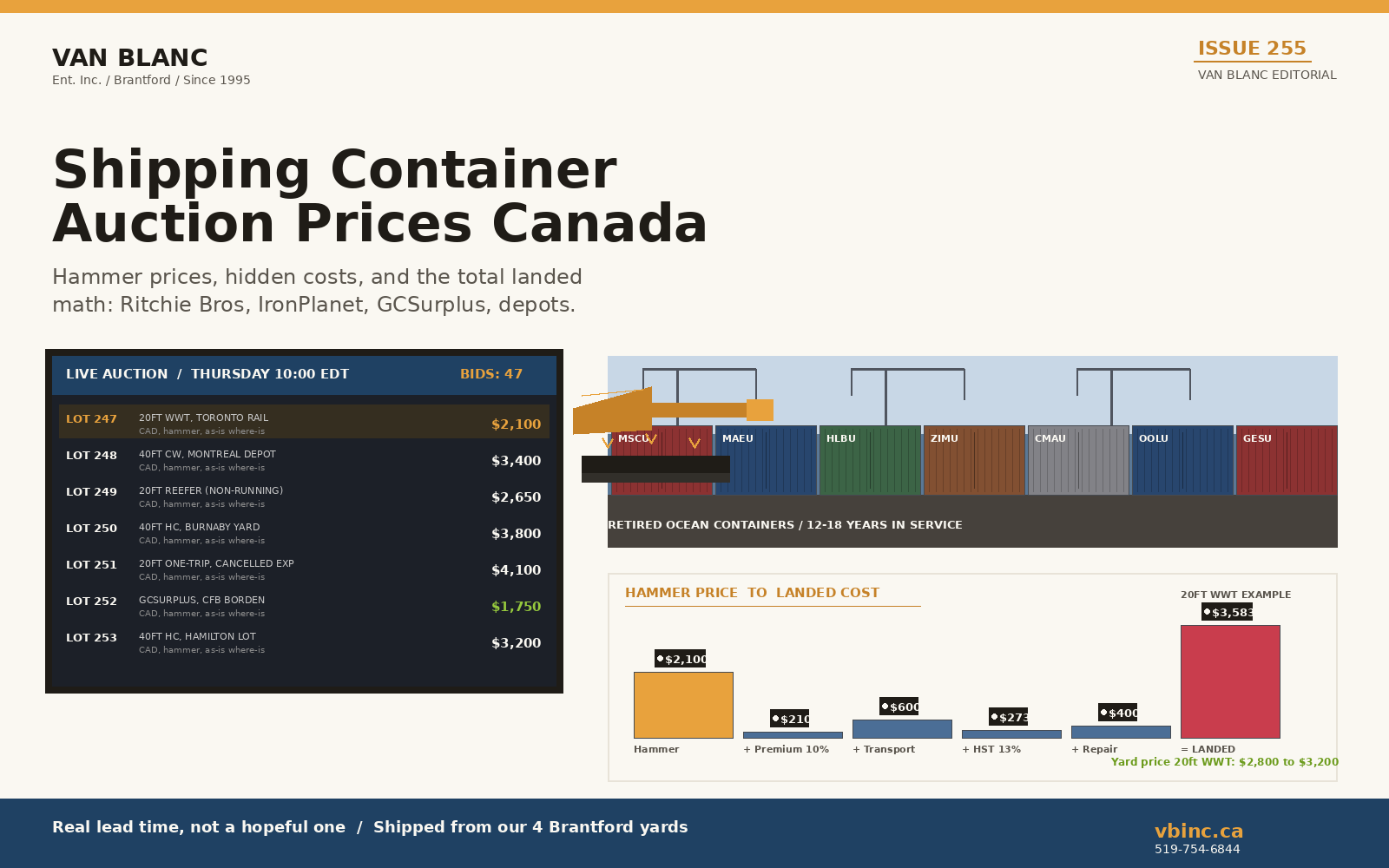
Quick Answer: Shipping container auction prices in Canada are driven by size, grade, the venue’s buyer premium, and how far the unit has to travel, with a 40ft hammer running well above a comparable 20ft before transport, repair, and broker fees are added. Ritchie Bros, IronPlanet, GCSurplus, and Container xChange depot sales are the four real venues. The hammer price is rarely the landed cost. Family-run since 1995 with cash-on-delivery pricing, call for a same-day quote tailored to your site. The LeBlanc family has run Van Blanc Ent. Inc. since 1995. 140+ verified Google reviews at 4.9 stars, 1-3 day delivery.
In This Guide
- Why Do Shipping Containers End Up at Auction in Canada?
- Which Auction Venues Do Canadian Container Buyers Actually Use?
- What Do Container Hammer Prices Look Like at Canadian Auctions?
- What Hidden Costs Get Added on Top of the Hammer Price?
- How Do Unclaimed Cargo Containers Reach the Auction Block?
- Are There Port Retirement Auctions in Halifax, Montreal, and Vancouver?
- Can You Buy a Container Through GCSurplus or AllSurplus?
- Auction Win or Yard Purchase: Which Is Cheaper for Ontario Buyers?
- How Does the Facebook Auction Scam Use a Real Hammer Price?
- Does Van Blanc Buy Containers at Auction?
- FAQs
Reading time: about 14 minutes.
Why Do Shipping Containers End Up at Auction in Canada?
Shipping containers reach a Canadian auction block through four routes: a leasing company retires an ocean unit after 12 to 18 years, customs seizes cargo a buyer abandoned at a port, a federal department rotates surplus through GCSurplus, or a private operator liquidates idle stock. Each route yields a different grade, price band, and set of hidden costs.
Most Canadians who type “shipping container auction prices canada” into Google think they have stumbled onto a secret. They have not. Auctions are a normal liquidation channel for the global container trade, and the actual numbers are not the bargain-basement steal that Reddit threads imply. Containers reach an auction block for one of four reasons: a leasing company retires a unit after 12 to 18 years of ocean service, a cargo owner abandoned the load at a Canadian port and customs seized it, a federal department is rotating surplus assets through GCSurplus, or a private operator (mining camp, construction firm, equipment yard) is liquidating idle stock through Ritchie Bros or IronPlanet. Each pathway produces a different grade of bin, a different price band, and a different list of hidden costs the winning bidder discovers in week two.
Paul has bought containers out of liquidation depots since the yard’s early years. He has bid at Ritchie Bros, walked unclaimed-cargo lots in Hamilton, and watched the math break for hundreds of one-time bidders who thought the hammer price was the landed price. Our notes on how Ontario resale values hold up over time show the same gap repeating, year after year, between the headline number and what a 20ft bin actually costs sitting on your gravel pad in southern Ontario.
Christian LeBlanc, second-generation operator: “People come in convinced the auction is a cheat code. I grew up around this trade with my dad, and the first thing he taught me about auctions is that the hammer is the start of the bill, not the end of it. By the time a Ritchie Bros win lands on your pad in Brant County, the math usually looks a lot like a yard quote. That surprises almost everyone.”
The First Number to Memorise
Auction hammer prices in Canada are quoted “as-is, where-is, FOB the seller’s lot.” That means the auctioneer’s fee, the transport from a Toronto rail yard or a Montreal port to your site, any CSC re-inspection, any rust repair, and any modification all sit on top of the winning bid. Add 35 to 60 percent to the hammer price and you have a truer landed cost.
Which Auction Venues Do Canadian Container Buyers Actually Use?
Canadian container buyers work with four real auction venues, not the twenty platforms the listicles name. Those four are Ritchie Bros and IronPlanet, Container xChange depot sales, GCSurplus and AllSurplus, and unclaimed-freight houses like 403 Auction and Salvex. Knowing the differences matters because each one auctions a different kind of container with a different paper trail.
Ritchie Bros and IronPlanet
Ritchie Bros is the largest industrial-equipment auctioneer in Canada, headquartered in Burnaby BC, with major yards in Toronto and Montreal. After acquiring IronPlanet, the combined platform runs weekly Thursday online auctions, with hundreds of lots crossing the block in 5-minute intervals every Wednesday and Thursday. Most transactions clear in Canadian dollars, and IronClad Assurance covers most Online Only items against gross misrepresentation. Containers appear in the Steel Containers / Conex category, with 20ft, 40ft, 40HC, and occasional reefers and open-tops. Typical sellers: equipment yards rotating stock, mining and forestry firms liquidating bunkhouse units, freight forwarders disposing of out-of-class boxes.
Container xChange Depot Sales
Container xChange is not strictly an auction, but it is the wholesale-pricing window most Canadian buyers do not know exists. The platform aggregates 29,000+ containers across 150+ verified depots worldwide, including 3+ depots in Toronto with around 54 monthly deals, 1+ depot in Montreal with around 38, and 1+ depot in Vancouver with around 33. Pricing is transparent and all-in at the depot gate, no bidding. It is the closest thing in the trade to a Bloomberg terminal for container wholesale costs, and the prices it publishes are the reference points the auction-house numbers either beat or fall short of.
GCSurplus and AllSurplus.com
GCSurplus is the federal Government of Canada’s surplus disposal arm, run by Public Services and Procurement Canada. It has been recycling federal assets back into the public market for 80 years. Containers appear when DND rotates out base storage, when Coast Guard retires deck units, or when a federal agency closes a remote installation. AllSurplus.com runs the parallel municipal and provincial channel for Ontario, with city, regional, and university auctions. Lots are real, listings are accurate, but inventory is irregular: a 20ft might appear once a quarter, not weekly.
403 Auction and Salvex (Unclaimed Freight Houses)
403 Auction is Canada’s largest unclaimed-freight auction house, based in Calgary but sourcing nationwide. It clears containers loaded with unclaimed cargo: lost-in-transit shipments, undeliverable merchandise, unclaimed customs goods. Salvex runs a similar U.S. and Canadian listing model for damaged or insurance-claim cargo. The container itself usually rides with the lot at modest implied cost, because the auctioneer is moving the cargo, not the steel.
The Auction Houses Canadians Mistakenly Search For
Many buyers search “Maersk container auction” or “Hapag-Lloyd retirement auction” expecting a direct sale from the shipping line. That is not how it works. Carriers retire boxes into leasing pools (Triton, Beacon, Florens, SeaCo), and those lessors liquidate through depot networks, regional brokers, or Container xChange. You will not find a public Maersk-branded retail auction. The same goes for ZIM, MSC, and CMA CGM.
What Do Container Hammer Prices Look Like at Canadian Auctions?
The patterns below come from auction-result scrapes, depot-pricing windows, and Paul’s own bidding notebook over the past two years. They describe how each grade tends to sit against the yard at hammer, before the buyer’s premium and transport are layered on. Use them as a calibration tool, not a ceiling.
| Container Type | Where Hammer Prices Sit vs. the Yard | Auction Discount Tendency | Spread Buyers Often Miss |
|---|---|---|---|
| 20ft Wind & Watertight | Below yard at hammer, narrows once landed | Modest | Transport from Toronto rail to a rural site can absorb most of the saving |
| 20ft Cargo Worthy | Slightly below yard, premium grade holds value | Slim | CSC re-inspection if exporting is an added line item |
| 20ft One-Trip | Close to yard; rarely discounted | Negligible | Rarely auctioned; appears as cancelled-order stock |
| 40ft Wind & Watertight | Below yard at hammer, bigger nominal gap | Modest | Tilt-deck haul on a 40 costs more than a 20 |
| 40ft Cargo Worthy | Slightly below yard, premium grade holds value | Slim | Floor inspection often deferred to buyer |
| 40ft High Cube | Below yard at hammer, demand keeps it firm | Modest | HC clearance limits trailer access on some sites |
| 40ft HC One-Trip | Close to yard; rarely discounted | Negligible | Branded paint may require overspray for resale |
| 20ft Reefer (non-running) | Far below a running unit; sold as scrap-grade steel | Wide on paper | Refrigeration unit rebuild can exceed the saving |
| 40ft HC Reefer (non-running) | Far below a running unit; sold as scrap-grade steel | Wide on paper | Same as above, often the bigger surprise |
Read the right-hand column closely. The auction discount looks generous against the yard price, but the spread buyer misses is the part that absorbs the saving. A 20ft WWT bought at hammer, once you add a transport quote out of Toronto and the buyer’s premium, lands right inside the comparable yard range. The “deal” was a wash. That is the most common auction outcome we see for first-time bidders, and it is why Paul stopped chasing the casual lots a decade ago.
Paul LeBlanc, owner: “I have a notebook from 2014 with hammer prices, transport costs, and what each bin actually cost me delivered to Brantford. The auction discount averaged about eleven percent against the yard price after everything was added up. That is real, but it is not the fifty percent the forum posts promise. And for every five bins that saved me a thousand each, one had a floor problem nobody flagged in the listing photos. That is the real economics. The auction price patterns we track have not changed much since.”
What Hidden Costs Get Added on Top of the Hammer Price?
Six line items live between the hammer and your gravel pad. Forgetting any of them is the difference between a working deal and a learning experience.
Buyer’s Premium
Most auction houses charge 8 to 12 percent on top of the hammer, so the winning bid climbs before tax is even applied. Some houses cap the premium; many do not. Read the auction terms before you bid.
Transport from the Auction Yard
This is the line item that surprises most buyers. A container at a Toronto rail yard, a Hamilton port lot, or a Montreal depot needs a tilt-deck or flatbed truck to your site. From Toronto to rural Brant County a 40ft costs more to haul than a 20ft, and a Montreal origin runs higher again for any size because of the longer distance. From Vancouver it is not worth it unless you are in BC, since the cross-country freight swamps any hammer saving.
CSC Plate and Re-Inspection
If you want to export your auction win, or use it under a freight forwarder’s bill of lading, the Container Safety Convention plate must be current. Many auctioned bins have expired plates. Re-inspection by a certified Canadian inspector is an extra cost on top of the hammer. For Wind and Watertight grade staying on land, this does not matter; for Cargo Worthy reuse, it does.
Floor and Door Repair
Auction listings show three photos. The floor in photo two is the one that costs you money in week three. Marine plywood floors with delamination, rotted patches, or oil contamination all cost extra to repair. Doors that bind, missing locking rods, and broken gaskets add up in shop labour. The auction-house “as is, where is” disclaimer means you absorb every surprise. If you have never walked a used bin before bidding, our walkthrough of what to check on a second-hand box covers the floor, door, and CSC details an auction listing tends to leave out.
Rust and Paint
Surface rust on a WWT auction bin is normal and cosmetic. Pit corrosion through panels is not. Cold galvanising spray and a single-coat overspray on a 20ft is cheap if you do it yourself and costs more if a shop does it.
Tax and Currency
HST applies on Canadian auction sales. If the listing was in USD on a U.S.-feeder auction, exchange and customs add 13 to 25 percent. Always confirm the auction’s currency before bidding.
The Quick Total-Cost Test
Before you bid, take the hammer price, add 10 percent buyer’s premium, add your transport quote, add HST, and add a contingency for surprises in the floor or doors. For a fuller picture of what moves the number, our breakdown of what a container actually costs to land in Canada walks through size, grade, distance, and season the same way. If that number still beats the comparable yard price, the auction makes sense. If it does not, walk away and call a local yard. In our experience, 60 to 70 percent of casual bidders fail this test after they have already won the lot, which is exactly when the panic call comes in.
How Do Unclaimed Cargo Containers Reach the Auction Block?
Unclaimed cargo containers reach auction through the route that fascinates Canadians the most and produces the smallest number of actual bargains. The process is well-defined by the Canada Border Services Agency and mirrored at every commercial port in Canada.
Cargo arrives at a port: Halifax, Montreal, Hamilton, Vancouver, Prince Rupert. The consignee has a clearance window to file paperwork, pay duties, and take possession. The internationally common window is 20 days, with warning notices issued around day 15. If the consignee fails to act, the load is moved to a General Order (GO) warehouse, and the goods enter a six-month holding period. After six months unclaimed, the cargo is sold at auction to recover duties, taxes, port handling fees, and storage charges.
What auction buyers actually win is the cargo, not the steel. The container itself is usually retained by the carrier or leasing company. In some Canadian variants, particularly with smaller carriers or abandoned-import scenarios, the container does ride with the lot. Auction houses like 403 Auction and Salvex publish these listings, often without disclosing what is inside the box. You bid on the load sight-unseen and discover the contents on pickup.
Reality of Unclaimed Cargo Lots
Most unclaimed loads turn out to be exactly what the auction lot description hints at: low-value consumer goods, damaged electronics, mis-routed industrial parts, occasionally a pallet of unusable textiles. Valuable cargo is almost always claimed and cleared, because the consignee or insurer pays the duties to recover the load. The bins that reach auction did so because nobody fought for the contents. Set your expectations accordingly.
Are There Port Retirement Auctions in Halifax, Montreal, and Vancouver?
The Port of Halifax is Canada’s deepest container port on the east coast with two terminals (Halterm and Fairview Cove) handling ultra-large container vessels and direct rail connections to central Canada. The Port of Montreal is the largest container port in eastern Canada and the key Europe gateway. The Port of Vancouver is the Asia-Pacific gateway. All three have on-port depots where containers cycle through inspection, repair, and retirement.
Direct port auctions for retired containers are rare and not run by the port authorities themselves. The port leases space to terminal operators (DP World, GCT, PSA Halifax), and terminal operators move retired stock through leasing pools or third-party brokers, not through public auctions. The path retired ocean containers take to a Canadian buyer is usually: carrier retires unit to lessor pool at the depot, lessor liquidates to a regional broker, broker resells through Container xChange or direct to dealers. A consumer buying a “port retirement” bin in Ontario is almost always buying a Toronto-warehouse unit that originally retired at Montreal or Halifax, then travelled inland on rail.
Retired containers typically spent 12 to 18 years at sea. Their CSC plate is expired. The doors and floors are functional but show wear. The grading the lessor assigns is what determines the price at the depot gate, which is what determines what the auction or broker can charge downstream.
Can You Buy a Container Through GCSurplus or AllSurplus?
GCSurplus is the federal Crown’s disposal agency. It has been running since 1944, eighty years of disposing of surplus government assets. Containers appear when the Department of National Defence retires storage units from bases (CFB Borden, CFB Kingston, CFB Trenton, CFB Petawawa), when the Coast Guard cycles equipment, or when a federal department closes an installation. Listings include detailed condition notes (a federal procurement standard the private-side auction houses do not match), photos from multiple angles, and pickup logistics for the originating base.
AllSurplus.com runs the municipal and provincial parallel: City of Toronto, City of Mississauga, Region of Waterloo, Ontario universities and colleges. Containers appear when public-works yards rotate stock, when school boards close storage sites, or when a transit agency liquidates equipment compounds.
Pricing on both platforms tends to be fair because the seller is required to recover taxpayer dollars at fair-market value, not chase a profit margin. A 20ft DND-retired unit at GCSurplus can hammer well below a comparable yard quote, with the final figure set by the unit’s grade and the day’s bidding. The container is usually in sound WWT condition, with the originating base’s stenciled markings still visible (which some buyers love and some buyers cover with paint).
Ontario Pickup Reality for Federal Surplus
GCSurplus lots are picked up from the originating site. A bin retired at CFB Petawawa is picked up at Petawawa, not at a central depot. The transport math gets ugly fast for buyers in southern Ontario when the bin sits four hours north. We have seen a low hammer price more than double once it is landed on the Petawawa-to-Brantford run. Always price the haul before you bid.
Auction Win or Yard Purchase: Which Is Cheaper for Ontario Buyers?
For Ontario buyers, the auction route makes financial sense in three specific scenarios and is a worse deal than a local yard in every other case.
Auction makes sense when: you need ten or more identical bins for a mining camp or construction-site office cluster, where the per-bin savings compound and the transport is consolidated; you have your own tilt-deck truck and can move the bin yourself; you are sourcing a specialty unit (an open-top box, a flat-rack deck, a tank container) that a local yard does not stock; you are bidding on cancelled-export stock that crossed once with cargo and qualifies as one-trip at a 25 percent discount.
A local yard makes sense when: you need one or two bins; you want to inspect the actual bin before paying; you need delivery in days, not weeks; you want the CSC plate, repair history, and warranty conversation handled at the source; you do not want to manage transport logistics yourself.
Most Ontario buyers fall into the second category. They search “shipping container auction prices canada” because the headline number looks like a steal, and they discover after three weeks of bidding, transport-coordinating, and surprise-repairing that the local-yard quote was actually the better deal. That pattern repeats often enough that we built our model around straight yard pricing instead of chasing the auction comparison, which is why most one-bin buyers end up on our graded bins ready to ship from Brantford rather than out bidding all night.
| Scenario | Better Route | Why |
|---|---|---|
| One 20ft for backyard storage | Local yard | Total cost wins after auction premium + transport |
| One 40ft for farm equipment | Local yard | Same; rural transport from auction site is brutal |
| Ten 20ft for mining bunkhouse cluster | Auction or direct broker | Consolidated transport, volume discount |
| Specialty: open-top, flat-rack, tank | Auction (specialty broker) | Local yards rarely stock these |
| Refrigerated for greenhouse | Local yard with verified running unit | Non-running reefer at auction is a money pit |
| One-trip for retail conversion | Local yard (cancelled-stock bids rare) | Branded paint at auction may need overspray |
| Five bins for site office cluster | Either; price the math both ways | Five is the threshold where auction starts to pencil |
How Does the Facebook Auction Scam Use a Real Hammer Price?
This is the predictable downstream consequence of the auction price discussion. A buyer reads that auction hammers can clear well below the retail price of a 20ft. The buyer searches Facebook Marketplace and finds a listing pegged at exactly that suspiciously low hammer figure. The listing claims “fresh from a port auction, must move this week, pickup in Toronto.” The seller has no yard address, asks for an Interac e-transfer deposit on a container you have not seen, and disappears.
Many people call us saying they found a bin far below the market on Facebook. Two weeks later they call back saying they got scammed. Don’t fall for it. The bin that’s suspiciously cheaper on Facebook is the bin that never arrives. The auction price the scammer quoted was real in the auction context (with all the hidden costs above) and impossible at retail (because no legitimate yard sells below cost). The scam works because the hammer-price number is real and the retail context is fake.
Recognising the pattern: a real seller has a real yard you can drive to, a real phone you can call, a real Google review history. Van Blanc’s 4.9 stars across 140+ Google reviews is the kind of paper trail a scam listing cannot fake. If a Facebook listing wants money before you can see the bin, walk away.
Does Van Blanc Buy Containers at Auction?
Van Blanc participates in auctions selectively. Paul bids at Ritchie Bros when a specialty unit appears or when a lot of ten-plus identical bins clears at a price that works after transport. Christian monitors GCSurplus for DND lots in the southern Ontario corridor. Container xChange depot pricing is checked weekly to calibrate yard pricing against wholesale.
What Van Blanc does not do: chase casual single-bin auction lots that other Ontario yards also bid on. The economics rarely work, and the calendar uncertainty (bid Thursday, win or lose Thursday night, arrange transport Friday, deliver next week) does not match the 1 to 3 day delivery promise we make to Ontario buyers. The four Brantford yards run on direct-supplier relationships with leasing depots, not auction wins. That is why a customer ordering a 20ft on Tuesday morning has it on their gravel by Wednesday or Thursday. The supply chain is built for speed, not for chasing the lowest possible hammer.
How to Calibrate an Auction Listing Against Our Yard Pricing
If you see an auction listing for a 20ft WWT, start with the hammer, add 10 percent buyer’s premium, add average Toronto-to-southern-Ontario transport, add HST on the lot at 13 percent, then add a floor-and-doors contingency. That running total is your true landed cost. Then call us at 519-754-6844 for the comparable 20ft delivered to your site. If we land within a few percent of that total, the auction is a wash and our same-week delivery makes the call. If we are higher, the auction is the play. We tell buyers straight either way.
Frequently Asked Questions
What is a realistic auction price for a used 20ft shipping container in Canada?
Hammer prices at Ritchie Bros, IronPlanet, GCSurplus, and AllSurplus for a Wind and Watertight 20ft sit below a comparable yard quote, but that is before buyer’s premium, transport, and HST. Add 35 to 60 percent for landed cost, which usually puts the auction win in the same range as a local Ontario yard’s quoted price.
Where do retired shipping containers come from before they hit Canadian auctions?
Most retired ocean containers spent 12 to 18 years in sea service before a leasing company (Triton, Beacon, Florens, SeaCo) cycled them out. The carriers (Maersk, Hapag-Lloyd, ZIM) do not run direct retail auctions. Retired bins flow from carrier to lessor pool, then to regional brokers, then to depot sales platforms like Container xChange or to auction houses.
Is GCSurplus a good place to buy a shipping container in Ontario?
GCSurplus lots are accurate, well-documented, and priced for fair-market recovery rather than profit. The catch is pickup logistics: a unit retired at CFB Petawawa or CFB Borden is picked up at that base, and the transport cost to southern Ontario can absorb the auction saving. Price the haul before bidding.
Can I really win a container at a customs auction in Canada?
Unclaimed cargo auctions in Canada (run through houses like 403 Auction or Salvex) sell the cargo inside the container after the CBSA 20-day clearance window plus six months in a General Order warehouse. Usually the carrier keeps the container itself. When the bin does ride with the lot, it is often a beat-up unit because nobody fought to recover it.
How much should I budget for transport from a Toronto auction yard to southern Ontario?
Tilt-deck transport from a Toronto rail or auction yard to rural southern Ontario costs more for a 40ft than for a 20ft, and a Montreal origin runs higher again for any size because of the longer distance. Always get a transport quote before you bid, because the auction house will not coordinate it for you.
What is the difference between an auction price and a yard price?
The auction hammer price is sold as-is, where-is and does not include buyer’s premium, transport, CSC re-inspection, HST, or any repair surprises. A yard price (like Van Blanc’s quoted price) is delivered, inspected, and warranted at the gate. The two numbers describe different things, which is why simple comparison is misleading.
Are there Maersk or Hapag-Lloyd public auctions in Canada?
No. Carriers like Maersk, Hapag-Lloyd, ZIM, MSC, and CMA CGM do not run public retail auctions for retired containers. They retire boxes into leasing pools, and those lessors liquidate through depot networks, regional brokers, or platforms like Container xChange. Any listing claiming to be a Maersk-branded auction should be treated with suspicion.
What auction venue has the most reliable container listings in Canada?
Ritchie Bros / IronPlanet has the largest container lot volume in Canada with weekly Thursday online auctions, Canadian-dollar pricing, and IronClad Assurance on Online Only items. GCSurplus has the most accurate condition descriptions. Container xChange has the most transparent depot pricing (technically not an auction). All four are legitimate venues used by serious buyers.
Can a single buyer get a good deal at a container auction in Canada?
Sometimes, but rarely. A casual single-bin auction win usually lands within a few percent of a comparable Ontario yard price after all hidden costs. Auctions become cheaper when you are buying ten or more identical bins, when you have your own transport, or when you are bidding on a specialty unit (open-top, flat-rack, reefer) that local yards do not stock.
Does Van Blanc match auction prices on individual containers?
We do not chase auction-price matching, because most auction wins land at or above our yard price once you add buyer’s premium, transport, HST, and repair contingency. We quote our yard pricing straight and tell buyers when an auction is the better route. Call 519-754-6844 with the specific lot details and we will do the total-cost math with you.
Sources
- Ritchie Bros. Auctioneers. (2026). Steel Containers: Conex, Shipping & Storage. rbauction.com/cp/containers
- Public Services and Procurement Canada. (2024). GCSurplus: 80 years of giving surplus government assets a new life. canada.ca
- Canada Border Services Agency. (2025). Commercial Vessel (C/VESS) Directory of CBSA Offices and Services. cbsa-asfc.gc.ca
- Container xChange. (2026). Shipping container price Canada: Buy new and used units (Wholesale prices). container-xchange.com
- ContainerAuction.com. (2025). Abandoned Shipping Containers: How Unclaimed Cargo Reaches Auction. containerauction.com
Reach Van Blanc in Brantford
We have been supplying shipping containers across Ontario since 1995. Our warehouse is at 90 Morton Avenue E in Brantford, and we deliver right across the province on a cash-on-delivery basis. No surprise fees, no chase-the-paperwork.
Van Blanc Ent. Inc., 90 Morton Ave E Unit 1B, Brantford, ON N3R 7J7. +1 888-509-6658
If you have an auction listing open in another tab and want a sanity check, call us with the lot number and your delivery postal code. We will run the total-cost math with you in five minutes. Most weeks the local yard wins; some weeks the auction does. Either way you get a straight number from someone who has been buying containers in Canada since before most of the auction houses had websites.
Related Reading
Ready to price your container?
Tell us the size and your postal code and we’ll send back an all-in number, container, delivery, and placement, usually within 1-3 days. No pressure, no mystery fees.
Family-run in Brantford since 1995 · 200+ containers in stock · 4.9★ across 140+ Google reviews · every box graded by a person, walk it before it lands.