
Quick Answer
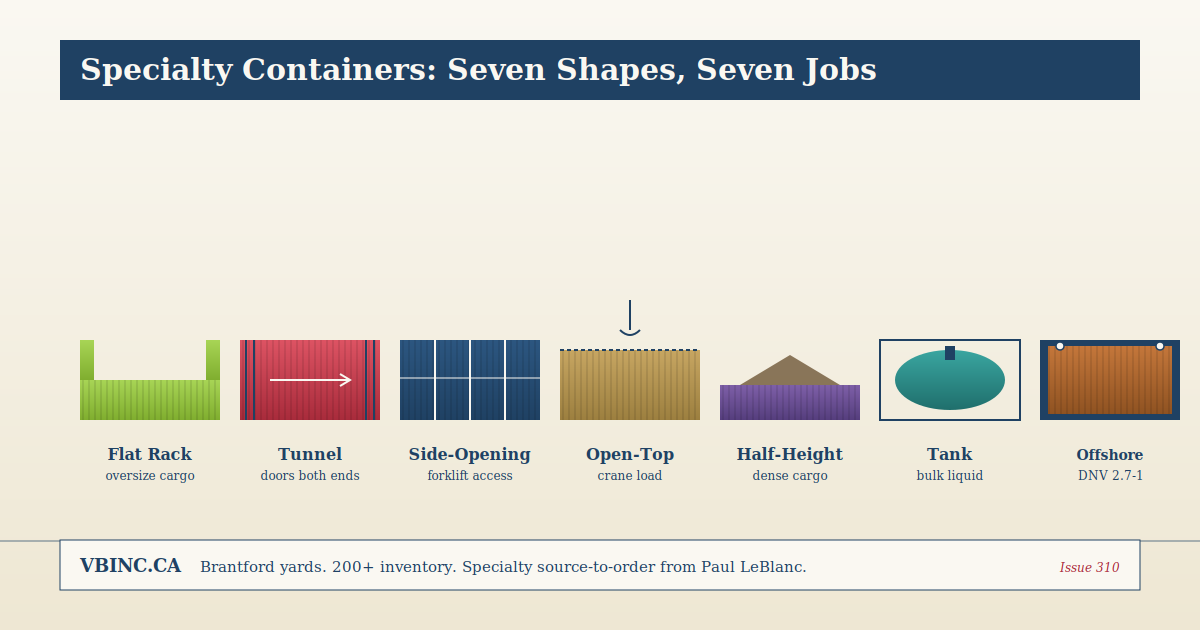
Per CBSA, Importing. Specialty containers are the boxes that exist because the standard 20ft and 40ft general-purpose unit cannot do the job. Flat racks haul oversize cargo with no side walls. Tunnel containers have doors on both ends for drive-through loading. Side-opening units expose the full length to a forklift. Open-tops let a crane drop cargo in from above. Half-height boxes carry steel, gravel, and other dense loads without wasting cubic space. Tank containers move bulk liquid. Offshore-rated units carry DNV 2.7-1 certification for marine lifts. In Ontario, standard 20ft and 40ft GP units sit in our yards ready to deliver in 1-3 days, and so do our new tunnel and side-opening units. Flat racks, open-tops and the rarer specialty types are almost always source-to-order with two to eight week lead times and a real price premium. Van Blanc Ent. Inc. stocks the standard sizes, tunnels and side openers in Brantford and brokers the other specialty types from established Canadian channels when buyers need them. Three decades family-run, 140+ verified Google reviews. 1-3 day delivery from our 4 Brantford yards across Ontario.
The first question on most specialty container calls is the same. “Do you have one in the yard?” Almost always the answer is no, and that is not a failure of stock. It is the structure of the market. Specialty containers are built in smaller production runs, retired in smaller numbers, and travel through a narrower set of depot and reseller channels than general-purpose 20ft and 40ft boxes. A Brantford yard with 200 plus units on the ground is the right place to buy a standard dry container today. For a flat rack, an open-top, or anything offshore-rated, the right move is to start the source call and accept that the lead time will measure in weeks, not days. New tunnels and side openers are the exception: those sit in our rows.
This guide walks each major specialty type. What it physically is. What it is built to carry. What honest Ontario availability and pricing look like in 2026. And where the cost-honest call is to buy a standard unit and modify it instead. Paul LeBlanc has spent thirty plus years in the trade and his bias is that buyers should know exactly what they are paying a premium for before they sign anything.
Flat Rack: Oversize Cargo, Machinery, Lumber Stacks
A flat rack is a shipping container with the side walls and roof removed. What remains is a reinforced platform base with two end walls, which are either fixed or collapsible. The 20ft flat rack runs roughly 5.70 metres of interior length and 2.35 metres wide, with about 2.24 metres of working height from base to top of the end wall. The 40ft version stretches to about 11.66 metres long and 2.37 metres wide. Floor strength is the defining feature. Lashing rings rated at 2,000 kg on 20ft units and 4,000 kg on 40ft units run down both rails to tie down loads that protrude past the deck.
The cargo that justifies a flat rack is wider than 2.35 metres, taller than the 2.59 metres a standard box gives you, or heavier than a regular floor can take. Yellow iron is the classic example. Skid steers, mini excavators, compact loaders with the bucket attached, anything with hydraulic arms or a roll cage that will not fit through standard end doors. Pre-fab structural steel is the other steady customer. Beams cut to 12 metre lengths ride on a 40ft flat rack with the protrusion tagged and lashed. Marine engines, transformers, drilling equipment, and oversize lumber stacks round out the demand.
Pricing in Ontario in 2026 sits well above standard dry. A used 20ft flat rack typically runs three to four times the price of a used 20ft GP. The 40ft version runs proportionally higher. The premium reflects scarcity rather than build cost. Specialty units are produced in much smaller numbers than the standard fleet, and once they retire from shipping line service the resale pool stays thin.
Tunnel: Doors on Both Ends for Drive-Through Loading
A tunnel container, also called a double-door or DD unit, has a full set of cargo doors on both end walls instead of just one. The physical dimensions match a standard 20ft or 40ft dry container exactly. Same external 6.058 or 12.192 metre length under ISO 668. Same 2.438 metre width. Same 2.591 metre standard height or 2.896 metre high cube height. The difference is access. Open both ends and the box becomes a tunnel.
Drive-through loading is the main pull. A forklift can enter one end, place a pallet, exit the other end, and never need to back out. For a contractor running a tight pad, a farmer staging round bales, or a site office that needs two sided foot traffic, the workflow difference is real. Splitting the unit also gets easier. A 20ft tunnel cut in half with a partition gives you two 10ft cells each with their own door, which is harder to achieve cleanly on a single-door box.
New “one-trip” tunnel units are in stock at our Brantford yards in 20ft and 40ft high cube, ready for your order and delivered in 1 to 3 days. Used IICL-grade tunnel units are rarer and the price premium over a single-door used dry box is usually fifteen to thirty percent.
Side-Opening: Forklift Access Full Length
A side-opening container, sometimes called a side-door or full-side-access unit, replaces one of the long side walls with a set of bi-fold or accordion doors. The roof and the opposite side stay intact. Open the side panels and a forklift driver sees the full 5.70 metre or 11.66 metre interior in a single sweep. No more reaching past pallet eight to retrieve pallet one.
The use case is workflow rather than cargo. The container itself still carries what a standard dry holds: dry pallets, tools, parts, secured equipment. What changes is the speed of placing and retrieving. Self-storage operators, tool cribs on industrial sites, retail back-stocks, and bulky-item rental fleets all gain real time savings from side access. The trade-off is structural. Removing a side wall reduces racking strength, and most side-opening boxes are not stacked more than two high without engineered support.
Side-opening units are almost always new “one-trip” stock rather than used, because the design is recent enough that the secondary market is shallow. New 20ft and 40ft high cube side openers are in stock in Brantford and deliver in 1 to 3 days. A new 20ft side-opening unit lands at roughly two to three times the price of a new one-trip standard 20ft, and the cost-honest comparison for many buyers is whether buying a standard box and adding personnel doors yourself meets the same workflow goal at lower cost.
Open-Top: Tall Cargo, Crane Loading
An open-top container has the same side walls and end walls as a standard dry box but the steel roof is replaced with removable roof bows and a tarpaulin. With the bows pulled and the tarp folded, the entire top of the container is exposed. A crane can lower cargo straight in from above, which is the point. The tarp goes back on for transit and the unit functions as a weather-resistant dry box again.
The cargo that needs an open-top is anything taller than the 2.39 metre interior height of a standard 20ft dry box or the 2.69 metre interior of a high cube. Glass panels stood on edge. Tall machinery with a fixed superstructure. Bagged or loose bulk that has to fill the corners rather than ride on pallets. The maximum payload on a 20ft open-top is roughly 28 tonnes, similar to a standard GP, but the door header is reinforced because the structural ring of the box now relies more heavily on the side rails and corner posts.
Used open-tops show up in Canadian depot inventories more often than flat racks or tanks, but still not as commonly as standard dry. A used 20ft open-top in Ontario typically lands at fifty to one hundred percent above a comparable used standard 20ft. New one-trip versions land higher again. Tarpaulin condition is the most overlooked inspection point on used stock; a tired tarp turns the box into a water trap on the first storm.
Half-Height: Dense Loads Like Steel and Gravel
Half-height containers are exactly what the name says. The footprint matches a standard 20ft or 40ft unit but the wall height stops at roughly 1.30 metres instead of 2.59. The point is not to save space. The point is to fill the box with something so dense that filling it to standard height would exceed the legal road, rail, or sea weight before the cubic space ran out.
Steel coils, mining ore, scrap, aggregate, gravel, sand, and crushed stone are the cargo profile. Pour the unit half full of crushed rock and you are already at the maximum gross weight a chassis can legally carry on the highway. Filling the same cargo into a full-height box wastes the upper half of the unit and risks running illegal on the road if anyone tops it up.
Half-height units are the rarest specialty type in Canadian secondary markets. Most production is captive to mining and bulk commodity operators who own their own fleets. Spot availability for a buyer in Ontario is genuinely scarce. When a unit does come available, the price is high relative to its cubic capacity because the buyer is paying for a specialty form factor, not for interior space.
Tank Container: Bulk Liquid Transport
A tank container is a stainless steel pressure vessel mounted inside a 20ft ISO frame. The frame matches standard 20ft external dimensions so the unit handles through any container terminal, but the cargo volume is in the cylinder, not in a rectangular box. Typical capacity runs 21,000 to 26,000 litres depending on the grade.
Tank containers move bulk liquid that does not fit a road tanker schedule. Food-grade tanks carry wine, edible oils, juice concentrate, and liquid sweeteners. Chemical-grade tanks carry industrial liquids under stricter cleaning protocols. Cryogenic tanks carry liquefied gases. Every cargo category has its own cleaning certification chain, and a tank that has carried a chemical product cannot move into food service without a full recommissioning.
For a Canadian buyer, tank containers almost never make sense to purchase outright unless you operate a recurring liquid logistics route. The economics favour leasing from established tank operators who handle cleaning, certification, inspection, and depot positioning. Van Blanc does not stock tank units and we tell buyers asking about them to start with the tank lessors who know the cleaning chain.
Offshore-Rated: Certified Lifts in Marine Environments
An offshore container looks like a heavy-duty dry box but it carries DNV 2.7-1 or equivalent certification. The standard governs offshore lifting where wind, swell, and crane motion can put dynamic loads on a box several times higher than dockside handling. Frame steel is thicker. Corner castings are upgraded. Lifting points are tested and stamped. Many offshore units include a certified lifting set permanently attached at the top corners.
The cargo is the supply chain that feeds offshore oil platforms, marine construction, wind installation vessels, and Arctic logistics. In landlocked Ontario the legitimate buyer is rare. The handful of inquiries we see annually are usually for atypical use cases: a contractor sourcing a heavy-rated box for repeated rough crane handling on land, an exporter staging gear for an east-coast offshore project, or a researcher buying surplus units after a North Sea fleet retirement.
Offshore-rated stock is the longest lead time in the specialty category. Units arrive into Canada through east-coast marine channels rather than the Toronto-Montreal corridor that feeds standard inventory. Lead time of two to four months is realistic, and the price premium over a standard dry box is significant. A cost-honest answer to most “I need a really tough box” requests is to buy a standard unit and reinforce specific lift points to project-engineered spec rather than chase a true DNV-certified container.
Specialty in Ontario: Stock vs Source-to-Order Lead Times
The lead-time conversation is the one that separates an honest specialty quote from a hopeful one. Standard 20ft and 40ft GP, high cube, and double-door units exist in real volume across Ontario depots. Van Blanc holds 200 plus across our four Brantford yards and our delivery promise on those is 1-3 days. Our new tunnel and side-opening units live in that pool too. The other specialty types in this guide do not. They are sourced from a much narrower network of depots and resellers, often with one or two suitable units in a province at a time.
Flat racks and open-tops are the more accessible specialty types because Canadian Tier 1 ports handle enough international cargo that some used stock retires into the secondary market each year. Realistic Ontario lead time for a used 20ft flat rack or open-top runs two to six weeks. Tunnel and side-opening units are different: Van Blanc keeps new ones in stock, so they ship in 1 to 3 days.
Half-height, tank, and offshore-rated units are genuinely scarce. We do not promise these on a calendar at all. When a buyer calls Van Blanc about one of these three, the honest answer is that we will work the source network and come back with a real timeline within forty-eight hours.
The Facebook scam pattern that has hit the standard container market this year is also showing up on specialty listings. The pattern is the same. A photo lifted from a manufacturer brochure. A price that undercuts the legitimate market by half. A request for an etransfer deposit. No physical address, no CSC plate visible, no inspection appointment offered. For specialty types, where the legitimate market itself is thin, scam exposure is higher because buyers have fewer reference points. The honest rule is the same as for standard boxes. Pay only after a physical inspection at a yard you have driven to, or after a depot-verified release confirmed by phone, never on a wire transfer to a listing that cannot put you in the same room as the unit.
Frequently Asked Questions
What is the difference between a flat rack and an open-top container?
A flat rack has only end walls and a reinforced platform base, with no sides or roof. It carries cargo that is wider, taller, or heavier than a standard box can hold. An open-top container has full side walls and end walls but a removable tarpaulin roof. It carries cargo that fits the width and length of a standard box but is too tall to load through end doors, allowing a crane to drop the cargo in from above.
Can Van Blanc deliver a flat rack or tunnel container to my Ontario site in 1-3 days?
For a tunnel, yes. Our 1-3 day Ontario delivery promise covers the standard 20ft and 40ft general-purpose units, plus the new tunnel and side-opening units we stock in our four Brantford yards. Flat racks and open-tops are almost always source-to-order. Realistic lead time on those runs two to eight weeks depending on the type and current depot availability.
How much more does a specialty container cost than a standard 20ft?
Tunnel containers run roughly fifteen to thirty percent above a comparable standard unit. Open-tops typically run fifty to one hundred percent above. Side-opening units run two to three times the price of a standard one-trip 20ft. Flat racks run three to four times. Half-height, tank, and offshore-rated units are priced case by case because spot availability drives the number more than category does. The premium reflects specialty production scarcity rather than build cost.
Is a tunnel container the same dimensions as a standard 20ft container?
Yes. A tunnel container shares the same ISO 668 external dimensions as a standard 20ft or 40ft unit. The difference is that both end walls have cargo doors instead of just one. Internal floor space, height, and width are identical. This is why tunnel units handle through any container terminal and ship on any standard chassis exactly like a single-door box.
What is DNV 2.7-1 certification and do I need it?
DNV 2.7-1 is the standard governing offshore containers, certifying that the unit can withstand the dynamic loads of crane handling at sea where wind and swell amplify lift forces. Most land-based Ontario buyers do not need a DNV-certified unit. If your use case is rough crane handling on land but not actual marine lifts, an engineered reinforcement of a standard box is usually cheaper and faster than sourcing a real DNV-rated unit, which can carry a two to four month lead time.
Can I get a side-opening container for self-storage at lower cost than I think?
Often no. New one-trip side-opening units land at two to three times the price of a standard 20ft. For self-storage operators the cost-honest comparison is to buy a standard 20ft and add personnel doors or roll-up doors along one side wall through a fabrication shop. Many fabrication shops in Ontario do this work, and the modified result usually costs less than a factory side-opening unit while meeting the same workflow goal.
Do half-height containers come in 40ft sizes?
They are produced primarily in 20ft footprint because the use case is dense cargo that hits legal weight limits well before cubic limits. A 40ft half-height would be even harder to load to full cubic capacity without exceeding road and rail weight allowances. A handful of 40ft half-heights exist for specific commodity routes but spot availability in Canadian secondary markets is essentially zero.
Are tank containers something Van Blanc sells?
No. Tank containers are a specialized leasing market with strict cleaning, certification, and inspection chains that we do not operate inside. We tell buyers asking about tank units to contact established tank operators directly. The leasing economics on tank containers almost always favour leasing over purchase unless the buyer runs a recurring high-volume liquid logistics route.
How do I know a Facebook listing for a flat rack is legitimate?
The honest filter for any specialty listing is whether the seller will put you in the same room as the actual unit before money moves. A legitimate seller has a yard address, will book an inspection appointment, will let you read the CSC plate, and will accept payment only at or after the inspection. A scam listing pressures you to wire a deposit before viewing, uses brochure photos, and gives you a price meaningfully below the legitimate market. The same rules that protect a standard container buyer protect a specialty buyer; the price spread is just higher.
What is the most common specialty container Van Blanc actually sources for Ontario buyers?
Tunnel double-door units, by a wide margin. Construction contractors, farmers, and small commercial sites want the drive-through workflow, and we keep new tunnels in stock, so they ship like a standard unit. Flat racks come second, mostly for one-off moves of yellow iron or structural steel. Open-tops third. The rest are real but rare. When a buyer calls about half-height, tank, or offshore-rated, Paul or Christian will say up front whether we can source that unit and on what lead time.
Need a specialty container in Ontario?
Standard 20ft and 40ft units, tunnels and side openers ship from our four Brantford yards in 1-3 days. Other specialty types are source-to-order and we will give you a real timeline within forty-eight hours. Visit our Brantford yards to inspect any standard unit before you buy.
Van Blanc Ent. Inc. | Brantford, Ontario | Request a specialty quote
Sources
- Boxhub. Specialty Shipping Container Guide: Open-Side, Side-Door, Tunnel Containers and More.
- DSV Global Transport and Logistics. Flat Rack Container Dimensions and Specifications.
- Hapag-Lloyd. 40 ft Flatrack High Cube and 40 ft Platform Container Specifications.
- Pelican Containers. 20 ft Standard Tunnel Double-Door Shipping Container Specifications.
- ATS Containers. Shipping Containers in Canada: Types, Prices and Buying Guide.
- International Organization for Standardization. ISO 668: Series 1 Freight Containers, Classification, Dimensions, and Ratings.
- DNV. Offshore Container Certification Standard DNV-ST-E271 (formerly 2.7-1).
Related Reading
Ready to price your container?
Tell us the size and your postal code and we’ll send back an honest, all-in number, container, delivery, and placement, usually within 1-3 days. No pressure, no mystery fees.
Family-run in Brantford since 1995 · 200+ containers in stock · 4.9★ across 140+ Google reviews · every box graded by a person, walk it before it lands.