
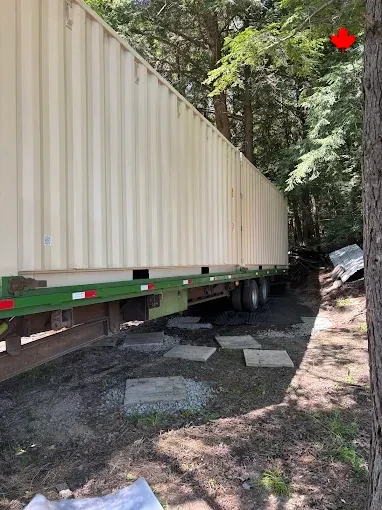
We sell containers. We do not rent.
Van Blanc sells shipping containers outright. We do not rent, we do not lease, and we do not offer rent-to-own. Renting comes up on this page because buyers compare it against owning, and that comparison is worth reading, but purchase is the only arrangement we offer. Stocked units deliver from our Brantford yards in 1 to 3 days. Request a sale quote or call the yard at 519-754-6844.
Quick Answer: A shipping container can sit anywhere with firm, level ground, truck access, and the owner’s blessing: driveways, side yards, back lots, farm laneways, and job sites are the standard homes. Block the corners, shed water away from the doors, and the spot is ready.
The question arrives at our counter in two forms. Buyers ask it before delivery, wanting to know if their property can host a box at all. And owners ask it mid-life, when a container needs a new home because the renovation ended or the site wrapped. Both versions have the same short answer, ground, access, permission, and the longer answer below, which walks every common placement with the honest trade-offs of each. Businesses on rent-to-own inherit the same physics; every unit we place, sold outright or on a commercial rent-to-own schedule, delivers to every spot this page approves.
What Any Container Spot Needs
Three things, and only three. Firm, level ground: packed gravel, asphalt, concrete, or well-drained earth, with blocking under the four corner castings so the frame stays square and air moves underneath. Truck access: roughly 30m (100ft) of straight approach for a 20ft delivery, overhead clear of wires and branches, and gates wide enough for the tilt-deck. And permission: your own property is yours, a landlord’s lot needs the landlord, and every municipality manages its own rules, so check with your local building or planning department before you order. That single sentence is the entire permitting section of this article, because the rest is your municipality’s conversation, not ours.
The Standard Homes, Ranked by How Often We Deliver to Them
The driveway. The renovation classic. A 20ft fits a double driveway with the doors clear and a car’s width beside it; tighter drives take the 10ft. The blocking matters double on asphalt, spreading the corner loads so summer heat cannot let the castings dimple the surface.
The side yard or back yard. The long-term residential home, out of the streetscape and close to the work. The delivery question is the route: gate width, septic locations, and the overhead wire nobody remembers until the driver points at it. Walk the path before you book and the drop is routine.
The farm laneway or field edge. Half of rural Ontario’s containers live at the end of a lane on railway ties, and they are the happiest boxes we ever revisit: level, ventilated underneath, doors downwind. Flag soft ground honestly at booking; a tilt-deck handles a firm lane in any season and a wet field in none.
The job site. Position on day one where the crane and staging will not bury it by month two, doors facing the work, clear of the mud line. Site boxes move again by design, so the exit route deserves the same thought as the entrance.
The business back lot. Behind the shop, doors toward the building for security, within cord’s reach of power if the box will ever hold a freezer or lights. Tell your insurer; most commercial policies extend contents coverage to an on-site container with a phone call.
Where a Container Cannot Go
The honest exclusion list is short but firm. Shared and condo-board properties generally cannot host one; the rules settle it before the physics does. Soft or flooding ground defeats any blocking. Slopes beyond a gentle grade rack frames and swing doors on their own schedule. And anywhere the truck cannot reach, the container cannot be, which sounds tautological until someone asks us to helicopter a box over a house, roughly annually. When a property fails the test, the alternatives are a smaller unit, a different corner of the lot, or honestly, a storage locker, and we will say which on the phone before any truck is booked.
Not Sure Your Spot Qualifies?
Describe the property and the approach over the phone and the driver’s answer is usually instant; tricky placements get scouted before booking. Size, grade, and postal code get the quote itself, with a real lead time, usually the same day.
Preparing the Spot in an Afternoon
The whole recipe: mark the footprint, 6.1m by 2.5m for a 20ft, level the ground by eye and a string line, and lay blocking, railway ties or patio stones, under where the four corner castings will land, set slightly proud of grade so water runs away from the door sills. That last clause does more for a container’s long life than any other sentence on this page; steel that drains stays sound, and steel that puddles writes rust at the sills. The deeper walkthrough, including drainage on clay and the winter frost question, lives in the full site-prep guide.
When the Container Needs a New Home
Containers outlive their first placement, and the mid-life move question deserves a straight answer. We deliver the containers we sell, empty, and place them where you want; relocating a loaded unit later is a third-party hauler’s job, and we are glad to point you toward one. The practical planning tip that erases the whole problem: pick the long-term spot before the first delivery, and if a later move is even possible, keep the pad simple and the approach clear. An empty container moves easily; a buried, fenced-in, garden-adjacent one moves expensively, and the difference was decided years earlier by whoever chose the spot.
Placement FAQ
Where can I store a shipping container on my property?
Anywhere with firm, level ground and truck access: driveways, side and back yards, farm laneways, and back lots are the standard homes. Block the four corners on ties or patio stones, set slightly proud of grade, and the spot is ready. Permits are managed by your municipality; check with your local building or planning department before you order.
Does a shipping container need a foundation?
No poured foundation, ever, for storage use. Blocking under the four corner castings keeps the frame square, the doors swinging true, and air moving underneath, which is all the steel asks for.
Can a container sit on grass or bare earth?
On well-drained, firm earth with proper corner blocking, yes; thousands of farm containers prove it decades at a time. On soft, wet, or flood-prone ground, no; blocking sinks and frames rack. When in doubt, describe the ground on the phone and the driver will tell you straight.
How much space does delivery need?
Roughly 30m (100ft) of straight approach for a 20ft, more for a 40ft, plus overhead clearance free of wires and branches and gates wide enough for the truck. The driver confirms the route by phone before rolling; tight placements get scouted first.
Can I move my container to a new spot later?
Empty, yes: a hauler with the right truck relocates an empty unit routinely. Loaded relocations are specialist work. The cheaper answer is planning: choose the long-term spot before first delivery and keep the approach clear if a move is ever possible.
Is it better to store a container at home or at a facility?
On your own property wins on access, cost, and convenience whenever the ground and rules allow it, which is the point of a container. When they do not, a locker facility is the honest alternative for small volumes, and we recommend one without hesitation.
Sources
- Canadian Council of Motor Transport Administrators. (2013). National Safety Code Standard 10: Cargo Securement. stacouncil.ca
- International Organization for Standardization. (2020). ISO 668: Series 1 freight containers, classification, dimensions and ratings. iso.org
- Cargo Integrity Group. (2020). CTU Code: A Quick Guide. ippc.int
- Institute of International Container Lessors. (current). Dry van technical bulletins. iicl.org
The Yard That Answers Placement Questions All Day
Van Blanc has delivered containers to every kind of Ontario property since 1995: family-run, 4.9 stars across 140+ verified Google reviews, shipping from 90 Morton Avenue East in Brantford in 1 to 3 days. Describe your spot and we will tell you honestly whether it works.
Van Blanc Ent. Inc., 90 Morton Ave E Unit 1B, Brantford, ON N3R 7J7. 1-888-509-6658