
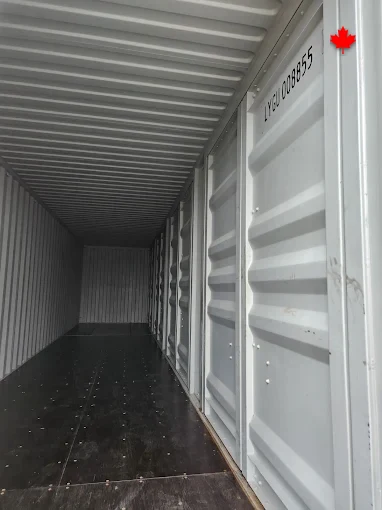
Quick Answer: Pack a shipping container heavy-low and even, keep a hand’s width off the walls, and strap tiers as you go. Spread weight across the floor rather than stacking one dense wall of boxes, the same principle the international CTU packing code builds on, scaled to a driveway.
The commercial world packs containers under a published rulebook: the IMO/ILO/UNECE Code of Practice for Packing of Cargo Transport Units, the CTU Code, which governs how professional loads cross oceans without shifting, crushing, or sweating. Almost none of it has reached the driveway, which is a shame, because a household or site load obeys the same physics as an export one. This guide scales the professional discipline down to the container behind your house: load order, weight, moisture, and the ten minutes of strapping that separates a clean unload from an avalanche.
Before the First Box Goes In
Three checks, two minutes. Sweep the floor and let it dry if the morning was wet; cargo sits for months on whatever you seal in with it. Confirm the container sits level on its blocking, because every stack you build inherits the floor’s lean, and a box leaning two degrees at the door end is a wall of goods leaning two degrees at your face in the spring. And walk your load plan mentally from the back wall forward: last-needed goods deepest, first-needed at the door, which sounds obvious until the fourth trip up the driveway rearranges everyone’s philosophy. And if the box is not yet sited at all, the placement guide comes first.
Weight: Low, Even, and Off the Door End
The CTU Code’s core principle survives translation intact: distribute weight across the floor, keep the centre of gravity low, and never concentrate mass in one end or one tier. In household terms, that means appliances, tool chests, and book boxes spread along the length at floor level, never stacked into one dense cliff at the door. Aim for even side-to-side loading too; a container packed heavy on one wall carries fine but unloads strangely, with tiers settling toward the heavy side over months. The floor itself is not the limit; a 20ft’s marine plywood floor carries far more than any household will ask of it. The limit is the stack, which brings us to tiers.
Build Tiers, Strap Tiers
Professional loads go in as vertical slices: build a tier from floor to as high as it goes, square and tight, then strap or brace it before starting the next. The household version is identical and takes one ratchet strap per tier run wall-to-wall through the container’s lashing points, the steel rings most units carry along the top and bottom rails. Heavy and rigid at the bottom of each tier, light and crushable up top, mattresses and sofa cushions as the top course where nothing minds the pressure. The payoff comes twice: nothing shifts when the seasons move the steel, and nothing greets you at head height when the doors open, because doors that open onto a strapped tier open onto a wall, and doors that open onto an unstrapped one open onto a decision.
Moisture: The Only Enemy That Works Nights
Steel breathes with the weather, and warm damp air touching a cold wall writes its moisture on whatever sits against it. The discipline is four habits. Nothing loads wet, and the day-before-the-cold-snap load of damp patio cushions is the classic self-inflicted wound. Keep a hand’s width between cargo and every wall so air moves where condensation would sit. Pallets or scrap lumber under the bottom course keep cardboard off the floor’s thermal mass. And leave the floor vents clear, because a container’s passive ventilation only works when the load does not entomb it. For long stores through an Ontario shoulder season, a couple of desiccant tubs at the door end are cheap insurance, and the professionals hang them by the tonne for exactly this reason.
How Much Actually Fits in a 20ft
The perennial question, answered from thirty years of watching people load. A 20ft holds 33.2 cubic metres, which in practice swallows the contents of a typical three-bedroom house’s main floor plus bedrooms, if packed in tiers rather than tossed. The visual rule from the yard: a load that would fill a double garage to chest height fits a 20ft with room to walk the aisle. What breaks the math is air, shipped inside furniture nobody disassembled. Bed frames flat against the walls, table legs off, sofas on end along one side, and the dense cube of boxes built in the space furniture would have wasted. A 40ft doubles all of it and adds the luxury of a genuine centre aisle, which is why the 20ft-versus-40ft decision usually turns on how much furniture is travelling assembled.
What Never Goes In
The short list, honestly: anything living, anything leaking, propane and fuel of any kind, and anything the container’s temperature swings would ruin, which in Ontario means candles in July and anything water-based in January. Documents, instruments, and heirloom photos belong in climate control, not steel; that is not a container failure, it is physics, and we say it plainly at the counter. Everything else a household owns loads fine under the disciplines above.
Need the Box Before the Boxes?
If the packing plan exists but the container does not yet, tell us the size and your postal code and the quote comes back with a real lead time, usually the same day. Renting for the project or buying for the decade both start the same way.
Unload Day, Planned at Load Time
The best unloads were decided months earlier. Straps come off one tier at a time, never all at once. The door-end tier carries the season’s first-needed goods because past-you was thoughtful. And the aisle you left, even a shoulder-width one, turns retrieval from archaeology into shopping. Households that expect to visit the container mid-term should load a genuine aisle down one side; storage you can walk into gets used, and storage you would have to excavate gets resented.
Packing FAQ
How should weight be distributed when packing a shipping container?
Low, even, and spread along the full floor length, the same principle the international CTU packing code applies to commercial loads. Heavy items at floor level across the container, never concentrated in one end or stacked into a single dense wall at the door.
How much furniture fits in a 20ft container?
About 33 cubic metres: typically a three-bedroom house’s contents when furniture is disassembled and boxes are built into tiers. The garage rule works too: a load that fills a double garage to chest height fits a 20ft with an aisle to spare.
How do I stop condensation from ruining stored boxes?
Four habits: load everything dry, keep a hand’s width between cargo and the steel walls, put pallets under the bottom course, and leave the floor vents clear. Desiccant tubs at the door end add cheap insurance for long stores.
What holds the load in place inside a container?
Ratchet straps run wall-to-wall through the lashing rings most containers carry along their rails, one strap per packed tier. Build each tier tight and square, strap it, then start the next; a strapped load cannot shift and cannot fall when the doors open.
What should never be packed in a shipping container?
Anything living, leaking, or fuelled: propane, gasoline, and solvents are the hard no. Temperature-sensitive goods like candles, liquids that freeze, instruments, and heirloom documents belong in climate control instead; steel swings with the seasons.
Should I pack a container differently for moving versus storage?
The physics is identical; the door-end plan differs. Storage loads put first-needed goods at the door and keep a walkable aisle. A container being trucked afterward gets the full CTU-style treatment: everything strapped, nothing free to shift in transit.
Sources
- International Maritime Organization, International Labour Organization, and UNECE. (2014). Code of Practice for Packing of Cargo Transport Units (CTU Code). ilo.org
- Cargo Integrity Group. (2020). CTU Code: A Quick Guide. ippc.int
- Canadian Council of Motor Transport Administrators. (2013). National Safety Code Standard 10: Cargo Securement. stacouncil.ca
- International Organization for Standardization. (2020). ISO 668: Series 1 freight containers, classification, dimensions and ratings. iso.org
The Box Half of the Equation
Van Blanc has supplied the steel side of Ontario’s packing plans since 1995: family-run, 4.9 stars across 140+ verified Google reviews, 200+ containers at 90 Morton Avenue East in Brantford, delivered in 1 to 3 days. Walk the rows, and bring your load plan; the counter has opinions.
Van Blanc Ent. Inc., 90 Morton Ave E Unit 1B, Brantford, ON N3R 7J7. 1-888-509-6658