
We sell containers. We do not rent.
Van Blanc sells shipping containers outright. We do not rent, we do not lease, and we do not offer rent-to-own. Renting comes up on this page because buyers compare it against owning, and that comparison is worth reading, but purchase is the only arrangement we offer. Stocked units deliver from our Brantford yards in 1 to 3 days. Request a sale quote or call the yard at 519-754-6844.
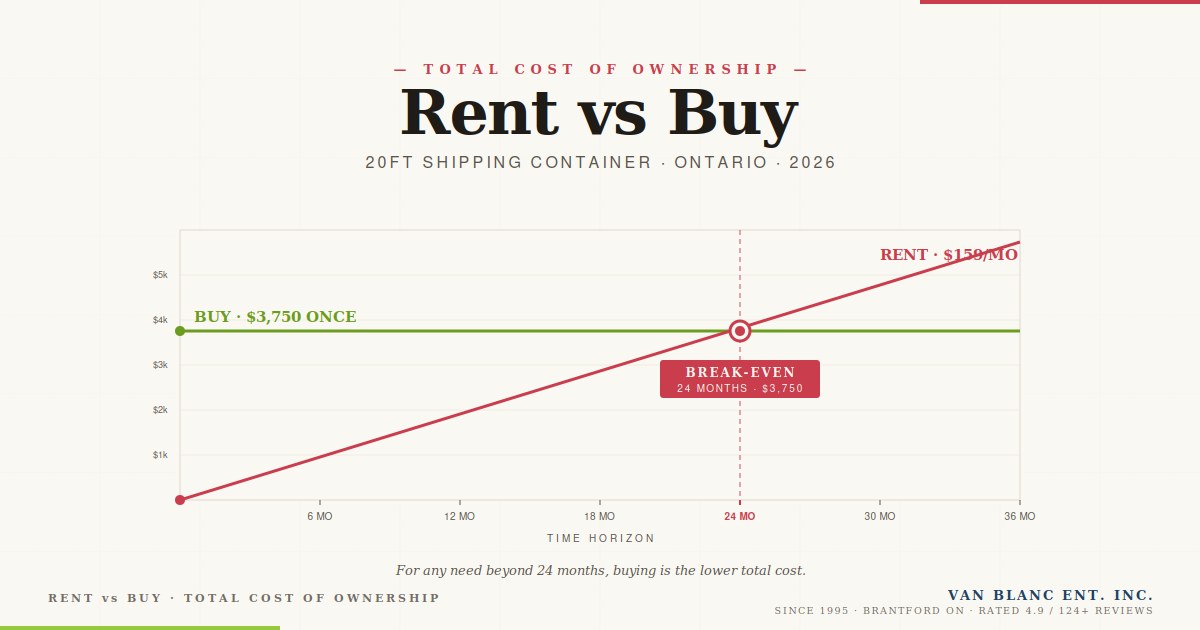
Quick Answer: Renting a 20 ft shipping container in Ontario is a recurring monthly charge plus delivery and pickup, while buying a used one outright is a single up-front cost on an asset you keep. These are the same steel boxes that move freight under Transport Canada rules, so the unit you rent and the unit you buy are functionally identical: the only real difference is who owns it. The break-even point is roughly 24 months. After two years, every additional month of renting is pure cost on an asset you could already own. Buy if you need it long-term, rent if you do not. Tell us your delivery address and we will quote real costs, no anchored numbers, just honest pricing. Real Brantford yards, real reviews (4.9 / 140+), real 1-3 day delivery. Family-operated since 1995.
In This Guide
- What Does a Shipping Container Cost Over 10 Years, Rent vs Buy?
- When Does Buying a Container Break Even Against Renting?
- What Hidden Costs Do Renting and Buying Each Carry?
- How Is a Shipping Container Taxed (CCA) for a Canadian Business?
- What Is an Owned Container Worth When You Resell It?
- When Is Renting a Shipping Container the Right Call?
- When Is Buying a Shipping Container the Right Call?
- Frequently Asked Questions
Reading Time: 14 minutes
The “rent or buy” decision is the most common one we walk through with new container buyers, and it is also the one where the honest answer changes most based on how long you actually need the container. Renting is the right tool for a clean three-month horizon. Buying is the right tool for anything beyond two years. The middle zone, six to 24 months, is where the math gets interesting and where the wrong choice can quietly cost a buyer a few thousand dollars over the life of the project.
This article walks through the real numbers: monthly rental at Ontario rates, purchase prices for the four container grades, the 24-month break-even, the tax treatment for business buyers, and the resale value of a container you eventually no longer need. By the end, the rent-or-buy question should have a clear answer for your specific situation, not a generic recommendation.
What Does a Shipping Container Cost Over 10 Years, Rent vs Buy?
Over a 10-year horizon, buying a shipping container is far cheaper than renting one. Renting is a monthly charge that never stops, while buying is a one-time cost on a steel asset you keep and can resell. The two strategies break even near 24 months. Every rented month after that is pure cost on a container you could already own.
The simplest way to see the difference is to lay out cumulative cost at each year mark. The rental side uses BigSteelBox‘s published monthly rate for a 20 foot storage container in most Canadian cities, plus typical delivery and pickup. The buy side uses a used cargo-worthy 20 footer delivered in Ontario. Rather than chase exact dollar figures that shift with the steel market and your delivery distance, the table below expresses each milestone as a share of the one-time purchase price, which holds steady no matter what the current quote happens to be.
| Time horizon | Cumulative rental cost (as a share of the one-time purchase price) | Cumulative cost of owning | Which strategy is ahead |
|---|---|---|---|
| 6 months | Roughly one quarter of the purchase price | Full purchase price, paid once | Renting, by a wide margin |
| 12 months | Roughly half the purchase price | Purchase price, unchanged | Renting |
| 18 months | Roughly three quarters of the purchase price | Purchase price, unchanged | Renting, but the gap is closing |
| 24 months (break-even) | Roughly equal to the purchase price | Purchase price, unchanged | A tie, the crossover point |
| 3 years | Around 1.5 times the purchase price | Purchase price, unchanged | Buying |
| 5 years | Around 2.5 times the purchase price | Purchase price, unchanged | Buying, clearly |
| 10 years | Around 5 times the purchase price | Purchase price, less 60 to 80 percent recovered on resale | Buying, decisively |
| 20 years | Around 10 times the purchase price | Purchase price, less resale value still recovered | Buying, overwhelmingly |
What the Numbers Show
For any horizon under 18 months, renting is the lower total cost. The 18 to 24 month band is the crossover zone where the two strategies land within a few percent of each other. After 24 months, the divergence accelerates rapidly. By year 5, owning has saved you well over the original purchase price compared with continuing to rent. By year 10, the cumulative rental cost is several times what the container would have cost to buy outright. The math compounds because rental is a recurring cost forever, while purchase is a one-time cost that decays slightly in value but never returns to zero.
Christian LeBlanc, second-generation operator: “I grew up around this trade, flying to Asia with my dad starting at 15, and the rent-versus-buy question still comes up on almost every call. People picture renting as the cheap option. It is, for a short job. Stretch that same rental past two years and you have quietly paid for a container you do not own. We would rather tell you that up front than collect rent on it.”
When Does Buying a Container Break Even Against Renting?
The 24-month figure is not a Van Blanc number. BigSteelBox publishes it openly on its own pricing pages, where it states that the rental-to-purchase break-even on their 20 foot container is “just over two years in most cities.” We break down what an Ontario monthly rate actually buys you in our guide to monthly container rental across the province. That is one national chain telling buyers honestly that after 24 months of rental, they have paid roughly the same as a new purchase outright.
The same math holds for used cargo-worthy and wind-and-watertight containers from a regional Ontario supplier. The break-even is slightly faster because used inventory costs less upfront. A wind-and-watertight 20 foot, the lowest-priced grade, breaks even against rental in about 16 months. A used cargo worthy, the middle grade, breaks even in about 24 months. A one-trip (new) unit, the highest-priced grade, takes about 41 months to break even because the up-front cost is higher. Buyers who want the longest service life often start from our freshly imported single-voyage stock and accept the longer payback for a box that will outlast the project.
| Purchase grade | Relative up-front cost | Break-even against monthly rental |
|---|---|---|
| Wind-and-Watertight 20 ft used | Lowest | ~16 months |
| Cargo Worthy 20 ft used | Mid | ~24 months |
| One-Trip (new) 20 ft | Highest | ~41 months |
| Wind-and-Watertight 40 ft used | Higher (larger unit) | ~25 months (vs higher 40 ft rental) |
| Cargo Worthy 40 ft used | Highest 40 ft option | ~34 months |
The Break-Even Insight
The lower the purchase grade, the faster the break-even. A wind-and-watertight 20 footer breaks even in 16 months. For any buyer who is sure they need the container for more than 18 months, the math is already done. Buy used WWT, save the difference over a cargo-worthy unit, and stop paying rent within a year and a half.
What Hidden Costs Do Renting and Buying Each Carry?
The simple rent-vs-buy math is real but does not capture every dollar. Both sides have costs that get glossed over in marketing comparisons.
| Cost category | Renting | Buying |
|---|---|---|
| Delivery fee | Quoted, added to first invoice | Quoted, added to purchase price |
| Pickup fee | Charged at end of rental | Not applicable |
| Site preparation | You handle (gravel pad, leveling) | You handle (gravel pad, leveling) |
| Maintenance over time | Supplier handles (covered in rent) | You handle (minimal: rust spot care, gasket replace if needed) |
| Insurance | Typically your responsibility while on your property | Typically your responsibility |
| Capital tied up | None (low cash up front) | The full purchase price, paid once up front |
| Opportunity cost of capital | Zero | Modest (the cash could be earning interest elsewhere) |
| End-of-life disposal | Supplier takes it away | Sell for ~60 to 80 percent of purchase price |
The most overlooked cost on the rent side is delivery and pickup. Both are real and significant. On a short rental of about 3 months in the GTA, the combined delivery and pickup fees can rival the base rent itself. Over a 90-day term, those one-time logistics charges nearly double the effective monthly cost, which is exactly why short rentals look cheaper than they end up being.
The most overlooked cost on the buy side is opportunity cost of capital. The cash you put into a container is cash you cannot put into other inventory, marketing, equipment, or a high-interest savings account. For a business, the opportunity cost can be meaningful if alternative uses of the cash generate strong returns. For a homeowner, the opportunity cost is usually minimal.
Paul LeBlanc, Van Blanc owner: “Most buyers ask about the sticker price. The right question is the all-in cost over the time horizon. A six-month rental in the GTA carries more cost than people expect once you add delivery and pickup. Six months of owning a container, by contrast, is mostly just the opportunity cost on the capital and almost zero maintenance. The math is closer than the marketing makes it look. We walk this through with buyers honestly before they sign anything.”
How Is a Shipping Container Taxed (CCA) for a Canadian Business?
For business buyers, the tax treatment changes the math meaningfully.
A shipping container purchased for business use is a capital asset under Canadian tax law, which means the purchase price is not deductible in the year of purchase. Instead, the Canada Revenue Agency (CRA) requires the business to claim Capital Cost Allowance (CCA), which is the tax term for depreciation, over several years based on the asset’s class.
Practical CCA Treatment for Shipping Containers
Most general business equipment used for storage falls under CCA Class 8, which has a depreciation rate of 20 percent on a declining-balance basis. A container purchased for business storage would let you claim 20 percent of its cost as deductible CCA in the first full year, then 20 percent of the remaining undepreciated balance in year two, and continuing down on the declining-balance schedule until the asset is fully depreciated over roughly 7 to 10 years.
Rental, by contrast, is a current expense and is fully deductible in the year incurred. The entire annual rental cost generates a full deduction in the same year.
Tax-adjusted math: For a business in a 30 percent tax bracket, the rental’s full annual deduction returns 30 cents of tax savings for every dollar of rent paid, in the same year. The container purchase returns the same 30 percent, but spread out: only on the 20 percent of cost claimable in year one to start, then on the declining-balance amounts in later years. By year 5, the purchase has returned tax savings on most of its original cost, while the rental has returned savings only on the rent paid so far. After year 5, the purchase has fully depreciated and provides no further deductions; the rental keeps providing deductions but only because you keep paying rent. This is general guidance. Consult a Canadian tax professional for your specific situation.
The net effect for most business buyers: the tax treatment slightly favours renting in years 1 to 5, then slightly favours buying after the depreciation completes. The break-even on a tax-adjusted basis is usually 28 to 36 months instead of 24, but the underlying logic stays the same. Long-term need = buy, short-term need = rent.
What Is an Owned Container Worth When You Resell It?
One side of the math the rent-vs-buy calculators almost never include is what an owned container is worth when you no longer need it.
The Canadian used-container market is active and consistent. How well a container holds its value starts with which grade you bought in the first place, a trade-off we walk through in our comparison of new and used containers for Canadian buyers. A 10-year-old cargo worthy 20 footer in good condition typically resells for 60 to 80 percent of its original delivered purchase price. A 20-year-old wind-and-watertight unit often still resells for 40 to 60 percent of purchase price. The market for used containers is large because demand keeps growing across farming, construction, residential storage, and modification applications.
The Resale Net-Out
If you buy a cargo worthy 20 footer, use it for 10 years, and sell it at the end, your net cost over a decade is only the portion of the purchase price you did not recover on resale, typically 20 to 40 percent of what you originally paid. Spread across 120 months, that effective monthly cost is a small fraction of any rental rate. Over the same decade, monthly rental would have added up to several times the purchase price, plus pickup fees. The resale value collapses the buy-side math into a near-trivial number for the long-horizon buyer.
For business buyers, the resale recovers a portion of the original capital outlay that the CCA has already partially depreciated for tax purposes. The accounting and the cash flow both improve at end of life when you sell.
When Is Renting a Shipping Container the Right Call?
Renting is not the wrong choice. It is the right choice in specific situations.
1. Defined Short-Term Project (under 18 months)
Kitchen renovation, basement build-out, house staging during a sale, three-month construction project. You know the end date. You will not need the container after the project. Rent. The math is on your side.
2. Trial Use Before Committing
You are not sure whether a container fits your operation, your back yard, your access constraints, or your aesthetic preference. Rent for 6 months. If it works, talk to the supplier about the purchase option (some let you apply rental fees toward purchase, though not all). If it does not work, you have not committed thousands of dollars.
3. Capital-Constrained Operation
You run a small business where every dollar of working capital matters more than the long-term storage cost. Rent. Keep the purchase capital working inside your business. Pay the rental as an operating expense.
4. Site or Use Will Change
You expect to move offices, relocate operations, or shift to a different storage solution within 18 months. Rent. The rental provider handles the move-out logistics.
When Is Buying a Shipping Container the Right Call?
1. Long-Term Storage Need (24+ months)
Farm storage, contractor yard, small business inventory, retail backstock, residential garden storage. If the container is on your property for at least 24 months, the math has already crossed. Buy, and match the grade to how the unit will actually be used rather than defaulting to the cheapest box on the lot.
2. Indefinite Horizon
You are setting up storage you expect to use for the next 5 to 20 years. The cumulative rental cost in this window is one to ten times the purchase price. Buy.
3. You Want to Modify the Container
Adding doors, windows, electrical, insulation, ventilation, paint, or cladding. Rental companies do not allow modification of their inventory. Buying is the only option for any custom build.
4. Refrigerated or Specialty Storage
Reefers, container offices, container homes, or any specialty configuration. The rental market does not stock these in Ontario at any scale. Buying outright is the only path.
5. You Want the Asset on Your Balance Sheet
For business owners building book value, an owned container is an asset that depreciates per CCA but holds resale value above the depreciated book value. That gap is unrecognised equity. Rental is an expense; ownership is an asset.
Worth the Drive to Brantford
Buyers from across Ontario have been driving to our Brantford yard for 30 years to walk inventory before they commit. Toronto is 90 minutes. Hamilton is 30. Cambridge and Kitchener-Waterloo under an hour. The rent-vs-buy conversation usually happens on the phone, but the final decision happens at the yard when the buyer can see exactly what they are buying. Worth the drive for unbeatable quality, family customer service with 30 years of experience.
Do Recurring Rental Bills Carry a Hidden Cost?
One factor the math does not capture, but every long-time business owner recognises, is the cognitive overhead of recurring monthly bills. Every rental adds a line to your monthly accounting, a renewal date to track, a delivery and pickup schedule to manage, and a “is this still worth it” review every quarter. A purchased container generates none of this. The container arrives once, lives on your property indefinitely, and disappears from your monthly cost stack from day one.
For a small business owner running tight margins on attention as well as on capital, the simplification matters. Fewer recurring vendors means fewer monthly decisions, fewer invoices to reconcile, and fewer renewal dates that can quietly tick up in price each year. Buying a container removes one variable cost from your operating life for the next decade or more. That simplification has real value for owners managing tight attention budgets, even when the dollar math is close.
If the math lands on renting, we will say so and point you to a rental company, because Van Blanc does not rent; if it lands on owning but the cash is the problem, an equipment loan through your own bank or financer puts the same grades on a monthly payment against a box you own from day one.
Ready to price your container?
Tell us the size and your postal code and we’ll send back an honest, all-in number, container, delivery, and placement, usually within 1-3 days. No pressure, no mystery fees.
Family-run in Brantford since 1995 · 200+ containers in stock · 4.9★ across 140+ Google reviews · every box graded by a person, walk it before it lands.
Rent or Buy: Which Wins at Your Time Horizon?
| Your time horizon | Best strategy |
|---|---|
| Under 6 months | Rent. Buying is overkill. |
| 6 to 18 months | Rent. The break-even has not arrived. |
| 18 to 24 months | Either works, depending on cash flow preference. Lean buy if cash is available. |
| 24 to 36 months | Buy. The math has crossed and continues to favour ownership. |
| 3 to 5 years | Buy. By a wide margin. |
| 5+ years or indefinite | Buy. Rental at this horizon is just paying for an asset you could have owned for years. |
| Unknown horizon, capital-tight | Rent. Convert to buy if the need continues past 18 months. |
| Any horizon with modifications planned | Buy. Rentals cannot be modified. |
Frequently Asked Questions
How much does it cost to rent a 20 foot shipping container in Ontario?
BigSteelBox publishes a flat monthly base rate for a 20 foot storage container in most Canadian cities, including Brantford and Hamilton, with delivery and pickup quoted separately. On a typical 3-month rental, the one-time delivery and pickup fees can rival the base rent itself, so the all-in cost of a short rental is meaningfully higher than the monthly rate alone suggests.
How much does it cost to buy a 20 foot shipping container in Ontario?
The purchase price depends on the grade: a used wind-and-watertight 20 footer is the most affordable, a used cargo worthy unit sits in the middle, and a one-trip (new) 20 footer is the highest. Delivery distance from the Brantford yard, the steel market, and the season all move the quote up or down. The cargo worthy grade is the most common purchase, balancing condition against cost for most buyers.
When does buying become cheaper than renting?
Roughly at 24 months of continuous use, based on BigSteelBox’s own published break-even math. The break-even is faster (about 16 months) for buyers who purchase the lower-priced wind-and-watertight grade, and slower (about 41 months) for buyers who purchase a one-trip new unit. For any horizon over 24 months, buying is the lower total cost.
Can I deduct a shipping container as a business expense in Canada?
A shipping container is a capital asset, not a current expense, so the purchase price is not immediately deductible. Instead, businesses claim Capital Cost Allowance (CCA) over several years. Most storage containers fall under CCA Class 8 at 20 percent declining-balance, meaning roughly 7 to 10 years of partial deductions until fully depreciated. Rental, by contrast, is fully deductible in the year incurred. Consult a Canadian tax professional for your specific case.
What is the resale value of a used shipping container?
A 10-year-old cargo worthy 20 footer in good condition typically resells for 60 to 80 percent of its original delivered purchase price. A 20-year-old wind-and-watertight unit often still resells for 40 to 60 percent. The used container market in Canada is active and consistent, making owned containers a recoverable asset rather than a sunk cost.
Can I apply rental payments toward a future purchase?
No. Van Blanc sells containers outright and does not rent, lease, or offer rent-to-own. For a need measured in weeks, a mobile-storage pod or a self-storage unit is usually the better call, and we will say so. Past a few months, buying a used wind-and-watertight box normally costs less than renting one, and you can sell it on or ask us about buyback when you are done.
What is the cheapest way to get a shipping container in Ontario?
For under 6 months of use, renting from a national chain is usually cheapest. For 18 months or more, buying a used wind-and-watertight 20 footer from a regional Ontario supplier is cheapest. The single cheapest total-cost path for any need longer than 18 months is buying used WWT outright and stopping the monthly cost forever.
Sources
- BigSteelBox. (2026). Rent or Buy BigSteelBox Shipping Containers. bigsteelbox.com/storage/rent-buy
- Canada Revenue Agency. (2025). Capital Cost Allowance (CCA) Classes. canada.ca
- International Organization for Standardization. (2022). ISO 6346:2022 Freight containers, Coding, identification and marking. iso.org/standard/82754.html
- Container xChange. (2026). Shipping Container Price Canada: Buy New and Used Units. container-xchange.com
- Ontario Construction News. (2026). Shipping Container Pricing in Canada: A 2026 Guide for Construction Professionals. ontarioconstructionnews.com
Reach Van Blanc in Brantford
Van Blanc has been the Brantford container yard since 1995. We sell new (one-trip) and used (cargo worthy, wind-and-watertight, and as-is) containers in 20, 40, 40 high cube, and 45 high cube sizes, delivered across Ontario in 1 to 3 days on a cash-on-delivery basis. The rent-vs-buy conversation is one we have on the phone every day. If your need is short-term, we will tell you to rent from a company that rents. If it is long-term, we will quote you the right grade for your specific use.
Van Blanc Ent. Inc. 90 Morton Ave E Unit 1B, Brantford, ON N3R 7J7. 519-754-6844 (cell) or 1-888-509-6658 (toll-free).
Worth the drive for unbeatable quality, family customer service with 30 years of experience. The total-cost math reads differently on paper than it does standing in the gravel beside the container you would actually own.