
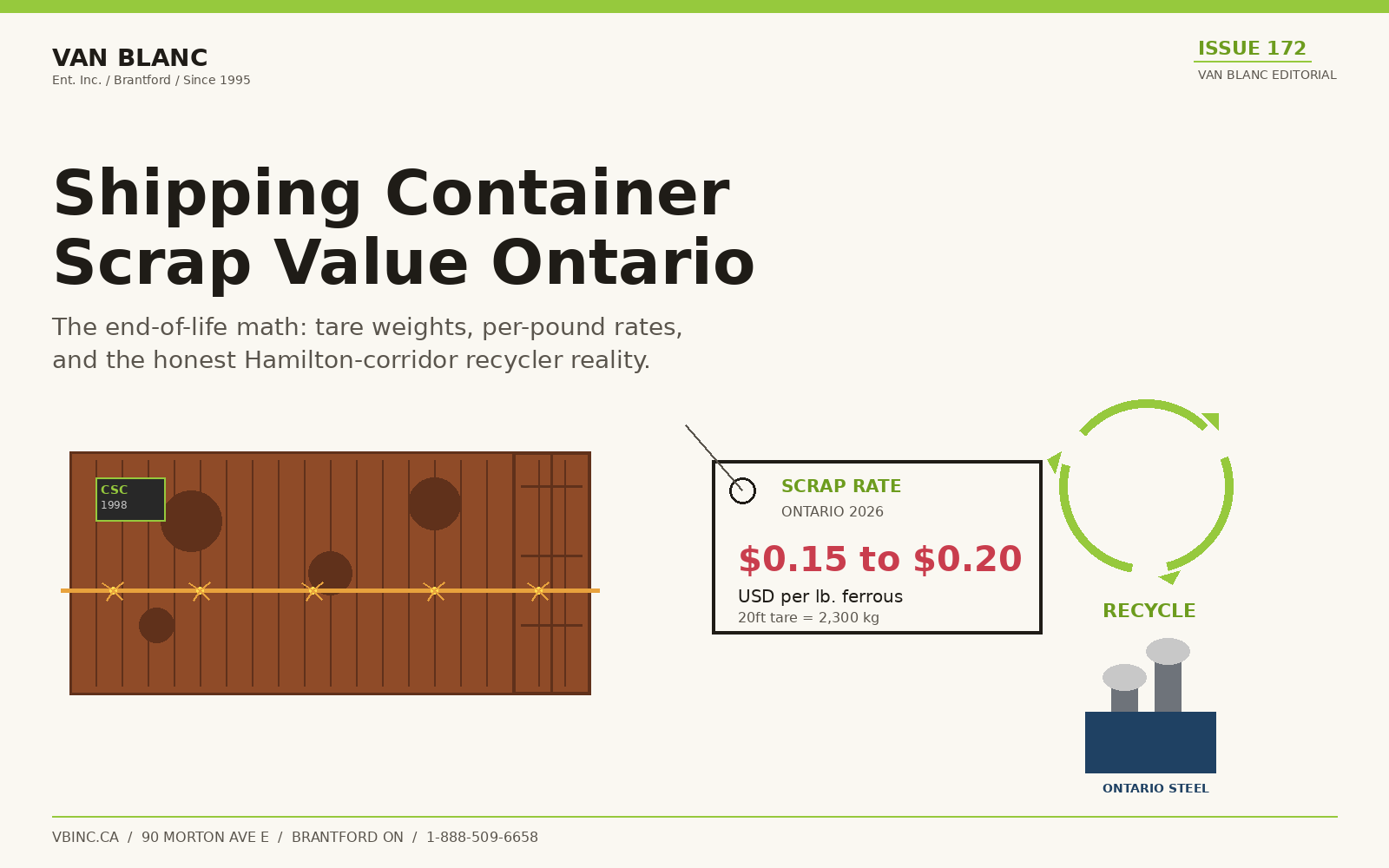
Quick Answer: A retired 20ft shipping container yields roughly 2,300 kg of weathering steel at prevailing Ontario scrap-steel rates, and a 40ft yields about 3,750 kg. Real recovery depends on grade, moisture, and the recycler’s pay schedule on the day of intake. Tell us your delivery address and we will quote real costs, no anchored numbers, just honest pricing.
In This Guide
- How Much Is a Shipping Container Worth as Scrap in Ontario?
- Why Does Weathering Steel Pay More Than Plain HMS?
- Where Can You Scrap a Container Near Brantford?
- Should You Cut the Bin on Site or Roll It Whole?
- Scrap or Resell: Which Is the Honest Choice?
- How Much Steel Survives by Grade and Age?
- What Paperwork and Weigh-Scale Checks Apply?
- When Are Ontario Scrap Steel Prices Highest?
- Is Recycling a Retired Sea Can Actually Green?
- What End-of-Life Pattern Do We See at Van Blanc?
- Frequently Asked Questions
Reading time: about 14 minutes.
Every shipping container eventually retires. Twenty or thirty years after a fresh one-trip 20ft lands in the driveway, the same steel box reaches a moment where the floor has given way, the corner castings have softened, or the panels need more patches than the bin is worth keeping in service. At that moment the question is practical: what is this thing worth as scrap, and where in Ontario do you take it?
Most container suppliers will not answer that honestly. We will. Van Blanc has watched the full Ontario lifecycle since 1995, including the quiet end of the curve where a working sea can becomes 2,300 kilograms of weathering steel headed to a Hamilton or Brantford recycler.
How Much Is a Shipping Container Worth as Scrap in Ontario?
A retired shipping container is worth its weathering-steel weight at the recycler’s posted ferrous rate on intake day. A 20ft holds about 2,300 kg of steel and a 40ft about 3,750 kg. Grade, moisture, contamination, and the yard’s pay schedule that day decide the final figure.
The arithmetic starts with tare weight, the published empty weight of the container before any cargo. Tare is stamped on the CSC plate of every legitimate ISO box. Once you know tare, the rest is the current Ontario price per pound at the recycler’s scale on the day you arrive.
| Container | Tare weight | Steel content (estimate) | Ferrous grade at intake |
|---|---|---|---|
| 20ft Standard Dry | 2,300 kg / 5,070 lb | ~95% weathering steel | HMS to mid grade |
| 20ft High Cube | 2,400 kg / 5,290 lb | ~95% weathering steel | HMS to mid grade |
| 40ft Standard Dry | 3,750 kg / 8,265 lb | ~95% weathering steel | HMS to mid grade |
| 40ft High Cube | 4,000 kg / 8,820 lb | ~95% weathering steel | HMS to mid grade |
| 45ft High Cube | 4,800 kg / 10,580 lb | ~95% weathering steel | HMS to mid grade |
| 20ft Refrigerated (reefer) | 3,080 kg / 6,790 lb | ~85% steel, balance insulation and aluminum | HMS to mid grade plus aluminum credit |
The 2026 Ontario reality, as of early May, sits where #1 Heavy Melting Steel and mixed shred scrap trade at prevailing ferrous rates, with mixed shred posting a touch lower than clean heavy melt. Converted to Canadian funds, clean ferrous recovers the stronger figure on a typical week. The recycler’s posted rate on intake day is the number that counts.
Paul LeBlanc, owner: “People want a flat scrap number and there isn’t one. The same 20ft bin can swing twenty percent in a season. I have watched the ferrous rate move through every cycle since I got into containers, and the honest answer is always the same. Strip it clean, weigh it on a scale you can read, and take the posted rate that day.”
Buyers who want the wider removal and disposal logistics behind retiring a bin rarely find concrete numbers anywhere. Yards pay more for clean, dry, contamination free steel than for a bin loaded with mouldy plywood. A container stripped down to bare panels clears the higher end of the range. A bin dragged in still loaded with delaminated hardwood flooring and a corroded reefer unit lands at the lower end.
Why Does Weathering Steel Pay More Than Plain HMS?
Weathering steel pays more than plain heavy melting steel because of what is alloyed into it. Shipping containers are built from Corten A or a closely related weathering steel, an alloy designed to form a stable rust patina that protects the underlying metal instead of eating through it. The grade has measurable copper, chromium, nickel, and phosphorous content. That additional alloy content matters at intake. Some Ontario recyclers grade weathering steel as a mid grade between plain heavy melt and structural steel, paying a few cents per pound above the basic HMS line.
Container steel is not the same as shed steel
A backyard storage shed built from galvanized rolled sheet sells at the bottom of the ferrous schedule. A retired sea can panel made from ASTM A588 or A242 family weathering steel sells higher because the alloy content carries through to the next melt. Smaller scrap yards sometimes miss this and pay the standard HMS rate by default. Larger Hamilton and Burlington recyclers with proper magnetic spectrometers grade it correctly. Ask the yard which grade they are putting it into before the truck rolls off the scale.
Christian LeBlanc, second-generation operator at Van Blanc, sees this routinely when a customer brings us back a thirty-year-old bin they bought from us in the late nineties. The steel still has structural memory. The corrosion is surface, not through-plate, which is the whole reason weathering steel earned its name. When a yard understands what they are buying, the per pound rate climbs.
Where Can You Scrap a Container Near Brantford?
You can scrap a retired container at several qualified ferrous yards within an hour of Brantford. Brantford sits inside a dense Ontario scrap belt. Hamilton has historically been the steel capital of Canada and the supporting recycler infrastructure has not vanished even as the mills consolidated. From our four Brantford yards a retired container can reach a Hamilton recycler in under thirty minutes, a Cambridge yard in under forty, and a Burlington intake in under an hour. Freight cost stays low. Net recovery on the bin stays high.
Wentworth Metal Recycling in Hamilton, ABS Recycling in Brantford itself, Combined Metal Industries with locations in Toronto and Cambridge, and a handful of smaller independent yards along the Highway 403 corridor all take whole containers. Some require advance notice for oversize loads. Most prefer the container cut into wall and roof panels before arrival because their yard cranes are sized for vehicle bodies and rebar bundles rather than full forty-foot rectangles.
The 403 corridor scrap belt
Brantford to Hamilton on the 403 is the densest stretch of ferrous recycling infrastructure in Ontario outside the Toronto industrial east end. A retired container moved from a Brant County farm to a Hamilton yard pays better net than the same container moved from Northern Ontario to a Sudbury recycler because the freight per kilometre eats less of the recovery. Geography matters at the end of a container’s life just as much as it matters at the start.
Should You Cut the Bin on Site or Roll It Whole?
Whether you cut the bin on site or roll it whole is the single biggest variable in net scrap recovery, and the right call depends on freight distance and whether you already own cutting gear. Each approach has a real cost and a real payoff.
Cutting on site means a tradesperson with a plasma cutter or oxy-acetylene rig sections the bin into roof panels, side panels, end-doors, floor frame, and corner castings. That cutting labour carries its own cost. The advantage is freight: a bundled stack of cut panels rides on a single flatbed, while a whole forty-foot container demands a tilt-deck or roll-off truck with permits.
Rolling the whole bin keeps the steel intact for any potential interior salvage. A whole bin lets the recycler do the cutting at their yard, which means they keep the cutting margin. Pay rate per pound drops slightly, but you save the labour cost. Economics depend on size, freight distance, and whether you have on-site cutting equipment already.
Scrap or Resell: Which Is the Honest Choice?
Scrap or resell is the decision most container blogs avoid. A 20ft container in Wind and Watertight condition still sells in the Ontario private market at a price that tracks its cosmetic shape. A scrap recovery on the same bin is roughly half of what a working resale would clear. The math is rarely in favour of scrap if the box still passes a basic wind-and-watertight check.
The honest decision also depends on what you plan to do next. Plenty of owners scrap a tired bin and immediately want a sound replacement, and a fresh one-trip box from our current Brantford stock lasts decades longer than the unit headed to the recycler. If the retiring container still seals, selling it working and buying clean almost always beats scrapping early.
Scrap becomes the right call in five specific situations. The floor has dropped through and the frame underneath is no longer sound. Corner castings have softened enough that crane lifts are unsafe. Doors have racked badly enough that they no longer seal and repair exceeds resale margin. Modifications have cut so many panel penetrations that the bin is structurally compromised. The buyer needs the space cleared faster than the resale market can move.
The two-quote rule
Before committing to scrap, get one written quote from a recycler for the bin as scrap and one written offer from a working container buyer through a local classifieds posting. The numbers are almost always far enough apart that the right answer reveals itself. If the resale offer comfortably beats scrap, sell working. If scrap beats resale or the resale market shows no interest in three weeks, scrap.
How Much Steel Survives by Grade and Age?
How much steel survives depends on the container’s grade and how many decades it has weathered. Published tare weights assume factory-fresh containers. Real-world tare drifts over decades. Older sea cans accumulate rust pitting that removes a small percentage of original steel weight. Modified containers with cut openings for windows or doors lose more. Containers with replaced floors using heavier hardwood or with added insulation gain weight. The same grade language buyers learn when they size up a used bin before paying also predicts how much steel will be left to recover decades later.
| Container condition | Typical net steel recovery | What drives the variance |
|---|---|---|
| One-trip retired after 25 years of dry-land storage | 97% of original tare | Minimal corrosion loss, original floor still present |
| Cargo Worthy used for 15 years | 92-95% of original tare | Surface rust accumulation, some panel pitting |
| Wind and Watertight retired after 30 years | 85-92% of original tare | Extensive surface oxidation, possible floor replacement |
| As-Is grade reaching end of life | 75-90% of original tare | Heavy pitting, frame thinning, partial through-corrosion |
| Heavily modified bin with multiple cut openings | 60-80% of original tare | Steel removed for windows, doors, vents, mod work |
If a buyer needs an accurate recovery number, the recycler’s scale is the final word. The estimates above guide expectations before you arrive. They are not a substitute for the weigh ticket on the day of intake.
What Paperwork and Weigh-Scale Checks Apply?
The paperwork and weigh-scale checks at an Ontario scrap yard are set by provincial rule, not yard preference. Ontario scrap yards operate under the Ministry of Government and Consumer Services rules for scrap metal sale, which means every transaction generates a paper trail. The yard records the seller’s name, address, government identification number, vehicle plate, weight, grade, and price paid. A cheque or electronic transfer is issued. Bring identification. Bring proof of ownership of the container if it could be questioned.
The weigh-scale itself is the moment of truth. The scale records gross weight when the truck arrives loaded, then tare weight after unloading. Net is the difference. A reputable yard prints the ticket with both numbers visible. If a yard refuses to show the gross and tare separately, walk away. That is the single most common Ontario scrap fraud, a yard that fudges the tare on the return weigh. Honest yards have nothing to hide.
Pickup versus drop-off
Most Ontario recyclers offer a pickup service for retired containers, sending their own roll-off truck to the property. Pickup convenience comes with a modest freight charge, usually for properties within an hour radius of the yard. Drop-off saves the freight cost but requires you to arrange the flatbed yourself. For a single 20ft container the pickup option usually nets out close to drop-off once you factor in your own flatbed rental. For multiple bins on the same site, drop-off scales better.
When Are Ontario Scrap Steel Prices Highest?
Ontario scrap steel prices usually run highest through the spring and summer construction season and softest in late autumn into January. Scrap steel prices move on global cycles. Chinese demand, North American mill output, Turkish import volume, and the Canadian dollar exchange rate all push the per pound rate up or down by ten to fifteen percent across a year. Spring construction season usually pushes ferrous prices upward. Late autumn through January can sag if industrial output slows.
For a single retired container the cycle barely matters. The difference between selling at the peak and trough on a 20ft bin is small on a 2,300 kg recovery. For a fleet liquidation of fifteen or twenty retired containers, timing the cycle can shift the total recovery by a meaningful margin. We have watched contractors deliberately hold retired bins in a back lot through a soft scrap quarter and wait for the spring lift.
If you are decommissioning a single bin, get two quotes, pick the better one, and move on. If you are decommissioning ten or more, track iScrapApp posted prices for #1 HMS over six weeks before you commit.
Is Recycling a Retired Sea Can Actually Green?
Recycling a retired sea can is genuinely green once the box has no working life left, because steel recovers almost completely back into new product. Steel is one of the most recyclable materials in modern industry. The Canadian Steel Producers Association estimates over 98% of North American steel ends up recycled, and the recycling loop uses roughly 75% less energy than producing new steel from virgin ore. A retired 20ft container melted into an Ontario electric arc furnace and rolled into new structural steel completes a loop that started when the original Asian mill cast the plate forty years earlier.
The environmental case is genuine. Recycling a container that still has a decade of working life left in it is not a green decision, it is a waste. The responsible end-of-life choice is the longest practical service life, with scrap as the final stage. Buyers who scrap a Wind and Watertight bin because it no longer matches their landscaping aesthetic are making a steel waste choice dressed up as a green one.
Christian LeBlanc, second-generation operator: “The greenest container is the one still working. We delivered bins in 1998 that are still standing on the same Brant County farm twenty-eight years later, still keeping rain off feed equipment. That is the win. The scrap yard is the last stop, not the second stop.”
What End-of-Life Pattern Do We See at Van Blanc?
The end-of-life pattern we see at Van Blanc is remarkably consistent across thirty years of Ontario container supply, and the typical lifecycle reads like this. A one-trip 20ft sea can lands at a Brant County farm in the late 1990s as new feed storage. It serves that purpose for fifteen years. The original buyer sells the farm and the container stays with the property. The new owner uses it for general storage another decade. Around year twenty-five the floor finally fails and the doors no longer seal properly. The bin reaches the end of its working life.
At that point the owner has three choices. Re-sell as a Wind and Watertight bin to a buyer who wants cheap rough storage. Scrap it to a Hamilton recycler for whatever the steel recovers. Or modify into a permanent fixture (workshop, chicken coop foundation, retaining wall) where the steel keeps serving in a different role.
Most Ontario containers we have tracked through the cycle end up in option one until structural failure becomes severe enough that option two is the only honest answer. Very few buyers scrap early. The math does not support it while the bin still seals.
When the scrap call finally comes, our recommendation is simple. Get the bin to the closest qualified recycler. Cut it down if you have the equipment. Roll it whole if you do not. Watch the weigh-scale. Take the cheque. The steel goes back into the Ontario industrial economy where it started.
Van Blanc keeps doing what we have done since 1995, which is supplying fresh one-trip and used containers from our four Brantford yards on 1-3 day delivery to every region of Ontario. The same family handles both ends of the lifecycle honestly. Every quote we give comes with a real lead time, not a hopeful one. The Brantford yard at 90 Morton Avenue East is open Monday through Friday for walk-throughs. Worth the drive for unbeatable quality, family customer service, and 30 years of experience.
For the broader retirement context, our guide to clearing and disposing of a worn-out bin covers structural removal, site remediation, and the disposal logistics that sit around the pure scrap math here.
Frequently Asked Questions
How much is a 40ft shipping container worth as scrap in Ontario?
A standard 40ft container with a 3,750 kg tare recovers a sum that tracks prevailing Ontario ferrous scrap rates on the day of intake. Converted to Canadian funds the figure moves with the exchange rate that week. The exact number comes off the recycler’s scale on the day of intake.
What is the scrap value of a 20ft sea can in 2026?
A 20ft sea can with a 2,300 kg tare weight clears a figure set by current Ontario heavy melt and mid grade ferrous rates. The Canadian-dollar recovery moves with the exchange rate week to week. Reefer units pay more because of the aluminum content in the refrigeration assembly.
Are shipping containers made from special steel that pays more than HMS at the scrap yard?
Yes. Containers use weathering steel from the Corten A family or ASTM A588 and A242 specifications. The alloy content (copper, chromium, nickel) carries through to the melt and some Ontario recyclers grade it as mid grade ferrous rather than plain heavy melt. Always confirm with the yard which grade they are putting your bin into.
Where can I scrap a shipping container near Brantford?
The Brantford to Hamilton corridor along Highway 403 has the densest concentration of qualified ferrous recyclers in Southwestern Ontario. ABS Recycling in Brantford, Wentworth Metal Recycling in Hamilton, and Combined Metal Industries in Cambridge all accept whole containers. Phone ahead for oversize load handling and current per pound rates.
Should I cut the container into panels before taking it to the scrap yard?
Cutting on site saves on freight because cut panels stack on a single flatbed instead of requiring a tilt-deck for a whole bin. Plasma or oxy-acetylene cutting labour adds a modest cost for a 40ft container. The freight savings on multiple trips usually outweigh the cutting cost, but for a single bin within an hour of the yard, rolling it whole on a tilt-deck is often simpler.
Is scrapping a working shipping container ever the right financial choice?
Rarely. A Wind and Watertight 20ft sea can still sells privately in Ontario well above its scrap recovery. Scrap is the right call only when the floor has failed, corner castings are unsafe, doors no longer seal, structural penetrations have compromised the panels, or speed of disposal outweighs the resale premium.
How much does it cost to have a scrap yard pick up a retired container?
Pickup service from Ontario recyclers carries a modest freight charge, typically for properties within an hour radius of the yard. The pickup convenience usually nets out close to self-arranged drop-off once you factor in your own flatbed rental for a single 20ft container. For multiple bins on one site, drop-off scales more economically.
Do Ontario scrap yards pay cash for shipping containers?
No, not for any meaningful amount. Provincial and municipal scrap metal regulations require electronic transfer or cheque payment, photo identification at intake, and full record-keeping of the transaction. The paper trail is mandatory. Yards that offer cash for full container loads are operating outside the regulations.
When are scrap steel prices highest in Ontario through the year?
Ferrous scrap prices typically lift through spring construction season as mill demand rises, peak in summer, and soften through late autumn into January when industrial output slows. For a fleet liquidation of ten or more containers, holding through a soft quarter and selling on the spring lift can add a meaningful margin to total recovery.
How much steel is actually in a retired shipping container?
Roughly 95 percent of a standard dry container’s tare weight is weathering steel. A 20ft bin yields about 2,200 kg of usable steel after accounting for wood flooring, gaskets, and hardware. A 40ft yields about 3,560 kg. Refrigerated containers run closer to 85 percent steel because insulation panels and aluminum reefer assembly reduce the ferrous share.
Sources
- International Organization for Standardization. (2022). ISO 6346:2022 Freight containers Coding, identification and marking. iso.org/standard/82754.html
- iScrap App. (2026, May 9). #1 HMS Heavy Melting Steel Scrap Prices. iscrapapp.com/metals/1-hms
- Schmidts Auto Recycling. (2026, March 21). Scrap Steel Prices in Ontario, Canada. schmidtsautorecycling.ca
- Government of Ontario. Scrap Metal Sales Regulation O. Reg. 290/24. Ministry of Government and Consumer Services. ontario.ca/laws/regulation/240290
- Canadian Steel Producers Association. (2025). Steel Sustainability and Recycling. canadiansteel.ca/sustainability
Reach Van Blanc in Brantford
We have been supplying shipping containers across Ontario since 1995. Our warehouse is at 90 Morton Avenue E in Brantford, and we deliver right across the province with cash on delivery, no surprise fees, no chase-the-paperwork.
Van Blanc Ent. Inc. 90 Morton Ave E Unit 1B, Brantford, ON N3R 7J7 +1 888-509-6658
If you are planning a container retirement and want a clear picture of the resale versus scrap math for your specific bin, call us before you cut. We can usually tell you in two minutes whether your sea can has working life left or whether the recycler is the honest next step.
Related Reading
Ready to price your container?
Tell us the size and your postal code and we’ll send back an honest, all-in number, container, delivery, and placement, usually within 1-3 days. No pressure, no mystery fees.
Family-run in Brantford since 1995 · 200+ containers in stock · 4.9★ across 140+ Google reviews · every box graded by a person, walk it before it lands.