
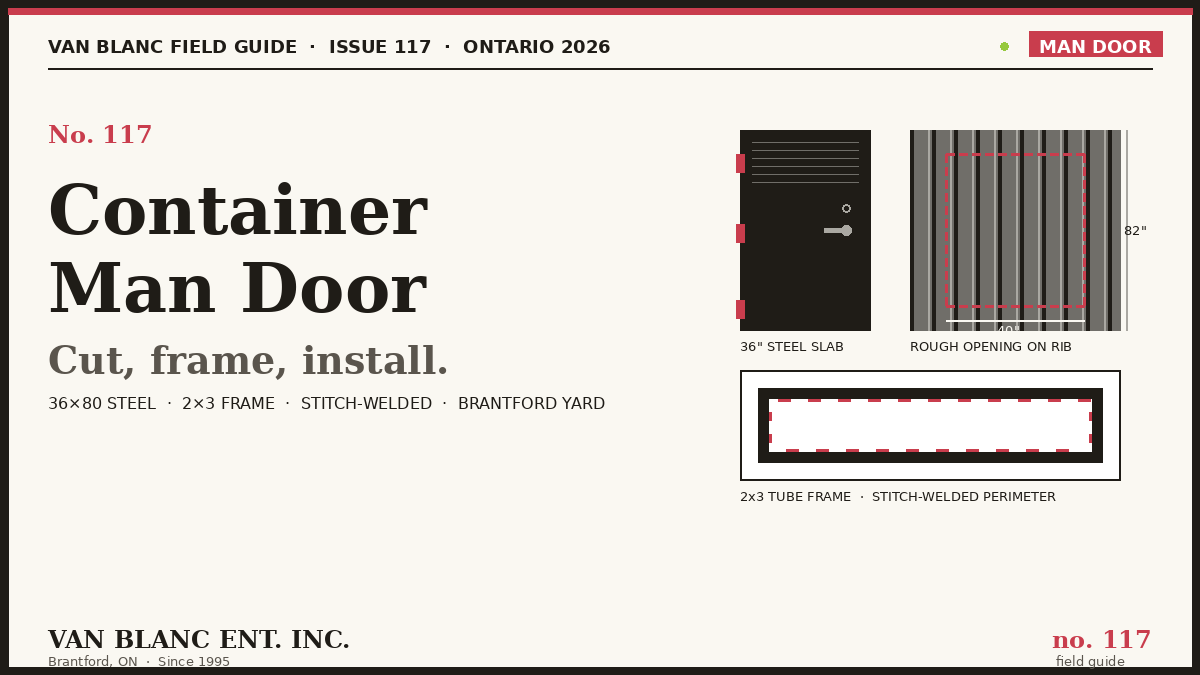
Quick Answer: A container man door in Ontario is a 36 by 80 inch steel personnel door cut into a shipping container side or end wall, framed with 2×3 steel tube, and welded in place. The installed quote at Van Blanc covers the cut, the frame, the weather seal, and the hardware in one number. What moves that number is your container grade, the door style, whether the cut lands on the side wall or the end wall, and your freight zone, so call for a real quote. Egress door dimensions in occupied steel builds follow Ontario Building Code guidance. Brantford-based since 1995, family-operated, 4.9-star verified (140+ Google reviews). 1-3 day delivery Ontario-wide.
In This Guide
- What Is a Container Man Door?
- Why Do Ontario Buyers Add a Man Door?
- What Sizes Do Container Man Doors Come In?
- Side Wall or End Wall: Where Should the Door Go?
- What Is the 11-Inch Corrugation Rule?
- How Is the Door Frame Built and Welded?
- What Is the Cutting Sequence in the Yard?
- What Drives the Installed Price in Ontario?
- Where Does Paul Put the Man Door After Thirty Years?
- Do You Need an Insulated Door?
- What Locks and Security Upgrades Are Available?
- How Long Is the Lead Time From Order to Pickup?
- What Man Door Mistakes Should You Avoid?
- Is a Cheap Online Door Kit Worth It?
- Frequently Asked Questions
- Reach Van Blanc in Brantford
Reading time: about 14 minutes.
What Is a Container Man Door?
A container man door is a hinged steel personnel door, usually 36 inches wide by 80 inches tall, cut into the side or end wall of a shipping container so people can walk in and out without rolling the heavy cargo doors. It is framed with 2×3 steel tube, welded in, and fitted with a lever and deadbolt.
A container man door is a hinged steel personnel door, usually 36 inches wide by 80 inches tall, cut into a shipping container so a person can walk in and out without rolling the heavy cargo doors at the end. It looks like a normal commercial entry door because that is what it is: a pre-hung 18-gauge cold-rolled steel slab, hinges, lever, deadbolt, weather stripping, and a 2 by 3 inch steel tube frame designed to be welded directly into a hole cut in the corrugated wall of a Corten container.
Christian LeBlanc, second-generation operator: “A man door is the single most-requested cut we do at the Brantford yard. People buy a sealed steel box and within a week they realise they do not want to wrestle a 150-pound cargo door every time they grab a tool. I grew up around this trade, flying to Asia with my dad starting at 15, and the door question comes up on almost every walk-through.”
The technical name is a steel personnel door. Most buyers in Ontario call it a man door because the trades have called it that for forty years. We use both terms in the yard, and so does Paul. The frame is what does most of the work. It carries the door weight, restores the structural load path that the corrugation was carrying before we cut it, and gives the lockset something to bite into.
The door is one of the first cuts buyers ask about once they start turning a plain bin into something usable. About four in ten containers we modify get at least one man door installed. The rest stay as pure storage with the original cargo doors at one end, because the buyer never needs to enter the bin alone.

Why Do Ontario Buyers Add a Man Door?
Ontario buyers add a man door because the cargo doors on a shipping container were designed for forklifts and pallets, not for a person who has to step in three times an hour. Each cargo door weighs about 150 pounds and seals with four locking rods. Rolling them open and closed for routine access is slow, hard on the hinges, and in winter it dumps the cold inside every time. A man door fixes that.

The most common Ontario use cases we install for:
- Site office conversions. A contractor in Brampton or Hamilton wants a steel office on the jobsite. The man door is the daily access; the cargo doors stay for moving equipment in and out.
- Workshop and tool storage. A homeowner in Brant or Norfolk County wants a 20ft container as a workshop. The man door makes the bin usable for an evening project without wrestling the cargo doors.
- Farm equipment storage. A farmer puts a 40ft container at the back of the field. A man door on the end wall lets him grab a part without opening the full cargo doors and exposing everything to weather.
- Retail and pop-up kiosks. A 20ft becomes a coffee kiosk or a market stall. The man door is the customer entry; the cargo doors become the open-air service window.
- Refrigerated container access. A reefer running at minus 18 holds its temperature better when staff use a small man door instead of the full cargo opening for routine product picking.
Most of these buyers also ask about windows and electrical at the same time. Doors and windows are normally cut on the same yard visit because the structural framing crew is already on the bin. If you are still deciding which bin to start with, pick the grade and size first, then we plan the door placement around how you intend to use it.
What Sizes Do Container Man Doors Come In?
Container man doors come in three standard sizes: 32 inch, 36 inch, and 48 inch wide, all roughly 80 inches tall. The container industry has settled on these three personnel door sizes. The extra two inches in width is the steel tube frame on each side. The extra two inches in height covers the head frame plus a 1/8 inch placement allowance so the welder is not fighting the slab clearance while tacking the frame in place. Cutting tight to the slab is a beginner mistake we see on DIY jobs every spring.
Side Wall or End Wall: Where Should the Door Go?
For a container man door, the two real placement choices are the side wall and the end wall. The roof is technically possible for a roof hatch but that is a different conversation and almost no Ontario buyer asks for it. The side wall and the end wall behave differently and the price changes accordingly.
Side wall placement
The long side of a 20ft or 40ft container is corrugated steel with eleven inches of pitch between rib peaks. The wall carries some of the racking load but not the primary roof load: that goes through the four corner castings and the top and bottom rails. Cutting a 40 by 82 inch hole in the side wall is straightforward as long as the frame is welded back in correctly and the cut lands on full corrugation peaks, not in the middle of a flat section. Most of our installs are side wall, usually near the front (cargo door) end so a contractor can dump a load through the cargo doors and walk out through the man door without re-stacking.
End wall placement
The end wall opposite the cargo doors is flat, not corrugated, and tied directly into the corner castings on three sides. Cutting an end-wall door means working closer to the primary load path of the container. The frame needs to land on the original top and bottom rails, and the side jambs need to be tied back to the corner castings with reinforcement gussets. The job takes longer and the price runs about 15 to 20 percent higher than a side-wall door because of the extra steel and welding time, but the structural penalty is lower and the door does not interfere with shelving against the long walls inside.
For a 20ft container becoming a workshop, end wall is often the better choice. For a 40ft becoming a contractor office, side wall near the front lets you keep both ends free for ventilation and emergency exit.
What Is the 11-Inch Corrugation Rule?
The 11-inch corrugation rule is the single most important man-door detail that rarely makes it onto a price page. The side walls of a standard ISO container have corrugations spaced on roughly 11 inch centres, peak to peak. When the frame is welded back in, every weld bead has to land on a corrugation rib, not in the middle of a flat valley. If the cut wanders between ribs, the welder ends up grinding off corrugation peaks to get a flat mating surface for the tube frame, which removes original steel and weakens the wall.
A 40 inch wide rough opening on the side of a 40ft container lines up almost perfectly with three full corrugation pitches plus a partial. We chalk the cut to land squarely on the rib peaks at the left and right edges of the opening. That way the new frame ties cleanly into the existing structural ribs above and below the door, the welds are continuous on a flat mating surface, and the wall keeps almost all of its original racking strength. Ignore this rule and the door works fine on day one but the wall flexes in transport and the seal cracks within two seasons.
How Is the Door Frame Built and Welded?
The man-door frame is a closed rectangle of 2 inch by 3 inch by 1/8 inch hollow structural steel tube, mitred or butt-welded at the corners, with the door hinges and the strike plate pre-attached at the right spacing for the slab. Most kits ship pre-welded as one piece so the field install is just lifting the frame into the rough opening, plumb and squaring it, tacking the corners, and running the perimeter weld.
The perimeter weld is stitch-welded, not continuous. Continuous welds put too much heat into the original container wall and the steel warps inward, leaving a visible bow that catches the eye on every walk-around afterwards. The pattern we use is a 25 to 30 millimetre bead every 250 to 300 millimetres on the inside, alternating with a matching stitch on the outside, then sealing the remaining gap with a butyl-tape weather strip and a tube of structural sealant.
Why we stitch-weld instead of running a continuous bead
A continuous weld looks more solid to an untrained eye but it actually creates a longer heat path through the original steel. The corrugated wall expands as it heats and shrinks as it cools, and a 40 inch continuous bead pulls the wall inward by about 3 to 5 millimetres at the centre. The wall ends up bowed and the door binds in the frame six months later when the temperature swings. Stitch welds put the same total weld metal down but in short, distributed beads that let the wall cool between passes. The bow stays under one millimetre, the door swings freely for years, and the structural strength is functionally identical.
What Is the Cutting Sequence in the Yard?
The cutting sequence for a container man door is a fixed nine-step process, and every install at our Brantford yard follows the same order. The order matters because each step protects the next one from heat distortion or layout error.
- Chalk the opening. Mark the rough opening on the outside of the wall, square and plumb, with the corner of the cut landing on a corrugation peak. Snap a chalk line on each edge.
- Drill the four corners. A 1/2 inch drill bit through each corner gives the saw or plasma a clean radius to round the corner rather than over-cut, which is a common DIY failure that cracks the corner under load.
- Tack the support brace inside. Before cutting, a horizontal 2×3 tube is tacked across the inside of the opening so the wall section being cut out cannot fall inward or twist as the last cut is finished.
- Cut three sides with plasma or angle grinder. Top, then bottom, then the long opposite-hinge side. The hinge side is cut last so the cut-out panel stays attached on the hinge side until the welder is ready to pull it.
- Cut the fourth side. Two operators lift the panel out as the last cut completes. A 40×82 panel of 14-gauge Corten weighs about 30 kilograms and is awkward, not heavy.
- Grind the rough opening square. Knock off the burr, square the corners with a body grinder, and bring the opening to the framed dimension. The frame should slide in with about 3 millimetres of play on each side.
- Set the frame plumb. Drop the pre-built frame in, shim it plumb in both axes, and tack-weld each corner.
- Stitch-weld the perimeter. Inside first, then outside, with stitch pattern as described above.
- Seal, paint, hang the slab. Butyl tape around the perimeter, structural sealant at every weld, two coats of touch-up paint matched to the container colour, then the door slab on the hinges and the lockset installed.
Start to finish, an experienced two-person crew puts a man door in a 20ft side wall in about three and a half hours, including the framed steel, hardware install, and paint. An end-wall install runs four to five hours. DIY jobs without a plasma cutter usually take a full weekend and miss the corrugation alignment.

What Drives the Installed Price in Ontario?
The installed price of a container man door in Ontario is driven by four things: your container grade, the door style, where the cut lands, and whether the install is bundled with other modifications. The table below leaves the dollars to the quote and instead shows what each option does to the number. Browse the grades and sizes we keep in the yard to see which base bin fits your build. The baseline is a standard 36×80 steel door on a side wall; everything else is described as how it moves the quote from there.
| Container grade | Door style | Effect on the installed quote | What is included |
|---|---|---|---|
| One-trip 20ft | 36×80 standard steel, single lock | Baseline side-wall install | Cut, frame, weld, weather seal, paint, lever, deadbolt |
| One-trip 20ft | 36×80 insulated R-5 with double-cylinder deadbolt | Higher than baseline for the insulated slab and upgraded lockset | Same plus insulated slab, upgraded lockset |
| One-trip 40ft | 36×80 standard steel | About the same as the 20ft, slightly more for travel on the cut | Same as 20ft, slightly more travel on the cut |
| Cargo Worthy 20ft or 40ft | 36×80 standard steel | At or near baseline, slightly less paint matching effort | Same install, slightly less paint matching effort |
| Wind and Watertight 20ft or 40ft | 36×80 standard steel | Lowest of the grades, accepts cosmetic paint mismatch on touch-up | Same install, accept cosmetic paint mismatch on touch-up |
| End-wall placement add | Any grade | Adds roughly 15 to 20 percent over a side-wall door | Reinforcement gussets to corner castings, extra welding time |
| 48 inch wide door upgrade | Any grade | Adds a modest amount over the standard 36 inch door | Heavier hinge spec, larger rough opening |
| Insulated R-5 slab upgrade | Any grade | Adds a modest amount for the foam-core slab over a hollow steel slab | Insulated steel slab vs hollow steel slab |
Grade is the biggest single lever in that table. A man door welds into any grade the same way, but the prep and paint differ. The cleanest result comes from a freshly arrived bin that has made just one loaded voyage (the industry calls these one-trip because they made exactly one cargo crossing), since the factory paint takes a colour-matched touch-up almost invisibly. Used Cargo Worthy and Wind and Watertight bins cost less and still hold the door fine; they just carry a bit more weathering around the new frame.
The numbers above are installed at our 90 Morton Avenue East yard in Brantford. Picking up the bin already cut and installed is the cheapest path. If you need the container delivered with the door already installed, add the regular Ontario delivery fee for your zone, which scales with distance from Brantford and whether the site needs tilt-deck access. We do not charge extra for the man door to be pre-installed before delivery; it is the same work on our end.
Why Ontario buyers drive to the Brantford yard for the door install
About a third of our man-door installs are for buyers who could buy a similar service closer to home. They drive to Brantford anyway because they want to walk the actual container, pick the side they want the door on, and watch where the chalk line goes before any cuts happen. Paul or Christian usually walks the bin with them. That conversation determines side wall versus end wall, near the cargo doors or far from them, hinge swing direction, and whether the window goes above or beside the door. Buyers who skip the yard visit and order a door blind usually call back six months later wanting the door moved.
Where Does Paul Put the Man Door After Thirty Years?
Paul LeBlanc, owner: “The mistake everyone makes is putting the man door in the middle of the long side. It looks balanced on paper, but when you actually use the container, you want the man door three or four feet from the front, near the cargo doors. That way you can walk in, work near the front of the bin where the natural light comes in when the cargo doors are open, and the back twelve feet stays clean for shelving. Thirty years of watching customers come back wanting the door moved. Always to the front. Never to the middle, never to the back.”
Paul started cutting doors into containers when most Ontario buyers still treated a bin as a sealed steel box, and he has watched the same placement decisions repeat across thirty years.
Do You Need an Insulated Door?
You need an insulated man door whenever the container is heated or cooled, because a standard steel man door slab is hollow inside. It is structurally fine but it acts like a thermal bridge through the container wall, especially in February when the outside surface is at minus 25 and the inside is being heated to 18. Condensation forms on the inside surface of the door, drips down to the threshold, and sits in the weather strip until something rusts.
An insulated slab has a polyurethane foam core, usually rated at R-5 or R-6, and breaks the thermal path. For occupied conversions (office, retail, residence, workshop with heating), the insulated slab is almost always worth the extra. For unheated storage where the bin temperature tracks the outside temperature, the standard slab is fine and condensation is not a problem.
Insulated slab plus spray foam wall vs uninsulated combo
If you are insulating the container walls with closed-cell spray foam (typical R-25 in our area), match the door with an insulated R-5 slab. The wall-to-door R-value mismatch otherwise creates a cold spot at the door that condenses moisture even when the rest of the bin is dry. Pair them or skip both. Mixing a fully insulated wall with an uninsulated door is the most common reason for a wet threshold in February.
What Locks and Security Upgrades Are Available?
For a container man door, the lock options run from a basic lever to a hardened deadbolt with a welded lockbox. The default lockset that ships with most steel man door kits is a commercial-grade lever with a 1 inch deadbolt. It is fine for low-risk storage. For anything containing tools, electronics, inventory, or business equipment, we recommend upgrading to a double-cylinder deadbolt with hardened steel insert and an exterior lockbox over the cylinder. That combination defeats the two most common break-in attempts we hear about: drilling out the cylinder and prying the strike plate.
- Standard lever with single-cylinder deadbolt. Included in the base install. Fine for shed-grade storage.
- Double-cylinder deadbolt with hardened insert. A modest add-on. Standard for offices, workshops, and any commercial use.
- Exterior lockbox over cylinder. A small add-on for a welded steel cup that covers the lock face. Useful for high-theft areas or tool-heavy bins.
- Heavy-duty hinge upgrade (BB threaded ball-bearing). A minor add-on. Reduces wear on 48 inch doors and on bins that get heavy daily traffic.
- Reinforced strike plate. An inexpensive add-on: a 6 inch backed strike replaces the 3 inch default and is the single highest-value security upgrade by ratio of cost to deterrent value.
- Mortise lock (industrial). A larger add-on: a drop-in commercial lock for high-cycle daily use. Standard on contractor offices.
Lock choice also depends on what the door is for. A storage bin can run a simple lever and deadbolt, but a container being lived in or worked in needs a door that opens fast under pressure, which is its own conversation about getting out of an occupied steel build in a hurry. Tell us the daily traffic and the theft risk and we match the hardware to it.
How Long Is the Lead Time From Order to Pickup?
The lead time for a container man door is two to four business days from order to pickup. For a one-trip 20ft or 40ft already in our yard, a standard 36 inch side-wall man door is ready to pick up in two to four business days from order. End-wall placement, insulated slab, or 48 inch upgrade adds a day. Cargo Worthy or Wind and Watertight bins are usually the same timeline because the install crew runs the same sequence regardless of grade; the only difference is paint touch-up time.
Custom builds (man door plus windows plus electrical plus insulation) run one to two weeks depending on how booked the modifications team is. Every quote we send for door work comes with a real lead time, not a hopeful one. If we are three weeks out, we say three weeks. If the container we have to source is on a truck from Toronto, we say that too.
What Man Door Mistakes Should You Avoid?
The man door mistakes worth avoiding are five recurring problems we see on owner-installed or cheaply-installed doors. Every one of them costs more to fix later than it would have cost to do right.
- Door cut between corrugation ribs, not on the rib peaks. The wall flexes in transport, the seal opens, water gets in. Fix: re-cut, re-frame on the correct line, repaint, which costs far more in rework than getting the line right the first time.
- Continuous weld bead instead of stitch. Wall bows inward, door binds in the frame. Fix: cut the frame out, hammer the wall back into plane, refit and stitch-weld, all of it labour you pay for twice.
- No interior support brace during the cut. The wall section twists as the last cut finishes, the cut goes off square, the frame never sits flush. Fix: re-cut to a larger opening and use a larger frame, so you carry the cost of the wasted first attempt.
- Uninsulated slab on an insulated container. Condensation at the door, rusted threshold within 18 months. Fix: replace the slab with insulated R-5, weather strip, and paint, a retrofit that costs more than ordering the right slab up front.
- Standard lock on a tool-heavy bin in an unfenced yard. Defeated in under three minutes with a cordless drill. Fix: deadbolt upgrade plus lockbox, on top of replacing the inventory lost in the break-in that triggered the call.
Is a Cheap Online Door Kit Worth It?
A cheap online man door kit is rarely worth it once you add the labour. Many Ontario buyers call us saying they can get a man door kit shipped from a US supplier for well under our installed price. The kit looks identical in the photos: a 36 inch slab, a 2×3 frame, hinges, a lever. Some buyers go that route. Two weeks later they call back. The kit arrived with bent frame stock from shipping, the hinges are stamped tin rather than forged steel, the deadbolt cylinder is a five-pin instead of the seven-pin that ships with a commercial grade lockset, and the weather strip is a foam tape that the first Ontario winter compresses flat.

The kit costs less because it is less of a door. Then the buyer still has to hire a welder, a plasma cutter, and a crew to set the frame plumb. By the time the bin is finished, they have spent about the same money for a worse door. Paul has watched this pattern repeat every season since the US e-commerce container market opened up around 2018.
The same scam pattern shows up on door kits
The deeper version of this trap is on Facebook Marketplace. Many people call us saying they can get a complete man door install kit from a listing that ships from somewhere indistinct. Two weeks later they call back saying they got scammed: payment sent, nothing arrived, listing taken down. The cheaper kit on Facebook is the kit that never arrives. We have taken that panicked call-back too many times to count over thirty years.
Ready to price your container?
Tell us the size and your postal code and we’ll send back an all-in number, container, delivery, and placement, usually within 1-3 days. No pressure, no mystery fees.
Family-run in Brantford since 1995 · 200+ containers in stock · 4.9★ across 140+ Google reviews · every box graded by a person, walk it before it lands.
Frequently Asked Questions
How much does a container man door cost installed in Ontario?
Installed at our Brantford yard, the price for a standard 36 by 80 inch steel man door on a one-trip 20ft or 40ft covers cutting, framing, welding, sealing, paint, a lever, and a deadbolt in one number. An insulated slab with an upgraded deadbolt costs more, and end-wall placement adds roughly 15 to 20 percent over a side-wall door because of the extra steel and welding time. The exact figure depends on container grade, door style, and your freight zone, so call for a real quote.
Can a man door be added to a used container?
Yes. Cargo Worthy and Wind and Watertight used containers take a man door install the same way one-trip containers do. The structural sequence is identical: chalk the cut on a corrugation peak, drill the corners, support-brace the inside, plasma-cut three sides, lift the panel, frame, stitch-weld, seal. The only difference on a used bin is more paint touch-up to blend the new frame with the existing weathered panels.
What is the standard size of a container man door?
The standard size is 36 inches wide by 80 inches tall. Narrower 32 inch doors exist for storage-only retrofits. Wider 48 inch doors are available for equipment access or wheelchair compliance, normally for a modest upcharge because of the heavier hinge spec and larger rough opening.
Where should I put the man door on my container?
For most uses, three to four feet from the cargo door end on a long side wall. This keeps the front of the bin open for natural light when the cargo doors are open, leaves the back wall clean for shelving, and avoids the structural complexity of an end-wall cut. Workshops and storage bins often work better with an end-wall door instead, so you can shelve both long walls.
Does cutting a man door weaken the container?
If it is framed correctly with 2×3 steel tube welded on a corrugation rib, the structural penalty is small and within ISO container racking tolerances. If the cut wanders between ribs and the frame is welded onto a flat section, the wall loses meaningful racking strength and will flex in transport. The framing is what carries the load: a properly framed opening transfers force around the door, the same way a window header works in a wood-framed wall.
How long does the install take?
An experienced two-person yard crew installs a side-wall 36 inch man door in about three and a half hours including paint. End-wall doors run four to five hours because of the corner-casting reinforcement. DIY installs without a plasma cutter typically take a full weekend, and the corrugation alignment and stitch-weld pattern are usually wrong on the first attempt.
Should I get an insulated door or a standard steel door?
If the container is being heated or air-conditioned, get the insulated R-5 slab. The thermal bridge through an uninsulated steel slab causes condensation at the threshold in winter and the door rusts at the bottom within two seasons. For unheated storage, the standard hollow steel slab is fine and condensation is not a problem because the interior tracks the outdoor temperature.
Can I install a man door myself?
Technically yes if you own a plasma cutter, a 200-amp welder, an angle grinder, and you have welded structural steel before. Practically, the corrugation alignment, the stitch-weld pattern, the corner gussets, and the frame plumb are the four things that go wrong on owner installs. The cost of redoing one is higher than the cost of having a yard crew do it correctly the first time, and you keep the warranty on the install.
What is the difference between a man door and a roll-up door?
A man door is a hinged steel personnel door, 36 by 80 inches, for people walking in and out. A roll-up door is a much larger overhead-coil door, usually 8 by 8 feet, for forklift access or equipment loading. They serve different purposes and often go on the same container. A construction site office typically gets one man door for staff plus a roll-up on the side for equipment.
Does the man door come with a lock?
Standard install includes a commercial-grade lever and a single-cylinder deadbolt. For anything more than shed-grade storage, we recommend upgrading to a double-cylinder deadbolt with hardened insert and a welded exterior lockbox. The lockbox is the single highest-value upgrade we add, because it covers the cylinder against drilling attacks.
Can I add a window beside the man door?
Yes. Windows are usually cut on the same yard visit because the structural framing crew is already on the bin. A 4 by 2 foot steel-framed window beside the man door adds to the installed price, with the amount depending on your bar grille and screen options. Cutting the door and window together saves on setup time compared with two separate visits.
How long do you take to deliver a container with a man door installed?
Two to four business days from order for a standard 36 inch side-wall door on a bin already in our yard. Add one day for end-wall placement, insulated slab, or 48 inch upgrade. Delivery to most of Ontario is one to three additional days from our four Brantford yards. Every quote comes with a real lead time, not a hopeful one.
Sources
Go Deeper: Detailed Topic Guides
For more depth on specific aspects of this topic, see our spoke articles:
More from this cluster
Deeper reads we’ve added since the original guide:
- International Organization for Standardization. (2013). ISO 1496-1:2013 Series 1 freight containers, Specification and testing, Part 1: General cargo containers. iso.org/standard/52187.html
- Government of Ontario. (2024). Building Code (O. Reg. 332/12), Section 3.3 and 3.4 on egress door dimensions. ontario.ca/laws/regulation/120332
- Ontario Construction News. (2026). Shipping container pricing in Canada: A 2026 guide for construction professionals. ontarioconstructionnews.com
Reach Van Blanc in Brantford
We have been supplying shipping containers across Ontario since 1995. Our warehouse is at 90 Morton Avenue East in Brantford, and we deliver across the province in one to three days from our four Brantford yards. The modifications crew is on site every business day. You can walk the bin with Paul or Christian before any cuts happen.
Van Blanc Ent. Inc. 90 Morton Ave E Unit 1B, Brantford, ON N3R 7J7 +1 888-509-6658
If you want to talk through where the man door goes on your specific bin, the easiest path is a fifteen-minute yard visit. Paul or Christian will walk you through side wall versus end wall, hinge swing, and whether you need a window next to it. No pressure, no charge for the conversation.
Placement requirements vary by municipality. A quick call to your local planning office before delivery is the easiest way to confirm what works for your property.