
What Container Does a Niagara Falls Vineyard Need?
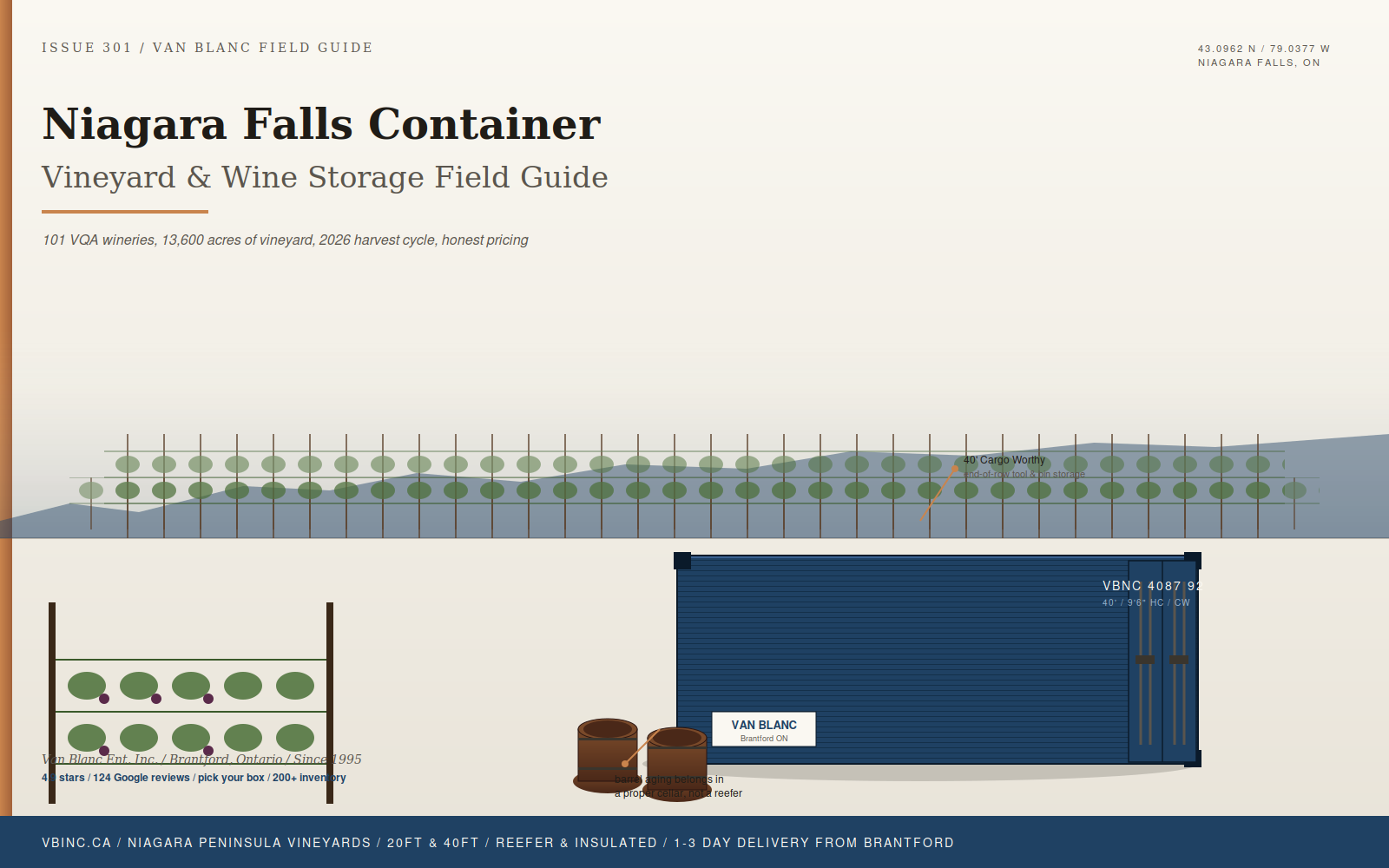
Most Niagara Peninsula vineyards on 5 to 15 acres need one 20ft One-Trip container for sprayers, trellis hardware, and pruning tools. A 40ft Cargo Worthy suits yards that also overwinter harvest bins, presses, or barrel racks. Reefer containers handle short-term crush staging and wine logistics rather than finished-wine aging.
Every box we sell arrived in Canada as ISO marine cargo regulated by Transport Canada, then gets graded by hand in our yards. For most Niagara Peninsula vineyards, a single 20ft One-Trip container handles year-round tool, sprayer, and trellis-hardware storage for a 5 to 15 acre operation. Step up to a 40ft Cargo Worthy unit when the same yard also stores harvest bins, presses, or stacked barrel racks in the off-season. Reefer containers are for short-term wine logistics and harvest crush staging, rather than finished-wine cellaring. Plan delivery during the dry window between April and mid-September, before harvest traffic chokes the gravel lanes. Van Blanc ships from our four Brantford yards, 1 to 3 days into Niagara-on-the-Lake, St. Catharines, or Niagara Falls vineyards. You walk the row in Brantford and pick the specific container before you pay. Call 519-754-6844 to book a yard visit.
The Niagara Peninsula is the biggest viticultural region in Canada, with roughly 13,600 acres of vineyard and around 101 VQA wineries between the Niagara Escarpment and Lake Ontario. A 12 acre family estate has different storage problems than a 200 acre cooperative grower, and both differ from a small cidery converting an old orchard. This guide covers what actually works for Niagara vineyard buyers in 2026: sizing, insulated versus refrigerated, pricing, and delivery realities.
Van Blanc has been in the container business in southern Ontario since 1995. Most vineyard inquiries we get are not from buyers shopping price first. They are from operators who wasted a season under tarps, or got burned on a Facebook deal that never showed up.
Why Do Niagara Wineries Buy Shipping Containers?
Niagara wineries buy shipping containers because secure, weatherproof storage is scarce on working vineyard land and a steel box solves it for less than a pole barn. Niagara is a tender-fruit and grape belt running from Grimsby in the west to Niagara-on-the-Lake in the east, with Niagara Falls anchoring the southern edge. According to the VQA Ontario appellation authority, the Niagara Peninsula holds about 65 percent of the province’s VQA wineries across approximately 13,600 acres of vineyard. Cider orchards, tender-fruit operations, and grape vineyards often share infrastructure and storage problems. A shipping container is one of the few pieces of equipment that crosses all three.
Buyers from this region fall into four groups. First, the small estate winery (5 to 25 acres) needing one secure box for sprayers, pruning gear, trellis wire, and harvest bins. Second, the medium cooperative or contract winery (50 to 200 acres) running a yard of 3 to 8 containers as a working compound. Third, the cidery or fruit-wine producer converting an existing orchard, often needing one insulated unit for short-term juice or product staging. Fourth, the new entrant who bought rural acreage, planted vines, and needs a tool box before the barn is built.
Christian LeBlanc, who runs our shipping side, puts it this way. “Vineyard buyers we see in Brantford are not first-time storage shoppers. They have already lost a sprayer to weather, or a tarp blew off in February, or a Facebook seller ghosted them after the e-transfer. They want to see the actual container, kick the floor, and book a real delivery date.” Van Blanc lets you stand in front of the unit before it leaves the yard.
20ft or 40ft: Which Container Fits Vineyard Tool Storage?
For vineyard tool storage, the size decision comes down to whether you are storing only tools or also bins, presses, and racks. A 20ft holds an enormous amount of hand and powered tools at the 5 to 25 acre scale. One 20ft One-Trip swallows:
- Two full sets of pneumatic pruning shears and compressors
- One 200 to 300 litre airblast or mounted sprayer
- Rolls of trellis wire and end-post hardware
- A pallet of fungicide and dormant-spray inventory on shelving
- Two or three small ATVs parked nose-to-tail
- Wall-mounted hose reels, gas cans, and weed control supplies
That covers the work side of a typical Niagara estate winery up to about 25 acres. Most vineyard buyers at this scale choose a single-voyage box with factory-fresh steel, since it sits in the open rows for decades and resells well when the operation changes hands. If the same operation also crushes its own fruit, presses on-site, or overwinters harvest bins and stacked barrels, the 20ft fills fast. A 40ft Cargo Worthy makes sense for the cube and cost-per-cubic-foot. The 40ft typically lands at roughly 1.8 to 2.0 times the price of the equivalent 20ft for double the volume.
The 40ft also wins on harvest bin staging. Standard 1.2 by 1.0 metre macro-bins (the half-tonne plastic bins at every Ontario weigh station) stack three high inside a 40ft with airflow gaps for fungal control. A 20ft holds about 18 to 22 empty stacked bins; a 40ft holds 38 to 44. For mid-size operations that share bins between growers, the 40ft is the workhorse.
What we do not recommend is buying a 40ft for a 5 acre property because “it might grow.” The 40ft needs a longer pad and more delivery clearance. If acreage is permanent, the 20ft moves easier on smaller lanes and resells better.
Can You Age Wine in a Reefer Container, or Only Stage It?
A reefer container is built for wine logistics, not multi-year barrel aging, so here is what refrigerated containers actually do. A reefer (a refrigerated ISO container) is a 20ft or 40ft container with an integrated refrigeration unit, insulated walls, and a setpoint typically between -25 and +25 degrees Celsius. They are excellent for some wine industry tasks and wrong for others. We will not sell you one for a job it cannot do.
What reefers are good for in a Niagara winery context, based on what temperature-controlled storage providers document for the wine sector:
- Harvest crush staging. Removing field heat from freshly picked grapes before pressing. Bringing fruit down to roughly 10 to 12 degrees Celsius slows fermentation onset and preserves aromatics. This is a short-window task during the September to October harvest.
- Short-term finished wine logistics. Holding palletized cased wine at 12 to 16 degrees Celsius for a few weeks during a distribution push, an event, or an export-prep cycle.
- Cider and fruit-wine staging. Holding pasteurized juice or filtered product cold before bottling.
- Cool-room overflow. Temporary expansion when an existing winery cool room is full during peak production.
What reefer containers are not the right tool for:
- Multi-year barrel aging. Barrels need stable humidity (around 70 percent), gentle airflow, and consistent temperature for years. Reefer units cycle, run dry, and are not designed for decade-long humidity stability. Build a proper insulated barrel room in the winery itself.
- Long-term ice-wine inventory. Reefers hold the temperature, but cost-per-bottle is high versus a proper cellar build over an 18-month horizon.
- Library wine collections. Premium aging needs more environmental stability than a portable reefer delivers.
A reefer is a logistics tool rather than an architectural one. Confusing the two costs money every harvest. If you are weighing what a refrigerated unit can actually hold, our breakdown of how cold a reefer holds and for how long sets realistic expectations before crush week.
Insulated or Standard: Which Container Overwinters Harvest Gear?
For overwintering harvest equipment, the choice between a bare dry container and a full reefer hides a middle option most Niagara vineyards underestimate: a standard container insulated on-site with closed-cell spray foam or rigid foam board. This is not a refrigerated unit. It does not actively cool or heat. It dampens the daily temperature swing and prevents the condensation cycles that destroy metal equipment over an Ontario winter.
For overwintering airblast sprayers, hydraulic harvest equipment, electric pruning gear, and electronic monitoring systems, humidity stability matters more than temperature delta. A standard uninsulated container in Niagara swings from minus 15 Celsius overnight to plus 20 in winter sunshine, pulling moisture onto cold steel. Closed-cell spray foam at 2 inches thick (about R-12 wall total) keeps the interior within roughly 10 to 12 degrees of outdoor average and dramatically reduces condensation.
For Niagara specifically, lake-effect humidity is more aggressive than further inland. Vineyards within 5 km of Lake Ontario see condensation problems that vineyards 15 km inland do not. On the bench or near the lake, an insulated 40ft is worth the cost. Well inland and dry, a standard unit plus a good vapour barrier on the floor is usually enough.
If you are pricing out the foam itself, our notes on what two inches of closed-cell actually buys you in R-value explain why thickness rather than brand drives the result. We stock all four condition grades across our four Brantford yards so buyers can walk the row and see the difference before they commit, and you can see what is sitting in the rows right now before you make the drive.
What Drives the Price of a Vineyard Container in Niagara?
The price of a vineyard container in Niagara is driven by grade, current yard inventory, and delivery distance. Container pricing in Ontario in 2026 is more volatile than it was pre-2020 but more rational than it was during the 2021 to 2022 supply shock. The 20ft and 40ft box prices are on the list of container prices by length; here is how each option ranks against the others and what actually moves your quote up or down. Pricing changes with grade, current inventory, and delivery distance, so call for a real quote, but the relationships below hold regardless of where the market sits:
| Option | Relative position in the lineup | What drives that quote up or down |
|---|---|---|
| 20ft Cargo Worthy | Entry point for secure dry storage | Grade and cosmetic condition, current yard inventory, distance into Niagara |
| 20ft One-Trip | A step above Cargo Worthy for near-new condition | Newest steel and best doors, so it carries a premium over Cargo Worthy |
| 40ft Cargo Worthy | Roughly 1.8 to 2.0 times the 20ft Cargo Worthy for double the volume | Best cost per cubic foot, but needs a longer pad and wider delivery clearance |
| 40ft High-Cube One-Trip | Top of the dry-storage range | Extra foot of interior height plus near-new condition both push it up |
| 20ft / 40ft Reefer (refrigerated) | A large multiple of the equivalent dry box | Compressor age, refrigeration condition, and running hours dominate the price |
| Closed-cell spray foam insulation | Add-on quoted separately, on-site | Square footage sprayed, foam thickness, and the contractor you hire |
Be skeptical of any Facebook or Kijiji listing offering a 40ft at a price far below the market with “free delivery” anywhere in Ontario. We have tracked this for three years. No container in Canada lists that low unless it is rotted, stolen, or fictional. Wholesale on an As-Is 40ft at the Port of Montreal already sits well above those teaser numbers before a truck is even hired. The Facebook box is the dominant scam pattern in our market.
Christian sees a version of this every harvest week. “The call comes three days after the e-transfer and the seller stops answering. There is nothing we can do at that point. Banks do not reverse e-transfers. The only protection is buying from a real Ontario yard you can drive to.”
How Does a Container Get Delivered Into a Vineyard?
A container gets delivered into a vineyard on a tilt-deck trailer that slides it onto a prepared pad, and vineyard delivery is its own discipline. The same fundamentals apply everywhere we run, and our overview of how a box gets dropped on your site covers the trailer, the angle, and the clearances in plain terms. The carrier’s tilt-deck trailers slide the container off the back at a 30 to 45 degree angle and level it onto the pad. They need a straight approach of roughly 70 to 90 feet for a 20ft drop and 90 to 110 feet for a 40ft drop, plus a firm enough surface to handle the truck’s axle weight, which during the slide is concentrated on the rear.
The Niagara vineyard delivery problems we see most often:
- Gravel lanes that look firm but are not. A lane that supports a tractor will not always support a loaded tilt-deck. Spring conditions are worst. We ask buyers to wait until the lane has dried out, usually mid-April onward, before scheduling.
- Slope across the drop pad. A pad with more than about 3 percent slope side-to-side makes leveling difficult and risks the container racking. The driver can level with timber cribbing, but it adds time. Pad cross-slope under 2 percent is best.
- Vine row clearance. The truck needs to swing the trailer wide. End-row posts and trellis wire within 12 to 15 feet of the lane are vulnerable. Mark hazards before the truck arrives.
- Overhead drip lines and irrigation. Header lines crossing the lane at less than 14 feet will get hit by the trailer mast. Either reroute temporarily or pick a different drop point.
- Bridge weight limits on creek crossings. A surprising number of Niagara vineyards have small bridges over agricultural drainage. Loaded delivery weight is around 25,000 to 30,000 pounds. Check the bridge plate before booking.
We send a pre-delivery checklist to every Niagara buyer before the truck rolls. Real lead time from order to drop is typically 1 to 3 days within Niagara region, shipped from our four Brantford yards. Not the 6-week “we will let you know” runaround you get from importers. For full delivery preparation specifics, read how we reach tucked-away rural properties and how to level the drop pad so the box sits true.
How Do Medium Wineries Lay Out a Multi-Container Yard?
A handful of mid-size Niagara wineries and cooperative growers lay out a multi-container yard on their property: 5 to 15 units arranged in a U or rectangle, used as a working compound for tools, harvest staging, equipment, and sometimes office space. Done well, this is one of the most cost-effective infrastructure builds in the wine business. Done poorly, it becomes a junkyard.
What we recommend for a multi-container vineyard yard:
- One 20ft One-Trip per discipline. Pruning gear, spray equipment, harvest bins, electrical and irrigation parts, fuel and chemical (separately ventilated). Discipline-based separation is faster than alphabetical and prevents cross-contamination.
- One 40ft for harvest bin and barrel rack overwintering. The 40ft handles the seasonal surge that does not fit anywhere year-round.
- Optional 20ft reefer for crush staging only. Powered down 10 months a year. Powered up for the September to October harvest.
- One 20ft office or break-room conversion. Insulated, windowed, with HVAC and a small kitchenette. The full conversion is built at the Brantford yard under engineered drawings, then delivered ready to wire in.
- Arranged in a U with the open end facing the work yard. Containers as windbreaks block prevailing westerly winds and create a sheltered staging area.
The accessories layer matters here too. The locks, vents, roll-up doors, and shelving that turn a bare box into a working compound are worth planning before the unit lands. Roll-up doors pay for themselves the first time you load a sprayer without swinging heavy double-doors.
Why Are Vineyard Owners Targeted by the Facebook Container Scam?
Vineyard owners are targeted by the Facebook container scam because harvest urgency makes them act fast, and we have to say this plainly because it costs Ontario growers real money every season. The fake “wine country deal” pattern works like this. A Facebook or Marketplace listing appears in August or September, offering a 40ft container with free delivery anywhere in Ontario. Photos look professional. The seller says they have a container at the Port of Toronto that needs to move this week. They ask for an e-transfer deposit to “hold” the unit, often a sizeable sum. The container never arrives. The phone goes dead. The bank cannot reverse the e-transfer.
This pattern targets vineyards specifically during harvest. Growers are time-pressed, cash is tight after equipment payments, and the urgency of bins-coming-in pushes people to act faster than they would in February. We get roughly one vineyard call per month August through November from someone who lost on this exact scam.
The test for any container seller: can you drive to their physical yard, walk the row, see the specific container you are buying, and inspect it before paying? Van Blanc has run 200+ unit inventory across our four Brantford yards for thirty years. National fleets ship from a generic pool. The pick-your-box rule is the strongest scam-protection in this market. Before you put money down, our walk-through of what to check on a used box before you pay covers the inspection points that separate a sound unit from a regret.
Which Niagara Sub-Region Shapes Your Container Choice?
Your Niagara sub-region shapes your container choice through soil, drainage, and lake-effect humidity, because Niagara is not one homogeneous wine region. The VQA recognizes 10 sub-appellations across the Peninsula, each with its own soil, drainage, and growing conditions that translate into different storage needs:
- Niagara-on-the-Lake (NOTL): Flatter, heavier soils. More humidity from Lake Ontario. Insulated containers strongly recommended for overwintering electronics and sprayers.
- Niagara Falls and Lincoln Lakeshore: Closer to the lake, similar moisture profile to NOTL. Standard plus vapour barrier works for most uses; insulated for premium equipment.
- The Bench (Beamsville Bench, Twenty Mile Bench, Short Hills Bench): Elevated, well-drained limestone soils. Slope problems for delivery; pad preparation matters more than insulation.
- Vinemount Ridge and Creek Shores: Drier microclimate. Standard containers handle most uses.
- St. David’s Bench and Four Mile Creek: Mixed conditions; site-specific advice.
Cidery operators across Niagara have their own storage cycle. Apples come off later than grapes, mostly mid-September through October, overlapping with grape harvest demand on local labour. A 20ft for apple bin and press storage is the typical entry point. Tender-fruit operations (peaches, plums) face their own bin and ladder problems, also well-served by a single 20ft.
For buyers in adjacent regions, see how we serve growers around the Falls and the southern bench, across the Garden City and the Twenty Mile corridor, and up into the escarpment communities above the lake. If your operation also runs a tasting room or a lakeside short-term rental, our piece on storage for seasonal hospitality in wine country covers that side of the business.
Ready to price your container?
Tell us the size and your postal code and we’ll send back an all-in number, container, delivery, and placement, usually within 1-3 days. No pressure, no mystery fees.
Family-run in Brantford since 1995 · 200+ containers in stock · 4.9★ across 140+ Google reviews · every box graded by a person, walk it before it lands.
Frequently Asked Questions: Niagara Falls Vineyard Container Storage
What size container do I need for a 10 acre Niagara vineyard?
A 20ft One-Trip container is the right starting size for a 5 to 25 acre vineyard storing tools, sprayers, trellis hardware, and pruning equipment. If you also overwinter harvest bins or stacked barrel racks on-site, step up to a 40ft Cargo Worthy. Many Niagara estate wineries at 10 acres run one 20ft for tools and add a 40ft when harvest volume grows.
Can I age wine in a reefer (refrigerated) container?
No, not for serious multi-year aging. Reefer containers cycle their compressors and run drier than a barrel cellar needs. They are excellent for short-term harvest crush staging (cooling fresh grapes before pressing), holding finished cased wine for a few weeks, and cool-room overflow during production. For multi-year barrel or library aging, build a proper insulated cellar instead.
How much does a 40ft container delivered to a Niagara vineyard cost in 2026?
The delivered cost of a 40ft into the Niagara Peninsula depends on grade, current yard inventory, and distance from our Brantford yards. A 40ft Cargo Worthy is the most economical 40ft option, a 40ft High-Cube One-Trip sits above it for the extra height and near-new condition, and a 40ft reefer costs several times more because the refrigeration unit, compressor age, and running hours dominate the quote. Call for a live number rather than trusting a fixed figure, and beware any Facebook ad priced far below the market for a 40ft, that band is almost always a scam in our region.
How long does delivery take from your yard to a Niagara vineyard?
Real lead time from order to drop is typically 1 to 3 days within Niagara region, shipped from our four Brantford yards. We do not run six-week importer schedules. Spring delivery may be delayed by lane conditions, but the truck moves fast once the ground is firm.
Do I need to insulate a container for overwintering vineyard equipment?
If you are within about 5 km of Lake Ontario or on the bench, insulating with closed-cell spray foam (2 inches thick, roughly R-12 wall total) is strongly worth the cost because lake-effect humidity drives condensation on cold steel. Further inland and drier, a standard container with a good vapour barrier on the floor handles most overwintering loads. The deciding factor is humidity stability rather than temperature alone.
What is the best time of year to take delivery on a vineyard property?
Mid-April through mid-September. Avoid spring thaw (March to mid-April) when gravel lanes lose their bearing capacity, and avoid harvest weeks (mid-September through late October) when vineyard traffic is heaviest and labour is busy. The dry summer window is ideal.
Can a container be used as temporary office or break-room on a vineyard?
Yes, container office conversions with insulation, windows, HVAC, and electrical are common in working vineyards. The full office conversion is built at the Brantford yard under engineered drawings and delivered ready for your electrician to connect. Anything to do with municipal approvals is handled on your side, so check with your local building department before you order.
How much harvest bin storage fits inside a 40ft container?
Standard 1.2m by 1.0m macro-bins stack three high with airflow inside a 40ft container. That is roughly 38 to 44 empty stacked bins per 40ft, or about 18 to 22 inside a 20ft. For mid-size growers who lend or share bins, the 40ft is the workhorse size for off-season bin storage.
Why should I drive to Brantford to buy instead of having a container shipped from anywhere?
Because you walk the row and pick the specific container before you pay. We hold 200+ containers across our four Brantford yards and let buyers inspect the exact unit they are buying. National fleet operators ship from a generic pool, so what you order is not what you saw online. That difference is the strongest scam-protection and quality-protection in this market.
What happens if I sent money to a Facebook container seller and nothing arrived?
The Canadian Anti-Fraud Centre is the right first call to document the scam pattern. Banks do not reverse e-transfers once accepted. Police rarely recover funds at the per-incident level. The most useful thing you can do is document the listing, the messages, and the payment, then report it to CAFC and to Facebook to help shut down the seller account. Then call a real Ontario yard and start over. We have helped dozens of vineyard owners through this in the last few years.
Walk the Row Before You Buy
Van Blanc Ent. Inc. has been supplying shipping containers in Ontario since 1995. We hold 200+ containers across four Brantford yards, deliver 1 to 3 days into Niagara, and let you stand in front of the specific unit before you pay. Rated 4.9 stars on 140+ Google reviews. Call 519-754-6844 or visit our Brantford yards to walk the row.
Sources and Further Reading
- VQA Ontario, Niagara Peninsula appellation overview (Ontario Wine Appellation Authority)
- VQA Ontario, 2025 Vintage Report (harvest timing and conditions)
- Wines in Niagara, harvest reports across Ontario winemakers
- Canadian Anti-Fraud Centre, online sale fraud reporting
- Ontario wine regional overview (Wikipedia, with VQA references)