
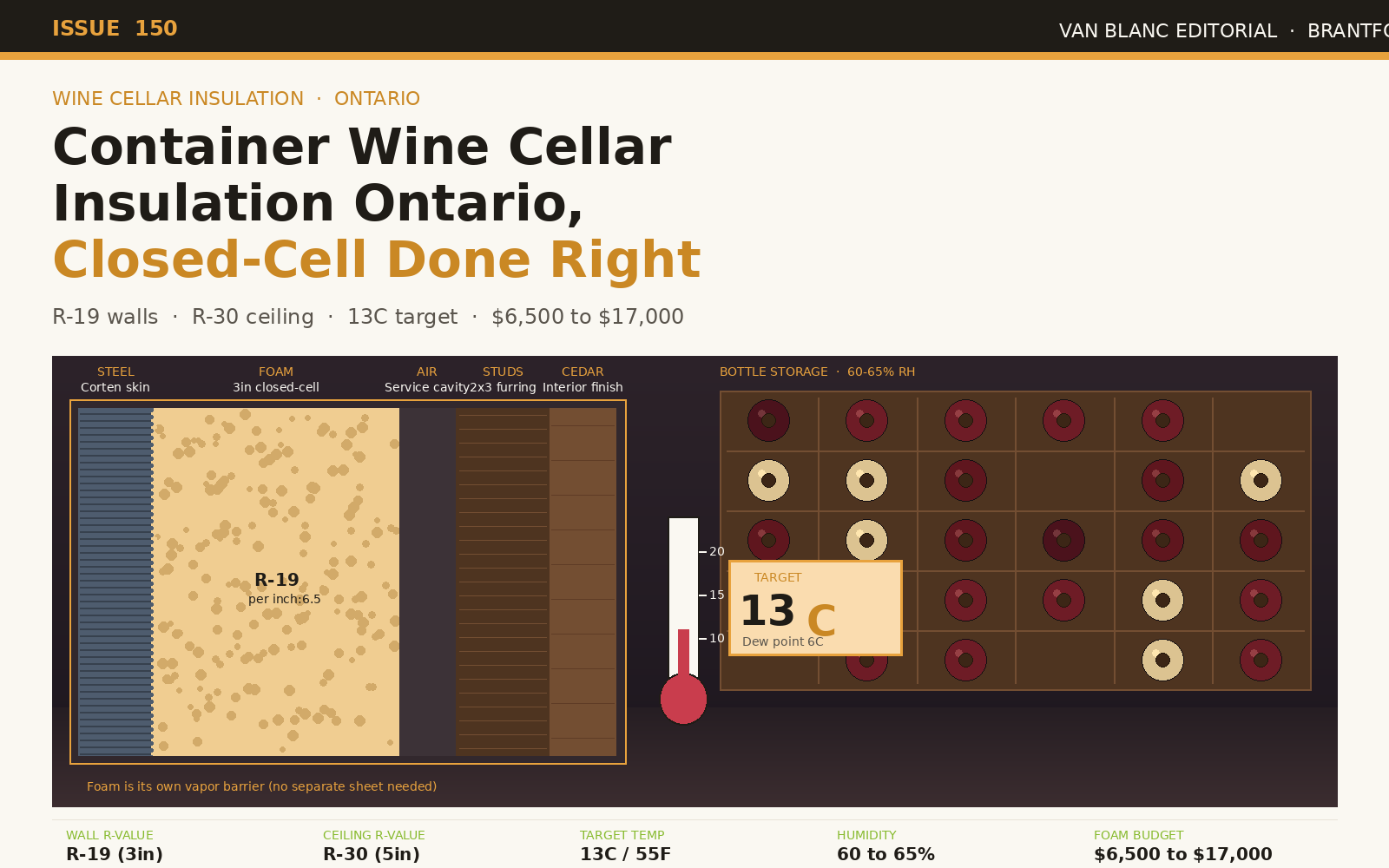
Quick Answer: A container wine cellar in Ontario is insulated with 3 to 5 inches of closed-cell spray foam applied directly to the steel skin, which reaches R-19 to R-30 and acts as its own vapor barrier in a single pass. That stack holds a 13 Celsius cellar at 60 to 65 percent humidity through any Ontario season, following temperature and humidity targets published by ASHRAE. Family-run since 1995, 4.9 stars across 140+ verified Google reviews. Delivery in 1-3 days from our 4 Brantford yards.
In This Guide
- Why Can’t a Bare Steel Container Hold 13 Celsius?
- How Much Spray Foam R-Value Does a Cellar Need?
- What Vapor Barrier Order Actually Works on Steel?
- What Is the Dew Point Trap, and How Do You Avoid It?
- How Do You Size the Cooling Unit to Match the Insulation?
- Where Do Thermal Bridges Hide in a Container Cellar?
- What Are the Ontario Specs for a 20ft vs 40ft Cellar?
- What Drives the Cost of Cellar Insulation?
- What Insulation Should You Never Use?
- How Delivery-Day Prep Sets Up the Insulation Job
- Frequently Asked Questions
Reading Time: 15 minutes
Why Can’t a Bare Steel Container Hold 13 Celsius?
A bare steel shipping container cannot hold 13 Celsius because Corten steel conducts heat in both directions: it overheats past 45 Celsius in summer sun and drops near minus 20 on a cold Ontario night. Wine needs a steady 12 to 14 Celsius, so the conduction path has to be broken with continuous insulation.
An uninsulated 20ft shipping container is a steel radiator. Corten panels conduct heat fast: from a 30 Celsius August afternoon, the interior climbs past 45 within two hours of direct sun. From a minus 15 January night, it bottoms out near minus 20 because the steel radiates faster than trapped air can hold. Neither extreme keeps wine alive.
A working wine cellar wants 12 to 14 Celsius year-round (55 to 57 Fahrenheit), with relative humidity between 60 and 65 percent. Variation of more than 2 Celsius across a week pushes corks to flex, accelerates oxidation through the seal, and ruins a vintage on a six-month timeline. Holding that target inside a steel box means breaking the conduction path, which is what proper container wine cellar insulation does. For the broader build-out picture (racking, doors, electrical, tasting room conversions), step back to how the whole cellar comes together.
The Three Heat-Loss Paths That Matter
Steel-shell heat loss happens through three paths at once. Conduction through the panel moves the most energy on a sunny day. Convection through any unsealed door gap moves the most when there is wind. Radiation off the inside steel surface dominates at night, dropping wall temperature below dew point. A proper insulation stack blocks all three. Closed-cell spray foam is the only common material that does, because it adheres directly to steel and seals every seam in one application.
How Much Closed-Cell Spray Foam R-Value Does a Wine Cellar Need?
Closed-cell polyurethane spray foam delivers R-6 to R-7 per inch installed, the highest of any practical container insulation. Three inches gets you to R-19 (the wall minimum most wine-cellar engineers recommend). Five to six inches gets you to R-30 to R-36, which is the right call for the ceiling because heat rises and ceiling losses dominate cooling load on a hot day.
Paul on Why Closed-Cell Won the Argument
Paul LeBlanc, owner: “I built an early container wine room back in the 2010s and tried doing it the cheap way first. The closed-cell rebuild has held tight for over a decade. In nineteen years around containers I have never seen a steel-shell cellar hold its temperature on anything but a continuous closed-cell skin.” Paul founded Van Blanc in 1995 after four decades in Asian trade, and his son Christian now runs the yard alongside him.
Industry sources align: Wine Cellar Authority pegs walls at R-13 minimum and R-19 ideal; WhisperKool calls for rigid foam or closed-cell at R-19 minimum, R-30 preferred. Canadian custom-cellar builders default to 3 inches walls, 5 inches ceiling for active-cooled cellars. Closed-cell adheres directly to corrugated steel, fills the corrugations, and cures into a continuous monolithic shell. Fiberglass batts and rigid foam board both leave air channels where condensation pools and rust starts.
Don’t Buy More R-Value Than You Need
Past R-30 on the ceiling and R-19 on walls, you hit diminishing returns. Doubling thickness from 3 to 6 inches roughly doubles cost but cuts cooling load by only 15 to 20 percent more, because the cellar’s biggest steady losses are now through the floor and door. Spend the saved budget on a properly sized cooling unit and a solid insulated door instead.
What Vapor Barrier Order Actually Works on Steel?
The vapor barrier rule for climate-controlled space is the same everywhere: barrier on the warm side of the insulation. In an Ontario wine cellar set to 13 Celsius, the warm side flips with the seasons (outside in summer, inside in winter). That bidirectional vapor drive is why closed-cell spray foam is the right material. It is its own vapor barrier (rated below 1 perm at 2 inches thickness, well into Class II territory) and eliminates the order-of-operations problem that hurts batt-and-poly builds.
A correct closed-cell stack for a steel container, inside out:
- Steel skin (existing corrugated wall, primed if rusty)
- Closed-cell spray foam (3 to 5 inches, sprayed direct, no membrane behind)
- Optional rigid foam layer (1 inch XPS or polyiso, used as an ignition barrier over the foam on commercial builds where the trades call for one)
- Service cavity (2×3 or 2×4 furring if you need to run electrical or hang racking from studs)
- Interior finish (cedar, redwood, painted drywall, or finished plywood)
No polyethylene sheet, no kraft-paper facing, no separate vapor barrier goes anywhere in the stack. The foam is the barrier. Adding a second barrier creates a trapped condensation layer that destroys the wall from inside, which is how fiberglass-batt container builds fail within three years.
Why Open-Cell Foam Is Wrong Here
Open-cell spray foam (R-3.6 per inch, vapor-permeable) works well in attics where vapor needs to dry to one side. In a steel container wine cellar it fails on two counts. It has half the R-value per inch, forcing a thicker spray that eats interior cubic feet you cannot spare in a 7-foot-wide cellar. And it lets moisture pass through to the cold steel skin in winter, where it condenses and starts a corrosion path. Closed-cell is the only spray-foam option that works on Corten steel in Ontario.
What Is the Dew Point Trap, and How Do You Avoid It?
The biggest failure pattern in DIY container wine cellars is hitting dew point inside the wall assembly. At a cellar interior of 13 Celsius and 65 percent humidity, the dew point sits at roughly 6 Celsius. Any surface inside the wall that drops below 6 Celsius condenses water out of the cellar air. On a Brantford steel container in January, bare interior steel sits at minus 10 to minus 15. Without a continuous closed-cell skin between that steel and the cellar air, condensation runs down the wall in sheets every cold night.
Closed-cell foam pushes the dew-point plane outside the assembly entirely. The warm interior surface of the foam stays well above 6 Celsius (typically 11 to 12 with a 3-inch wall spec), so condensation simply cannot happen on the inside face. The cold steel behind the foam is isolated from cellar air, so any micro-gap moisture that does reach the steel cannot accumulate. Breezaire and CellarCool engineering guides spell this out: dew point inside a refrigerated wall assembly is what destroys cellars from the inside, and the only reliable defense in a steel-shell build is a continuous closed-cell layer adhered to the steel.
Ontario’s Bidirectional Vapor Drive
Most US wine-cellar guides assume a single dominant vapor direction. Ontario flips. Summer days push outside humidity inward; winter nights push humid cellar air toward the cold outside. A wood-frame wall can dry to one side or the other; a steel container cannot, because steel is impermeable. Closed-cell is the right answer precisely because it is also impermeable, so the assembly does not depend on drying through. That impermeability is exactly what a steel container needs, since the panel itself can never breathe to either side.
How Do You Size the Cooling Unit to Match the Insulation?
The cooling unit and insulation are a matched pair. Under-insulate and you need a bigger compressor that short-cycles and burns out early. The Ontario sweet spot for a 20ft container cellar with R-19 walls and R-30 ceiling is a 6,000 to 8,000 BTU/hr through-the-wall unit, or a small split system with similar capacity. WhisperKool, Breezaire, and CellarPro all publish sizing tables built around roughly 50 BTU/hr per usable cubic foot in Ontario’s climate zone.
A 40ft High Cube cellar needs 14,000 to 18,000 BTU/hr, usually a ducted split-system with a remote condenser outside the container. Under-insulate to R-13 and the sizing chart roughly doubles, along with the monthly electric bill. Over 15 years, the closed-cell upgrade typically pays back inside 4 years through lower compressor cycling and lower electricity draw. If you are still deciding on the cooling side of the build, our notes on holding a steady cellar temperature in an Ontario container walk through unit choice in more detail.
Where Do Thermal Bridges Hide in a Container Cellar?
Closed-cell on walls and ceiling does not fix the three biggest thermal bridges: the cam-lock door, the corner castings, and the floor channel. Each leaks heat at rates that can spoil an otherwise well-insulated cellar.

The cam-lock door is the worst offender because the door bars conduct directly through the seal area. Three fixes work in combination: replace the stock rubber gasket with high-density EPDM rated for 13 Celsius; build an interior insulated false door against a separate gasket (the high-end standard); foam-fill the door bar cavities to eliminate through-conduction.
The eight corner castings are solid steel weldments that conduct heat straight through any wall insulation around them. Wrap them on the interior with 2 inches of closed-cell after the main spray, or accept eight cold spots 4 to 5 Celsius below wall average year-round. The floor is the third bridge: 2 inches of XPS rigid foam under a plywood subfloor, taped at seams, is the working spec.
Backyard 20ft Cellar for a Serious Collector
A typical private build starts with a 20ft new (one-trip) container: 3 inches of closed-cell on the walls, 5 inches on the ceiling, a cedar interior finish, 50-bottle racks on three walls, and a Breezaire WKL3000 through-the-wall unit. The container is the foundation; the racking, electrical, door upgrade, and cooling unit stack on top of it. For a buyer without a basement to renovate, that bin-on-a-pad path is what makes a serious cellar possible at all. We will quote the box once you settle the spec, and you can see what is sitting in the yard right now before you commit.
What Are the Ontario Specs for a 20ft vs 40ft Cellar?
For Ontario’s specific climate range (minus 30 Celsius lows to plus 35 Celsius highs, with monthly relative humidity swinging from 30 percent in February to 85 percent in August), the working insulation specs land here:
| Component | 20ft Container Cellar | 40ft High Cube Cellar |
|---|---|---|
| Wall closed-cell | 3 inches (R-19) | 3 to 4 inches (R-19 to R-25) |
| Ceiling closed-cell | 5 inches (R-30) | 5 to 6 inches (R-30 to R-36) |
| Floor XPS rigid | 2 inches (R-10) | 2 to 3 inches (R-10 to R-15) |
| Door upgrade | EPDM seal + interior false door | EPDM + interior false door + foamed cam bars |
| Corner castings (8) | 2 inches closed-cell wrap | 2 inches closed-cell wrap |
| Target cellar temp | 13 Celsius | 13 Celsius |
| Target humidity | 60 to 65 percent | 60 to 65 percent |
| Cooling capacity | 6,000 to 8,000 BTU/hr | 14,000 to 18,000 BTU/hr split |
These specs hold for an unshaded container in southern Ontario. Heavy shade drops cooling load by 25 to 35 percent and lets you step down a size on the unit; full sun on a dark container adds 15 to 20 percent and warrants the upper end of every spec.
What Drives the Cost of Container Wine Cellar Insulation?
Closed-cell spray foam in Ontario installs at a modest per-board-foot rate (one board foot equals one square foot at one inch thickness). A 20ft container with roughly 320 square feet of interior wall and ceiling surface area at the working 3-inch wall and 5-inch ceiling spec works out to 1,200 to 1,400 board feet of foam. The spray bill scales with that volume, and we will quote your exact box once the spec is set.
A 40ft High Cube doubles the surface area, so the foam volume roughly doubles too. Add floor XPS materials, a door upgrade, and the cooling unit (the head plus the electrical run), and the full insulation-and-climate package lands on top of the container price. Compare that to a built-in Brantford basement wine cellar with similar performance, and the container path delivers real value, especially where a basement doesn’t exist (a winery property, a vineyard outbuilding, a rural lot, a commercial back yard). Tell us your build and we will quote the full package.
The Facebook Cellar Trap
Christian sees this every couple of months. Somebody buys a “wine cellar ready” container off Facebook Marketplace from a seller claiming it is pre-insulated. The buyer pays a deposit, waits two weeks, gets nothing, and calls us looking for a real bin. A claim that a 20ft comes fully wine-cellar insulated, container included, for far less than a real build is a scam every time. Call us; we will quote you a real bin and recommend an actual spray foam installer who knows container work.
What Insulation Should You Never Use on a Container Cellar?
Three insulation materials get tried on container cellars and all three fail on the same root cause: they let cellar air reach the cold steel skin, where it condenses and corrodes.
Fiberglass batts are the worst. R-3 to R-4 per inch (so you need a thick stud cavity, eating interior space), they hold moisture once it gets in, and they leave continuous air paths along the corrugation valleys. Fiberglass-insulated container builds typically show interior wall rust within 2 to 3 years and unrecoverable mould within 5. Rigid foam board (XPS or polyiso) is better but still wrong for walls because boards cannot conform to corrugated steel, leaving air gaps along every valley. Rigid board works fine for the floor (flat plywood over steel cross-members) and as a secondary ignition barrier on top of closed-cell. Mineral wool batts (Roxul, Rockwool) handle moisture better at R-4 to R-4.3 per inch but still leave the corrugation-air-gap problem and still need a continuous interior vapor barrier that is hard to install correctly behind cedar finish.
Why Container Builders Standardize on Closed-Cell
Every Ontario container modification shop that has done more than a dozen wine cellar conversions ends up specifying closed-cell for the same reasons. It is the only material that conforms to the corrugated profile with zero air gaps. It is its own vapor barrier, eliminating trapped-condensation failure. It cures into a structurally bonded shell that adds stiffness to the container walls. It meets CAN/ULC-S705.1, the Canadian material standard that reputable Ontario spray foam installers and insurers ask for by name.
How Does Delivery-Day Prep Set Up the Insulation Job?
Van Blanc has been delivering shipping containers across Ontario since 1995. For a wine cellar build, delivery-day setup matters more than for storage bins because the foam crew needs the container positioned, levelled, and accessible before they spray. We coordinate three things before the bin leaves Brantford.
First, the bin gets a final interior wipe-down. Spray foam adheres to clean primed steel; it does not bond well to dust, oil residue, or surface rust. For wine cellar projects we recommend a new (one-trip) container because the interior steel is essentially new, the paint is uniform, and the foam crew can spray on day one without prep delays. The industry calls these one-trip because the box made exactly one loaded ocean voyage; you can read why a factory-clean box is worth it for a cellar build when foam adhesion matters this much. Second, we walk through door placement and cooling unit cutout location before delivery so the install crew can frame immediately. Third, the tilt-deck truck drops the container onto level pads. A bin that lands out of plumb stresses the foam shell over time and can crack the closed-cell layer at the wall-to-ceiling joints. We level it with shims before the driver leaves.
Christian LeBlanc, second-generation operator: “Insulation is where most container cellar projects either hold or fail, and it happens in the first week. If the steel is clean, the bin is level, and the foam goes on the day after delivery, the cellar holds for decades. If you skip those three things, you find out in February or August what corners cost.”
Frequently Asked Questions
How thick should closed-cell spray foam be for a wine cellar in a shipping container?
Three inches on the walls (R-19) and five inches on the ceiling (R-30) is the working Ontario spec for a 20ft container cellar holding 13 Celsius year-round. A 40ft High Cube can step up to four inches on walls and five to six on the ceiling because ceiling losses dominate the cooling load on a hot day.
Do I need a separate vapor barrier with closed-cell spray foam?
No. Closed-cell at two inches or more is rated under one perm, a Class II vapor retarder on its own. Adding a polyethylene sheet or kraft-paper barrier on top of closed-cell creates a trapped condensation layer that destroys the wall from inside. The foam is the barrier.
Why is closed-cell better than fiberglass for a container wine cellar?
Fiberglass leaves air channels along the corrugated steel walls, which lets cellar air reach the cold steel skin where it condenses. Closed-cell sprays directly onto the steel, fills every corrugation, seals all seams, and is its own vapor barrier. Fiberglass-insulated containers typically show interior rust and mould within three years; closed-cell holds for over a decade.
What temperature and humidity should a wine cellar hold?
Twelve to fourteen Celsius (55 to 57 Fahrenheit) with 60 to 65 percent relative humidity is the classic target. Variation of more than two Celsius across a week shortens cork life and accelerates oxidation. A properly insulated container with the right cooling unit holds within 0.5 Celsius of the setpoint year-round.
How much does container wine cellar insulation cost in Ontario in 2026?
Closed-cell spray foam installs at a modest per-board-foot rate. A 20ft container at the working spec (3 inch walls, 5 inch ceiling) covers the foam alone, and a 40ft High Cube roughly doubles that volume. Floor XPS, a door upgrade, and the cooling unit add to a complete build. Tell us your spec and we will quote the installed total.
Can I insulate a used shipping container for a wine cellar?
Yes, and many of our cellar buyers do start with a used bin. A new (one-trip) container is still the better starting point because the interior steel is essentially new and ready for foam on day one, while a used Cargo Worthy or Wind & Watertight bin needs rust-spot grinding, a primer coat, and a full wipe-down first. The foam your installer sprays should be certified to CAN/ULC-S705.1, the Canadian material standard reputable Ontario crews already use.
What does the dew point math look like at 13 Celsius cellar conditions?
At 13 Celsius and 65 percent humidity, the dew point sits at approximately 6 Celsius. Any wall surface below 6 Celsius condenses water out of cellar air. Bare steel in a Brantford January sits at minus 10 to minus 15, which is why a continuous closed-cell layer is non-negotiable. The foam keeps the warm interior face above 11 Celsius.
Will spray foam void my container warranty?
Closed-cell applied to interior steel does not affect manufacturer warranty on a One-Trip container; it adds no penetrations and protects the steel from interior moisture. Drilled mounting holes (cooling cutout, personnel door, exterior conduit) need butyl tape and epoxy primer sealing to maintain warranty.
How long does it take to insulate a 20ft container wine cellar?
The spray foam install runs one to two days for a 20ft. Add a day for floor XPS and service-cavity framing. Door upgrades and cooling unit installation add three to seven days depending on whether you do a stock-seal swap or a full insulated false door. Most builds go from bare container to working cellar in two to four weeks.
Ready to price your container?
Tell us the size and your postal code and we’ll send back an honest, all-in number, container, delivery, and placement, usually within 1-3 days. No pressure, no mystery fees.
Family-run in Brantford since 1995 · 200+ containers in stock · 4.9★ across 140+ Google reviews · every box graded by a person, walk it before it lands.
Sources
- International Organization for Standardization. (2022). ISO 6346:2022, Freight containers, Coding, identification and marking. iso.org/standard/82754.html
- Underwriters Laboratories of Canada. (2022). CAN/ULC-S705.1: Standard for Thermal Insulation, Spray Applied Rigid Polyurethane Foam, Medium Density, Material Specification. ul.com
- ASHRAE. (2023). ASHRAE Handbook, Refrigeration, Chapter on Beverage and Cellar Storage Conditions. ashrae.org
- Wine Cellar Authority. (2025). Wine Cellar Insulation Guide: Best Practices and Materials. winecellarauthority.com
- WhisperKOOL. (2025). Dew Point and Your Wine Cellar. whisperkool.com
- Natural Resources Canada. (2024). Keeping the Heat In, Chapter 4: Insulation, Vapour Barriers and Air Barriers. natural-resources.canada.ca
Reach Van Blanc in Brantford
We have been supplying shipping containers across Ontario since 1995. Our warehouse is at 90 Morton Avenue E in Brantford, and we deliver right across the province on a cash-on-delivery basis. No surprise fees, no chase-the-paperwork.
Van Blanc Ent. Inc., 90 Morton Ave E Unit 1B, Brantford, ON N3R 7J7, +1 888-509-6658
If you are spec’ing a container wine cellar build, call Christian or Paul before you order the bin. We can recommend the right starting condition (One-Trip is almost always the answer for cellar work), walk you through the cooling unit cutout placement, and connect you with Ontario spray foam crews who actually know container work. Five minutes on the phone saves a costly do-over after the bin arrives.
Related Reading
- the complete cellar conversion guide (parent hub)
- keeping a cellar temperature stable
- reefer setups for a working winery
- choosing a refrigerated container
- turning a steel box into something else
- the modifications we build at the yard
For the full container wine cellar context including racking, electrical, door builds, and tasting-room conversions, see our full walk-through of a finished wine room.